
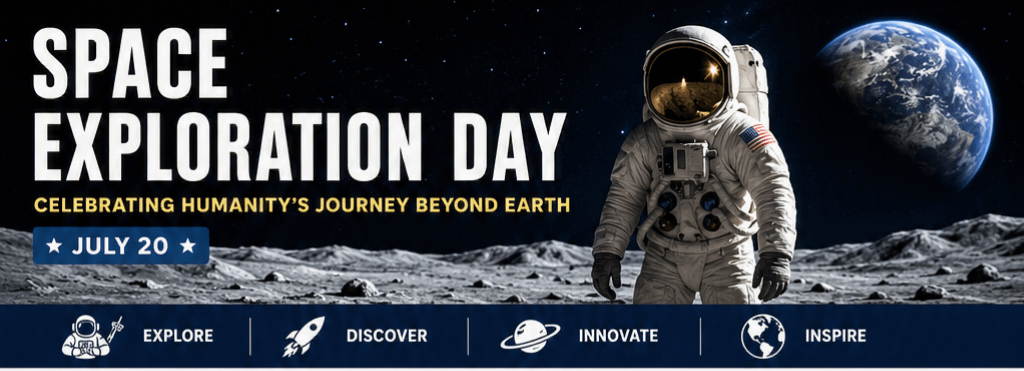
Reaching Beyond the Horizon
Every year on Space Exploration Day, we celebrate one of humanity’s greatest achievements—the courage to explore beyond the boundaries of our home planet. Observed on July 20, the day commemorates the anniversary of the historic Apollo 11 Moon landing in 1969, when astronauts Neil Armstrong and Buzz Aldrin became the first humans to walk on the Moon while Michael Collins orbited above in the command module.
Space Exploration Day is more than a remembrance of an incredible moment in history. It is a celebration of curiosity, scientific discovery, innovation, and the determination that drives people to ask, “What’s next?”
The Historic Moon Landing
On July 20, 1969, millions of people around the world watched as Neil Armstrong descended the ladder of the lunar module Eagle and uttered the famous words:
“That’s one small step for man, one giant leap for mankind.”
Those few moments forever changed human history. For the first time, humanity had successfully landed on another world.
The Apollo 11 mission demonstrated what could be accomplished through vision, teamwork, engineering, and perseverance. It inspired generations of scientists, engineers, astronauts, and dreamers.
Why Space Exploration Matters
Space exploration isn’t simply about traveling to distant planets. It has transformed life here on Earth in countless ways.
Scientific Discovery
Exploring space helps us better understand:
- How our solar system formed
- The origins of stars and galaxies
- The possibility of life beyond Earth
- Earth’s changing climate
- The future of our own planet
Every mission adds another piece to the puzzle of our universe.
Technology That Benefits Everyday Life
Many technologies developed for space missions have become part of our daily lives, including:
- GPS improvements
- Satellite communications
- Weather forecasting
- Medical imaging technology
- Water purification systems
- Lightweight materials
- Memory foam innovations
- Advanced robotics
Space research often leads to breakthroughs that improve healthcare, transportation, communication, and public safety.
A New Era of Space Exploration
The excitement of space travel has entered a new chapter.
Today, astronauts live and work aboard the International Space Station while conducting groundbreaking research in microgravity. Robotic explorers continue to study Mars, distant asteroids, and the outer reaches of our solar system.
Meanwhile, new missions are preparing humanity to:
- Return astronauts to the Moon
- Build long-term lunar habitats
- Explore Mars
- Search for signs of life on icy moons
- Develop technologies for deep-space travel
Private companies are also helping make space more accessible through reusable rockets and commercial spaceflight.
Amazing Facts About Space
Here are a few fascinating facts to celebrate Space Exploration Day:
- The Moon is approximately 238,855 miles (384,400 km) from Earth.
- Light from the Sun takes about 8 minutes and 20 seconds to reach Earth.
- One day on Venus is longer than one year on Venus.
- Jupiter is so large that more than 1,300 Earths could fit inside it.
- There are billions of galaxies in the observable universe.
- The footprints left by Apollo astronauts remain on the Moon because there is no wind or rain to erase them.
How to Celebrate Space Exploration Day
There are many fun ways to celebrate this inspiring holiday:
Visit a Planetarium
Experience immersive shows that bring the universe to life.
Watch a Space Documentary
Learn about Apollo missions, Mars rovers, black holes, or the James Webb Space Telescope.
Observe the Night Sky
Spend an evening looking at the stars with binoculars or a telescope. Even without equipment, you can spot planets, constellations, and satellites.
Read About Space History
Explore the incredible stories behind Mercury, Gemini, Apollo, the Space Shuttle, and modern exploration missions.
Inspire the Next Generation
Encourage children to ask questions about science, astronomy, and engineering. Today’s curious minds may become tomorrow’s astronauts and mission leaders.
Looking Toward the Future
The next generation of explorers may witness achievements once considered science fiction.
Future missions could include:
- Human settlements on the Moon
- Crewed missions to Mars
- Mining resources from asteroids
- Discovering microbial life beyond Earth
- Interstellar probes traveling farther than ever before
Each step forward expands humanity’s understanding of the universe and our place within it.
Final Thoughts
Space Exploration Day reminds us that progress begins with curiosity. Every rocket launch, telescope image, and scientific discovery represents humanity’s desire to learn, grow, and reach beyond the known.
The Apollo 11 Moon landing proved that extraordinary goals can be achieved through courage, innovation, and cooperation. More than five decades later, that same spirit continues to inspire new generations of explorers who look toward the stars with hope and determination.
As we celebrate Space Exploration Day, we honor the pioneers who made history—and the dreamers who will shape the future of space exploration.
Happy Space Exploration Day!
Read More Holidays & National Days
Leave a ReplyCancel reply