
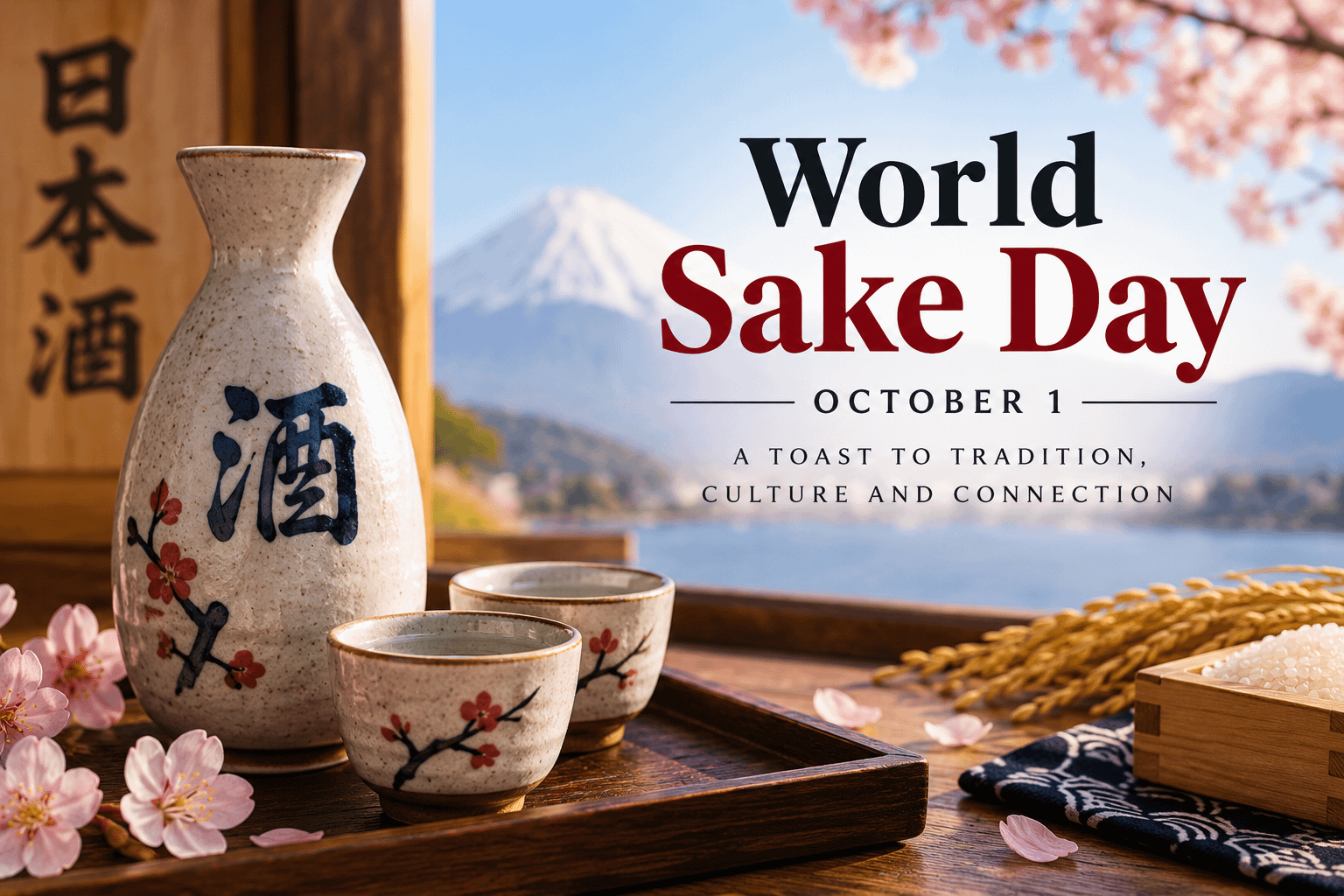
Every year on October 1, sake lovers, brewers, restaurants, and Japanese culture enthusiasts come together to celebrate World Sake Day, also known as Nihonshu no Hi or Sake Day.
It is a day dedicated to one of Japan’s most recognizable traditional beverages and the centuries of craftsmanship behind it. From small family-run breweries to modern sake producers experimenting with new techniques and flavors, sake represents a fascinating combination of history, agriculture, craftsmanship, and culture.
World Sake Day is also an opportunity for people who have never tried sake to learn more about what it actually is.
Although sake is sometimes called “rice wine,” its production process is considerably different from winemaking. Sake is brewed from rice, water, yeast, and koji, a specially cultivated mold that helps convert the rice’s starches into sugars that yeast can ferment.
That unusual brewing process gives sake its distinctive character and allows brewers to produce an enormous variety of styles.
Whether you already appreciate a chilled glass of premium sake or you are simply curious about Japanese food and culture, October 1 is the perfect occasion to discover something new.
What Is World Sake Day?
World Sake Day is celebrated annually on October 1.
In Japan, the occasion is commonly known as Nihonshu no Hi, which can be translated as “Sake Day.”
The observance was established by the Japan Sake and Shochu Makers Association in 1978 as a celebration of sake and the people responsible for producing it.
October also traditionally marks an important period in Japan’s sake-making calendar. Historically, the beginning of October was associated with the start of the brewing season following the rice harvest.
Today, World Sake Day has expanded beyond Japan.
Sake breweries, Japanese restaurants, bars, cultural organizations, and sake enthusiasts around the world celebrate with tastings, dinners, educational events, brewery tours, and special releases.
A Drink With Centuries of History
Sake has an incredibly long history in Japan.
Its exact origins are difficult to pinpoint because fermented rice beverages existed in different forms centuries before modern sake developed.
Over generations, Japanese brewers gradually improved their techniques for polishing rice, cultivating koji, managing fermentation, filtering the finished beverage, and controlling temperature.
Brewing eventually became a highly specialized craft.
Traditionally, the person responsible for overseeing the brewing process is known as a toji, or master brewer.
The toji works with a brewing team to manage every stage of production. Temperature, water quality, rice preparation, koji development, fermentation, and timing can all influence the final sake.
Modern technology has made the process more precise, but many breweries continue to preserve traditions passed down through generations.
That connection between old and new is one of the most interesting things about sake.
How Sake Is Made
Sake begins with surprisingly simple ingredients:
Rice, water, koji, and yeast.
Turning those ingredients into sake, however, requires considerable skill.
The process generally begins by polishing rice.
Ordinary table rice retains most of the outside portion of the grain. Rice intended for premium sake may be polished considerably further.
Removing the outer layers can reduce proteins, fats, and other components that influence flavor.
After polishing, the rice is washed, soaked, and steamed.
A portion of the steamed rice is then used to produce koji.
Koji plays an essential role because yeast cannot directly ferment the starch contained in rice. Koji enzymes break those starches into sugars.
The yeast then converts the available sugars into alcohol.
One of sake’s most fascinating characteristics is that these processes can occur simultaneously during fermentation.
This technique is known as multiple parallel fermentation.
After fermentation, the sake is typically pressed to separate the liquid from the remaining rice solids. Depending on the style, it may then be filtered, pasteurized, diluted, matured, or bottled.
Small differences throughout this process can create dramatically different results.
Understanding Different Types of Sake
Walking into a sake shop or looking at a Japanese restaurant’s sake menu can initially feel overwhelming.
Terms such as Junmai, Ginjo, Daiginjo, Nigori, and Honjozo may be unfamiliar.
Learning a few basic categories makes exploring sake much easier.
Junmai
Junmai sake is produced from rice, water, koji, and yeast without added distilled brewing alcohol.
These sakes can vary considerably, but many have rich, savory, or rice-forward characteristics.
Ginjo
Ginjo is a premium category produced using rice that has been polished to a greater degree.
Ginjo sake is often associated with delicate aromas and flavors that can include fruit, flowers, herbs, or subtle sweetness.
Daiginjo
Daiginjo generally represents an even higher level of rice polishing and careful brewing.
These sakes can be exceptionally aromatic, elegant, and refined.
Because their flavors can be delicate, many people prefer drinking premium Daiginjo sake slightly chilled.
Honjozo
Honjozo sake contains a small amount of distilled brewing alcohol added during production.
This isn’t necessarily done to make the beverage significantly stronger. The addition can help extract aromatic compounds and create a lighter, smoother drinking experience.
Nigori
Nigori sake is recognizable by its cloudy appearance.
It contains fine rice particles that remain after coarse filtration.
Nigori can have a creamy texture and may taste sweeter than many clear sake styles, although sweetness varies considerably between producers.
Sparkling Sake
Sparkling sake has become increasingly popular.
These beverages contain carbonation and are often lighter and sweeter than traditional sake, making them approachable for people trying sake for the first time.
Hot or Cold?
One of the most common questions about sake is whether it should be served hot or cold.
The answer is:
It depends on the sake.
Some varieties are best enjoyed chilled because cooler temperatures help preserve their delicate aromas.
Others can become richer and more comforting when gently warmed.
Some sake can even be enjoyed at room temperature.
Rather than assuming that all premium sake should be cold or all traditional sake should be hot, consider the brewer’s recommendation.
Experimenting with temperature can be part of the experience.
Try the same sake chilled and then slightly warmer. You may be surprised by how dramatically its aroma, texture, and flavor change.
Sake and Food
Another reason sake has attracted fans around the world is its versatility with food.
Sushi and sashimi are obvious combinations, but sake can accompany considerably more than Japanese cuisine.
Depending on the style, sake may complement:
- Sushi and sashimi
- Grilled seafood
- Tempura
- Yakitori
- Ramen
- Teriyaki dishes
- Dumplings
- Roasted vegetables
- Chicken
- Pork
- Steak
- Cheese
- Chocolate
- Fruit-based desserts
The enormous range of sake styles makes experimentation worthwhile.
A light, aromatic sake may pair beautifully with seafood, while a fuller-bodied Junmai can stand alongside richer foods.
The goal does not have to be finding a technically “perfect” pairing.
Sometimes the best pairing is simply the combination you enjoy.
The Importance of Rice and Water
Two of sake’s simplest ingredients are also among its most important.
Different varieties of rice are cultivated specifically for sake production. These are often called sakamai, or sake rice.
One of the best-known varieties is Yamada Nishiki, which is highly regarded by many brewers.
Water is equally important.
Sake is primarily water, and breweries historically developed around locations with reliable access to suitable water sources.
Mineral composition can affect fermentation and influence the character of the finished sake.
This means that sake can reflect where it was produced in subtle ways.
The Meaning of “Kanpai”
If you celebrate World Sake Day with friends, you may hear someone say:
Kanpai!
It is the Japanese equivalent of saying “Cheers!”
Sharing sake can be about more than simply drinking alcohol. In Japan, sake has long appeared in celebrations, ceremonies, festivals, meals, and important social occasions.
That cultural connection is one reason World Sake Day isn’t merely another drinking holiday.
It celebrates the traditions surrounding the beverage as well.
How to Celebrate World Sake Day
There are many ways to enjoy October 1.
You could visit a Japanese restaurant and order a sake you have never tried before. Ask about the different styles available and see what pairs well with your meal.
Another option is organizing a small sake tasting.
Choose three or four different styles and compare them side by side. You might select a Junmai, Ginjo, Daiginjo, and Nigori.
Pay attention to:
Appearance: Is it clear, cloudy, or sparkling?
Aroma: Do you notice fruit, flowers, rice, herbs, or something else?
Flavor: Is it dry, sweet, savory, rich, or delicate?
Texture: Does it feel light, creamy, smooth, or full-bodied?
You can also celebrate without drinking.
World Sake Day is an excellent opportunity to learn about Japanese brewing traditions, watch a documentary about sake production, explore Japanese cuisine, or read about the history of breweries in different regions of Japan.
Visit a Sake Brewery
If you have the opportunity, visiting a sake brewery can provide an entirely different appreciation for the beverage.
Seeing polished rice, steaming equipment, fermentation tanks, koji rooms, and the people responsible for production makes it easier to understand the work involved.
Many breweries in Japan welcome visitors, while sake breweries have also appeared in other countries as interest in the beverage has expanded internationally.
A brewery tour can turn something you previously thought of as simply a drink into a lesson in chemistry, agriculture, history, and craftsmanship.
Sake Continues to Evolve
Tradition remains extremely important in the sake industry, but that does not mean brewers have stopped experimenting.
Modern producers are exploring different yeast strains, rice varieties, fermentation techniques, aging methods, sparkling styles, lower-alcohol varieties, and creative approaches to serving sake.
Bartenders have also begun incorporating sake into cocktails.
This innovation introduces sake to people who might never have ordered a traditional serving.
The interesting part is watching centuries of brewing knowledge interact with modern tastes.
Sake doesn’t have to choose between tradition and innovation.
It can embrace both.
Supporting the People Behind the Bottle
World Sake Day is also an opportunity to recognize the farmers, brewers, distributors, restaurant workers, educators, and others who keep sake culture alive.
Every bottle represents a chain of people.
Rice must be cultivated.
Brewers must transform it.
Distributors bring bottles to new markets.
Restaurants introduce customers to different varieties.
Educators help people understand what they are drinking.
And sake enthusiasts keep exploring and sharing their discoveries.
When you find a sake you enjoy, take a moment to learn about the brewery that produced it.
There is often an interesting story behind the label.
Drink Responsibly
Because sake is smooth and often served in small cups, it can be easy to underestimate its alcohol content.
Many traditional sakes are around 15–16% alcohol by volume, although strength varies.
Small cups do not mean the beverage is weak.
Enjoy sake slowly, drink water alongside it, eat while drinking, understand your limits, and never drive after consuming alcohol.
World Sake Day should be about appreciating the beverage and its culture—not excessive drinking.
A Toast to World Sake Day
World Sake Day on October 1 offers an opportunity to discover one of Japan’s most fascinating culinary traditions.
Behind every glass is a remarkable process involving rice, water, koji, yeast, fermentation, patience, and generations of accumulated knowledge.
You don’t need to be a sake expert to participate.
Try a style you have never tasted.
Pair sake with a favorite meal.
Learn about a Japanese brewery.
Discover how sake is produced.
Or simply raise a glass with friends and appreciate the people and traditions behind it.
The world of sake is far more diverse than many people realize, and World Sake Day provides the perfect excuse to explore it.
Kanpai!
How will you celebrate World Sake Day this October 1?
Leave a ReplyCancel reply