Category: Love & Relationships

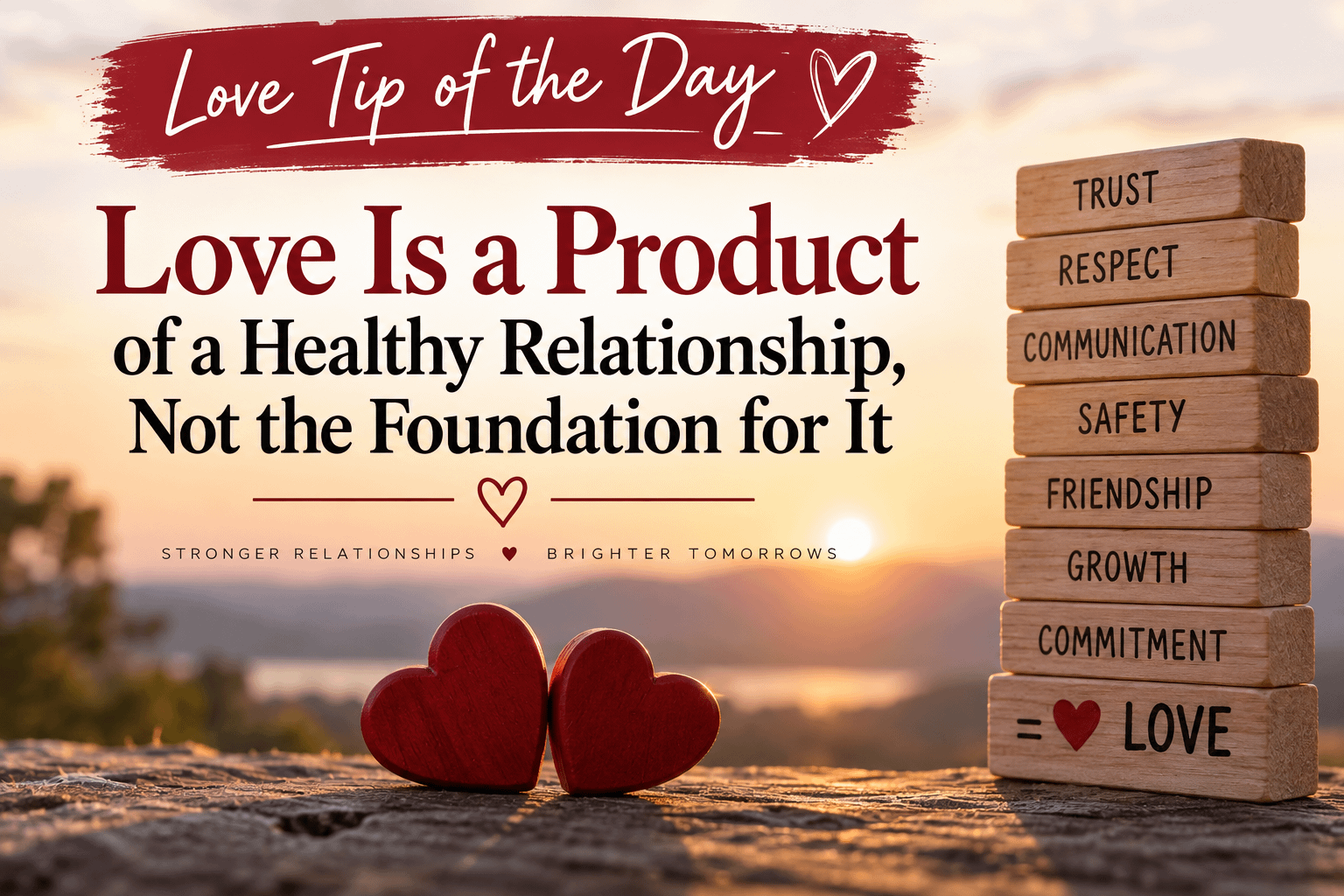
  • Love Tip of the Day: Love Is a Product of a Healthy Relationship, Not the Foundation for It

    Love Tip of the Day: Love Is a Product of a Healthy Relationship, Not the Foundation for It

    Advertisements

    We often hear that love is the foundation of a relationship.

    “Love is all you need.”

    “If two people truly love each other, they can make anything work.”

    “Love conquers all.”

    These ideas sound beautiful, but relationships are more complicated than that.

    Love is incredibly important. Without affection, emotional connection, attraction, compassion, and genuine care for one another, a relationship can become empty. But love by itself cannot carry the entire weight of a relationship.

    Love is often the product of a healthy relationship, not the foundation holding it together.

    The real foundation is built from things such as trust, honesty, respect, communication, loyalty, emotional safety, accountability, consistency, forgiveness, effort, and shared commitment.

    When those things are present, love has somewhere safe to grow.

    When they disappear, two people can still love each other deeply while becoming increasingly unhappy together.

    That is one of the hardest lessons about relationships:

    You can love someone and still have an unhealthy relationship with them.

    Love Alone Cannot Fix Everything

    People sometimes remain in struggling relationships because they believe their love should eventually overcome every problem.

    They think:

    We love each other, so we’ll figure it out.

    Sometimes they do.

    But figuring it out requires more than love.

    It requires action.

    You cannot love away dishonesty.

    You cannot love away disrespect.

    You cannot love away repeated betrayal.

    You cannot love away emotional neglect.

    You cannot love away poor communication if neither person is willing to learn how to communicate differently.

    You cannot love away resentment while refusing to address what created it.

    Love can provide the motivation to work through those problems, but it cannot do the work itself.

    Both people have to participate.

    A healthy relationship is not simply two people saying, “I love you.”

    It is two people consistently behaving in ways that make those words believable.

    Trust Gives Love Somewhere to Live

    Trust is one of the strongest pieces of any relationship.

    Without trust, even enormous amounts of love can become buried underneath suspicion, anxiety, jealousy, and fear.

    Trust means knowing that your partner’s words and actions generally match.

    It means believing they will protect the relationship even when you aren’t standing beside them.

    It means feeling comfortable being vulnerable because you believe your vulnerability will not later be used against you.

    Trust does not mean blindly believing everything someone says. Healthy trust develops through repeated experiences.

    Someone makes a promise and keeps it.

    They tell the truth when lying would have been easier.

    They admit when they make a mistake.

    They behave consistently when nobody is watching.

    Little by little, trust grows.

    And when trust grows, love often becomes deeper because both people feel safer giving more of themselves.

    Respect Protects Love

    You can disagree with someone and still respect them.

    In fact, disagreement is inevitable in a long-term relationship.

    Two people will not always have identical opinions, priorities, habits, personalities, or emotional needs.

    The important question isn’t whether you disagree.

    It is how you treat each other while disagreeing.

    Healthy couples learn that winning an argument is less important than protecting the relationship.

    They don’t deliberately humiliate one another.

    They don’t constantly bring up old mistakes simply to cause pain.

    They don’t attack vulnerabilities that were shared in confidence.

    They don’t treat each disagreement as an opportunity to prove who has more power.

    Instead, they try to understand.

    That doesn’t mean every conversation will be calm and perfect. People become frustrated. Voices sometimes rise. Emotions sometimes take over.

    What matters is the willingness to come back together afterward and repair what happened.

    Respect says:

    Even when I’m angry with you, I still recognize your value.

    That is one of the strongest forms of love.

    Communication Keeps the Relationship Connected

    Communication isn’t simply talking.

    It is learning how to express what is happening inside you while also creating enough emotional space to hear what is happening inside your partner.

    That requires vulnerability.

    Instead of:

    “You never care about me.”

    Try:

    “I’ve been feeling disconnected from you lately, and I miss feeling close to you.”

    Instead of:

    “You always ignore me.”

    Try:

    “When we’re together and you’re constantly distracted, I sometimes feel like I’m not important in that moment.”

    The goal is not to avoid difficult conversations.

    The goal is to make difficult conversations productive.

    Healthy communication allows two people to discuss uncomfortable subjects without constantly fearing that the relationship will collapse.

    Money.

    Family.

    Intimacy.

    Jealousy.

    Parenting.

    Boundaries.

    Future plans.

    Mistakes.

    Emotional needs.

    Disappointment.

    These conversations are not signs that something is wrong.

    Often, they are signs that two people care enough about their relationship to deal with reality rather than pretend everything is fine.

    Emotional Safety Allows Love to Become Deeper

    One of the most overlooked parts of a healthy relationship is emotional safety.

    Can you tell your partner what you are afraid of?

    Can you admit that something hurt you?

    Can you say you need reassurance without being mocked?

    Can you share your insecurities without worrying that they will later become ammunition during an argument?

    Can you admit when you’re struggling?

    When the answer is yes, something powerful happens.

    People stop performing.

    They stop pretending they have everything together.

    They allow themselves to be fully known.

    That is where intimacy becomes much deeper than physical attraction.

    There is something incredibly meaningful about being able to sit beside another person and know:

    I don’t have to pretend around you.

    You know my strengths.

    You know my weaknesses.

    You know the mistakes I’ve made.

    You know the things I’m still working through.

    And you still choose to walk beside me.

    That kind of emotional safety strengthens love.

    Consistency Matters More Than Grand Gestures

    Relationships aren’t usually built during anniversaries, vacations, Valentine’s Day, or expensive date nights.

    They’re built on ordinary Tuesdays.

    They are built in small moments nobody posts online.

    Making coffee for your partner.

    Checking on them after a difficult day.

    Sending a message because you know they have something important happening.

    Listening when they need to talk.

    Helping when they’re overwhelmed.

    Remembering something they mentioned weeks ago.

    Holding their hand when life becomes frightening.

    Showing affection for no particular reason.

    These things may seem insignificant individually.

    Together, they create security.

    A grand romantic gesture can make someone feel loved for an evening.

    Consistency can make someone feel loved for years.

    Accountability Keeps Love From Becoming an Excuse

    A healthy relationship requires two people capable of saying:

    “I was wrong.”

    Not:

    “I’m sorry you feel that way.”

    Not:

    “I only did it because you…”

    Not:

    “Well, you did something worse.”

    Real accountability means acknowledging your actions without immediately trying to escape responsibility for them.

    Everyone makes mistakes in relationships.

    We say things we shouldn’t.

    We misunderstand each other.

    We become defensive.

    We make selfish decisions.

    We sometimes fail the people we love.

    The difference between healthy and unhealthy relationships is often what happens afterward.

    Healthy partners take responsibility.

    They apologize.

    They listen.

    They make changes.

    Because an apology without changed behavior eventually becomes meaningless.

    Boundaries Do Not Weaken Love

    Some people believe love means having no boundaries.

    It doesn’t.

    Healthy boundaries protect both individuals and the relationship itself.

    You are still an individual even when you love someone deeply.

    You still need friendships.

    Interests.

    Privacy.

    Personal growth.

    Time to yourself.

    Goals.

    Opinions.

    Healthy love does not demand that two people erase themselves and become one identity.

    Instead, it allows two complete people to build a shared life while continuing to grow individually.

    A strong relationship should not make your world smaller.

    Ideally, it should give you the confidence and support to continue becoming the person you want to be.

    Friendship Matters More Than People Realize

    Romantic attraction is powerful, but friendship often carries relationships through the seasons when excitement naturally changes.

    Do you actually enjoy being around each other?

    Can you laugh together?

    Can you talk about meaningless things as easily as serious ones?

    Do you enjoy sharing experiences?

    Do you celebrate each other’s victories?

    Do you still have curiosity about one another?

    Do you genuinely like the person you love?

    That last question matters.

    Because life is long.

    There will be stressful seasons.

    Financial problems.

    Career changes.

    Family issues.

    Loss.

    Illness.

    Aging.

    Disappointment.

    There may be periods when romance takes a back seat to survival.

    Friendship becomes incredibly valuable during those seasons.

    Healthy Love Requires Two People Choosing Each Other

    Long-term relationships involve choice.

    Feelings naturally fluctuate.

    Some days you will feel incredibly close.

    Other days you might feel distant.

    There will be periods when life becomes busy and romance feels harder to prioritize.

    Healthy relationships recognize that love is both emotional and intentional.

    Sometimes love looks like passion.

    Sometimes love looks like patience.

    Sometimes love looks like forgiveness.

    Sometimes love looks like giving your partner space.

    Sometimes love looks like staying up late because they need someone to listen.

    Sometimes love looks like having a difficult conversation neither of you wants to have.

    And sometimes love looks like waking up and choosing the relationship again.

    Never Stop Learning Each Other

    One mistake couples sometimes make is believing they completely know their partner.

    But people change.

    The person you met five years ago isn’t exactly the same person standing beside you today.

    Neither are you.

    Life changes people.

    Success changes people.

    Failure changes people.

    Parenthood changes people.

    Loss changes people.

    Aging changes people.

    Experiences change priorities.

    That means healthy relationships require continued curiosity.

    Ask questions.

    What are they dreaming about now?

    What worries them?

    What makes them feel loved?

    What have they been thinking about lately?

    What do they need more of?

    What do they need less of?

    Who are they becoming?

    Don’t assume you already know every answer.

    Keep dating the person you’re with, even after you’ve been together for years.

    Love Should Feel Like Partnership

    A healthy relationship shouldn’t constantly feel like one person is dragging the other toward the future.

    There will certainly be seasons when one person carries more.

    If your partner is struggling, you may need to provide additional support.

    Later, you may be the one who needs them.

    Relationships will rarely be perfectly 50/50 every day.

    But over time, both people should be contributing.

    Both should care.

    Both should communicate.

    Both should compromise.

    Both should make sacrifices.

    Both should protect the relationship.

    Both should make the other person feel valued.

    A relationship becomes exhausting when only one person is constantly trying to save it.

    Love requires participation.

    A Healthy Relationship Creates More Love

    This is why love should not be viewed as the only foundation of a relationship.

    Imagine building a house.

    You don’t build the roof first.

    You create a strong foundation capable of supporting everything that comes afterward.

    Relationships work similarly.

    Build trust.

    Build respect.

    Build communication.

    Build emotional safety.

    Build friendship.

    Build loyalty.

    Build consistency.

    Build accountability.

    Build forgiveness.

    Build intimacy.

    Build partnership.

    Then something beautiful happens.

    Love grows naturally inside everything you’ve built together.

    The more emotionally safe you feel, the easier it becomes to love openly.

    The more respected you feel, the easier it becomes to give respect.

    The more trustworthy your partner becomes, the easier it becomes to be vulnerable.

    The more appreciated you feel, the more naturally affection grows.

    Healthy relationships create an environment where love can continuously renew itself.

    Love Is Something You Build Together

    The strongest relationships aren’t necessarily the ones with the most dramatic love stories.

    They are often the ones where two people quietly keep showing up.

    They choose honesty when dishonesty would be easier.

    They communicate when silence would be more comfortable.

    They apologize when pride tells them not to.

    They protect each other’s vulnerabilities.

    They support each other’s dreams.

    They laugh together.

    They forgive.

    They grow.

    They keep learning each other.

    And they refuse to take the relationship for granted.

    Love may have brought them together.

    But the relationship they intentionally built is what allowed that love to become stronger.

    Love Tip of the Day

    Don’t spend all your energy asking:

    “Does this person love me?”

    Also ask:

    “Are we building the kind of relationship where love can remain healthy?”

    Because saying “I love you” is important.

    But so is showing:

    I respect you.

    I trust you.

    I listen to you.

    I value you.

    I am honest with you.

    I will take responsibility when I hurt you.

    I want you to feel safe with me.

    I am willing to keep growing beside you.

    Those actions create the environment where lasting love becomes possible.

    Love doesn’t excuse an unhealthy relationship.

    Love doesn’t replace trust.

    Love doesn’t eliminate the need for communication.

    Love doesn’t make respect optional.

    Instead, love becomes stronger when all of those things exist together.

    Build the relationship first.

    Protect what you’ve built.

    Keep choosing each other.

    And allow love to become the beautiful product of two people who consistently create a healthy place for it to grow.

    What are you and your partner doing today to create a relationship where love can continue to grow?


  • Love Tip of the Day: When You Need Extra Love

    Advertisements

    There are days when the normal amount of love doesn’t feel like enough.

    You may need an extra hug. You may need to hear, “I love you” one more time. You may need someone to sit beside you without trying to fix anything. You may need reassurance that you’re still wanted, valued, appreciated, and safe in the relationship.

    There is nothing shameful about needing extra love sometimes.

    We aren’t emotionally identical from one day to the next. Stress, grief, disappointment, loneliness, insecurity, exhaustion, fear, and everything happening around us can change what we need from the person we love.

    A healthy relationship isn’t about giving exactly the same amount every single day. Sometimes one person has more to give while the other needs more support.

    The important thing is learning how to recognize those moments—and being willing to communicate about them.

    Some Days Are Heavier Than Others

    You can wake up one morning feeling confident and strong, then wake up the next day feeling completely different.

    Maybe work has been overwhelming.

    Maybe you’re worried about money.

    Maybe someone disappointed you.

    Maybe you’re missing someone.

    Maybe an anniversary or memory has brought emotions back to the surface.

    Maybe you’re questioning yourself.

    Or maybe you can’t even explain why you’re feeling down.

    You simply know you need the person you love a little more than usual.

    Those are the moments when relationships can become especially meaningful.

    Love isn’t only about sharing the easy days. It’s about recognizing when the person beside you is carrying something heavy and saying through your actions:

    “You don’t have to carry all of this alone.”

    Don’t Make Your Partner Guess

    One of the biggest mistakes we make in relationships is expecting the other person to automatically know what we need.

    We think:

    They should know I’m upset.

    They should know I need affection.

    They should realize something is wrong.

    If they really loved me, I wouldn’t have to ask.

    But even someone who loves you deeply cannot read your mind.

    Your partner might notice that you’re quieter than usual but misunderstand why. They might assume you need space when you actually want closeness. They might try to solve your problem when all you really want is a hug.

    Communication gives love direction.

    There is strength in being able to say:

    “I’m having a hard day. I could use a little extra love today.”

    That isn’t weakness.

    It’s emotional honesty.

    Extra Love Can Be Something Small

    When people hear “I need more love,” they sometimes imagine huge romantic gestures.

    But extra love often comes through the smallest things.

    It might be a longer hug before leaving for work.

    Holding hands while watching television.

    A kiss on the forehead.

    A message saying, “Thinking about you.”

    Making their favorite meal.

    Sitting beside them when they’re having a difficult night.

    Putting the phone away and actually listening.

    Asking, “How are you really doing?”

    Or simply saying:

    “I’m here.”

    Small acts can carry enormous emotional weight when someone is struggling.

    You don’t always need the perfect words.

    Sometimes your presence is enough.

    Reassurance Matters

    Even strong people need reassurance.

    Even independent people need reassurance.

    Even people who appear confident sometimes need to hear that they matter.

    Relationships can become so familiar that we stop saying the things we assume our partner already knows.

    Of course they know you love them.

    But hearing it still matters.

    Of course they know you appreciate them.

    Tell them anyway.

    Of course they know you’re attracted to them.

    Remind them.

    Of course they know you’re proud of them.

    Say it.

    Never underestimate what a few sincere words can do for someone who is struggling internally.

    “I love you.”

    “I’m proud of you.”

    “I’m glad you’re in my life.”

    “You matter to me.”

    “We’re going to get through this together.”

    Those aren’t complicated sentences.

    But on the right day, they can mean everything.

    Learn How Your Partner Receives Love

    Giving someone extra love isn’t only about doing what you consider loving.

    It’s about understanding what makes them feel loved.

    You might show love by buying gifts, while your partner desperately wants quality time.

    You might try to solve their problems, while they want you to listen.

    You might think giving them space is respectful, while they’re hoping you’ll pull them closer.

    This is why understanding each other matters.

    Ask questions.

    “What would help you tonight?”

    “Do you want advice or do you just need me to listen?”

    “Would you like some space or would you rather I stay with you?”

    “Is there anything I can do to make today easier?”

    You don’t lose romance by asking.

    You become a better partner.

    Love Isn’t Always 50/50

    People often describe healthy relationships as 50/50.

    Real life doesn’t always work that way.

    Some days it might be 50/50.

    Other days it might be 70/30.

    There may be days when your partner is exhausted and you carry more.

    There may be days when you’re emotionally drained and they’re the one keeping everything together.

    The goal shouldn’t be to keep score.

    The goal should be to build a relationship where both people know that when they stumble, someone will reach for their hand.

    That doesn’t mean one person should constantly give while receiving nothing in return. A healthy relationship still requires mutual effort.

    But temporary imbalance is part of loving another human being.

    When someone you love is hurting, you don’t say:

    “I’ve already given you your half.”

    You give what you can because they matter to you.

    And when your difficult day eventually comes, hopefully they’ll do the same.

    Don’t Shame Someone for Needing Reassurance

    If your partner says they need extra affection, don’t immediately dismiss them as needy.

    If they ask whether you still love them, don’t automatically become irritated.

    If they’re feeling insecure, don’t make them feel foolish.

    Try to understand what’s underneath the request.

    Maybe something happened that shook their confidence.

    Maybe they’ve been feeling disconnected from you.

    Maybe they’re overwhelmed.

    Maybe they’re afraid of losing something important.

    You can have healthy boundaries while still responding with compassion.

    Sometimes people aren’t asking for the world.

    They’re asking for confirmation that the person they love hasn’t emotionally disappeared.

    When You’re the One Who Needs Extra Love

    It can be difficult to admit when you’re the person needing more.

    You might worry about appearing weak.

    You might be afraid of rejection.

    You might think you should handle everything yourself.

    But emotional independence doesn’t mean never needing anyone.

    Human beings are built for connection.

    There will be times when you need someone to remind you that you’re loved.

    Instead of becoming distant and hoping your partner chases you, try communicating directly.

    Say what you’re feeling.

    Tell them what would help.

    Instead of:

    “You obviously don’t care about me.”

    Try:

    “I’ve been feeling disconnected lately, and I could really use some extra affection.”

    Instead of:

    “You never pay attention to me.”

    Try:

    “Can we spend some time together tonight? I miss feeling close to you.”

    The goal isn’t to accuse.

    It’s to connect.

    Be Each Other’s Safe Place

    One of the most beautiful things a relationship can become is a safe place.

    Not a perfect place.

    Not a place where nobody ever argues.

    Not a place without frustration or mistakes.

    A safe place.

    A relationship where you can say:

    “I’m not okay today.”

    And the other person doesn’t immediately judge you.

    Where you can admit:

    “I need you.”

    And you’re not made to feel embarrassed.

    Where vulnerability isn’t later used as ammunition during an argument.

    Where weakness isn’t punished.

    Where love doesn’t disappear the moment life becomes difficult.

    That kind of emotional safety takes time to build.

    But when two people intentionally create it, the relationship becomes much deeper than romance alone.

    It becomes partnership.

    Pay Attention Before They Have to Ask

    Communication is important, but so is awareness.

    When you’ve been with someone for a while, you begin recognizing their subtle changes.

    Their voice sounds different.

    They’re quieter.

    They’re not laughing as much.

    They’re staring off into space.

    They’re more tired than usual.

    They’re withdrawing.

    Instead of ignoring those signs, gently check in.

    “You’ve seemed a little down today. Are you okay?”

    They might say they’re fine.

    They might not be ready to talk.

    That’s okay.

    You can still remind them:

    “If you need me, I’m here.”

    Sometimes simply knowing someone noticed makes a person feel less alone.

    Love Them a Little Louder

    There will be moments when subtle love isn’t enough.

    Love them a little louder.

    Hold them longer.

    Listen more carefully.

    Send the message.

    Give the compliment.

    Sit beside them.

    Tell them you appreciate them.

    Remind them why you chose them.

    Make time when life has become too busy.

    Ask the second question instead of accepting “I’m fine” immediately.

    Give them room to be human.

    Relationships aren’t strengthened only by vacations, anniversaries, gifts, and romantic evenings.

    They’re strengthened on ordinary Tuesdays when one person is falling apart and the other decides to stay close.

    Those moments might never appear in photographs.

    Nobody else may ever know about them.

    But they are often the moments people remember most.

    Extra Love Should Never Become Control

    There is an important distinction between needing reassurance and trying to control another person.

    Healthy extra love might mean asking for affection, quality time, communication, encouragement, or emotional support.

    It shouldn’t mean demanding passwords, tracking someone’s location, isolating them from friends, constantly testing their loyalty, or requiring them to prove their love every hour.

    Love should create security—not captivity.

    You can need someone deeply while still respecting their individuality.

    The healthiest relationships allow both people to say:

    “I love you, I’m here for you, and I respect you as your own person.”

    Never Become Too Comfortable to Show Love

    Sometimes relationships lose affection not because the love disappeared, but because people became comfortable.

    They stop trying.

    They stop complimenting each other.

    They stop dating each other.

    They stop saying good morning.

    They stop kissing goodbye.

    They assume there will always be another opportunity.

    Don’t wait until your relationship feels distant to start showing affection again.

    Make love visible.

    Make appreciation audible.

    If you think something kind about your partner, say it.

    If you want to hug them, hug them.

    If you’re grateful for something they did, tell them.

    If you miss them, let them know.

    People shouldn’t have to wonder whether they’re loved when we have the ability to remind them.

    Sometimes the Strongest Person Needs the Most Love

    Pay special attention to the person who always seems strong.

    They’re often the one everyone relies on.

    They’re the listener.

    The helper.

    The provider.

    The problem solver.

    The person who says, “I’ll handle it.”

    Because they’re strong, people sometimes forget to check on them.

    But strength doesn’t eliminate emotion.

    The person carrying everyone else may occasionally need someone to carry them.

    Ask how they’re doing.

    Give them permission to put down the weight.

    Remind them that they don’t always have to be the strong one around you.

    Sometimes one of the greatest expressions of love is giving someone a place where they no longer have to pretend everything is okay.

    Love Is Showing Up

    Real love isn’t measured only by what happens when everything is going well.

    It’s revealed when life becomes difficult.

    It’s staying present during tears.

    It’s listening when you’ve heard the story before.

    It’s patience when someone isn’t quite themselves.

    It’s reminding them that one difficult season doesn’t change how you feel about them.

    It’s choosing kindness when frustration would be easier.

    It’s saying:

    “I’m still here.”

    Sometimes that’s exactly the extra love someone needs.

    Love Tip of the Day

    When the person you love needs extra love, don’t make them feel guilty for needing it.

    Give the extra hug.

    Send the extra message.

    Offer the extra reassurance.

    Spend the extra few minutes listening.

    Hold their hand a little tighter.

    And when you’re the one who needs more love, don’t be afraid to communicate it.

    You don’t always have to be strong.

    You don’t always have to pretend you’re fine.

    Sometimes the healthiest thing you can say to the person you trust is:

    “I need a little extra love today.”

    The right kind of love won’t laugh at that vulnerability.

    It will recognize the courage it took to say it and respond with compassion.

    Because love isn’t only saying “I love you” when life is easy.

    Love is noticing when those words need to be said again—and saying them a little louder.

    When someone you love is having a difficult day, what small thing can you do to make sure they feel a little more loved?

  • Love Tip of the Day: Don’t Abandon Your Family

    Advertisements

    Family relationships are not always easy.

    There will be disagreements. There will be disappointments. There will be days when you feel misunderstood, frustrated, exhausted, or hurt. There may even be moments when walking away seems easier than staying and working through what has happened.

    But love is not measured only by how we treat people when everything is going well.

    Love is revealed in what we do when relationships become difficult.

    Today’s love tip is simple: Don’t abandon your family.

    That does not mean accepting abuse, manipulation, violence, or destructive behavior. Healthy boundaries are sometimes necessary, and there are situations where distance is the safest and healthiest choice.

    But there is an important difference between protecting yourself from harm and abandoning people simply because loving them has become inconvenient.

    Family needs more than words.

    Family needs presence.

    Family needs effort.

    Family needs forgiveness.

    And sometimes, family needs someone willing to say:

    “Things are difficult right now, but I’m still here.”

    Love Is More Than the Easy Moments

    It is easy to talk about love during birthdays, holidays, weddings, vacations, family dinners, and celebrations.

    Those moments matter.

    But they are not the only moments that define a family.

    Families are also built during hospital visits, financial struggles, arguments, job losses, heartbreak, grief, disappointment, mistakes, and uncertain seasons.

    Anyone can say, “I love you.”

    The harder question is:

    What does your love look like when someone you care about is struggling?

    Do you disappear?

    Do you stop calling?

    Do you avoid uncomfortable conversations?

    Do you turn your back because their problems have become inconvenient?

    Or do you find a way to remain present while maintaining healthy boundaries?

    Sometimes love looks like sitting beside someone when you don’t know what to say.

    Sometimes it means making a phone call.

    Sometimes it means listening without trying to solve everything.

    Sometimes it means saying, “I disagree with what you did, but I still love you.”

    And sometimes love means refusing to give up on a relationship without first trying to repair it.

    Your Presence Matters More Than You Realize

    People often underestimate the importance of simply being there.

    You may think you need the perfect advice.

    You don’t.

    You may think you need to fix the problem.

    You don’t.

    You may think you need to know exactly what someone needs.

    You don’t.

    Sometimes they simply need to know they haven’t been forgotten.

    A text saying, “Thinking about you today,” can matter.

    A phone call can matter.

    Showing up for dinner can matter.

    Checking on someone who has been unusually quiet can matter.

    Sitting with someone who is grieving can matter.

    The smallest act of presence can remind someone:

    “I still matter to somebody.”

    Never underestimate that.

    Don’t Disappear When Someone Is Struggling

    One of the most painful experiences a person can endure is discovering that people they thought would always be there disappeared when life became difficult.

    It happens more often than we like to admit.

    Someone experiences grief.

    People initially surround them.

    Then weeks pass.

    Months pass.

    Everyone else returns to normal life.

    But the grieving person doesn’t.

    Eventually, the calls become less frequent.

    The messages stop.

    The invitations disappear.

    The grieving person isn’t only dealing with the loss anymore.

    Now they’re dealing with loneliness too.

    The same thing can happen after divorce, unemployment, illness, depression, financial hardship, addiction recovery, or other difficult circumstances.

    People sometimes distance themselves because they don’t know what to say.

    You don’t need perfect words.

    Say:

    “I don’t know what to say, but I’m here.”

    That sentence can mean more than you realize.

    Don’t Let Pride Destroy Something Valuable

    Families sometimes remain separated for years because nobody wants to make the first move.

    Everyone waits.

    Everyone keeps score.

    Everyone remembers what the other person did.

    Nobody picks up the phone.

    Days become months.

    Months become years.

    Then one day, someone realizes how much time has disappeared.

    Pride can convince us that making the first move means losing.

    It doesn’t.

    Sometimes reaching out first is an act of courage.

    You can say:

    “I don’t want us to keep living like this.”

    That doesn’t mean accepting all the blame.

    It doesn’t mean pretending nothing happened.

    It means deciding that repairing the relationship matters more than winning the argument.

    Learn to Have Difficult Conversations

    Strong families aren’t families that never disagree.

    They are families that learn how to disagree without destroying each other.

    You can be angry without becoming cruel.

    You can be disappointed without humiliating someone.

    You can establish boundaries without treating someone as worthless.

    You can disagree without turning every conversation into a battle.

    Instead of:

    “You always do this.”

    Try:

    “When this happens, it hurts me.”

    Instead of:

    “You don’t care about anybody.”

    Try:

    “I haven’t felt supported lately.”

    Instead of immediately walking away, ask:

    “Can we talk about what happened?”

    Communication doesn’t guarantee reconciliation.

    But silence almost guarantees that misunderstandings will grow.

    Don’t Use Silence as a Weapon

    Taking some time to cool down can be healthy.

    Using silence to punish someone is different.

    Ignoring someone intentionally, refusing to communicate, disappearing without explanation, or withholding affection to gain control can cause tremendous emotional damage.

    If you need space, say so.

    “I’m upset and need some time to think. I want to talk about this when I’ve calmed down.”

    That communicates something important:

    I’m taking space, but I’m not abandoning you.

    There is a huge emotional difference between those two things.

    Your Children Remember Who Stayed

    Children notice more than adults sometimes realize.

    They notice who attends their events.

    They notice who asks about their day.

    They notice who listens.

    They notice who keeps promises.

    They notice who disappears.

    They notice when adults put their own conflicts ahead of the child’s emotional needs.

    Children should never feel responsible for adult disagreements.

    When relationships between adults become difficult, children still need stability, reassurance, and love.

    Tell them:

    “Whatever happens between the adults, you are loved.”

    Then prove it through your actions.

    Show up.

    Call.

    Listen.

    Keep your promises.

    Be dependable.

    Years later, they may not remember every gift you bought them.

    But they will remember whether you were there.

    Don’t Wait Until Tomorrow to Appreciate Your Family

    One of life’s hardest truths is that we often assume there will always be more time.

    Another birthday.

    Another holiday.

    Another dinner.

    Another conversation.

    Another chance to say, “I love you.”

    But tomorrow is never guaranteed.

    Sometimes the last conversation happens without anyone realizing it is the last conversation.

    That’s why love shouldn’t constantly be postponed.

    Call your parents.

    Check on your children.

    Talk to your siblings.

    Spend time with your spouse or partner.

    Tell people you appreciate them.

    Say the words while they can hear them.

    “I love you.”

    “I’m proud of you.”

    “Thank you.”

    “I’m sorry.”

    “I forgive you.”

    “I’m here.”

    Those words become incredibly important when someday you no longer have the opportunity to say them.

    Forgiveness Doesn’t Mean Forgetting

    Family members will hurt each other sometimes.

    We are human.

    People make mistakes.

    People say things they regret.

    People make bad decisions.

    Forgiveness does not mean pretending something didn’t happen.

    It doesn’t mean removing every boundary.

    And it doesn’t mean allowing someone to repeatedly mistreat you.

    Forgiveness can simply mean refusing to let bitterness control the rest of your life.

    Some relationships can be repaired.

    Others may need distance.

    Some may never return to what they once were.

    But even when reconciliation isn’t possible, you can choose not to carry hatred everywhere you go.

    Don’t Confuse Boundaries With Abandonment

    This distinction matters.

    “Don’t abandon your family” should never be interpreted as “stay somewhere you’re being abused.”

    You are allowed to establish boundaries.

    You are allowed to say no.

    You are allowed to protect yourself and your children.

    You are allowed to step away from dangerous or destructive situations.

    Sometimes loving someone means refusing to participate in their destructive behavior.

    You can love someone while saying:

    “I love you, but I cannot allow you to treat me this way.”

    That’s not necessarily abandonment.

    That’s a boundary.

    Healthy love includes compassion, but it also includes respect.

    And respect has to go both ways.

    Family Doesn’t Require Perfection

    There is no perfect family.

    Every family has problems.

    Every family has disagreements.

    Every family has things they wish they could change.

    Social media can sometimes make it appear that everyone else’s family is happier, healthier, and more connected.

    You’re usually seeing highlights.

    Behind closed doors, almost every family is dealing with something.

    The goal shouldn’t be perfection.

    The goal should be connection.

    Growth.

    Respect.

    Communication.

    Forgiveness.

    And a willingness to keep trying when the relationship is worth saving.

    Be the Person Who Shows Up

    There is something powerful about being dependable.

    Be the person who answers the phone.

    Be the person who remembers birthdays.

    Be the person who checks in.

    Be the person who attends important moments.

    Be the person who asks:

    “How are you really doing?”

    And then stays long enough to hear the answer.

    You don’t need to solve everyone’s problems.

    You don’t need unlimited emotional energy.

    You don’t have to sacrifice your entire life.

    But when possible, let the people you love know they aren’t facing everything alone.

    Love Is Often Spelled T-I-M-E

    You can buy someone expensive gifts and still make them feel alone.

    You can provide financially and still be emotionally absent.

    You can live in the same house and barely know what someone is going through.

    Love requires attention.

    Put the phone down sometimes.

    Sit together.

    Have dinner.

    Take a drive.

    Go for a walk.

    Ask questions.

    Listen to stories you’ve already heard.

    Create memories.

    Time seems ordinary while we’re living it.

    Later, we often discover those ordinary moments were some of the most important moments of our lives.

    Stop Keeping Score

    Healthy families aren’t built on scorecards.

    “I called last time.”

    “I apologized first.”

    “I helped them more than they helped me.”

    “They didn’t come to my event, so I’m not going to theirs.”

    Keeping score turns relationships into transactions.

    Love isn’t supposed to be a competition.

    Of course, relationships should have mutual effort. One person shouldn’t carry everything forever.

    But sometimes one person is going through a season where they have less to give.

    There may come a time when you’re the one who needs extra support.

    Family can be strongest when people take turns carrying one another.

    Don’t Let One Bad Chapter Become the Entire Story

    People change.

    People mature.

    People learn.

    Someone who hurt you years ago may not be the same person today.

    That doesn’t automatically mean you should trust them again.

    Trust should be rebuilt through consistent actions.

    But when genuine change occurs, consider leaving room for something new.

    Sometimes families remain trapped because everyone keeps treating each other according to who they used to be.

    Allow people the opportunity to demonstrate growth.

    And allow yourself the opportunity to grow too.

    Choose Your Family Every Day

    Love isn’t only a feeling.

    Love is a decision made repeatedly.

    Choose patience.

    Choose communication.

    Choose kindness.

    Choose honesty.

    Choose forgiveness when appropriate.

    Choose boundaries when necessary.

    Choose presence.

    Choose to make the call.

    Choose to send the message.

    Choose to have the conversation.

    Choose to say, “I love you,” before another day disappears.

    Family can frustrate you more than almost anyone because family knows you deeply.

    But family can also become one of life’s greatest sources of strength.

    Protect those relationships when they are healthy enough to protect.

    Repair them when they are repairable.

    And don’t throw people away simply because things became difficult.

    Love Tip of the Day

    Don’t abandon your family when they need you most.

    You don’t have to fix everything.

    You don’t have to agree with everything.

    You don’t have to tolerate abuse or sacrifice healthy boundaries.

    But when love still exists and reconciliation is possible, don’t let pride, anger, inconvenience, or temporary conflict steal years you can never get back.

    Call.

    Listen.

    Apologize.

    Forgive.

    Show up.

    Spend time together.

    Say what needs to be said.

    Because someday, you may look back and realize the ordinary moments you spent together were actually extraordinary.

    Family isn’t about having perfect relationships.

    It’s about imperfect people continuing to find ways to love one another.

    When life becomes difficult, don’t make the people you love wonder whether you’ve disappeared. Remind them: “I’m still here.”

    Who in your family could use a call, message, hug, or reminder today that they are loved and haven’t been forgotten?

  • Love Tip of the Day: Be Together for the Right Reasons

    Advertisements

    Love can be one of the most beautiful parts of life. Finding someone who makes you smile, supports you, listens to you, and wants to walk beside you can bring a kind of happiness that is difficult to describe.

    But being in a relationship is not automatically the same thing as being in a healthy relationship.

    Sometimes people stay together because they genuinely love one another and want to build a life together. Other times, they stay because they are afraid of being alone, because they have already invested years into the relationship, because starting over feels overwhelming, or simply because being together has become comfortable.

    That is why one of the most important love tips is also one of the simplest:

    Be together for the right reasons.

    A relationship should exist because two people continue choosing each other—not because either person feels trapped, obligated, afraid, or unable to imagine another option.

    Love Should Be a Choice

    There is something powerful about knowing someone doesn’t have to be with you.

    They choose to be.

    They could walk away, build another life, or follow another path, but instead they continue choosing a life that includes you.

    And you choose them too.

    That choice is at the heart of lasting love.

    Healthy relationships aren’t built entirely on obligation. They are built on two people repeatedly deciding:

    I want you in my life.

    Not because they cannot survive without each other.

    Not because they are terrified of being alone.

    Not because everyone expects them to stay together.

    But because their lives are genuinely better when they share them.

    Love becomes much stronger when it is freely given instead of emotionally required.

    Don’t Be With Someone Just Because You’re Lonely

    Loneliness can convince us that almost any connection is better than having no connection at all.

    When you’ve spent nights wishing someone were beside you, it can become tempting to accept relationships that aren’t truly right for you.

    You may overlook incompatibility.

    You may tolerate disrespect.

    You may ignore warning signs.

    You may convince yourself that something is love simply because it temporarily makes you feel less alone.

    But loneliness is not a strong enough foundation for a relationship.

    Being with the wrong person can sometimes make you feel even lonelier than actually being alone.

    You can sit beside someone every evening and still feel invisible.

    You can sleep beside someone and still feel emotionally miles apart.

    You can technically be “in a relationship” while desperately wishing someone truly understood you.

    The goal shouldn’t simply be finding someone.

    The goal should be finding someone with whom you can build something meaningful.

    Don’t Stay Because You’re Afraid to Start Over

    One of the most common reasons people remain in unhappy relationships is the fear of starting again.

    You may think about all the years you’ve invested.

    All the memories you’ve created.

    All the plans you’ve made.

    All the people who know you as a couple.

    And suddenly leaving feels like admitting all those years were wasted.

    But time spent loving someone isn’t necessarily wasted simply because the relationship eventually changes or ends.

    Relationships teach us.

    People change us.

    Experiences shape us.

    Sometimes a relationship can have been meaningful during one chapter of your life without being right for every chapter that follows.

    Staying solely because you’ve already stayed for years doesn’t guarantee happiness.

    The number of years behind you shouldn’t be the only reason you remain together for the years ahead.

    The better question is:

    If I met this person today, knowing everything I know now, would I still choose them?

    The answer can tell you a great deal.

    Don’t Confuse Comfort With Love

    Comfort is an important part of relationships.

    Eventually, love becomes familiar.

    You develop routines.

    You know each other’s habits.

    You have favorite restaurants, television shows, jokes, traditions, and weekend rituals.

    There is something wonderful about that familiarity.

    But sometimes familiarity becomes the only thing keeping two people together.

    Change is scary.

    Starting over is uncomfortable.

    Meeting someone new requires vulnerability.

    So people remain where they are simply because it is familiar.

    But comfortable isn’t always the same as happy.

    A healthy relationship should provide security while still containing affection, respect, communication, friendship, and genuine desire to share life together.

    You shouldn’t stay simply because leaving would be inconvenient.

    Stay because there is something worth staying for.

    Don’t Build Love Around Fear

    Fear is another powerful reason people remain in relationships that no longer feel healthy.

    Fear of being alone.

    Fear of never finding someone else.

    Fear of getting older alone.

    Fear of disappointing family.

    Fear of hurting someone’s feelings.

    Fear of financial changes.

    Fear of losing mutual friends.

    Fear of admitting the relationship isn’t what you hoped it would become.

    Those fears can be very real.

    But fear should never be the glue holding a relationship together.

    Love built primarily around fear eventually becomes emotional imprisonment.

    You should feel free to choose your partner—not terrified of what will happen if you don’t.

    Be Together Because You Respect Each Other

    Love gets much of the attention in relationships, but respect is just as important.

    You should be with someone whose feelings matter to you.

    Someone whose dreams you respect.

    Someone whose boundaries you honor.

    Someone whose opinions you can disagree with without trying to tear them down.

    And they should offer you the same respect.

    Healthy couples don’t have to agree about everything.

    They will argue.

    They will misunderstand one another.

    They will occasionally disappoint each other.

    But even during difficult moments, respect should remain.

    Arguments shouldn’t become opportunities for humiliation.

    Private insecurities shouldn’t become weapons.

    Mistakes shouldn’t be stored away so they can be used during future fights.

    Love without respect eventually becomes painful.

    Be with someone you can disagree with while still remembering that you love them.

    Be Together Because You Can Be Yourselves

    One of the greatest feelings in a relationship is knowing you don’t constantly have to perform.

    You don’t have to pretend everything is okay.

    You don’t have to hide every insecurity.

    You don’t have to become someone completely different just to keep your partner interested.

    You can laugh loudly.

    You can admit when you’re scared.

    You can talk about your dreams.

    You can share the parts of yourself that aren’t perfectly polished.

    And you know the other person isn’t going to disappear simply because they discovered you’re human.

    The right relationship gives both people room to be themselves while encouraging each other to grow.

    You shouldn’t have to lose yourself to keep someone else.

    Love should add to who you are, not erase you.

    Be Together Because You Make Each Other Better

    The right relationship doesn’t require perfection.

    It encourages growth.

    Your partner should inspire you to become a better version of yourself—not because they constantly criticize you, but because their love makes you want to grow.

    You encourage each other’s dreams.

    You celebrate victories.

    You provide encouragement during failures.

    You remind each other of your strength when life becomes difficult.

    You challenge unhealthy habits without trying to control each other.

    You want to see each other succeed.

    Love shouldn’t become a competition where one person’s success threatens the other.

    When you truly love someone, their happiness matters to you.

    Their dreams matter.

    Their future matters.

    You want them to become everything they are capable of becoming.

    Be Together Because You Enjoy Each Other

    This sounds obvious, but it is surprisingly important.

    You should actually like the person you love.

    Love isn’t only romance.

    It is friendship.

    It is conversation.

    It is laughter.

    It is sharing ridiculous jokes nobody else understands.

    It is sitting together doing absolutely nothing and somehow enjoying it.

    It is wanting to tell them what happened during your day.

    It is seeing something funny and immediately thinking about sending it to them.

    It is wanting their company, not simply needing their presence.

    Romantic excitement naturally changes over time, but friendship can become one of the strongest foundations of lasting love.

    Years from now, appearances will change.

    Bodies will change.

    Circumstances will change.

    Life will bring challenges neither person can predict.

    Having someone beside you whom you genuinely enjoy being around makes those years much more meaningful.

    Be Together Because You Can Communicate

    Communication doesn’t mean never misunderstanding each other.

    It means being willing to work through those misunderstandings.

    You should be able to say:

    “I’m hurting.”

    “I need you.”

    “I disagree.”

    “I made a mistake.”

    “I’m sorry.”

    “I don’t understand.”

    “Can we talk about this?”

    “I love you.”

    Those conversations aren’t always easy.

    Vulnerability rarely is.

    But relationships become stronger when people can communicate without constantly fearing punishment, ridicule, or rejection.

    Silence may prevent an argument temporarily, but unresolved feelings rarely disappear.

    Healthy love creates space for difficult conversations.

    Be Together Because Trust Exists

    Trust is one of the foundations of lasting love.

    Without it, relationships become exhausting.

    Constant suspicion.

    Checking phones.

    Questioning every friendship.

    Wondering where someone really was.

    Analyzing every text.

    Trying to catch someone in a lie.

    That isn’t peace.

    A healthy relationship should allow both people to breathe.

    Trust doesn’t mean blindly ignoring obvious problems. It means creating a relationship where honesty is expected and demonstrated.

    Your words should match your actions.

    Promises should mean something.

    And when trust is damaged, rebuilding it requires accountability, patience, honesty, and consistent behavior.

    Love becomes much easier to enjoy when you aren’t constantly wondering whether you can believe the person beside you.

    Be Together Because You Choose Each Other During the Hard Days

    Relationships aren’t tested only during romantic dinners, vacations, anniversaries, and beautiful moments.

    They are tested during ordinary and difficult days.

    When money gets tight.

    When someone loses a job.

    When someone gets sick.

    When family problems appear.

    When stress becomes overwhelming.

    When life doesn’t follow the plan.

    When one person is struggling and doesn’t know how to explain what they’re feeling.

    Those are the moments when love becomes more than words.

    Sometimes love looks like holding someone’s hand.

    Sometimes it looks like making dinner because they’re exhausted.

    Sometimes it looks like listening without trying to fix everything.

    Sometimes it looks like saying, “We’ll figure this out together.”

    You don’t truly know what a relationship is made of until life stops being easy.

    Don’t Expect Another Person to Complete You

    There is a romantic idea that somewhere in the world exists another person who will “complete” you.

    But healthy love isn’t two incomplete people desperately trying to become one whole person.

    It is two individuals choosing to share their lives.

    Your partner can support you.

    Encourage you.

    Love you.

    Comfort you.

    Believe in you.

    But they cannot become your entire identity.

    You still need your own values, interests, friendships, goals, and sense of self.

    The strongest relationships aren’t necessarily built by people who cannot live without each other.

    They are often built by people who could stand on their own but choose to stand together.

    There is a big difference.

    Love Should Feel Like Partnership

    Relationships work best when neither person feels like they’re carrying everything alone.

    Both people contribute.

    Not necessarily in identical ways.

    Life isn’t always exactly 50/50.

    Sometimes one person may be struggling and the other carries more for a while.

    Later, those roles may reverse.

    What matters is knowing you’re teammates.

    When a problem appears, it shouldn’t always become:

    Me versus you.

    Instead, try to make it:

    Us versus the problem.

    That change in perspective can completely transform how couples handle conflict.

    You aren’t enemies trying to win an argument.

    You’re partners trying to protect something you both value.

    Keep Asking Yourself Why You Choose Them

    Relationships evolve.

    People evolve.

    Life changes.

    That’s why occasionally asking yourself why you are still together can actually be healthy.

    Hopefully, your answers sound something like:

    Because I love them.

    Because I respect them.

    Because I trust them.

    Because we laugh together.

    Because we support each other.

    Because I can be myself around them.

    Because they make ordinary days better.

    Because we’ve built something worth protecting.

    Because I still look at them and know that, despite everything life has brought us, I would choose them again.

    Those are powerful reasons to stay.

    The Right Reasons Won’t Always Be Perfect Reasons

    Being together for the right reasons doesn’t mean every day will feel romantic.

    Some days you’ll annoy each other.

    Some days you’ll need space.

    Some days you’ll argue about something ridiculously small.

    Some days stress will make both of you less patient than you should be.

    Love isn’t proven by having a perfect relationship.

    It’s proven through commitment, honesty, forgiveness, communication, effort, respect, and the willingness to keep learning how to love each other better.

    The right person won’t magically remove every problem from your life.

    Instead, they’ll become someone you want beside you while you face those problems.

    Love Tip of the Day

    Be together because you genuinely want to share your lives—not because you’re afraid of what life would look like apart.

    Choose someone because you love who they are.

    Choose someone because you respect them.

    Choose someone because you trust them.

    Choose someone because you can laugh together, cry together, dream together, struggle together, and continue growing together.

    And make sure they’re choosing you for those same reasons.

    You deserve to know that the person beside you isn’t there simply because they’re lonely, comfortable, afraid, or obligated.

    They’re there because when they look at all the paths their life could take, they still want one of those paths to include you.

    At the end of the day, some of the strongest love isn’t built on the words “I need you.”

    It’s built on something even more meaningful:

    “I choose you.”

    If you looked at your relationship today—not your history, not your fears, and not other people’s expectations—would you still choose each other?

  • Love Tip of the Day: Learn How Your Partner Needs to Be Loved

    Advertisements

    Loving someone is one thing.

    Learning how they need to be loved is something deeper.

    We often enter relationships believing that if our love is genuine, the other person will automatically feel it. We give affection in the ways that make sense to us. We say the things we would want to hear. We offer the kind of support we would want to receive. We show love according to our own experiences, personality, and needs.

    But there is something important we sometimes forget:

    The way you naturally give love may not be the way the person you love receives it best.

    One person may feel deeply loved when they hear, “I appreciate you.”

    Another may need quality time and meaningful conversations.

    Someone else may feel loved when their partner notices they are overwhelmed and quietly helps without being asked.

    Another person may need physical affection, reassurance, encouragement, patience, or simply the comfort of knowing someone is consistently there.

    Healthy love is not only about saying:

    “This is how I love you.”

    It is also about asking:

    “What makes you feel loved by me?”

    Love Requires Learning

    When you truly care about someone, you become a student of their heart.

    You learn what makes them smile.

    You learn what makes them uncomfortable.

    You discover what they worry about.

    You notice what makes them feel appreciated.

    You recognize the things that hurt them.

    You begin understanding what makes them feel safe enough to open up.

    You learn when they need advice and when they simply need someone to listen.

    You learn when they want closeness and when they need a little space.

    You learn the difference between the smile they give everyone else and the smile that tells you they are genuinely happy.

    None of this happens overnight.

    Real relationships require curiosity.

    Even after years together, there should still be things you want to discover about each other.

    People grow.

    People change.

    Life changes us.

    The person you fell in love with years ago may have different fears, dreams, priorities, and emotional needs today.

    Never stop learning the person you love.

    Don’t Assume They Know You Love Them

    One of the easiest mistakes in a long-term relationship is assuming love no longer needs to be expressed.

    You think:

    “They know I love them.”

    Maybe they do.

    But knowing someone loves you and feeling loved by them are not always the same thing.

    People need reminders.

    Say it.

    Show it.

    Demonstrate it.

    Tell them you appreciate them.

    Reach for their hand.

    Send the unexpected message.

    Ask about their day and actually listen to the answer.

    Notice when something is bothering them.

    Celebrate their accomplishments.

    Encourage their dreams.

    Thank them for the ordinary things they do.

    Love should never become something that is simply assumed.

    Make it something that can still be felt.

    Pay Attention to the Little Things

    Grand romantic gestures can be wonderful.

    Flowers are beautiful.

    Trips are exciting.

    Anniversary dinners are memorable.

    Expensive gifts can be thoughtful.

    But most relationships are not built during extraordinary moments.

    They are built during ordinary Tuesdays.

    They are built through the morning text.

    The cup of coffee.

    The kiss before leaving for work.

    The question, “Did you make it home safely?”

    The hug after a difficult day.

    The inside jokes nobody else understands.

    The conversation while making dinner.

    The hand resting on theirs while watching television.

    The willingness to listen when they need to talk.

    The simple message:

    “I was thinking about you.”

    Those moments may seem insignificant individually, but together they create emotional security.

    They say:

    I notice you.

    I care about you.

    You matter to me.

    I am still choosing you.

    Listen to What They Tell You

    Sometimes people tell us exactly how they need to be loved, but we do not hear them because we are listening defensively instead of lovingly.

    Your partner might say:

    “I wish we spent more time together.”

    You hear criticism.

    What they may really be saying is:

    “I miss you.”

    They might say:

    “You never tell me how you feel.”

    You hear an accusation.

    They may actually be saying:

    “I want to feel closer to you.”

    They might say:

    “I feel like you’re always on your phone.”

    You hear complaining.

    But underneath those words might be:

    “I want your attention because our time together matters to me.”

    Not every complaint is an attack.

    Sometimes it is an attempt to communicate an unmet emotional need.

    Instead of immediately defending yourself, ask:

    “What are they trying to tell me they need?”

    That one question can completely change a conversation.

    Ask Instead of Guessing

    You do not have to become a mind reader to have a strong relationship.

    Ask questions.

    “What makes you feel most loved?”

    “What can I do more often that would make you happy?”

    “Is there anything you wish we did more together?”

    “When you’re having a difficult day, what helps you most?”

    “Do you want me to listen, help you solve it, or just hold you?”

    “What makes you feel appreciated?”

    These conversations may initially feel awkward, especially if you are not accustomed to discussing emotions.

    Have them anyway.

    A few minutes of uncomfortable honesty can prevent months of misunderstanding.

    Learn How They Handle Difficult Days

    Love is easy when everything is going well.

    The relationship feels different when life becomes difficult.

    Stress.

    Financial problems.

    Family problems.

    Job uncertainty.

    Health concerns.

    Loss.

    Fear.

    Exhaustion.

    Disappointment.

    These are the moments when learning how your partner needs to be loved becomes especially important.

    Some people want to talk immediately.

    Others need time before they can find the words.

    Some want advice.

    Others want someone to listen.

    Some need physical affection.

    Others need quiet companionship.

    Sometimes the most loving thing you can say is:

    “I’m here. You don’t have to go through this alone.”

    You don’t always have to fix their problem.

    Sometimes you simply need to make sure they don’t feel alone while facing it.

    Make Them Feel Emotionally Safe

    One of the greatest gifts you can give someone you love is emotional safety.

    They should be able to tell you when they are afraid.

    When they are insecure.

    When something hurts.

    When they make a mistake.

    When they disagree with you.

    When they need reassurance.

    When they are struggling.

    They should not have to constantly calculate whether honesty will lead to ridicule, anger, punishment, manipulation, or days of silence.

    A healthy relationship should be a place where vulnerability is treated with care.

    If someone trusts you with something deeply personal, remember what that trust represents.

    They are handing you a vulnerable piece of themselves.

    Handle it gently.

    Never use someone’s deepest insecurities as ammunition during an argument.

    Words spoken in anger can remain long after the argument ends.

    Love Them on Ordinary Days

    Don’t wait until Valentine’s Day.

    Don’t wait until their birthday.

    Don’t wait until your anniversary.

    Don’t wait until the relationship is struggling.

    Don’t wait until you almost lose them before realizing how important they are.

    Love them today.

    Love them when nothing exciting is happening.

    Love them while grocery shopping.

    Love them while folding laundry.

    Love them during the drive home.

    Love them while sitting together doing absolutely nothing.

    Relationships are mostly made of ordinary days.

    If you only make someone feel special on special occasions, you are missing hundreds of opportunities to love them throughout the year.

    Learn Their Dreams

    When you love someone, their dreams should matter to you.

    Ask what they want from life.

    Ask where they hope to be five years from now.

    Ask what they would attempt if they weren’t afraid of failing.

    Ask what they have always wanted to do.

    Then encourage them.

    You don’t have to share every dream.

    You don’t have to understand every ambition.

    But your relationship should be a place where both people are encouraged to grow rather than pressured to become smaller.

    Love shouldn’t say:

    “Stay exactly where you are so I feel comfortable.”

    Healthy love says:

    “Become everything you’re capable of becoming, and I’ll be cheering for you.”

    Understand Their Past Without Punishing Them for It

    Everyone enters a relationship carrying a story.

    Previous heartbreak.

    Family experiences.

    Broken trust.

    Rejection.

    Loss.

    Mistakes.

    Regrets.

    Insecurities.

    Sometimes a person’s reactions make more sense when you understand where they came from.

    Someone who has been abandoned may need reassurance.

    Someone who has been betrayed may struggle with trust.

    Someone who grew up feeling unheard may become especially sensitive when they feel ignored.

    Understanding someone’s past doesn’t mean unhealthy behavior should be excused.

    It means compassion can exist alongside boundaries.

    Sometimes love sounds like:

    “I understand why this is difficult for you, and I want us to work through it together.”

    Don’t Stop Dating Each Other

    Relationships often begin with intention.

    You plan dates.

    You dress up.

    You ask questions.

    You send thoughtful messages.

    You stay awake talking.

    You make time for each other.

    Then life gets busy.

    Work.

    Bills.

    Children.

    Responsibilities.

    Schedules.

    Eventually two people who once couldn’t get enough time together can become two people sharing a home but barely connecting.

    Keep dating each other.

    It doesn’t have to be expensive.

    Take a walk.

    Make dinner together.

    Get coffee.

    Watch the sunset.

    Drive somewhere new.

    Turn off the phones and talk.

    Sit outside together.

    Recreate your first date.

    Do something spontaneous.

    The activity matters less than the intention behind it.

    You are saying:

    “Our relationship still deserves my time.”

    Notice Their Effort

    People want to feel appreciated.

    Unfortunately, the things someone consistently does can eventually become invisible.

    Maybe they cook dinner.

    Maybe they work long hours.

    Maybe they handle appointments.

    Maybe they clean.

    Maybe they remember birthdays.

    Maybe they always check on you.

    Maybe they make sure everyone else is okay before thinking about themselves.

    Notice.

    Say thank you.

    Don’t allow someone’s consistent kindness to become something you simply expect.

    One sincere sentence can mean more than you realize:

    “I notice everything you do, and I appreciate you.”

    Love Isn’t About Perfection

    You are going to misunderstand each other.

    You will occasionally say the wrong thing.

    You will forget something.

    You will have bad days.

    You will disagree.

    There will be times when one person needs more from the relationship than the other.

    Healthy love is not the absence of mistakes.

    It is the willingness to repair them.

    Apologize when you are wrong.

    Listen when you have hurt someone.

    Forgive when forgiveness is appropriate.

    Change behavior when an apology requires change.

    Choose understanding over winning.

    The goal should never be:

    Me versus you.

    It should be:

    Us versus the problem.

    Don’t Make Them Beg for the Basics

    Someone shouldn’t have to repeatedly beg for communication.

    Respect.

    Honesty.

    Affection.

    Consistency.

    Time.

    Reassurance.

    Effort.

    If the person you love repeatedly tells you something matters to them, take it seriously.

    You may not completely understand why something is important.

    You don’t necessarily have to.

    If it matters deeply to someone you love, that alone should make it worth understanding.

    Keep Choosing Each Other

    Falling in love can happen unexpectedly.

    Staying in love requires intention.

    There will be days when romance feels effortless.

    There will also be days filled with stress, exhaustion, frustration, and responsibilities.

    Those are the days when love becomes a choice.

    Choose patience.

    Choose communication.

    Choose kindness.

    Choose honesty.

    Choose forgiveness.

    Choose affection.

    Choose effort.

    Choose each other.

    Love is not only something you feel.

    Love is something you repeatedly demonstrate.

    Love Tip of the Day

    Learn how your partner needs to be loved instead of assuming the way you give love is automatically the way they receive it.

    Pay attention.

    Listen.

    Ask questions.

    Notice what makes them feel valued.

    Learn what makes them feel safe.

    Discover what they need when life becomes difficult.

    Remember the small things.

    Support their dreams.

    Respect their vulnerability.

    Keep dating them.

    Keep appreciating them.

    Keep learning them.

    Because one of the most beautiful things you can say to someone isn’t simply:

    “I love you.”

    It is:

    “I love you enough to learn how to love you well.”

    Love is not about finding someone and then assuming the work is finished.

    It is about continuing to discover them.

    The person beside you today is still growing.

    Still changing.

    Still dreaming.

    Still healing.

    Still becoming.

    Be curious about who they are becoming.

    Never assume you know everything about their heart simply because you have known them for years.

    Keep asking.

    Keep listening.

    Keep noticing.

    Keep choosing them.

    Sometimes the strongest relationships aren’t built by people who love each other more than everyone else.

    They are built by two people who never stop learning how to love each other.

    What is one small thing someone can do that instantly makes you feel loved and appreciated?

  • Love Tip of the Day: Make Your Partner Feel Chosen, Not Just Loved

    Advertisements

    Love is one of the most powerful things we can give another person.

    But sometimes simply loving someone is not enough.

    A person can know that you love them and still wonder whether you truly choose them.

    They can hear the words “I love you” and still feel overlooked.

    They can be in a committed relationship and still feel lonely.

    They can sleep beside you every night and still wonder whether they are important to you.

    That is why today’s love tip is simple:

    Make your partner feel chosen, not just loved.

    Being chosen means knowing that someone isn’t merely staying because the relationship is familiar, convenient, comfortable, or difficult to leave.

    It means feeling that your partner continues to look at you and think:

    Out of everyone in this world, I still want you.

    Healthy relationships need that reassurance.

    Not once.

    Not only at the beginning.

    But throughout the relationship.

    Love Should Never Feel Like an Assumption

    At the beginning of a relationship, people usually make their interest obvious.

    They text.

    They call.

    They make plans.

    They flirt.

    They compliment each other.

    They ask questions.

    They stay up late talking.

    They find excuses to spend time together.

    They notice little things.

    They remember details.

    They make an effort because they are trying to show the other person:

    I am interested in you.

    Then something sometimes changes.

    Comfort arrives.

    The relationship becomes established.

    Days become routines.

    Weeks become months.

    Months become years.

    And gradually, two people can begin assuming that their partner already knows how they feel.

    The effort that once came naturally begins disappearing.

    The conversations become shorter.

    Date nights become less frequent.

    Compliments become rare.

    Phones receive more attention.

    Life becomes busy.

    Eventually, one person may start wondering:

    Do they still want me, or are they simply used to having me around?

    That is a painful question to have inside a relationship.

    Don’t allow love to become something your partner has to assume.

    Show it.

    Choose Them in the Small Moments

    Making someone feel chosen doesn’t require extravagant romantic gestures.

    You don’t need expensive vacations.

    You don’t need flowers every week.

    You don’t need fancy restaurants.

    You don’t need to constantly buy gifts.

    Some of the strongest expressions of love happen in incredibly ordinary moments.

    Put your phone down when they’re talking.

    Reach for their hand while you’re walking.

    Send a message during the day saying you’re thinking about them.

    Bring them their favorite snack without being asked.

    Sit beside them.

    Ask how their day went and actually listen to the answer.

    Remember something important they told you.

    Kiss them goodbye.

    Hug them when you come home.

    Tell them they look good.

    Make plans together.

    Check on them when you know they’ve had a difficult day.

    Say goodnight.

    Say good morning.

    Say:

    “I’m glad you’re here.”

    These things seem small.

    But relationships are largely built from small moments repeated over time.

    Don’t Make Your Partner Compete for Your Attention

    One of the easiest ways to make someone feel unimportant is to constantly give everything else your attention.

    Your phone.

    Social media.

    Work.

    Friends.

    Television.

    Video games.

    Hobbies.

    Notifications.

    Emails.

    There will always be something competing for your attention.

    That doesn’t mean you should abandon your interests or spend every moment focused on your relationship.

    Healthy couples still need individual lives.

    But your partner should not constantly feel like they are standing at the back of the line waiting for whatever remains of your attention.

    Sometimes choosing your partner is as simple as putting your phone face down.

    Looking at them.

    Listening.

    Being present.

    Giving someone your full attention communicates something powerful:

    You matter enough for me to stop everything else for a moment.

    Keep Dating Each Other

    Relationships shouldn’t stop being romantic simply because they become serious.

    Keep dating.

    You don’t need to recreate your first date every weekend.

    Dating can be simple.

    Go for coffee.

    Take a drive.

    Cook dinner together.

    Watch the sunset.

    Take a walk.

    Visit somewhere you’ve never been.

    Have breakfast together.

    Try a new restaurant.

    Watch a movie.

    Sit outside and talk.

    The activity matters less than the intention.

    You are deliberately creating time for each other.

    That says:

    Our relationship is still worth investing in.

    There is something beautiful about knowing someone has had countless opportunities to become complacent and instead continues choosing to pursue you.

    Tell Them Why You Choose Them

    Sometimes people need to hear why they matter.

    Don’t assume your partner knows.

    Tell them.

    Tell them what you admire about them.

    Tell them what initially attracted you to them.

    Tell them something you appreciate.

    Tell them what makes them different.

    Tell them what they bring into your life.

    Maybe it’s their kindness.

    Their humor.

    Their loyalty.

    Their patience.

    Their strength.

    Their compassion.

    Their intelligence.

    Their determination.

    Their ability to make you laugh.

    Their willingness to stand beside you during difficult times.

    There are probably dozens of things you appreciate that you rarely say aloud.

    Say them.

    People shouldn’t have to wonder what you see in them.

    Choose Them During Difficult Conversations

    Choosing someone isn’t only about romance.

    Sometimes choosing your partner means choosing the relationship during conflict.

    Every couple disagrees.

    There will be misunderstandings.

    There will be frustration.

    There will be hurt feelings.

    There will be moments when both people believe they’re right.

    During those moments, remember something important:

    Your partner isn’t supposed to be your enemy.

    The goal isn’t to win every argument.

    The goal is to understand each other and protect the relationship.

    You can disagree without humiliating someone.

    You can be angry without becoming cruel.

    You can explain that you’re hurt without intentionally hurting them back.

    You can take space without threatening the relationship.

    You can apologize.

    You can admit when you’re wrong.

    You can listen.

    You can forgive.

    Choosing your partner during conflict means remembering that the relationship matters more than your ego.

    Loyalty Is Part of Choosing Someone

    Being chosen also means feeling secure.

    Your partner shouldn’t constantly have to wonder whether you’re searching for someone better.

    Healthy relationships require boundaries.

    That includes how you interact with other people.

    If you’re in a committed relationship, behave like someone who values that commitment.

    Don’t deliberately create jealousy.

    Don’t secretly entertain attention from people who want something romantic from you.

    Don’t keep backup options.

    Don’t flirt simply because you enjoy the validation.

    Don’t compare your partner with everyone else.

    Don’t make someone feel foolish for trusting you.

    Loyalty isn’t simply avoiding physical cheating.

    It is protecting the relationship even when your partner isn’t standing beside you.

    Choose Them Publicly and Privately

    Some people behave differently depending on who’s around.

    They’re affectionate privately but distant publicly.

    Or they praise their partner privately while constantly making jokes at their expense around friends.

    That can slowly damage someone’s sense of security.

    Your partner should never have to wonder whether you’re proud to be with them.

    You don’t have to turn your relationship into a social-media performance.

    Privacy is healthy.

    But there is a difference between privacy and secrecy.

    Someone who loves you shouldn’t make you feel hidden.

    Let your actions communicate:

    I’m proud that you’re part of my life.

    Don’t Compare Your Relationship to Social Media

    Social media can make ordinary relationships look inadequate.

    You see anniversary trips.

    Flowers.

    Engagement photos.

    Perfect date nights.

    Expensive gifts.

    Romantic vacations.

    Beautiful houses.

    Happy couples.

    What you don’t see are the disagreements.

    Financial stress.

    Difficult conversations.

    Bad moods.

    Insecurities.

    Ordinary Tuesdays.

    Don’t compare your complete relationship to someone else’s carefully selected moments.

    Choosing your partner means appreciating the relationship you’re actually building instead of constantly looking around wondering whether somebody else has something better.

    Make Them Feel Safe Being Vulnerable

    One of the deepest ways you can choose someone is by becoming a safe place for their truth.

    If your partner tells you something difficult, listen.

    If they’re afraid, don’t mock them.

    If they’re insecure, don’t use that insecurity against them later.

    If they share something painful from their past, treat it carefully.

    If they cry, don’t shame them.

    If they admit they’re struggling, don’t immediately tell them to get over it.

    Vulnerability requires trust.

    When someone shows you the parts of themselves they normally hide from the world, they’re giving you something valuable.

    Handle it carefully.

    Choose Them When Life Gets Difficult

    It is easy to love someone when everything is going well.

    Real relationships are tested when life becomes difficult.

    Financial problems.

    Job loss.

    Family problems.

    Health concerns.

    Grief.

    Stress.

    Disappointment.

    Unexpected changes.

    Sometimes your partner won’t be the happiest version of themselves.

    Sometimes they’ll be exhausted.

    Sometimes they’ll be scared.

    Sometimes they’ll struggle.

    Those are often the moments when knowing they’re still chosen matters most.

    You don’t always need the perfect advice.

    Sometimes love sounds like:

    “I’m here.”

    “We’ll figure this out.”

    “You don’t have to face this alone.”

    Never Stop Learning About Each Other

    People change.

    The person you started dating years ago isn’t exactly the same person standing beside you today.

    Neither are you.

    Our experiences change us.

    Our goals change.

    Our fears change.

    Our priorities change.

    Our dreams evolve.

    That’s why couples should never stop getting to know each other.

    Ask questions.

    What are you dreaming about lately?

    What has been stressing you?

    Is there something you want to accomplish?

    What makes you happiest right now?

    Is there something you wish we did more often?

    What can I do to make you feel more loved?

    Those conversations keep relationships alive.

    Choose Them Without Losing Yourself

    Choosing your partner doesn’t mean abandoning yourself.

    Healthy love isn’t about becoming completely dependent on another person.

    You can love someone deeply and still have:

    Your own friendships.

    Your own interests.

    Your own goals.

    Your own boundaries.

    Your own identity.

    Two healthy individuals can choose to build something together without either person disappearing inside the relationship.

    Real love doesn’t ask you to become smaller.

    It encourages both people to grow.

    Appreciation Matters More Than We Realize

    One of the biggest dangers in long-term relationships is taking someone for granted.

    You become accustomed to everything they do.

    Dinner gets made.

    Bills get handled.

    Errands get completed.

    Children get cared for.

    Appointments get remembered.

    Problems get solved.

    Support gets given.

    Eventually, all those acts of love can begin feeling normal.

    Don’t let familiarity erase gratitude.

    Say thank you.

    “I appreciate you.”

    “Thank you for doing that.”

    “I noticed what you did.”

    “That meant a lot to me.”

    Never underestimate what appreciation can do for a relationship.

    People want to know that their effort matters.

    Don’t Wait Until They’re Walking Away

    Sometimes people suddenly become incredibly romantic when they realize they’re losing someone.

    They start calling.

    They start listening.

    They start apologizing.

    They start planning dates.

    They start saying everything they should have been saying for years.

    Don’t wait for someone to reach their breaking point before showing them how important they are.

    Love them while they’re there.

    Appreciate them while they’re there.

    Choose them while they’re still choosing you.

    Relationships shouldn’t require the threat of losing someone before we remember their value.

    Love Is a Daily Choice

    Love isn’t only an emotion.

    Feelings change.

    Some days you’ll feel deeply romantic.

    Other days you’ll be tired, frustrated, distracted, stressed, or overwhelmed.

    That is normal.

    Long-term love requires something deeper than emotion.

    It requires choice.

    You choose patience.

    You choose honesty.

    You choose loyalty.

    You choose communication.

    You choose affection.

    You choose forgiveness.

    You choose effort.

    You choose respect.

    You choose to keep learning.

    And you choose the person beside you.

    Again.

    And again.

    And again.

    Love Tip of the Day

    Today, don’t simply assume your partner knows you love them.

    Make them feel chosen.

    Put down your phone and give them your attention.

    Tell them something you appreciate about them.

    Send the message.

    Plan the date.

    Give the compliment.

    Reach for their hand.

    Ask the question.

    Listen to the answer.

    Protect their trust.

    Be proud of them.

    Support their dreams.

    Stand beside them during difficult moments.

    Keep flirting.

    Keep laughing.

    Keep learning about each other.

    Keep creating memories.

    And occasionally remind them:

    “If I had to choose again, I’d still choose you.”

    Because one of the greatest feelings in a relationship isn’t simply knowing that someone loves you.

    It’s knowing that after seeing your imperfections, learning your story, experiencing difficult seasons with you, sharing ordinary days with you, and watching both of you change over time, they still look at you and say:

    You.

    I still choose you.

    And perhaps that’s one of the strongest forms of lasting love there is.

    What is one small thing your partner does that makes you feel truly chosen and loved?

  • Love Tip of the Day: Learn How Your Partner Needs to Be Comforted

    Advertisements

    Love is easy to recognize during the good moments.

    It is there in the laughter, the dates, the celebrations, the inside jokes, and the quiet evenings when everything seems right.

    But some of the most meaningful expressions of love happen when life isn’t going well.

    When your partner is stressed.

    When they are disappointed.

    When they have had a terrible day.

    When they are grieving something.

    When they are worried about the future.

    When they feel overwhelmed and don’t even know how to explain what is happening inside them.

    Those are the moments when love becomes more than simply saying, “I love you.”

    It becomes learning how to comfort the person you love in the way they actually need to be comforted.

    That distinction matters.

    Because sometimes we give people the kind of comfort that would help us, rather than the comfort that would help them.

    Today’s love tip is simple:

    Learn how your partner needs to be comforted, not just how you naturally try to comfort them.

    That small change can create a much deeper sense of emotional safety in a relationship.

    Everyone Handles Difficult Moments Differently

    Imagine your partner comes home after an incredibly difficult day.

    You immediately start asking questions.

    “What happened?”

    “What did they say?”

    “Why didn’t you do this?”

    “Have you thought about doing that?”

    You are trying to help.

    But instead of feeling better, your partner becomes quieter.

    You might wonder why they are shutting you out when you’re only trying to be supportive.

    The problem may not be your intentions.

    The problem may simply be that they don’t need advice at that moment.

    Maybe they need twenty minutes of silence.

    Maybe they need a hug.

    Maybe they need to vent without hearing a solution.

    Maybe they need reassurance.

    Maybe they want you to distract them and make them laugh.

    Maybe they simply need to hear:

    “I’m here. You don’t have to figure everything out tonight.”

    There isn’t one correct way to comfort someone.

    The important thing is discovering what makes your partner feel supported.

    Stop Assuming—Start Asking

    One of the easiest ways to improve emotional communication in a relationship is also one of the simplest.

    Ask.

    When your partner is upset, try asking:

    “Do you want me to listen, help you figure it out, or just be here with you?”

    That question can prevent so many misunderstandings.

    It gives your partner permission to tell you what they need instead of expecting you to read their mind.

    Sometimes they may say:

    “I just need to vent.”

    Other times:

    “What do you think I should do?”

    And sometimes:

    “I don’t really want to talk about it right now.”

    All three answers are okay.

    Healthy love doesn’t require someone to immediately explain every emotion they experience.

    Sometimes loving someone means giving them room while making sure they know they aren’t alone.

    Listening Can Be More Powerful Than Fixing

    When we love someone, there is a natural desire to make their problems disappear.

    Someone hurts them, and we want to defend them.

    Something goes wrong, and we want to fix it.

    They are struggling, and we want to provide an answer.

    But not every painful situation has an immediate solution.

    And sometimes trying to solve the problem too quickly can unintentionally make your partner feel unheard.

    Imagine your partner says:

    “My job has been overwhelming lately. I feel like I can’t keep up.”

    You immediately respond:

    “Then you should find another job.”

    That might eventually be a reasonable conversation.

    But right now your partner may simply need someone to understand.

    A different response might be:

    “That sounds exhausting. You’ve been carrying a lot lately.”

    Now they feel heard.

    You aren’t dismissing the problem.

    You aren’t trying to control their decision.

    You’re standing beside them while they process it.

    Sometimes the greatest comfort isn’t an answer.

    It’s knowing someone understands that you’re hurting.

    Learn the Difference Between Space and Abandonment

    Some people need space when they are overwhelmed.

    That doesn’t necessarily mean they are angry with you.

    It doesn’t always mean something is wrong with the relationship.

    And it doesn’t mean you should completely disappear.

    There is a healthy middle ground.

    You can say:

    “I’ll give you some space. I’m here whenever you’re ready.”

    That sentence communicates two important things.

    I respect your need for space.

    And:

    I’m not leaving you alone emotionally.

    This is especially important in relationships where one person wants immediate conversation while the other needs time to process emotions.

    Without understanding that difference, a painful cycle can develop.

    One partner pulls away.

    The other becomes worried and moves closer.

    The first feels pressured and pulls away further.

    The second becomes even more anxious.

    Eventually both people feel misunderstood.

    Learning each other’s emotional rhythms can help break that cycle.

    Pay Attention to What Calms Them

    You can learn a lot about your partner simply by paying attention.

    What seems to help them when life becomes difficult?

    Maybe physical affection helps.

    A long hug.

    Holding hands.

    Sitting close together.

    Maybe words help.

    “You’re going to get through this.”

    “I’m proud of you.”

    “You don’t have to handle this alone.”

    Maybe practical help matters most.

    Making dinner.

    Handling an errand.

    Taking something off their plate.

    Maybe they need quiet companionship.

    Sitting together without forcing conversation.

    Maybe they need humor.

    A funny movie.

    A ridiculous joke.

    A spontaneous drive.

    None of these approaches are automatically better than another.

    The best comfort is the comfort that makes the person you love feel safe, understood, and supported.

    Remember the Little Things They Tell You

    One of the most powerful ways to show love is remembering what someone has told you about themselves.

    Suppose your partner once says:

    “When I’m upset, I hate being asked a million questions.”

    Remember that.

    Or:

    “When I’m stressed, sometimes I just need you to hug me.”

    Remember that too.

    Or:

    “If I’m quiet, please don’t assume I’m mad at you. Sometimes I just need time to think.”

    Those statements are pieces of an emotional instruction manual.

    Pay attention to them.

    When someone has told you what they need and you remember it months later, they feel known.

    There is something deeply comforting about realizing:

    This person has been listening to me.

    Don’t Make Their Pain About You

    This can be difficult.

    Your partner is unusually quiet.

    They seem distant.

    Their mood changes.

    Immediately your mind starts wondering:

    “Did I do something?”

    “Are they mad at me?”

    “Is something wrong between us?”

    Sometimes those questions are reasonable.

    But sometimes your partner is simply struggling with something that has nothing to do with you.

    If every difficult emotion they experience becomes a conversation about whether they still love you, they may eventually become afraid to show vulnerability.

    Instead, give them room to have emotions.

    You can gently ask:

    “Is there anything you need from me right now?”

    That keeps the focus on support rather than turning their difficult moment into reassurance for you.

    Comfort Doesn’t Always Require Words

    There are moments when words aren’t enough.

    Sometimes there isn’t anything useful to say.

    A person can experience disappointment, grief, heartbreak, fear, exhaustion, or sadness that cannot be solved with a motivational sentence.

    In those moments, presence matters.

    Sit beside them.

    Hold their hand.

    Put your arm around them.

    Make them something warm to drink.

    Turn off the distractions.

    Let the silence exist.

    There are times in life when someone doesn’t need you to make the darkness disappear.

    They simply need someone willing to sit beside them until it becomes a little easier to see again.

    That is love too.

    Don’t Use Vulnerability Against Them Later

    If your partner trusts you enough to show you their weakest moments, protect that trust.

    Don’t bring those moments up during arguments to hurt them.

    Don’t mock something they cried about.

    Don’t share their private struggles with other people without permission.

    Don’t use something they confessed against them months later.

    Vulnerability requires safety.

    When someone opens their heart to you, they are handing you something fragile.

    Handle it carefully.

    The goal should be for your partner to know:

    “I can tell this person what I’m going through without worrying that it will someday become ammunition against me.”

    That kind of emotional security strengthens relationships in ways that romantic gestures alone never can.

    Check In After the Difficult Moment Passes

    Support shouldn’t always end when the immediate crisis ends.

    Check in later.

    “How are you feeling about everything today?”

    “Did things get any better?”

    “Is there anything I can do?”

    Those small follow-ups show that you didn’t just listen because the situation was happening in front of you.

    You remembered.

    And you still care.

    Sometimes the follow-up conversation is actually when someone is ready to talk.

    They may have needed time to understand their own emotions first.

    Learn Each Other Before the Hard Days Come

    You don’t have to wait until something goes wrong to have these conversations.

    During a calm moment, ask your partner:

    “When you’re having a really difficult day, what helps you the most?”

    You might be surprised by the answer.

    Then tell them what helps you.

    Maybe you need reassurance.

    Maybe you need physical affection.

    Maybe you need someone to listen without interrupting.

    Maybe you need a little time alone before you’re ready to talk.

    These conversations help couples understand each other before emotions are running high.

    Think of it as learning how to take care of each other’s hearts.

    Love Is Learning Someone Over and Over Again

    People change.

    What comforted someone five years ago might not be what they need today.

    Life experiences change us.

    Loss changes us.

    Success changes us.

    Failure changes us.

    Parenthood changes us.

    Age changes us.

    Stress changes us.

    Healing changes us.

    That means loving someone requires continuing to learn who they are becoming.

    Don’t assume that because you’ve been together for years you automatically know everything about them.

    Stay curious.

    Keep asking.

    Keep listening.

    Keep paying attention.

    Some of the strongest relationships aren’t built by two people who magically understand each other all the time.

    They are built by two people who continue making the effort to understand.

    Today’s Love Tip

    When the person you love is struggling, don’t immediately assume you know what they need.

    Ask.

    Listen.

    Pay attention.

    Maybe they need advice.

    Maybe they need encouragement.

    Maybe they need space.

    Maybe they need a hug.

    Maybe they need you to sit beside them without saying anything at all.

    Learning how your partner needs to be comforted sends a powerful message:

    “Your feelings matter to me. I want to understand you, not just respond to you.”

    Anyone can love someone when everything is going perfectly.

    A deeper kind of love reveals itself when life becomes difficult and you can look at the person beside you and communicate—through your words, your actions, or simply your presence:

    You don’t have to face this moment alone. I’m here.

    When you’re having a difficult day, what is one thing your partner can do that instantly makes you feel loved and supported?

  • Love Tip of the Day: Listen to Understand, Not Just to Respond

    Advertisements

    One of the greatest gifts you can give someone you love is your full attention.

    Relationships are built through countless conversations. Some are serious. Some are funny. Some happen while sitting together at the dinner table, while others happen in the car, late at night, or during an ordinary moment that unexpectedly becomes important.

    But simply hearing someone speak is not the same as truly listening to them.

    Today’s love tip is simple: Listen to understand, not just to respond.

    When the person you love is talking to you, they may not always be looking for advice, a solution, or an explanation. Sometimes they simply want to know that their thoughts matter to you. They want to feel heard, understood, and emotionally connected.

    Learning how to listen with patience and genuine interest can strengthen a relationship in ways that grand gestures never will.

    Hearing Someone and Listening to Someone Are Different

    We hear things all day long.

    We hear conversations, televisions, phones, traffic, music, notifications, coworkers, family members, and countless other sounds competing for our attention.

    Listening requires something more.

    Listening requires intention.

    When you truly listen to your partner, you are communicating something without necessarily saying a word:

    You matter to me.

    Your attention tells them that their feelings are important enough for you to stop what you are doing and hear what they have to say.

    Unfortunately, many conversations become less about understanding and more about preparing a response.

    While one person is talking, the other person may already be thinking:

    How am I going to defend myself?

    What should I say next?

    How can I prove my point?

    How can I fix this?

    When that happens, communication becomes a competition instead of a connection.

    Healthy love requires learning to slow down and listen.

    You Don’t Have to Fix Everything

    One of the most important lessons in relationships is realizing that not every problem needs an immediate solution.

    Sometimes the person you love needs advice.

    Sometimes they need help.

    But sometimes they simply need you.

    Maybe they had a terrible day at work.

    Maybe someone hurt their feelings.

    Maybe they are worried about something they cannot control.

    Maybe they are overwhelmed.

    Maybe they are carrying something emotionally that they haven’t been able to explain.

    Our natural reaction may be to jump into problem-solving mode.

    “Here’s what you should do.”

    “Don’t worry about it.”

    “Just forget about them.”

    “You need to…”

    Those responses may come from a good place, but they can accidentally make someone feel dismissed.

    Sometimes a better response is:

    “I’m listening.”

    Or:

    “Tell me more.”

    Or simply:

    “I understand why you feel that way.”

    Those few words can provide something advice cannot: emotional support.

    Put Away the Distractions

    One of the easiest ways to show someone that they matter is also one of the hardest habits for many people today:

    Put the phone down.

    Phones have become constant companions. We check messages, social media, emails, videos, news, and notifications throughout the day.

    But imagine trying to share something important while the person across from you keeps looking at a screen.

    Even if they hear every word, it may not feel like they are listening.

    When your partner wants to talk about something important, give them your attention whenever possible.

    Put the phone down.

    Turn away from the television.

    Look at them.

    Listen.

    You don’t have to do this perfectly every second of every day. Real life is busy. People multitask.

    But there should be moments in a relationship when your partner knows:

    Right now, you have my attention.

    Those moments matter.

    Listen Without Immediately Becoming Defensive

    Some of the hardest conversations in relationships involve hearing something we don’t necessarily want to hear.

    Maybe your partner says they feel neglected.

    Maybe they tell you something you did hurt them.

    Maybe they say they need more affection, communication, quality time, or support.

    The instinctive response may be to defend yourself.

    “I didn’t mean it that way.”

    “That’s not what happened.”

    “You do the same thing.”

    “You’re overreacting.”

    Defensiveness may protect your pride for a moment, but it rarely strengthens the relationship.

    Instead, try listening to the emotion underneath the words.

    Your partner may not be saying you’re a terrible person.

    They may simply be saying:

    “I need something from you.”

    You can disagree with someone’s interpretation of an event while still respecting how they felt about it.

    There is enormous power in saying:

    “I didn’t realize that hurt you. Help me understand.”

    That sentence opens the door to communication instead of slamming it shut.

    Ask Questions Because You Care

    Good listeners don’t just remain silent.

    They participate.

    Ask thoughtful questions.

    “What happened next?”

    “How did that make you feel?”

    “Is there anything I can do?”

    “Do you want advice, or do you just need me to listen?”

    That last question can be especially helpful.

    Sometimes people want solutions.

    Other times they want support.

    Instead of guessing, ask.

    It prevents frustration and shows that you’re trying to give your partner what they actually need rather than what you assume they need.

    Remember the Little Things They Tell You

    Listening doesn’t end when the conversation does.

    One of the most meaningful signs that someone was truly listening is when they remember something later.

    Maybe your partner mentioned an important meeting coming up.

    Ask how it went.

    Maybe they told you their friend was going through a difficult situation.

    Ask for an update.

    Maybe they mentioned a restaurant they wanted to try.

    Remember it for a future date.

    Maybe they casually mentioned something they loved.

    Surprise them with it someday.

    These small actions communicate something powerful:

    I remember what you tell me because what matters to you matters to me.

    Love is often found in these tiny details.

    Create a Relationship Where Honesty Feels Safe

    People communicate more openly when they believe they can speak without being attacked, mocked, ignored, or punished.

    If someone repeatedly feels dismissed when they express themselves, eventually they may stop talking.

    That’s when distance begins growing.

    The conversations become shorter.

    The important things remain unspoken.

    Eventually two people can live beside each other while feeling emotionally miles apart.

    Healthy relationships create room for honesty.

    That doesn’t mean every conversation will be comfortable.

    Sometimes love requires difficult conversations.

    But both people should know they can express themselves respectfully without fearing that their vulnerability will later be used against them.

    When someone trusts you enough to share their heart, protect that trust.

    Don’t Turn Every Disagreement Into a Battle

    Listening becomes especially important during disagreements.

    When emotions rise, people often stop listening entirely.

    They interrupt.

    They raise their voices.

    They repeat their arguments.

    They search for weaknesses in the other person’s words.

    But the goal of a disagreement shouldn’t always be determining who wins.

    If one person wins an argument while the relationship becomes more damaged, did anyone really win?

    Sometimes the healthiest question is:

    “What are we actually trying to solve here?”

    Remember that you’re supposed to be partners.

    It should be the two of you against the problem—not the two of you against each other.

    Listen carefully enough to understand what the disagreement is really about.

    Many arguments aren’t actually about dishes, text messages, schedules, money, or small inconveniences.

    There may be something deeper underneath.

    “I don’t feel appreciated.”

    “I don’t feel important.”

    “I feel alone.”

    “I need reassurance.”

    “I want us to spend more time together.”

    Listening helps uncover what is actually being communicated.

    Pay Attention to What Isn’t Being Said

    Communication isn’t always verbal.

    Sometimes the person you love may say, “I’m fine,” while everything about them suggests otherwise.

    Their tone changes.

    They become quieter.

    Their energy feels different.

    They withdraw.

    They stop laughing the way they normally do.

    Knowing someone deeply means learning to recognize these changes.

    You don’t need to pressure them.

    Sometimes simply saying:

    “You seem quieter today. If something is bothering you, I’m here.”

    can make a tremendous difference.

    It gives them an invitation without forcing them to speak before they’re ready.

    Make Time for Conversations That Aren’t About Responsibilities

    Long-term relationships can easily become dominated by logistics.

    What time are we leaving?

    Did you pay that bill?

    What’s for dinner?

    Who is picking this up?

    What are we doing this weekend?

    Did you call them?

    Those conversations are necessary, but they aren’t enough to maintain emotional intimacy.

    Talk about life.

    Talk about dreams.

    Talk about fears.

    Talk about memories.

    Ask questions you haven’t asked in a while.

    “What are you excited about lately?”

    “Is there anything you’ve been wanting to do?”

    “What’s something you’ve been thinking about a lot?”

    “What would make this year better for you?”

    People continue changing throughout their lives.

    The person you love today isn’t exactly the same person they were five or ten years ago.

    Keep getting to know them.

    Listen During the Good Moments Too

    Listening isn’t only important when something is wrong.

    Listen when your partner is excited.

    If they tell you about something they accomplished, celebrate it.

    If they’re passionate about something you don’t completely understand, let them tell you about it.

    If they share a dream, don’t immediately explain why it won’t work.

    Sometimes love means becoming excited because someone you love is excited.

    You don’t have to share every interest.

    You simply need to care that it matters to them.

    Being Heard Creates Emotional Intimacy

    Physical affection is important in many relationships, but emotional intimacy matters too.

    Emotional intimacy develops when two people feel safe being themselves around each other.

    They can laugh together.

    They can admit when they’re afraid.

    They can talk about disappointment.

    They can share hopes.

    They can reveal insecurities.

    They can say, “I’m struggling,” without pretending everything is perfect.

    Listening helps create that environment.

    When someone knows you’ll hear them without immediately judging them, they are more likely to open their heart.

    That openness creates connection.

    Learn to Say, “I Was Wrong”

    Listening sometimes reveals something uncomfortable:

    Maybe you were wrong.

    Maybe you misunderstood.

    Maybe you reacted poorly.

    Maybe your words hurt someone even though that wasn’t your intention.

    There is strength in admitting it.

    You don’t lose anything by saying:

    “I’m sorry.”

    “I shouldn’t have said that.”

    “I understand now.”

    “I was wrong.”

    A sincere apology doesn’t weaken a relationship.

    It can strengthen one.

    Pride builds walls.

    Humility opens doors.

    Give the Person You Love Your Presence

    You don’t need expensive gifts every day to show someone you love them.

    You don’t need elaborate dates every weekend.

    You don’t need to constantly create perfect romantic moments.

    Sometimes the greatest gift is simply being present.

    Sit together.

    Talk.

    Listen.

    Laugh.

    Ask questions.

    Remember what they tell you.

    Notice when something feels different.

    Be someone they can talk to when life is wonderful and when life feels overwhelming.

    Because eventually, one of the things people remember most about a relationship isn’t everything their partner bought them.

    They remember how that person made them feel.

    They remember whether they felt important.

    They remember whether they felt safe.

    They remember whether they felt understood.

    Love Tip of the Day

    Listen to understand, not just to respond.

    When the person you love speaks, don’t always rush to defend yourself, solve the problem, or prepare your next sentence.

    Give them your attention.

    Listen to their words.

    Listen to their feelings.

    Ask questions.

    Try to understand their perspective.

    You won’t always agree.

    You won’t always know what to say.

    You won’t always be able to fix what they’re going through.

    But sometimes love isn’t about having the perfect answer.

    Sometimes love simply says:

    “I’m here. I’m listening. What you have to say matters to me.”

    And those may be some of the most meaningful words a person can hear from someone they love.

    When was the last time you put everything else aside and truly listened to the person you love?

  • Love Tip of the Day: Learn to Listen Without Trying to Fix Everything

    Advertisements

    Love is often expressed through words, affection, loyalty, and the things we do for another person. But one of the most powerful ways we can show someone we love them is surprisingly simple:

    Listen.

    Not listen while preparing your response.

    Not listen while deciding who is right.

    Not listen only long enough to offer advice.

    Really listen.

    Today’s Love Tip of the Day is about learning to listen to the person you love without immediately trying to fix everything they are going through.

    Sometimes the person you love doesn’t need you to solve the problem. They need to know they don’t have to face the problem alone.

    Listening Is One of the Most Underrated Forms of Love

    When we think about romance, we often picture dates, flowers, thoughtful gifts, physical affection, and beautiful words.

    Those things can certainly make a relationship special.

    But everyday love is often much quieter.

    It can look like sitting beside someone at the end of a difficult day and giving them your full attention.

    It can mean putting your phone down when they begin telling you something important.

    It can mean allowing them to explain how they feel without interrupting them.

    It can mean hearing something uncomfortable without immediately becoming defensive.

    Those moments may not seem romantic, but they can build tremendous emotional intimacy.

    Being heard makes people feel valued.

    Being understood makes people feel connected.

    And knowing that someone genuinely cares about what is happening inside your heart can create a sense of security that expensive gifts could never replace.

    Not Every Problem Needs an Immediate Solution

    Many of us naturally want to help the people we love.

    When our partner tells us about a problem, our minds immediately start looking for solutions.

    Someone at work upset them?

    Here’s what they should say tomorrow.

    They’re stressed about money?

    Let’s create a budget.

    They’re frustrated with a family member?

    Here’s how they should handle the situation.

    They’re overwhelmed?

    Let’s figure out how to reorganize everything.

    Our intentions may be completely loving.

    But sometimes that’s not what the other person needs.

    They may already know what they’re going to do.

    They may not be ready to decide.

    They may simply need somewhere safe to release everything they’ve been carrying.

    Instead of immediately offering solutions, try asking:

    “Do you want my advice, or do you just need me to listen?”

    That one question can completely change a conversation.

    It communicates something important:

    I’m here for what you need, not just for what I think you need.

    Listen to Understand, Not to Respond

    There is a major difference between hearing someone and understanding them.

    Hearing requires ears.

    Understanding requires attention.

    When we’re truly listening, we’re trying to see the situation from the other person’s perspective.

    We’re paying attention to their words, emotions, body language, and what might be underneath everything they’re saying.

    Maybe your partner says:

    “I’m exhausted.”

    You could hear that as a simple statement about being tired.

    But perhaps what they’re really communicating is:

    “I’ve been carrying too much lately, and I don’t know how much longer I can keep doing everything.”

    Or maybe they say:

    “You haven’t spent much time with me lately.”

    It might be tempting to respond:

    “That’s not true. We watched television together yesterday.”

    But the deeper message might be:

    “I miss feeling connected to you.”

    Listening for the emotion behind the words allows you to understand what your partner is actually trying to communicate.

    Put Away the Distractions

    It’s difficult to make someone feel heard when your attention is divided.

    Phones have made this especially challenging.

    Your partner may be telling you about something important while you’re scrolling social media, checking messages, reading emails, or watching television.

    You might technically hear every word.

    But what message does your divided attention communicate?

    Possibly:

    Whatever is happening on this screen is just as important as what you’re telling me.

    When possible, put the phone down.

    Look at your partner.

    Give them your attention.

    You don’t have to spend hours doing this every day. Even ten or fifteen minutes of completely focused conversation can be more meaningful than an entire evening spent together while both people are distracted.

    Attention is valuable.

    Giving someone your undivided attention tells them:

    You matter to me.

    Don’t Turn Every Conversation Into a Debate

    Relationships involve disagreements.

    Two people aren’t going to see everything exactly the same way.

    But communication becomes difficult when every difference of opinion turns into a courtroom.

    Your partner explains how something made them feel, and suddenly you’re building your defense.

    “But that’s not what happened.”

    “You misunderstood me.”

    “That’s not what I meant.”

    “You’re making it sound worse than it was.”

    Maybe you’re technically correct.

    But before defending yourself, listen.

    If something you did hurt the person you love, understanding their feelings doesn’t necessarily mean you’re admitting malicious intent.

    You can say:

    “I didn’t mean to make you feel that way, but I understand why it hurt.”

    Intent and impact aren’t always identical.

    Sometimes loving someone means caring about how your actions affected them, even when hurting them wasn’t your intention.

    Don’t Interrupt the Difficult Parts

    Some conversations are uncomfortable.

    Your partner may need to tell you something you don’t want to hear.

    Maybe they feel neglected.

    Maybe something you’ve been doing has been bothering them.

    Maybe they need more affection.

    Maybe they feel disconnected.

    Maybe they’re worried about the direction of the relationship.

    Our natural reaction may be to interrupt and defend ourselves.

    Try resisting that impulse.

    Let them finish.

    You might discover that what you thought they were going to say isn’t actually what they meant.

    Interrupting can also teach someone that opening up isn’t safe.

    If every difficult conversation results in defensiveness, anger, or interruption, eventually they may stop bringing difficult things to you.

    And silence isn’t necessarily a sign that everything is okay.

    Sometimes silence means someone has stopped believing that talking will help.

    Healthy relationships create room for uncomfortable conversations.

    Validate Feelings Without Pretending You Agree With Everything

    Validation doesn’t mean agreeing with every interpretation your partner has.

    It means acknowledging that their feelings are real.

    There is a difference between:

    “You shouldn’t feel that way.”

    and:

    “I can understand why that made you feel that way.”

    One dismisses the emotion.

    The other acknowledges it.

    You might see the situation completely differently and still respect what your partner is feeling.

    For example:

    “I remember that situation differently, but I understand why it upset you.”

    That’s mature communication.

    Both people’s perspectives can exist in the same conversation.

    Love doesn’t require identical thoughts.

    It requires respect.

    Ask Better Questions

    Good listening isn’t always silent.

    Sometimes the best way to show someone you’re listening is to ask thoughtful questions.

    Instead of immediately offering advice, ask:

    “What happened after that?”

    “How did that make you feel?”

    “What’s bothering you most about it?”

    “What do you think you want to do?”

    “Is there anything I can do to help?”

    These questions encourage conversation instead of taking control of it.

    They also help your partner process what they’re experiencing.

    Sometimes people discover their own answer simply because someone gave them the space to talk through the problem.

    Remember the Little Things They Tell You

    Listening becomes especially meaningful when you remember.

    Your partner mentions an important meeting coming up next week.

    Ask them afterward how it went.

    They tell you they’re worried about something happening with their family.

    Check in later.

    They mention something they’re excited about.

    Remember it.

    They tell you their favorite dessert, movie, restaurant, song, or place.

    Store those little details somewhere in your heart.

    Remembering tells someone:

    I wasn’t just waiting for you to stop talking. I cared about what you said.

    Small details often create some of the biggest emotional connections in relationships.

    Sometimes They Need Comfort More Than Advice

    Imagine your partner comes home after a terrible day.

    Everything went wrong.

    They’re frustrated.

    They’re exhausted.

    They’re overwhelmed.

    You could immediately explain how they should handle everything tomorrow.

    Or you could say:

    “That sounds like a really rough day. Come here.”

    Sometimes a hug does more than a strategy.

    Sometimes sitting beside someone does more than giving them five solutions.

    Sometimes hearing:

    “I’m here.”

    is exactly what they need.

    Love doesn’t always remove the problem.

    Sometimes love simply refuses to let someone carry the problem alone.

    Men and Women Can Both Fall Into the Fix-It Trap

    The desire to fix problems isn’t exclusive to one gender.

    People who care deeply about others often want to make their pain disappear.

    When someone we love is hurting, doing nothing can feel uncomfortable.

    We want action.

    We want solutions.

    We want to make things better.

    But listening isn’t doing nothing.

    Listening is an action.

    Being emotionally present is an action.

    Offering comfort is an action.

    Giving someone a safe place to talk is an action.

    You may not be able to solve what happened at their job, repair their difficult family relationship, erase their anxiety about tomorrow, or change something painful from their past.

    But you can make sure they aren’t emotionally alone while facing it.

    That matters.

    Don’t Use Their Vulnerability Against Them Later

    This is one of the most important parts of emotional safety.

    When someone tells you something deeply personal, they are trusting you with a vulnerable part of themselves.

    Protect it.

    Don’t save their insecurities as ammunition for your next argument.

    Don’t mock something they admitted when they were struggling.

    Don’t tell other people something they shared privately unless they’ve given you permission or there is a genuine safety concern requiring outside help.

    Trust can take years to build and seconds to damage.

    When someone knows their vulnerability is safe with you, they’re more likely to continue opening their heart.

    That’s how emotional intimacy grows.

    Listen Even When You’ve Heard the Story Before

    Sometimes the person we love needs to talk about the same thing more than once.

    A difficult situation.

    A disappointment.

    A loss.

    A fear.

    A painful memory.

    You might think:

    We’ve already talked about this.

    But emotions don’t always disappear after one conversation.

    People process experiences differently.

    Sometimes they need to revisit something before they fully understand how they feel about it.

    Patience can be another form of love.

    You don’t have to pretend you’ve never heard the story.

    You simply have to recognize that if they’re bringing it up again, something about it may still matter to them.

    Make Emotional Check-Ins Normal

    Couples shouldn’t have to wait until something is terribly wrong before talking about their relationship.

    Ask each other questions occasionally.

    “How are you really doing?”

    “Is there anything you’ve been stressed about lately?”

    “Do you feel like we’ve been spending enough time together?”

    “Is there anything I could be doing better?”

    “What have you been enjoying about us lately?”

    These conversations can prevent small issues from quietly becoming major problems.

    They also remind both people that the relationship deserves attention.

    Love isn’t something we put on autopilot.

    It needs maintenance.

    Communication is part of that maintenance.

    Listening Can Help Keep Small Problems Small

    Many relationship conflicts don’t begin as enormous problems.

    They grow.

    Someone feels overlooked but says nothing.

    Someone feels unappreciated but doesn’t know how to explain it.

    Someone wants more affection but worries about sounding needy.

    Someone is frustrated about a recurring behavior but keeps pushing the feeling down.

    Eventually, a small problem carries months of emotion behind it.

    Regular listening creates opportunities for those feelings to come out earlier.

    A conversation today might prevent an argument three months from now.

    Don’t Assume You Already Know What They’re Thinking

    Long-term couples can become so familiar with each other that they begin making assumptions.

    “I know exactly what they’re going to say.”

    “I already know what they’re thinking.”

    “They always react this way.”

    Maybe.

    But people change.

    Their feelings change.

    Their priorities change.

    Their fears change.

    Their dreams change.

    The person you love today isn’t exactly the same person they were five or ten years ago.

    Keep getting to know them.

    Ask questions.

    Stay curious.

    Listen to who they are becoming instead of assuming you already know everything about them.

    Your Partner Should Feel Safe Talking to You

    One of the strongest foundations a relationship can have is the knowledge that both people can come to each other.

    When life is exciting, they want to tell you.

    When something funny happens, they want to tell you.

    When they’re scared, they can tell you.

    When they make a mistake, they can tell you.

    When they’re struggling, they can tell you.

    When something is bothering them about the relationship, they can tell you.

    That kind of openness doesn’t happen automatically.

    It’s built through hundreds of conversations where each person learns:

    My feelings matter here.

    My voice matters here.

    I can be honest here.

    I can be vulnerable here.

    I will be heard here.

    That is emotional safety.

    And emotional safety can make love much stronger.

    Listening Doesn’t Mean Losing Yourself

    Healthy listening doesn’t mean one person’s feelings always take priority.

    Both partners deserve to be heard.

    There may be times when you need to say:

    “I want to talk about this, but I’m too upset to have a productive conversation right now. Can we come back to it later?”

    That’s okay.

    There may also be conversations where boundaries are necessary.

    Listening doesn’t mean tolerating insults, manipulation, threats, or disrespect.

    Healthy communication requires respect from both sides.

    The goal isn’t for one person to become silent while the other talks endlessly.

    The goal is to create a relationship where both people know their voices matter.

    Try This Love Tip Today

    At some point today, ask the person you love:

    “How was your day—really?”

    Then listen.

    Put your phone down.

    Don’t interrupt.

    Don’t immediately give advice.

    Don’t turn the conversation toward yourself.

    Ask a question or two.

    Pay attention.

    And if they’re struggling, ask:

    “Do you want me to help you figure it out, or would you rather I just listen?”

    You might be surprised by how powerful such a simple moment can become.

    Love Often Looks Like Being Present

    Grand romantic gestures have their place.

    Anniversary dinners are wonderful.

    Flowers are beautiful.

    Surprises are exciting.

    Vacations create memories.

    But relationships are mostly built in ordinary moments.

    The conversation in the kitchen.

    The drive home.

    The few minutes before falling asleep.

    The phone call during a difficult afternoon.

    The quiet moment when someone finally admits:

    “I’m having a hard time.”

    Those moments may never appear in photographs.

    Nobody else may know they happened.

    But they’re often where the deepest parts of a relationship are built.

    Final Thoughts

    Today’s Love Tip of the Day is simple:

    Learn to listen without trying to fix everything.

    The person you love will sometimes need your advice.

    Sometimes they’ll need your help.

    Sometimes they’ll need you to step in and take action.

    But other times, they’ll simply need you.

    Your attention.

    Your patience.

    Your understanding.

    Your presence.

    There is tremendous comfort in knowing that when the world becomes overwhelming, there is one person you can sit beside and speak honestly with.

    You don’t have to have every answer.

    You don’t have to solve every problem.

    You don’t always need the perfect words.

    Sometimes love simply says:

    “I’m here. Tell me what’s going on. I’m listening.”

    And sometimes that’s exactly enough.

    When the person you love is having a difficult day, are you more likely to offer solutions right away—or give them the space to simply be heard?

  • Love Tip of the Day: Learn How Your Partner Needs to Be Comforted

    Advertisements

    Love is easy to recognize during the good moments.

    It can be found in laughter across the dinner table, a spontaneous hug, a thoughtful text message, a quiet evening together, or plans for the future. Those moments matter, but some of the deepest expressions of love happen when life isn’t going well.

    When your partner is stressed, disappointed, overwhelmed, angry, grieving, worried, or simply having a difficult day, how you respond can have a lasting impact on your relationship.

    Today’s love tip is simple:

    Learn how your partner needs to be comforted instead of assuming they want to be comforted the same way you do.

    Two people can deeply love each other and still have completely different emotional needs.

    One person may want to talk immediately.

    Another may need silence.

    One person might want a long hug.

    Another might want a little space before being touched.

    Someone may feel better when their partner offers solutions, while someone else may become frustrated because all they wanted was to be heard.

    Learning these differences is an important part of building a loving, emotionally safe relationship.

    Love Isn’t Always About Fixing the Problem

    When someone you love is hurting, your natural instinct may be to make the problem disappear.

    You start offering suggestions.

    “Why don’t you do this?”

    “Have you tried talking to them?”

    “Maybe you should…”

    Your intentions may be completely loving. You see someone you care about struggling, and you want to help.

    But sometimes your partner doesn’t need a solution.

    They need a person.

    They need someone who will sit beside them and acknowledge that what they’re experiencing is difficult.

    Sometimes one of the most loving things you can say is:

    “I’m here. Do you want me to listen, help you figure this out, or just stay with you for a while?”

    That question can prevent a surprising amount of frustration.

    Instead of guessing what your partner needs, you’re giving them an opportunity to tell you.

    Everyone Experiences Comfort Differently

    Think about how people react when they’re upset.

    Some immediately call someone.

    Some become quiet.

    Some cry.

    Some clean the house.

    Some go for a drive.

    Some need physical affection.

    Some need time alone to organize their thoughts.

    None of these responses automatically means someone cares more or less about their relationship.

    People process emotions differently.

    The mistake happens when we assume our preferred method of receiving comfort should also be our partner’s preferred method.

    You might think:

    “If I were upset, I’d want someone to hug me.”

    So you hug your partner.

    But perhaps your partner feels overwhelmed and needs ten minutes alone first.

    Or you might think:

    “When I’m stressed, I want practical advice.”

    So you immediately begin suggesting solutions.

    Meanwhile, your partner is thinking:

    “I don’t need you to solve this. I just need you to understand why I’m upset.”

    Healthy relationships become stronger when both people learn these differences.

    Ask Instead of Guessing

    One of the easiest ways to understand your partner’s emotional needs is simply to ask.

    Not necessarily in the middle of an argument.

    Choose a calm moment.

    You might ask:

    “When you’re having a really difficult day, what helps you feel supported?”

    Their answer might surprise you.

    Maybe they want reassurance.

    Maybe they appreciate physical affection.

    Maybe they want you to make them laugh.

    Maybe they need you to take something off their plate.

    Maybe they want to talk without interruption.

    Maybe they need some quiet before they’re ready to discuss anything.

    You don’t have to become a mind reader to be a loving partner.

    You just have to remain curious about the person you love.

    Listen Without Preparing Your Response

    There is a difference between hearing someone and truly listening to them.

    Sometimes while our partner is talking, we’re already preparing our response.

    We’re thinking about what advice to give.

    We’re preparing our defense.

    We’re comparing their experience to something that happened to us.

    We’re waiting for our opportunity to speak.

    Real listening requires temporarily putting those instincts aside.

    Give your partner your attention.

    Let them finish their thoughts.

    Ask questions when appropriate.

    Try to understand what they’re experiencing before deciding what you think about it.

    Sometimes your partner may need twenty minutes to talk through something that you could summarize in two sentences.

    That’s okay.

    The purpose isn’t always efficiency.

    Sometimes talking is how people process what they’re feeling.

    Don’t Minimize What They’re Feeling

    One of the quickest ways to make someone feel emotionally alone is to minimize their experience.

    Statements such as:

    “You’re overthinking it.”

    “It’s not that serious.”

    “Just forget about it.”

    “Other people have it worse.”

    “You’re being too sensitive.”

    may seem like attempts to provide perspective, but they can make your partner feel dismissed.

    You don’t necessarily have to agree with every interpretation your partner has.

    You can still acknowledge their feelings.

    There is a major difference between saying:

    “You’re making too big of a deal about this.”

    and:

    “I can see why that really bothered you.”

    Validation doesn’t mean automatically agreeing with everything.

    It means recognizing that your partner’s emotional experience is real to them.

    Sometimes Comfort Is Quiet

    Love doesn’t always require the perfect words.

    Sometimes there aren’t any.

    There will be moments when your partner experiences something you cannot fix.

    A disappointment.

    A family problem.

    A frightening situation.

    A loss.

    A difficult decision.

    A painful memory.

    During those moments, you may feel pressure to say something profound.

    You don’t have to.

    Sometimes sitting beside someone is enough.

    Holding their hand can be enough.

    Making them a cup of coffee can be enough.

    Putting your arm around them can be enough.

    Saying “I’m here” can be enough.

    Your presence can communicate love when words cannot.

    Pay Attention to the Little Signals

    People don’t always announce when they need comfort.

    Your partner may not walk through the door and say:

    “I’ve had a terrible day and I need emotional support.”

    Instead, you may notice small changes.

    They’re quieter than usual.

    They’re distracted.

    They’re unusually short-tempered.

    They don’t seem interested in something they normally enjoy.

    They’re staring at their phone.

    They’re sitting alone.

    They’re having difficulty sleeping.

    They’re carrying tension in their face or body.

    Rather than immediately taking their mood personally, gently check in.

    Try:

    “You seem a little quieter tonight. Is everything okay?”

    That simple question communicates something important:

    I notice you.

    Feeling noticed is a powerful form of love.

    Don’t Make Their Difficult Moment About You

    Suppose your partner comes home unusually quiet.

    It’s easy to immediately wonder:

    “Are they mad at me?”

    Then you start questioning them.

    “What’s wrong?”

    “Did I do something?”

    “Why are you acting like this?”

    Suddenly, instead of receiving comfort, your partner has to reassure you.

    There will certainly be times when relationship problems need to be discussed. But not every bad mood is about the relationship.

    Your partner has an entire world outside your relationship.

    Work stress.

    Family responsibilities.

    Financial concerns.

    Friendships.

    Health worries.

    Personal goals.

    Disappointments.

    Memories.

    Responsibilities.

    Give them room to be human without assuming every emotional change is a reflection of how they feel about you.

    Learn When to Give Space Without Withdrawing Love

    Some people genuinely need space when they’re overwhelmed.

    That doesn’t necessarily mean they want emotional distance from the relationship.

    They may simply need time to think.

    There’s a difference between giving someone healthy space and emotionally abandoning them.

    Healthy space sounds like:

    “Take whatever time you need. I’m here when you’re ready.”

    Emotional withdrawal sounds like:

    “Fine. Deal with it yourself.”

    The first communicates patience.

    The second communicates rejection.

    You can give someone room while still reminding them that they’re loved.

    Physical Affection Can Be Powerful—When It’s Wanted

    A hug can communicate what hundreds of words cannot.

    For many people, physical affection provides reassurance and emotional safety.

    A hand on the shoulder.

    Holding hands.

    A long embrace.

    Sitting close together.

    Resting your head against your partner.

    These small forms of connection can be incredibly comforting.

    But remember the main lesson of today’s love tip:

    Learn what your partner needs.

    If they’re overwhelmed and don’t want physical contact at that moment, respect that.

    Affection should feel comforting, not obligatory.

    Comfort Can Also Be Practical

    Emotional support doesn’t always involve conversations.

    Sometimes love looks like noticing that your partner is overwhelmed and quietly helping.

    Cook dinner.

    Handle the dishes.

    Pick something up from the store.

    Take care of an errand.

    Bring them their favorite drink.

    Prepare their lunch for tomorrow.

    Take over a responsibility that evening.

    These gestures communicate:

    “You don’t have to carry everything tonight.”

    Small acts of service can become powerful expressions of love because they demonstrate that you’re paying attention.

    Remember What Has Helped Before

    Relationships give us opportunities to learn each other.

    Pay attention to what helps your partner during difficult moments.

    Maybe they relax after taking a walk.

    Maybe talking before bed helps.

    Maybe they need reassurance that you’re staying beside them.

    Maybe they appreciate humor after they’ve had time to process things.

    Maybe music helps them decompress.

    Maybe they want to get out of the house.

    Maybe they need an hour alone before they’re ready to talk.

    Remembering these patterns helps you become a more supportive partner.

    Over time, you begin understanding each other’s emotional language.

    Don’t Use Vulnerable Moments Against Them Later

    This is incredibly important.

    If your partner opens up to you during a vulnerable moment, protect what they share.

    Don’t bring it up later to embarrass them.

    Don’t use it as ammunition during an argument.

    Don’t mock their fears.

    Don’t tell other people private information they trusted you with unless there is a legitimate safety concern.

    Emotional intimacy requires trust.

    Someone who believes their vulnerabilities will eventually be used against them will eventually stop sharing them.

    When your partner trusts you with something painful, treat that trust carefully.

    Be a Safe Place for Honesty

    A strong relationship doesn’t mean both people are happy every moment.

    It means both people can be honest when they’re not.

    Your partner should be able to say:

    “I’m overwhelmed.”

    “I’m scared.”

    “I’m disappointed.”

    “I don’t know what to do.”

    “I need some time.”

    “I need you.”

    “I just need someone to listen.”

    without feeling ashamed for having emotions.

    And you deserve that same safety.

    Love grows when two people realize they don’t always have to pretend they’re okay around each other.

    Comfort Should Go Both Ways

    Support cannot permanently flow in only one direction.

    There may be seasons when one person needs more support than the other. Life isn’t perfectly balanced every day.

    But over time, both people should feel that their emotions matter.

    Both people should feel heard.

    Both should be able to ask for help.

    Both should receive compassion.

    Both should be allowed difficult days.

    A healthy relationship isn’t one person constantly rescuing another.

    It’s two people learning how to stand beside each other through different seasons of life.

    Ask the Question That Can Change Everything

    When you don’t know what your partner needs, ask:

    “What would help you most right now?”

    It’s such a simple question.

    Yet it removes assumptions.

    Maybe they’ll say:

    “Just listen.”

    “Can you hug me?”

    “I need some time alone.”

    “Can we go for a drive?”

    “I don’t know. Just stay with me.”

    “Can you help me figure this out?”

    “Can we talk about something else for a while?”

    Now you know.

    Instead of loving your partner according to what you think they should need, you’re learning how to love them according to who they actually are.

    The Goal Isn’t Perfection

    You will sometimes get this wrong.

    Your partner will too.

    You may offer advice when they wanted comfort.

    You may give space when they wanted closeness.

    You may say something that doesn’t come across the way you intended.

    Healthy love isn’t about perfectly predicting another person’s emotions.

    It’s about being willing to learn.

    When you get it wrong, you can say:

    “I’m sorry. I was trying to help, but I realize that’s not what you needed.”

    That humility can turn a misunderstanding into a moment of connection.

    Love Is Often Found in Difficult Moments

    Romantic gestures are wonderful.

    Date nights matter.

    Anniversaries matter.

    Compliments matter.

    Affection matters.

    But relationships are also built during ordinary difficult days.

    The evening when your partner comes home exhausted.

    The morning when they’re worried about something.

    The night when they can’t sleep.

    The day when something doesn’t go according to plan.

    The moment when they’re carrying something they haven’t figured out how to explain.

    Those moments provide opportunities to communicate:

    You don’t have to face everything alone.

    That’s one of the greatest gifts a loving relationship can provide.

    Today’s Love Tip

    Learn how your partner needs to be comforted instead of assuming they need what you would need.

    Ask questions.

    Listen carefully.

    Respect their need for space when necessary.

    Offer affection when it’s welcomed.

    Help practically when you can.

    Protect their vulnerabilities.

    Pay attention to the little signals.

    And sometimes simply sit beside them.

    You won’t always be able to solve what they’re facing.

    You aren’t supposed to.

    Sometimes love isn’t about removing someone’s burden.

    Sometimes love is quietly reminding them that they don’t have to carry it alone.

    When your partner is having a difficult day, what small thing helps them feel most loved and supported?

Exit mobile version