
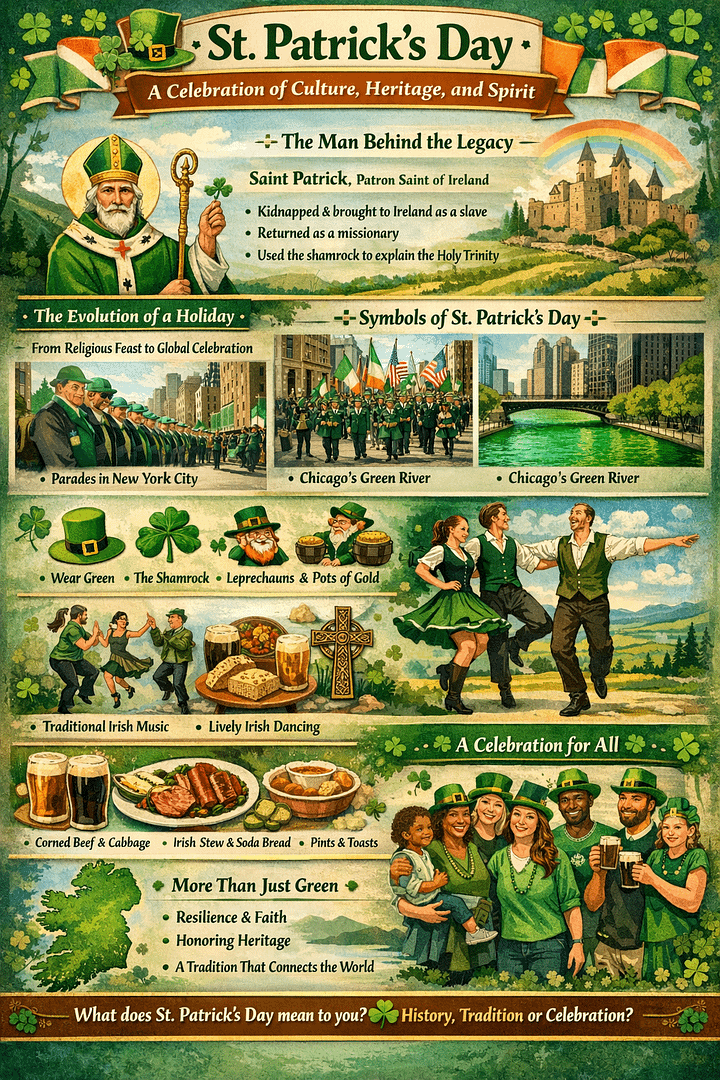
Every year on March 17, the world turns a little greener as millions gather to celebrate St. Patrick’s Day—a holiday that blends history, faith, folklore, and festivity into one unforgettable experience. What began as a religious observance in honor of a humble missionary has grown into a global celebration of Irish pride, identity, and connection.
The Man Behind the Legacy
At the heart of the holiday is Saint Patrick, the beloved patron saint of Ireland. Though often romanticized in legend, his real story is one of hardship, faith, and resilience.
Born in Roman Britain in the late 4th century, Patrick was kidnapped at the age of sixteen and taken to Ireland as a slave. He spent years working in isolation, tending sheep and surviving harsh conditions. During this time, he turned deeply to faith, which would later define his life’s purpose.
After escaping captivity, Patrick returned home—but something unexpected happened. He felt called back to Ireland, the very place of his suffering, this time as a missionary. His return wasn’t driven by revenge, but by compassion and conviction. He dedicated his life to spreading Christianity and connecting with the Irish people on a cultural level.
Legend tells us he used the shamrock to explain the Holy Trinity—Father, Son, and Holy Spirit—making complex theology accessible through nature. Whether fact or folklore, this story remains a powerful symbol of how faith and culture can intertwine.
The Evolution of a Holiday
Originally, St. Patrick’s Day was a quiet, religious feast day observed primarily in Ireland. It was a time for reflection, prayer, and honoring Patrick’s contributions to Irish Christianity. For centuries, the celebration remained modest and deeply spiritual.
However, everything changed with the Irish diaspora.
As Irish immigrants spread across the world—particularly to the United States—they carried their traditions with them. In places like New York City, Irish communities began organizing parades as early as the 18th century. These events weren’t just celebrations—they were statements of identity, unity, and pride in the face of discrimination and hardship.
Over time, cities like Chicago added their own flair, famously dyeing the Chicago River green—an iconic tradition that captures the playful spirit of the holiday.
Today, St. Patrick’s Day is celebrated worldwide, from Dublin to Sydney, blending Irish customs with local culture in unique and vibrant ways.
Symbols That Tell a Story
St. Patrick’s Day is rich with imagery, each symbol carrying layers of meaning:
The Color Green: Once associated with Irish nationalism and the lush landscapes of Ireland—often called the “Emerald Isle”—green has become the defining color of the holiday. Wearing it is both a celebration and a playful tradition.
The Shamrock: More than just a plant, it represents heritage, faith, and storytelling. It’s a quiet reminder of Patrick’s teachings and Ireland’s deep spiritual roots.
Leprechauns: Drawn from Irish folklore, these mischievous fairies are said to guard hidden pots of gold. While more whimsical than historical, they add a magical charm to the celebration.
The Celtic Cross and Harp: Traditional Irish symbols that reflect the country’s artistic, religious, and cultural legacy.
Music, Dance, and the Heartbeat of Ireland
No St. Patrick’s Day celebration is complete without music. Traditional Irish instruments like fiddles, tin whistles, and bodhráns create rhythms that are both haunting and uplifting. Songs passed down through generations tell stories of love, loss, rebellion, and hope.
Irish dance, particularly step dancing, adds a visual energy to the celebration. With precise footwork and upright posture, dancers bring history to life through movement—each step echoing centuries of tradition.
In pubs and public squares, strangers become friends as music fills the air. It’s not uncommon for entire rooms to join in song, creating a shared moment that transcends language and background.
Food, Drink, and Togetherness
Food plays a central role in bringing people together on St. Patrick’s Day. While some dishes associated with the holiday—like corned beef and cabbage—are more Irish-American than traditionally Irish, they’ve become staples of the celebration.
Other traditional foods include Irish stew, soda bread, and hearty meals that reflect Ireland’s agricultural roots. These dishes are simple, comforting, and meant to be shared.
And of course, there’s the toast—raising a glass in honor of friendship, memory, and good fortune. Whether in a bustling pub or a quiet home, the act of gathering is what truly defines the day.
A Celebration of Identity and Belonging
What makes St. Patrick’s Day truly special is its inclusivity. You don’t need Irish ancestry to take part. The holiday has become a universal celebration of culture and connection—a day where everyone is invited to belong.
For many, it’s also a day of remembrance. It honors the struggles and triumphs of Irish immigrants who built new lives far from home, carrying their traditions with them and shaping the cultures of the places they settled.
It’s a reminder that identity is something to be celebrated, not hidden—and that our differences can bring us closer together.
Beyond the Festivities
While parades, green attire, and lively gatherings are the most visible parts of St. Patrick’s Day, its deeper meaning lies in resilience, faith, and transformation.
The story of Saint Patrick is ultimately one of returning to a place of pain with purpose. It’s about finding strength in adversity and choosing compassion over bitterness.
In many ways, that message still resonates today.
A Global Tradition That Keeps Growing
From small towns to major cities, St. Patrick’s Day continues to evolve. Modern celebrations include cultural festivals, educational events, and even global landmarks lighting up in green.
Yet despite its growth, the heart of the holiday remains unchanged: connection, storytelling, and shared joy.
Read More Holidays & National Days
Leave a ReplyCancel reply