
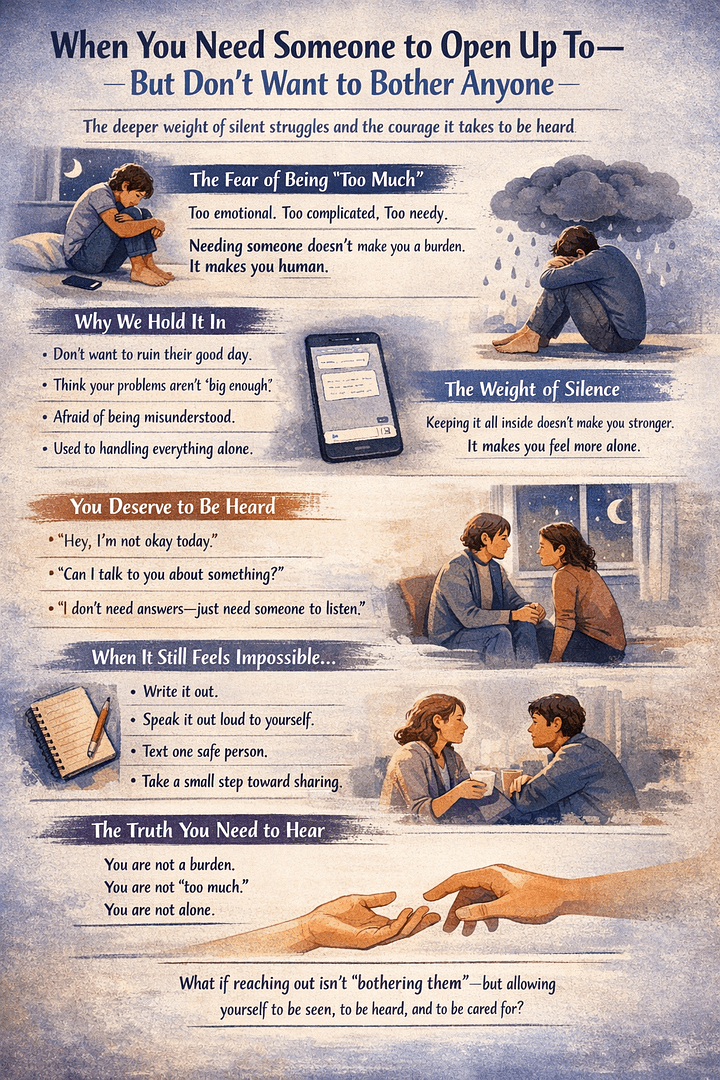
The deeper weight of silent struggles and the courage it takes to be heard
There’s a specific kind of heaviness that settles in when you need someone—really need someone—but stop yourself from reaching out. It’s not loud or dramatic. It doesn’t always come with tears. Sometimes it’s just a quiet ache sitting in your chest while you go about your day, pretending everything is fine.
You might be surrounded by people. You might even have conversations, laugh, respond, show up. But underneath it all is this constant thought:
“I wish I could tell someone how I actually feel… but I don’t want to bother anyone.”
So you don’t.
And that silence becomes its own kind of burden.
The Inner Conflict No One Sees
What makes this feeling so exhausting is the constant internal push and pull.
One part of you is overwhelmed—full of thoughts, emotions, questions, maybe even pain you don’t fully understand yourself. That part is asking for release, for connection, for someone to sit with you in it.
But another part of you shuts it down just as quickly:
They’re busy.
They have their own problems.
This isn’t important enough.
I’ll just deal with it myself.
You go back and forth, sometimes within seconds. You open a message, type something vulnerable… then delete it. You consider making a call… then decide against it. You tell yourself to wait until the “right time,” but that time rarely comes.
So the words stay inside.
And over time, they don’t just stay—they build.
Where This Feeling Comes From
This hesitation doesn’t come out of nowhere. It’s often rooted in experiences that taught you—directly or indirectly—that your feelings might be inconvenient.
Maybe at some point in your life:
You were told you were “too sensitive”
Your emotions were minimized or ignored
Someone reacted with impatience when you tried to open up
You learned to be the “strong one” for everyone else
You felt like you had to earn your place by not needing too much
Even subtle moments can shape this belief. A sigh. A distracted response. A conversation that quickly shifted away from you. These things add up, and eventually, you start filtering yourself before anyone else gets the chance to.
You don’t stop feeling—you just stop sharing.
The Role You’ve Learned to Play
For many people, this struggle is even deeper because they’ve become the listener in everyone else’s life.
You’re the one people come to. The one who gives advice, who shows up, who checks in, who carries others when they’re falling apart. You know how to hold space for people—but you don’t always know how to ask for space in return.
Not because you don’t deserve it.
But because you’ve trained yourself not to need it.
And when you’re used to being the strong one, asking for help can feel like breaking character.
The Misunderstanding of “Being a Burden”
Somewhere along the way, needing someone became confused with being a burden.
But they are not the same thing.
A burden is something forced, unwanted, or excessive.
But opening up—honestly, gently, vulnerably—is an invitation. It’s trust.
The people who care about you don’t measure your worth by how little you need them. They care because of who you are—not because of how quiet you can keep your struggles.
In fact, many people feel closer to someone because they opened up, not in spite of it.
Connection isn’t built on perfection. It’s built on honesty.
The Cost of Keeping Everything Inside
When you keep everything to yourself, it doesn’t just disappear.
It shows up in other ways:
Overthinking small things until they feel overwhelming
Feeling emotionally distant, even when you’re around people
Carrying a constant sense of tension or exhaustion
Struggling to sleep because your mind won’t slow down
Feeling unseen, even by people who care about you
You start to feel like you’re living two lives—the one people see, and the one you’re silently managing on your own.
And the longer you stay in that space, the harder it becomes to step out of it.
What Opening Up Actually Looks Like
Opening up doesn’t have to be a dramatic, all-at-once release.
It can be simple. Imperfect. Even a little awkward.
It might sound like:
“Hey… can I talk to you about something that’s been on my mind?”
“I don’t really know how to explain this, but I’ve been struggling a bit.”
“I don’t need you to fix anything—I just don’t want to feel alone in it.”
You don’t have to have the right words. You don’t have to explain everything perfectly. You just have to start.
Because often, the hardest part isn’t being heard—it’s allowing yourself to be.
When It Still Feels Too Hard
Even knowing all of this, there are moments when reaching out feels impossible.
And that’s okay.
Start where you are.
Write everything down without filtering it.
Record your thoughts out loud just to hear them.
Send a message you don’t over-edit.
Choose one person who feels even slightly safe.
Or even take a step toward connection in a different way—reading something that resonates, listening to a voice that understands, reminding yourself that you’re not the only one who feels this way.
You don’t have to go from silence to full vulnerability overnight.
You just have to take one small step toward not carrying it alone.
The Truth You Might Need to Hear
You are not a burden for having feelings.
You are not “too much” for needing support.
You are not weak for wanting someone to listen.
And you don’t have to earn the right to be heard by suffering in silence first.
The right people won’t see your honesty as an interruption.
They’ll see it as trust—and they’ll meet you there.
Final Reflection
There will always be moments in life when things feel heavier than you can carry on your own. That doesn’t mean you’ve failed. It means you’re human.
And being human was never meant to be a solo experience.
So the next time that thought creeps in—“I don’t want to bother anyone”—pause and ask yourself something different:
“What if I’m not bothering them… what if I’m giving someone a chance to be there for me?”
Because sometimes, the connection you’re afraid to reach for…
is the very thing that will remind you you’re not alone.
Leave a ReplyCancel reply