
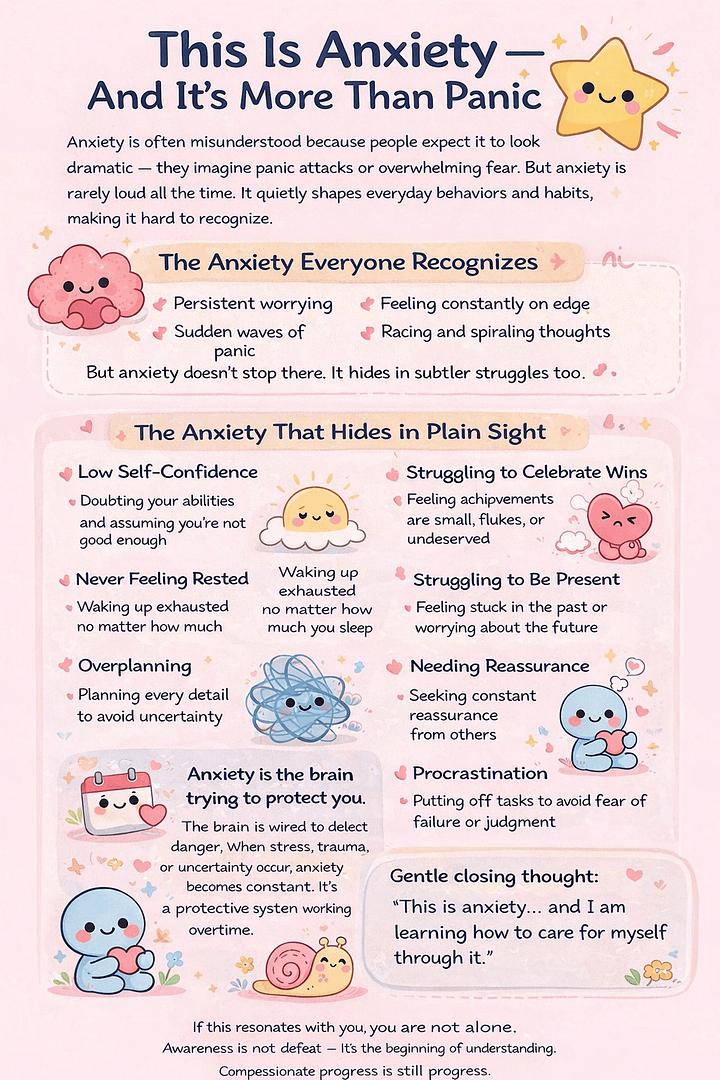
Anxiety is often misunderstood because people expect it to look dramatic. They imagine shaking hands, racing hearts, or moments of overwhelming panic that are impossible to ignore. And while those experiences are real, they represent only a small part of what anxiety truly is.
For many people, anxiety does not arrive as chaos.
It arrives quietly.
It blends into daily habits, personality traits, and routines so seamlessly that it becomes difficult to recognize where you end and anxiety begins.
Anxiety is not always loud. Sometimes, it is simply exhausting.
The Anxiety Everyone Recognizes
We tend to validate anxiety only when it becomes visible. When someone is panicking, overwhelmed, or openly distressed, support appears quickly because the struggle is obvious.
Commonly recognized signs include:
Persistent worrying
Restlessness or inability to relax
Sudden panic or fear
Racing thoughts
Physical tension or unease
These moments feel intense because the nervous system is in survival mode — preparing for danger even when no immediate threat exists.
But anxiety doesn’t disappear once the panic fades. Often, it reshapes everyday life in quieter, less obvious ways.
The Anxiety That Hides in Plain Sight
The hardest part about anxiety is that it often disguises itself as personality.
People may describe themselves as “overthinkers,” “perfectionists,” or “just bad at relaxing,” never realizing these patterns may be rooted in anxiety.
Low Self-Confidence
Anxiety plants doubt in even the most capable minds. You may question your worth, minimize your talents, or assume others are more competent — even when evidence says otherwise.
It becomes difficult to trust yourself because anxiety constantly asks, “What if you’re wrong?”
Never Feeling Truly Rested
You can sleep eight hours and still wake up tired. Anxiety keeps the brain alert, scanning for problems even during rest.
Your body may be still, but your mind never fully clocks out.
Struggling to Celebrate Wins
Instead of enjoying accomplishments, anxiety redirects attention toward the next worry:
“Was it good enough?”
“Can I do it again?”
“What if this was just luck?”
Success becomes temporary relief rather than lasting pride.
Struggling to Be Present
Anxiety lives in two places: the past and the future.
It replays conversations already finished and rehearses conversations that haven’t happened yet. Meanwhile, the present moment — where life actually exists — slips quietly by.
You are physically there but mentally somewhere else.
Overplanning as Protection
Planning feels productive, but sometimes it is fear wearing the mask of preparation.
An anxious mind believes that if every detail is controlled, disappointment or failure can be avoided. The plan becomes a shield against uncertainty.
Crippling Indecisiveness
Simple choices can feel overwhelming because anxiety turns every option into a risk.
Instead of asking, “What do I want?” the mind asks, “What if I regret this?”
The fear of making the wrong choice becomes heavier than the choice itself.
Needing Reassurance
Seeking reassurance is often misunderstood as insecurity. In reality, it is an attempt to quiet internal noise that constantly questions safety, relationships, or self-worth.
A single reassuring word can feel like a deep breath after holding air too long.
Procrastination Isn’t Always Laziness
Anxiety can freeze action. Tasks feel overwhelming not because you don’t care, but because you care too much.
Fear of failure, judgment, or imperfection creates mental paralysis. Avoidance becomes temporary relief from emotional pressure.
Why Many People Don’t Realize They Have Anxiety
Because these behaviors look ordinary, many people blame themselves instead of recognizing anxiety’s role.
They say:
“I just overthink.”
“I’m not disciplined.”
“I’m too sensitive.”
“I need to try harder.”
But anxiety thrives in self-criticism. The more someone believes they are flawed, the stronger anxiety’s voice becomes.
Understanding anxiety reframes the narrative. It shifts the question from self-blame to self-awareness.
Anxiety Is the Brain Trying to Protect You
At its core, anxiety is not an enemy. It is a protective system working overtime.
The brain is designed to detect danger and keep you safe. When stress, trauma, uncertainty, or prolonged pressure occur, that alarm system becomes hypersensitive.
It begins responding to emotional risks the same way it would respond to physical danger.
Your mind isn’t trying to sabotage you — it’s trying to prepare you.
The problem is that constant protection can feel like constant fear.
Living With Anxiety While Learning to Heal
Healing from anxiety does not usually mean eliminating it completely. Instead, healing looks like building a new relationship with your thoughts and emotions.
It means learning to:
notice anxious thoughts without immediately believing them,
pause before spiraling into worst-case scenarios,
allow imperfection,
and give yourself permission to rest without guilt.
Progress is rarely dramatic. It shows up in small, meaningful moments:
making a decision faster than before,
enjoying a conversation without overanalyzing it later,
celebrating a small success,
feeling calm for a few extra minutes.
These moments may seem minor, but they represent profound internal change.
The Power of Compassion Toward Yourself
One of anxiety’s greatest challenges is the harsh inner voice it creates. Many people speak to themselves in ways they would never speak to someone they love.
Healing begins when compassion replaces criticism.
Instead of saying:
“Why am I like this?”
Try asking:
“What do I need right now?”
That simple shift transforms anxiety from a battle into a conversation.
You Are Not Alone in This Experience
Millions of people carry anxiety quietly. They show up to work, maintain relationships, smile in conversations, and fulfill responsibilities — all while managing an invisible weight.
If you recognize yourself in these experiences, know this:
You are not weak.
You are not broken.
You are human, navigating a mind that has learned to stay alert for too long.
And awareness is not defeat — it is the beginning of understanding.
A Gentle Closing Thought
Anxiety is not only panic.
It is doubt, exhaustion, overthinking, hesitation, and the longing to feel safe within your own mind.
But alongside anxiety lives resilience — the quiet strength that keeps you moving forward despite uncertainty.
Every moment you choose patience with yourself is a step toward peace.
Sometimes healing begins with a simple acknowledgment:
“This is anxiety… and I am learning how to care for myself through it.”
Leave a ReplyCancel reply