
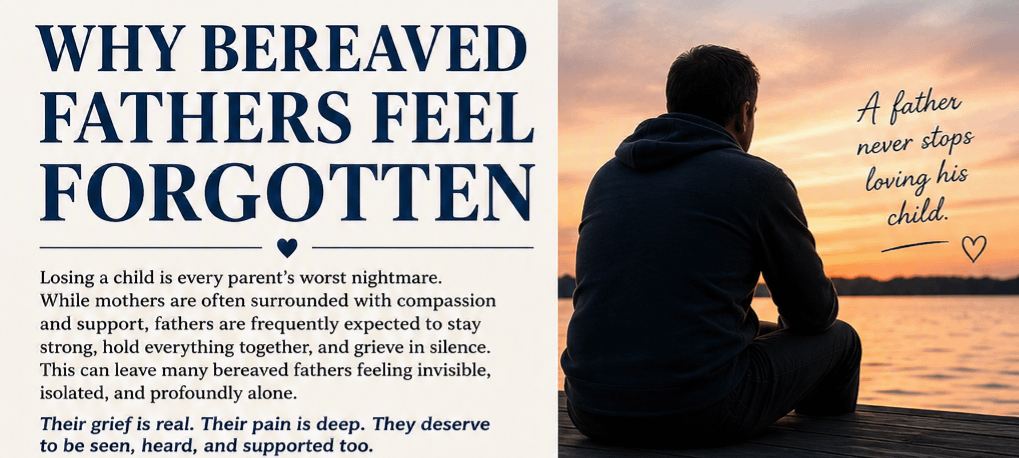
For many fathers, the most painful part of losing a child is not only the death itself—it is what happens afterward. As the weeks turn into months and the months into years, many bereaved fathers begin to notice something that hurts almost as much as the loss itself.
The world seems to forget.
People stop asking.
Friends stop checking in.
Family members stop mentioning their child.
Life continues for everyone else while a father’s world remains forever changed.
This quiet loneliness leaves many bereaved fathers wondering if anyone remembers that they are grieving too.
Why Bereaved Fathers Feel Forgotten
There is no greater pain than burying your own child. Every parent who experiences this loss carries a wound that never completely heals. Yet fathers often experience another layer of suffering that receives very little attention—the feeling of becoming invisible in their grief.
Society often expects fathers to be the protectors, providers, and steady foundation for everyone else. While mothers are frequently surrounded with compassion and emotional support, fathers are often expected to quietly carry their heartbreak without drawing attention to themselves.
This isn’t because people don’t care.
It’s because many people simply don’t realize fathers grieve just as deeply.
Society Still Has Outdated Expectations of Men
For generations, boys have been taught certain messages about emotions.
“Big boys don’t cry.”
“Be a man.”
“Stay strong.”
“Don’t let them see you fall apart.”
These lessons become deeply rooted long before adulthood.
When tragedy strikes, those expectations become chains.
After losing a child, many fathers feel enormous pressure to stay composed—not because they actually feel strong, but because they believe everyone expects them to be.
Instead of expressing heartbreak, they suppress it.
Instead of asking for help, they carry the burden alone.
Instead of crying openly, they wait until no one is watching.
Many fathers describe crying in the shower, during long drives, late at night after everyone has gone to bed, or while sitting alone beside their child’s grave.
Their grief isn’t absent.
It’s simply hidden.
Everyone Sees the Mother’s Pain
There is no comparison between a mother’s grief and a father’s grief. Both are devastating.
But society often responds differently.
People instinctively gather around grieving mothers.
Meals arrive.
Flowers are delivered.
Support groups are recommended.
People ask how she is sleeping, eating, and coping.
Meanwhile, the father often hears:
“Take care of your wife.”
“She’s going to need you.”
“Stay strong for your family.”
Again, these comments are made with love.
But they unintentionally communicate something painful:
Your job is to help everyone else.
Very few people stop and ask:
“Who is helping you?”
Fathers Often Become the Caregiver
Immediately following a child’s death, fathers frequently become consumed with responsibilities.
They arrange the funeral.
Meet with clergy.
Handle insurance paperwork.
Manage finances.
Answer phone calls.
Notify employers.
Support siblings.
Comfort grandparents.
Care for their spouse.
By the time everything slows down, everyone assumes the hardest part is over.
For the father, however, that’s often when the silence begins.
The tasks disappear.
The distractions fade.
Reality settles in.
His child is still gone.
Grief Looks Different in Fathers
One reason fathers are overlooked is because they often grieve differently than others expect.
Instead of talking constantly about their emotions, fathers may:
- Become extremely quiet.
- Spend long hours working.
- Throw themselves into home projects.
- Exercise excessively.
- Withdraw socially.
- Focus entirely on helping others.
- Spend more time outdoors.
- Visit meaningful places alone.
To outsiders, these behaviors can look like acceptance.
In reality, they are often survival.
Every hammer swing…
Every extra shift at work…
Every hour spent fixing something…
May simply be a father trying to quiet a mind filled with memories.
People Mistake Silence for Healing
Silence can be deceptive.
Many fathers stop talking about their child because they notice what happens when they do.
Conversations become uncomfortable.
People change the subject.
Someone quickly says,
“They’re in a better place.”
Or,
“You have to move forward.”
Eventually fathers learn something heartbreaking.
Talking about their child often makes others uncomfortable.
So they stop talking.
Not because they’ve healed.
Because they’ve learned their grief has no audience.
The World Moves On Faster Than Fathers Can
The first few weeks after a child’s death are filled with support.
People visit.
Food fills the refrigerator.
Cards arrive.
Phone calls come daily.
Then something changes.
Weeks become months.
Life returns to normal—for everyone else.
For the father, normal no longer exists.
Every morning begins with remembering.
Every night ends with missing.
Every holiday carries an empty chair.
Every birthday becomes another reminder of what should have been.
The calendar continues.
His heart remains frozen on the day his child died.
The Loneliness of Forgotten Anniversaries
Few people remember the dates that matter most.
The birthday.
The day of the accident.
Graduation day.
The first Father’s Day.
The first Christmas.
The wedding that never happened.
The grandchildren that will never be born.
While others celebrate life’s milestones, bereaved fathers quietly mourn the milestones their child never reached.
Sometimes all they wish for is one text message.
“Thinking of your son today.”
Those few words can mean more than anyone realizes.
Fathers Miss Ordinary Moments Most
People often assume fathers miss birthdays or holidays the most.
Those days are painful.
But many fathers say the hardest moments are surprisingly ordinary.
Walking past their child’s favorite restaurant.
Seeing someone wearing the same type of shoes.
Hearing their favorite song.
Watching a baseball game they would have watched together.
Driving past their old school.
Seeing a father and son fishing.
Watching a graduation.
Smelling their favorite cologne.
Finding an old voicemail.
Life constantly reminds fathers of the child they love.
No one else notices.
Many Fathers Feel Forgotten at Work
Returning to work after losing a child can be emotionally exhausting.
Coworkers often offer condolences.
For a few days, everyone is understanding.
Then deadlines return.
Projects resume.
Business continues.
People stop mentioning the loss.
The father may smile.
He may complete every assignment.
He may appear productive.
Meanwhile, he may be struggling simply to make it through the day.
Success at work often hides unbearable pain.
The Invisible Guilt Fathers Carry
Many bereaved fathers carry enormous guilt, even when the loss was completely beyond their control.
Questions haunt them endlessly.
“Should I have protected them better?”
“Why didn’t I notice something sooner?”
“Could I have changed the outcome?”
“Why wasn’t it me instead?”
These thoughts replay thousands of times.
Because fathers often keep these questions to themselves, others never realize the battle taking place inside.
Friendships Often Change
Loss changes relationships.
Some friends remain.
Others quietly disappear.
Not because they stopped caring.
Because they don’t know what to say.
Some avoid calling because they’re afraid of making things worse.
Others assume enough time has passed.
The father experiences this differently.
Every unanswered phone call reinforces a painful belief:
“People have forgotten my child.”
Fathers Never Stop Being Fathers
One of the greatest misconceptions is that parenthood somehow ends when a child dies.
It doesn’t.
A father doesn’t stop loving.
He doesn’t stop wondering.
He doesn’t stop remembering.
He still thinks:
“I wonder what they would be doing today.”
“How old would they be now?”
“Would they be married?”
“Would they have children?”
His role as father didn’t disappear.
Only the opportunities to live it out changed.
Why Speaking Their Child’s Name Matters
Many people avoid mentioning a deceased child because they fear reopening old wounds.
The truth is different.
The wound is already open.
Bereaved fathers think about their child every single day.
Hearing someone say their child’s name doesn’t create pain.
It often brings comfort.
It reminds them that someone else remembers.
That someone else still sees the life that mattered.
Never underestimate the healing power of saying,
“I was thinking about your daughter today.”
Or,
“I remember how much your son loved baseball.”
These simple sentences tell a grieving father:
Your child still matters.
Faith Can Become Both a Comfort and a Struggle
Many fathers lean heavily on their faith after losing a child.
Others wrestle with difficult questions.
Why did this happen?
Why didn’t God intervene?
What purpose could there possibly be?
Can I ever feel joy again without betraying my child’s memory?
These questions are not signs of weak faith.
They are signs of honest grief.
Many fathers eventually discover that faith doesn’t erase sorrow.
Instead, it gives them someone to carry their sorrow with.
Hope doesn’t remove tears.
It gives those tears meaning.
Healing Does Not Mean Forgetting
One fear many fathers have is that healing somehow means leaving their child behind.
Nothing could be further from the truth.
Healing is not forgetting.
Healing is learning to carry love alongside loss.
It is discovering that laughter and tears can exist together.
That memories can hurt and comfort at the same time.
That living fully is not a betrayal of the child who died.
In fact, many fathers eventually choose to honor their child by living in a way that reflects the love they shared.
How We Can Better Support Bereaved Fathers
If you know a father who has lost a child, remember that your support matters long after the funeral ends.
You don’t need perfect words.
You simply need to show up.
Here are a few meaningful ways to help:
- Ask how he is doing, not just how his spouse is coping.
- Speak his child’s name naturally and respectfully.
- Remember birthdays, anniversaries, and holidays.
- Send a simple text saying you’re thinking of him.
- Let him tell stories without changing the subject.
- Don’t rush his healing or suggest he “move on.”
- Accept tears without trying to fix them.
- Continue checking in months and years later.
The greatest gift you can offer is your willingness to remember.
A Letter to Every Bereaved Father
If you are a father who has buried a son or daughter, this message is for you.
You are not weak because you cry.
You are not broken because you still miss them years later.
You are not failing because grief still catches you by surprise.
You loved deeply.
That love did not end when your child’s life ended.
You are still a father.
Your child is still part of your story.
The world may not always remember, but your love continues to matter.
Your tears honor the bond you shared.
Your memories keep their legacy alive.
And even if it feels as though others have forgotten, there are fathers across the world carrying the same invisible weight, walking the same difficult road, and understanding your pain in ways few others can.
Final Thoughts
Bereaved fathers often feel forgotten not because their grief is less significant, but because it is less visible. Behind the quiet strength that so many fathers display is a heart that has been permanently changed by unimaginable loss.
Healing does not come from pretending the pain no longer exists. It comes through being seen, being heard, and knowing that both the father and the child he loves are still remembered.
If there is one thing every grieving father deserves, it is this simple assurance:
You have not been forgotten. Your child has not been forgotten. Your love will never be forgotten.
Share this:
- Share on X (Opens in new window) X
- Share on Facebook (Opens in new window) Facebook
- Share on LinkedIn (Opens in new window) LinkedIn
- Share on Reddit (Opens in new window) Reddit
- Share on Tumblr (Opens in new window) Tumblr
- Share on Pinterest (Opens in new window) Pinterest
- Share on Telegram (Opens in new window) Telegram
- Share on Threads (Opens in new window) Threads
- Share on Bluesky (Opens in new window) Bluesky
Leave a ReplyCancel reply