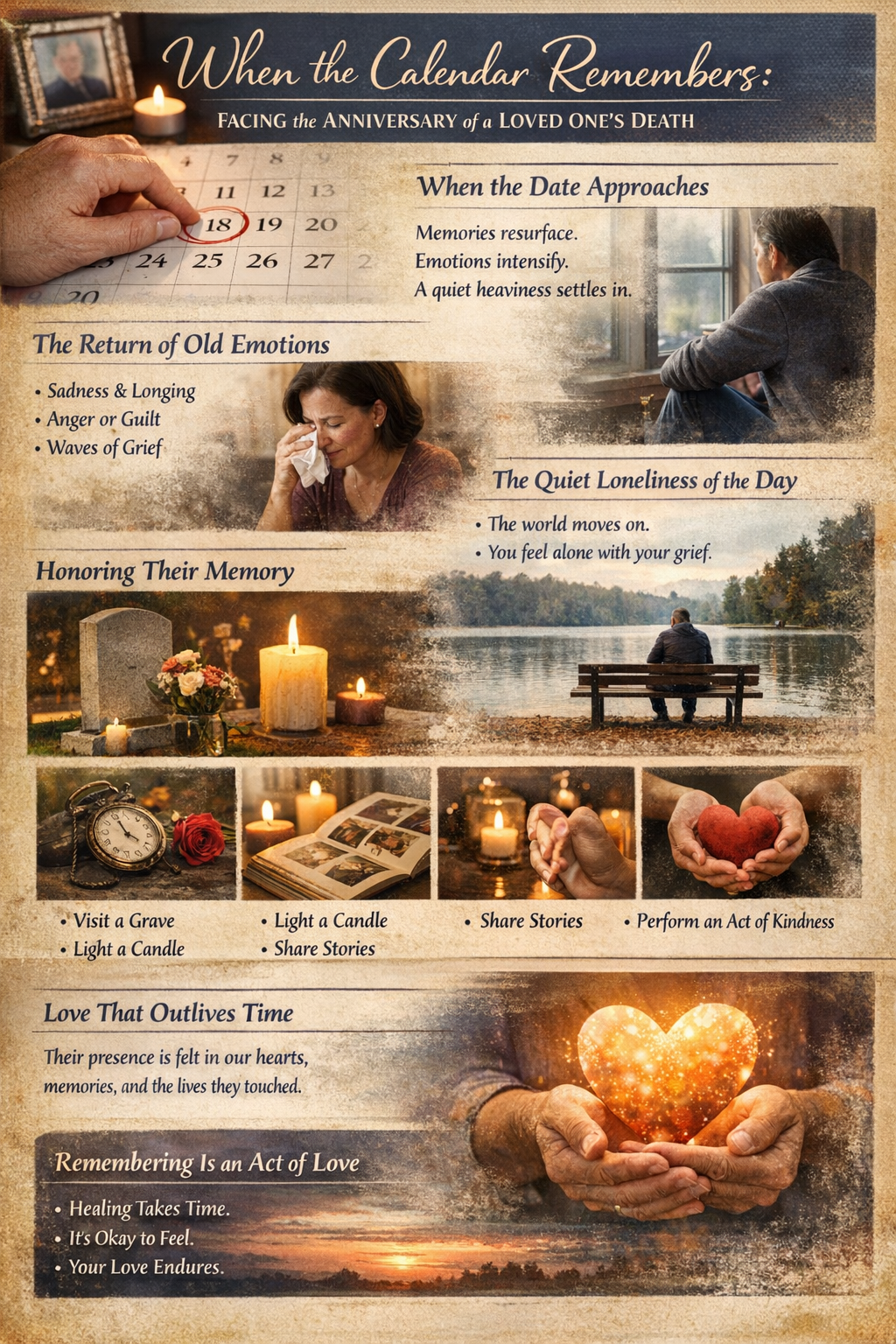
There are dates on the calendar that most people barely notice—days that pass quietly and without meaning. But when you have lost someone you love, there is often one date that never fades into the background. It arrives each year carrying a quiet heaviness that can be felt long before the day itself appears.
The anniversary of a loved one’s death is not just another day. It is a moment when memories return more vividly, emotions rise more easily, and the reality of loss feels closer than it might on ordinary days.
For many people, it is one of the most difficult days of the year.
When the Date Approaches
Sometimes the anniversary begins affecting us even before we realize it. Days or weeks beforehand, you may notice subtle emotional shifts. You might feel more reflective, more sensitive, or unexpectedly sad. A sense of uneasiness can settle in without an obvious explanation.
This is often called the “anniversary reaction.” Our minds and bodies remember the trauma of loss, even if we are not consciously thinking about the exact date.
Memories may surface more frequently. You might find yourself replaying the final days you shared with your loved one, remembering conversations, moments, or details that once seemed small but now feel significant. The mind revisits those memories as if trying to understand them all over again.
It can feel as though time briefly moves backward.
The Return of Old Emotions
Grief is not a straight path. It moves in waves, sometimes gentle and sometimes overwhelming. Even if years have passed since the loss, the anniversary can bring back emotions that feel surprisingly fresh.
You may feel sadness, longing, anger, regret, or deep loneliness. Some people experience a renewed sense of disbelief, as if part of them still struggles to accept that their loved one is truly gone.
Others feel a quiet emptiness.
There can also be moments of guilt—guilt for moving forward with life, guilt for things left unsaid, or guilt for feeling happiness when the person they love is no longer here to share it.
All of these feelings are normal. Grief is deeply personal, and no two people experience it in exactly the same way.
The Memories That Surface
On the anniversary of a loved one’s passing, memories often feel closer than usual. Simple things can trigger them—a familiar song, a photograph, a scent, or even a place you once visited together.
You may remember the way they laughed, the way they spoke your name, or the small habits that made them uniquely themselves. Sometimes the memories bring smiles. Other times they bring tears.
What can be surprising is how vivid those memories remain, even years later. It reminds us that the people we love leave permanent imprints on our hearts.
They may no longer be physically present, but the connection we had with them continues to exist through memory.
The Quiet Loneliness of the Day
One of the hardest parts of anniversary days is that the world keeps moving forward while you feel pulled backward in time. For everyone else, it may seem like an ordinary day. But for you, it holds profound meaning.
This can create a deep sense of isolation.
Friends and coworkers may not realize what the day represents. Some people may want to acknowledge the loss but feel unsure of what to say. Others may simply not remember the date at all.
Because of this, many people spend the anniversary quietly, carrying their memories privately.
Yet it is important to remember that grief is shared by many, even when it feels lonely. Across the world, countless people mark similar days on their calendars—days that represent love, loss, and remembrance.
Honoring Their Memory
For some people, the anniversary becomes a day of remembrance rather than just sorrow. Many find comfort in honoring their loved one in ways that feel meaningful.
Some visit a gravesite or memorial location. Others light a candle at home, say a prayer, or spend time looking through photographs and old letters. Some people listen to music their loved one enjoyed or cook a favorite meal that reminds them of shared moments.
Others choose to honor the person by doing something kind—donating to a charity, helping someone in need, or simply performing an act of kindness in their memory.
These rituals do not erase the pain, but they can transform the day into something more than grief alone. They become a way to acknowledge the love that still remains.
When the Pain Still Feels Fresh
People sometimes believe that grief should fade completely with time. In reality, the loss of someone deeply loved can stay with us for a lifetime.
Even decades later, the anniversary may still stir powerful emotions.
That does not mean you have failed to heal. It simply means the love you had for that person was real and meaningful.
Healing does not mean forgetting. It means learning to carry the memories forward in a way that allows life to continue.
Love That Outlives Time
The anniversary of a loved one’s death reminds us of something both painful and beautiful: love does not end when life does.
The bond you shared with that person continues through the memories you hold, the stories you tell, and the ways they shaped who you are. Their influence becomes woven into your life, quietly guiding your thoughts and actions.
Even though they are no longer here physically, their presence remains in countless small ways—in the lessons they taught you, the laughter you shared, and the love that still lives in your heart.
Moving Through the Day
There is no right or wrong way to experience an anniversary of loss. Some people prefer to spend the day quietly reflecting. Others surround themselves with family or friends. Some choose to stay busy, while others allow themselves space to grieve openly.
Whatever approach you take is valid.
What matters most is allowing yourself to feel what you feel without judgment. Grief is not something that can be rushed or controlled. It unfolds at its own pace.
Remembering Is an Act of Love
When the anniversary arrives and the memories return, it may bring tears, reflection, or moments of quiet sadness. But those feelings also represent something deeply meaningful.
They are reminders of the love that once existed and continues to exist.
The calendar may mark the day someone left this world, but it also marks the enduring connection that remains.
And in that way, remembering becomes more than grief—it becomes another expression of love that time can never erase.
Leave a Reply