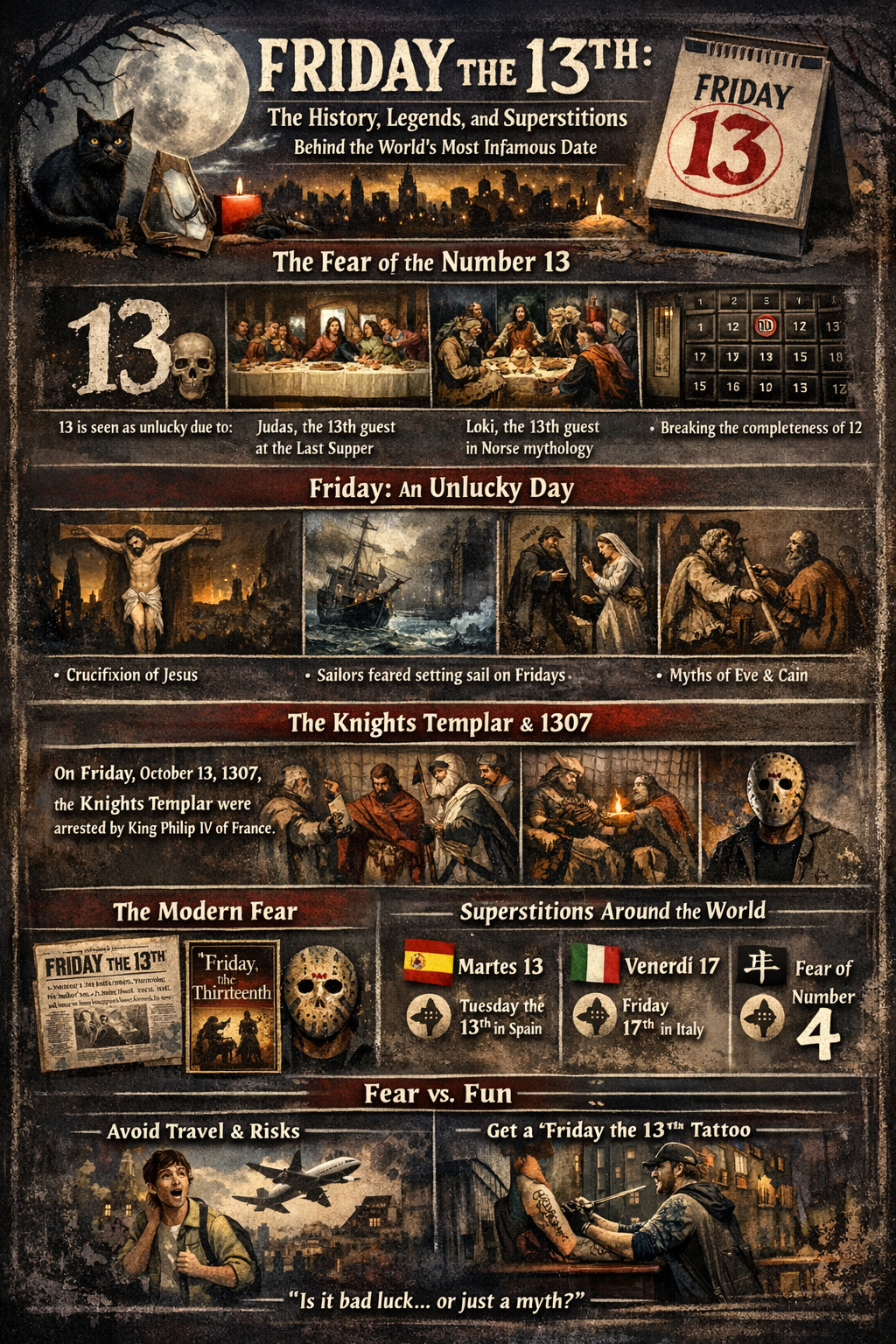
Few dates on the calendar carry the same chilling reputation as Friday the 13th. For generations, this day has been surrounded by mystery, superstition, and a lingering sense of unease. Many people associate it with bad luck, strange accidents, or unfortunate events, while others see it as nothing more than an entertaining myth.
Despite its eerie reputation, Friday the 13th is not tied to a single origin story. Instead, its legend developed slowly over centuries, blending religious symbolism, ancient mythology, historical events, and cultural storytelling. The result is one of the most widely recognized superstitions in the modern world.
Whether someone fears the date or laughs it off, the mystique of Friday the 13th continues to capture imaginations across cultures.
The Fear of the Number 13
Long before the date Friday the 13th gained its dark reputation, the number 13 itself had already been viewed with suspicion. The fear of the number is known as triskaidekaphobia, a term used to describe the irrational fear or avoidance of the number.
Many scholars believe the superstition stems from the idea that 12 represents completeness or harmony, while 13 disrupts that balance. Throughout history and across cultures, the number 12 appears repeatedly as a symbol of order:
12 months in a year
12 zodiac signs
12 Olympian gods in Greek mythology
12 tribes of Israel
12 apostles in Christian tradition
12 hours on a clock face
When the number 13 appears after this symbolic completeness, it seems to break the pattern, creating a sense of imbalance.
One of the most frequently cited examples comes from Christian tradition. During the Last Supper, there were thirteen people at the table: Jesus and his twelve disciples. Judas Iscariot, the disciple who later betrayed Jesus, is often described as the 13th guest. Over time, this story fueled the belief that gathering thirteen people together would bring bad luck or tragedy.
Another myth originates from Norse mythology. In the story, twelve gods gathered for a feast in Valhalla. Loki, the mischievous trickster god, arrived as the uninvited 13th guest. His presence led to deception and ultimately to the death of the beloved god Balder. This story reinforced the symbolic danger of the number thirteen.
Because of these traditions, the number has long been treated cautiously. Even today, many buildings skip the 13th floor, hospitals avoid room number 13, and some airlines omit row 13 entirely.
Why Friday Was Considered Unlucky
Just as the number 13 had its own negative associations, Friday itself was once considered an unlucky day in many Western traditions.
In Christian belief, Good Friday, the day Jesus was crucified, was a day of sorrow and sacrifice. Because of this association, Friday gradually became linked with misfortune in folklore.
During the Middle Ages, a variety of superstitions developed around the day. Many believed it was unlucky to begin a journey, start a business venture, or hold an important event on a Friday. Sailors were said to be particularly wary of setting sail on that day, fearing storms or disaster.
Some legends even claimed that major biblical events occurred on Fridays, including:
Eve giving Adam the forbidden fruit
Cain killing Abel
The Great Flood beginning
While historians debate the accuracy of these claims, the stories helped cement Friday’s reputation as a day when things might go wrong.
When this already suspicious day eventually combined with the feared number 13, it created a superstition that seemed doubly ominous.
The Knights Templar and Friday the 13th
One historical event often associated with the superstition took place on Friday, October 13, 1307.
On that day, King Philip IV of France ordered the mass arrest of the Knights Templar, a powerful religious military order that had gained immense wealth and influence during the Crusades. The king, deeply in debt to the order, accused the Templars of heresy, blasphemy, and other crimes.
Hundreds of knights were arrested across France in a coordinated raid. Many were imprisoned, tortured into confessions, and eventually executed. The order was later dissolved by the Church.
Because the arrests occurred on a Friday the 13th, some historians believe this tragic event helped fuel the superstition. However, there is little evidence that people at the time viewed the date as cursed. The connection between the event and the superstition appears to have been emphasized much later in history.
Nevertheless, the dramatic story of betrayal, secrecy, and persecution fits perfectly into the mythology surrounding the infamous date.
The Birth of the Modern Friday the 13th Legend
Interestingly, the widespread fear of Friday the 13th as a specific date did not become common until relatively recently.
One major influence came in 1907 with the publication of the novel Friday, the Thirteenth by Thomas W. Lawson. The book tells the story of a stockbroker who exploits public superstition about the date to manipulate the stock market and cause financial panic. The novel was widely read and helped popularize the idea that the day itself carried special misfortune.
In the late 20th century, the superstition gained even more visibility through entertainment. The Friday the 13th horror film series, beginning in 1980, turned the date into a symbol of terror for an entire generation. The iconic hockey mask worn by the villain Jason Voorhees became one of the most recognizable images in horror history.
These films did not create the superstition, but they amplified it in popular culture.
Friday the 13th Around the World
Interestingly, not every culture fears Friday the 13th.
In some countries, other dates carry the unlucky reputation:
In Spain and Greece, the unlucky day is Tuesday the 13th
In Italy, the feared date is often Friday the 17th
In parts of East Asia, the number 4 is considered unlucky because its pronunciation is similar to the word for death
These variations show how superstition is shaped by cultural traditions rather than universal truths.
Real-World Effects of the Superstition
Even though there is no scientific evidence that Friday the 13th brings bad luck, the superstition still has measurable effects.
Studies have shown that on Friday the 13th:
Some people avoid flying or traveling
Fewer weddings and major events are scheduled
Businesses occasionally experience lower sales
Anxiety increases among those who believe in the superstition
Economists have even estimated that fear of the date costs businesses hundreds of millions of dollars in lost productivity and travel each year.
Ironically, some researchers suggest that accidents may slightly increase on the day—not because it is cursed, but because anxious people behave differently when they expect bad luck.
Turning Fear Into Celebration
In recent years, many people have begun embracing Friday the 13th rather than fearing it.
Tattoo shops around the world often hold Friday the 13th tattoo events, offering small themed tattoos at discounted prices. These gatherings attract long lines of customers eager to celebrate the day’s rebellious spirit.
Others treat the date as a chance to challenge superstition by doing things they might normally avoid. For them, Friday the 13th becomes a reminder that fear often comes from stories rather than reality.
In this way, the once-feared date has slowly transformed into a cultural phenomenon—part spooky tradition, part playful myth.
The Power of Superstition
The enduring legend of Friday the 13th reveals something powerful about human nature. People have always searched for patterns and meaning in the events around them. When misfortune happens on a certain day, it is easy to connect the two, even when the link may not exist.
Over centuries, scattered myths about the number 13, the symbolism of Friday, historical tragedies, and modern storytelling combined into one unforgettable superstition.
Yet for all its mystery, Friday the 13th ultimately reminds us that sometimes the scariest things in life are the stories we pass down from generation to generation.
Leave a Reply