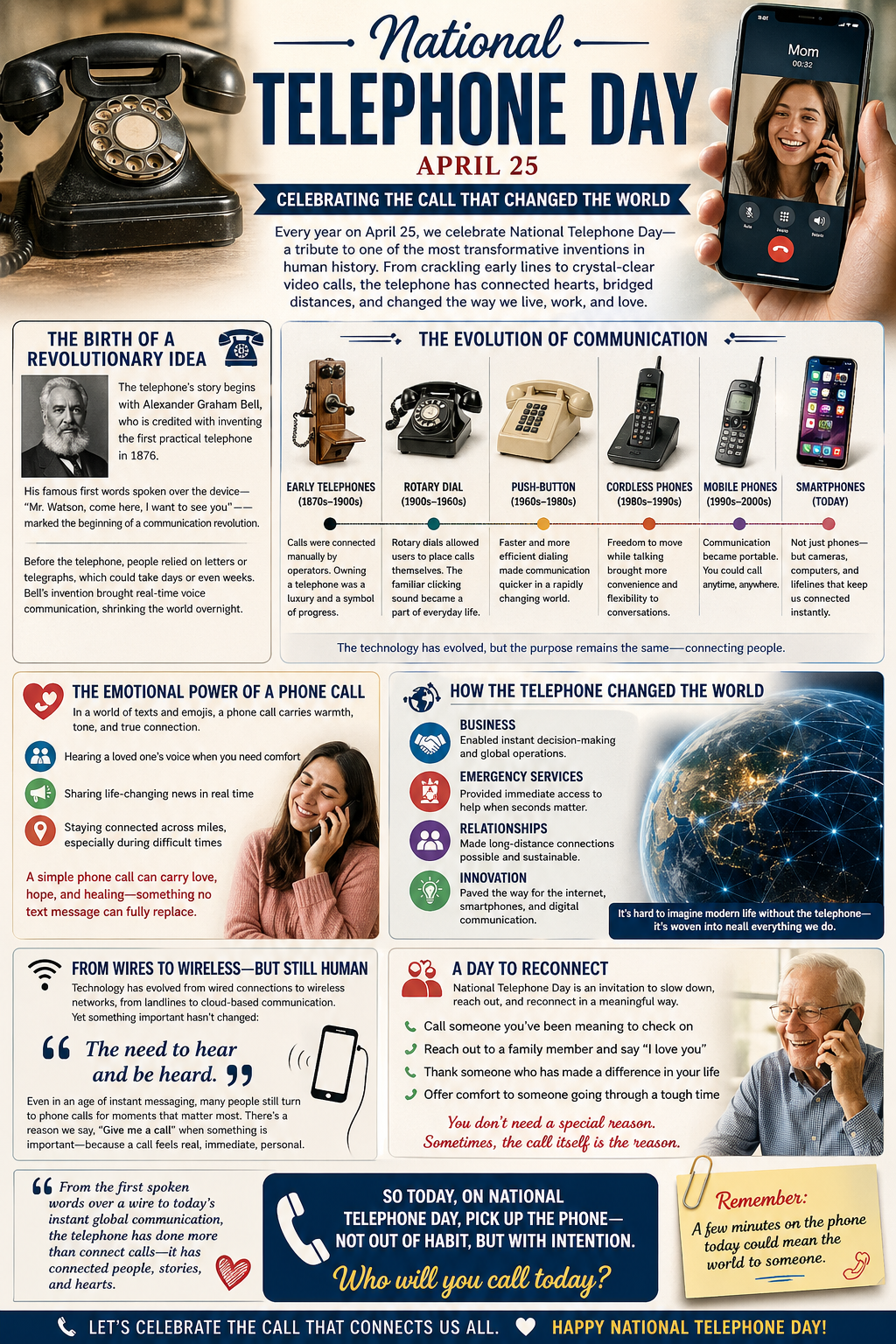
Every year on April 25, National Telephone Day invites us to pause and appreciate a device so woven into our lives that we often forget its extraordinary impact. The telephone didn’t just make communication faster—it reshaped human connection, collapsed distance, and gave voice to moments that matter most.
From the first crackling transmission to today’s seamless video calls, the telephone has become more than a tool—it’s a lifeline between people, emotions, and experiences.
📜 The Birth of a Revolutionary Invention
The story begins with Alexander Graham Bell, whose groundbreaking work in 1876 led to the first successful telephone call. That historic moment—simple in words but monumental in impact—sparked a global transformation.
But Bell’s invention didn’t appear out of nowhere. It came from years of experimentation, curiosity, and a desire to improve communication for humanity. At the time, the fastest method of long-distance communication was the telegraph—limited to coded messages and trained operators. The telephone broke that barrier by allowing people to hear each other instantly, bringing a human element into technology for the first time.
It wasn’t just innovation—it was connection brought to life.
☎️ The Evolution of Communication
The telephone’s journey is a story of continuous innovation:
🕰️ Early Telephones: A New Era Begins
The earliest telephones required operators to manually connect calls. Conversations were brief, often formal, and considered a luxury. Having a telephone in your home or business was a symbol of progress and status.
🔄 Rotary Dial Systems
By the early 20th century, rotary dial phones allowed users to place calls themselves. The familiar clicking sound of the dial became part of everyday life—a rhythm of connection that many still remember fondly.
🔘 Push-Button Revolution
In the mid-20th century, push-button phones replaced rotary dials, making communication faster and more efficient. This shift mirrored a world that was becoming increasingly fast-paced.
📡 Cordless Freedom
The late 20th century introduced cordless phones, allowing people to move freely while talking. Conversations became more relaxed, more personal—woven into daily routines.
📱 The Rise of Mobile Phones
Then came mobile phones, freeing communication from physical spaces entirely. No longer tied to walls or wires, people could connect anytime, anywhere.
🌐 Smartphones: The Modern Era
Today’s smartphones have transformed the telephone into a multifunctional device. Voice calls are just one feature among many—texts, video chats, social media, and instant messaging now define communication.
Yet, despite all the advancements, the essence remains unchanged: the human voice still matters most.
❤️ The Emotional Power of a Phone Call
In a world dominated by quick texts and scrolling feeds, a phone call carries a different kind of weight.
A voice holds emotion that words on a screen often cannot capture. It carries tone, warmth, pauses, laughter—and even silence that speaks volumes.
Think about the moments where a call meant everything:
A parent hearing their child’s voice after a long day
A friend calling just to check in when something feels off
Sharing joyful news that feels too big for a text
Reaching out during grief, when words are hard but presence matters
For those navigating loss, distance, or loneliness, a simple call can be a powerful reminder: you are not alone.
🌍 How the Telephone Changed the World
The telephone didn’t just change communication—it transformed society in ways we still feel today.
💼 Business and Industry
The telephone accelerated decision-making and collaboration. Deals could be made in minutes instead of days, fueling economic growth and globalization.
🚑 Emergency Response
Access to immediate help has saved countless lives. The ability to call for assistance in seconds has made communities safer and more responsive.
🏡 Family and Relationships
Long-distance relationships became possible. Families separated by miles could remain emotionally close, sharing everyday moments and milestones.
🧠 Cultural Impact
The telephone shaped language, etiquette, and behavior. From answering machines to voicemail greetings, it introduced new ways of expressing ourselves.
🔄 From Wires to Wireless—But Still Human
Technology has evolved from wired connections to wireless networks, from landlines to cloud-based communication. Yet something important hasn’t changed:
The need to hear and be heard.
Even in an age of instant messaging, many people still turn to phone calls for moments that matter most. There’s a reason we say, “Give me a call” instead of “Send me a message” when something is important.
Because a call feels real. Immediate. Personal.
🙏 A Day to Reconnect
National Telephone Day is more than a historical celebration—it’s an invitation.
An invitation to slow down.
To reach out.
To reconnect in a way that feels meaningful.
Today, consider:
Calling someone you’ve been meaning to check on
Reaching out to a family member just to say “I love you”
Thanking someone who has made a difference in your life
Offering comfort to someone going through a difficult time
You don’t need a special reason. Sometimes, the call itself is the reason.
💬 Final Reflection
The telephone has come a long way—from Bell’s first words to a world of instant global communication. But its true legacy isn’t measured in technology—it’s measured in human connection.
Every call carries a piece of us—our voice, our emotions, our presence.
So today, don’t just celebrate the invention.
📞 Use it. Feel it. Share it.
Because at the other end of the line…
there’s always someone who might need to hear your voice.
Leave a Reply