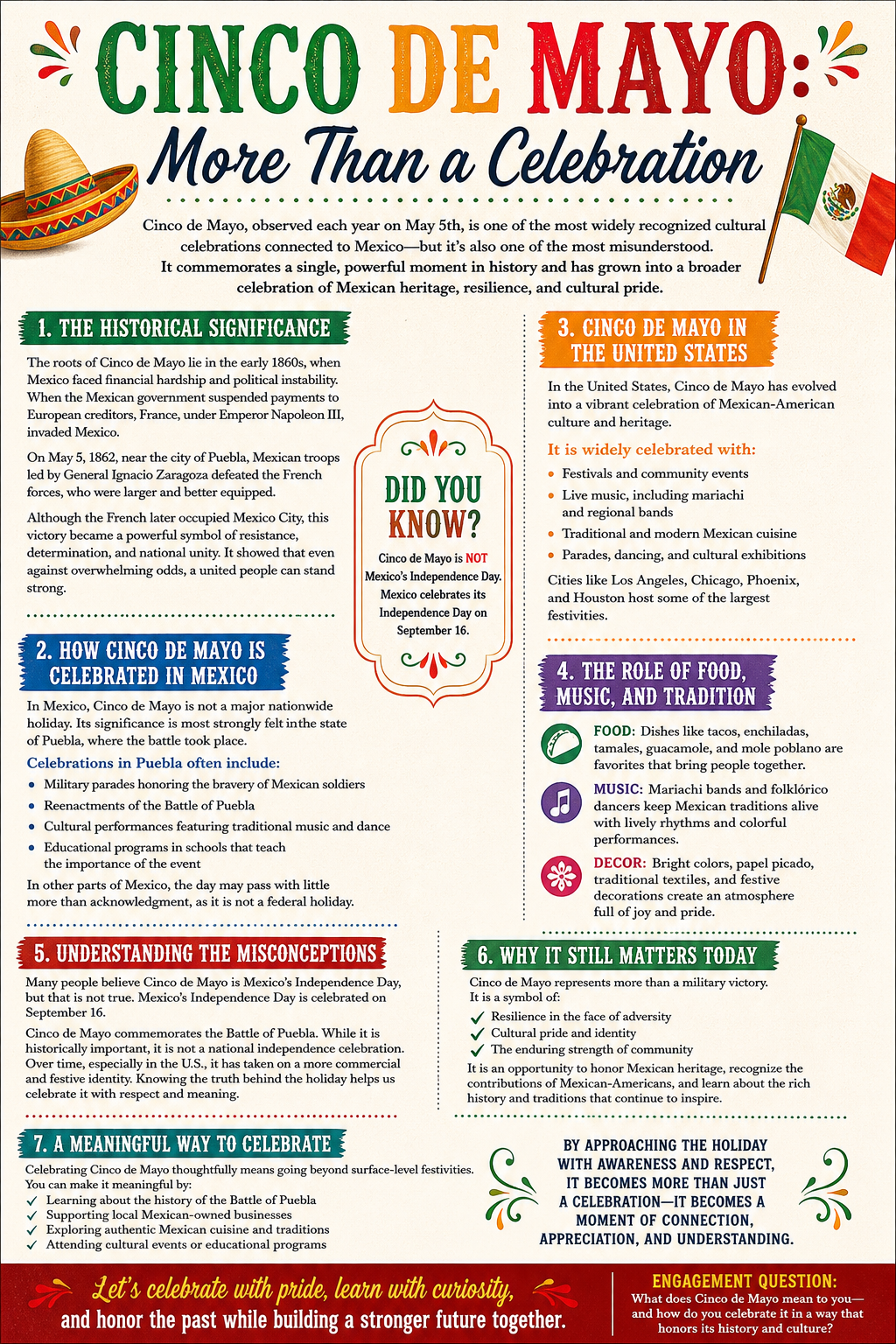
Cinco de Mayo, observed each year on May 5th, is one of the most widely recognized cultural celebrations connected to Mexico—but it’s also one of the most misunderstood. Often mistaken for Mexico’s Independence Day, the holiday actually commemorates a single, powerful moment in history: the Mexican army’s victory over French forces at the Battle of Puebla in 1862. Beyond that historic event, Cinco de Mayo has grown into a broader celebration of Mexican heritage, resilience, and cultural pride—especially in the United States.
📜 The Historical Significance
The roots of Cinco de Mayo lie in a time of political and financial struggle for Mexico. In the early 1860s, Mexico was deeply in debt following years of internal conflict. When the Mexican government temporarily suspended payments to European creditors, France, under Emperor Napoleon III, saw an opportunity to expand its influence in the Americas.
French forces invaded Mexico, expecting a swift victory. However, on May 5, 1862, near the city of Puebla, Mexican troops led by General Ignacio Zaragoza mounted a courageous defense. Despite being outnumbered and less equipped, the Mexican army defeated the French forces in a stunning upset.
While the victory did not end the war—France would later occupy Mexico City—it became a powerful symbol of resistance, determination, and national unity. The Battle of Puebla showed that even in the face of overwhelming odds, a committed and unified people could stand their ground.
🇲🇽 How Cinco de Mayo Is Celebrated in Mexico
In Mexico, Cinco de Mayo is not a major nationwide holiday. Its significance is most strongly felt in the state of Puebla, where the battle took place. There, the day is marked with pride and historical reflection.
Celebrations in Puebla often include:
Military parades honoring the bravery of Mexican soldiers
Reenactments of the Battle of Puebla, bringing history to life
Cultural performances showcasing traditional music and dance
Educational programs in schools that teach the importance of the event
In other parts of Mexico, the day may pass with little more than acknowledgment, as it is not considered a federal holiday.
🇺🇸 Cinco de Mayo in the United States
In the United States, Cinco de Mayo has evolved into a much larger cultural celebration, particularly in communities with strong Mexican-American roots. The holiday began gaining popularity in the U.S. during the 20th century, especially as a way for Mexican-Americans to celebrate their heritage and identity.
Today, it is widely celebrated across the country with:
Festivals and community events
Live music performances, including mariachi and regional bands
Traditional and modern Mexican cuisine
Parades, dancing, and cultural exhibitions
Cities like Los Angeles, Chicago, Phoenix, and Houston host some of the largest festivities. For many, the day serves as a way to honor Mexican culture while also bringing communities together through food, music, and shared experiences.
🌮 The Role of Food, Music, and Tradition
Cinco de Mayo is often associated with vibrant celebrations filled with flavor, sound, and color. Food plays a central role, with popular dishes such as tacos, enchiladas, tamales, guacamole, and mole poblano taking center stage. These dishes reflect the rich culinary traditions of Mexico, blending indigenous and Spanish influences.
Music is equally important. Mariachi bands, known for their lively rhythms and traditional attire, are a staple of many celebrations. Folklórico dancers, dressed in colorful, flowing garments, perform traditional dances that tell stories of Mexico’s regions and history.
Decorations often include bright colors, papel picado (decorative paper banners), and festive displays that create an atmosphere of joy and celebration.
⚠️ Understanding the Misconceptions
One of the most common misconceptions is that Cinco de Mayo marks Mexico’s independence from Spain. In reality, Mexico’s Independence Day is celebrated on September 16 and commemorates the start of the Mexican War of Independence in 1810.
Cinco de Mayo is specifically about the Battle of Puebla. While it is historically significant, it is not a national independence celebration. Over time, particularly in the U.S., the holiday has taken on a more commercial and festive identity, sometimes overshadowing its historical roots.
Understanding the true meaning behind Cinco de Mayo allows for a more respectful and meaningful celebration—one that honors history rather than simply using the day as an excuse to party.
🌎 Cultural Significance Today
Today, Cinco de Mayo represents more than a military victory. It has become a symbol of:
Resilience in the face of adversity
Cultural pride and identity
The enduring strength of community
For Mexican-Americans, the holiday can be a powerful expression of heritage, offering a chance to celebrate traditions, share stories, and pass cultural values down through generations.
At the same time, it serves as an opportunity for others to learn about Mexican history and culture in a respectful and appreciative way.
❤️ A Meaningful Way to Celebrate
Celebrating Cinco de Mayo thoughtfully means going beyond surface-level festivities. It can include:
Learning about the history of the Battle of Puebla
Supporting local Mexican-owned businesses
Exploring authentic Mexican cuisine and traditions
Attending cultural events or educational programs
By approaching the holiday with awareness and respect, it becomes more than just a celebration—it becomes a moment of connection, appreciation, and understanding.
Leave a Reply