Author: Brett Murphy

  • When the Past Is Haunting You While You’re Trying to Move Forward

    When the Past Is Haunting You While You’re Trying to Move Forward

    Moving forward is often described as a clean break—a fresh start, a new chapter, a chance to leave everything behind. But real life rarely works that way. For many people, the past doesn’t stay in the past. It lingers quietly in the background or shows up unexpectedly, right when you’re trying your hardest to heal, grow, and become someone new. When the past is haunting you while you’re trying to move forward, progress can feel exhausting, confusing, and painfully slow.

    The past haunts us because unresolved pain doesn’t fade on its own. Experiences that hurt deeply—loss, trauma, betrayal, abandonment, failure, or regret—leave emotional imprints. Even when circumstances change, the emotions tied to those moments can resurface. You might find yourself reliving conversations, replaying mistakes, or feeling emotions that seem out of place in your current life. It’s not because you’re weak; it’s because your mind and heart are still trying to make sense of what happened.

    Trying to move forward while carrying unresolved pain can feel like walking through fog. You know where you want to go, but your vision is clouded by memories that won’t release their grip. Certain places, songs, dates, or even smells can pull you back without warning. One moment you’re focused on the future, and the next you’re overwhelmed by a past you thought you had already faced.

    What makes this especially difficult is the pressure—both internal and external—to “be over it.” Society often treats healing like a deadline, as if pain should expire after a certain amount of time. You may tell yourself you should be stronger by now, happier by now, more healed by now. This self-judgment can be just as painful as the memories themselves, creating shame on top of grief.

    Fear also plays a powerful role. The past haunts us when it taught us lessons through pain. If you were hurt deeply, your mind may try to protect you by staying alert, always watching for signs of danger. This can make it hard to trust again, love again, or fully embrace new opportunities. Even good things can feel threatening when your past taught you how quickly joy can turn into loss.

    Moving forward doesn’t mean erasing the past or pretending it didn’t shape you. It means learning how to carry your experiences in a way that doesn’t define or limit you. Healing is not about forgetting—it’s about integrating. The pain becomes part of your story, but it no longer controls how the rest of the story is written.

    There will be days when you feel strong and hopeful, convinced that you’re finally turning a corner. And then there will be days when the past feels closer than ever, when emotions resurface and progress feels undone. This doesn’t mean you’re failing. Healing is not linear. Growth often looks like revisiting the same wounds with a little more understanding each time.

    Sometimes the past haunts us because it still needs compassion. Not judgment. Not denial. Compassion. That may mean allowing yourself to grieve what you lost, acknowledge what hurt you, or forgive yourself for choices you made while doing the best you could with what you knew at the time. Letting yourself feel—without rushing the process—is often the most powerful step forward.

    You are allowed to move forward while still healing. You are allowed to build a future even if parts of you are still tender. Progress can be slow, quiet, and imperfect—and still be real. Each step you take, no matter how small, matters.

    One day, the memories that once haunted you will soften. They may still exist, but they won’t hold the same power. They will become reminders of what you survived rather than proof of what broke you. And when that day comes, you’ll realize that moving forward was never about outrunning the past—it was about learning how to walk alongside it without letting it lead.

    If the past is haunting you right now, know this: you are not stuck. You are healing. And even on the days it doesn’t feel like it, you are still moving forward.

  • 🍝 National Spaghetti Day: Celebrating a Timeless Comfort Food

    🍝 National Spaghetti Day: Celebrating a Timeless Comfort Food

    Every year, National Spaghetti Day invites us to celebrate one of the most beloved dishes in the world. Simple, comforting, and endlessly customizable, spaghetti has earned its place at tables across cultures and generations. Whether topped with rich marinara, hearty meat sauce, or a drizzle of olive oil and garlic, this classic pasta brings people together one bite at a time.

    A Dish With a Rich History

    Spaghetti’s roots trace back to Italy, where pasta-making traditions date back centuries. While pasta itself evolved through various cultures, spaghetti became iconic for its long, thin strands and versatility. Over time, it crossed oceans and borders, becoming a staple in kitchens around the globe.

    Why Spaghetti Is So Loved

    Spaghetti isn’t just food—it’s comfort in a bowl. It’s often tied to memories of family dinners, celebrations, and shared moments. Its appeal lies in its simplicity: a few basic ingredients can create something deeply satisfying. From homemade sauces simmered for hours to quick weeknight meals, spaghetti adapts to every lifestyle.

    Endless Ways to Enjoy It

    One of spaghetti’s greatest strengths is how easily it can be personalized. Classic tomato sauce, creamy Alfredo, pesto, seafood, vegetables, or spicy twists—there’s a version for every palate. It can be dressed up for special occasions or kept humble for cozy nights at home.

    Bringing People Together

    Spaghetti has a way of turning meals into moments. It’s often served family-style, encouraging conversation, laughter, and connection. Whether you’re cooking for loved ones or enjoying a quiet meal alone, spaghetti feels familiar and comforting.

    How to Celebrate National Spaghetti Day

    Celebrate by cooking your favorite spaghetti dish, trying a new recipe, or sharing a meal with someone special. You can even honor the day by revisiting a childhood favorite or creating a new tradition around this timeless meal.

    National Spaghetti Day reminds us that sometimes the simplest dishes bring the greatest joy. So twirl your fork, savor every bite, and celebrate a food that has stood the test of time. 🍝❤️

    Read More Holidays & National Days

  • National Chocolate Covered Cherry Day

    National Chocolate Covered Cherry Day

    National Chocolate Covered Cherry Day is a sweet celebration of one of the most nostalgic and indulgent treats around. Observed each year on January 3rd, this day honors the perfect harmony of rich chocolate, juicy cherries, and that irresistible fondant or syrupy center that melts in your mouth.


    A Bite of History 🍒🍫

    Chocolate-covered cherries have been delighting candy lovers for generations. While the exact origins are debated, they gained widespread popularity in the early 20th century as confectioners experimented with combining fruit and chocolate. Over time, these treats became a staple in candy boxes, holiday assortments, and Valentine’s Day gifts—symbolizing indulgence, romance, and a little bit of luxury.


    Why We Love Them

    There’s something special about the experience of biting into a chocolate-covered cherry. First comes the snap of smooth chocolate, followed by the sweetness of the cherry and its liquid center. It’s a treat that engages all the senses and delivers both comfort and delight in one bite.

    Beyond taste, chocolate-covered cherries often carry emotional value. They remind many people of childhood, special occasions, shared candy dishes, or handwritten notes tucked into gift boxes. Sometimes, it’s not just about the candy—it’s about the memories attached to it.


    A Treat with Balance

    Cherries are naturally rich in antioxidants and flavor, and when paired with dark or milk chocolate, they create a balance of tart and sweet that feels indulgent without being overwhelming. While still a treat best enjoyed in moderation, they offer a more refined alternative to overly sugary candies.


    How to Celebrate National Chocolate Covered Cherry Day

    • Enjoy your favorite brand or try an artisanal version from a local chocolatier

    • Make your own at home by dipping maraschino or fresh cherries in melted chocolate

    • Share a box with friends, family, or coworkers

    • Pair them with coffee, wine, or hot chocolate for an elevated experience

    • Gift them as a simple but thoughtful surprise


    A Small Joy Worth Celebrating

    In the middle of winter, National Chocolate Covered Cherry Day is a reminder that even the smallest pleasures can brighten our day. It encourages us to slow down, savor something sweet, and enjoy a moment of comfort—one chocolate-covered cherry at a time.

    Sometimes, happiness really is that simple. 🍒🍫

    Read More Holidays & National Days

  • Trying to Live Again While I Am Broken and Damaged

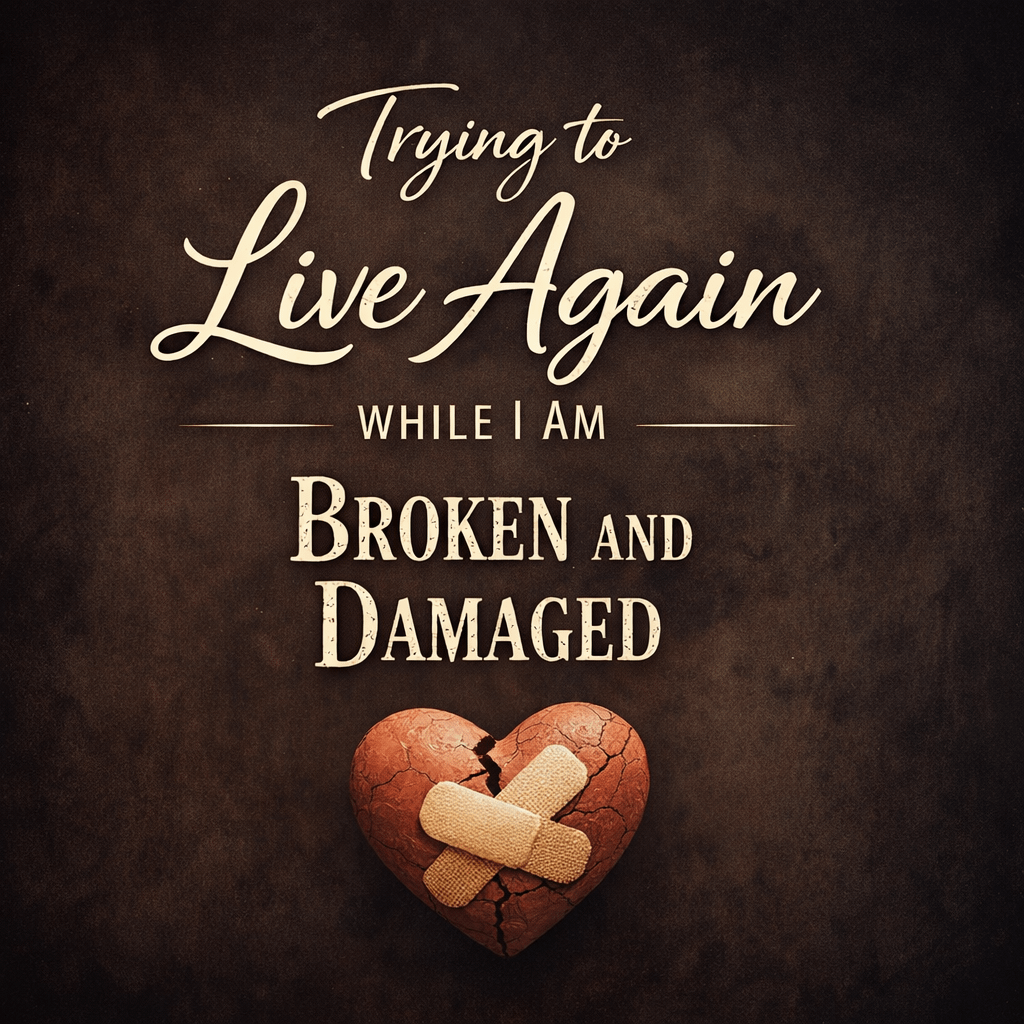
    Trying to Live Again While I Am Broken and Damaged

    For the past decade, I have been beaten down, broken and damaged. I have died twice. Paul brought me back to life. Twice. Once in life and once from the afterlife.

    I flatlined from a massive stroke in 2015 and came back because my son needed me. The other time I died was when Paul passed away. That shattered my heart, life and soul into oblivion.

    I have had been living with half of me in the afterlife and the other part of me living like a zombie in this place we call life.

    In my grief, I have pushed away people and have not let myself get anywhere near anything that is good or could help me feel something that is positive or experience any kind of happiness.

    The reason I have done this, is simple. I am broken. I am damaged. Living in fear of happiness being taken away again. Afraid of something or someone killing me again because I trusted in the path of the goodness. I have spent years being scared to pull one half of me from the grave and merge it with half that is here and wanting nothing more to be happy once again.

    Paul’s death is my crucible. Most people believe there are two types of crucibles. The first one is to become stronger from the experience and survive it, and the second one is die. But there’s a third type. The one where you learn to love the fire and choose to stay in it because it’s easier to embrace the pain when it’s all you know anymore. That is what I have been doing all these years. Embracing the pain and staying in the fire. Finally accepting it and moving out of it has been almost equally as hard as my son’s death and living with it.

    Being broken and damaged has changed me. It has reshaped how I see the world, how I trust, how I hope. The person I was before the pain feels like a stranger now—someone who lived without flinching at memories, dates, or certain words. Someone who could love and be happy. Pain, grief, anger, rage, sadness and everything that has happened, has changed me. The change has been hard and painful.

    Trying to live again doesn’t mean I am healed. It doesn’t mean the cracks are gone or that the damage no longer exists. It means I am learning how to exist with the broken pieces still inside me. Some days, I carry them gently. Other days, they cut deep. Both days count.

    There is grief in realizing that life will never look the same. Dreams have shifted. Joy feels unfamiliar. Laughter can arrive unexpectedly—and leave just as fast—sometimes followed by guilt, as if happiness is a betrayal of the pain you carry. But joy does not erase loss, and living again does not mean forgetting. It means allowing space for both.

    When you are broken, progress looks different. It’s not about “moving on.” It’s about learning how to stand in the middle of the wreckage and still choose to stay. It’s about finding small reasons to keep going—morning light through a window, a familiar song, a moment of quiet where the pain loosens its grip just a little.

    You may feel damaged, like something essential inside you has been permanently altered. And maybe it has. But damaged does not mean useless. Broken things can still hold meaning, depth, and beauty. In fact, they often hold more. They understand pain, compassion, and resilience in ways untouched things never could.

    Trying to live again is an act of defiance against everything that tried to take you down. It is choosing life even when it hurts. It is allowing yourself to be unfinished, unhealed, and still worthy of existing fully.

    Bring broken and trying anyway, shows that we are not weak. We are not failing. We are surviving in the most honest way possible. Living again doesn’t require perfection—it only requires presence. And even on our hardest days, our presence matters.

    We are allowed to live again, even in pieces.

    It has been 1530 days since my son died. It has taken Paul that many days to help me accept his death. To accept that I can move forward and let happiness and anything that is good in.

    I accept that I am broken. I accept that I am damaged. I am no longer going to let fear keep me from living and trying. I am not going to forget everything and run. I am going to face everything and rise from the ashes like a phoenix. I am going to try to live. I will get knocked down and get right back up. I will always fight to live from now on.

    A Father’s Guide to Surviving the Loss of a Child


  • Motivation and Inspiration Day: Finding the Spark That Keeps Us Moving Forward

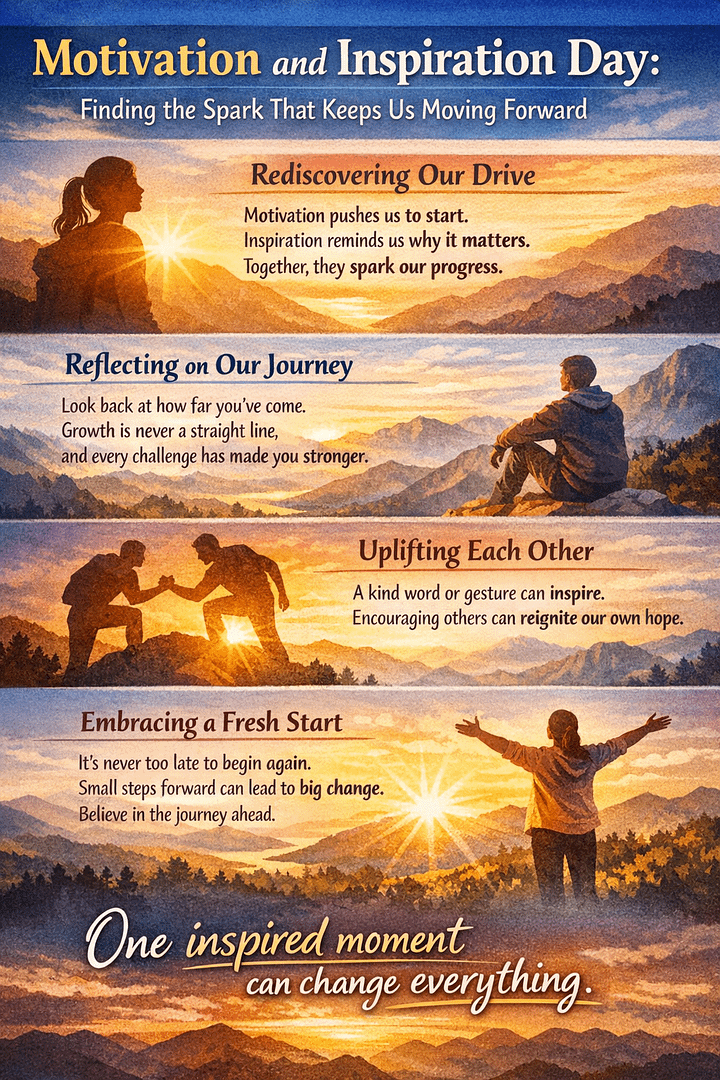
    Motivation and Inspiration Day: Finding the Spark That Keeps Us Moving Forward

    Motivation and Inspiration Day serves as a meaningful reminder that no matter where we are in life, we all need encouragement to keep going. In a world filled with constant noise, pressure, and comparison, it’s easy to feel stuck, exhausted, or unsure of our direction. This day invites us to slow down, reconnect with our purpose, and rediscover the spark that fuels progress and hope.

    Motivation is often born from within. It’s the inner drive that pushes us to begin, to try again, and to take responsibility for our own growth. Some days, motivation feels strong and effortless. Other days, it’s quiet and fragile, requiring intention and patience to uncover. Motivation doesn’t always appear as excitement or ambition—it can show up as discipline, resilience, or simply the decision not to give up.

    Inspiration complements motivation by reminding us why our efforts matter. Inspiration often comes from outside ourselves: a story of perseverance, a quote that resonates deeply, a moment of beauty, or witnessing someone else rise after hardship. These moments can shift our perspective and help us see possibilities beyond our current struggles. Inspiration doesn’t demand perfection; it encourages belief—belief that change is possible and that our dreams are worth pursuing.

    Motivation and Inspiration Day is also a time for reflection. It encourages us to look back at the challenges we’ve faced and recognize the strength it took to overcome them. Growth rarely follows a straight line. Setbacks, pauses, and detours are part of every journey. Honoring how far we’ve come—even when progress feels slow—builds confidence and renews our sense of purpose.

    This day reminds us of the power we hold in uplifting others. A kind message, a word of encouragement, or simply acknowledging someone’s effort can have a lasting impact. Motivation is contagious, and inspiration multiplies when shared. Sometimes, being a source of hope for someone else helps reignite our own sense of meaning.

    Most importantly, Motivation and Inspiration Day reassures us that it’s never too late to start again. Whether you’re pursuing a new goal, healing from loss, redefining your path, or just trying to get through the day, your journey matters. Let this day be a gentle reminder that even small steps create momentum—and that within you, and around you, there is always something worth believing in.

    Because one inspired thought, one motivated action, can be the beginning of lasting change.

    Read More Holidays & National Days

    Read More Of Inspiration & Motivation

  • National Science Fiction Day: Imagining Tomorrow, Today

    National Science Fiction Day: Imagining Tomorrow, Today

    Every year on January 2nd, fans around the world celebrate National Science Fiction Day, a tribute to one of the most imaginative and influential genres ever created. Chosen to honor the birthday of legendary author Isaac Asimov, this day invites us to explore distant galaxies, futuristic technologies, parallel worlds, and the timeless question: What if?

    The Power of Science Fiction

    Science fiction does more than entertain—it challenges the limits of human thought. Long before inventions became reality, science fiction envisioned them first. From video calls and artificial intelligence to space travel and robotics, many of today’s innovations were once only ideas on the pages of sci-fi novels.

    At its core, science fiction asks us to think critically about humanity’s future. It explores ethics, science, society, and the consequences of progress, reminding us that innovation must be balanced with responsibility.

    A Genre That Reflects Humanity

    While sci-fi is often associated with spaceships and aliens, its true focus is humanity itself. Stories like Star Trek, The Matrix, Dune, and The Twilight Zone examine power, identity, freedom, and survival. They hold a mirror up to our world, allowing us to question our choices and imagine better outcomes.

    Science fiction also provides a safe space to explore fears and hopes—climate change, technological dependence, political conflict, and the search for connection in an ever-changing universe.

    Why National Science Fiction Day Matters

    National Science Fiction Day isn’t just for hardcore fans. It’s a celebration of curiosity, creativity, and forward thinking. It encourages readers, writers, creators, and dreamers to ask bold questions and imagine solutions beyond today’s limitations.

    Whether through books, films, television, games, or digital storytelling, science fiction continues to inspire new generations of innovators, scientists, and creators.

    How to Celebrate

    You can celebrate National Science Fiction Day in many ways:

    • Revisit a classic sci-fi book or movie

    • Discover an independent sci-fi creator

    • Write your own futuristic short story

    • Discuss how sci-fi predictions compare to today’s reality

    • Share your favorite sci-fi quote or universe online

    Looking Toward the Future

    As technology advances at lightning speed, science fiction feels more relevant than ever. The genre reminds us that the future is not just something that happens to us—it’s something we shape through imagination, creativity, and choice.

    On National Science Fiction Day, let your imagination travel beyond the stars and remember: today’s science fiction may become tomorrow’s reality.

    Read More Holidays & National Days

  • New Year’s Day: A Quiet Beginning Full of Possibility

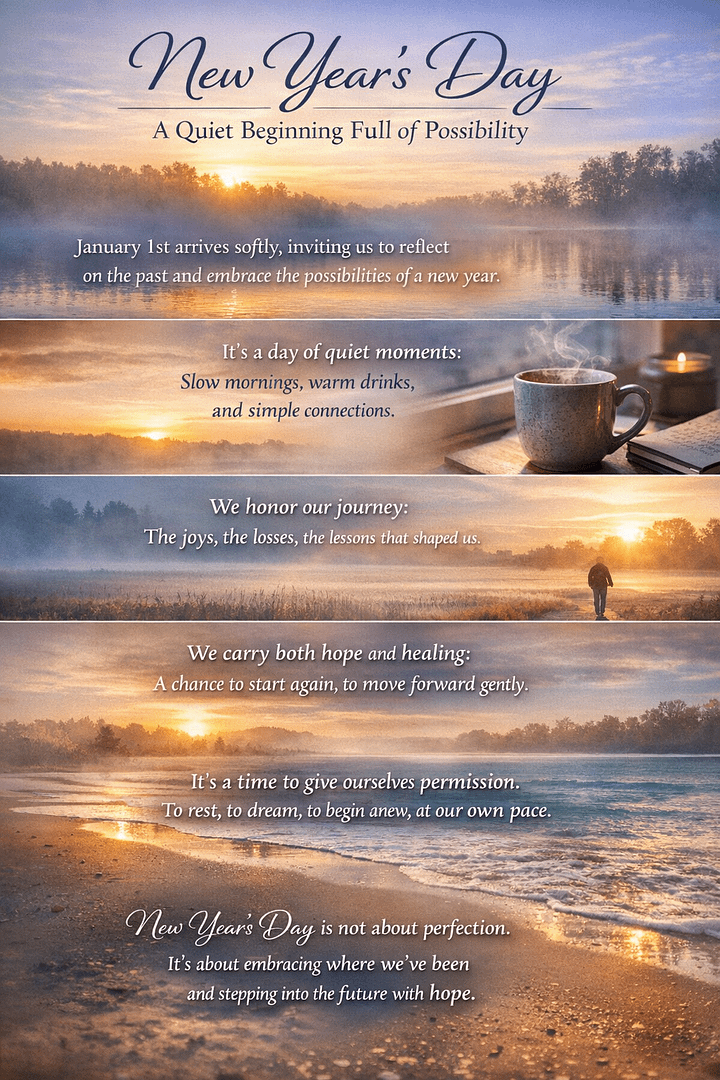
    New Year’s Day: A Quiet Beginning Full of Possibility

    New Year’s Day arrives with a softness that feels almost sacred. After the excitement, noise, and expectations of New Year’s Eve, January 1st offers something rare in a fast-moving world: stillness. The celebrations fade, the clocks reset, and we are left with a day that feels open, untouched, and filled with quiet promise.

    This day stands as a threshold between what has been and what has yet to unfold. It invites reflection without judgment. The past year may have brought joy, heartbreak, success, loss, or unexpected change. On New Year’s Day, we are encouraged to acknowledge all of it—the moments that made us proud and the ones that taught us hard lessons. Each experience, no matter how heavy or beautiful, helped shape the person stepping into this new chapter.

    Unlike the pressure often placed on resolutions, New Year’s Day asks for intention rather than perfection. It reminds us that growth does not require dramatic announcements or instant transformation. True change is often quiet and gradual. It begins with awareness, honesty, and small decisions made consistently over time. Choosing rest over burnout, kindness over criticism, and patience over urgency can be powerful acts of renewal.

    For many, New Year’s Day is defined by simplicity. It is a day of slow mornings, warm food, familiar routines, and shared silence. There is comfort in the ordinary moments—sipping coffee while the world feels paused, taking a reflective walk, or enjoying time with loved ones without distraction. These simple rituals ground us and help us reconnect with what truly matters.

    New Year’s Day can also be emotionally complex. While some welcome the new year with optimism and excitement, others carry grief, loneliness, or the weight of memories. The absence of loved ones can feel especially heavy on a day that symbolizes new beginnings. This day does not require us to hide those feelings. Instead, it gently reminds us that healing and hope can coexist with sorrow. Moving forward does not mean forgetting—it means carrying love with us in new ways.

    At its core, New Year’s Day represents hope. Not the loud, unrealistic kind, but a steady, resilient hope—the kind that says, even after everything, there is still more life to live. It reminds us that every sunrise offers another opportunity to grow, to heal, and to begin again. Even the smallest step forward counts.

    Rather than demanding clarity or certainty, New Year’s Day offers permission. Permission to start where we are. Permission to take life one day at a time. Permission to release the pressure of becoming “better” and instead focus on becoming more aligned with what brings peace and purpose.

    As the year stretches ahead, New Year’s Day becomes a quiet anchor in our memory. It reminds us that beginnings don’t have to be dramatic to be meaningful. Sometimes, the most powerful changes start in silence.

    New Year’s Day is not about erasing the past or reinventing ourselves overnight. It is about honoring our journey, embracing the present moment, and gently stepping toward the future with hope, grace, and intention.

    Read More Holidays & National Days

  • NEW YEAR’S EVE: Standing at the Threshold of Time

    NEW YEAR’S EVE: Standing at the Threshold of Time

    New Year’s Eve is a rare moment in our lives—a pause between what has been and what is yet to come. It is the final heartbeat of a year filled with experiences that shaped us, challenged us, and carried us forward in ways we may not have fully understood at the time. As the clock counts down toward midnight, we stand at a threshold, looking backward with reflection and forward with cautious hope.

    For many, New Year’s Eve is wrapped in celebration. Fireworks light up the sky, glasses clink in joyful toasts, and voices rise together in anticipation of a fresh start. For others, the night is quiet and deeply personal—spent at home, in prayer, in thought, or in remembrance. There is no single right way to welcome the new year. This night belongs equally to those who celebrate loudly and those who reflect silently.

    Looking Back: A Year That Changed Us

    The closing of a year naturally invites reflection. We revisit moments that brought joy and those that brought pain. We remember goals we achieved, plans that shifted, and expectations that didn’t unfold as we imagined. Some days felt triumphant, others overwhelming. And yet, here we are—still standing.

    New Year’s Eve reminds us that survival itself is an accomplishment. Growth often happens quietly, in ways we don’t recognize until we look back. The year may have tested our patience, our faith, or our resilience, but it also taught us lessons we will carry forward. Every challenge faced and every tear shed has added depth to who we are today.

    This night gives us permission to release what no longer serves us. Regret. Shame. Old narratives about who we should have been or what we should have done. We are not required to bring the weight of the past into the future. Letting go is not forgetting—it is choosing peace.

    The Emotions We Carry into Midnight

    New Year’s Eve can stir a wide range of emotions. Excitement and hope often share space with sadness and longing. For those who experienced loss, this night can feel especially heavy. The absence of loved ones is deeply felt when milestones pass and time moves forward without them.

    Yet love does not end with the year. Memories remain. Bonds endure. Even in grief, New Year’s Eve can be a quiet act of honoring—holding space for those who shaped our lives and continue to live on in our hearts. It is okay if joy feels muted or celebration feels distant. Healing does not follow a calendar.

    Carrying Forward What Matters Most

    As we prepare to step into the new year, we choose what we carry with us. Strength gained through hardship. Wisdom earned through experience. Gratitude for moments, people, and lessons that mattered. We carry forward kindness—toward others and toward ourselves.

    New Year’s Eve is not about erasing the past but integrating it. Everything we’ve lived through has contributed to our story. Even the unfinished chapters matter.

    Welcoming a New Beginning

    When midnight arrives, the new year does not demand transformation overnight. It simply offers opportunity. A fresh beginning does not mean a flawless one. It means another chance to show up, to try again, and to believe that small steps still count.

    Resolutions are optional. Intentions are powerful. Whether your goal is healing, growth, rest, connection, or simply getting through the day, it is enough. Progress does not need to be loud to be meaningful.

    A Gentle Truth to End the Year

    New Year’s Eve is not about becoming someone entirely new—it is about continuing forward as someone stronger, wiser, and more compassionate than before. You are allowed to move into the new year at your own pace. You are allowed to hope quietly. You are allowed to begin again.

    As the final seconds of the year fade away, take a breath. Acknowledge how far you’ve come. Release what you can. Hold close what matters.

    Here’s to new beginnings—soft, brave, and full of possibility. 🕯️✨

    Read More Holidays & National Days

  • What Not to Do on New Year’s If You Truly Want to Improve Your Life

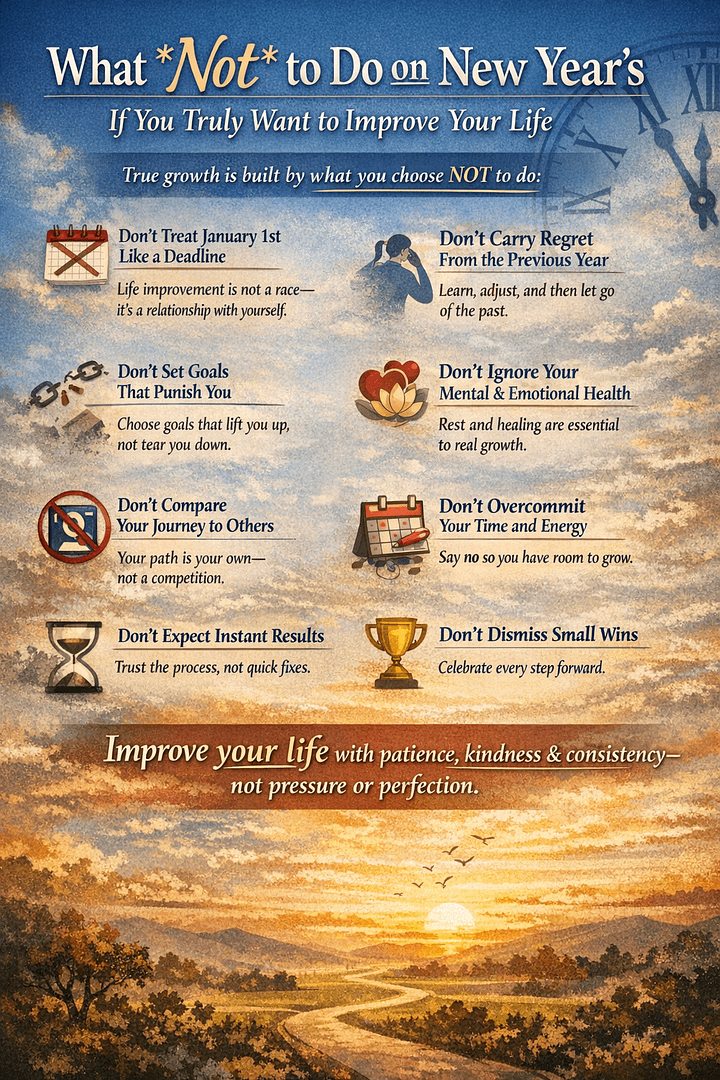
    What Not to Do on New Year’s If You Truly Want to Improve Your Life

    The arrival of a new year often comes with loud messages telling us to do more, be more, change faster. While the idea of a fresh start can feel inspiring, it can also create unnecessary pressure. Many people begin the year exhausted, overwhelmed, or discouraged—long before any real progress is made.

    If the goal is lasting improvement rather than temporary motivation, it’s just as important to know what not to do as it is to know what to do. True growth isn’t born from force; it’s built through awareness, compassion, and consistency.


    1. Don’t Treat January 1st Like a Deadline

    One of the biggest mistakes people make is believing they must have everything figured out by the first day of the year. This mindset turns the new year into a test instead of an opportunity.

    Life doesn’t reset overnight. Growth is ongoing, and meaningful change happens gradually. When you pressure yourself to “start perfectly,” you risk giving up as soon as things feel uncomfortable.

    Life improvement is not a race—it’s a relationship with yourself.


    2. Don’t Set Goals That Punish You

    Resolutions rooted in self-criticism—lose weight because I’m not enough, work harder because I failed, fix everything that’s wrong with me—are rarely sustainable. When goals come from shame, they drain motivation rather than build it.

    Improvement should feel supportive, not harsh. If a goal makes you feel anxious, exhausted, or inadequate before you’ve even begun, it may be time to rethink it.

    Choose goals that add to your life, not ones that make you feel smaller.


    3. Don’t Compare Your Journey to Someone Else’s Progress

    At the start of the year, social media becomes flooded with bold declarations, vision boards, and success stories. While inspiring to some, this constant comparison can quietly sabotage your confidence.

    Everyone starts the year with different circumstances, struggles, and resources. Comparing your chapter one to someone else’s chapter ten will only make you feel behind—even when you’re exactly where you need to be.

    Your path is valid, even if it looks quieter or slower than others’.


    4. Don’t Carry Regret From the Previous Year

    Many people enter the new year dragging the emotional weight of what they didn’t accomplish. Unfinished goals, missed opportunities, and past mistakes can linger like shadows.

    But regret doesn’t create change—it creates fear. The lessons of the past year are meant to guide you forward, not keep you stuck.

    You are allowed to learn, adjust, and move on without punishment.


    5. Don’t Ignore Rest, Healing, and Emotional Health

    Self-improvement is often framed around productivity, achievement, and hustle. What’s rarely discussed is how deeply important rest and emotional well-being are to long-term growth.

    If you’re mentally drained, emotionally grieving, or physically exhausted, pushing harder won’t fix it. Healing is not a delay—it’s a requirement.

    A well-rested, emotionally supported person grows faster than a burned-out one.


    6. Don’t Overcommit Your Time and Energy

    New year enthusiasm can lead to saying yes to every plan, project, and promise. Before long, you’re overwhelmed, resentful, and stretched too thin.

    Growth requires space. When your calendar is packed, there’s no room to reflect, adjust, or breathe.

    Learning to say no is one of the most powerful acts of self-improvement.


    7. Don’t Expect Immediate Results

    We live in a world that celebrates overnight success, but real change rarely works that way. Expecting quick outcomes sets you up for disappointment and self-doubt.

    Consistency may feel boring, but it’s where transformation lives. Small habits repeated daily will always outperform dramatic bursts of effort.

    Trust slow progress—it lasts longer.


    8. Don’t Dismiss Small Wins

    Many people overlook progress because it doesn’t feel “big enough.” But improvement is built from countless small choices that often go unnoticed.

    Waking up earlier, setting one boundary, choosing rest, or showing kindness to yourself—these are victories worth honoring.

    Small steps, taken consistently, create powerful change.


    Final Reflection

    The new year is not about becoming someone new. It’s about becoming more honest, more compassionate, and more aligned with who you already are.

    Let go of pressure. Release comparison. Replace perfection with patience.

    True life improvement doesn’t begin with grand resolutions—it begins with treating yourself like someone worth caring for.

    And that choice can start today, no matter what day the calendar says.

    Read More Of Health & Wellness

  • Why You Should Join Pickax

    Why You Should Join Pickax

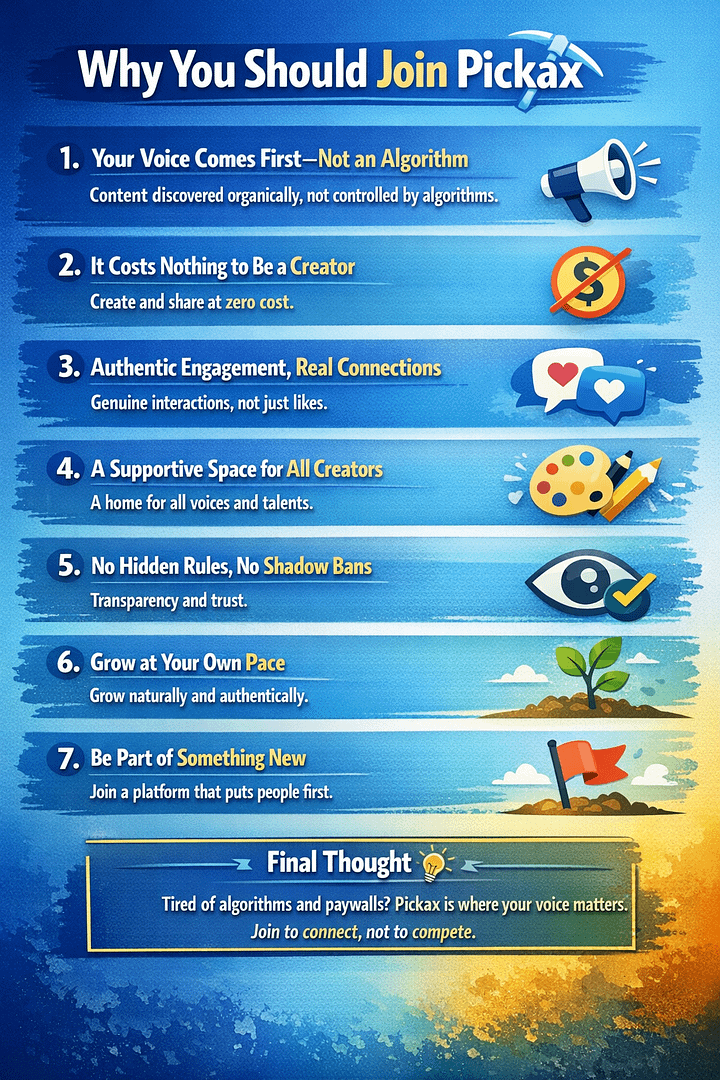
    In a digital world dominated by algorithms, ads, and pay-to-play visibility, finding a platform that truly values creators and authentic connection can feel impossible. That’s exactly why Pickax is different—and why more creators and community-minded users are choosing to join it every day.

    1. Your Voice Comes First—Not an Algorithm

    On most social platforms, your content is filtered, buried, or boosted based on ever-changing algorithms. On Pickax, your voice isn’t competing against a system designed to decide who gets seen. Content is discovered organically, giving everyone a fair chance to be heard, no matter their follower count.

    2. It Costs Nothing to Be a Creator

    Unlike other platforms that charge monthly fees or lock features behind paywalls, Pickax allows you to create, share, and grow at zero cost. You don’t have to pay to post, reach your audience, or be recognized as a creator. Your creativity—not your wallet—is what matters.

    3. Authentic Engagement, Real Connections

    Pickax is built for meaningful interaction. Instead of chasing likes or viral trends, the platform encourages genuine conversations and thoughtful engagement. This creates a community where people actually connect, support one another, and value quality over quantity.

    4. A Supportive Space for All Creators

    Whether you’re a writer, artist, entrepreneur, advocate, or someone sharing personal experiences, Pickax welcomes all voices. It’s a platform where storytelling, inspiration, education, and creativity can thrive without being overshadowed by ads or influencer-only exposure.

    5. No Hidden Rules, No Shadow Bans

    Pickax believes in transparency. You don’t have to guess why your content isn’t being seen or worry about being quietly restricted. What you share reaches the community as intended, creating trust between the platform and its users.

    6. Grow at Your Own Pace

    Growth on Pickax isn’t about pressure—it’s about purpose. Whether you’re building an audience, sharing your journey, or simply connecting with like-minded people, Pickax allows you to grow naturally and authentically.

    7. Be Part of Something New

    Pickax isn’t just another social platform—it’s a movement toward fairness, creativity, and community. By joining now, you’re helping shape a space that puts people first and redefines what online connection should be.

    Final Thought
    If you’re tired of fighting algorithms, paying to be seen, or feeling unheard, Pickax offers a refreshing alternative. It’s a place where your voice matters, creativity is valued, and community comes before clicks.

    Join Pickax—not to compete, but to connect.

    https://pickax.com/?referralCode=0mvx4ds&refSource=copy

    Read More Opportunities & Growth