Author: Brett Murphy

  • 🍓 National Strawberry Month: A Sweet Celebration of Nature’s Favorite Berry

    Every May, National Strawberry Month invites us to slow down and savor one of nature’s sweetest gifts. With their vibrant red color, juicy texture, and naturally refreshing taste, strawberries have become a symbol of sunshine, renewal, and simple joy. As spring transitions into summer, there’s no better time to celebrate this beloved fruit that has captured hearts—and taste buds—around the world.

    🌱 A Berry Rooted in History and Culture

    Strawberries have a story that stretches back centuries. Ancient Romans believed strawberries had medicinal properties, using them to treat everything from inflammation to digestive issues. In medieval Europe, strawberries symbolized purity, passion, and prosperity, often appearing in art and literature.

    The modern strawberry we enjoy today is the result of careful cultivation and innovation. In the 1700s, French gardeners crossbred wild strawberry varieties from North America and South America, creating the larger, sweeter fruit we now recognize. Since then, strawberries have become a global staple—grown on nearly every continent and featured in cuisines worldwide.

    🌞 The Magic of Strawberry Season

    May is peak strawberry season across much of the United States, making it the perfect time to enjoy them at their freshest. Fields come alive with rows of bright red berries, warmed by the sun and ready to be picked.

    There’s something special about strawberries in season:

    Their flavor is richer and sweeter
    Their texture is juicier and more satisfying
    Their aroma is stronger and more inviting

    Visiting a local farm for a U-pick experience turns a simple fruit into a memorable moment—families walking the rows, kids filling baskets, and laughter carried on a warm breeze. It’s not just about the strawberries—it’s about the experience.

    💪 A Nutritional Powerhouse in Every Bite

    Strawberries may taste indulgent, but they’re packed with health benefits that make them a smart addition to any diet.

    High in Vitamin C – Supports immune health and skin vitality
    Rich in Antioxidants – Helps fight inflammation and protect cells
    Good Source of Fiber – Aids digestion and promotes fullness
    Heart-Healthy – May help reduce cholesterol and blood pressure
    Low in Calories – Naturally sweet without added sugar

    A single cup of strawberries delivers a powerful boost of nutrients while satisfying your sweet tooth in the healthiest way possible.

    🍰 From Garden to Table: Endless Possibilities

    Strawberries are one of the most versatile fruits you can enjoy. Whether you’re keeping it simple or getting creative in the kitchen, they fit into nearly every meal of the day.

    🍓 Fresh & Simple
    Enjoy them straight from the bowl
    Slice them over cereal or oatmeal
    Add them to salads for a burst of sweetness
    🥤 Refreshing Drinks
    Blend into smoothies with banana and yogurt
    Infuse into lemonade or iced tea
    Create fresh strawberry milk or juices
    🍰 Sweet Treats
    Classic strawberry shortcake
    Homemade pies, cobblers, and crisps
    Cheesecakes and chocolate-dipped strawberries
    🍽️ Savory Twists
    Pair with grilled chicken and balsamic glaze
    Add to spinach salads with nuts and cheese
    Use in salsas for a sweet-and-spicy kick

    Strawberries don’t just enhance flavor—they elevate presentation with their bold color and natural beauty.

    🚜 Supporting Local Farms and Communities

    National Strawberry Month is also about connection—to the land, to farmers, and to your local community. Buying strawberries from local growers ensures you’re getting the freshest product while supporting small businesses and sustainable agriculture.

    Farmers markets and roadside stands often offer strawberries picked just hours before sale. Many farms also host seasonal events, giving visitors a chance to experience agriculture firsthand. These moments help bridge the gap between farm and table, reminding us where our food truly comes from.

    ❤️ More Than a Fruit—A Feeling

    Strawberries carry a sense of nostalgia. They remind us of childhood summers, backyard picnics, homemade desserts, and shared laughter. They’re present in life’s simplest pleasures—morning breakfasts, afternoon snacks, and special celebrations.

    Their heart-like shape even makes them a symbol of love, making strawberries a popular choice for romantic occasions and meaningful gestures.

    🌼 Celebrating the Joy of the Season

    National Strawberry Month is more than a celebration of a fruit—it’s a celebration of life’s sweeter moments. It encourages us to embrace the season, spend time outdoors, support local communities, and enjoy the flavors that make this time of year so special.

    So whether you’re picking them fresh from the field, blending them into your favorite drink, or sharing a dessert with loved ones, take a moment this May to truly appreciate the simple joy of strawberries.

    🍓 A Sweet Reminder

    Sometimes, happiness doesn’t come from something big—it comes from something as simple as a fresh strawberry, warmed by the sun and enjoyed in the moment.

    Read More Holidays & National Days
  • 🥬 National Lettuce Month: Celebrating the Crisp, Green Foundation of Fresh Eating

    🥬 National Lettuce Month: Celebrating the Crisp, Green Foundation of Fresh Eating

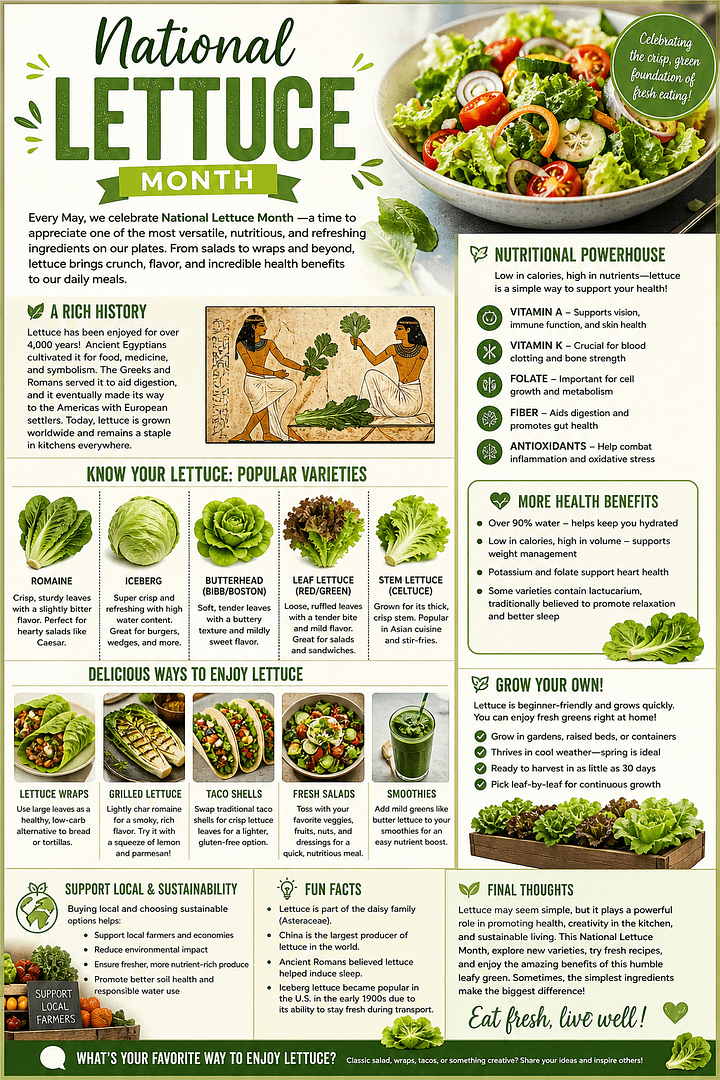
    Every May, food lovers and health enthusiasts come together to celebrate National Lettuce Month—a tribute to one of the most versatile, refreshing, and nourishing ingredients found in kitchens around the world. While it’s often seen as a simple salad base, lettuce is far more than a sidekick—it’s a powerhouse of nutrition, a culinary staple, and a symbol of fresh, clean eating.

    🌱 A Deeper Look at Lettuce’s Origins

    Lettuce has been cultivated for over 4,000 years, with its roots tracing back to ancient Egypt. The Egyptians prized lettuce not only for its edible leaves but also for the oil extracted from its seeds. It was considered a sacred plant associated with fertility and was often depicted in ancient art.

    As civilizations evolved, lettuce spread to ancient Greece and Rome, where it became a popular dish served at the end of meals to aid digestion. Eventually, European settlers brought lettuce to the Americas, where it thrived and became a staple in households and agriculture alike.

    Today, lettuce is grown globally, with the United States—especially California and Arizona—leading production.

    🥗 Exploring the Many Varieties of Lettuce

    Lettuce comes in a wide range of varieties, each offering distinct flavors, textures, and uses:

    Romaine (Cos) – Crisp, sturdy leaves with a slightly bitter flavor; perfect for hearty salads like Caesar.
    Iceberg – Known for its crunch and high water content; commonly used in burgers and wedges.
    Butterhead (Bibb/Boston) – Soft, delicate leaves with a buttery texture and mild sweetness.
    Leaf Lettuce (Red/Green) – Loose, ruffled leaves with a tender bite; great for fresh salads.
    Stem Lettuce (Celtuce) – Grown for its thick, edible stem; popular in Asian cuisine.

    Each type offers its own unique experience, proving that lettuce is anything but boring.

    💪 Nutritional Powerhouse in Every Leaf

    Despite being low in calories, lettuce is packed with essential nutrients that support overall health:

    Vitamin A – Supports vision, immune function, and skin health
    Vitamin K – Crucial for blood clotting and bone strength
    Folate – Important for cell growth and metabolism
    Fiber – Aids digestion and promotes gut health
    Antioxidants – Help combat inflammation and oxidative stress

    Darker lettuces like romaine and red leaf tend to have higher nutrient content than lighter varieties like iceberg.

    🧠 Health Benefits You Might Not Know

    Lettuce does more than just fill your plate—it supports your well-being in subtle but powerful ways:

    Hydration Boost – Lettuce is made up of over 90% water, helping keep you hydrated
    Weight Management – Low in calories, high in volume—perfect for feeling full without overeating
    Heart Health – Nutrients like potassium and folate contribute to cardiovascular wellness
    Better Sleep – Some varieties contain compounds like lactucarium, traditionally believed to promote relaxation
    🍴 Creative and Delicious Ways to Enjoy Lettuce

    Lettuce can be used in far more ways than just salads:

    Lettuce Wraps – Use large leaves as a healthy, low-carb alternative to bread or tortillas
    Grilled Lettuce – Lightly char romaine for a smoky, gourmet twist
    Smoothies – Add mild greens like butter lettuce to boost nutrients
    Soup Garnish – Add shredded lettuce to soups for texture and freshness
    Taco Shells – Swap traditional shells for a lighter, gluten-free option
    🌿 Growing Your Own Lettuce

    One of the best ways to celebrate National Lettuce Month is by growing your own. Lettuce is beginner-friendly and grows quickly:

    Can be grown in gardens, raised beds, or containers
    Thrives in cool weather, making spring ideal
    Ready to harvest in as little as 30 days
    Can be picked leaf-by-leaf for continuous growth

    Even a small windowsill can produce fresh lettuce for your meals.

    🌍 Supporting Local Farmers and Sustainability

    National Lettuce Month is also a reminder to support local agriculture. Buying from farmers markets or local growers helps:

    Reduce environmental impact from transportation
    Support small businesses and local economies
    Ensure fresher, more nutrient-rich produce

    Sustainable farming practices also help preserve soil health and reduce water waste—making lettuce a smart choice for both your body and the planet.

    🥬 Fun Facts About Lettuce
    Lettuce is part of the daisy family (Asteraceae)
    China is the largest producer of lettuce in the world
    Ancient Romans believed lettuce helped induce sleep
    Iceberg lettuce became popular in the U.S. in the early 1900s due to its ability to stay fresh during transport
    🌟 Final Thoughts

    Lettuce may seem simple, but it plays a powerful role in promoting health, creativity in the kitchen, and sustainable living. National Lettuce Month is the perfect time to explore new varieties, try fresh recipes, and reconnect with wholesome eating.

    Whether you’re enjoying a crisp salad, wrapping up your favorite fillings, or growing your own greens, lettuce reminds us that sometimes the simplest ingredients are the most essential.

    Read More Holidays & National Days
  • 🥗 National Salad Month: Fresh Flavors, Healthy Living, and Endless Creativity

    🥗 National Salad Month: Fresh Flavors, Healthy Living, and Endless Creativity

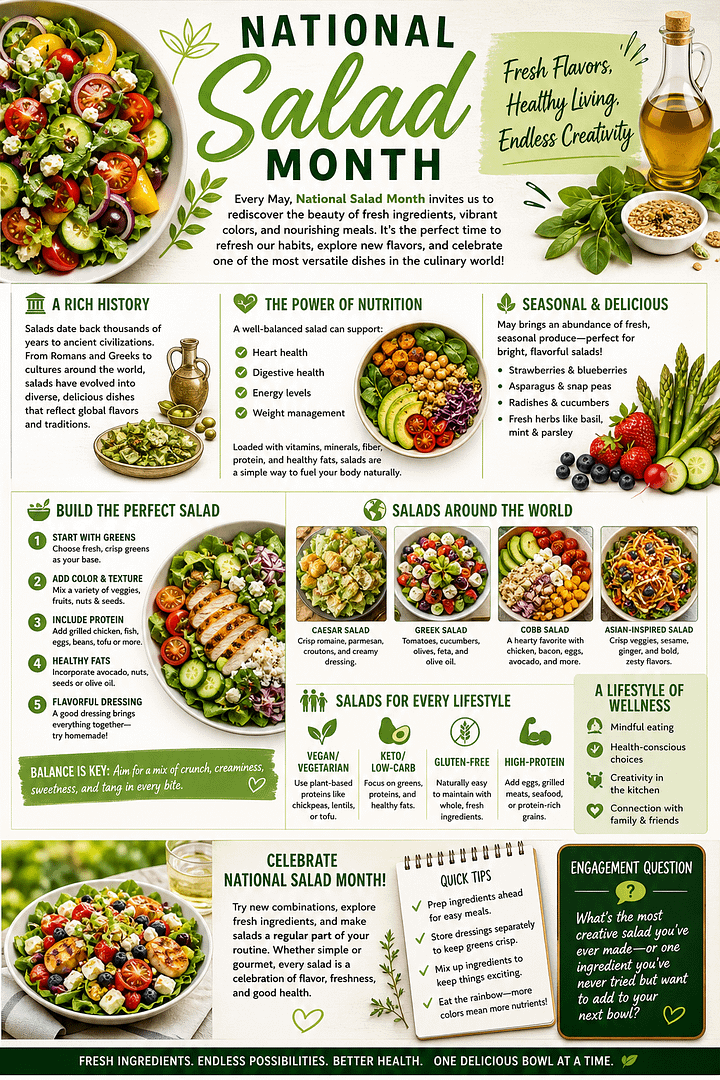
    Every May, National Salad Month invites us to rediscover the beauty of fresh ingredients, vibrant colors, and nourishing meals. While salads are often seen as a simple side dish, this month shines a spotlight on their true potential—transforming them into hearty, flavorful, and satisfying creations that can take center stage on any table.

    As the days grow warmer and nature comes alive, there’s no better time to embrace meals that feel light yet energizing. National Salad Month is more than a celebration—it’s an opportunity to refresh your habits, reconnect with wholesome foods, and explore the creativity that salads bring to everyday life.

    🌿 The Rich History Behind Salads

    The concept of salad dates back thousands of years. Ancient civilizations, including the Romans and Greeks, enjoyed dishes made from raw vegetables, herbs, and oils. In fact, the word “salad” comes from the Latin word sal (salt), referring to the salted greens often served in early recipes.

    Over time, salads evolved across cultures:

    Europe introduced composed salads like the classic French Niçoise
    The Mediterranean region embraced olive oil, fresh herbs, and vegetables
    Asia brought bold flavors with sesame, ginger, and soy-based dressings
    America popularized hearty, protein-rich salads like Cobb and chef’s salad

    Today, salads reflect global influence, combining flavors and techniques from around the world into one bowl.

    🥑 The Power of a Nutrient-Dense Meal

    Salads are one of the easiest ways to pack a wide range of nutrients into a single dish. A thoughtfully built salad can support:

    Heart health through fiber-rich vegetables and healthy fats
    Digestive health with raw and whole ingredients
    Energy levels thanks to balanced macronutrients
    Weight management by offering filling, low-calorie options

    Key nutritional components often found in salads include:

    Leafy greens (spinach, kale, arugula) – rich in vitamins A, C, and K
    Colorful vegetables (bell peppers, carrots, tomatoes) – loaded with antioxidants
    Proteins (chicken, fish, beans, tofu) – essential for muscle and satiety
    Healthy fats (avocado, nuts, seeds) – support brain and heart health

    When combined, these ingredients create a powerful, well-rounded meal that fuels your body naturally.

    🍓 Seasonal Eating: Why May Matters

    One of the highlights of National Salad Month is the abundance of fresh, seasonal produce available in May. Eating seasonally not only enhances flavor but also supports local farmers and sustainability.

    Popular spring and early summer salad ingredients include:

    Strawberries and blueberries
    Asparagus and snap peas
    Radishes and cucumbers
    Fresh herbs like basil, mint, and parsley

    These ingredients bring brightness, crunch, and natural sweetness—perfect for building refreshing salads that celebrate the season.

    🍽️ Elevating Salads from Simple to Spectacular

    A great salad is all about balance—flavor, texture, and presentation. Here’s how to take your salads to the next level:

    1. Build Layers of Flavor

    Start with a base of greens, then layer in ingredients that contrast and complement each other—sweet, savory, tangy, and crunchy.

    2. Play with Texture

    Combine crisp vegetables with creamy elements like avocado or cheese, and add crunch with nuts, seeds, or croutons.

    3. Add a Protein Boost

    Transform your salad into a meal by including grilled chicken, steak, shrimp, eggs, tofu, or legumes.

    4. Don’t Forget the Dressing

    A good dressing ties everything together. Try homemade vinaigrettes with olive oil, vinegar, citrus juice, and herbs for a fresh, clean taste.

    5. Presentation Matters

    A beautifully arranged salad isn’t just visually appealing—it enhances the dining experience. Think vibrant colors and thoughtful plating.

    🌎 Salads Around the World

    Salads are enjoyed globally, each culture adding its own unique twist:

    Caesar Salad – Crisp romaine, parmesan, croutons, and creamy dressing
    Greek Salad – Tomatoes, cucumbers, olives, feta, and olive oil
    Cobb Salad – A hearty American favorite with chicken, bacon, eggs, and avocado
    Asian-Inspired Salads – Featuring cabbage, sesame, ginger, and bold dressings

    Exploring these varieties is a great way to expand your palate during National Salad Month.

    🥗 Salads for Every Lifestyle

    Salads are incredibly adaptable, making them perfect for a wide range of dietary preferences:

    Vegan/Vegetarian – Use plant-based proteins like chickpeas, lentils, or tofu
    Keto/Low-Carb – Focus on greens, proteins, and healthy fats
    Gluten-Free – Naturally easy to maintain with whole foods
    High-Protein – Add eggs, grilled meats, or protein-rich grains

    No matter your lifestyle, there’s a salad combination that fits your needs.

    🌞 A Lifestyle of Wellness and Mindful Eating

    National Salad Month is about more than just what’s on your plate—it’s about how you approach food. It encourages:

    Mindful eating – Slowing down and appreciating flavors
    Health-conscious choices – Fueling your body with intention
    Creativity in the kitchen – Experimenting with new ingredients
    Connection – Sharing meals with family and friends

    It’s a reminder that healthy eating doesn’t have to be boring—it can be vibrant, delicious, and deeply satisfying.

    💚 Celebrate National Salad Month

    This May, challenge yourself to try new salad combinations, explore fresh ingredients, and make salads a regular part of your routine. Whether you’re enjoying a simple garden salad or crafting a gourmet bowl, each bite is a step toward better health and greater appreciation for fresh food.

    Read More Holidays & National Days

  • 🧀 American Cheese Month: Celebrating a Classic Favorite

    🧀 American Cheese Month: Celebrating a Classic Favorite

    American Cheese Month, celebrated each April, is more than just a nod to a familiar ingredient—it’s a celebration of comfort, tradition, innovation, and the simple joys of everyday meals. From lunchboxes to backyard cookouts, American cheese has become a symbol of American food culture, bringing people together one melted slice at a time.

    🧀 What Makes American Cheese Unique?

    American cheese stands apart from traditional cheeses because of how it’s made. It begins with real cheeses like cheddar and colby, which are blended with milk, emulsifiers, and seasonings. This process creates a product that is:

    Smooth and creamy
    Uniform in texture
    Exceptionally meltable

    Unlike many natural cheeses that can separate or become oily when heated, American cheese melts evenly into a silky, rich consistency. That’s why it’s often the top choice for recipes where texture matters most.

    🇺🇸 The History Behind the Slice

    The story of American cheese is deeply tied to innovation and accessibility. In the early 1900s, James L. Kraft discovered a way to process cheese so it would last longer without spoiling. His invention helped reduce waste and made cheese easier to distribute across the country.

    During World War I and World War II, processed cheese became a staple in military rations because of its durability and nutritional value. After the wars, it found its way into American homes, quickly becoming a household favorite.

    By the 1950s and beyond, American cheese was everywhere—featured in diners, school cafeterias, and family kitchens—cementing its place as a cultural icon.

    🍔 American Cheese and Comfort Food Culture

    Few ingredients are as closely tied to comfort food as American cheese. Its creamy melt and mild flavor make it the perfect companion for some of the nation’s most beloved dishes:

    Cheeseburgers – The classic pairing that defines fast food and backyard grilling
    Grilled cheese sandwiches – Crispy on the outside, irresistibly gooey on the inside
    Breakfast sandwiches – Adding richness to eggs, sausage, or bacon
    Mac and cheese – Boosting creaminess and texture
    Hot sandwiches and melts – Like patty melts and tuna melts

    American cheese doesn’t just complement these dishes—it elevates them, turning simple ingredients into something satisfying and memorable.

    🧀 The Great Debate: Processed vs. Natural

    American cheese has long been part of a larger conversation about processed foods. Some critics argue that it lacks the complexity of traditional cheeses, while others point out its practical benefits.

    Here’s a balanced look:

    Pros:

    Consistent taste and texture
    Superior melting quality
    Affordable and widely available
    Long shelf life

    Cons:

    Less complex flavor than aged cheeses
    Contains added ingredients for processing

    Despite the debate, American cheese continues to thrive—not because it tries to be something it’s not, but because it delivers exactly what people expect: comfort, reliability, and great melt.

    🍽️ Creative Ways to Celebrate American Cheese Month

    American Cheese Month is the perfect time to get creative in the kitchen. Whether you’re cooking for yourself or hosting friends and family, here are some fun ways to celebrate:

    🔥 Host a Backyard Cookout

    Fire up the grill and serve classic cheeseburgers topped with perfectly melted American cheese. Add hot dogs, sides, and drinks for a full celebration.

    🥪 Reinvent the Grilled Cheese

    Take your sandwich to the next level by adding:

    Tomato slices
    Crispy bacon
    Avocado
    Caramelized onions

    Pair it with tomato soup for a timeless combo.

    🍲 Make Comfort Food Favorites

    Try dishes like:

    Cheesy casseroles
    Homemade cheese sauces
    Loaded nachos with an American cheese twist
    🧀 Family Cooking Night

    Get everyone involved in making simple, cheesy recipes. It’s a great way to create memories while celebrating a classic ingredient.

    ❤️ A Taste of Nostalgia

    For many people, American cheese is more than just food—it’s a memory. It’s the grilled cheese your parents made on a rainy day, the cheeseburger at your favorite diner, or the sandwich packed in your school lunch.

    Its familiar taste brings a sense of comfort that goes beyond flavor. It reminds us of simpler times, shared meals, and moments that matter.

    🧀 American Cheese in Modern Times

    Today, American cheese continues to evolve. You can find:

    Deli-sliced varieties with a fresher taste
    Organic and preservative-free options
    Artisan-style versions made with higher-quality ingredients

    Even chefs in upscale kitchens sometimes turn to American cheese for its unbeatable melt, proving that it still has a place in both casual and creative cooking.

    🧀 Final Thoughts

    American Cheese Month is a celebration of more than just a food—it’s a celebration of tradition, innovation, and the everyday meals that bring people together. Whether you enjoy it in a classic grilled cheese, melted over a burger, or as part of a new recipe, American cheese continues to hold a special place in American hearts and kitchens.

    So this month, embrace the nostalgia, savor the flavor, and enjoy every melty bite.

    Read More Holidays & National Days
  • 🥚 National Egg Month: Celebrating One of Nature’s Most Perfect Foods

    🥚 National Egg Month: Celebrating One of Nature’s Most Perfect Foods

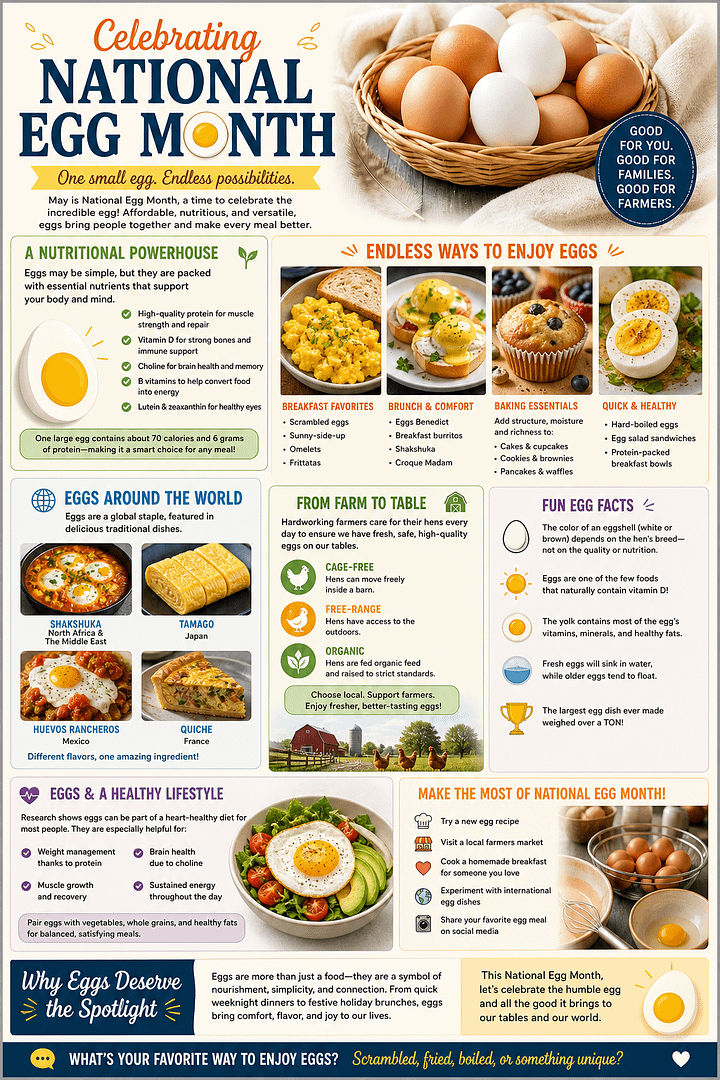
    May is National Egg Month, a time to recognize and celebrate one of the most versatile, affordable, and nutrient-rich foods enjoyed across the world. From hearty breakfasts to delicate pastries, eggs are a cornerstone ingredient that has stood the test of time. This month isn’t just about enjoying eggs—it’s about appreciating their role in nutrition, culture, and everyday life.

    🐔 A Simple Food with a Powerful Nutritional Punch

    Eggs may be simple, but they are incredibly powerful when it comes to nutrition. Each egg is a compact source of essential nutrients that support your body from head to toe.

    High-quality protein that helps build and repair muscle
    Vitamin D to support strong bones and immune health
    Choline, a nutrient vital for brain development and memory
    B vitamins that help convert food into energy
    Lutein and zeaxanthin, antioxidants that promote healthy vision

    Unlike many processed foods, eggs are naturally nutrient-dense without added sugars or preservatives. They are also relatively low in calories, making them a smart choice for balanced eating.

    For athletes, growing children, and busy adults alike, eggs provide long-lasting energy and nourishment.

    🍳 Endless Ways to Enjoy Eggs

    Eggs are a global staple, appearing in traditional dishes across cultures:

    Shakshuka – A rich, spiced tomato dish with poached eggs, popular in North Africa and the Middle East
    Tamago – A slightly sweet, layered omelet in Japanese cuisine
    Huevos Rancheros – A bold Mexican breakfast with eggs, tortillas, and salsa
    Quiche – A savory French pie filled with eggs, cheese, and meats or vegetables

    These dishes highlight how eggs transcend borders, bringing people together through shared meals and traditions.

    🧑‍🌾 From Farm to Table: The Journey of an Egg

    Behind every egg is a story of care, farming, and dedication. Egg farmers work daily to ensure hens are healthy and eggs are fresh and safe.

    There are different types of egg production systems:

    Cage-free – Hens can move freely within a barn
    Free-range – Hens have some outdoor access
    Organic – Produced with organic feed and stricter standards

    Buying eggs locally or from trusted farms not only supports small businesses but also connects you to the source of your food. Fresh eggs often have richer flavor and brighter yolks, enhancing your meals naturally.

    💡 Fun & Surprising Egg Facts
    The color of an egg (white or brown) depends on the hen’s breed—not its nutritional value
    Eggs are one of the few foods that naturally contain vitamin D
    The yolk holds most of the egg’s nutrients, including healthy fats and vitamins
    Fresh eggs will sink in water, while older eggs tend to float
    The largest egg dish ever made weighed over a ton!
    🥗 Eggs and a Healthy Lifestyle

    Eggs have gone through years of debate regarding cholesterol, but modern research shows that for most people, eggs can be part of a heart-healthy diet when eaten in moderation.

    They are especially helpful for:

    Weight management, thanks to their protein content
    Muscle growth and recovery
    Brain health, due to choline
    Sustained energy throughout the day

    Pairing eggs with vegetables, whole grains, and healthy fats creates balanced meals that fuel your body effectively.

    ❤️ Why National Egg Month Matters

    National Egg Month isn’t just about food—it’s about appreciation. It’s about recognizing the farmers, the nutrition, the cultural traditions, and the everyday moments eggs help create.

    From a quick breakfast before work to a family brunch on the weekend, eggs are part of life’s simple joys. They remind us that sometimes the most basic ingredients can bring the greatest comfort.

    🥚 Make the Most of National Egg Month

    Here are a few ways to celebrate:

    Try a new egg recipe you’ve never made before
    Visit a local farmers market and support egg producers
    Cook a homemade breakfast for family or friends
    Experiment with international egg dishes
    Share your favorite egg meal on social media

    Read More Holidays & National Days
  • 🌸 Bereaved Mother’s Day: Honoring Love That Never Ends

    🌸 Bereaved Mother’s Day: Honoring Love That Never Ends

    Bereaved Mother’s Day is a sacred and often unspoken observance held each year on the Sunday before traditional Mother’s Day. It is a day carved out with intention—to recognize mothers whose children are no longer physically present, yet remain forever woven into their hearts, their identities, and their lives.

    While the world prepares for flowers, cards, and celebrations, this day gently acknowledges a different reality—one where love remains, but the arms ache with absence. It offers space for grief, remembrance, and the quiet strength it takes to continue forward.

    💔 The Depth of a Mother’s Love

    There is no loss quite like the loss of a child. It reshapes everything—how time feels, how memories are held, how the future is imagined.

    For a bereaved mother:

    Every milestone becomes a reminder
    Every holiday carries both light and heaviness
    Every “what could have been” lingers in the heart

    And yet, through all of it, one thing never changes: she is still a mother.

    Motherhood is not defined by presence alone—it is defined by love. And that love does not end. It stretches beyond what we can see, beyond what we can hold, and into something eternal.

    🕊️ Grief Has No Timeline

    Grief is not something that can be measured or neatly resolved. It doesn’t follow a schedule, and it doesn’t look the same from one day to the next.

    Some days may feel manageable. Others may feel overwhelming.

    A sound, a scent, a song—any small thing can bring a wave of emotion rushing back. And on days like Bereaved Mother’s Day, those emotions can feel even closer to the surface.

    It’s important to remember:

    There is no “right way” to grieve
    Healing does not mean forgetting
    Strength can look like simply getting through the day

    Grief is not something to “move on” from—it is something we learn to carry, because it is tied to love.

    🌷 Creating Space for Remembrance

    Bereaved Mother’s Day is not about grand gestures—it’s about meaningful ones. It’s about allowing yourself to feel, to remember, and to honor your child in a way that feels true to you.

    Some mothers find comfort in tradition, while others create new rituals each year.

    You might choose to:

    Light a candle and sit in quiet reflection
    Write your child a letter, saying the things still in your heart
    Visit a place that holds special meaning
    Cook a favorite meal or play a song that brings memories alive
    Look through photos and speak their name out loud
    Release something symbolic—like a balloon or flower—into the sky or water

    These acts are not about holding on to pain—they are about holding on to love.

    🤍 The Power of Being Seen

    One of the most painful parts of child loss can be the silence that follows. The world keeps moving, while a mother’s heart remains tethered to someone who is no longer visible to others.

    Bereaved Mother’s Day helps break that silence.

    It says:

    Your child mattered
    Your motherhood matters
    Your grief deserves acknowledgment

    Sometimes, the most healing thing is simply being seen and understood.

    🌼 Supporting a Bereaved Mother with Compassion

    If you know a bereaved mother, this day can be an opportunity to show care in a meaningful way. You don’t need perfect words—you just need a willing heart.

    Here are gentle ways to support:

    Say her child’s name—this can be incredibly meaningful
    Send a message letting her know you’re thinking of her
    Acknowledge her as a mother, even if her child is not physically here
    Offer to spend time together, or simply sit with her in silence
    Avoid clichés like “everything happens for a reason”

    Presence is more powerful than advice. Compassion is more powerful than solutions.

    🌅 Love That Transcends Time

    Bereaved Mother’s Day is not only about loss—it is about enduring love.

    It is about:

    The lullabies that still echo in memory
    The dreams that live on in a mother’s heart
    The invisible bond that cannot be broken

    Love like this doesn’t disappear—it transforms. It becomes part of who a mother is, shaping her strength, her compassion, and her perspective on life.

    Many bereaved mothers go on to honor their children in powerful ways—through acts of kindness, advocacy, creativity, or simply by living with deeper intention.

    Their love continues to make an impact.

    🌹 Holding Space for Yourself

    If you are a bereaved mother, this day is yours in whatever way you need it to be.

    You are allowed to:

    Feel everything, or feel nothing at all
    Step away from celebrations if it’s too much
    Create your own meaning for the day
    Rest, reflect, or remember

    There is no expectation—only grace.

    ✨ A Message to Every Bereaved Mother

    Your love did not end.
    Your motherhood did not end.
    Your child’s story did not end.

    It lives on—in you, through you, and because of you.

    Even in the quiet moments…
    Even in the hardest days…
    That bond remains unbreakable

    A Father’s Guide to Surviving the Loss of a Child

    Grief & Child Loss


  • National Salsa Month: A Celebration of Flavor, Culture, and Connection

    National Salsa Month: A Celebration of Flavor, Culture, and Connection

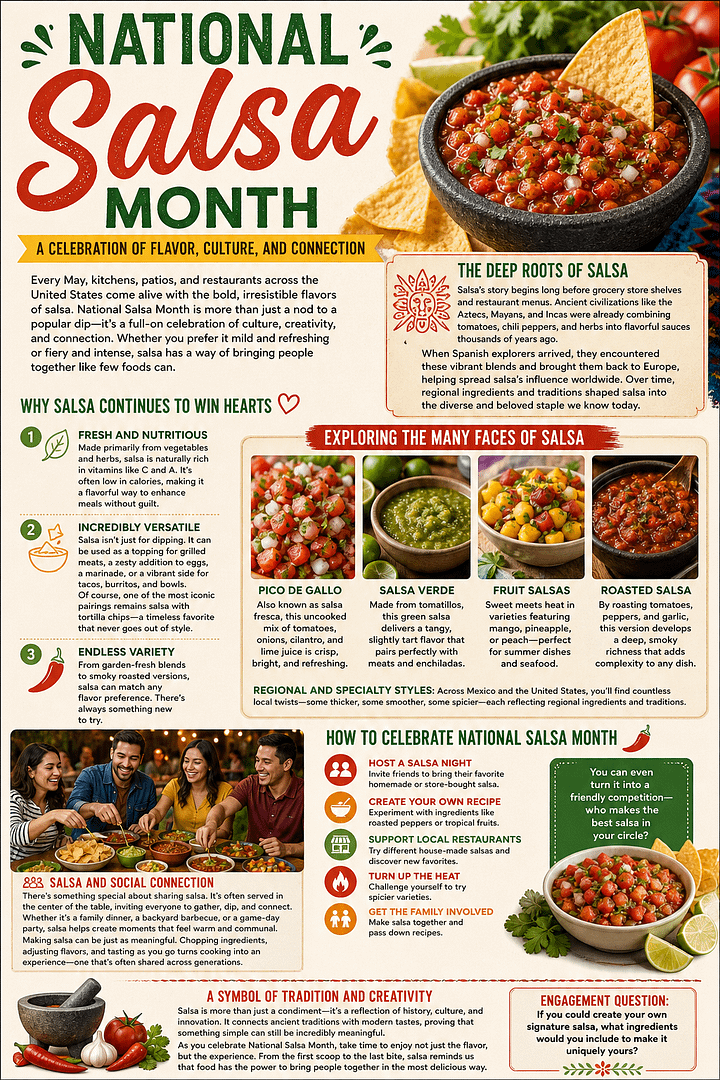
    Every May, kitchens, patios, and restaurants across the United States come alive with the bold, irresistible flavors of salsa. National Salsa Month is more than just a nod to a popular dip—it’s a full-on celebration of culture, creativity, and connection. Whether you prefer it mild and refreshing or fiery and intense, salsa has a way of bringing people together like few foods can.

    The Deep Roots of Salsa

    Salsa’s story begins long before grocery store shelves and restaurant menus. Ancient civilizations like the Aztecs, Mayans, and Incas were already combining tomatoes, chili peppers, and herbs into flavorful sauces thousands of years ago. These early recipes were simple, fresh, and deeply tied to the land.

    When Spanish explorers arrived, they encountered these vibrant blends and brought them back to Europe, helping spread salsa’s influence worldwide. Over time, regional ingredients and traditions shaped salsa into the diverse and beloved staple we know today.

    Why Salsa Continues to Win Hearts

    Salsa has earned its place as one of the most popular condiments in America—and for good reason:

    1. Fresh and Nutritious

    Made primarily from vegetables and herbs, salsa is naturally rich in vitamins like C and A. It’s often low in calories, making it a flavorful way to enhance meals without guilt.

    2. Incredibly Versatile

    Salsa isn’t just for dipping. It can be used as:

    A topping for grilled chicken, steak, or fish
    A flavorful addition to eggs and breakfast dishes
    A marinade or finishing sauce
    A vibrant side for tacos, burritos, and bowls

    Of course, one of the most iconic pairings remains salsa with tortilla chips—a timeless favorite that never goes out of style.

    3. Endless Variety

    From garden-fresh blends to smoky roasted versions, salsa can match any flavor preference. There’s always something new to try.

    Exploring the Many Faces of Salsa

    Salsa comes in countless styles, each offering a unique taste experience:

    Pico de Gallo

    Also known as salsa fresca, this uncooked mix of tomatoes, onions, cilantro, and lime juice is crisp, bright, and refreshing.

    Salsa Verde

    Made from tomatillos, this green salsa delivers a tangy, slightly tart flavor that pairs perfectly with meats and enchiladas.

    Fruit Salsas

    Sweet meets heat in varieties featuring mango, pineapple, or peach—perfect for summer dishes and seafood.

    Roasted Salsa

    By roasting tomatoes, peppers, and garlic, this version develops a deep, smoky richness that adds complexity to any dish.

    Regional and Specialty Styles

    Across Mexico and the United States, you’ll find countless local twists—some thicker, some smoother, some spicier—each reflecting regional ingredients and traditions.

    Salsa and Social Connection

    There’s something special about sharing salsa. It’s often served in the center of the table, inviting everyone to gather, dip, and connect. Whether it’s a family dinner, a backyard barbecue, or a game-day party, salsa helps create moments that feel warm and communal.

    Making salsa can be just as meaningful. Chopping ingredients, adjusting flavors, and tasting as you go turns cooking into an experience—one that’s often shared across generations.

    How to Celebrate National Salsa Month

    Make the most of this flavorful month with simple, fun ideas:

    Host a Salsa Night: Invite friends to bring their favorite homemade or store-bought salsa
    Create Your Own Recipe: Experiment with ingredients like roasted peppers or tropical fruits
    Support Local Restaurants: Try different house-made salsas and discover new favorites
    Turn Up the Heat: Challenge yourself to try spicier varieties
    Get the Family Involved: Make salsa together and pass down recipes

    You can even turn it into a friendly competition—who makes the best salsa in your circle?

    A Symbol of Tradition and Creativity

    Salsa is more than just a condiment—it’s a reflection of history, culture, and innovation. It connects ancient traditions with modern tastes, proving that something simple can still be incredibly meaningful.

    As you celebrate National Salsa Month, take time to enjoy not just the flavor, but the experience. From the first scoop to the last bite, salsa reminds us that food has the power to bring people together in the most delicious way.

    Read More Holidays & National Days
  • National Stroke Awareness Month: Recognizing the Signs, Saving Lives

    National Stroke Awareness Month: Recognizing the Signs, Saving Lives

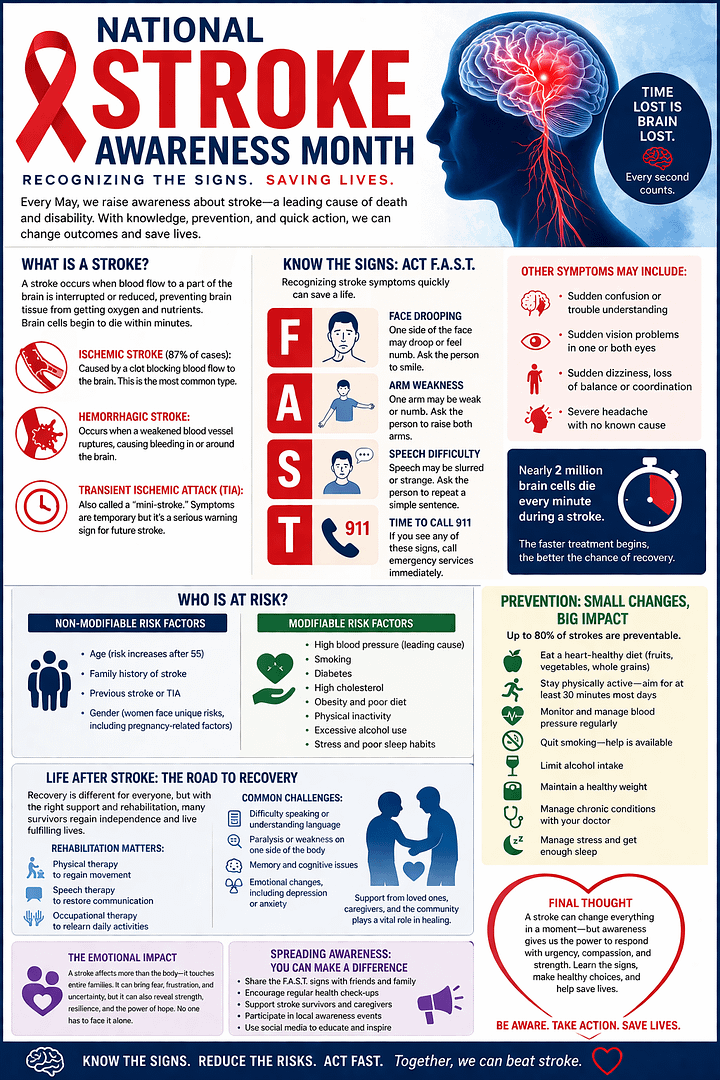
    Every May, National Stroke Awareness Month serves as a powerful reminder that knowledge can save lives. A stroke can strike without warning, changing a life in seconds—but with awareness, prevention, and fast action, outcomes can be dramatically improved. This month is about more than statistics—it’s about people, families, and the strength to act when it matters most.

    Understanding Stroke: A Race Against Time

    A stroke occurs when the brain is deprived of oxygen-rich blood. Because brain cells begin to die within minutes, stroke is often described as a “brain attack.” The faster treatment begins, the better the chances of survival and recovery.

    The Three Types of Stroke
    Ischemic Stroke (87% of cases):
    Caused by a clot blocking blood flow to the brain. This is the most common type and often linked to narrowed or blocked arteries.
    Hemorrhagic Stroke:
    Occurs when a weakened blood vessel ruptures, causing bleeding in or around the brain. High blood pressure is a major contributor.
    Transient Ischemic Attack (TIA):
    Often called a “mini-stroke,” TIAs are temporary but serious warning signs. Symptoms may go away quickly, but they should never be ignored—they often signal a future stroke risk.
    The Urgency: Why Every Second Counts

    When a stroke happens, nearly 2 million brain cells die every minute. That’s why immediate medical attention is critical. Treatments such as clot-busting medications or surgical procedures can significantly reduce damage—but only if administered quickly.

    Delays in treatment can lead to:

    Permanent brain damage
    Loss of speech or mobility
    Cognitive impairment
    Death

    Time lost is brain lost.

    Recognizing the Signs: Think F.A.S.T.

    Knowing the warning signs can empower you to act without hesitation:

    F – Face Drooping: One side of the face may droop or feel numb. Ask the person to smile.
    A – Arm Weakness: One arm may be weak or numb. Ask them to raise both arms.
    S – Speech Difficulty: Speech may be slurred or strange. Ask them to repeat a simple sentence.
    T – Time to Call 911: If any of these signs are present—even briefly—call immediately.
    Additional Symptoms to Watch For:
    Sudden confusion or trouble understanding
    Sudden vision problems in one or both eyes
    Sudden dizziness, loss of balance, or coordination
    Severe headache with no known cause

    Even if symptoms disappear, seek help right away—it could be a TIA.

    Who Is at Risk?

    Stroke does not discriminate—it can affect anyone at any time. However, certain factors increase risk.

    Non-Modifiable Risk Factors:
    Age (risk increases after 55)
    Family history of stroke
    Previous stroke or TIA
    Gender (women face unique risks, including pregnancy-related factors)
    Modifiable Risk Factors:

    These are the ones you can take control of:

    High Blood Pressure: The leading cause of stroke
    Smoking: Doubles the risk
    Diabetes: Damages blood vessels over time
    High Cholesterol: Leads to artery blockages
    Obesity and Poor Diet
    Physical Inactivity
    Excessive Alcohol Use
    Stress and Poor Sleep Habits
    Prevention: Small Changes, Big Impact

    Up to 80% of strokes are preventable, making lifestyle choices incredibly powerful.

    Steps You Can Take Today:
    Eat a heart-healthy diet (low in sodium, rich in fruits, vegetables, and whole grains)
    Stay physically active—aim for at least 30 minutes most days
    Monitor and manage blood pressure regularly
    Quit smoking—help is available, and it’s never too late
    Limit alcohol intake
    Maintain a healthy weight
    Manage chronic conditions with your doctor

    Preventing a stroke isn’t about perfection—it’s about consistency and commitment.

    Life After Stroke: The Road to Recovery

    A stroke doesn’t just impact the body—it affects every part of a person’s life. Recovery is often a long and emotional journey that requires patience, resilience, and support.

    Common Challenges After a Stroke:
    Difficulty speaking or understanding language
    Paralysis or weakness on one side of the body
    Memory and cognitive issues
    Emotional changes, including depression or anxiety
    Rehabilitation Matters:

    Recovery often involves a team approach:

    Physical therapy to regain movement
    Speech therapy to restore communication skills
    Occupational therapy to relearn daily activities

    Support from loved ones and caregivers is essential—and so is hope. Many stroke survivors go on to lead meaningful, fulfilling lives.

    The Emotional Impact: More Than a Medical Event

    A stroke doesn’t just affect the individual—it touches entire families. It can bring uncertainty, fear, and grief for the life that once was. But it can also reveal strength, resilience, and the power of community.

    For many, recovery becomes a story of perseverance—one step, one word, one day at a time.

    Spreading Awareness: You Can Make a Difference

    National Stroke Awareness Month is a call to action for everyone:

    Share the F.A.S.T. signs with friends and family
    Encourage loved ones to get regular health check-ups
    Support stroke survivors and caregivers
    Participate in local awareness events or fundraisers
    Use social media to educate and inspire others

    You don’t have to be a medical professional to save a life—you just need to recognize the signs and act quickly.

    Final Reflection

    A stroke can change everything in a moment—but awareness gives us the power to respond with urgency, compassion, and strength. This month, take the time to learn, to share, and to care.

    Because when it comes to stroke, knowledge isn’t just power—it’s lifesaving.

    Read More Holidays & National Days
  • National Barbecue Month: A Celebration of Smoke, Flavor, and Tradition

    National Barbecue Month: A Celebration of Smoke, Flavor, and Tradition

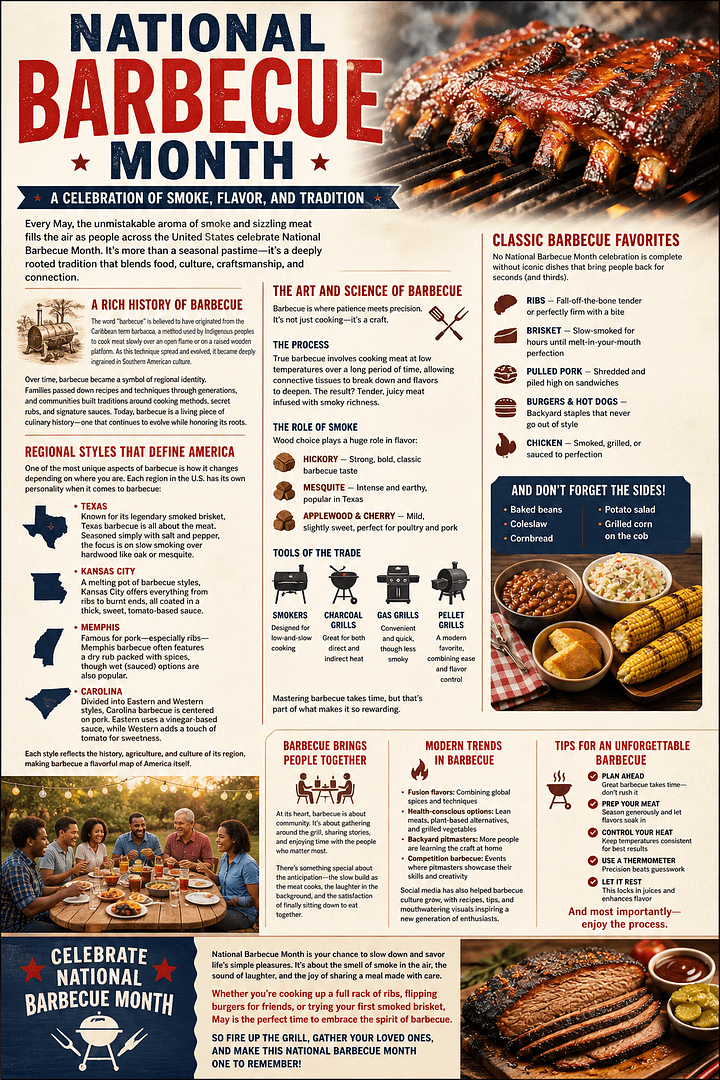
    Every May, the unmistakable aroma of smoke and sizzling meat fills the air as people across the United States celebrate National Barbecue Month. It’s more than a seasonal pastime—it’s a deeply rooted tradition that blends food, culture, craftsmanship, and connection. From seasoned pitmasters to weekend grillers, May is a time to honor the timeless ritual of barbecue and everything it represents.

    A Rich History of Barbecue

    Barbecue has a long and fascinating history that stretches back centuries. The word “barbecue” is believed to have originated from the Caribbean term barbacoa, a method used by Indigenous peoples to cook meat slowly over an open flame or on a raised wooden platform. As this technique spread and evolved, it became deeply ingrained in Southern American culture.

    Over time, barbecue became a symbol of regional identity. Families passed down recipes and techniques through generations, and communities built traditions around cooking methods, secret rubs, and signature sauces. Today, barbecue is a living piece of culinary history—one that continues to evolve while honoring its roots.

    Regional Styles That Define America

    One of the most unique aspects of barbecue is how it changes depending on where you are. Each region in the U.S. has its own personality when it comes to barbecue:

    Texas: Known for its legendary smoked brisket, Texas barbecue is all about the meat. Seasoned simply with salt and pepper, the focus is on slow smoking over hardwood like oak or mesquite.
    Kansas City: A melting pot of barbecue styles, Kansas City offers everything from ribs to burnt ends, all coated in a thick, sweet, tomato-based sauce.
    Memphis: Famous for pork—especially ribs—Memphis barbecue often features a dry rub packed with spices, though wet (sauced) options are also popular.
    Carolina: Divided into Eastern and Western styles, Carolina barbecue is centered on pork. Eastern uses a vinegar-based sauce, while Western adds a touch of tomato for sweetness.

    Each style reflects the history, agriculture, and culture of its region, making barbecue a flavorful map of America itself.

    The Art and Science of Barbecue

    Barbecue is where patience meets precision. It’s not just cooking—it’s a craft.

    The Process

    True barbecue involves cooking meat at low temperatures over a long period of time, allowing connective tissues to break down and flavors to deepen. The result? Tender, juicy meat infused with smoky richness.

    The Role of Smoke

    Wood choice plays a huge role in flavor:

    Hickory: Strong, bold, classic barbecue taste
    Mesquite: Intense and earthy, popular in Texas
    Applewood & Cherry: Mild, slightly sweet, perfect for poultry and pork
    Tools of the Trade
    Smokers: Designed for low-and-slow cooking
    Charcoal grills: Great for both direct and indirect heat
    Gas grills: Convenient and quick, though less smoky
    Pellet grills: A modern favorite, combining ease and flavor control

    Mastering barbecue takes time, but that’s part of what makes it so rewarding.

    Classic Barbecue Favorites

    No National Barbecue Month celebration is complete without iconic dishes that bring people back for seconds (and thirds):

    Ribs: Fall-off-the-bone tender or perfectly firm with a bite
    Brisket: Slow-smoked for hours until melt-in-your-mouth perfection
    Pulled Pork: Shredded and piled high on sandwiches
    Burgers & Hot Dogs: Backyard staples that never go out of style
    Chicken: Smoked, grilled, or sauced to perfection

    And let’s not forget the sides:

    Baked beans
    Coleslaw
    Cornbread
    Potato salad
    Grilled corn on the cob

    Together, these dishes create the full barbecue experience.

    Barbecue Brings People Together

    At its heart, barbecue is about community. It’s about gathering around the grill, sharing stories, and enjoying time with the people who matter most. Whether it’s a family reunion, a neighborhood cookout, or a holiday like Memorial Day, barbecue creates moments that turn into memories.

    There’s something special about the anticipation—the slow build as the meat cooks, the laughter in the background, and the satisfaction of finally sitting down to eat together.

    Modern Trends in Barbecue

    While tradition remains strong, barbecue continues to evolve:

    Fusion flavors: Combining global spices and techniques
    Health-conscious options: Lean meats, plant-based alternatives, and grilled vegetables
    Backyard pitmasters: More people are learning the craft at home
    Competition barbecue: Events where pitmasters showcase their skills and creativity

    Social media has also helped barbecue culture grow, with recipes, tips, and mouthwatering visuals inspiring a new generation of enthusiasts.

    Tips for an Unforgettable Barbecue

    Want to step up your grilling game this May?

    Plan ahead: Great barbecue takes time—don’t rush it
    Prep your meat: Season generously and let flavors soak in
    Control your heat: Keep temperatures consistent for best results
    Use a thermometer: Precision beats guesswork
    Let it rest: This locks in juices and enhances flavor

    And most importantly—enjoy the process.

    Celebrate National Barbecue Month

    National Barbecue Month is your chance to slow down and savor life’s simple pleasures. It’s about the smell of smoke in the air, the sound of laughter, and the joy of sharing a meal made with care.

    Whether you’re cooking up a full rack of ribs, flipping burgers for friends, or trying your first smoked brisket, May is the perfect time to embrace the spirit of barbecue.

    So fire up the grill, gather your loved ones, and make this National Barbecue Month one to remember.

    Read More Holidays & National Days

  • 🥂 Sauvignon Blanc Day: A Crisp Celebration of One of the World’s Most Refreshing Wines

    🥂 Sauvignon Blanc Day: A Crisp Celebration of One of the World’s Most Refreshing Wines

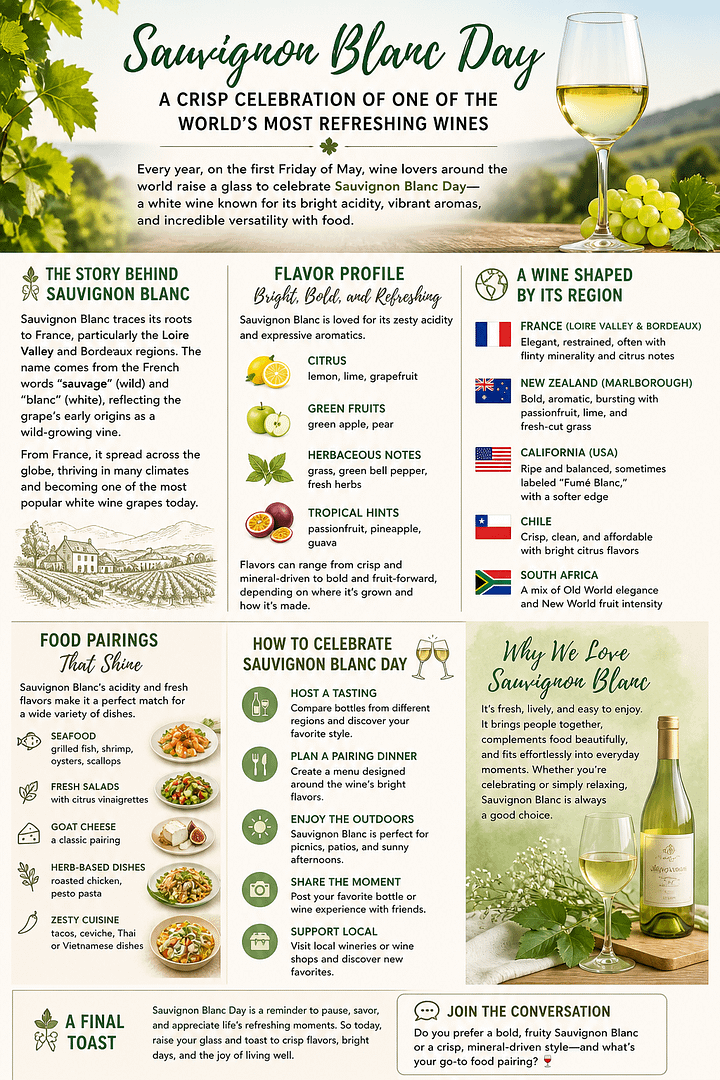
    Every year, wine lovers around the world come together to celebrate Sauvignon Blanc Day, typically observed on the first Friday of May. It’s a day dedicated to appreciating a white wine that embodies freshness, vibrancy, and pure enjoyment. Whether you’re a seasoned wine enthusiast or someone just beginning to explore, Sauvignon Blanc offers an inviting, approachable experience that fits almost any occasion.

    🌿 The Story Behind Sauvignon Blanc

    Sauvignon Blanc traces its roots back to France, particularly the Loire Valley and Bordeaux regions. The name itself comes from the French words “sauvage” (wild) and “blanc” (white), hinting at the grape’s early origins as a wild-growing vine.

    In Bordeaux, Sauvignon Blanc is often blended with Semillon to create complex, age-worthy wines. In the Loire Valley, it shines on its own, producing elegant, mineral-driven wines that reflect the unique soils and climate of the region.

    Over time, Sauvignon Blanc spread across the globe, finding ideal growing conditions in countries like New Zealand, the United States, Chile, and South Africa. Today, it is one of the most widely planted and celebrated white wine grapes in the world.

    🍋 Flavor Profile: Bright, Bold, and Refreshing

    One sip of Sauvignon Blanc, and you’ll quickly understand why it stands out. It’s known for its zesty acidity and expressive aromatics, making it incredibly refreshing and lively on the palate.

    Common flavor notes include:

    🍋 Citrus: lemon, lime, grapefruit
    🍏 Green fruits: green apple, pear
    🌱 Herbaceous tones: grass, green bell pepper, fresh herbs
    🥭 Tropical hints: passionfruit, pineapple, guava (especially in warmer climates)

    The flavor can range from crisp and mineral-driven to bold and fruit-forward, depending on where it’s grown and how it’s made. Some winemakers even experiment with oak aging, adding subtle notes of vanilla or creaminess.

    🌍 A Wine Shaped by Its Region

    Sauvignon Blanc is a perfect example of how terroir—the combination of soil, climate, and environment—affects wine. Here’s how it expresses itself around the world:

    🇫🇷 France (Loire Valley & Bordeaux)
    Elegant, restrained, often with flinty minerality and citrus notes
    🇳🇿 New Zealand (Marlborough)
    Bold, aromatic, bursting with passionfruit, lime, and fresh-cut grass
    🇺🇸 California
    Ripe and balanced, sometimes labeled “Fumé Blanc,” with a softer edge
    🇨🇱 Chile
    Crisp, clean, and affordable with bright citrus flavors
    🇿🇦 South Africa
    A mix of Old World elegance and New World fruit intensity

    Each bottle tells a story of where it comes from, making Sauvignon Blanc an exciting wine to explore and compare.

    🍽️ Food Pairings That Shine

    Sauvignon Blanc is one of the most versatile wines when it comes to food. Its high acidity and fresh flavors make it a natural partner for a wide range of dishes.

    Perfect pairings include:

    🐟 Seafood: grilled fish, shrimp, oysters, scallops
    🥗 Fresh salads: especially with vinaigrettes or citrus dressings
    🧀 Goat cheese: a classic and iconic pairing
    🍗 Herb-based dishes: roasted chicken, pesto pasta
    🌮 Zesty cuisine: tacos, ceviche, Thai or Vietnamese dishes

    Its ability to cut through richness while enhancing freshness makes it a go-to wine for both casual meals and elegant dinners.

    🎉 How to Celebrate Sauvignon Blanc Day

    Sauvignon Blanc Day is the perfect excuse to slow down and enjoy a glass (or two). Here are some meaningful ways to celebrate:

    🥂 Host a tasting: Compare bottles from different regions and discover your favorite style
    🍽️ Plan a pairing dinner: Create a menu designed around the wine’s bright flavors
    🌿 Enjoy the outdoors: Sauvignon Blanc is perfect for picnics, patios, and sunny afternoons
    📸 Share the moment: Post your favorite bottle or wine experience with friends
    🛍️ Support local wineries or wine shops: Discover new labels and hidden gems
    🌞 Why Sauvignon Blanc Is So Loved

    There’s something undeniably uplifting about Sauvignon Blanc. It’s not heavy or complicated—it’s fresh, lively, and easy to enjoy. It brings people together, complements food beautifully, and fits effortlessly into everyday moments.

    Whether you’re unwinding after a long day, celebrating with friends, or simply enjoying a quiet evening, Sauvignon Blanc offers a simple pleasure that feels just right.

    🥂 A Final Toast

    Sauvignon Blanc Day is more than just a celebration of wine—it’s a reminder to pause, savor, and appreciate life’s refreshing moments. In a fast-paced world, sometimes all you need is a chilled glass, good company, and a reason to smile.

    So today, raise your glass and toast to crisp flavors, bright days, and the joy of living well.

    Read More Holidays & National Days