Author: Brett Murphy

  • 🧀 National Grilled Cheese Month: A Celebration of Comfort, Simplicity, and Golden Perfection

    🧀 National Grilled Cheese Month: A Celebration of Comfort, Simplicity, and Golden Perfection

    Every April, something simple—and incredibly special—takes center stage in kitchens, cafés, and hearts across the country: the grilled cheese sandwich. National Grilled Cheese Month is more than just a nod to a popular comfort food; it’s a tribute to tradition, creativity, and the kind of meals that bring people together without needing anything fancy.

    In a world that often moves too fast, grilled cheese reminds us to slow down. To savor. To enjoy the little things.

    A Sandwich That Stood the Test of Time

    The story of grilled cheese is woven into American history. While melted cheese on bread dates back to ancient times, the version we recognize today became widely popular in the United States during the early 1900s. When sliced bread and affordable cheese became accessible, this simple sandwich found its way into homes everywhere.

    During difficult times like the Great Depression, grilled cheese wasn’t just a meal—it was survival. It was nourishment on a budget, warmth during uncertainty, and something families could count on.

    By World War II, it had become a staple for soldiers and civilians alike. Cafeterias served “cheese dream” sandwiches—open-faced, melted, and filling. Over time, it evolved into the two-slice classic we know today.

    What started as necessity became tradition.

    Why Grilled Cheese Means So Much

    There’s something emotional about grilled cheese that goes beyond taste. It’s not just food—it’s memory.

    It’s:

    Sitting at the kitchen table as a kid, watching butter melt in a pan
    The sound of bread crisping to golden perfection
    A parent or grandparent making something simple feel special
    A late-night snack when the world feels quiet

    Grilled cheese is comfort in its purest form. It doesn’t try to impress—it just delivers.

    And somehow, that’s what makes it unforgettable.

    The Art of the Perfect Grilled Cheese

    While it may seem easy, a truly great grilled cheese is an art form.

    The essentials:

    Bread: Soft white, hearty sourdough, or artisan slices
    Cheese: American for melt, cheddar for flavor, or a blend for depth
    Butter (or mayo): For that perfectly crisp, golden exterior

    But the magic is in the details:

    Low, steady heat ensures the bread doesn’t burn before the cheese melts
    Even spreading creates that signature crunch
    Patience turns simple ingredients into something extraordinary

    A perfect grilled cheese isn’t rushed—it’s crafted.

    From Comfort Food to Culinary Canvas

    What makes grilled cheese truly special is its versatility. While the classic remains untouchable, modern takes have turned this sandwich into a gourmet experience.

    Creative variations include:

    Savory upgrades: Bacon, ham, caramelized onions, sautéed mushrooms
    Fresh additions: Tomato, spinach, avocado, arugula
    Sweet & savory combos: Brie with apple slices or fig jam
    Bold flavors: Jalapeños, pesto, garlic butter, or spicy aioli

    Food trucks, diners, and upscale restaurants alike have embraced grilled cheese as a platform for innovation—proving that even the simplest dish can evolve without losing its soul.

    The Iconic Pairing: Tomato Soup

    Few combinations are as iconic as grilled cheese and tomato soup. The crispy, buttery sandwich dipped into a warm, tangy soup creates a perfect balance of textures and flavors.

    It’s comfort on another level—especially on cold or rainy days.

    This pairing has become more than a meal. It’s a ritual. A tradition passed down through generations.

    Grilled Cheese in Today’s World

    Even in an era of fast food and endless options, grilled cheese continues to hold its place. Why?

    Because it’s:

    Affordable
    Easy to make
    Universally loved
    Infinitely customizable

    From quick lunches to late-night cravings, grilled cheese fits every moment. It doesn’t require a special occasion—it becomes one.

    And in recent years, it’s even gained a following online, with food creators sharing unique spins, cheese pulls, and recipes that push the limits of creativity.

    A Month to Slow Down and Savor

    National Grilled Cheese Month is an invitation—not just to eat, but to experience.

    It’s a chance to:

    Cook something simple with intention
    Share a meal with family or friends
    Teach someone how to make their first grilled cheese
    Try a new twist on an old favorite

    It reminds us that food doesn’t have to be complicated to be meaningful.

    Sometimes, the most powerful moments happen over something as simple as melted cheese on toasted bread.

    More Than Food—It’s Connection

    At its core, grilled cheese is about togetherness.

    It’s about:

    Conversations at the table
    Laughter between bites
    Quiet moments of comfort
    Remembering the people who made it for you

    Food has a way of connecting us—and grilled cheese does it effortlessly.

    🧡 Final Reflection

    In a world that often feels overwhelming, grilled cheese is a reminder of what matters: warmth, simplicity, and connection.

    This April, take the time to make one. Share one. Or enjoy it quietly on your own.

    Because sometimes, the smallest things bring the greatest comfort.

    Read More Holidays & National Days
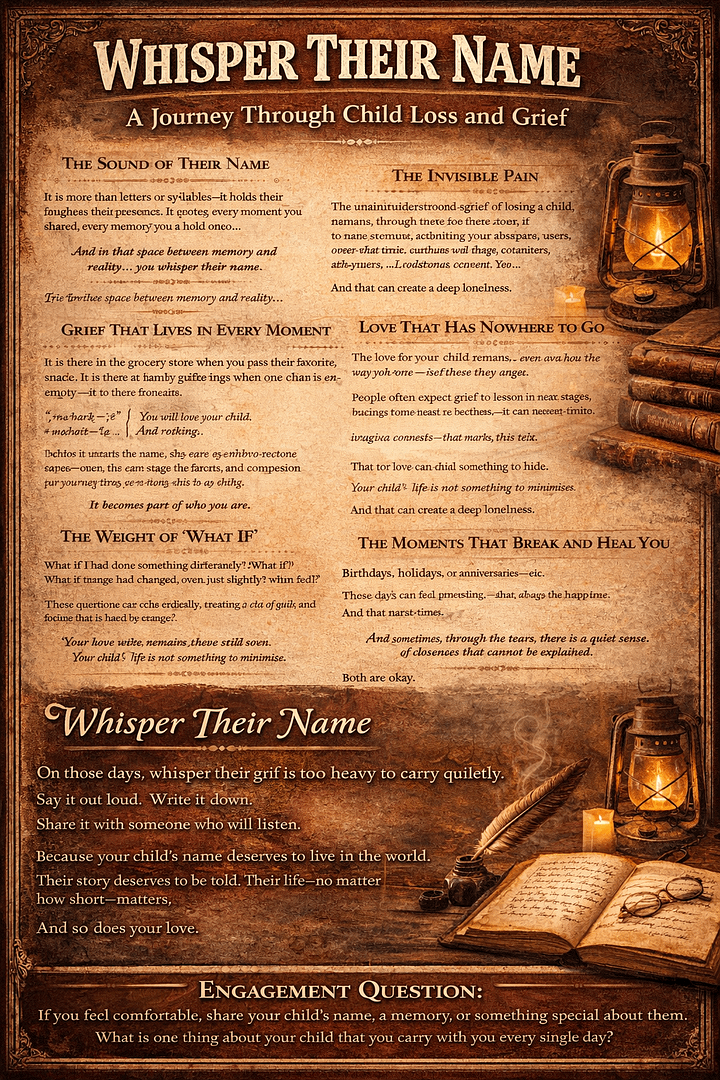
  • Whisper Their Name: A Journey Through Child Loss and Grief

    Whisper Their Name: A Journey Through Child Loss and Grief

    There are losses that alter the very structure of a person’s life—and then there is the loss of a child. It is not something you “get through.” It is something you learn to carry. It changes how you see the world, how you measure time, and how you understand love.

    Because when a child is gone, everything after is divided into two parts:
    before… and after.

    Before, life may have felt ordinary—busy, loud, full of plans.
    After, even the smallest moments feel different, marked by an absence that never fully leaves.

    And in that space between memory and reality…
    you whisper their name.

    The Sound of Their Name

    There is something sacred about a child’s name.

    It is more than letters or syllables—it holds their laughter, their personality, their presence. It carries every moment you shared, every memory you hold onto.

    After loss, saying their name can feel both comforting and painful.
    Some people hesitate. Some avoid it.
    But for a grieving parent, hearing or speaking that name is everything.

    Because it means they are still seen.
    Still remembered.
    Still loved.

    You whisper their name in the quiet hours of the night when sleep won’t come.
    You whisper it in the morning when the world feels too heavy to face.
    You whisper it because it connects you to them in a way nothing else can.

    And sometimes… you whisper it just to feel close again.

    Grief That Lives in Every Moment

    Child loss grief is not something that stays in one place. It follows you into every part of life.

    It is there in the grocery store when you pass their favorite snack.
    It is there at family gatherings when one chair is empty.
    It is there in the milestones that should have been—graduations, birthdays, weddings that will never come.

    Grief doesn’t wait for the “right” time.
    It arrives unannounced.

    A song.
    A smell.
    A place.

    And suddenly, you are back in a moment that feels both distant and painfully close.

    People often expect grief to lessen in neat stages, but child loss does not follow that pattern. It expands, contracts, reshapes itself over time—but it never disappears.

    It becomes part of who you are.

    The Weight of “What If”

    One of the heaviest burdens in child loss is the question that never finds an answer:

    What if?

    What if I had done something differently?
    What if I had known?
    What if things had changed, even just slightly?

    These questions can echo endlessly, creating a cycle of guilt and doubt that is hard to escape.

    But the truth—no matter how difficult—is that love does not cause loss.

    You loved your child.
    You still love your child.
    And nothing about that love was ever wrong.

    Learning to release the weight of “what if” is not easy. It takes time, patience, and compassion for yourself. And even then, those thoughts may still come.

    When they do, remind yourself:
    Your love was real.
    Your presence mattered.
    And your child knew they were loved.

    The Invisible Pain

    Grief is often misunderstood—especially the grief of losing a child.

    In the beginning, there may be support. People reach out. They offer words, meals, and comfort. But as time passes, the world quietly returns to normal.

    Yours does not.

    The pain doesn’t follow a timeline. It doesn’t expire after weeks or months. It stays, even when others stop asking how you’re doing.

    And that can create a deep loneliness.

    You may feel like you have to hide your grief to make others comfortable.
    You may feel like your child’s name is spoken less and less.
    You may feel like the world is forgetting someone you can never forget.

    But your grief is not something to hide.
    Your child’s life is not something to minimize.

    You have every right to speak their name.
    To share their story.
    To remember them out loud.

    Love That Has Nowhere to Go

    One of the most painful parts of child loss is this:

    The love you have for your child does not go away.

    It remains—full, strong, and constant—but without the physical presence to receive it.

    That love has nowhere obvious to go… so it settles into your heart, often becoming grief.

    But that love can still move.

    It moves through the way you honor them.
    Through the kindness you show others.
    Through the way you carry their memory into the world.

    Some parents create foundations, scholarships, or charities in their child’s name.
    Some write, speak, or share their stories.
    Some simply live each day trying to reflect the love their child gave them.

    There is no right way to carry that love forward.

    Only your way.

    The Moments That Break and Heal You

    There will always be moments that bring the pain rushing back.

    Birthdays that should have been celebrated.
    Holidays that feel incomplete.
    Anniversaries that mark time without them.

    These days can feel unbearable.

    But they can also hold something else—connection.

    Lighting a candle.
    Releasing a balloon.
    Looking through old photos.
    Sharing stories with others who remember.

    In these moments, grief and love exist side by side.

    And sometimes, through the tears, there is a quiet sense of closeness that cannot be explained.

    Learning to Live With Both Joy and Pain

    One of the hardest lessons in grief is allowing yourself to feel joy again.

    There can be guilt in smiling.
    In laughing.
    In experiencing moments of happiness.

    It can feel like you are leaving your child behind.

    But you are not.

    Your child is a part of you.
    And every moment you live carries them forward.

    Learning to live again does not mean forgetting.
    It means making space—for both the pain and the beauty that still exists in life.

    Some days, that balance feels impossible.
    Other days, it comes quietly.

    Both are okay.

    A Bond That Death Cannot Break

    The relationship between a parent and child does not end with death.

    It changes—but it does not disappear.

    You may no longer hold their hand, hear their voice, or see their smile.
    But the bond remains.

    In your thoughts.
    In your dreams.
    In the way you still speak to them when no one else is around.

    Love does not require presence to exist.
    It simply requires connection.

    And that connection is unbreakable.

    Whisper Their Name

    There will be days when the grief is too heavy to carry quietly.

    On those days, whisper their name.

    Say it out loud.
    Write it down.
    Share it with someone who will listen.

    Let it be heard.

    Because your child’s name deserves to live in the world.
    Their story deserves to be told.
    Their life—no matter how short—matters.

    And so does your love.

    Forever Changed, Forever Connected

    You will never be the same person you were before this loss.

    And that is not a failure—it is a reflection of love.

    You have loved deeply.
    You have lost deeply.
    And you continue to carry both.

    That is strength, even when it doesn’t feel like it.

    So in the quiet moments, when the world slows down and your heart speaks the loudest…

    Whisper their name.

    Not just in grief,
    but in love.

    Because they are still part of your story.
    Still part of your life.
    Still part of you.

    Always.

    A Father’s Guide to Surviving the Loss of a Child

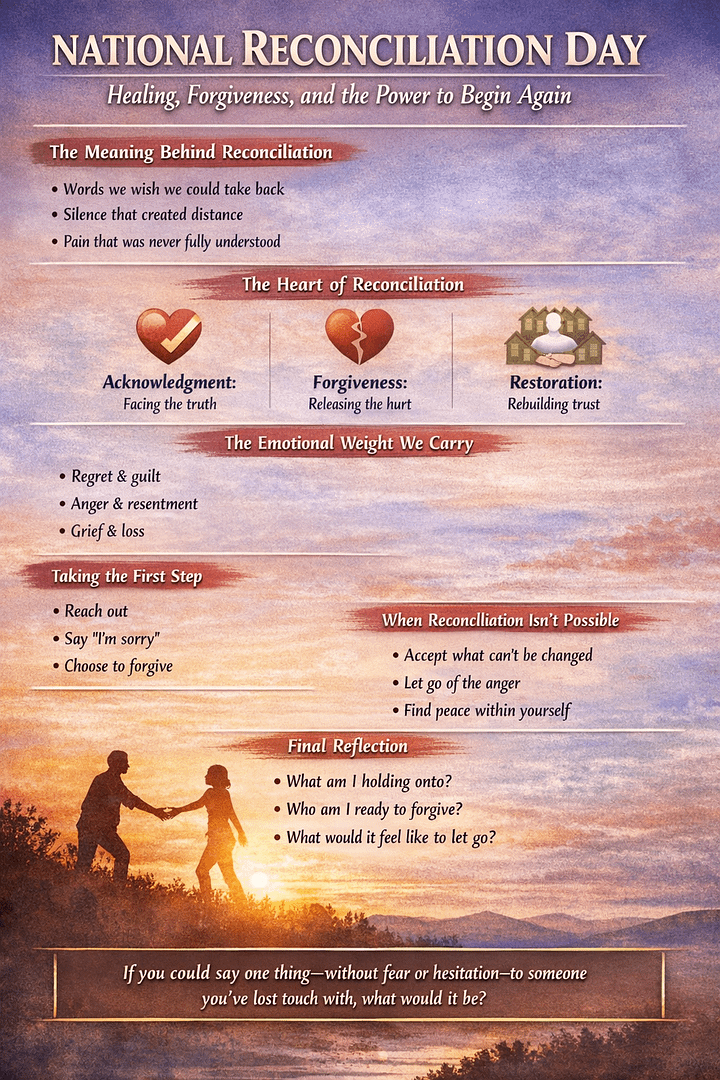
  • National Reconciliation Day: Healing, Forgiveness, and the Power to Begin Again

    National Reconciliation Day: Healing, Forgiveness, and the Power to Begin Again

    In a world that often feels fractured by misunderstanding, loss, and unresolved pain, National Reconciliation Day rises as a quiet but powerful call—to heal, to forgive, and to find our way back to one another.

    This day is not just about repairing broken relationships. It is about confronting what has been left unsaid, acknowledging wounds that never fully healed, and choosing—sometimes against every instinct—to open the door to peace again.

    Reconciliation is not easy. It is not quick. And it is rarely simple. But it is one of the most courageous things a human heart can do.

    The Meaning Behind Reconciliation

    At its core, reconciliation is about restoring what has been broken, even if it never returns to exactly what it once was. It is the act of bridging distance—emotional, relational, or even generational.

    It asks us to face truths we may have avoided:

    Words we wish we could take back
    Silence that created distance
    Pain that was never fully understood

    Reconciliation does not erase these things. Instead, it transforms them into something new—something that can coexist with growth, understanding, and, sometimes, even deeper connection than before.

    The Emotional Weight We Carry

    Many people walk through life carrying invisible burdens:

    Regret over things left unsaid
    Anger toward someone who hurt them
    Guilt for mistakes they cannot undo
    Grief for relationships that faded or ended

    These emotions do not disappear on their own. They settle into the heart, quietly shaping how we see the world and how we connect with others.

    National Reconciliation Day reminds us that we do not have to carry that weight forever.

    Sometimes, healing begins not with fixing everything—but with acknowledging that something needs to be healed at all.

    The Courage to Take the First Step

    Reconciliation often starts in the smallest ways:

    A message that says, “I’ve been thinking about you.”
    A phone call that begins with silence, then honesty
    A simple “I’m sorry” or “I forgive you”

    These words may seem small, but they carry immense power. They break through walls that may have stood for years.

    But taking that first step requires courage—because it comes with uncertainty.

    Will they respond?
    Will they understand?
    Will things ever be the same again?

    The truth is, reconciliation does not guarantee the outcome we hope for. But it does guarantee that we have chosen growth over pride, and healing over distance.

    Forgiveness: The Heart of Reconciliation

    Forgiveness is often misunderstood. It is not about saying what happened was okay. It is not about forgetting the pain or pretending it didn’t matter.

    Forgiveness is about releasing the hold that pain has on your life.

    When we hold onto anger, resentment, or bitterness, we remain tied to the moment that hurt us. Forgiveness is the act of cutting that tie—not for them, but for ourselves.

    It is one of the most freeing choices a person can make.

    And yet, it is also one of the hardest.

    Reconciliation Within Families

    Some of the deepest wounds exist within families. These are the relationships we expect to be unbreakable—yet they are often the ones most strained by time, misunderstanding, or unresolved conflict.

    National Reconciliation Day is a chance to reflect on those bonds:

    The parent you haven’t spoken to
    The sibling you grew apart from
    The child you wish you could understand better

    Family reconciliation can be especially emotional because it touches on identity, history, and love that never fully disappears—even when distance grows.

    Sometimes, healing begins with simply saying:
    “I miss you.”

    When Reconciliation Meets Grief

    For those who have lost someone—especially a child, a parent, or a loved one taken too soon—reconciliation takes on a different meaning.

    It may not be about reaching out. It may be about making peace with:

    Words you never got to say
    Moments you wish you could relive
    Love that still exists without a place to go

    In these cases, reconciliation becomes deeply internal.

    It is about forgiving yourself.
    It is about allowing yourself to grieve without guilt.
    It is about honoring love without being consumed by loss.

    Sometimes, reconciliation is not with a person—but with the life that remains.

    When Reconciliation Isn’t Possible

    Not every relationship can be repaired. Some situations involve deep harm, broken trust, or circumstances where reconnecting is not safe or healthy.

    And that’s important to acknowledge.

    Reconciliation does not always mean reunion.

    In those cases, it may look like:

    Letting go of anger without reopening the relationship
    Accepting what cannot be changed
    Choosing peace over continued pain

    You are allowed to heal—even if the other person is no longer part of your life.

    The Ripple Effect of Reconciliation

    When one person chooses reconciliation, it often creates a ripple effect.

    A healed relationship can:

    Restore families
    Strengthen communities
    Inspire others to confront their own unresolved conflicts

    Even small acts of forgiveness can change the emotional landscape of an entire group of people.

    Peace is contagious—just like conflict is.

    A Day That Matters More Than We Realize

    National Reconciliation Day is not just symbolic. It is an invitation.

    An invitation to:

    Reflect on who or what needs healing in your life
    Release burdens you’ve carried too long
    Choose understanding instead of judgment
    Begin again, even if it feels uncertain

    It reminds us that while we cannot control the past, we are not powerless in the present.

    Final Reflection

    Reconciliation is not a moment—it is a process. It unfolds slowly, often imperfectly, and sometimes painfully.

    But within that process is something deeply human:
    the desire to connect, to heal, and to love despite everything.

    On this National Reconciliation Day, take a moment to ask yourself:

    What am I holding onto?
    Who am I ready to forgive?
    What would it feel like to finally let go?

    Because sometimes, the most powerful thing you can do…

    is choose peace when holding onto pain would be easier.

    Read More Holidays & National Days

  • What You Give Is Who You Are

    What You Give Is Who You Are

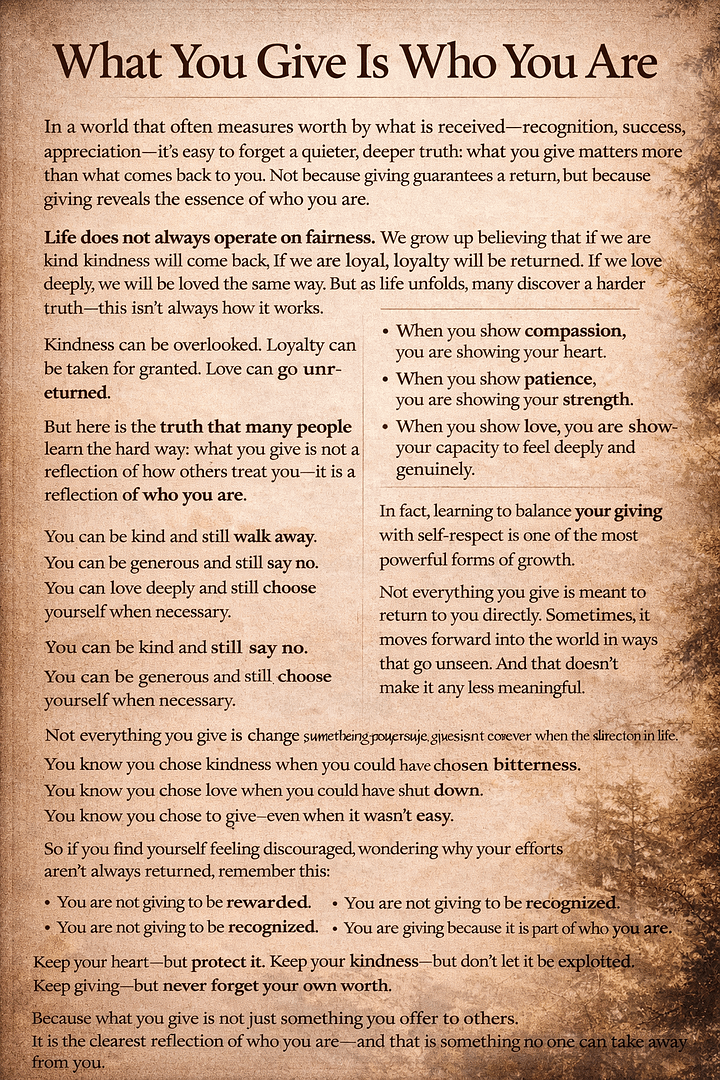
    In a world that often measures worth by what is received—recognition, success, appreciation—it’s easy to forget a quieter, deeper truth: what you give matters more than what comes back to you. Not because giving guarantees a return, but because giving reveals the essence of who you are.

    Life does not always operate on fairness. We grow up believing that if we are kind, kindness will come back. If we are loyal, loyalty will be returned. If we love deeply, we will be loved the same way. But as life unfolds, many discover a harder truth—this isn’t always how it works.

    Kindness can be overlooked. Loyalty can be taken for granted. Love can go unreturned.

    And when that happens, it hurts.

    There is a quiet ache in giving your best to someone or something and not receiving that same energy in return. It can make you question yourself. It can make you wonder if you are giving too much, caring too deeply, or trusting too easily. It can even tempt you to close your heart, to give less, to protect yourself from disappointment.

    But here is the truth that many people learn the hard way: what you give is not a reflection of how others treat you—it is a reflection of who you are.

    When you show compassion, you are showing your heart.
    When you show patience, you are showing your strength.
    When you show love, you are showing your capacity to feel deeply and genuinely.

    Those things are not weaknesses. They are not flaws. They are the very qualities that define your character.

    And just because someone else fails to recognize or return what you give does not mean it loses its value.

    There is strength in continuing to be kind in a world that can be cold. There is courage in choosing to love in a world that sometimes responds with indifference. There is resilience in staying true to yourself when it would be easier to become hardened or guarded.

    But this doesn’t mean you should allow yourself to be taken advantage of.

    There is an important difference between giving from the heart and giving at the expense of yourself. Healthy giving comes from a place of strength, not depletion. It means knowing when to step back, when to set boundaries, and when to protect your energy.

    Because being a giving person does not mean you have to accept being undervalued.

    You can be kind and still walk away.
    You can be generous and still say no.
    You can love deeply and still choose yourself when necessary.

    In fact, learning to balance your giving with self-respect is one of the most powerful forms of growth.

    There will always be people who take more than they give. There will always be situations where your efforts go unnoticed. But there will also be moments—sometimes quiet, sometimes unexpected—where what you give makes a difference in ways you may never fully see.

    A kind word might stay with someone longer than you realize.
    A small act of support might come at exactly the right time.
    A moment of patience might change someone’s day… or even their direction in life.

    Not everything you give is meant to return to you directly. Sometimes, it moves forward into the world in ways that go unseen. And that doesn’t make it any less meaningful.

    What matters most is this: when you look at yourself, you know who you are.

    You know you chose kindness when you could have chosen bitterness.
    You know you chose love when you could have shut down.
    You know you chose to give—even when it wasn’t easy.

    That kind of self-awareness creates something powerful: peace.

    Because at the end of the day, you are not defined by how others treat you. You are defined by how you show up—especially when it’s hard.

    So if you find yourself feeling discouraged, wondering why your efforts aren’t always returned, remember this:

    You are not giving to be rewarded.
    You are not giving to be recognized.
    You are giving because it is part of who you are.

    And in a world where so many people change based on how they are treated, choosing to stay true to your character is one of the strongest things you can do.

    Keep your heart—but protect it.
    Keep your kindness—but don’t let it be exploited.
    Keep giving—but never forget your own worth.

    Because what you give is not just something you offer to others.

    It is the clearest reflection of who you are—and that is something no one can take away from you.

    Read More Of Inspiration & Motivation

  • April Fools’ Day: A Celebration of Laughter, Tricks, and Human Connection

    April Fools’ Day: A Celebration of Laughter, Tricks, and Human Connection

    Every year on April 1st, something quietly shifts across the world. People wake up with a little more curiosity, a little more caution, and—if they’re lucky—a little more laughter waiting around the corner. April Fools’ Day isn’t just a day for jokes; it’s a reminder that even in a world filled with seriousness, there is still space for play.

    It is one of the rare moments where laughter becomes expected, mischief becomes acceptable, and joy becomes contagious.

    The Origins: A Story That Mirrors the Day Itself

    April Fools’ Day is fittingly mysterious. Much like the pranks it celebrates, its origins are not entirely clear, and that uncertainty has become part of its identity.

    One widely accepted theory traces the tradition back to 16th-century France. When the Gregorian calendar replaced the Julian calendar, New Year’s celebrations moved from late March/early April to January 1st. Those who either didn’t know about the change or chose to ignore it continued celebrating in early April—and became the targets of jokes and ridicule. They were labeled “April fools,” often having paper fish placed on their backs as a prank.

    Other historians connect the day to ancient festivals like Hilaria in Rome, where people dressed in disguises and mocked one another, or to medieval celebrations that temporarily flipped social roles—allowing humor to break the structure of everyday life.

    No matter its exact origin, the meaning has stayed consistent: laughter is timeless, and people have always found ways to create it.

    The Psychology of a Good Laugh

    There’s a reason April Fools’ Day has lasted for centuries—it taps into something deeply human.

    Laughter:

    Reduces stress
    Strengthens relationships
    Releases endorphins
    Helps us cope with difficult emotions

    In many ways, humor is survival. It’s how people navigate pain, loss, uncertainty, and pressure. Even a small joke can interrupt a heavy moment and remind us that we’re still here, still connected, still capable of joy.

    For those carrying deeper burdens—grief, heartbreak, or stress—April Fools’ Day can feel different. But even then, a gentle laugh can become a moment of relief, not replacement. It doesn’t erase pain, but it gives it space to breathe.

    The Evolution of the Prank

    What once started as simple tricks has grown into an art form.

    Classic pranks still hold their place:

    The whoopee cushion under a chair
    Plastic insects hidden in unexpected places
    Swapping everyday items like sugar and salt
    Fake spills or broken objects

    But today’s world has taken things further.

    Modern pranks include:

    Fake social media announcements
    Elaborate workplace setups (like covering an office in sticky notes)
    Brand campaigns announcing outrageous fake products
    Viral videos designed to trick viewers before revealing the joke

    Companies now participate just as much as individuals, creating playful campaigns that sometimes blur the line between fiction and reality—at least for a few hours.

    The Fine Line: Humor vs. Harm

    While April Fools’ Day celebrates jokes, it also quietly teaches responsibility.

    The best pranks share one thing in common: everyone laughs.

    The worst ones:

    Embarrass people publicly
    Trigger fear or anxiety
    Cross personal boundaries
    Exploit trust in harmful ways

    Humor should never come at the cost of someone else’s dignity. A good prank surprises—but it also respects.

    A simple question to ask before any joke:
    Will this create laughter… or regret?

    Why April Fools’ Day Still Matters Today

    In a fast-paced, often overwhelming world, April Fools’ Day stands as a small but meaningful pause.

    It reminds us:

    To not take everything so seriously
    To reconnect with childlike curiosity
    To share moments that don’t require perfection
    To laugh—even when life feels heavy

    For many people, especially those navigating loss or hardship, joy can feel distant. Days like this don’t fix that—but they can soften it, even if just for a moment.

    And sometimes, a moment is enough.

    More Than a Joke—A Reflection of Humanity

    At its core, April Fools’ Day isn’t about tricks—it’s about connection.

    It’s about:

    The friend who sets up a harmless joke just to see you smile
    The coworker who breaks the routine with laughter
    The family moment that turns into a shared memory

    These small interactions matter more than we often realize. They remind us that beneath all the seriousness of life, we are still human—still capable of joy, still capable of making each other feel something good.

    A Final Thought

    Not every April Fools’ Day will be filled with laughter for everyone. Some people will carry pain that humor can’t reach. But even then, the spirit of the day still offers something gentle:

    A reminder that light still exists.

    And sometimes, the smallest smile is the strongest kind of resilience.

    Read More Holidays & National Days

  • Trying to Honor My Son by Living

    Trying to Honor My Son by Living

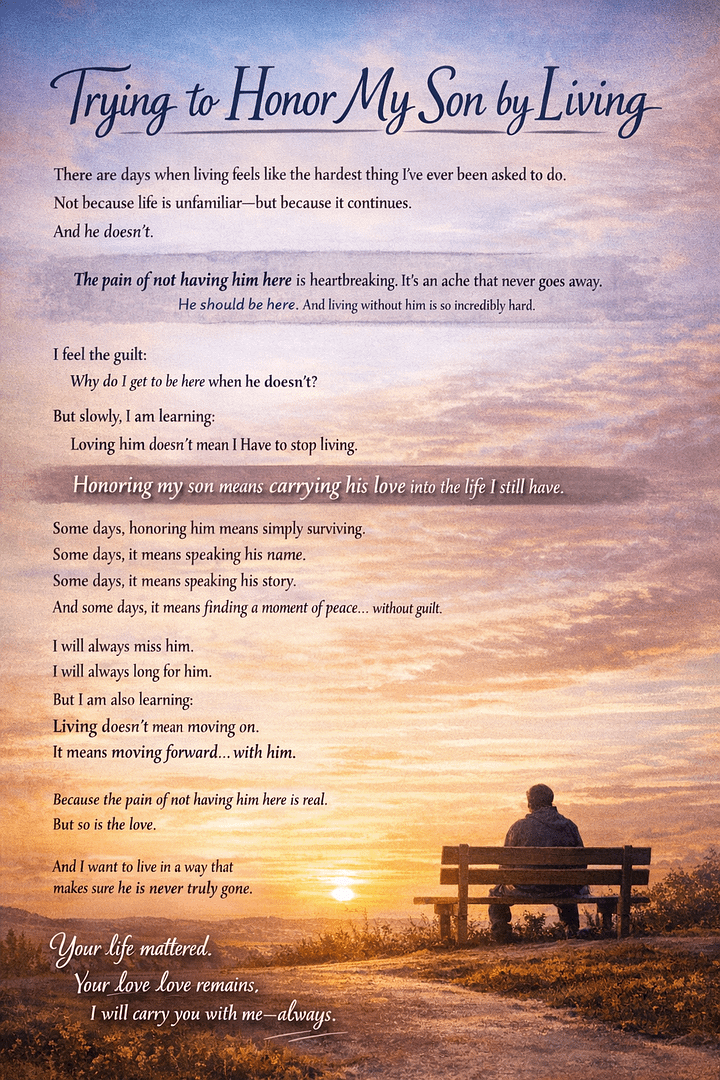
    There are days when living feels like the hardest thing I have ever been asked to do.

    Not because life is unfamiliar—but because it continues.

    And he doesn’t.

    That is the quiet, unbearable truth that grief lays at your feet every single morning. The world wakes up, the sun rises, people laugh, plans are made… and somehow, you are expected to step into that same rhythm carrying a loss that never sets down.

    But what people don’t always see—what is so hard to explain—is the pain of not having him here.

    It’s not just sadness.
    It’s not just missing someone.

    It is a deep, aching absence that lives in everything.

    It’s in the empty chair at the table.
    It’s in the silence where his voice should be.
    It’s in the moments you instinctively reach for your phone to call or text… and then remember you can’t.

    It’s the kind of pain that doesn’t ask permission. It shows up in the middle of ordinary moments—at the grocery store, driving down a familiar road, hearing a song, watching someone else’s child laugh.

    And suddenly, your chest tightens.

    Because he should be here.

    He should be living his life.
    He should be laughing, growing, becoming.
    He should be part of the everyday moments that now feel incomplete without him.

    There is a helplessness in that realization that cuts deeper than words can hold.

    You can’t fix it.
    You can’t change it.
    You can’t go back.

    All you can do is feel it.

    And the weight of that pain—it doesn’t fade the way people think it will. It doesn’t just “get better.” It changes shape, it moves, it softens in places over time… but it never truly leaves.

    Because he was never meant to leave.

    There are nights when the grief is loud.

    When memories replay over and over.
    When questions have no answers.
    When the ache of wanting just one more moment, one more conversation, one more hug becomes almost too much to carry.

    And in those moments, living doesn’t feel strong.

    It feels impossible.

    It feels unfair.

    It feels like you are being asked to walk forward while your heart is anchored in the past.

    There is a guilt that comes with surviving him.

    A guilt that whispers:

    Why do I get to be here when he doesn’t?
    Why do I get another day when he doesn’t?

    And that guilt can make even the smallest steps forward feel like betrayal.

    Smiling feels wrong.
    Laughing feels wrong.
    Feeling anything other than pain can feel like you are somehow letting him go.

    But the truth—the one that takes time, tears, and a thousand broken moments to begin to understand—is this:

    Loving him doesn’t mean I have to stop living.

    In fact, it may mean the opposite.

    Honoring my son is not found in staying frozen in the moment I lost him. It is not found in refusing joy or pushing away healing. It is found in choosing, even when it hurts, to carry his love into the life I still have.

    Because the pain of not having him here will always be real.

    I will always miss him.
    I will always wish he was here.
    There will always be moments that feel incomplete because he is not in them.

    But alongside that pain, there is also something else that refuses to die:

    Love.

    A love that didn’t end when his life did.
    A love that still moves through me, even on the hardest days.
    A love that asks me—not gently, but persistently—to do something with it.

    So I try.

    Some days, honoring him means simply surviving the day.
    Some days, it means speaking his name so he is never forgotten.
    Some days, it means sharing his story so others know he was here, that he mattered.
    And some days, it means allowing myself to feel a moment of peace… without guilt.

    Because if I stop living completely, then grief becomes the only thing left.

    And he was so much more than grief.

    He was laughter.
    He was light.
    He was love.

    And if I can carry even a small piece of that into the world—through kindness, through compassion, through simply showing up—then his life continues to matter in a way that reaches beyond his time here.

    Living will never be easy again.

    Not in the way it once was.

    There will always be a part of me that is missing.
    There will always be a part of my heart that belongs to him, frozen in time.

    But I am learning—slowly, imperfectly—that living doesn’t mean moving on.

    It means moving forward… with him.

    In every step I take.
    In every breath I draw.
    In every act of love I choose to give, even when I am hurting.

    Because the pain of not having him here is real.

    But so is the love.

    And that love is what keeps me going.

    Not because I want to live in a world without him…

    but because I want to live in a way that makes sure he is never truly gone.

    A Father’s Guide to Surviving the Loss of a Child

  • Grieving the Life Your Child Would Have Had

    Grieving the Life Your Child Would Have Had

    There is a grief that exists beyond what most people can see or fully understand.

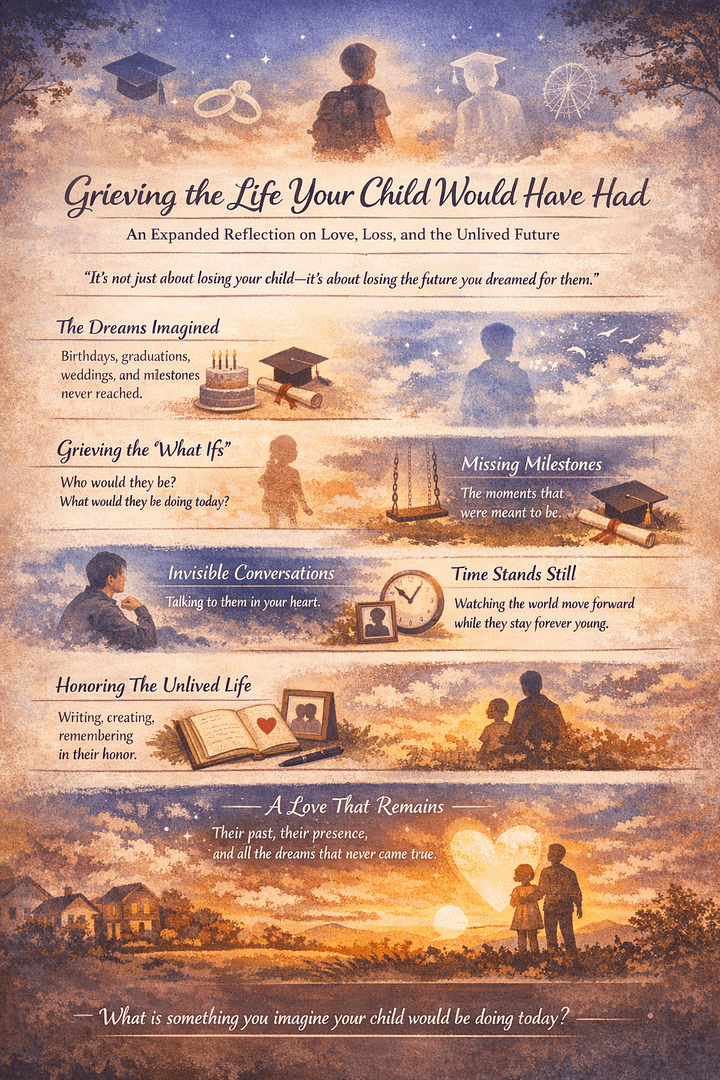
    It is not only the grief of losing your child—it is the grief of losing the life they were meant to live. It is mourning a future that once felt certain. A life that was imagined in quiet moments, built in your heart through dreams, hope, and love.

    This grief is not loud. It does not always show itself in tears or words.

    But it is constant.

    It lives in the spaces between what is… and what should have been.

    The Life You Began Imagining Before It Ever Happened

    When a child is born, so is a vision of their future.

    You don’t just hold your child—you begin to hold their possibilities.

    You picture:

    Their first steps turning into long walks into independence
    Their first words becoming conversations filled with personality
    Their small hands growing into capable, confident ones
    Their childhood unfolding into a life of purpose and identity

    You begin to imagine birthdays, friendships, challenges, achievements, and even the kind of person they will become.

    These are not unrealistic fantasies. They are part of what it means to love a child.

    And when that child is gone, those visions don’t disappear. They remain vivid, unfinished, and painfully suspended in time.

    A Future That Still Feels Real

    Grieving the life your child would have had is unique because that future never had the chance to become memory.

    It exists only in your heart and mind—but it feels just as real as anything that actually happened.

    You may find yourself wondering:

    What would they look like today?
    What would they be passionate about?
    Who would they love?
    What kind of life would they be building?

    These thoughts can come at any time—while driving, while watching others, while sitting in silence.

    You might see someone their age and instinctively measure time against what your child should be experiencing.

    And in those moments, the absence becomes overwhelming.

    Because you’re not just remembering—you’re imagining a life that deserved to exist.

    Grieving Milestones That Never Arrived

    Grief is often tied to anniversaries and dates—but for parents, it also attaches itself to milestones that never came.

    You grieve:

    The first day of school they never walked into
    The graduation they never celebrated
    The job they never got
    The family they never created
    The aging you will never witness

    Each milestone becomes a reminder—not just of loss, but of interruption.

    Life didn’t just end. It was cut off mid-story.

    And what makes this especially painful is that these milestones continue to happen all around you—for other children, other families, other lives moving forward.

    You are left standing still, holding a future that never got the chance to begin.

    The Invisible Conversations

    There are conversations that continue long after your child is gone.

    They happen quietly, internally, sometimes without words.

    You might:

    Talk to them in your thoughts
    Wonder what advice they would give you now
    Imagine their reactions to your life today
    Picture them sitting beside you in moments of joy or struggle

    These imagined interactions are not illusions.

    They are extensions of love.

    They are your heart’s way of keeping connection alive—even when the world has moved on.

    The Pain of Watching Time Move Forward

    Time becomes complicated after loss.

    The world continues. People grow older. Life evolves.

    But for you, your child remains at the age they were.

    And that creates a painful contrast.

    You may notice:

    Children their age growing up, while yours stays frozen in time
    Friends becoming parents, while your child never had that chance
    Years passing, while your memories remain anchored

    There is a quiet, almost surreal feeling in watching time move forward while part of your life stands still.

    It can feel like living in two realities at once.

    The Guilt That Sometimes Follows

    Grieving the life your child would have had can also bring unexpected emotions—like guilt.

    You might feel guilty for:

    Imagining a future they didn’t get to live
    Laughing or finding joy in your own life
    Moving forward while they cannot
    Wondering if you’re holding on too tightly or not enough

    These feelings are deeply human.

    But the truth is this:
    Loving your child includes loving the life they deserved.

    There is no guilt in remembering, imagining, or honoring what should have been.

    Learning to Carry Both Love and Loss

    Over time, you begin to understand that this grief is not something you “get over.”

    It is something you learn to carry.

    You carry:

    The child you knew
    The person they were becoming
    The future they never reached

    And somehow, you find space for all of it to exist together.

    There will be days when the weight feels unbearable.
    And there will be days when the love feels stronger than the pain.

    Both are part of the journey.

    Finding Ways to Honor the Unlived Life

    Many parents find meaning in honoring not just the life their child lived—but the life they were meant to have.

    This can look like:

    Writing letters to your child at different imagined ages
    Celebrating milestones in symbolic ways
    Creating something in their name—a scholarship, a cause, a tradition
    Sharing stories so others know who they were and who they could have been

    In doing this, you are not pretending.

    You are acknowledging that your child’s life mattered—and still does.

    The World May Not Understand—But You Do

    One of the hardest parts of this kind of grief is how invisible it can be to others.

    People may offer comfort focused only on the past:
    “They had a good life.”
    “At least you had the time you did.”

    But what often goes unspoken is the magnitude of the future that was lost.

    You carry that understanding alone at times.

    But it is real.
    It is valid.
    And it deserves to be acknowledged.

    A Love That Continues to Grow

    Even in absence, your love does not stop.

    In fact, it often grows.

    It grows in:

    The way you remember them
    The way you speak about them
    The way you carry their presence into your daily life

    Love does not need a future to exist.

    It only needs a connection.

    And that connection remains unbroken.

    Final Reflection

    Grieving the life your child would have had is one of the deepest forms of loss a heart can carry.

    It is not just about what was taken.

    It is about everything that never had the chance to be given.

    The laughter not heard.
    The dreams not lived.
    The life not fully written.

    And yet, in the middle of that unfinished story, something remains complete:

    Your love for them.

    A love that holds their past…
    their presence…
    and even the future they never got to live.

    A Father’s Guide to Surviving the Loss of a Child

  • 🥔 National Tater Day: Celebrating the Humble Potato in All Its Glory

    🥔 National Tater Day: Celebrating the Humble Potato in All Its Glory

    Every year on March 31st, we celebrate a food that has quietly become one of the most beloved staples across the world—the potato. National Tater Day isn’t about flashy cuisine or complicated recipes. It’s about honoring something simple, reliable, and deeply comforting.

    From roadside diners to family dinner tables, from childhood lunches to late-night cravings, the potato has been there—steady, satisfying, and always welcome.

    🌍 A Global Journey Rooted in Simplicity

    Long before fries and chips became icons of modern food culture, potatoes were being grown high in the Andes Mountains over 7,000 years ago. Indigenous communities in South America understood their value long before the rest of the world caught on.

    When Spanish explorers brought potatoes to Europe in the 16th century, the crop slowly spread across continents. It became a lifeline during difficult times—easy to grow, rich in nutrients, and capable of feeding entire populations.

    Today, the potato is one of the most widely consumed foods on Earth, bridging cultures, cuisines, and generations.

    🍽️ The Endless Versatility of the Tater

    What makes potatoes so special isn’t just their taste—it’s their ability to become almost anything.

    They can be:

    Crispy and golden (fries, tots, hash browns)
    Soft and comforting (mashed, baked, scalloped)
    Crunchy and addictive (chips)
    Hearty and filling (soups, stews, casseroles)

    No matter how you prepare them, potatoes adapt. They take on flavor, texture, and personality depending on how they’re cooked—making them one of the most versatile ingredients in the kitchen.

    🏡 A Symbol of Comfort and Home

    There’s something deeply emotional about potato-based dishes. They’re often tied to memories:

    A parent serving mashed potatoes at dinner
    Sharing fries with friends after a long day
    Holiday meals filled with casseroles and baked dishes
    Simple moments that feel bigger because of the people around you

    Potatoes aren’t just food—they’re part of our personal stories.

    In times of stress or uncertainty, people often turn to comfort food. And more often than not, that comfort includes potatoes.

    🍟 National Tater Day Traditions

    There’s no official rulebook for celebrating National Tater Day—but that’s part of the beauty. It’s a day that invites creativity, comfort, and connection.

    Here are a few meaningful ways to celebrate:

    🍳 Cook Something Special

    Try making a potato dish from scratch. Whether it’s garlic mashed potatoes or crispy roasted wedges, cooking can turn a simple ingredient into something memorable.

    👨‍👩‍👧‍👦 Share a Meal

    Gather with family or friends and build a meal around potatoes. A baked potato bar with toppings can turn dinner into an experience.

    🍽️ Support Local Restaurants

    Stop by your favorite diner or restaurant and order fries, tots, or a specialty potato dish. It’s a small way to support your community.

    📸 Share Your Plate

    Post your favorite potato dish online. Food has a way of bringing people together—even digitally.

    💡 The Potato’s Role in Everyday Life

    The potato is more than just a side dish—it’s a reminder of how something simple can be essential.

    It feeds millions.
    It fits into almost any budget.
    It brings warmth to the table.

    In a world that often pushes complexity, the potato stands as proof that simple things still matter.

    ❤️ A Deeper Reflection

    Sometimes, we overlook the ordinary. We chase bigger moments, grander experiences, and louder celebrations. But National Tater Day quietly reminds us that joy doesn’t have to be complicated.

    It can be found in:

    A warm meal after a long day
    A shared plate of fries and laughter
    A familiar taste that brings back memories

    The potato doesn’t demand attention—it earns it over time.

    🌟 Final Thoughts

    National Tater Day is more than just a celebration of food—it’s a celebration of comfort, connection, and simplicity.

    So today, take a pause.

    Enjoy something warm.
    Share it with someone who matters.
    And appreciate the small, meaningful things that often go unnoticed.

    Because sometimes, the simplest things—like a potato—can bring the greatest comfort.

    Read More Holidays & National Days
  • When Faith, Justice, and Restraint Fight Loss, Pain, and Vengeance

    When Faith, Justice, and Restraint Fight Loss, Pain, and Vengeance

    There is a war that few people talk about—a war that leaves no visible scars, yet reshapes lives in ways that cannot be undone. It is not fought with weapons or witnessed by crowds. It is fought in silence, behind closed doors, in long nights and heavy mornings.

    It begins the moment loss enters your life.

    Not just any loss—but the kind that alters your identity. The kind that forces you to confront a reality you never prepared for. The kind that leaves you asking questions that have no easy answers.

    And in that moment, something awakens.

    Two opposing forces rise within you.

    One is fueled by loss, pain, and vengeance—intense, immediate, and consuming.
    The other is carried by faith, justice, and restraint—quiet, patient, and enduring.

    What follows is not just grief.

    It is a battle for your soul.

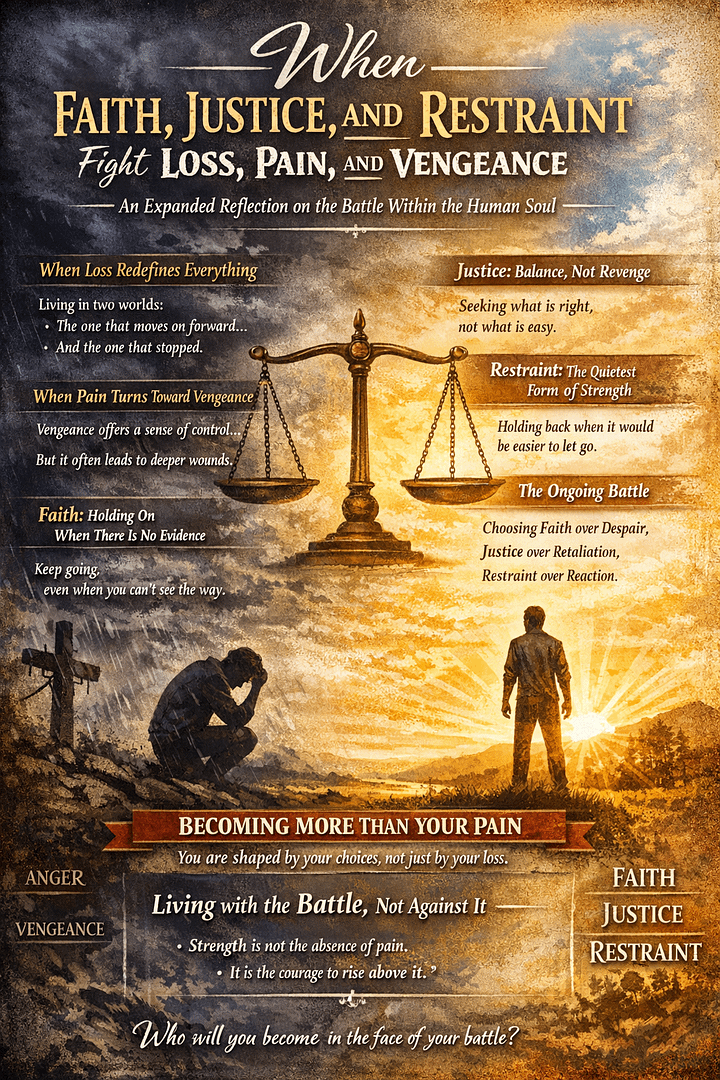
    When Loss Redefines Everything

    Loss does more than take something away—it changes how you see everything that remains.

    It reshapes your sense of safety.
    It fractures your understanding of fairness.
    It challenges your belief in what is right and what is just.

    For those who have lost deeply—especially a child, a partner, or someone who was a part of their everyday existence—the world no longer feels the same. The colors fade. The noise dulls. Even joy feels unfamiliar, like something meant for someone else.

    You begin to live in two worlds at once:

    The one that continues moving forward without pause
    And the one that stopped the moment your loss occurred

    And in that space, pain becomes your constant companion.

    The Nature of Pain: A Language Without Words

    Pain is not always loud.

    Sometimes it is quiet—so quiet that others cannot see it, yet so heavy that it becomes difficult to carry. It hides behind forced smiles, routine conversations, and the simple act of getting through the day.

    Pain speaks in different ways:

    In the silence of an empty room
    In the memory of a voice you can no longer hear
    In the ache of milestones that now feel incomplete

    It is unpredictable.

    A scent, a song, a date on the calendar—anything can trigger a wave that pulls you back into the depths of grief without warning.

    And when those waves hit, they bring with them something powerful:

    The need for an answer.
    The need for meaning.
    The need for justice.

    When Pain Turns Toward Vengeance

    When pain has nowhere to go, it begins to search for direction.

    And often, it finds it in vengeance.

    Vengeance does not always appear as rage. Sometimes it shows up as quiet resentment. Sometimes as a desire to see someone held accountable in a way that mirrors your own suffering.

    It tells you:

    They should not get to move on when I cannot.
    There should be consequences that match this pain.
    If I can make them feel this, maybe I will feel less.

    And in moments of deep hurt, that thinking can feel justified—even necessary.

    Because vengeance offers something grief often takes away:

    A sense of control.

    But vengeance is a deceptive force.

    It feeds on your pain while convincing you it is helping you release it. It keeps you tied to the very moment you are trying to escape. It can slowly transform your identity, replacing who you were with who your pain has made you.

    It feels powerful.

    But it often leads to deeper wounds.

    Faith: Holding On When There Is No Evidence

    Faith is often misunderstood as certainty.

    In truth, faith is choosing to believe when certainty no longer exists.

    It is standing in the middle of your pain and saying:

    There has to be something more than this.
    My story cannot end here.
    Even if I don’t understand, I will not give up.

    Faith does not remove grief. It does not answer every question. It does not promise immediate healing.

    What it does is give you something to hold onto when everything else feels like it is slipping away.

    For some, faith is rooted in spirituality or belief in a higher power.
    For others, it is found in purpose—in honoring a loved one, in helping others, in continuing forward despite the weight.

    Faith is not loud.

    It is a whisper that says, keep going—even when every part of you wants to stop.

    Justice: The Difference Between Balance and Revenge

    Justice is often confused with vengeance, but they are not the same.

    Vengeance is driven by emotion.
    Justice is grounded in principle.

    Vengeance asks, How can I make them feel what I feel?
    Justice asks, What is right, and how do we uphold it?

    True justice is not about causing suffering—it is about accountability, truth, and restoring balance where it has been broken.

    It is not always satisfying.
    It is not always immediate.
    And it does not always feel like enough.

    But justice protects something that vengeance cannot:

    Your integrity.

    It allows you to stand firm without becoming consumed. It gives structure to chaos. It provides a path forward that is not dictated by anger, but guided by fairness.

    Restraint: The Quietest Form of Strength

    Restraint is one of the most misunderstood forms of power.

    In a world that often celebrates reaction—quick responses, emotional outbursts, immediate action—restraint can look like weakness.

    But restraint is anything but weak.

    It is choosing not to act when acting would be easier.
    It is holding back words that cannot be taken back.
    It is refusing to let pain dictate your behavior.

    Restraint requires awareness.
    It requires discipline.
    And most of all, it requires courage.

    Because it is not easy to pause when everything inside you is demanding release.

    But in that pause, something important happens:

    You create space between who you are and what you feel.

    And in that space, you reclaim control.

    The Ongoing Battle: There Is No Final Victory

    This battle is not won in a single moment.

    It does not end with a decision or a realization.

    It is fought again and again—in small choices, in quiet thoughts, in how you respond to the world around you.

    Some days, pain will be louder than faith.
    Some days, vengeance will feel stronger than restraint.
    Some days, justice will feel too slow to matter.

    And that is part of being human.

    The goal is not perfection.

    The goal is awareness.

    Each time you choose:

    Faith over despair
    Justice over retaliation
    Restraint over reaction

    you are not eliminating the battle—you are strengthening the side that leads you forward.

    Becoming More Than Your Pain

    Pain has the power to define you—but only if you allow it to.

    Loss will always be a part of your story.
    Grief will always leave its mark.
    The memory of what was taken will never fully disappear.

    But you are more than what you have lost.

    You are more than what you have endured.

    And the choices you make in the face of that pain will determine who you become.

    You can become hardened—or you can become deeper.
    You can become consumed—or you can become compassionate.
    You can become reactive—or you can become intentional.

    Faith, justice, and restraint do not erase your pain.

    They transform how you carry it.

    Living With the Battle, Not Against It

    The truth is, the goal is not to silence loss, pain, or even the instinct for vengeance.

    Those emotions are part of being human.

    The goal is to not let them lead.

    To acknowledge them without becoming them.
    To feel them without being controlled by them.
    To understand them without acting on every impulse they create.

    Because strength is not the absence of pain.

    It is the ability to carry it without letting it destroy who you are.

    A Final Thought

    There will be moments when the weight feels unbearable.

    Moments when faith feels distant, justice feels delayed, and restraint feels impossible.

    In those moments, remember this:

    You do not have to win the entire battle today.

    You only have to choose, in this moment, which side you will stand on.

    And sometimes, that choice alone is enough to keep you moving forward.

    A Father’s Guide to Surviving the Loss of a Child

  • National I Am In Control Day: Reclaiming Your Power, One Choice at a Time

    National I Am In Control Day: Reclaiming Your Power, One Choice at a Time

    National I Am In Control Day is more than just a date on the calendar—it’s a mindset. It’s a declaration. A reminder that no matter how chaotic life may feel, there is always one thing you can control: yourself.

    In a world that often feels overwhelming—where expectations are high, distractions are endless, and life can change in an instant—this day becomes a powerful checkpoint. It invites you to stop, breathe, and reconnect with the truth that your life is not defined by what happens to you, but by how you choose to respond.

    The Illusion of Control vs. Real Control

    Many people spend their lives trying to control things that were never theirs to control:

    Other people’s opinions
    Outcomes that haven’t happened yet
    Situations shaped by forces beyond their reach

    This constant effort creates stress, anxiety, and frustration. It’s exhausting trying to hold onto something that was never meant to be held.

    Real control is different.
    It’s not about gripping tighter—it’s about letting go of what isn’t yours and fully stepping into what is.

    You control:

    Your mindset
    Your attitude
    Your effort
    Your boundaries
    Your next decision

    And that is more powerful than trying to control the world.

    The Courage to Take Ownership

    Taking control requires courage—real courage.

    It means looking in the mirror and saying:

    “I am responsible for where I go from here.”
    “I may not have caused everything in my life, but I will take ownership of what I do next.”

    Ownership is not about blame. It’s about power.

    When you stop blaming circumstances, people, or the past, you take your power back. You shift from being a passenger in your life to becoming the driver.

    And that shift changes everything.

    Control in the Middle of Chaos

    Life doesn’t pause to give you time to feel ready. Challenges come without warning:

    Loss
    Heartbreak
    Financial stress
    Health struggles
    Moments where everything feels uncertain

    In those moments, control feels impossible.

    But this is where it matters most.

    Control in chaos looks like:

    Choosing not to give up
    Taking one step when you feel frozen
    Allowing yourself to feel—but not letting emotions control your decisions
    Holding onto hope, even when it feels fragile

    Sometimes control isn’t loud or visible.
    Sometimes it’s simply getting through the day without breaking.

    And that counts.

    The Battle Within: Your Mind

    The greatest battles are rarely external—they’re internal.

    Your thoughts can either empower you or limit you:

    “I can’t do this.”
    “I’m not strong enough.”
    “What’s the point?”

    These thoughts feel real, but they are not facts—they are patterns.

    Taking control means challenging those patterns:

    Replacing doubt with possibility
    Replacing fear with action
    Replacing negativity with intentional thinking

    It’s not about pretending everything is okay.
    It’s about choosing not to let your mind work against you.

    Discipline: The Foundation of Control

    Motivation comes and goes. It’s unreliable.

    Control is built on discipline.

    Discipline is:

    Showing up when you don’t feel like it
    Following through when it’s hard
    Staying consistent even when progress feels slow

    It’s waking up and choosing growth over comfort.

    Every time you follow through on something you said you would do, you build trust with yourself. And that trust becomes the foundation of confidence.

    Boundaries: Protecting Your Peace

    Taking control also means protecting your energy.

    You are allowed to:

    Say no without guilt
    Walk away from what drains you
    Distance yourself from negativity
    Choose environments that support your growth

    Boundaries are not selfish—they are necessary.

    Without them, other people’s chaos can become your chaos.
    With them, you create space for clarity, peace, and purpose.

    Letting Go to Take Control

    This may sound contradictory, but one of the most powerful ways to take control is to let go.

    Let go of:

    The past you can’t change
    The expectations that don’t serve you
    The need for everything to be perfect

    Letting go doesn’t mean giving up.
    It means freeing yourself from what’s holding you back.

    And in that freedom, you find control.

    Building a Life You’re Proud Of

    Control isn’t just about surviving—it’s about creating.

    It’s about building a life that reflects who you truly are:

    Setting goals that matter to you
    Taking steps toward your purpose
    Becoming the person you know you can be

    This doesn’t happen overnight.

    It happens through:

    Small daily actions
    Consistent effort
    A willingness to keep going, even when it’s hard

    Your life is shaped by what you repeatedly do.
    And every day gives you a new chance to choose differently.

    The Quiet Strength of Resilience

    There’s a strength that doesn’t need to be loud.

    It’s the strength of:

    Getting back up after being knocked down
    Continuing when no one is watching
    Holding yourself together when everything feels like it’s falling apart

    That strength is resilience.

    And resilience is one of the clearest signs that you are, in fact, in control—no matter what life throws your way.

    A Message to Anyone Struggling

    If you’re reading this and life feels out of control right now, hear this:

    You don’t have to fix everything today.
    You don’t have to have all the answers.

    You just have to take one step.

    One decision.
    One moment of choosing yourself.

    That’s where control begins.

    Final Thoughts

    National I Am In Control Day is not about perfection.
    It’s not about having everything figured out.

    It’s about recognizing your power—right here, right now.

    It’s about standing in the middle of your life, no matter how messy it may feel, and saying:

    “I may not control everything… but I control me.”

    And that is more than enough to change your life.

    Read More Holidays & National Days