Author: Brett Murphy

  • Everything Starts With Honesty

    Everything Starts With Honesty

    Honesty is often described as a virtue, a character trait, or a moral expectation. But in reality, it is something far more fundamental: it is the starting point of everything that truly matters. Before trust can be built, before healing can begin, before success can last, and before relationships can deepen, there must be truth. Without honesty, progress is an illusion. With it, even the most difficult realities become workable.

    We live in a world that often rewards appearances over authenticity. Social media filters reality. Professional environments sometimes value performance over transparency. Even in personal relationships, people hide parts of themselves to avoid rejection, conflict, or vulnerability. But while dishonesty may feel safer in the moment, it always comes at a cost. Eventually, what is hidden becomes heavier than what is revealed.

    Everything starts with honesty—especially the life you are trying to build.

    The Courage to Be Honest With Yourself

    The most important truth is also the hardest: the truth you tell yourself.

    Self-honesty requires facing uncomfortable realities. It means acknowledging when you are unhappy instead of pretending everything is fine. It means admitting when you are afraid, when you have made mistakes, or when you are holding onto something that no longer fits who you are becoming. It means recognizing patterns that repeat in your life and accepting your role in them.

    Many people avoid this kind of honesty because it threatens the stories they have built about themselves. We tell ourselves we are “just tired,” when we are actually burned out. We say “this is fine,” when something inside us knows it is not. We blame circumstances, other people, or bad luck when the deeper truth is that we are afraid to change.

    But growth does not begin with motivation. It begins with truth.

    You cannot heal what you refuse to acknowledge. You cannot improve what you will not examine. Self-honesty is not about self-judgment—it is about clarity. Once you are honest about where you are, you finally gain the power to choose where you are going.


    Honesty in Relationships: Where Trust Is Born

    Every meaningful relationship stands or falls on honesty. Trust is not built through perfection; it is built through truth. People do not need you to be flawless—they need you to be real.

    Dishonesty in relationships does not always appear as obvious lies. Sometimes it shows up as silence when something matters, avoidance when conflict is needed, or half-truths meant to “keep the peace.” Over time, these small omissions create emotional distance. What is not said becomes heavier than what is.

    Honesty does not mean brutal honesty. It does not mean speaking without care or compassion. True honesty is rooted in respect—it is about sharing truth in a way that seeks understanding, not harm. It means expressing your needs instead of expecting others to guess them. It means addressing problems before resentment grows. It means being willing to have difficult conversations because the relationship matters more than temporary comfort.

    When honesty is present, relationships gain stability. When it is absent, even the strongest bonds begin to fracture.


    Integrity: When Honesty Becomes Action

    Honesty is not only about what you say—it is about what you do. This is where honesty becomes integrity.

    Integrity is the alignment between your values and your behavior. It is choosing what is right even when no one is watching. It is keeping your word, admitting when you are wrong, and taking responsibility when it would be easier to shift blame.

    In a culture that often celebrates shortcuts and appearances, integrity can feel slow and inconvenient. But what is built without honesty is never secure. Success that depends on deception eventually collapses. Relationships built on falsehood eventually break. A reputation created through manipulation eventually fades.

    A life built on honesty, however, endures.

    When your actions reflect your values, you gain something more valuable than approval: self-respect. And self-respect is the foundation of confidence, leadership, and lasting influence.


    Honesty and Emotional Freedom

    There is a unique kind of freedom that comes from telling the truth. When you stop pretending, hiding, or performing, your mind becomes lighter. You no longer carry the burden of maintaining versions of yourself for different people. You simply exist as who you are.

    Honesty allows you to set boundaries. It gives you permission to say no without guilt, to ask for help without shame, and to walk away from what does not align with your well-being. It teaches you that protecting your truth is not selfish—it is necessary.

    Living honestly also means accepting your limitations. You are not required to be everything to everyone. You are allowed to admit when something is too much, when you are uncertain, or when you need time to grow. This kind of honesty fosters emotional maturity and strengthens resilience.

    When you live in truth, you no longer waste energy maintaining what is false. You use that energy to build what is real.


    Honesty in Healing and Growth

    Every journey of healing begins with acknowledgment. Whether the pain comes from loss, betrayal, failure, or personal struggle, progress does not start with positivity—it starts with honesty.

    You must first name what hurts.

    Avoidance delays healing. Minimizing pain does not make it disappear. But when you allow yourself to say, “This affected me,” or “I am not okay,” you take back control. Honesty gives pain a voice, and once something has a voice, it can be understood, processed, and eventually transformed.

    The same is true for personal growth. Change does not begin with ambition alone. It begins with an honest assessment of where you are, what you need, and what must change. Without that clarity, goals remain fantasies. With it, they become plans.


    Choosing Honesty Every Day

    Honesty is not a single decision—it is a daily practice. It shows up in small moments: telling the truth when it would be easier to stay silent, admitting mistakes instead of defending them, and choosing transparency over image.

    This practice requires courage. Truth is not always comfortable. It may disrupt relationships, challenge routines, or force you to confront realities you would rather avoid. But discomfort is temporary. The consequences of dishonesty last far longer.

    Every time you choose honesty, you strengthen the foundation of your life. You create relationships that are real, goals that are achievable, and a sense of self that does not depend on approval or illusion.


    The Foundation of Everything

    You cannot build a future on what is false.
    You cannot repair what you refuse to acknowledge.
    You cannot become who you are meant to be while hiding from who you are.

    Whether you are trying to rebuild trust, heal old wounds, pursue a new path, or redefine your identity, the starting point is always the same.

    Everything starts with honesty.

    And from that truth, everything else becomes possible.

    Read More Of Love & Relationships

    Read More Of Inspiration & Motivation

  • Ratification Day: When a Nation Became a Constitution

    Ratification Day: When a Nation Became a Constitution

    Every year on December 7, the United States quietly marks a moment that forever shaped its identity—Ratification Day. On this date in 1787, Delaware became the first state to ratify the U.S. Constitution, setting in motion the legal and political foundation of the nation we know today. While not as widely celebrated as Independence Day or Constitution Day, Ratification Day represents the moment when the idea of America officially became a governing reality.

    From Revolution to Framework

    After winning independence from Great Britain, the newly formed states faced a daunting challenge: how to govern themselves as a unified nation. The Articles of Confederation, the country’s first attempt at national government, proved too weak to manage economic instability, interstate disputes, and national defense.

    In 1787, delegates from across the states gathered in Philadelphia for what became the Constitutional Convention. Their goal was bold—design a system that balanced federal authority with states’ rights, individual liberty with collective security, and democratic participation with stable governance.

    The result was the U.S. Constitution, but writing it was only half the battle. For it to take effect, at least nine of the thirteen states had to formally approve—or ratify—the document.

    December 7, 1787: The First Yes

    On Ratification Day, Delaware became the first state to ratify the Constitution unanimously. Eager to secure its place in the new republic and strengthen the fragile union, Delaware proudly earned the nickname “The First State.”

    Other states soon followed. By June 21, 1788, New Hampshire became the ninth state to ratify, officially establishing the Constitution as the supreme law of the land. By 1790, all thirteen original states had ratified, fully uniting under the new system of government.

    Why Ratification Matters

    Ratification Day is not just a historical footnote—it symbolizes:

    • The birth of American democracy in action
      Citizens and state conventions debated, challenged, and ultimately chose their governing framework.

    • The power of compromise
      The Constitution exists because people with different interests found common ground.

    • The foundation of individual rights
      Ratification led to the addition of the Bill of Rights, protecting freedoms such as speech, religion, and due process.

    Without ratification, the Constitution would have remained a proposal rather than the living document that continues to guide the nation.

    A Living Legacy

    More than two centuries later, the Constitution remains one of the oldest written national constitutions still in use. While it has been amended to reflect social progress and changing values, its core principles—liberty, justice, and representative government—remain intact.

    Ratification Day reminds us that democracy is not something handed down effortlessly. It is built through participation, debate, and the courage to believe in a shared future.

    How to Observe Ratification Day

    You can honor this day in meaningful ways:

    • Read the Constitution or explore the Federalist Papers

    • Discuss the importance of civic responsibility with students or family

    • Reflect on the rights and responsibilities you hold as a citizen

    • Visit a historic site or watch a documentary about America’s founding

    A Moment Worth Remembering

    Ratification Day is the day a bold experiment in self-governance became real. It marks the moment when thirteen diverse states chose unity over division and laid the groundwork for a nation still striving to live up to its founding ideals.

    In remembering Ratification Day, we are reminded that the strength of democracy lies not only in its documents—but in the people who continue to uphold them.

  • Make Your Dream Come True Day: Turning “Someday” Into Today

    Make Your Dream Come True Day: Turning “Someday” Into Today

    Every dream begins quietly. It may start as a whisper in the back of your mind, a vision you revisit when life grows still, or a longing you’ve carried for years without fully naming. Dreams are personal, powerful, and often fragile—easily pushed aside by deadlines, responsibilities, and the demands of everyday survival.

    Make Your Dream Come True Day exists to interrupt that cycle. It is not about instant success or overnight transformation. It is about something far more meaningful: recognizing the dreams you’ve postponed and choosing, once again, to believe that your life can be shaped intentionally.

    This day asks one essential question: What would happen if you stopped waiting and started becoming?


    Why Dreams Matter More Than We Admit

    Dreams are not childish fantasies or unrealistic expectations. They are reflections of your values, your identity, and your deepest hopes for the kind of life you want to live. A dream may point toward freedom, creativity, stability, healing, connection, or purpose—but at their core, all dreams are about alignment: living in a way that feels true to who you are.

    When dreams are ignored for too long, life can become mechanical. Days blur into routines, weeks into obligations, and years into quiet resignation. You may still function, still meet expectations, still appear “successful”—yet feel a persistent sense that something essential is missing.

    Dreams restore meaning. They give direction to choices and significance to effort. Even when they take time to unfold, they remind you that your life is not just something that happens to you—it is something you are allowed to shape.


    The Fear That Keeps Dreams at a Distance

    Most people don’t abandon their dreams because they lack ability. They step away because fear becomes louder than hope.

    Fear of failure whispers, “What if you try and it doesn’t work?”
    Fear of judgment asks, “What will people think if you change direction?”
    Fear of uncertainty insists, “At least you know where you are now.”

    These fears are powerful because they feel protective. They promise safety in familiarity. But what they often protect you from is growth.

    There is also the fear of being “too late.” Many people believe dreams have expiration dates—that opportunity belongs to the young, the wealthy, the lucky, or the already confident. But dreams are not bound by age or circumstance. They are bound only by your willingness to pursue them.

    Waiting for perfect timing is another common trap. We tell ourselves we’ll start when we have more time, more money, more support, or more confidence. Yet perfect conditions rarely arrive. Confidence, clarity, and readiness are usually created through action, not before it.


    Redefining What It Means for a Dream to “Come True”

    Popular culture often portrays dreams as dramatic endings: a book deal, a promotion, a sold-out show, financial freedom, or public recognition. While these milestones are meaningful, they are not the only measure of a dream fulfilled.

    Sometimes a dream comes true in quieter ways:

    • Choosing peace over pressure

    • Leaving what no longer aligns with who you are

    • Healing from something you once believed would always define you

    • Building a life that feels balanced rather than impressive

    A dream coming true is not always about reaching a destination—it is about becoming the person you once imagined you could be.


    Turning a Dream Into a Direction

    Make Your Dream Come True Day is not about accomplishing everything in one day. It is about making the invisible visible and the possible practical.

    1. Name the Dream
    What is the dream you keep returning to? The one that never fully disappears, no matter how long you ignore it. Be honest. Write it down. Say it out loud. Dreams gain power when they are acknowledged.

    2. Get Specific
    Vague dreams stay distant. Instead of “I want to be happier,” try “I want work that allows creativity,” or “I want to feel strong and healthy,” or “I want to live with less fear.” Specificity transforms a wish into a direction.

    3. Break It Into Real Steps
    Big dreams can feel overwhelming because we imagine them all at once. But every meaningful change is built from small, intentional actions: a single conversation, a short daily habit, one application, one practice session, one boundary.

    4. Commit to One Action Today
    You don’t need to overhaul your life. You only need to begin. Action builds momentum, and momentum builds belief.

    5. Accept Imperfect Progress
    Waiting to be “ready” often becomes a form of avoidance. You will learn as you go. You will adjust. Progress, even when messy, is more powerful than perfection that never begins.


    The Role of Belief and Resilience

    Believing in your dream does not mean you will never feel doubt. It means you refuse to let doubt write the ending of your story. Every person who has built something meaningful—whether a career, a family, a creative life, or a sense of inner peace—has faced uncertainty, criticism, and moments of wanting to quit.

    Resilience is not the absence of fear. It is the decision to move forward anyway.

    There will be days when progress feels invisible, when setbacks test your resolve, when old habits call you back to comfort. On those days, remembering why your dream matters will be more important than remembering how to achieve it.


    Your Dream Is Not Selfish

    Many people hesitate to pursue their dreams because they believe it is selfish, impractical, or irresponsible. But living authentically is not selfish—it is sustainable. When you move toward what fulfills you, you become more present, more compassionate, and more capable of contributing meaningfully to the world around you.

    Your dream does not take away from others. It adds something unique that only you can offer.


    Make Today the Beginning

    Make Your Dream Come True Day is not about proving anything to anyone else. It is about honoring the life you want to live and choosing not to postpone it any longer.

    You do not have to know every step. You do not have to be fearless. You do not have to change everything at once. You only have to begin.

    Send the message. Start the project. Have the conversation. Take the risk. Choose the next right step.

    Because dreams do not come true by wishing.
    They come true by believing enough to act.

    And today is a perfect day to begin.

    Read More Holidays & National Days

  • National Pizza Week: A Celebration of America’s Favorite Slice

    National Pizza Week: A Celebration of America’s Favorite Slice

    There are foods we enjoy, and then there are foods that become part of our identity. Pizza is firmly in the second category. Every year, National Pizza Week gives us a reason to celebrate one of the most beloved comfort foods in the world—crispy, cheesy, endlessly customizable, and universally adored.

    From family dinners and birthday parties to late-night cravings and game-day gatherings, pizza has woven itself into the fabric of everyday life. It is more than just a meal; it is tradition, convenience, creativity, and connection all baked into one perfect slice.


    From Humble Beginnings to a Global Icon

    Pizza’s story begins in Naples, Italy, where simple flatbreads were topped with tomatoes, olive oil, herbs, and cheese as an affordable meal for working families. These early pizzas were not gourmet dishes—they were practical, nourishing, and made for sharing.

    When Italian immigrants brought pizza to the United States in the late 19th and early 20th centuries, it found new life. American cities embraced it, adapted it, and made it their own. Over time, pizza evolved from a niche ethnic food into a nationwide staple.

    Distinct regional styles emerged, each reflecting local culture and taste:

    • New York Style: Thin, foldable slices with a crisp edge and soft center.

    • Chicago Deep Dish: A hearty, pie-like pizza with thick crust, layers of cheese, toppings, and rich tomato sauce.

    • Detroit Style: Square pizzas with thick, airy crusts and crispy, caramelized cheese edges.

    • Neapolitan: Light, blistered crusts with simple, fresh toppings.

    • Sicilian, California, and more: Each adding its own creative twist.

    What began as street food has become a worldwide phenomenon and a symbol of shared meals across cultures.


    Why Pizza Has Universal Appeal

    Pizza is one of the few foods that truly fits every occasion.

    Celebration? Pizza.
    Family night? Pizza.
    Work lunches? Pizza.
    Heartbreak, comfort, or joy? Still pizza.

    Its greatest strength is flexibility. Pizza welcomes every taste, diet, and preference. Whether you crave traditional pepperoni, bold barbecue chicken, vegetarian combinations, or plant-based alternatives, there is a slice for everyone.

    It also adapts to changing lifestyles. Gluten-free crusts, dairy-free cheeses, and health-conscious toppings ensure that pizza remains accessible to people with different needs. At the same time, gourmet variations with truffle oil, prosciutto, figs, or fresh arugula show how elevated this humble dish can become.

    Pizza is both simple and sophisticated—whatever you want it to be.


    The Emotional Connection to Pizza

    Pizza is rarely eaten alone. It is passed around tables, shared from boxes, split into slices, and enjoyed in moments of togetherness. It shows up at birthday parties, sleepovers, study sessions, office celebrations, sports nights, and family dinners.

    For many people, pizza is tied to memory:

    • Friday nights as a kid.

    • Celebrating a big win with friends.

    • Ordering in during hard times when cooking felt impossible.

    • Late-night conversations fueled by one more slice.

    Food has the power to comfort and connect, and pizza does both effortlessly.


    Ways to Celebrate National Pizza Week

    1. Support Local Pizzerias
    Your neighborhood pizza shop is often a small business built on family recipes, long hours, and community loyalty. National Pizza Week is a perfect opportunity to order local, try a house specialty, and show appreciation for the people behind your favorite slices.

    2. Explore a New Style or Topping
    Break out of your usual order. If you’re a classic pepperoni fan, try a white pizza, a veggie-loaded option, or a regional style you’ve never had before. You might discover a new favorite.

    3. Host a Pizza Night
    Turn dinner into an experience. Invite friends or family and set up a “build-your-own pizza” station with different sauces, cheeses, and toppings. It’s interactive, fun, and perfect for all ages.

    4. Make Pizza at Home
    Homemade pizza can be surprisingly simple and deeply satisfying. Whether you use store-bought dough or make everything from scratch, the process—rolling, topping, baking—becomes part of the celebration. It’s also a great way to involve kids or experiment with new flavors.

    5. Give Back Through Pizza
    Some communities use food-themed weeks to support local causes. Consider donating meals, buying an extra pizza for someone in need, or supporting a charity event hosted by a local restaurant.


    Pizza in Culture and Community

    Pizza is everywhere—in movies, TV shows, memes, and everyday conversations. It has become shorthand for comfort, fun, and familiarity. It represents community in a box: multiple slices, meant to be shared.

    In a fast-paced world, pizza reminds us to pause. To sit down together. To laugh, talk, and enjoy something simple and satisfying. It doesn’t ask for perfection—just appetite and company.


    More Than Food—It’s a Shared Experience

    National Pizza Week isn’t just about indulgence. It’s about honoring a dish that has crossed borders, evolved through generations, and remained a constant in our lives. It celebrates creativity, tradition, and togetherness.

    So whether you’re enjoying a gourmet wood-fired pie, a late-night delivery, or a homemade creation fresh from your oven, take a moment to appreciate what pizza represents: connection, comfort, and joy in the simplest form.

    This week, grab a box, raise a slice, and savor not just the flavors—but the memories being made around it.

    🍕 What’s your all-time favorite pizza topping or style—and who do you love sharing it with?

    Read More Holidays & National Days

  • The Highs and Lows of Emotions

    The Highs and Lows of Emotions

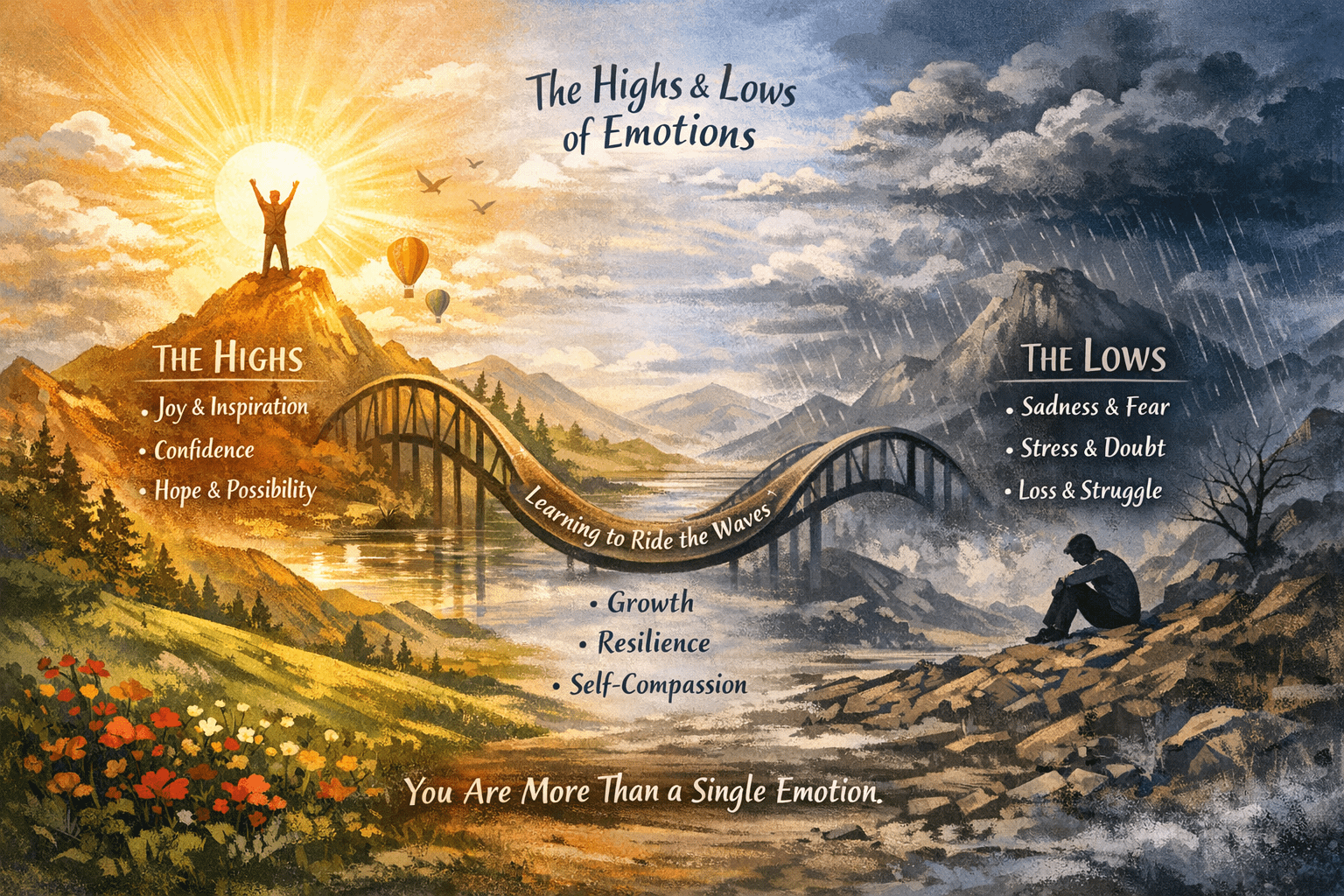
    Life is not lived in a straight line. It moves in waves—moments of clarity followed by confusion, joy followed by sorrow, confidence followed by doubt. Our emotions rise and fall just as naturally as the tide. These highs and lows are not signs of weakness or instability; they are the very rhythm of being human. To feel deeply is not a flaw—it is a reflection of our capacity to care, to hope, to love, and to grow.

    Understanding Emotional Highs

    Emotional highs are the moments when life feels meaningful and vibrant. They may come from major milestones—achieving a long-term goal, falling in love, finding purpose—or from small, quiet victories like being understood, feeling appreciated, or finally taking a breath after a long struggle.

    In these moments, we feel:

    • Motivated and energized

    • More connected to others

    • Confident in who we are

    • Hopeful about what lies ahead

    Highs remind us of our potential. They show us what we are capable of when we believe in ourselves. They give us proof that our effort matters, that growth is real, and that light does exist—even if we cannot always see it.

    Yet emotional highs are not meant to be permanent. If they were, they would lose their meaning. What makes them powerful is their contrast—the knowledge that they exist alongside difficulty.

    Understanding Emotional Lows

    Emotional lows are often misunderstood. They are seen as weakness, failure, or something to “get over.” In reality, emotional lows are part of our internal processing system. They surface when something inside us needs attention.

    Lows may be triggered by:

    • Loss, grief, or disappointment

    • Stress, exhaustion, or burnout

    • Feeling unseen or misunderstood

    • Fear of change or uncertainty about the future

    During these times, we may feel disconnected, heavy, or stuck. Our inner voice may become critical. Motivation fades. Hope feels distant. But emotional lows are not the end of our story—they are pauses that invite reflection.

    Pain reveals what matters. It shows us where we are hurting, where boundaries are needed, and where healing must begin. Often, the most meaningful transformations are born in moments when we feel broken, not when we feel comfortable.

    Why We Need Both the Highs and the Lows

    Without emotional highs, life would feel flat, mechanical, and uninspired. Without emotional lows, we would never develop depth, empathy, or resilience.

    • Highs show us what is possible.

    • Lows show us what is necessary.

    Our struggles teach us compassion for others. Our joy teaches us gratitude for the present. Together, they shape our identity. The person you are today is not defined by your happiest moments alone—but also by the challenges you survived, the nights you endured, and the strength you discovered when you thought you had none left.

    Learning to Ride Emotional Waves

    Emotional balance does not mean staying positive at all times. It means learning how to move through emotions rather than resisting them.

    1. Acknowledge What You Feel
    Suppressing emotions does not make them disappear—it simply buries them. Naming what you feel gives you power over it. Sadness, anger, fear, and confusion are not enemies; they are signals asking to be heard.

    2. Practice Emotional Self-Compassion
    You would not criticize a friend for struggling—so do not do it to yourself. When you are low, speak to yourself with patience and kindness. Growth is not linear, and healing has no deadline.

    3. Create Space for Reflection
    Emotions often carry messages about what is missing or misaligned in our lives. Ask yourself:
    What is this feeling trying to tell me?
    What do I need right now—rest, connection, change, or forgiveness?

    4. Honor Your Highs Without Fear
    Many people hesitate to enjoy happiness, worried it will be taken away. But joy is not something to ration. Celebrate progress. Savor peace. Let yourself feel proud of how far you have come.

    You Are More Than a Single Emotion

    No moment defines you. Not your best day. Not your worst. You are the sum of everything you have felt and everything you continue to become.

    Emotions are temporary visitors, not permanent identities. You are not your sadness. You are not your anxiety. You are not even your joy. You are the one experiencing them—learning from them, growing through them, and moving forward despite them.

    Finding Meaning in the Emotional Journey

    The highs remind us that life holds beauty.
    The lows remind us that we are human.

    Together, they give life its depth. They teach us resilience, empathy, gratitude, and self-awareness. They show us that strength is not the absence of struggle—it is the courage to keep going through it.

    When you accept both the light and the darkness within yourself, you stop fighting who you are and start becoming who you are meant to be.

    Read More Health & Wellness

  • National Clean Off Your Desk Day: Clear Your Space, Clear Your Mind

    National Clean Off Your Desk Day: Clear Your Space, Clear Your Mind

    Every year, National Clean Off Your Desk Day reminds us that sometimes the smallest changes make the biggest difference. A cluttered desk may seem harmless, but over time it can quietly steal our focus, increase stress, and slow our productivity. This day isn’t just about tidying up—it’s about resetting your environment so you can think more clearly, work more efficiently, and feel more in control.

    Why Your Desk Matters

    Your workspace reflects your mindset. Piles of papers, tangled cords, and scattered supplies can create visual noise that competes for your attention. Studies have shown that clutter can increase anxiety and make it harder to concentrate. On the other hand, a clean, organized desk sends a powerful message to your brain: This is a space for focus, purpose, and progress.

    When your desk is clear, you spend less time searching for what you need and more time doing what actually matters.

    The Emotional Weight of Clutter

    Clutter isn’t just physical—it’s emotional. Old notes, unfinished projects, and outdated documents can subconsciously remind us of stress, deadlines, and tasks we’ve been avoiding. Cleaning your desk can feel surprisingly freeing, like closing open loops in your mind.

    National Clean Off Your Desk Day gives you permission to let go:

    • Let go of what no longer serves you.

    • Let go of what you’ve already completed.

    • Let go of the chaos that doesn’t belong in your future.

    How to Clean with Purpose

    You don’t need hours or fancy organizers. You just need intention.

    1. Empty it out. Remove everything from your desk so you can start fresh.

    2. Sort with honesty. Keep only what you truly use. Recycle, file, or discard the rest.

    3. Create zones. Designate areas for work essentials, personal items, and current projects.

    4. Go digital. Scan important papers and reduce physical clutter.

    5. Add inspiration. Keep one or two meaningful items—a photo, a quote, or a small plant—to make your space feel yours without overwhelming it.

    More Than a Clean Desk

    This day isn’t really about furniture. It’s about mindset. When you take control of your physical space, you reclaim mental clarity. A clean desk can spark motivation, boost confidence, and even inspire creativity. It’s a symbolic reset—a chance to say, “I’m ready for what’s next.”

    Carry the Habit Forward

    Use National Clean Off Your Desk Day as a starting point, not a one-time event. A few minutes of organization at the end of each day or week can prevent clutter from taking over again. Over time, this simple habit can transform not just your workspace, but your workflow and well-being.

    So today, clear the papers, wipe the surface, and make room for focus, intention, and fresh ideas. Because sometimes, the path to a clearer mind really does begin with a cleaner desk.

    Read More Holidays & National Days

  • National Sunday Supper Day: Bringing Hearts Back to the Table

    National Sunday Supper Day: Bringing Hearts Back to the Table

    .In a world that moves faster every day—where calendars are crowded, notifications never stop, and meaningful conversations are often reduced to quick texts—National Sunday Supper Day invites us to slow down and return to something beautifully simple: sharing a meal with the people we love.

    Observed on the second Sunday of January, this day is more than a celebration of food. It is a call to reconnect, to restore relationships, and to rediscover the power of gathering around a table. Long before digital distractions and nonstop schedules, Sunday supper was a cherished tradition—a time when families, friends, and neighbors came together at the end of the week to share stories, laughter, and comfort.

    The Tradition Behind Sunday Supper

    Sunday has long been considered a day of rest and reflection. In many households, it was the one day when everyone could be present at the same time. Meals were unhurried. Conversations stretched across the table. Elders passed down stories, children shared their dreams, and everyone felt rooted in something larger than themselves.

    Sunday supper was never about perfection. It wasn’t about fancy dishes or Instagram-worthy presentation. It was about presence. It was about knowing that no matter how busy or difficult life became, there would always be a place at the table where you were welcomed, heard, and valued.

    National Sunday Supper Day was created to remind us of this powerful tradition—and to encourage us to revive it in our modern lives.

    Why Shared Meals Matter

    Research consistently shows what many of us already feel in our hearts: eating together strengthens bonds. Families who regularly share meals report better communication, stronger emotional connections, and healthier relationships. For children, family dinners are linked to improved academic performance, stronger self-esteem, and better social skills. For adults, shared meals reduce stress, combat loneliness, and foster a sense of belonging.

    But beyond statistics, there is something deeply human about sitting together to eat. A shared meal creates a space where people feel safe to open up, to listen, and to be fully present. Around the table, barriers soften. Differences are discussed. Laughter flows more easily. Even silence can feel comforting when it is shared.

    In a time when many people feel disconnected—even while being constantly “connected” online—Sunday supper offers a powerful antidote: genuine, face-to-face connection.

    More Than Food: A Moment of Meaning

    Sunday supper is not just about nourishment for the body—it is nourishment for the soul. It marks the transition from one week to the next, offering a chance to reflect on what has passed and prepare for what lies ahead.

    It becomes a space for:

    • Gratitude: Sharing what you’re thankful for.

    • Support: Checking in on each other’s struggles.

    • Celebration: Recognizing achievements, big or small.

    • Healing: Rebuilding connection after busy or difficult weeks.

    For some, Sunday supper is a time of laughter and abundance. For others, especially those who have experienced loss, it can be a bittersweet reminder of loved ones who once sat at the table. Yet even in that ache, gathering can be a way to honor their memory—keeping traditions alive and finding comfort in togetherness.

    How to Celebrate National Sunday Supper Day

    You don’t need an elaborate menu or a perfectly set table to take part. The heart of the day is intention.

    1. Invite your people.
    Family, close friends, neighbors, or anyone who could use connection and warmth.

    2. Keep it simple.
    Comfort food, leftovers, takeout, or a shared potluck all work beautifully. What matters is not what’s served, but who is there.

    3. Create conversation.
    Put away phones and distractions. Ask meaningful questions:

    • What was the best part of your week?

    • What are you looking forward to?

    • What’s something you’ve been carrying that you’d like to share?

    4. Make it a ritual.
    Let this day be the beginning of something ongoing. Even once a month can build a tradition that brings people closer.

    Reclaiming What Truly Matters

    In our culture of constant motion, we often overlook the quiet power of simple moments. National Sunday Supper Day reminds us that connection does not require grand gestures—it begins with a seat at the table.

    Every shared meal is an opportunity to strengthen bonds, heal distances, and remind one another that we are not meant to navigate life alone. It is in these moments of togetherness that we rediscover what truly sustains us: love, community, and the knowledge that we belong.

    So this Sunday, set the table. Light a candle. Serve whatever you have. Invite the people who matter most—and take your seat.

    The food may fill your stomach.
    But the togetherness will fill your heart.

    Read More Holidays & National Days

  • NATIONAL VISION BOARD DAY: Turning Dreams Into Direction

    NATIONAL VISION BOARD DAY: Turning Dreams Into Direction

    Every year on National Vision Board Day, we are given a powerful invitation: to slow down, reflect on what truly matters to us, and intentionally design the future we want to step into. In a world filled with constant noise, obligations, and distractions, this day serves as a gentle pause—a reminder that our lives do not have to be built on autopilot. Instead, they can be shaped with purpose, clarity, and heart.

    A vision board is far more than a collection of images and inspirational quotes. It is a visual representation of your inner world—your hopes, values, priorities, and long-term goals. It transforms ideas that live quietly in your mind into something tangible that you can see, revisit, and realign with every day. Whether your aspirations center on career growth, healing, financial stability, creativity, relationships, or personal peace, a vision board gives those dreams direction.

    Why Vision Boards Matter

    At its core, a vision board works by sharpening focus. When you regularly see images, words, and symbols that reflect your goals, your mind becomes more attuned to opportunities that support them. This isn’t about wishful thinking or blind optimism—it’s about awareness. When you know what you’re aiming for, your choices become more intentional. You begin to recognize paths that move you forward and distractions that pull you off course.

    Vision boards also strengthen motivation. Life is rarely linear; setbacks, doubt, and exhaustion are inevitable. But when you are reminded of why you started—when you see the future you’re building in front of you—it becomes easier to keep going. A vision board reconnects you to your purpose during moments when momentum feels lost.

    Perhaps most importantly, vision boards create emotional alignment. A list of goals can feel distant and abstract, but a carefully chosen image can evoke excitement, peace, courage, or determination. That emotional connection gives your goals weight. It turns “someday” into something that feels real, personal, and worth pursuing.

    What to Include on Your Vision Board

    There is no single “right” way to create a vision board. The most powerful boards are those that reflect your authentic desires rather than society’s expectations. Some areas you might choose to explore include:

    • Career and Purpose: Your dream job, business ideas, creative projects, leadership goals, or the impact you want to make in the world.

    • Wellness and Healing: Mental clarity, emotional strength, physical health, rest, and balance.

    • Relationships and Connection: Healthy boundaries, deeper friendships, love, family goals, or community.

    • Personal Growth: Confidence, self-trust, education, spiritual alignment, or habits you want to cultivate.

    • Lifestyle and Joy: Travel, financial freedom, home life, hobbies, or simple everyday happiness.

    The most important element is intention. Every image, phrase, or symbol should resonate with what you truly want—not what you think you “should” want. Your vision board is not about perfection; it is about honesty.

    The Process: Creating With Meaning

    Creating a vision board can be as simple or as elaborate as you choose. Some people spend hours with magazines, scissors, and glue. Others curate digital boards using apps, phone wallpapers, or online platforms. Regardless of the method, the process itself is a form of reflection.

    Before you begin, ask yourself meaningful questions:
    What am I ready to grow into? What do I want to release? What would a fulfilling life look and feel like for me?
    As you choose each element, notice what stirs emotion within you. That emotional response is often your intuition pointing you toward what matters most.

    Vision Boards in the Digital Age

    While traditional poster boards remain popular, digital vision boards have become just as powerful. Many people now keep their goals visible through phone lock screens, tablets, or private online collections. Some even create seasonal or yearly boards to reflect changing priorities. The format is less important than consistency—your vision should be something you return to often.

    More Than Goals: A Commitment to Yourself

    National Vision Board Day is not simply about dreaming—it is about choosing direction. It is about acknowledging that while we cannot control every circumstance, we can choose what we focus on and what we work toward. Even the smallest actions, taken consistently in alignment with your vision, can lead to meaningful transformation.

    It is also important to remember that a vision board is not a rigid contract with the future. Life evolves, and so do we. Your goals may shift, your values may deepen, and your dreams may take new shapes. That does not mean you have failed—it means you are growing. A vision board is a living reflection of who you are becoming, not a static measure of success.

    A Moment of Intention

    On this day, give yourself permission to dream honestly and boldly. Ask yourself:
    What kind of life do I want to wake up to? What do I want to feel, build, and become?
    Then give those answers a place where you can see them, believe in them, and move toward them.

    Because when your dreams are paired with intention, they stop being distant wishes—and start becoming a path forward. National Vision Board Day is your reminder that your future is not something that simply happens to you. It is something you can envision, shape, and step into—one purposeful choice at a time.

  • National Law Enforcement Appreciation Day: Honoring Those Who Serve and Protect

    National Law Enforcement Appreciation Day: Honoring Those Who Serve and Protect

    Each year on January 9th, communities across the nation observe National Law Enforcement Appreciation Day (L.E.A.D.), a day set aside to recognize and honor the men and women who dedicate their lives to public safety. While their work often unfolds quietly in the background of our daily routines, law enforcement officers stand at the front lines of society’s most challenging moments. This day serves as a reminder to pause, reflect, and express gratitude for their service, courage, and commitment.

    Law enforcement is far more than a job—it is a vocation built on responsibility, discipline, and sacrifice. Officers answer calls in the middle of the night, walk into volatile situations with limited information, and make split-second decisions that can carry lifelong consequences. They face physical danger, emotional strain, and public scrutiny, all while being expected to maintain professionalism, restraint, and integrity. Behind the badge are individuals who choose to protect others, even when it means putting their own safety at risk.

    Beyond emergency response and crime prevention, law enforcement officers are deeply woven into the fabric of their communities. They serve as mentors in youth programs, participate in school visits, coach sports teams, direct traffic at local events, conduct wellness checks on vulnerable residents, and provide guidance during moments of crisis. Many of these actions never make headlines, yet they leave lasting impacts on individuals and neighborhoods. From helping a stranded motorist to consoling a victim after a traumatic event, these quiet acts of service are the foundation of public trust.

    At the same time, modern policing exists within a complex social landscape. Conversations around accountability, transparency, and reform are both necessary and ongoing. National Law Enforcement Appreciation Day does not ignore these realities; rather, it encourages a balanced perspective—one that acknowledges challenges while still recognizing the humanity, dedication, and positive contributions of those who serve. Progress in any profession comes from honest dialogue, mutual respect, and a shared commitment to doing better for the communities involved.

    The emotional toll of law enforcement is often unseen. Officers routinely witness trauma, loss, and conflict, yet are expected to return to duty with resilience and composure. Many carry the weight of what they have experienced long after a shift ends. Their families also share in these sacrifices—enduring long hours, missed holidays, and the constant concern that accompanies a career in public safety. Appreciation, therefore, extends not only to officers themselves but to the loved ones who support them behind the scenes.

    Showing gratitude does not require grand gestures. A simple “thank you,” a handwritten note, a respectful conversation, or a message of support on social media can mean more than most people realize. Community members can also participate in neighborhood safety programs, attend public forums, and engage in constructive dialogue that strengthens understanding on both sides. When citizens and law enforcement work together, trust grows, and communities become safer and more connected.

    National Law Enforcement Appreciation Day is ultimately about recognizing service, honoring sacrifice, and reaffirming the importance of unity. It reminds us that behind every uniform is a human being who chose a path of responsibility in order to protect others. While challenges remain and progress must continue, today is a moment to acknowledge the dedication, courage, and compassion demonstrated by those who stand watch over our communities.

    On this day, and every day, let us remember that respect, gratitude, and cooperation are powerful forces. By valuing those who serve and fostering mutual understanding, we help build a future where safety, dignity, and trust can flourish for everyone.

    Read More Holidays & National Days

  • National JoyGerm Day: Spreading Happiness, One Smile at a Time

    National JoyGerm Day: Spreading Happiness, One Smile at a Time

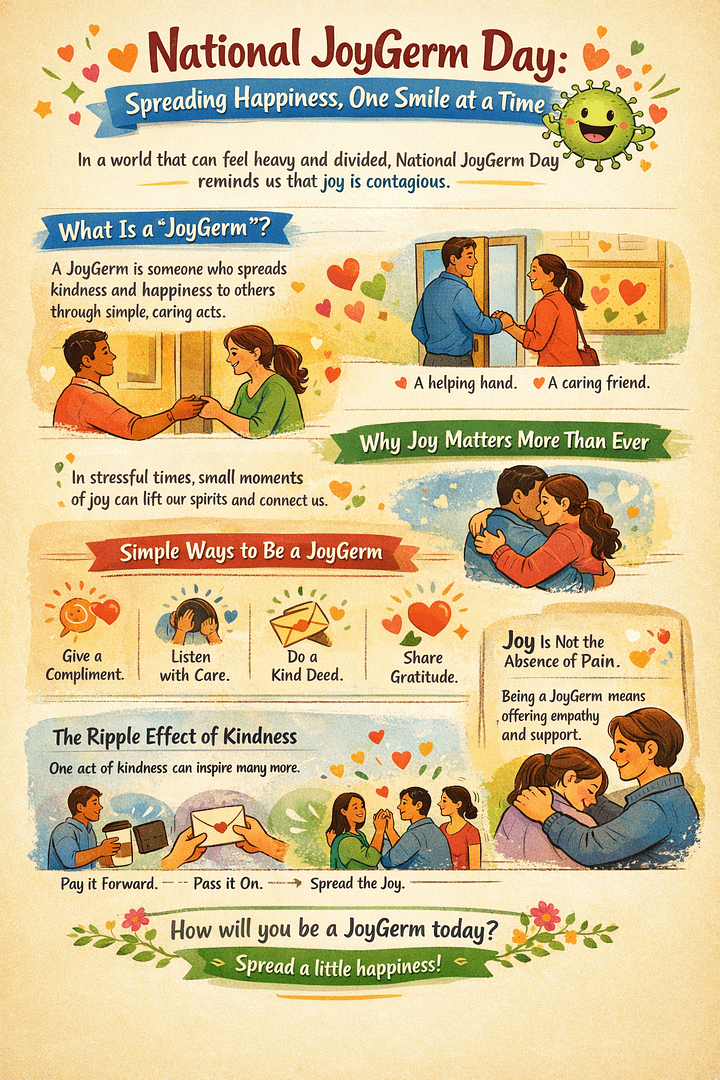
    In a world that often feels rushed, overwhelming, and divided, National JoyGerm Day arrives as a gentle but powerful reminder: joy is contagious. Just like germs can spread from person to person, so can kindness, warmth, and hope. Today isn’t about forcing happiness or pretending everything is perfect—it’s about recognizing how even the smallest moments of goodness can ripple outward and touch lives in ways we may never fully see.

    National JoyGerm Day invites us to slow down and remember something deeply human: we affect one another. Our words, our tone, our patience, and our presence can either weigh people down or lift them up. This day encourages us to choose the latter.


    What Is a “JoyGerm”?

    A “JoyGerm” is someone who spreads joy simply through how they show up in the world. It might be the stranger who holds the door when your hands are full. The friend who sends a message at just the right moment. The coworker who brings humor and empathy into an otherwise stressful day. Or the family member who listens without judgment when you need to vent.

    Being a JoyGerm doesn’t require constant cheerfulness or a bubbly personality. Joy is not about perfection or endless positivity. It is about authenticity, compassion, and connection. Some of the most powerful JoyGerms are quiet people who make others feel seen, valued, and safe.


    Why Joy Matters More Than Ever

    Modern life is filled with pressure. We juggle work, family, finances, health, and the constant stream of news that can leave us feeling anxious or emotionally exhausted. Many people walk through their days carrying invisible burdens—grief, loneliness, stress, or uncertainty about the future.

    Joy, even in small doses, can be grounding. Research consistently shows that positive social interactions can lower stress levels, improve mental health, and strengthen resilience. But beyond science, we all know this truth in our hearts: one kind moment can change the emotional direction of an entire day.

    National JoyGerm Day reminds us that we don’t have to wait for circumstances to improve before choosing kindness. We can create better moments right now, in the ordinary spaces of our lives.


    Joy in the Small Things

    Joy doesn’t always come in dramatic, life-changing events. More often, it shows up quietly:

    • A smile exchanged in passing

    • A sincere “How are you, really?”

    • A message that says, “I was thinking of you today.”

    • A shared laugh over something simple

    These moments may feel small, but they matter. For someone who feels overlooked, they can be deeply affirming. For someone who is struggling silently, they can feel like a lifeline.

    On National JoyGerm Day, we are reminded that we all have the power to create these moments—no special talents, resources, or platforms required.


    Simple Ways to Be a JoyGerm

    You don’t need to make grand gestures to spread joy. In fact, the most meaningful acts are often the simplest:

    • Offer a genuine compliment. Let someone know what you admire or appreciate about them.

    • Practice true presence. Put down your phone, make eye contact, and really listen.

    • Perform a quiet good deed. Pay for someone’s coffee, hold the door, or help without being asked.

    • Express gratitude openly. Tell people why they matter to you.

    • Encourage without comparison. Celebrate others without diminishing yourself.

    • Share warmth through small habits. A kind note, a thoughtful text, or a warm smile can go a long way.

    None of these actions take much time, yet their emotional impact can be lasting.


    Joy Is Not the Absence of Pain

    Celebrating joy does not mean denying reality. Life includes loss, disappointment, illness, heartbreak, and uncertainty. Many people carry wounds that are invisible to those around them. Being a JoyGerm is not about telling others to “just be positive” or minimizing what they are going through.

    True joy grows best in empathy.

    Sometimes spreading joy looks like:

    • Sitting quietly with someone who is grieving

    • Letting a friend cry without trying to fix everything

    • Saying, “I don’t have the right words, but I’m here.”

    In these moments, joy is not loud or flashy—it is gentle, steady, and deeply human.


    The Ripple Effect of Kindness

    One of the most beautiful things about joy is how it multiplies. A kind gesture often inspires another. A thoughtful word can encourage someone to pass that warmth along. You may never know how far your small act traveled—who it helped, who it comforted, or who it inspired to be kinder in return.

    National JoyGerm Day celebrates this chain reaction. It reminds us that while we may not be able to change the entire world at once, we can change the world for someone—right now.


    Choosing to Be the Beginning

    Today, ask yourself:

    • Who could use encouragement from me?

    • Where can I slow down and be more present?

    • How can I bring light into a space that feels heavy?

    Being a JoyGerm is not about being louder, brighter, or more perfect than you truly are. It is about choosing compassion, patience, and connection in the ordinary moments of life.

    Because when joy spreads—even quietly—the world becomes a little softer, a little kinder, and a little more hopeful for all of us. 🌿