Author: Brett Murphy

  • Finding a Way to Live After the Loss of a Child

    Finding a Way to Live After the Loss of a Child

    The loss of a child is a pain that few people can truly understand unless they have experienced it themselves. It is a loss that changes everything. It changes the way you see the world, the way you see yourself, and the way you experience each day. It is not simply the loss of a loved one; it is the loss of hopes, dreams, plans, and a future you expected to share with your child.

    When a child dies, a piece of a parent’s heart goes with them. The world continues moving forward while your own world feels frozen in time. People go back to work, attend celebrations, and continue their daily routines, while you struggle to understand how life can continue after such a devastating loss.

    In the beginning, survival often becomes the only goal. Getting out of bed, eating a meal, answering a phone call, or simply making it through another day can feel like monumental accomplishments. The grief is overwhelming, consuming every thought and emotion.

    Yet even within this unimaginable pain, there is a path forward.

    Not a path away from your child.

    Not a path that erases your grief.

    But a path that allows you to carry your child with you while continuing to live.

    The Day Your World Changed Forever

    Every bereaved parent remembers the moment their life changed.

    The phone call.

    The knock on the door.

    The doctor’s words.

    The accident.

    The diagnosis.

    The final goodbye.

    Life is often divided into two parts: before and after.

    Before your child died, the future seemed predictable. There were birthdays to celebrate, milestones to witness, and dreams to pursue. After their death, everything becomes uncertain.

    Many parents describe feeling as though they are living in a nightmare they cannot wake up from. The mind struggles to comprehend what has happened. It feels impossible that someone who brought so much life, love, and meaning into the world could suddenly be gone.

    Those early days are often filled with shock and disbelief. Even when you know the truth, part of you may continue expecting your child to walk through the door, send a text message, or call your name.

    This reaction is normal.

    Love does not disappear simply because a life has ended.

    Understanding the Nature of Grief

    One of the biggest misconceptions about grief is that it follows a predictable timeline.

    People often talk about grief as though it has stages that eventually end. While grief may include denial, anger, bargaining, depression, and acceptance, these emotions rarely occur in a neat sequence.

    You may feel acceptance one day and overwhelming anger the next.

    You may laugh with friends in the afternoon and cry yourself to sleep that night.

    You may think you are doing better, only to be knocked down by a wave of grief triggered by a song, a photograph, or a memory.

    Grief is not linear.

    It moves like the ocean. Sometimes the waves are gentle. Other times they crash into you without warning.

    The important thing to remember is that there is no right or wrong way to grieve.

    Some parents cry every day.

    Some cry very little.

    Some want to talk constantly about their child.

    Others process their grief quietly.

    Your grief belongs to you. It reflects the unique relationship you shared with your child.

    The Loneliness No One Talks About

    One of the hardest parts of losing a child is the loneliness that often follows.

    In the beginning, support may come from many directions. Family members visit. Friends call. Cards arrive in the mail. People bring meals and offer condolences.

    But eventually, life goes on for everyone else.

    The phone calls become less frequent.

    The visits become rare.

    The world moves forward.

    Meanwhile, your grief remains.

    Many parents find themselves feeling abandoned, not because people no longer care, but because others simply do not know how to handle prolonged grief.

    Some people become uncomfortable when a child’s name is mentioned.

    Others avoid discussing the loss altogether.

    Some offer well-intentioned but hurtful comments such as:

    “Everything happens for a reason.”

    “They’re in a better place.”

    “You need to move on.”

    What grieving parents often need most is not advice.

    They need someone willing to sit with them in their pain.

    Someone willing to listen.

    Someone willing to remember.

    Someone willing to say their child’s name.

    When Grief Affects Relationships

    The loss of a child impacts every relationship in a parent’s life.

    Marriages can be strained as spouses grieve differently. One partner may want to talk openly while the other withdraws. One may cry frequently while the other focuses on practical tasks.

    Neither approach is wrong.

    They are simply different ways of surviving.

    Friendships may change as well. Some friends become unexpected sources of strength. Others disappear entirely.

    Family dynamics can shift.

    Parents may struggle to support one another while managing their own grief.

    Siblings may feel overlooked as parents focus on their loss.

    These challenges are common and do not mean relationships are doomed. Open communication, patience, counseling, and understanding can help families navigate these difficult changes together.

    Learning to Carry the Pain

    One of the most difficult truths bereaved parents face is that the pain never completely disappears.

    The goal is not to stop loving your child.

    The goal is not to forget.

    The goal is not to “get over it.”

    The goal is to learn how to carry the pain without allowing it to destroy you.

    Over time, grief often changes.

    It remains present but becomes less consuming.

    You learn how to function again.

    You learn how to smile again.

    You learn how to experience moments of happiness without feeling guilty.

    The pain becomes part of your story rather than the entirety of it.

    This does not happen overnight.

    It happens one day at a time.

    Sometimes one breath at a time.

    Finding Purpose After Tragedy

    Many bereaved parents eventually find themselves asking a difficult question:

    “What do I do now?”

    The answer is different for everyone.

    Some find purpose through advocacy.

    Others through volunteering.

    Some write books, start charities, mentor grieving parents, or raise awareness about issues connected to their child’s death.

    Others find purpose in quieter ways.

    Being a loving spouse.

    Being present for surviving children.

    Helping neighbors.

    Serving their community.

    Living with kindness and compassion.

    Purpose does not erase pain.

    But it can provide direction.

    It reminds us that even in the midst of tragedy, our lives still have meaning.

    Keeping Your Child’s Legacy Alive

    Your child’s story did not end when their life ended.

    Their influence continues.

    Their love continues.

    Their legacy continues.

    Many parents find comfort in creating lasting tributes.

    This may include:

    • Memorial scholarships
    • Charity fundraisers
    • Annual remembrance events
    • Memory gardens
    • Online memorial pages
    • Acts of service performed in their honor
    • Family traditions dedicated to their memory

    Others keep their child’s memory alive in everyday ways.

    Sharing stories.

    Displaying photographs.

    Cooking their favorite meals.

    Listening to music they loved.

    Watching favorite movies.

    Celebrating birthdays and special dates.

    Every act of remembrance says the same thing:

    “You mattered.”

    “You are loved.”

    “You will never be forgotten.”

    Giving Yourself Permission to Experience Joy

    One of the greatest struggles after losing a child is learning how to be happy again.

    Many parents feel guilty when they laugh.

    Guilty when they travel.

    Guilty when they enjoy themselves.

    Guilty when they begin building a life beyond their grief.

    But happiness is not betrayal.

    Joy is not forgetting.

    Healing is not abandonment.

    Your child would not want you to spend the rest of your life trapped in darkness.

    The love you shared was never meant to end with their death.

    It was meant to continue through the way you live.

    Every smile.

    Every act of kindness.

    Every meaningful moment.

    These things honor their memory.

    You can miss your child desperately and still embrace life.

    The two can exist together.

    Faith and Hope in the Midst of Heartbreak

    For many parents, faith becomes both a struggle and a source of comfort.

    Some find themselves angry with God.

    Others lean on their faith more deeply than ever before.

    Both responses are understandable.

    Grief often raises difficult questions that may never be fully answered.

    Why did this happen?

    Why my child?

    Why our family?

    While answers may remain elusive, faith can provide hope that love transcends death.

    It can offer comfort in believing that our children are not truly gone but are waiting beyond this life.

    Hope does not remove grief.

    Hope simply gives us a reason to keep moving forward despite it.

    The Strength You Never Wanted to Find

    People often tell bereaved parents how strong they are.

    Most parents dislike hearing this because they never wanted to discover that strength.

    They would trade every ounce of it for one more moment with their child.

    Yet strength emerges nonetheless.

    Not because parents choose this journey.

    But because they choose to keep going.

    They get up each morning.

    They face another day.

    They continue loving.

    They continue remembering.

    They continue living.

    That is courage.

    That is resilience.

    That is extraordinary strength.

    Moving Forward While Carrying Love

    Life after the loss of a child is not about moving on.

    You do not move on from a child you love.

    You move forward with them.

    You carry them in your heart, your memories, your decisions, and your dreams.

    Their influence remains woven into every part of your life.

    The grief may never disappear completely.

    Neither will the love.

    Over time, you learn that both can coexist.

    The sadness remains.

    The longing remains.

    But so does the gratitude for having loved them.

    So does the pride of being their parent.

    So does the joy of remembering who they were.

    Your child’s life mattered.

    Their story matters.

    And your story matters too.

    Even after the darkest loss imaginable, there is still life to be lived, love to be shared, and hope to be found.

    Not because you leave your child behind.

    But because you carry them with you every step of the way.

    A Father’s Guide to Surviving the Loss of a Child

  • Why Pickax Is Better Than X

    Why Pickax Is Better Than X

    In the rapidly evolving landscape of social media platforms, Pickax has emerged as a compelling alternative to X. While X has long been a dominant player, Pickax offers unique features and a user-centric approach that make it stand out. This article explores the key reasons why Pickax is a better choice for users seeking a more open, creative, and community-driven experience.

    1. Commitment to Free Speech

    Pickax prioritizes unrestricted expression, fostering an environment where users can share their thoughts without fear of heavy-handed moderation. Unlike X, which has faced criticism for inconsistent content policies, Pickax’s transparent guidelines ensure that diverse voices are heard, making it a haven for open dialogue.

    2. Creator-Friendly Monetization

    Pickax empowers content creators with robust monetization tools, allowing them to earn directly from their audience through subscriptions, tips, and premium content. While X offers monetization, its revenue-sharing model often favors established accounts, leaving smaller creators at a disadvantage. Pickax’s inclusive approach ensures that creators of all sizes can thrive.

    3. Decentralized and User-Driven Design

    Unlike X’s centralized structure, Pickax embraces a decentralized model, giving users more control over their feeds and data. This reduces reliance on algorithms that prioritize engagement over quality, offering a more authentic experience tailored to individual preferences.

    4. Enhanced Privacy Protections

    Pickax places a premium on user privacy, minimizing data collection and offering clear opt-out options. X, on the other hand, has been scrutinized for its data practices, which can feel invasive to privacy-conscious users. Pickax’s commitment to transparency builds trust and sets a new standard for social platforms.

    5. Community Engagement and Collaboration

    Pickax fosters vibrant communities through features like collaborative spaces and group projects, encouraging users to connect and create together. X’s focus on individual posts and trends can feel fragmented, whereas Pickax’s emphasis on collaboration strengthens user connections and drives meaningful interactions.

    6. Innovative Features for Modern Users

    From customizable profiles to integrated multimedia tools, Pickax offers a dynamic platform that adapts to modern user needs. X’s interface, while familiar, has lagged in adopting innovative features, leaving users wanting more flexibility and creativity in how they express themselves.

    Conclusion

    While X remains a popular platform, Pickax offers a refreshing alternative that prioritizes free speech, creator empowerment, privacy, and community. Its forward-thinking design and user-first philosophy make it an ideal choice for those seeking a more open and engaging social media experience. As the digital world continues to evolve, Pickax is poised to lead the way.

    Read More Opportunities & Growth

  • How To Support Someone When Grief Hits Out Of Nowhere

    How To Support Someone When Grief Hits Out Of Nowhere

    Grief has a way of appearing when it is least expected. A familiar song on the radio, a photograph tucked away in a drawer, a special date on the calendar, or even a random scent can suddenly bring a flood of emotions rushing back. One moment a person may seem perfectly fine, and the next they may be overwhelmed by sadness, longing, anger, or heartache.

    These unexpected waves of grief can be confusing and exhausting for the person experiencing them. They can also leave friends and family unsure of how to respond. While you cannot take away someone’s pain, your presence and support can make a tremendous difference during these difficult moments.

    Understanding Unexpected Grief

    Many people assume grief follows a predictable timeline, but that is rarely the case. Grief is not something that simply disappears after a certain number of weeks, months, or years. It changes over time, but it remains a part of the person’s life.

    Even years after a loss, a memory or reminder can trigger intense emotions. This does not mean the person is moving backward in their healing journey. It simply means their love, memories, and connection to the person they lost are still present.

    Understanding this reality is the first step toward offering meaningful support.

    Learn to Recognize the Signs

    When grief suddenly surfaces, the signs may not always be obvious. Some people cry openly, while others become quiet and withdrawn. Some may appear angry or irritable, while others seem distracted or emotionally distant.

    You may notice:

    • Sudden tears or emotional outbursts
    • Difficulty concentrating
    • Withdrawal from conversations
    • Fatigue or exhaustion
    • Anxiety or restlessness
    • Changes in mood
    • A desire to be alone

    Recognizing these signs allows you to respond with compassion rather than confusion or frustration.

    Simply Be Present

    One of the greatest gifts you can offer someone who is grieving is your presence.

    Many people feel pressure to find the perfect words, but often there are no words that can truly ease the pain. Instead of trying to fix the situation, focus on simply being there.

    You might sit quietly beside them, offer a hug, hold their hand, or simply say:

    • “I’m here for you.”
    • “You don’t have to go through this alone.”
    • “Take all the time you need.”

    Sometimes silence speaks louder than any advice ever could.

    Listen Without Trying to Solve Their Pain

    When someone chooses to talk about their grief, allow them to share freely.

    Resist the urge to offer solutions or explanations. Grief is not a problem that can be fixed. It is an experience that must be felt and processed.

    Instead of saying:

    • “Everything happens for a reason.”
    • “At least they’re no longer suffering.”
    • “You need to stay strong.”

    Try saying:

    • “That sounds incredibly painful.”
    • “I can see how much you miss them.”
    • “Thank you for sharing that with me.”

    Listening with patience and compassion often provides more comfort than any advice ever could.

    Offer Practical Help

    Grief affects both the mind and body. During emotional moments, even simple tasks can feel overwhelming.

    Rather than saying, “Let me know if you need anything,” offer specific assistance such as:

    • Bringing over a meal
    • Running errands
    • Picking up groceries
    • Helping with household chores
    • Watching children or pets
    • Accompanying them to appointments

    Specific offers are easier to accept than open-ended invitations for help.

    Allow Them to Grieve in Their Own Way

    There is no right or wrong way to grieve.

    Some people need to talk about their loved one frequently. Others prefer to process their emotions privately. Some find comfort in keeping busy, while others need time alone to reflect.

    Respect their individual coping style and avoid judging how they handle their loss.

    You might gently ask:

    • “Would you like to talk about what’s on your mind?”
    • “What would feel most helpful right now?”
    • “Would you rather have company or some quiet time?”

    Giving them control over how they process their grief can be incredibly empowering.

    Continue Showing Up

    One of the hardest parts of grief is that support often fades long before the pain does.

    In the days immediately following a loss, many people receive calls, visits, and messages. Weeks or months later, those expressions of support often disappear, even though the grieving person may still be struggling deeply.

    Make a habit of checking in regularly.

    A simple message such as:

    “Just wanted you to know I was thinking about you today.”

    can remind someone that they are not forgotten.

    Consistent support often means more than grand gestures.

    Encourage Additional Support When Necessary

    If someone appears stuck in overwhelming grief or is struggling to function in daily life, professional support may be beneficial.

    Approach the subject gently and without pressure.

    You could say:

    “Have you considered talking with a grief counselor? Sometimes it helps to have someone trained to walk through these feelings with you.”

    Support groups, therapists, pastors, and grief counselors can provide valuable guidance and understanding.

    Remember to Care for Yourself

    Supporting someone through grief can be emotionally draining. It is important to care for your own emotional well-being as well.

    Take time to rest, seek support when needed, and maintain healthy boundaries. Caring for yourself allows you to continue showing up for others in a healthy and sustainable way.

    Final Thoughts

    When grief strikes unexpectedly, it can feel like a powerful wave crashing over someone’s heart without warning. While you cannot remove their pain, you can provide comfort by offering your presence, patience, and understanding.

    You do not need perfect words or special training to help someone through a difficult moment. Often, the most meaningful thing you can do is simply stay beside them, listen without judgment, and remind them they do not have to carry their grief alone.

    Sometimes healing begins not because the pain disappears, but because someone cared enough to walk through it with them.

    A Father’s Guide to Surviving the Loss of a Child

  • How to Help Someone Grieving a Miscarriage

    How to Help Someone Grieving a Miscarriage

    Few losses are as heartbreaking and difficult to understand as the loss of a pregnancy. A miscarriage often carries not only the pain of losing a child but also the loss of dreams, hopes, and plans for the future. For many parents, the grief is profound, yet it is often overlooked or misunderstood by others.

    If someone you care about has experienced a miscarriage, you may feel unsure about what to say or how to help. While no words can take away their pain, your compassion, patience, and presence can make a meaningful difference during one of the most difficult times of their life.

    Recognize the Significance of the Loss

    The first and most important step is acknowledging that a real loss has occurred. Even if the pregnancy was early, the emotional connection and hopes attached to that child were real.

    Simple words such as, “I am so sorry for your loss,” can provide comfort because they validate the grief rather than dismiss it.

    Many well-intentioned comments can unintentionally cause more pain. Avoid statements such as:

    • “You can always have another baby.”
    • “Everything happens for a reason.”
    • “At least it happened early.”
    • “It wasn’t meant to be.”

    While these comments may be intended to provide comfort, they can make grieving parents feel as though their loss is being minimized. Instead, focus on acknowledging their pain and letting them know they are not alone.

    Be Willing to Listen

    One of the greatest gifts you can offer is simply listening.

    People grieving a miscarriage often experience a wide range of emotions, including sadness, anger, guilt, confusion, fear, and loneliness. They may want to talk about their experience repeatedly, or they may not want to talk at all.

    Allow them to lead the conversation.

    Listen without trying to solve the problem or provide answers. Sometimes people simply need someone who will sit with them in their pain without trying to make it better.

    You might say:

    • “I’m here to listen whenever you need me.”
    • “Tell me how you’re feeling.”
    • “You don’t have to go through this alone.”

    If they choose not to talk, respect their space while continuing to remind them that support is available whenever they are ready.

    Offer Practical Support

    Grief affects both emotional and physical energy. Everyday tasks can suddenly feel overwhelming.

    Instead of offering general help by saying, “Let me know if you need anything,” consider making specific offers.

    For example:

    • Bring over a meal.
    • Help with grocery shopping.
    • Pick up medications.
    • Assist with household chores.
    • Offer transportation to appointments.
    • Watch other children for a few hours.

    Specific acts of kindness often relieve burdens that grieving parents may be too exhausted or overwhelmed to manage themselves.

    Understand That Both Parents Grieve

    When supporting a couple after a miscarriage, remember that both parents may be grieving, even if they express it differently.

    One parent may cry openly while the other appears calm and focused. One may want to talk while the other withdraws. Different grief responses do not mean one person is hurting more than the other.

    Avoid comparing their reactions. Instead, support each person where they are emotionally and recognize that grief looks different for everyone.

    Be Sensitive to Difficult Days

    Grief often resurfaces around significant dates.

    A due date, the anniversary of the miscarriage, holidays, Mother’s Day, Father’s Day, or pregnancy announcements can trigger intense emotions.

    Remembering these dates and reaching out can mean more than you realize.

    A simple text such as:

    “Thinking of you today and sending love.”

    can provide comfort and remind them that their child and their grief have not been forgotten.

    Many grieving parents fear that others will eventually stop acknowledging their loss. Your willingness to remember can be deeply meaningful.

    Avoid Putting a Timeline on Healing

    One of the biggest misconceptions about grief is that it should have an endpoint.

    There is no schedule for healing after a miscarriage. Some people may appear to recover quickly, while others carry visible pain for months or years.

    Avoid comments like:

    • “Are you doing better now?”
    • “It’s time to move on.”
    • “You need to stay positive.”

    Healing is not about forgetting. It is about learning to carry the loss while continuing to live.

    Allow them to grieve at their own pace without expectations.

    Encourage Self-Care Without Pressure

    Basic self-care often becomes difficult during periods of intense grief.

    Encourage gentle activities that support emotional and physical well-being, such as:

    • Taking short walks.
    • Getting adequate rest.
    • Eating nutritious meals.
    • Spending time outdoors.
    • Practicing prayer or meditation.
    • Engaging in creative outlets.

    Offer companionship rather than pressure.

    Instead of saying, “You need to get out of the house,” try saying, “Would you like to take a short walk together?”

    Small invitations can provide comfort without making someone feel forced to move faster than they are ready.

    Support Professional Help if Needed

    For some individuals, grief can become overwhelming and difficult to navigate alone.

    If you notice signs of severe depression, prolonged isolation, hopelessness, or emotional distress that interferes with daily life, gently suggest professional support.

    You might say:

    “Many people find it helpful to talk with a counselor after a loss like this. If you’d like, I can help you find someone.”

    Support groups, grief counselors, faith leaders, and mental health professionals can provide valuable tools for healing.

    Continue Showing Up

    Perhaps the most important thing you can do is continue showing up.

    Many grieving parents receive support immediately after a miscarriage, only to find that the calls, messages, and visits stop after a few weeks. Yet their grief often continues long after everyone else has returned to normal life.

    A text months later, a thoughtful card, or simply asking how they are doing can remind them they have not been forgotten.

    Your continued presence communicates something powerful:

    “You still matter. Your child still matters. And you do not have to carry this grief alone.”

    Final Thoughts

    Supporting someone after a miscarriage is not about having the perfect words. It is about being present, compassionate, and willing to walk beside them through their pain.

    You cannot take away their grief, but you can help lighten the burden by listening, remembering, and offering consistent support. Sometimes the greatest gift you can give is simply letting someone know they are seen, heard, and loved during one of the hardest chapters of their life.

    In a world that often rushes people through grief, your willingness to stay present can be a source of comfort and healing that they will never forget.

    A Father’s Guide to Surviving the Loss of a Child

  • How to Recognize When Someone Is Hiding Their Grief

    How to Recognize When Someone Is Hiding Their Grief

    Grief does not always look the way people expect it to. While some individuals openly express their pain through tears, conversations, or visible sadness, others become experts at concealing what they are feeling. They continue working, smiling, helping others, and carrying on with daily responsibilities while quietly struggling beneath the surface.

    For many people, hiding grief feels safer than revealing it. They may fear being judged, appearing weak, becoming a burden to others, or facing emotions that feel overwhelming. As a result, they wear a mask that can make it difficult for friends and family to recognize just how much they are hurting.

    Learning to recognize the signs of hidden grief can help us offer support to those who need it most, even when they never ask for help.

    Why People Hide Their Grief

    Everyone grieves differently. Some people were raised to believe they should stay strong no matter what happens. Others worry that showing emotion will make others uncomfortable or cause concern.

    Many grieving individuals hide their pain because:

    • They do not want sympathy.
    • They feel responsible for supporting others.
    • They fear losing control of their emotions.
    • They believe they should be “over it” by now.
    • They don’t know how to explain what they are feeling.

    The result is often silent suffering that can continue for months or even years.

    They Appear Strong All the Time

    One of the most common signs of hidden grief is someone who insists they are fine no matter what.

    Whenever asked how they are doing, they may quickly respond with:

    • “I’m okay.”
    • “I’m getting by.”
    • “Everything’s fine.”

    While these answers may be genuine on some days, they can also become a shield that prevents deeper conversations. People hiding grief often become skilled at redirecting attention away from their emotions.

    They Stay Constantly Busy

    Some grieving individuals fill every moment of their day with activity.

    They work longer hours, volunteer for extra responsibilities, take on new projects, or constantly stay on the move. Keeping busy can serve as a distraction from painful thoughts and memories.

    While staying active can be healthy, nonstop busyness may sometimes be an attempt to avoid confronting grief.

    Changes in Mood

    Grief affects emotional balance, even when someone tries to suppress it.

    A person hiding grief may experience:

    • Irritability
    • Sudden frustration
    • Increased anxiety
    • Emotional numbness
    • Unexpected emotional outbursts

    These reactions can seem unrelated to their loss, but often they are signs of emotions that have been bottled up for too long.

    Withdrawal From Others

    Not everyone who is grieving wants company.

    Someone hiding grief may begin declining invitations, avoiding social gatherings, or becoming less responsive to messages and phone calls. They may isolate themselves because being around others feels exhausting or because they don’t want to answer questions about how they are doing.

    Even if they seem distant, they often still need connection and support.

    Changes in Sleeping Patterns

    Grief can have a powerful impact on sleep.

    Some people struggle with insomnia, lying awake replaying memories and unanswered questions. Others sleep excessively because sleep offers temporary relief from emotional pain.

    Persistent changes in sleep patterns may indicate that someone is carrying a heavier burden than they are willing to admit.

    Physical Symptoms With No Clear Cause

    Grief affects more than the heart—it affects the entire body.

    A grieving person may experience:

    • Frequent headaches
    • Fatigue
    • Muscle tension
    • Digestive problems
    • Appetite changes
    • Increased illness

    When emotional pain remains unaddressed, it often finds ways to express itself physically.

    They Avoid Talking About Their Loss

    One of the clearest signs of hidden grief is avoiding any discussion of the person, relationship, or situation that caused the pain.

    They may quickly change the subject when the loss is mentioned. They might avoid photographs, memories, anniversaries, or places connected to what they have lost.

    While some avoidance is natural, ongoing avoidance can signal unresolved grief that remains deeply painful.

    They Focus Entirely on Helping Others

    Many grieving individuals pour their energy into caring for everyone around them.

    They become the helper, the listener, the problem-solver, and the caretaker. By focusing on other people’s needs, they can temporarily avoid facing their own pain.

    While generosity is admirable, constantly helping others while neglecting personal healing can lead to emotional exhaustion.

    They Seem Fine Until a Trigger Appears

    A song. A photograph. A birthday. An anniversary.

    Someone who appears completely composed may suddenly become emotional when confronted with a reminder of their loss.

    These moments reveal that grief is still present, even if it remains hidden most of the time.

    How You Can Support Someone Who Is Hiding Their Grief

    If you suspect someone is carrying hidden grief, remember that your role is not to force them to open up. Instead, create a safe space where they know they can.

    You can help by:

    • Checking in regularly.
    • Listening without judgment.
    • Avoiding pressure to “move on.”
    • Being patient with emotional ups and downs.
    • Letting them know you are available whenever they are ready to talk.

    Sometimes the most meaningful support comes from simply being present.

    Final Thoughts

    Grief does not always announce itself through tears or visible sadness. Some of the people who seem the strongest may be carrying the heaviest burdens. Hidden grief often reveals itself through subtle changes in behavior, mood, relationships, and physical health.

    When we learn to recognize these signs, we become better equipped to offer compassion, understanding, and support. A simple conversation, a kind message, or a willingness to listen can make a profound difference in the life of someone silently struggling with loss.

    You may never fully understand the depth of another person’s grief, but your presence can remind them they do not have to carry it alone.

    A Father’s Guide to Surviving the Loss of a Child

  • How to Deal with Others Celebrating Their Child After Your Child’s Passing

    How to Deal with Others Celebrating Their Child After Your Child’s Passing

    The loss of a child is an indescribable pain, a grief that reshapes your world and leaves an enduring void. While you navigate this profound loss, you may find yourself surrounded by others celebrating their children—through birthdays, graduations, or everyday milestones. These moments, filled with joy for others, can feel like a stark contrast to your sorrow, amplifying feelings of isolation, anger, or heartache. Coping with this disparity is one of the many challenges of grieving a child, but there are ways to honor your grief, protect your heart, and find a path toward healing. This article offers compassionate strategies to help you manage these difficult moments while staying true to your emotions and your child’s memory.

    Understanding the Emotional Impact

    When you’ve lost a child, celebrations of other children can trigger a complex mix of emotions. You might feel:

    Grief and Longing: Seeing others celebrate their child’s milestones may remind you of the moments you’ll never share with your child.

    Jealousy or Resentment: It’s natural to feel envious of others’ joy, even if you don’t wish them ill. These feelings don’t make you a bad person; they’re a reflection of your love and loss.

    Isolation: You may feel disconnected from friends, family, or society, as their happiness seems worlds apart from your reality.

    Guilt: You might feel guilty for not being able to celebrate with others or for feeling angry about their joy.

    These emotions are valid, and acknowledging them is the first step toward coping. Grief is not linear, and triggers like celebrations can intensify your pain unexpectedly. Be gentle with yourself as you navigate these feelings.

    Strategies for Coping

    While the pain of losing a child never fully disappears, there are ways to manage the emotional weight of others’ celebrations. Below are practical and compassionate strategies to help you cope.

    1. Honor Your Grief

    Your grief is unique, and it deserves space. Allow yourself to feel whatever emotions arise without judgment. Some ways to honor your grief include:

    Create a Private Ritual: On days when others’ celebrations feel overwhelming, set aside time to remember your child. Light a candle, write a letter to them, or visit a special place that reminds you of them.

    Journal Your Feelings: Writing can be a safe outlet for processing complex emotions. Describe what you’re feeling, what you miss, or what you wish others understood about your grief.

    Talk to Your Child: Whether through prayer, meditation, or quiet reflection, speaking to your child can provide comfort and maintain your connection with them.

    2. Set Boundaries

    It’s okay to protect your emotional well-being by setting boundaries around events or conversations that feel too painful. Here’s how:

    Politely Decline Invitations: If attending a child’s birthday party or milestone event feels too difficult, it’s okay to say no. You might say, “Thank you so much for inviting me. I’m not able to attend, but I’m thinking of you and wishing you a wonderful day.”

    Limit Social Media Exposure: Social media can be flooded with images of happy families and children’s achievements. Consider muting or unfollowing accounts that trigger pain, or take a temporary break from platforms like Instagram or Facebook.

    Communicate Your Needs: If close friends or family are celebrating, let them know what you’re comfortable with. For example, “I’m so happy for your family, but I might need to step away from some events right now. I hope you understand.”

    3. Find Supportive Communities

    Grief can feel isolating, but you don’t have to face it alone. Connecting with others who understand your loss can provide comfort and validation.

    Join a Grief Support Group: Organizations like The Compassionate Friends or local bereavement groups offer spaces to share your story with others who have lost a child. These groups can help you feel less alone in your pain.

    Seek Out Empathetic Friends: Identify one or two trusted people who listen without judgment. Share what you’re going through and let them know what kind of support you need—whether it’s a listening ear or help avoiding certain topics.

    Consider Professional Support: A grief counselor or therapist can provide tools to cope with triggers and help you process your emotions in a safe space.

    4. Redirect Your Energy

    When others’ celebrations feel overwhelming, redirecting your focus to meaningful activities can help you regain a sense of purpose and connection.

    Engage in Acts of Kindness: Doing something kind in your child’s memory, like donating to a cause they cared about or helping another grieving parent, can be healing.

    Pursue Creative Outlets: Art, music, or writing can be powerful ways to express your grief and honor your child. Create something that reflects their spirit or your love for them.

    Focus on Self-Care: Grief is exhausting, so prioritize small acts of self-care, like taking a walk, practicing mindfulness, or enjoying a favorite meal.

    5. Reframe Others’ Joy

    It’s hard to witness others’ happiness when you’re grieving, but sometimes reframing their joy can help ease the pain. This doesn’t mean forcing yourself to feel happy for them—it means finding a perspective that feels manageable.

    Acknowledge the Duality of Emotions: You can feel happy for someone else’s joy while still grieving your loss. These emotions can coexist, and it’s okay if they feel conflicting.

    Focus on Your Child’s Legacy: Remind yourself that your child’s life, however brief, was meaningful. Their impact on you and others continues, even if their milestones aren’t visible in the same way.

    Practice Compassion: Recognize that others may not fully understand your pain. Their celebrations aren’t meant to hurt you, and approaching them with compassion (when possible) can reduce feelings of resentment.

    6. Plan for Triggering Days

    Certain days, like holidays, birthdays, or anniversaries, can be especially hard when others are celebrating. Planning ahead can help you feel more in control.

    Create a Plan for Difficult Days: Decide in advance how you’ll spend triggering days. You might choose to spend time with supportive people, engage in a meaningful activity, or simply rest.

    Have an Exit Strategy: If you attend an event, plan a way to leave early if it becomes too much. Drive yourself or arrange for a friend to check in with you.

    Celebrate Your Child in Your Own Way: On days when others are celebrating, find a way to honor your child. This could be as simple as sharing a memory with someone you trust or doing something your child loved.

    Communicating with Others

    One of the hardest parts of grief is navigating relationships with people who may not fully understand your pain. Here are tips for communicating effectively:

    Be Honest but Kind: If someone’s celebration feels overwhelming, you might say, “I’m so glad you’re celebrating this milestone. I’m finding it hard to join in right now because of my grief, but I’m rooting for you.”

    Educate When You’re Ready: If you feel up to it, share a bit about your experience to help others understand. For example, “Grief comes in waves, and sometimes happy events can bring up sadness for me.”

    Accept That Some Won’t Understand: Not everyone will respond with the sensitivity you need, and that’s okay. Focus on the people who show up for you and let go of those who don’t.

    Finding Meaning Over Time

    As time passes, the intensity of your grief may shift, though the love for your child remains constant. Finding meaning doesn’t mean moving on—it means integrating your loss into your life in a way that feels authentic.

    Create a Legacy: Many parents find comfort in creating a legacy for their child, such as starting a scholarship, planting a tree, or advocating for a cause. These acts keep your child’s memory alive.

    Celebrate Your Child’s Life: Find ways to celebrate your child’s life, even in small moments. Share stories about them, display their favorite things, or incorporate their memory into family traditions.

    Allow Joy to Return: Over time, you may find moments of joy amidst your grief. This doesn’t diminish your love for your child—it’s a testament to your resilience and their enduring presence in your heart.

    When to Seek Extra Help

    Grief is a lifelong journey, but if you feel stuck or overwhelmed, it may be time to seek additional support. Consider reaching out if you experience:

    Persistent feelings of hopelessness or depression

    Inability to engage in daily activities

    Thoughts of self-harm or suicide

    A therapist, counselor, or support group can provide guidance and help you find a path forward. In the U.S., you can contact the National Suicide Prevention Lifeline at 988 for immediate support.

    Closing Thoughts

    Navigating others’ celebrations while grieving the loss of your child is an immense challenge, but you are not alone. Your grief is a reflection of the deep love you have for your child, and that love will always be a part of you. By honoring your emotions, setting boundaries, seeking support, and finding ways to carry your child’s memory forward, you can face these difficult moments with strength and grace. Take it one day at a time, and know that your child’s light continues to shine in your heart and in the world.

    A Father’s Guide to Surviving the Loss of a Child

  • Understanding How to Cope With Loss When You Become a Pareavor

    Understanding How to Cope With Loss When You Become a Pareavor

    There are some experiences in life that forever change who we are. For a parent, the death of a child is one of those life-altering moments. It creates a pain so profound that words often fail to describe it. Many bereaved parents find themselves searching for a term that acknowledges their unique loss. That term is pareavor—a parent who has lost a child through death.

    Becoming a pareavor is not a role anyone chooses. It is a journey thrust upon you by tragedy, heartbreak, and unimaginable grief. The loss of a child changes your world, your future, your identity, and often your understanding of life itself. Yet even in the midst of overwhelming sorrow, it is possible to learn how to carry the loss while continuing to live with purpose and love.

    The Reality of Becoming a Pareavor

    When a child dies, something inside a parent changes forever.

    Parents are not supposed to bury their children. We grow up believing we will watch them grow, build lives of their own, and create memories that stretch far into the future. When that future is suddenly taken away, it can feel as though part of your own life has been stolen as well.

    The grief of child loss is not simply missing someone you love. It is mourning the future that will never happen. It is grieving birthdays that will never be celebrated, milestones that will never be reached, and conversations that will never take place.

    Many pareavors struggle with questions that seem impossible to answer:

    • Who am I now?
    • How do I continue living without my child?
    • Will this pain ever become bearable?
    • Is it okay to experience joy again?

    These questions are normal. They are part of trying to make sense of a reality that feels impossible to accept.

    Grief Does Not Follow a Straight Line

    One of the biggest misconceptions about grief is that it follows a predictable path.

    People often expect grief to progress neatly through stages and eventually disappear. The reality is very different. Grief comes in waves. Some days you may feel relatively stable, while other days a simple memory, song, photograph, or familiar place can bring overwhelming emotions rushing back.

    You may experience:

    • Deep sadness
    • Anger
    • Guilt
    • Loneliness
    • Anxiety
    • Emotional numbness
    • Confusion
    • Exhaustion

    All of these reactions are normal.

    There is no right way to grieve and no timeline that determines when you should feel better. Every parent’s journey is unique.

    The Weight of Identity Loss

    Many pareavors discover that one of the most difficult parts of child loss is the shift in identity.

    You are still a parent.

    You always will be.

    Yet the daily role you once held may no longer exist in the same way.

    This can leave you feeling lost and disconnected from who you were before your child’s death. You may wonder where you belong or how to define yourself now.

    The truth is that your child will always be part of your identity. Their life, their love, and the impact they had on your heart remain woven into who you are. While grief changes you, it does not erase the bond you share with your child.

    Learning to Carry the Grief

    Many grieving parents spend years trying to escape their pain.

    They search for ways to move past it, avoid it, or somehow leave it behind.

    Eventually, many discover an important truth:

    You do not move on from the loss of a child.

    You move forward with it.

    The grief does not disappear because your love does not disappear.

    Instead, you gradually learn how to carry both.

    In the beginning, the weight feels unbearable. Every day can feel like a battle just to survive. Over time, however, you become stronger. The grief remains, but you develop the ability to live alongside it.

    This is not forgetting.

    This is healing.

    Healthy Ways to Cope as a Pareavor

    While nothing can remove the pain of losing a child, there are ways to support yourself during the grieving process.

    Allow Yourself to Grieve

    Give yourself permission to feel whatever emotions arise.

    Some days you may cry.

    Some days you may feel angry.

    Some days you may feel nothing at all.

    Every emotion is part of the process.

    Honor Your Child’s Memory

    Many parents find comfort in keeping their child’s memory alive.

    You might:

    • Create a memory book
    • Celebrate their birthday
    • Support a cause they loved
    • Share stories about them
    • Plant a tree in their honor

    Remembering your child is not holding yourself back. It is an expression of enduring love.

    Find Support

    Grief can feel incredibly isolating.

    Connecting with other bereaved parents can provide understanding that few others can offer. Support groups, counseling, faith communities, and online grief communities can remind you that you are not walking this path alone.

    Care for Yourself

    Grief affects both the mind and body.

    Try to:

    • Stay hydrated
    • Eat nourishing meals
    • Rest when possible
    • Take walks
    • Spend time outdoors
    • Practice prayer or meditation

    Small acts of self-care can help you endure difficult days.

    Seek Professional Guidance

    There is strength in asking for help.

    A grief counselor or therapist can provide tools and support to help you process complicated emotions, manage triggers, and navigate the challenges of life after loss.

    Finding Purpose After Loss

    Many pareavors eventually discover that honoring their child becomes part of their healing journey.

    Some volunteer.

    Some mentor others.

    Some advocate for causes connected to their child’s life.

    Some write, speak, or share their story to help grieving families.

    Purpose does not remove grief, but it can give meaning to the love you continue to carry.

    Your child’s life mattered.

    The impact they had on your heart continues to matter.

    And the ways you choose to honor them can become part of the legacy they leave behind.

    Moving Forward With Love

    The goal of grief is not to forget your child.

    The goal is not to “get over it.”

    The goal is not to return to the person you were before your loss.

    The goal is to learn how to live with a heart that has been forever changed.

    Some days will still hurt.

    Certain dates will always be difficult.

    There will always be moments when you miss your child with every fiber of your being.

    But there can also be moments of peace.

    Moments of gratitude.

    Moments of laughter.

    Moments of hope.

    Experiencing joy again does not mean you love your child any less. It means their love continues to live within you as you move forward.

    If you are a pareavor, know this:

    Your grief is real.

    Your love is eternal.

    Your child will always matter.

    And even on the darkest days, you do not walk this journey alone.

    A Father’s Guide to Surviving the Loss of a Child

  • How to Honor Your Child Who Gave Their Life for This Country

    How to Honor Your Child Who Gave Their Life for This Country

    There are few losses more profound than the loss of a child. When that child also gave their life while serving their country, the grief carries a unique weight. As a parent, you are left holding two powerful truths at the same time: overwhelming sorrow and immense pride.

    Your child answered a call greater than themselves. They wore the uniform, stood in service to others, and made sacrifices that many will never fully understand. While nothing can erase the pain of their absence, there are meaningful ways to honor their memory, preserve their legacy, and ensure that their service is never forgotten.

    Remember That Their Legacy Lives On

    One of the greatest fears many parents have after losing a child is that the world will forget them. Yet a life lived in service leaves an impact that continues long after death.

    Your child’s name, service, courage, and sacrifice are part of the history of this nation. Their story deserves to be told. Sharing memories, photographs, and stories keeps their spirit alive not only for you but for future generations.

    Talk about them often. Speak their name. Tell people who they were beyond their military service—their sense of humor, their dreams, their passions, and the love they shared with others.

    A hero is remembered not only for how they died but for how they lived.

    Create a Living Memorial

    A living memorial can become a powerful tribute to your child’s life.

    Some parents choose to:

    • Plant a tree in their honor.
    • Create a memorial garden.
    • Dedicate a bench in a local park.
    • Sponsor a scholarship in their name.
    • Establish a charitable project that reflects their values.

    These tributes create lasting reminders that your child’s life continues to inspire others.

    Every flower that blooms, every student helped, and every act of kindness done in their name becomes part of their continuing legacy.

    Participate in Memorial Events

    Many families find comfort in attending events that honor fallen service members and Gold Star families.

    Memorial Day ceremonies, Veterans Day observances, Gold Star Families events, and local remembrance services provide opportunities to gather with others who understand the sacrifices military families make. These events help ensure that those who gave their lives in service are remembered and honored by their communities.

    While these gatherings can be emotional, they often provide a sense of connection and purpose.

    You are surrounded by people who understand that freedom comes at a cost.

    Support Fellow Military Families

    Many grieving parents discover healing through helping others.

    Supporting active-duty military families, veterans, or newly bereaved Gold Star families can be a meaningful way to honor your child’s memory. The compassion you offer may become the lifeline someone else desperately needs.

    You understand a journey that few people can truly comprehend.

    By extending a hand to others, you carry forward the spirit of service that your child embodied.

    Keep Their Traditions Alive

    What were the things your child loved most?

    Maybe they enjoyed fishing, hiking, coaching youth sports, volunteering, or spending time with family.

    Continuing those traditions can create powerful moments of connection.

    Cook their favorite meal on special occasions. Visit places they loved. Listen to their favorite music. Celebrate their birthday in ways that reflect who they were.

    These traditions become bridges between memory and the present.

    Share Their Story

    Stories have the power to inspire.

    Consider writing about your child’s life and service. Share their journey on social media, in local newspapers, at schools, or within veterans’ organizations.

    Many Gold Star families find comfort in knowing that others are learning from the example their loved one set. Personal stories from those who knew and served alongside fallen service members often become treasured gifts for families because they reveal the lasting impact that person had on others.

    Every story shared helps keep your child’s memory alive.

    Honor Them Through How You Live

    Perhaps the greatest tribute you can offer is to live a life that reflects the values your child stood for.

    Honor them by:

    • Showing kindness.
    • Serving others.
    • Standing up for what is right.
    • Demonstrating courage during difficult times.
    • Living with gratitude.

    Many parents feel guilty when they begin to smile again, laugh again, or move forward with life.

    But honoring your child does not require remaining trapped in sorrow forever.

    Your child would want their life to inspire you, not imprison you.

    Allow Yourself to Grieve

    Honoring your child also means acknowledging your grief.

    You do not have to be strong every day.

    There will be birthdays, anniversaries, holidays, and ordinary moments that bring tears without warning. That is not weakness. It is love.

    Grief is the price we pay for loving someone deeply.

    Allow yourself to mourn. Allow yourself to remember. Allow yourself to heal at your own pace.

    There is no timeline for a parent’s love.

    A Legacy That Endures Forever

    Your child’s sacrifice will always matter.

    Their service helped protect others. Their courage made a difference. Their life touched countless people, including yours.

    Though they are no longer physically beside you, their influence remains woven into the hearts of those who knew them and into the freedoms they helped defend.

    Honor them by remembering.

    Honor them by sharing their story.

    Honor them by living a life filled with purpose, love, and hope.

    Most importantly, honor them by speaking their name and carrying their memory forward.

    A child who gave their life for this country is never truly gone. Their legacy lives on through the people who love them, the lives they touched, and the nation they served.

    A Father’s Guide to Surviving the Loss of a Child

  • How Lonely Life Becomes After Your Child Passes Away

    How Lonely Life Becomes After Your Child Passes Away

    There is a loneliness that comes with losing a child that few people can truly understand. It is not the loneliness of being physically alone. It is the loneliness of carrying a pain so deep that even when surrounded by family, friends, and coworkers, you can still feel completely isolated.

    When your child dies, a part of your world dies with them. The person you worried about, prayed for, laughed with, and loved unconditionally is suddenly gone. The phone stops ringing. The conversations stop. The daily routines disappear. What remains is a silence that can feel overwhelming.

    For many grieving parents, the loneliness after the loss of a child is one of the hardest parts of the journey. Research has found that loneliness is a common and significant challenge for bereaved parents, often affecting their emotional well-being long after the initial loss.

    The World Keeps Moving

    One of the most painful realities is discovering that life continues for everyone else.

    People go back to work. They celebrate birthdays. They post family pictures. They talk about vacations, graduations, and future plans.

    Meanwhile, you are trying to figure out how to survive another day without your child.

    At first, there is often an outpouring of support. Friends call. Family members check in. Meals are delivered. But as weeks become months and months become years, many people assume you are doing better.

    The truth is that grief does not operate on a schedule.

    While others may return to normal life, your heart is still trying to understand a loss that changed everything.

    Nobody Knows What to Say

    Another reason loneliness grows after the death of a child is that many people become uncomfortable around grief.

    Some avoid mentioning your child because they fear upsetting you.

    Others stop asking how you are doing because they assume bringing up the loss will make things worse.

    Unfortunately, their silence often creates even more pain.

    Many bereaved parents report feeling ignored or forgotten as they try to re-enter daily life after their child’s death. Friends and coworkers often do not know what to say, leaving parents feeling isolated and alone.

    What grieving parents usually want is simple:

    They want their child to be remembered.

    They want someone to say their child’s name.

    They want acknowledgment that their child mattered and still matters.

    The Empty Chair Never Leaves

    There are reminders everywhere.

    A favorite song.

    A birthday.

    A holiday.

    An old photograph.

    A restaurant your child loved.

    A milestone they should have reached.

    Every reminder can reopen the wound.

    You may find yourself sitting in a room full of people while feeling as though you are the only person carrying this burden.

    That is because grief is often invisible.

    Others see you functioning.

    They do not see the tears that come when you are alone.

    They do not hear the conversations you still have with your child in your heart.

    They do not feel the ache that follows you everywhere you go.

    Even Relationships Can Feel Different

    The loss of a child changes relationships.

    Friends may drift away.

    Family members may grieve differently.

    Even marriages and partnerships can be strained under the weight of such profound sorrow.

    You may discover that the people you expected to support you the most are not always the ones who show up.

    At the same time, complete strangers who have experienced similar losses may become some of your strongest sources of support.

    This is why many bereaved parents find comfort in connecting with other grieving parents who truly understand the pain. Shared experiences often reduce feelings of isolation and provide a sense of connection that others cannot fully offer.

    Missing Your Best Friend

    For some parents, their child was not only their son or daughter.

    They were also their best friend.

    They were the person you called first.

    The person who made you laugh.

    The person who gave your life purpose.

    When they are gone, it can feel as though nobody else understands you the way they did.

    The absence becomes more than grief.

    It becomes a daily loneliness that follows you into every room.

    You miss their voice.

    You miss their smile.

    You miss their presence.

    Most of all, you miss being their parent.

    Learning to Carry the Loneliness

    The loneliness of losing a child may never completely disappear.

    But over time, many parents learn ways to carry it.

    Some find comfort in faith.

    Some honor their child’s memory through service to others.

    Some write, speak, or share their story.

    Others find healing through support groups and friendships with fellow bereaved parents.

    The goal is not to forget.

    The goal is not to “move on.”

    The goal is to learn how to move forward while carrying the love you will always have for your child.

    Because love does not end when life ends.

    The bond between parent and child remains.

    Even in death.

    Even in silence.

    Even in the loneliest moments.

    Final Thoughts

    If you have lost a child and feel alone, know that your feelings are valid. The loneliness that follows child loss is one of the most difficult aspects of grief, and many parents experience it. You are not weak for feeling isolated. You are carrying one of life’s heaviest burdens.

    There will be days when the silence feels overwhelming.

    There will be moments when you wonder if anyone understands.

    But there are others walking this same road.

    Others who know the heartbreak.

    Others who understand the emptiness.

    And while nothing can replace the child you lost, connection, faith, and support can help remind you that you do not have to carry this grief entirely by yourself.

    Your child’s life mattered.

    Your grief matters.

    And so do you.

    A Father’s Guide to Surviving the Loss of a Child

  • Why It Is Important to Check On People Who Have Lost a Child

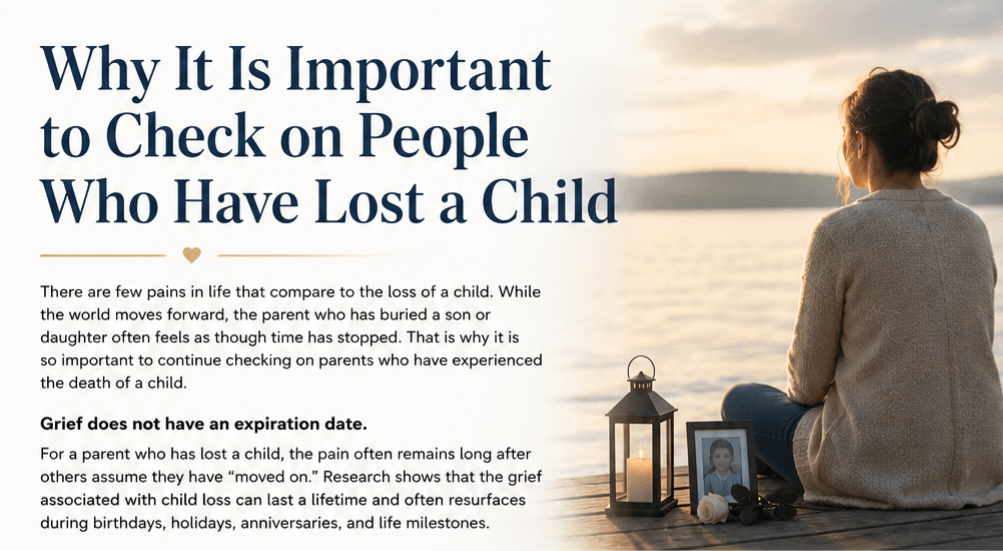
    Why It Is Important to Check On People Who Have Lost a Child

    There are few pains in life that compare to the loss of a child. It is a grief that changes a parent forever. While the world continues to move forward, the parent who has buried a son or daughter often feels as though time has stopped. The loss becomes a permanent part of their life, and although they may learn how to carry it, they never truly stop grieving. That is why it is so important to continue checking on parents who have experienced the death of a child.

    Many people offer support immediately after a loss. They send cards, flowers, messages, and prayers. Family and friends gather around during the funeral and the weeks that follow. However, as time passes, the phone calls become less frequent, the visits become rare, and life returns to normal for everyone except the grieving parent.

    The truth is that grief does not have an expiration date.

    For a parent who has lost a child, the pain often remains long after others assume they have “moved on.” Research consistently shows that the grief associated with child loss can last a lifetime and often resurfaces during birthdays, holidays, anniversaries, and significant life milestones.

    The Loneliness That Follows

    One of the most difficult parts of losing a child is the loneliness that follows.

    People often stop mentioning the child because they are afraid of causing pain. They worry they might say the wrong thing. In reality, many grieving parents desperately want to hear their child’s name spoken. They want to know their child has not been forgotten.

    When nobody asks how they are doing, it can feel as though the world has forgotten both their child and their grief. Months and years after the loss, many bereaved parents describe feeling isolated as support fades while their pain remains.

    A simple text message can make a tremendous difference:

    “I was thinking about you today.”

    “How are you doing?”

    “I remembered your son today and wanted you to know.”

    These small gestures remind grieving parents that they are not alone.

    Grief Doesn’t Follow a Schedule

    One of the biggest misconceptions about grief is that it follows a timeline. Many people assume that after a year or two, a parent should be doing better.

    The reality is very different.

    Grief can intensify unexpectedly. A song, a photograph, a graduation season, or seeing other families together can trigger powerful emotions. Parents may appear strong on the outside while privately struggling with overwhelming sadness, guilt, anger, or loneliness. There is no “normal” timeline for losing a child.

    Checking in regularly lets grieving parents know they do not have to hide their pain.

    Sometimes They Won’t Ask for Help

    Many grieving parents become experts at saying, “I’m fine.”

    Not because they are fine, but because they do not want to burden others.

    The emotional weight of child loss can be exhausting. Some parents feel guilty asking for support. Others believe nobody could truly understand what they are experiencing. As a result, they often suffer in silence.

    That is why checking on them matters.

    Do not wait for them to reach out. Reach out first.

    Ask how they are doing. Listen without trying to fix their pain. Sometimes the greatest gift you can give someone is simply your presence.

    Remember the Important Dates

    One of the most meaningful ways to support a grieving parent is to remember their child.

    Remember birthdays.

    Remember anniversaries.

    Remember holidays.

    Remember the day their child passed away.

    These dates can be incredibly difficult. While everyone else is focused on celebrations and daily life, parents are often reliving memories and feeling the weight of their loss all over again.

    A message that says, “I’m thinking about you and your child today,” can bring comfort during an otherwise painful day.

    You Don’t Have to Have the Perfect Words

    Many people avoid grieving parents because they are afraid of saying the wrong thing.

    The truth is that perfection is not required.

    You do not need a speech.

    You do not need answers.

    You simply need compassion.

    Often, the most meaningful words are the simplest:

    “I’m here for you.”

    “I can’t imagine what you’re going through, but I care.”

    “Tell me about your child.”

    The willingness to listen is far more valuable than finding the perfect words.

    Faith, Hope, and Healing

    For many parents, faith becomes an important source of strength after the loss of a child. While it may not remove the pain, it can provide hope during the darkest moments. It reminds them that love does not end with death and that the bond they share with their child continues.

    Yet even with faith, grief remains a heavy burden.

    No parent should have to carry that burden alone.

    Final Thoughts

    If you know someone who has lost a child, do not assume they are okay simply because time has passed.

    Check on them.

    Call them.

    Send a message.

    Invite them to lunch.

    Remember their child.

    Remember their pain.

    Most importantly, remind them that they are not forgotten.

    Your simple act of kindness may not take away their grief, but it can make the journey a little less lonely. Sometimes the greatest gift you can give a grieving parent is letting them know that both they and their child still matter.

    A Father’s Guide to Surviving the Loss of a Child