There is a war that few people talk about—a war that leaves no visible scars, yet reshapes lives in ways that cannot be undone. It is not fought with weapons or witnessed by crowds. It is fought in silence, behind closed doors, in long nights and heavy mornings.
It begins the moment loss enters your life.
Not just any loss—but the kind that alters your identity. The kind that forces you to confront a reality you never prepared for. The kind that leaves you asking questions that have no easy answers.
And in that moment, something awakens.
Two opposing forces rise within you.
One is fueled by loss, pain, and vengeance—intense, immediate, and consuming.
The other is carried by faith, justice, and restraint—quiet, patient, and enduring.
What follows is not just grief.
It is a battle for your soul.
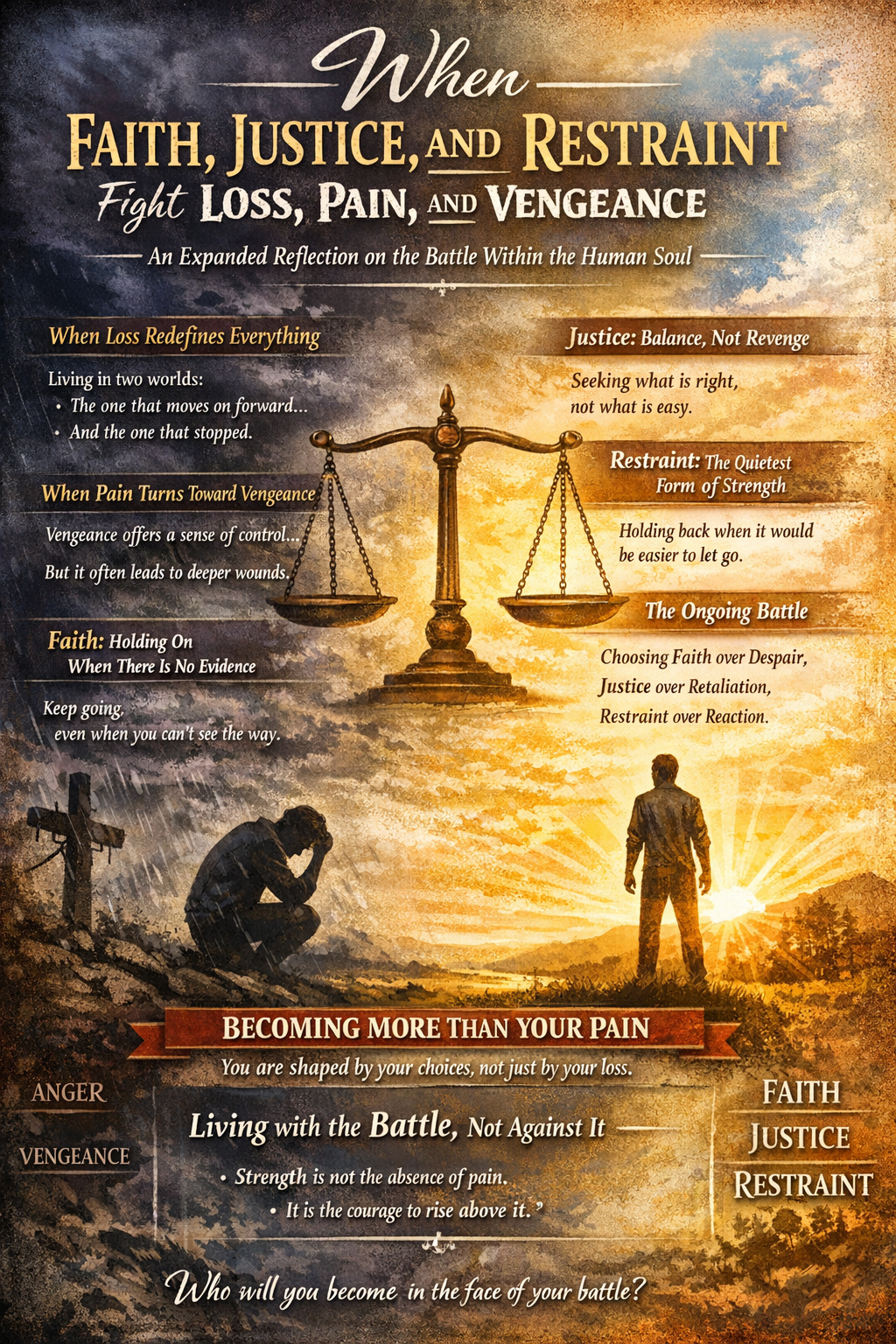
When Loss Redefines Everything
Loss does more than take something away—it changes how you see everything that remains.
It reshapes your sense of safety.
It fractures your understanding of fairness.
It challenges your belief in what is right and what is just.
For those who have lost deeply—especially a child, a partner, or someone who was a part of their everyday existence—the world no longer feels the same. The colors fade. The noise dulls. Even joy feels unfamiliar, like something meant for someone else.
You begin to live in two worlds at once:
The one that continues moving forward without pause
And the one that stopped the moment your loss occurred
And in that space, pain becomes your constant companion.
The Nature of Pain: A Language Without Words
Pain is not always loud.
Sometimes it is quiet—so quiet that others cannot see it, yet so heavy that it becomes difficult to carry. It hides behind forced smiles, routine conversations, and the simple act of getting through the day.
Pain speaks in different ways:
In the silence of an empty room
In the memory of a voice you can no longer hear
In the ache of milestones that now feel incomplete
It is unpredictable.
A scent, a song, a date on the calendar—anything can trigger a wave that pulls you back into the depths of grief without warning.
And when those waves hit, they bring with them something powerful:
The need for an answer.
The need for meaning.
The need for justice.
When Pain Turns Toward Vengeance
When pain has nowhere to go, it begins to search for direction.
And often, it finds it in vengeance.
Vengeance does not always appear as rage. Sometimes it shows up as quiet resentment. Sometimes as a desire to see someone held accountable in a way that mirrors your own suffering.
It tells you:
They should not get to move on when I cannot.
There should be consequences that match this pain.
If I can make them feel this, maybe I will feel less.
And in moments of deep hurt, that thinking can feel justified—even necessary.
Because vengeance offers something grief often takes away:
A sense of control.
But vengeance is a deceptive force.
It feeds on your pain while convincing you it is helping you release it. It keeps you tied to the very moment you are trying to escape. It can slowly transform your identity, replacing who you were with who your pain has made you.
It feels powerful.
But it often leads to deeper wounds.
Faith: Holding On When There Is No Evidence
Faith is often misunderstood as certainty.
In truth, faith is choosing to believe when certainty no longer exists.
It is standing in the middle of your pain and saying:
There has to be something more than this.
My story cannot end here.
Even if I don’t understand, I will not give up.
Faith does not remove grief. It does not answer every question. It does not promise immediate healing.
What it does is give you something to hold onto when everything else feels like it is slipping away.
For some, faith is rooted in spirituality or belief in a higher power.
For others, it is found in purpose—in honoring a loved one, in helping others, in continuing forward despite the weight.
Faith is not loud.
It is a whisper that says, keep going—even when every part of you wants to stop.
Justice: The Difference Between Balance and Revenge
Justice is often confused with vengeance, but they are not the same.
Vengeance is driven by emotion.
Justice is grounded in principle.
Vengeance asks, How can I make them feel what I feel?
Justice asks, What is right, and how do we uphold it?
True justice is not about causing suffering—it is about accountability, truth, and restoring balance where it has been broken.
It is not always satisfying.
It is not always immediate.
And it does not always feel like enough.
But justice protects something that vengeance cannot:
Your integrity.
It allows you to stand firm without becoming consumed. It gives structure to chaos. It provides a path forward that is not dictated by anger, but guided by fairness.
Restraint: The Quietest Form of Strength
Restraint is one of the most misunderstood forms of power.
In a world that often celebrates reaction—quick responses, emotional outbursts, immediate action—restraint can look like weakness.
But restraint is anything but weak.
It is choosing not to act when acting would be easier.
It is holding back words that cannot be taken back.
It is refusing to let pain dictate your behavior.
Restraint requires awareness.
It requires discipline.
And most of all, it requires courage.
Because it is not easy to pause when everything inside you is demanding release.
But in that pause, something important happens:
You create space between who you are and what you feel.
And in that space, you reclaim control.
The Ongoing Battle: There Is No Final Victory
This battle is not won in a single moment.
It does not end with a decision or a realization.
It is fought again and again—in small choices, in quiet thoughts, in how you respond to the world around you.
Some days, pain will be louder than faith.
Some days, vengeance will feel stronger than restraint.
Some days, justice will feel too slow to matter.
And that is part of being human.
The goal is not perfection.
The goal is awareness.
Each time you choose:
Faith over despair
Justice over retaliation
Restraint over reaction
you are not eliminating the battle—you are strengthening the side that leads you forward.
Becoming More Than Your Pain
Pain has the power to define you—but only if you allow it to.
Loss will always be a part of your story.
Grief will always leave its mark.
The memory of what was taken will never fully disappear.
But you are more than what you have lost.
You are more than what you have endured.
And the choices you make in the face of that pain will determine who you become.
You can become hardened—or you can become deeper.
You can become consumed—or you can become compassionate.
You can become reactive—or you can become intentional.
Faith, justice, and restraint do not erase your pain.
They transform how you carry it.
Living With the Battle, Not Against It
The truth is, the goal is not to silence loss, pain, or even the instinct for vengeance.
Those emotions are part of being human.
The goal is to not let them lead.
To acknowledge them without becoming them.
To feel them without being controlled by them.
To understand them without acting on every impulse they create.
Because strength is not the absence of pain.
It is the ability to carry it without letting it destroy who you are.
A Final Thought
There will be moments when the weight feels unbearable.
Moments when faith feels distant, justice feels delayed, and restraint feels impossible.
In those moments, remember this:
You do not have to win the entire battle today.
You only have to choose, in this moment, which side you will stand on.
And sometimes, that choice alone is enough to keep you moving forward.