Some movies entertain. Some movies shock. And then there are movies that unexpectedly reach into the deepest parts of grief and pain that many people spend years trying to survive. Punisher: One Last Kill became that kind of film for me.
On the surface, the movie is a brutal vigilante story centered around The Punisher, also known as Frank Castle. But underneath the violence, gunfire, and dark atmosphere is a devastating psychological study about trauma, loss, emptiness, and the emotional destruction left behind after losing the people you love most. Watching this film after losing my son in a car accident affected me in a way very few movies ever have.
The film opens with a version of Frank Castle who has already completed his mission of revenge. Everyone responsible for his family’s deaths is gone. The war is over. But instead of peace, Frank is left with silence, emotional emptiness, and unbearable grief. That emotional direction hit me hard because grief often feels exactly like that. People sometimes assume pain fades once time passes or once life moves forward, but the truth is that loss changes everything permanently.
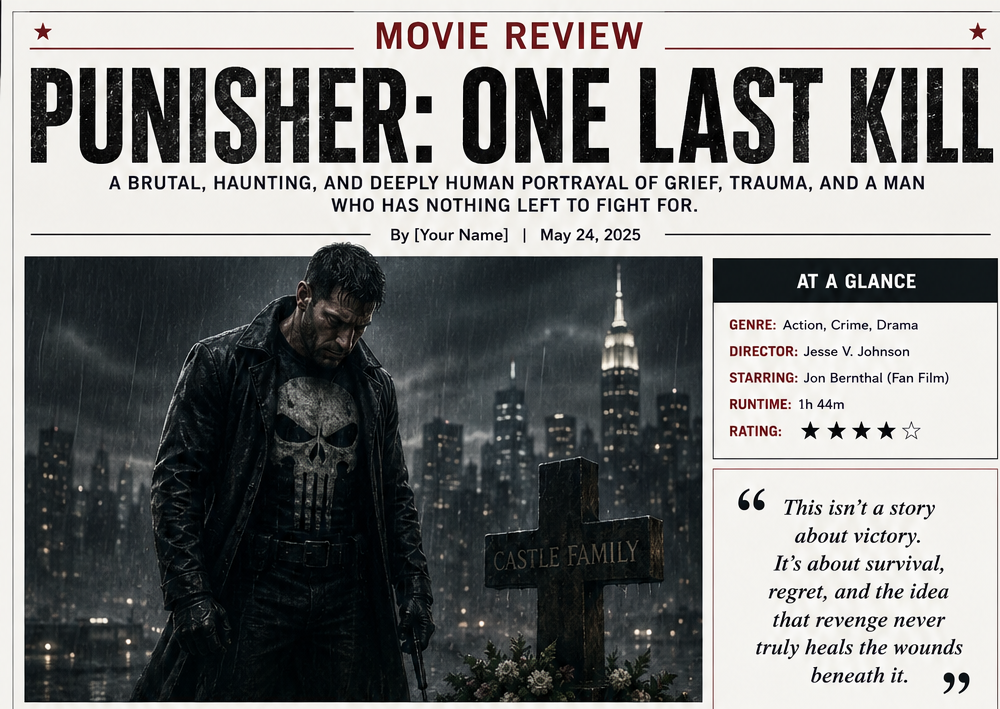
One of the most emotionally difficult aspects of the movie is Frank’s suicidal ideation. Several scenes show him sitting at his family’s gravesite holding his final bullet and contemplating whether he should end his own life. The scenes are quiet and haunting, carrying far more emotional weight than the action sequences. They capture the exhaustion that grief can create — not necessarily wanting to die, but feeling emotionally drained from carrying pain every single day.
After losing my son, there were moments where life no longer felt familiar. There is a loneliness that comes with child loss that is difficult to explain to people who have never experienced it. A part of your heart, your future, and your identity disappears. Watching Frank sit at those graves reminded me how grief isolates people emotionally, even when surrounded by others. The movie does not romanticize his pain. Instead, it shows the devastating emotional paralysis that can happen after profound loss.
The first half of the film functions almost entirely as a psychological character study. Frank suffers from severe PTSD and constant hallucinations involving his deceased daughter and fallen allies. The line between memory and reality becomes blurred as trauma consumes his mind. Those scenes felt painfully real because grief often works the same way in everyday life.
When you lose someone you love deeply, memories stop feeling like simple memories. Sometimes you hear their voice in your head. Sometimes certain places, songs, smells, or moments suddenly bring them rushing back into your mind without warning. Sometimes your brain replays old moments over and over again, almost like emotional flashbacks. The film captures that emotional torment extremely well through Frank’s hallucinations and fractured mental state.
What affected me most was how the movie portrayed grief as something ongoing instead of something that simply “heals” with time. Frank Castle is still alive physically, but emotionally he remains trapped in the moment he lost his family. As a grieving parent, that felt deeply relatable. Losing a child changes how you experience the world forever. Holidays change. Birthdays change. Everyday life changes. Even moments of happiness can carry sadness underneath them because you constantly feel the absence of the person who should still be there.
Visually, the movie reinforces this emotional heaviness through dark lighting, empty environments, abandoned streets, and bleak imagery. There is very little warmth in Frank’s world, and that emptiness mirrors the emotional numbness grief can create. Even the action scenes feel stripped of triumph or satisfaction. The violence is brutal, grounded, and emotionally exhausting rather than exciting.
What makes Punisher: One Last Kill powerful is that it understands revenge does not heal grief. Frank killed everyone responsible for his pain, but the emotional wounds remained. That truth quietly sits underneath the entire film. No amount of anger, revenge, distraction, or time can fully erase the pain of losing someone you love deeply — especially a child.
At times, watching the movie was emotionally difficult because it forced me to confront feelings that many grieving parents carry privately: hopelessness, emotional exhaustion, loneliness, guilt, and the struggle to find meaning after unimaginable loss. But strangely, the film also reminded me that grief is not weakness. It showed how trauma can consume even the strongest people, and how surviving emotional pain can become its own kind of battle.
The independent nature of the production occasionally shows through technically, but emotionally the movie succeeds because it is honest about suffering. It does not hide from darkness or pretend that pain has easy answers. Instead, it presents a broken man struggling to live with memories he cannot escape.
For me, Punisher: One Last Kill became more than a vigilante film. It became a reflection of grief itself — the anger, the emptiness, the memories, the emotional isolation, and the constant struggle to keep moving forward after losing someone you love. Beneath the violence and tragedy is a heartbreaking reminder that some wounds never fully heal, and some people spend the rest of their lives learning how to carry the pain while still finding reasons to continue.