Category: Grief & Child Loss

  • How to Support Someone During National Bereaved Parents Month

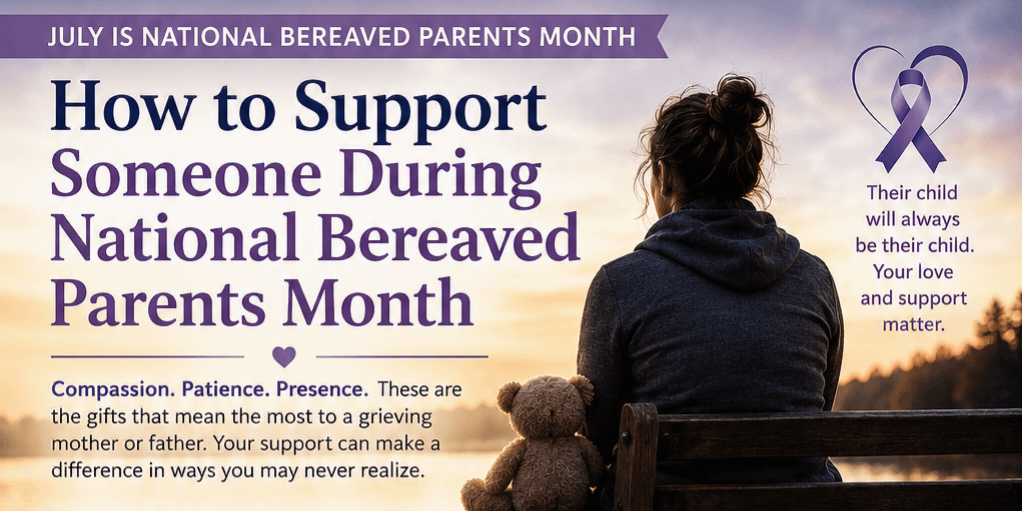
    How to Support Someone During National Bereaved Parents Month

    Every July, National Bereaved Parents Month shines a light on one of life’s most profound and often misunderstood losses—the death of a child. While awareness is important, what grieving parents need most is not simply recognition. They need compassion, patience, and people who are willing to walk beside them without trying to fix their pain.

    There is no timeline for losing a son or daughter. Whether the loss happened weeks ago or decades ago, a bereaved parent carries that love and grief every single day. National Bereaved Parents Month offers all of us an opportunity to reach out, acknowledge their child, and remind them they are not alone.

    Understanding the Reality of Child Loss

    The death of a child changes every part of a parent’s life.

    Dreams are altered.
    Traditions feel incomplete.
    Birthdays become bittersweet.
    Holidays often bring more pain than celebration.

    Many bereaved parents continue working, smiling, and helping others while carrying an invisible weight that few people ever truly see.

    One of the greatest misconceptions about grief is that it eventually disappears. In reality, grief changes over time, but love never ends. Parents don’t “move on” from their children—they learn to move forward while carrying them in their hearts.

    Why National Bereaved Parents Month Matters

    This month serves several important purposes:

    • Raises awareness about child loss.
    • Encourages compassionate conversations.
    • Educates others about the grieving process.
    • Honors the lives of children who are deeply loved and deeply missed.
    • Reminds bereaved parents they are seen.

    Sometimes simply knowing someone remembers can provide comfort during an incredibly difficult journey.

    The Best Ways to Support a Bereaved Parent

    1. Say Their Child’s Name

    Many people avoid mentioning the child because they fear causing sadness.

    The truth is, parents are already thinking about their child.

    Hearing their child’s name often brings comfort because it reminds them that others remember too.

    Simple statements can mean everything:

    • “I’ve been thinking about Paul today.”
    • “I remember how much he loved helping people.”
    • “She had such a beautiful smile.”

    Love deserves to be remembered.

    2. Don’t Avoid Them

    Grieving parents often experience unexpected loneliness.

    Friends disappear.

    Conversations become awkward.

    Invitations stop coming.

    Sometimes people simply don’t know what to say, so they say nothing at all.

    Presence is far more valuable than perfect words.

    A simple message saying,

    “I’m thinking about you today.”

    can mean more than you realize.

    3. Listen More Than You Speak

    Many people instinctively try to solve grief.

    They offer advice.

    They compare losses.

    They encourage parents to “stay strong.”

    Instead, give them permission to talk.

    Allow silence.

    Allow tears.

    Allow memories.

    Sometimes listening is the greatest gift you can offer.

    4. Avoid Harmful Phrases

    Although usually well-intentioned, certain comments can deepen someone’s pain.

    Avoid saying:

    • “Everything happens for a reason.”
    • “They’re in a better place.”
    • “At least you have other children.”
    • “You’ll get over it.”
    • “You need to move on.”

    Instead try:

    • “I’m so sorry.”
    • “I can’t imagine how hard this is.”
    • “I’m here for you.”
    • “You don’t have to go through this alone.”

    Simple honesty is powerful.

    5. Remember Important Dates

    Grief intensifies around:

    • Birthdays
    • Angelversaries
    • Holidays
    • Mother’s Day
    • Father’s Day
    • Family celebrations

    Mark these dates on your calendar.

    Send a message.

    Mail a card.

    Drop off flowers.

    These small gestures tell parents that their child has not been forgotten.

    6. Offer Practical Help

    Grief is emotionally exhausting.

    Instead of saying:

    “Let me know if you need anything.”

    Offer something specific.

    Examples include:

    • Bringing dinner.
    • Mowing the lawn.
    • Walking the dog.
    • Babysitting siblings.
    • Running errands.
    • Delivering groceries.

    Practical support removes stress during overwhelming moments.

    7. Respect Their Way of Grieving

    Every parent grieves differently.

    Some openly cry.

    Some stay quiet.

    Some volunteer.

    Some write.

    Some start foundations.

    Some keep every belonging exactly where it was.

    There is no right way.

    Support should never come with expectations.

    8. Keep Showing Up

    Support often fades after the funeral.

    Yet grief continues long afterward.

    Check in months later.

    Check in years later.

    One text can remind someone they have not been forgotten.

    Consistency speaks louder than grand gestures.

    Supporting Fathers

    Bereaved fathers are often overlooked.

    Society frequently expects men to remain strong, provide stability, and suppress emotion.

    Many fathers cry in private.

    Many feel isolated because few people ask how they are doing.

    During National Bereaved Parents Month, remember fathers too.

    Ask how they are coping.

    Invite them to talk.

    Respect if they don’t.

    Simply knowing someone cares can make a tremendous difference.

    Supporting Mothers

    Mothers often experience intense emotional, physical, and spiritual grief.

    Many feel pressure to hide their pain so others will be comfortable.

    Allow mothers to share memories.

    Celebrate their child’s life.

    Recognize that motherhood never ends, even after loss.

    A mother whose child has died is still a mother.

    If You Don’t Know What to Say

    You don’t need perfect words.

    Try these:

    • “I’m thinking of you today.”
    • “I remember your child.”
    • “Would you like to tell me about them?”
    • “I’m here whenever you need me.”
    • “You are not alone.”

    Sometimes the smallest sentence carries the greatest comfort.

    Ways Communities Can Help

    Churches, workplaces, schools, and organizations can also participate by:

    • Hosting remembrance events.
    • Sharing educational resources.
    • Creating memory walls.
    • Lighting candles in honor of children.
    • Supporting local grief organizations.
    • Encouraging conversations about child loss.

    Awareness creates compassion.

    Compassion creates healing.

    What Bereaved Parents Often Wish Others Knew

    Many grieving parents share similar hopes:

    • Don’t forget our child.
    • Don’t avoid us because you’re uncomfortable.
    • Let us laugh without guilt.
    • Let us cry without judgment.
    • Don’t expect grief to have an expiration date.
    • Continue remembering our child long after everyone else has moved on.

    These wishes cost nothing to honor but mean everything to those living with loss.

    A Final Thought

    National Bereaved Parents Month is about more than awareness—it is about love that never ends.

    Every bereaved parent carries two stories: one filled with unimaginable heartbreak and another filled with immeasurable love. Supporting them does not require perfect words or grand gestures. It requires kindness, patience, empathy, and the willingness to simply be present.

    If someone in your life has lost a child, let this month be a reminder to reach out. Send a message. Share a memory. Say their child’s name. Offer your time. Listen without judgment.

    You may never fully understand their pain, but your compassion can help lighten the burden they carry.

    Because while grief may last a lifetime, no parent should have to walk that journey alone.

    A Father’s Guide to Surviving the Loss of a Child

  • National Bereaved Parents Awareness Month: Honoring Love That Never Ends

    National Bereaved Parents Awareness Month: Honoring Love That Never Ends

    Every July, National Bereaved Parents Awareness Month shines a compassionate light on one of life’s most profound and often misunderstood losses—the death of a child. While the world continues to move forward, bereaved parents carry a love that never fades and a grief that forever changes who they are.

    This month is dedicated to acknowledging their journey, increasing awareness about child loss, encouraging meaningful support, and reminding grieving parents that they are not alone.

    What Is National Bereaved Parents Awareness Month?

    National Bereaved Parents Awareness Month is observed throughout July to recognize parents who have experienced the death of a child, regardless of the child’s age or the cause of death.

    Whether the loss occurred through:

    • Miscarriage
    • Stillbirth
    • Infant loss
    • Childhood illness
    • Accidents
    • Violence
    • Suicide
    • Military service
    • Addiction
    • Adult child loss

    the pain remains real, and every parent’s grief deserves compassion and understanding.

    The month serves as an opportunity for families, friends, communities, workplaces, churches, healthcare providers, and support organizations to better understand what bereaved parents experience long after funeral services have ended.


    The Grief That Never Truly Ends

    People often assume grief follows a timeline. They expect parents to “move on” after weeks, months, or even a few years.

    Bereaved parents know differently.

    A child isn’t someone you simply lose.

    They’re part of your identity.

    Every birthday.
    Every holiday.
    Every graduation that never happens.
    Every family photograph.
    Every quiet evening.

    The absence remains.

    Healing doesn’t mean forgetting.

    Healing means learning how to carry unbearable love alongside unbearable loss.


    Why Awareness Matters

    Many grieving parents say one of the hardest parts isn’t only losing their child.

    It’s feeling invisible afterward.

    Friends stop asking.

    Coworkers avoid the subject.

    People become uncomfortable.

    The child’s name slowly disappears from conversations.

    Awareness changes that.

    It teaches others that speaking a child’s name is often comforting rather than painful. It reminds people that acknowledging a loss months or years later can be one of the greatest gifts they can offer.

    Grief shared is not grief removed—but it becomes less lonely.


    What Bereaved Parents Wish Others Understood

    Every parent’s journey is unique, but many share similar experiences.

    There Is No Timeline

    Grief doesn’t end after one year.

    Or five years.

    Or twenty years.

    Parents simply learn new ways to carry it.


    They Still Want Their Child Remembered

    Many people avoid mentioning the child’s name because they’re afraid of causing pain.

    The truth is:

    Bereaved parents already think about their child every day.

    Hearing someone remember them reminds parents that their child’s life mattered.


    Milestones Can Be Difficult

    Ordinary dates often become extraordinary reminders.

    • Birthdays
    • Death anniversaries
    • Mother’s Day
    • Father’s Day
    • Holidays
    • School graduations
    • Weddings
    • Family gatherings

    These moments can reopen wounds that never completely heal.


    Joy and Grief Can Exist Together

    A grieving parent can laugh.

    Smile.

    Celebrate.

    Travel.

    Find love again.

    None of those things mean they have forgotten their child.

    Grief and happiness are not opposites.

    They often exist side by side.


    How You Can Support a Bereaved Parent

    You don’t need perfect words.

    You simply need compassion.

    Here are meaningful ways to help:

    Say Their Child’s Name

    One sentence can mean everything.

    “I was thinking about Michael today.”

    “I remember Sarah’s beautiful smile.”

    Those words remind parents their child continues to be remembered.


    Listen More Than You Speak

    You don’t have to fix grief.

    You simply need to be present.

    Sometimes silence shared with someone who cares is more comforting than advice.


    Remember Important Dates

    Mark birthdays and anniversaries on your calendar.

    Send a simple message:

    “I’m remembering your son today.”

    “I know today may be difficult. I’m thinking of you.”

    Small gestures become unforgettable acts of kindness.


    Avoid Harmful Phrases

    Although well-intentioned, statements like these often hurt:

    • “Everything happens for a reason.”
    • “At least you have other children.”
    • “They’re in a better place.”
    • “You need to move on.”
    • “God needed another angel.”

    Instead, try:

    “I’m so sorry.”

    “I remember your child.”

    “I’m here whenever you need someone.”


    Finding Hope After Child Loss

    Hope doesn’t mean forgetting.

    Hope doesn’t erase grief.

    Hope simply means believing that life can still have purpose.

    Many bereaved parents discover healing through:

    • Faith
    • Counseling
    • Support groups
    • Writing
    • Volunteering
    • Honoring their child’s memory
    • Helping other grieving families
    • Creating scholarships or memorials
    • Advocacy for causes related to their child’s life

    Purpose often grows from pain.


    To Every Bereaved Parent

    If you’re reading this because you’ve lost a child, know this:

    Your grief is valid.

    Your love did not end the day your child died.

    You don’t have to pretend you’re okay.

    You don’t have to grieve according to someone else’s expectations.

    Take each day one breath at a time.

    Honor your child in whatever way brings peace to your heart.

    Speak their name.

    Tell their stories.

    Celebrate the love that continues to live within you.

    Their life mattered.

    It always will.


    Ways to Observe National Bereaved Parents Awareness Month

    Communities can help raise awareness throughout July by:

    • Wearing a remembrance ribbon or memorial jewelry.
    • Lighting a candle in honor of a child.
    • Sharing photos and memories on social media.
    • Donating to organizations that support grieving families.
    • Participating in remembrance walks or memorial events.
    • Volunteering with bereavement support organizations.
    • Checking in with a grieving parent.
    • Encouraging open conversations about child loss.
    • Supporting local hospitals, hospices, and grief centers.
    • Offering meals, cards, or simple acts of kindness.

    Every act of remembrance tells grieving parents one important message:

    Your child will never be forgotten.


    Final Thoughts

    National Bereaved Parents Awareness Month reminds us that while death may end a life, it never ends a parent’s love.

    Grief is not something to overcome—it is something carried with courage, faith, and enduring love.

    This July, take a moment to remember the families whose hearts forever carry both joy and sorrow. Reach out. Say a child’s name. Offer compassion without expectations.

    Sometimes the greatest gift we can give a bereaved parent is simply acknowledging that their child mattered, their grief matters, and their love will always matter.

    Because love does not end with goodbye.

    A Father’s Guide to Surviving the Loss of a Child

  • Honoring the Dead by Fighting: Living a Life Worthy of Their Memory

    Honoring the Dead by Fighting: Living a Life Worthy of Their Memory

    We Cannot Bring Them Back, But We Can Carry Them Forward

    Losing someone we love changes us forever. Whether it is a parent, spouse, sibling, close friend, or child, death leaves an emptiness that words often fail to describe. There are days when grief feels unbearable and nights when silence becomes overwhelming.

    In those moments, it is easy to believe that giving up would somehow lessen the pain.

    But honoring those who have passed is not found in surrender.

    It is found in the fight.

    Not a fight against the reality of death—that battle cannot be won—but a fight to keep living with purpose, to love despite heartbreak, to hope despite disappointment, and to become the person they believed we could be.

    The greatest tribute we can offer those we have lost is refusing to let their memory die within us.


    Fighting Doesn’t Mean You Never Cry

    Strength is often misunderstood.

    Many believe strength means hiding emotions, pretending everything is fine, or never allowing yourself to break.

    Real strength is different.

    Real strength looks like:

    • Getting out of bed when you don’t want to.
    • Going to work with a broken heart.
    • Celebrating birthdays and holidays while carrying an empty chair in your heart.
    • Smiling through tears because someone else needs you.
    • Continuing to love after experiencing unimaginable loss.

    The fight isn’t against your emotions.

    The fight is against allowing grief to convince you that life no longer matters.


    Every Day You Continue Is an Act of Honor

    Your loved one invested time, love, memories, and dreams into your life.

    Would they truly want your story to end with theirs?

    Most would answer no.

    They would want you to:

    • Laugh again.
    • Dream again.
    • Love again.
    • Build again.
    • Help others again.

    Every step forward becomes a testimony that their love continues to shape the world through you.


    Grief Is Not the Enemy

    Too many people believe they must “beat grief.”

    Grief is not something to defeat.

    Grief is love with nowhere to go.

    Instead of fighting grief, fight despair.

    Fight hopelessness.

    Fight isolation.

    Fight the temptation to believe that your life has no purpose anymore.

    You can carry grief while still carrying hope.

    Both can exist together.


    Honor Them by Becoming Better

    Perhaps your loved one taught you kindness.

    Live kindly.

    Perhaps they believed in your potential.

    Reach it.

    Perhaps they sacrificed so you could have opportunities they never had.

    Don’t waste those opportunities.

    The greatest monument you can build isn’t made of stone.

    It is made through the choices you make every single day.

    Your life becomes their legacy.


    Turn Pain into Purpose

    Many of the world’s greatest ministries, charities, foundations, businesses, and support groups began because someone refused to let tragedy have the final word.

    Pain can either make us bitter or make us compassionate.

    When you’ve experienced deep loss, you understand suffering in a way others may never fully grasp.

    That understanding becomes a gift.

    You know how to comfort.

    You know how to listen.

    You know how to stand beside someone when words aren’t enough.

    Your scars may become someone else’s source of hope.


    Fighting Means Choosing Life Every Morning

    Some mornings are harder than others.

    Certain songs.

    Certain places.

    Certain dates.

    A familiar scent.

    An old photograph.

    They all have the power to reopen wounds.

    Yet every morning you choose to stand up and continue living, you declare that love is stronger than death.

    Not because death didn’t hurt.

    But because love refuses to disappear.


    Let Their Values Live Through You

    The people we lose leave behind more than memories.

    They leave behind lessons.

    Perhaps they taught integrity.

    Practice honesty.

    Perhaps they taught generosity.

    Give freely.

    Perhaps they taught forgiveness.

    Choose grace.

    When others see those qualities in you, they are seeing part of the person you lost.

    Their influence continues long after their final breath.


    There Will Be Setbacks

    Healing is not a straight line.

    Some days you will feel like you’re making progress.

    Other days it will feel like you’re right back at the beginning.

    That does not mean you’ve failed.

    It means you’re human.

    Keep fighting.

    Keep praying.

    Keep trusting.

    Keep moving one step at a time.

    Even slow progress is still progress.


    For Those Who Lost a Child

    There may be no greater pain than burying your own child.

    The dreams you carried, the future you imagined, and the life you expected are forever changed.

    Many grieving parents wonder if life can ever have meaning again.

    It can.

    Not because the pain disappears.

    But because love continues.

    Honor your child’s memory by living in a way that reflects the values you hoped to teach them.

    Tell their story.

    Speak their name.

    Help others.

    Love deeply.

    Carry them with you—not as a weight that keeps you from living, but as a light that reminds you why life still matters.


    Faith Gives the Fight Meaning

    For those who believe in God, death is not the final chapter.

    Scripture reminds us that this life is temporary and that those who die in faith are held securely in God’s hands.

    That hope does not erase grief.

    It transforms it.

    We fight because we believe there is more beyond this life.

    We fight because love never truly ends.

    We fight because one day sorrow will give way to joy.

    Faith reminds us that every tear is seen, every prayer is heard, and every life lived with love leaves an eternal impact.


    Final Thoughts

    Honoring the dead isn’t about remaining trapped in the past.

    It isn’t about refusing to smile, refusing to heal, or refusing to move forward.

    The greatest honor we can give those we love is to continue living with courage, purpose, compassion, and faith.

    Fight for your family.

    Fight for your future.

    Fight for your faith.

    Fight for those who no longer can.

    Because every act of kindness, every step forward, every dream pursued, and every life touched becomes another chapter in the legacy they left behind.

    They may no longer walk beside you.

    But through the life you choose to live, they continue to walk within you.

    A Father’s Guide to Surviving the Loss of a Child
  • Recognizing When Your Grief Is Out of Control

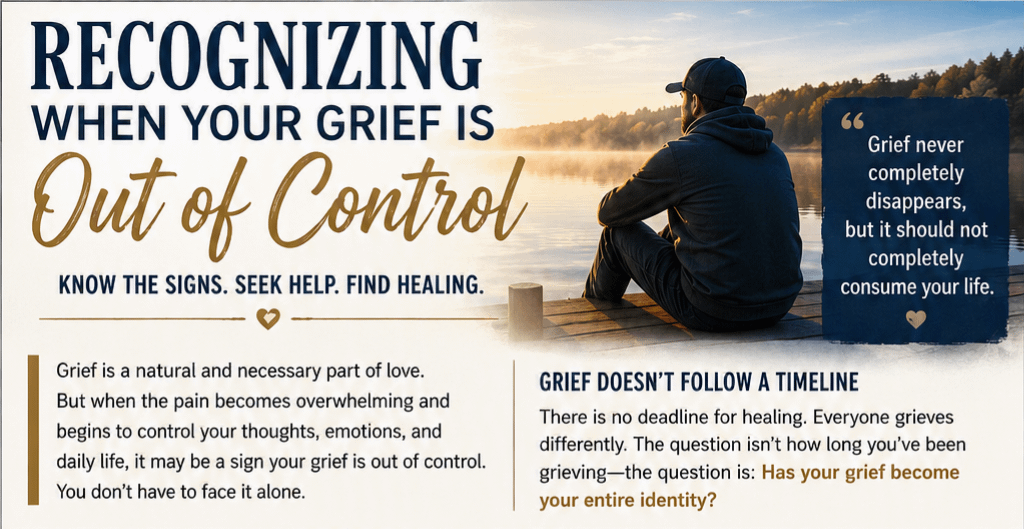
    Recognizing When Your Grief Is Out of Control

    Grief changes you.

    When you lose someone you love—especially a child—you don’t simply return to the person you were before. Your heart has experienced something that words can never fully explain. Tears become familiar. Loneliness becomes constant. Memories can appear without warning, and some days simply getting out of bed feels like a victory.

    All of this is normal.

    But there comes a point when grief can begin to control every part of your life rather than simply becoming a part of it.

    Many grieving parents, spouses, siblings, and friends don’t realize when they’ve crossed that line because the pain has become their normal.

    As someone who has experienced the devastating loss of a son, I understand how easy it is to believe that suffering forever is simply the price of loving someone deeply. While grief never completely disappears, it should not completely consume your life.

    Recognizing when grief is becoming unhealthy isn’t admitting weakness.

    It’s recognizing that your heart needs help carrying a burden that was never meant to be carried alone.


    Grief Doesn’t Follow a Timeline

    One of the biggest myths about grief is that there is a deadline.

    People often hear things like:

    • “It’s been a year.”
    • “You need to move on.”
    • “They’re in a better place.”
    • “Time heals everything.”

    None of those statements understand grief.

    There is no calendar that tells your heart when to stop hurting.

    Some people cry every day for months.

    Others feel numb for years before emotions finally surface.

    Everyone grieves differently.

    The issue isn’t how long you’ve been grieving.

    The question is:

    Has your grief become your entire identity?


    When Grief Begins Controlling Your Life

    Grief is meant to be felt.

    But it should never become the only thing you feel.

    If your thoughts, emotions, decisions, and relationships are all controlled by your loss every single day, your grief may have moved beyond healthy mourning.

    You may notice that every conversation returns to your loss.

    You stop making plans because you assume nothing will ever matter again.

    You no longer believe happiness is possible.

    Life begins revolving around surviving instead of living.

    That isn’t because you don’t love the person who died.

    It’s because grief has quietly taken over.


    Warning Signs Your Grief May Be Out of Control

    You Have Completely Withdrawn From Everyone

    Isolation often feels safer.

    No one asks uncomfortable questions.

    No one expects you to smile.

    No one accidentally says something hurtful.

    But isolation slowly feeds grief.

    If weeks or months go by without meaningful conversations, friendships, family interaction, or social activity, grief may be building walls that become harder to escape.

    Healing requires connection.


    You Feel Guilty Whenever You Experience Happiness

    Many grieving parents believe:

    “If I smile, I’m forgetting them.”

    “If I laugh, I didn’t love them enough.”

    “If I enjoy life, I’m betraying them.”

    Nothing could be further from the truth.

    Your loved one is not honored by your permanent suffering.

    They would likely want you to smile again.

    Finding joy doesn’t erase love.

    It proves love still lives inside you.


    You Can’t Function in Daily Life

    Grief affects concentration.

    That is normal.

    But if months have passed and you are unable to:

    • Pay bills
    • Maintain hygiene
    • Go to work
    • Prepare meals
    • Care for your family
    • Complete simple responsibilities

    your grief may be preventing you from functioning.

    There is no shame in asking for help.


    You’re Using Alcohol or Drugs to Escape

    Pain demands relief.

    Some people seek that relief through alcohol.

    Others use prescription medication incorrectly.

    Some turn to drugs.

    Some become addicted to gambling, shopping, or other distractions.

    None of these remove grief.

    They only postpone it.

    Eventually, the grief returns—often stronger than before.


    You’re Constantly Angry

    Grief doesn’t always look like sadness.

    Sometimes it looks like rage.

    You may find yourself angry at:

    • God
    • Doctors
    • Family
    • Friends
    • Yourself
    • The driver
    • Life itself

    Anger is part of grief.

    But when every interaction becomes hostile or explosive, unresolved pain may be controlling your emotions.


    You Think About Death Constantly

    Many grieving people say,

    “I don’t want to die…

    I just don’t want to keep hurting.”

    That feeling deserves to be taken seriously.

    If thoughts of death become frequent, if you feel hopeless, or if you begin believing people would be better off without you, don’t keep those thoughts to yourself.

    Reach out to someone you trust.

    Professional help can make an enormous difference.

    Seeking help is an act of courage, not failure.


    You Refuse to Talk About Your Loved One

    Some grieving people can’t stop talking.

    Others refuse to say their loved one’s name.

    Both extremes can become unhealthy.

    Healing often comes through remembering.

    Sharing stories.

    Looking at photographs.

    Laughing through tears.

    Keeping memories alive helps keep love alive.


    Your Physical Health Is Declining

    Grief affects the body.

    You may notice:

    • Constant exhaustion
    • Headaches
    • High blood pressure
    • Weight gain or loss
    • Sleep problems
    • Digestive issues
    • Panic attacks

    Ignoring these symptoms only makes healing harder.

    Your heart has been broken emotionally.

    Your body often feels the effects too.


    Every Day Feels Exactly the Same

    One of grief’s greatest dangers is emotional stagnation.

    You stop looking forward to anything.

    Birthdays don’t matter.

    Holidays lose meaning.

    The future disappears.

    Life becomes surviving one day at a time with no hope of change.

    When you stop believing tomorrow could be different, grief has begun stealing your future.


    Why Many Fathers Never Notice

    Many men were raised to believe:

    • Stay strong.
    • Don’t cry.
    • Handle it yourself.
    • Keep moving.

    So instead of processing grief…

    They bury it.

    They work longer hours.

    They isolate.

    They stay busy.

    They become emotionally unavailable.

    On the outside, they appear strong.

    Inside, they’re falling apart.

    Strength isn’t pretending you’re okay.

    Strength is admitting when you’re not.


    Healing Doesn’t Mean Forgetting

    One of the greatest fears grieving parents have is healing itself.

    They worry that feeling better somehow means loving less.

    It doesn’t.

    You can heal…

    while still crying.

    You can heal…

    while still missing them every day.

    You can heal…

    while carrying their memory forever.

    Healing doesn’t replace love.

    It allows love to exist without destroying you.


    Steps Toward Healing

    If you recognize yourself in these warning signs, remember that healing doesn’t happen all at once. It often begins with one small decision.

    Consider taking these first steps:

    • Talk with someone you trust.
    • Join a grief support group.
    • Speak with a licensed grief counselor.
    • Pray honestly, even if your faith feels shaken.
    • Take care of your physical health through sleep, nutrition, and movement.
    • Allow yourself moments of joy without guilt.
    • Honor your loved one by living a life that reflects the love they gave you.

    Each small step is progress.


    There Is Hope Beyond the Pain

    Losing someone you love changes you forever.

    There is no returning to the person you once were.

    But there is a path toward becoming someone who carries grief with strength instead of being crushed by it.

    Your loved one will always be part of your story.

    Their memory deserves to live on.

    So do you.

    If your grief feels like it has taken control of your life, don’t face it alone. Reaching out for support is not giving up—it is choosing hope. Healing doesn’t mean the pain disappears. It means learning that even with a broken heart, life can still hold purpose, love, and moments of peace.

    You are not leaving your loved one behind by healing.

    You are carrying them forward in the way you choose to live.

    A Father’s Guide to Surviving the Loss of a Child
  • Why It’s Hard to Live After Losing a Child

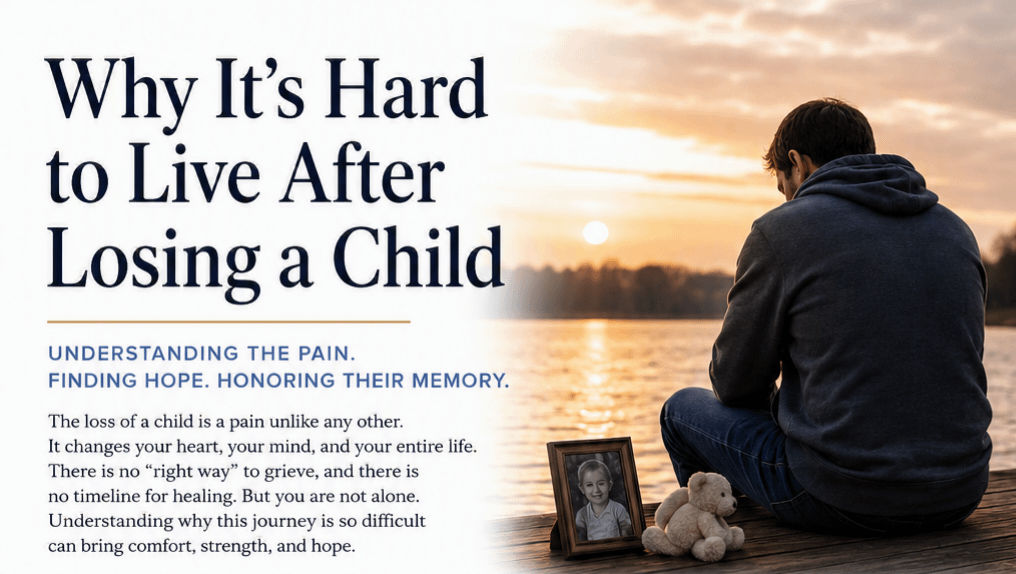
    Why It’s Hard to Live After Losing a Child

    There is no pain quite like the loss of a child.

    It is a grief that defies explanation, ignores timelines, and forever changes the heart of every parent who experiences it. The death of a child isn’t simply another tragedy to overcome. It is the loss of a piece of yourself—a love so deep that words often fail to describe it.

    People often say that losing a parent is part of life. Losing a spouse is heartbreaking. Losing a close friend is devastating. While each of those losses carries tremendous pain, the death of a child feels different because it goes against the natural order of life. Parents expect to leave this world before their children. We spend years protecting them, teaching them, encouraging them, and dreaming about the future they will have.

    When that future is suddenly taken away, something inside a parent breaks.

    Many grieving parents quietly ask themselves a question they never imagined asking:

    “How am I supposed to keep living after this?”

    The answer isn’t simple.

    The truth is that life after losing a child isn’t about finding happiness again overnight. It’s about learning to carry unimaginable pain while slowly discovering that life can still hold purpose, even though it will never look the same again.


    Your Entire Identity Changes

    Before your child died, you probably knew exactly who you were.

    You were Mom.

    You were Dad.

    Your daily routines often revolved around your child.

    Helping with homework.

    Attending games.

    Cooking favorite meals.

    Giving advice.

    Celebrating birthdays.

    Planning vacations.

    Making memories.

    Whether your child was five years old or fifty, being their parent was woven into your identity.

    Then suddenly…

    Silence.

    The phone no longer rings.

    Their bedroom remains untouched.

    Their laughter becomes a memory.

    The role you treasured most suddenly feels as though it has nowhere to go.

    Many parents describe feeling lost because they no longer recognize themselves.

    You aren’t just grieving your child.

    You’re grieving the person you were when they were alive.


    Every Dream Dies With Them

    Most parents begin imagining their child’s future long before that child becomes an adult.

    You picture graduations.

    Weddings.

    Careers.

    Children of their own.

    Family traditions.

    Holiday dinners surrounded by generations.

    You imagine growing older while watching them build their own lives.

    Those dreams become part of your emotional investment as a parent.

    When your child dies, every one of those dreams disappears in an instant.

    You’re not simply mourning someone who is gone.

    You’re mourning thousands of moments that will never happen.

    That invisible grief often hurts as much as the loss itself.


    Life Feels Meaningless

    After child loss, many parents struggle to understand why anything matters anymore.

    The job that once felt important now seems insignificant.

    Household chores feel pointless.

    Vacations feel empty.

    Goals disappear.

    Even hobbies lose their appeal.

    People may encourage you to stay busy, but staying busy doesn’t replace purpose.

    Purpose often disappears because the person who gave your life so much meaning is gone.

    This doesn’t mean your life no longer has value.

    It simply means your heart must slowly rediscover why you’re still here.

    That takes time.

    Sometimes years.


    The Pain Never Takes a Day Off

    Many people assume grief slowly fades away.

    Parents know differently.

    Child loss becomes something you carry every day.

    Some mornings begin with tears before your feet touch the floor.

    Certain songs suddenly become unbearable.

    A random scent can instantly transport you back to memories you weren’t prepared to revisit.

    You may be laughing with friends one moment and fighting back tears the next.

    Grief doesn’t ask permission before it arrives.

    It simply shows up.

    And it often arrives when you least expect it.


    People Slowly Stop Asking

    Immediately after your child’s death, support often pours in.

    Meals arrive.

    Cards fill the mailbox.

    Friends call.

    Family checks in.

    Then something changes.

    Weeks become months.

    Months become years.

    The phone grows quiet.

    People assume you’ve “moved on.”

    The reality is that you’ve simply become better at hiding your pain.

    Many grieving parents feel abandoned—not because people stopped caring entirely, but because they stopped remembering that grief never truly leaves.

    One of the loneliest moments is realizing you’re still grieving as deeply as ever while everyone else has returned to normal life.


    Fathers Often Grieve Alone

    While every parent grieves differently, fathers frequently face unique challenges.

    Many men were raised to believe that showing emotion is weakness.

    They become the organizer.

    The provider.

    The protector.

    The one who comforts everyone else.

    Meanwhile, their own heartbreak remains hidden beneath responsibility.

    A father may cry in the shower where no one can hear.

    He may sit alone in his truck after work.

    He may bury himself in overtime because staying busy hurts less than sitting quietly with his thoughts.

    People often ask mothers how they’re doing.

    Many fathers are never asked at all.

    That silence can become one of the greatest burdens a grieving father carries.


    Your Marriage May Be Tested

    Few experiences challenge a marriage like the loss of a child.

    Not because love disappears.

    Because grief changes both people differently.

    One parent may want to talk constantly.

    The other may withdraw into silence.

    One may cry openly.

    The other may appear emotionally numb.

    Neither response is wrong.

    They’re simply different.

    Problems begin when each partner mistakes different grief for a lack of love.

    Patience becomes essential.

    Communication becomes essential.

    Grace becomes essential.

    Remember that you’re both climbing the same mountain, even if you’re taking different paths.


    Guilt Becomes a Constant Companion

    Almost every grieving parent asks impossible questions.

    “Could I have prevented this?”

    “Should I have noticed something sooner?”

    “Why wasn’t it me instead?”

    These thoughts appear even when logic says there was nothing you could have done.

    Parents are wired to protect.

    When protection becomes impossible, the mind searches desperately for control.

    Unfortunately, guilt often fills that space.

    The painful truth is this:

    You cannot rewrite yesterday.

    You can only decide how you honor your child’s memory today.


    Holidays Become Emotional Minefields

    Christmas isn’t Christmas anymore.

    Birthdays become heartbreaking.

    Mother’s Day and Father’s Day hurt differently.

    Even simple family gatherings become reminders of the empty chair.

    Many parents dread holidays more than ordinary days.

    Others continue celebrating because they know their child loved those traditions.

    There is no right way.

    Some years you’ll decorate.

    Other years you’ll barely get through the day.

    Give yourself permission to grieve differently each season.


    You Fear Forgetting

    One of the greatest fears grieving parents carry is forgetting.

    Forgetting the sound of their voice.

    The way they laughed.

    The smell of their hair.

    Their favorite sayings.

    The little details only a parent remembers.

    This fear causes many parents to hold tightly to photographs, videos, clothing, journals, and keepsakes.

    These aren’t signs of refusing to heal.

    They’re expressions of enduring love.

    Love naturally fights to preserve memory.


    Happiness Can Feel Like Betrayal

    One of grief’s cruelest lies is convincing you that healing somehow dishonors your child.

    You begin feeling guilty when you laugh.

    When you enjoy dinner.

    When you smile at a joke.

    When you go on vacation.

    Part of you wonders…

    “Should I be happy if my child isn’t here?”

    But love doesn’t require lifelong misery.

    Your child loved your smile long before they died.

    That love didn’t disappear.

    Choosing moments of joy isn’t forgetting them.

    It’s allowing their love to continue influencing your life.


    Faith May Be Shaken

    Many parents wrestle with God after losing a child.

    Questions pour out.

    Why did this happen?

    Why didn’t You stop it?

    Why my family?

    Why my child?

    These questions aren’t signs of weak faith.

    They’re signs of deep pain.

    Throughout the Bible, people cried out honestly to God.

    David.

    Job.

    Jeremiah.

    Even Jesus wept.

    Faith isn’t pretending everything makes sense.

    Faith is continuing to seek God when nothing makes sense.

    Sometimes the holiest prayer is simply:

    “Lord…I don’t understand.”


    You Wonder If Life Will Ever Feel Worth Living Again

    Perhaps the hardest question grieving parents face is this:

    “Will I ever truly live again?”

    At first, the answer feels impossible.

    You’re surviving.

    Not living.

    Existing.

    Not thriving.

    But slowly…

    Very slowly…

    Healing begins to make room for something unexpected.

    Not the absence of grief.

    But the presence of purpose.

    You begin helping others.

    Sharing your story.

    Supporting grieving parents.

    Honoring your child’s legacy through acts of kindness.

    Speaking their name with more smiles than tears.

    Your child becomes part of the reason you continue living instead of the reason you stop.


    Living Doesn’t Mean Leaving Them Behind

    This is one of the greatest misconceptions about healing.

    Many parents fear moving forward because it feels like moving on.

    Those are not the same thing.

    Moving on suggests leaving someone behind.

    Moving forward means carrying them with you.

    You carry their lessons.

    Their laughter.

    Their values.

    Their love.

    Every act of kindness inspired by them keeps their legacy alive.

    Your relationship changes after death.

    It does not end.

    Love refuses to die.


    What Healing Really Looks Like

    Healing after child loss is rarely dramatic.

    It happens quietly.

    The first day you laugh without guilt.

    The first time you sleep through the night.

    The first family gathering you survive.

    The first vacation where you smile again.

    The first conversation where you speak your child’s name without immediately breaking down.

    Healing isn’t forgetting.

    Healing is learning that your broken heart can still beat with love.

    You will always miss your child.

    You will always wish they were here.

    That longing is the price of extraordinary love.


    Your Child’s Legacy Can Become Your Purpose

    Many bereaved parents eventually discover that their greatest source of healing comes from helping others.

    Some start charities.

    Some mentor grieving parents.

    Some volunteer.

    Some write.

    Some simply become more compassionate people because they understand suffering in a way few others ever will.

    Your child’s life mattered.

    Their influence didn’t end the day they died.

    Every life you touch because of them becomes another chapter in their legacy.


    Final Thoughts

    If you are reading this while carrying the unbearable weight of losing your son or daughter, please know this:

    You are not weak.

    You are not broken beyond repair.

    You are carrying a burden that very few people can truly understand.

    There will always be days when grief feels overwhelming.

    There will be birthdays that hurt.

    Anniversaries that reopen old wounds.

    Ordinary moments that unexpectedly bring tears.

    That is not failure.

    That is love continuing to exist.

    Your child will always be part of who you are.

    Nothing—not even death—can erase the bond between a parent and child.

    Although your life has been forever changed, it is still possible to discover hope again. It is still possible to laugh without guilt, to love without fear, and to honor your child’s memory by living a life filled with compassion, purpose, and faith.

    The pain may never completely disappear.

    But neither will the love.

    And sometimes, that love becomes the light that helps guide you through even the darkest nights.

    A Father’s Guide to Surviving the Loss of a Child
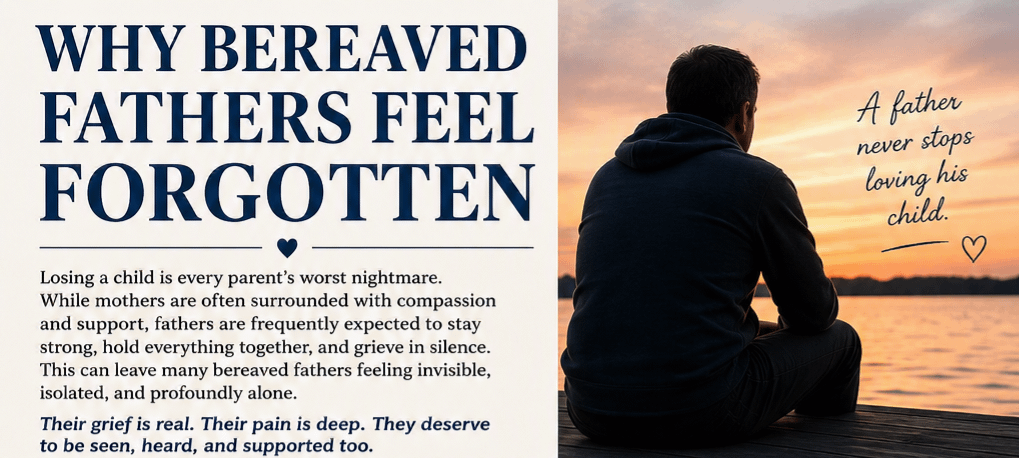
  • Why Bereaved Fathers Feel Forgotten

    Why Bereaved Fathers Feel Forgotten

    For many fathers, the most painful part of losing a child is not only the death itself—it is what happens afterward. As the weeks turn into months and the months into years, many bereaved fathers begin to notice something that hurts almost as much as the loss itself.

    The world seems to forget.

    People stop asking.

    Friends stop checking in.

    Family members stop mentioning their child.

    Life continues for everyone else while a father’s world remains forever changed.

    This quiet loneliness leaves many bereaved fathers wondering if anyone remembers that they are grieving too.

    Why Bereaved Fathers Feel Forgotten

    There is no greater pain than burying your own child. Every parent who experiences this loss carries a wound that never completely heals. Yet fathers often experience another layer of suffering that receives very little attention—the feeling of becoming invisible in their grief.

    Society often expects fathers to be the protectors, providers, and steady foundation for everyone else. While mothers are frequently surrounded with compassion and emotional support, fathers are often expected to quietly carry their heartbreak without drawing attention to themselves.

    This isn’t because people don’t care.

    It’s because many people simply don’t realize fathers grieve just as deeply.

    Society Still Has Outdated Expectations of Men

    For generations, boys have been taught certain messages about emotions.

    “Big boys don’t cry.”

    “Be a man.”

    “Stay strong.”

    “Don’t let them see you fall apart.”

    These lessons become deeply rooted long before adulthood.

    When tragedy strikes, those expectations become chains.

    After losing a child, many fathers feel enormous pressure to stay composed—not because they actually feel strong, but because they believe everyone expects them to be.

    Instead of expressing heartbreak, they suppress it.

    Instead of asking for help, they carry the burden alone.

    Instead of crying openly, they wait until no one is watching.

    Many fathers describe crying in the shower, during long drives, late at night after everyone has gone to bed, or while sitting alone beside their child’s grave.

    Their grief isn’t absent.

    It’s simply hidden.

    Everyone Sees the Mother’s Pain

    There is no comparison between a mother’s grief and a father’s grief. Both are devastating.

    But society often responds differently.

    People instinctively gather around grieving mothers.

    Meals arrive.

    Flowers are delivered.

    Support groups are recommended.

    People ask how she is sleeping, eating, and coping.

    Meanwhile, the father often hears:

    “Take care of your wife.”

    “She’s going to need you.”

    “Stay strong for your family.”

    Again, these comments are made with love.

    But they unintentionally communicate something painful:

    Your job is to help everyone else.

    Very few people stop and ask:

    “Who is helping you?”

    Fathers Often Become the Caregiver

    Immediately following a child’s death, fathers frequently become consumed with responsibilities.

    They arrange the funeral.

    Meet with clergy.

    Handle insurance paperwork.

    Manage finances.

    Answer phone calls.

    Notify employers.

    Support siblings.

    Comfort grandparents.

    Care for their spouse.

    By the time everything slows down, everyone assumes the hardest part is over.

    For the father, however, that’s often when the silence begins.

    The tasks disappear.

    The distractions fade.

    Reality settles in.

    His child is still gone.

    Grief Looks Different in Fathers

    One reason fathers are overlooked is because they often grieve differently than others expect.

    Instead of talking constantly about their emotions, fathers may:

    • Become extremely quiet.
    • Spend long hours working.
    • Throw themselves into home projects.
    • Exercise excessively.
    • Withdraw socially.
    • Focus entirely on helping others.
    • Spend more time outdoors.
    • Visit meaningful places alone.

    To outsiders, these behaviors can look like acceptance.

    In reality, they are often survival.

    Every hammer swing…

    Every extra shift at work…

    Every hour spent fixing something…

    May simply be a father trying to quiet a mind filled with memories.

    People Mistake Silence for Healing

    Silence can be deceptive.

    Many fathers stop talking about their child because they notice what happens when they do.

    Conversations become uncomfortable.

    People change the subject.

    Someone quickly says,

    “They’re in a better place.”

    Or,

    “You have to move forward.”

    Eventually fathers learn something heartbreaking.

    Talking about their child often makes others uncomfortable.

    So they stop talking.

    Not because they’ve healed.

    Because they’ve learned their grief has no audience.

    The World Moves On Faster Than Fathers Can

    The first few weeks after a child’s death are filled with support.

    People visit.

    Food fills the refrigerator.

    Cards arrive.

    Phone calls come daily.

    Then something changes.

    Weeks become months.

    Life returns to normal—for everyone else.

    For the father, normal no longer exists.

    Every morning begins with remembering.

    Every night ends with missing.

    Every holiday carries an empty chair.

    Every birthday becomes another reminder of what should have been.

    The calendar continues.

    His heart remains frozen on the day his child died.

    The Loneliness of Forgotten Anniversaries

    Few people remember the dates that matter most.

    The birthday.

    The day of the accident.

    Graduation day.

    The first Father’s Day.

    The first Christmas.

    The wedding that never happened.

    The grandchildren that will never be born.

    While others celebrate life’s milestones, bereaved fathers quietly mourn the milestones their child never reached.

    Sometimes all they wish for is one text message.

    “Thinking of your son today.”

    Those few words can mean more than anyone realizes.

    Fathers Miss Ordinary Moments Most

    People often assume fathers miss birthdays or holidays the most.

    Those days are painful.

    But many fathers say the hardest moments are surprisingly ordinary.

    Walking past their child’s favorite restaurant.

    Seeing someone wearing the same type of shoes.

    Hearing their favorite song.

    Watching a baseball game they would have watched together.

    Driving past their old school.

    Seeing a father and son fishing.

    Watching a graduation.

    Smelling their favorite cologne.

    Finding an old voicemail.

    Life constantly reminds fathers of the child they love.

    No one else notices.

    Many Fathers Feel Forgotten at Work

    Returning to work after losing a child can be emotionally exhausting.

    Coworkers often offer condolences.

    For a few days, everyone is understanding.

    Then deadlines return.

    Projects resume.

    Business continues.

    People stop mentioning the loss.

    The father may smile.

    He may complete every assignment.

    He may appear productive.

    Meanwhile, he may be struggling simply to make it through the day.

    Success at work often hides unbearable pain.

    The Invisible Guilt Fathers Carry

    Many bereaved fathers carry enormous guilt, even when the loss was completely beyond their control.

    Questions haunt them endlessly.

    “Should I have protected them better?”

    “Why didn’t I notice something sooner?”

    “Could I have changed the outcome?”

    “Why wasn’t it me instead?”

    These thoughts replay thousands of times.

    Because fathers often keep these questions to themselves, others never realize the battle taking place inside.

    Friendships Often Change

    Loss changes relationships.

    Some friends remain.

    Others quietly disappear.

    Not because they stopped caring.

    Because they don’t know what to say.

    Some avoid calling because they’re afraid of making things worse.

    Others assume enough time has passed.

    The father experiences this differently.

    Every unanswered phone call reinforces a painful belief:

    “People have forgotten my child.”

    Fathers Never Stop Being Fathers

    One of the greatest misconceptions is that parenthood somehow ends when a child dies.

    It doesn’t.

    A father doesn’t stop loving.

    He doesn’t stop wondering.

    He doesn’t stop remembering.

    He still thinks:

    “I wonder what they would be doing today.”

    “How old would they be now?”

    “Would they be married?”

    “Would they have children?”

    His role as father didn’t disappear.

    Only the opportunities to live it out changed.

    Why Speaking Their Child’s Name Matters

    Many people avoid mentioning a deceased child because they fear reopening old wounds.

    The truth is different.

    The wound is already open.

    Bereaved fathers think about their child every single day.

    Hearing someone say their child’s name doesn’t create pain.

    It often brings comfort.

    It reminds them that someone else remembers.

    That someone else still sees the life that mattered.

    Never underestimate the healing power of saying,

    “I was thinking about your daughter today.”

    Or,

    “I remember how much your son loved baseball.”

    These simple sentences tell a grieving father:

    Your child still matters.

    Faith Can Become Both a Comfort and a Struggle

    Many fathers lean heavily on their faith after losing a child.

    Others wrestle with difficult questions.

    Why did this happen?

    Why didn’t God intervene?

    What purpose could there possibly be?

    Can I ever feel joy again without betraying my child’s memory?

    These questions are not signs of weak faith.

    They are signs of honest grief.

    Many fathers eventually discover that faith doesn’t erase sorrow.

    Instead, it gives them someone to carry their sorrow with.

    Hope doesn’t remove tears.

    It gives those tears meaning.

    Healing Does Not Mean Forgetting

    One fear many fathers have is that healing somehow means leaving their child behind.

    Nothing could be further from the truth.

    Healing is not forgetting.

    Healing is learning to carry love alongside loss.

    It is discovering that laughter and tears can exist together.

    That memories can hurt and comfort at the same time.

    That living fully is not a betrayal of the child who died.

    In fact, many fathers eventually choose to honor their child by living in a way that reflects the love they shared.

    How We Can Better Support Bereaved Fathers

    If you know a father who has lost a child, remember that your support matters long after the funeral ends.

    You don’t need perfect words.

    You simply need to show up.

    Here are a few meaningful ways to help:

    • Ask how he is doing, not just how his spouse is coping.
    • Speak his child’s name naturally and respectfully.
    • Remember birthdays, anniversaries, and holidays.
    • Send a simple text saying you’re thinking of him.
    • Let him tell stories without changing the subject.
    • Don’t rush his healing or suggest he “move on.”
    • Accept tears without trying to fix them.
    • Continue checking in months and years later.

    The greatest gift you can offer is your willingness to remember.

    A Letter to Every Bereaved Father

    If you are a father who has buried a son or daughter, this message is for you.

    You are not weak because you cry.

    You are not broken because you still miss them years later.

    You are not failing because grief still catches you by surprise.

    You loved deeply.

    That love did not end when your child’s life ended.

    You are still a father.

    Your child is still part of your story.

    The world may not always remember, but your love continues to matter.

    Your tears honor the bond you shared.

    Your memories keep their legacy alive.

    And even if it feels as though others have forgotten, there are fathers across the world carrying the same invisible weight, walking the same difficult road, and understanding your pain in ways few others can.

    Final Thoughts

    Bereaved fathers often feel forgotten not because their grief is less significant, but because it is less visible. Behind the quiet strength that so many fathers display is a heart that has been permanently changed by unimaginable loss.

    Healing does not come from pretending the pain no longer exists. It comes through being seen, being heard, and knowing that both the father and the child he loves are still remembered.

    If there is one thing every grieving father deserves, it is this simple assurance:

    You have not been forgotten. Your child has not been forgotten. Your love will never be forgotten.

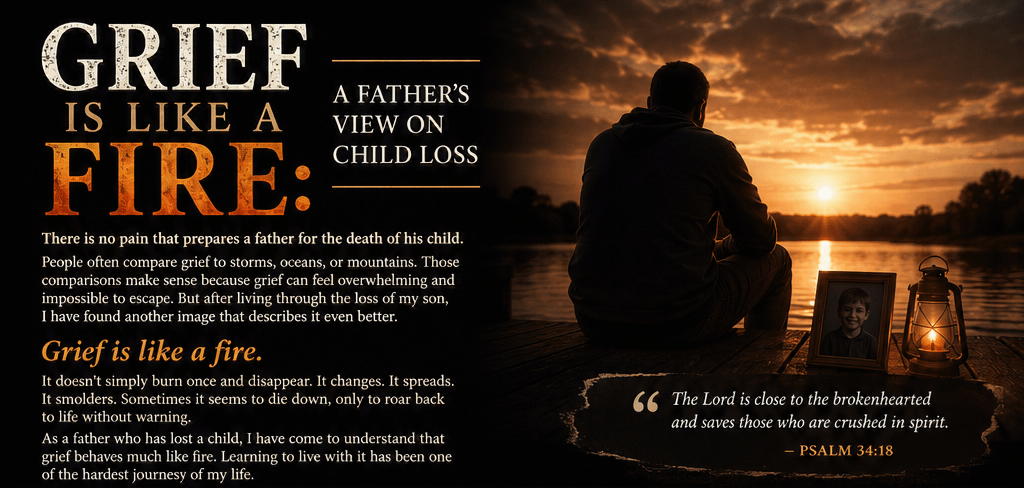
  • Grief Is Like a Fire: A Father’s View on Child Loss

    Grief Is Like a Fire: A Father’s View on Child Loss

    There is no pain that prepares a father for the death of his child.

    People often compare grief to storms, oceans, or mountains. Those comparisons make sense because grief can feel overwhelming and impossible to escape. But after living through the loss of my son, I have found another image that describes it even better.

    Grief is like a fire.

    It doesn’t simply burn once and disappear. It changes. It spreads. It smolders. Sometimes it seems to die down, only to roar back to life without warning.

    As a father who has lost a child, I have come to understand that grief behaves much like fire. Learning to live with it has been one of the hardest journeys of my life.

    The Fire Starts With One Devastating Moment

    Every fire begins with a spark.

    For grieving parents, that spark is the phone call, the knock on the door, the hospital room, or the words no parent should ever hear.

    “I’m sorry… your child didn’t make it.”

    In one sentence, life is divided into two parts:

    Before.

    After.

    Nothing remains untouched.

    Dreams burn.

    Plans burn.

    Future birthdays burn.

    Family traditions burn.

    The image you had of growing old while watching your child build a family of their own disappears in an instant.

    That first fire is violent.

    It consumes everything.

    The Flames Burn Hot

    In the early days after losing a child, grief feels unbearable.

    You can barely breathe.

    Food has no taste.

    Sleep disappears.

    Even simple conversations require enormous effort.

    Your mind constantly replays memories.

    “What if…”

    “If only…”

    “I should have…”

    Those thoughts feed the fire.

    As fathers, many of us try to stay strong.

    We arrange funerals.

    Handle paperwork.

    Comfort our spouses.

    Take care of family members.

    We become firefighters for everyone else’s pain while silently burning inside ourselves.

    No one notices that our own heart is turning to ashes.

    Some Days the Fire Seems Smaller

    Eventually, people begin telling you something they genuinely believe.

    “It gets easier.”

    The truth is more complicated.

    The fire doesn’t always get smaller.

    Sometimes you simply become better at carrying it.

    Life slowly resumes.

    You go back to work.

    You mow the lawn.

    You pay bills.

    You laugh once in a while.

    From the outside, people assume you’ve healed.

    Inside, the embers are still glowing.

    The fire has not gone out.

    It is simply waiting.

    Certain Things Pour Gasoline on the Flames

    A father never knows exactly when grief will return.

    Sometimes it takes almost nothing.

    A favorite song.

    A birthday.

    Graduation season.

    A father teaching his son to drive.

    Seeing someone your child’s age.

    An old voicemail.

    A forgotten photograph.

    The smell of their favorite cologne.

    One ordinary moment can suddenly ignite emotions you thought you had under control.

    Without warning, the fire becomes an inferno again.

    People may wonder why you are struggling years later.

    They don’t realize grief doesn’t operate on a calendar.

    Love has no expiration date.

    Neither does loss.

    Grief Leaves Scars Like Fire Does

    Fire changes everything it touches.

    So does losing a child.

    You don’t return to the person you once were.

    Some parts of you never recover.

    The carefree father.

    The man who believed bad things happened only to other families.

    The confidence that tomorrow is guaranteed.

    Those pieces are gone forever.

    Instead, something new begins to form.

    A different perspective.

    Greater compassion.

    More patience.

    A deeper appreciation for ordinary moments.

    The scars remain.

    But scars also remind us that healing, although imperfect, is possible.

    Some Fires Are Hidden

    One of the hardest parts of child loss is that fathers often grieve differently than others expect.

    Many men cry in private.

    They hide in their garages.

    They stay busy.

    They throw themselves into work.

    They fix things because they cannot fix what truly matters.

    Society often mistakes silence for strength.

    It isn’t.

    Silence is simply another way grief burns.

    Just because a father isn’t talking doesn’t mean he isn’t hurting.

    Many of us carry raging fires behind calm faces.

    The Fire Can Either Destroy or Refine

    Fire has two purposes.

    It destroys.

    It also refines.

    Steel becomes stronger because of intense heat.

    Gold is purified in the furnace.

    While no father would ever choose this fire, many eventually discover that pain begins shaping them in unexpected ways.

    You become more compassionate.

    You listen more carefully.

    You notice people who are hurting.

    You become less interested in impressing others and more interested in loving them.

    The fire changes your priorities.

    Not because losing your child was good.

    Nothing about it is good.

    But because surviving unimaginable pain changes the way you see the world.

    Faith Became My Shelter

    There were days when I questioned everything.

    Days when I didn’t understand why God allowed my son to die.

    Days when I had no answers.

    But over time I discovered something remarkable.

    The fire of grief could not consume God’s love.

    When everything else felt uncertain, His promises remained.

    Psalm 34:18 says:

    “The Lord is close to the brokenhearted and saves those who are crushed in spirit.”

    I learned that faith doesn’t remove the fire.

    It gives you Someone to stand beside you in the flames.

    Just as God was with Shadrach, Meshach, and Abednego in the fiery furnace, He walks beside grieving fathers through the fires of unimaginable loss.

    Sometimes His presence doesn’t remove the pain.

    It gives us the strength to survive it.

    The Fire Never Truly Goes Out

    I don’t believe grief ends.

    I believe love continues.

    As long as I love my son, there will always be embers.

    Some days they barely glow.

    Other days they burn brightly.

    Both are normal.

    Both are part of loving someone who is no longer here.

    The goal isn’t to extinguish the fire.

    The goal is to learn how to live without letting it consume the life your child would want you to keep living.

    To Every Father Carrying This Fire

    If you’ve lost a son or daughter, I want you to know something.

    You’re not weak because you’re still grieving.

    You’re not broken because you cry years later.

    You’re not failing because birthdays still hurt.

    You’re carrying one of life’s heaviest burdens.

    The fire you’re walking through would overwhelm anyone.

    But somehow, one day at a time, you’re still standing.

    That matters.

    Honor your child.

    Speak their name.

    Tell their stories.

    Carry their memory with pride.

    And when the fire grows too hot, don’t carry it alone.

    Lean on family.

    Lean on friends.

    Lean on other grieving fathers.

    Most importantly, lean on God.

    Because while grief may burn for the rest of your life, His love burns even brighter.

    Final Thoughts

    Grief is like a fire.

    It begins suddenly.

    It burns fiercely.

    It leaves scars.

    It flares up unexpectedly.

    It changes everything it touches.

    But it doesn’t have to destroy you.

    A father’s heart after child loss will never be the same.

    Yet within those ashes, hope can slowly begin to grow again.

    Not because you forget.

    Not because the pain disappears.

    But because love is stronger than death, and the memory of your child continues to light the path forward.

    The fire remains.

    So does love.

    A Father’s Guide to Surviving the Loss of a Child
  • How To Go On Living When Someone You Love Dies

    How To Go On Living When Someone You Love Dies

    There are moments in life that divide our story into two parts: before the loss and after the loss.

    When someone you deeply love dies, the world changes instantly. The future you imagined disappears. Ordinary routines suddenly feel meaningless. The person whose voice, presence, laughter, advice, or love helped shape your life is no longer physically here.

    In those first days, weeks, and even months, many people ask a question they never thought they would have to ask:

    “How do I go on living when someone I love has died?”

    It is a question born from heartbreak. It comes from a place where pain feels endless and the future seems impossible to imagine.

    The truth is that learning to live after loss is one of the hardest journeys a person will ever face. There is no shortcut, no simple formula, and no timeline for healing. Yet millions of people who have suffered devastating losses have discovered that while life may never be the same, it can still hold meaning, purpose, and even moments of joy again.

    Understanding That Life Will Never Be the Same

    One of the greatest struggles after loss is the desire to return to who you were before.

    We want life to feel normal again.

    We want the pain to stop.

    We want things to go back to the way they were.

    But grief does not work that way.

    The death of someone you love changes you. It becomes part of your story. The goal is not to become the person you were before the loss. The goal is to learn how to carry your grief while continuing to live.

    Healing does not mean forgetting.

    Moving forward does not mean leaving them behind.

    It means learning how to bring their memory with you into the next chapter of your life.

    Take Life One Day at a Time

    After a significant loss, the future can feel overwhelming.

    You may wonder:

    • How will I survive next week?
    • How will I make it through the holidays?
    • How can I live the rest of my life without them?

    Those questions are too large for a grieving heart.

    Instead, focus on today.

    Ask yourself:

    • What do I need to do today?
    • How can I care for myself today?
    • What is one small step I can take today?

    Sometimes survival means getting out of bed.

    Sometimes it means taking a shower.

    Sometimes it means eating a meal.

    Sometimes it means simply making it through another day.

    Small victories matter during grief.

    Allow Yourself to Feel the Pain

    Many people try to avoid grief because it hurts so much.

    They stay busy.

    They distract themselves.

    They bury their emotions.

    They convince themselves they need to be strong.

    But grief ignored is grief delayed.

    Pain has a way of demanding attention.

    Tears are not weakness.

    Sadness is not failure.

    Heartbreak is evidence of love.

    Allow yourself to cry.

    Allow yourself to remember.

    Allow yourself to feel.

    Healing begins when we stop fighting our emotions and start acknowledging them.

    Stop Comparing Your Grief to Others

    Every person grieves differently.

    Some cry openly.

    Some become quiet.

    Some want company.

    Some need solitude.

    Some find comfort in talking.

    Others process their grief internally.

    There is no correct way to grieve.

    The only wrong way is believing you should grieve exactly like someone else.

    Your relationship with the person who died was unique.

    Your grief will be unique too.

    Honor your own journey.

    Keep Talking About Them

    Many grieving people discover something painful after a loss.

    The world moves on.

    Friends stop mentioning the person’s name.

    Family members avoid bringing them up.

    People fear making you sad.

    But for those who are grieving, silence can hurt.

    Speak their name.

    Tell stories.

    Share memories.

    Look at photographs.

    Celebrate birthdays.

    Remember anniversaries.

    Keeping their memory alive does not prevent healing.

    It helps preserve the love that still exists.

    Accept Help When It Is Offered

    One of the most common responses to grief is isolation.

    Many people withdraw because they do not want to burden others.

    Yet grief was never meant to be carried alone.

    When people offer support:

    • Accept the meal.
    • Accept the phone call.
    • Accept the invitation.
    • Accept the hug.

    You do not have to be strong every moment.

    Sometimes strength means allowing others to help carry part of your burden.

    Take Care of Your Physical Health

    Grief affects more than emotions.

    It impacts the entire body.

    Many grieving people experience:

    • Fatigue
    • Sleep problems
    • Appetite changes
    • Difficulty concentrating
    • Physical aches and pains

    During grief, basic self-care becomes essential.

    Try to:

    • Stay hydrated.
    • Eat nourishing foods.
    • Get regular sleep.
    • Take short walks.
    • Spend time outdoors.

    These simple habits may seem small, but they help support healing both physically and emotionally.

    Find Purpose Again

    One of grief’s greatest challenges is the loss of purpose.

    When someone you love dies, life can feel empty.

    You may wonder why you should keep moving forward.

    Purpose often returns slowly.

    Sometimes it comes through helping others.

    Sometimes through faith.

    Sometimes through volunteering.

    Sometimes through work.

    Sometimes through honoring the memory of the person who died.

    Purpose does not erase grief.

    It gives grief somewhere meaningful to go.

    Let Yourself Experience Joy Without Guilt

    Many grieving people feel guilty when they laugh again.

    They feel guilty when they enjoy a vacation.

    They feel guilty when they smile.

    They feel guilty when life begins moving forward.

    But happiness is not betrayal.

    Joy does not mean you loved them less.

    Laughter does not mean you forgot.

    The person you loved would not want you trapped in endless suffering.

    Allow yourself to experience moments of happiness.

    Your heart is capable of carrying both grief and joy at the same time.

    Understand That Love Never Dies

    Death ends a life.

    It does not end a relationship.

    The love you shared remains.

    The lessons they taught remain.

    The memories remain.

    The impact they had on your life remains.

    Many grieving people eventually discover that while they can no longer see or hear their loved one, they continue to carry them in countless ways.

    Love does not disappear because someone dies.

    Love changes form.

    Moving Forward Doesn’t Mean Moving On

    Perhaps the most important truth about grief is this:

    You do not move on from someone you love.

    You move forward with them in your heart.

    You carry their memory into every new experience.

    You honor them through the way you live.

    You keep loving them even though they are gone.

    Life after loss is not about forgetting.

    It is about learning to live while remembering.

    Final Thoughts

    If you are grieving today, know this:

    You do not have to have all the answers.

    You do not have to know how you will survive the next year.

    You only need to take the next step.

    And then the next.

    And then the next.

    There will be difficult days.

    There will be tears.

    There will be moments when the loss feels as fresh as the day it happened.

    But there will also be moments of peace.

    Moments of gratitude.

    Moments of healing.

    And eventually, moments when you realize that although the pain remains, it no longer controls every part of your life.

    The person you love will always be part of your story.

    Their absence will always matter.

    But your life still matters too.

    Keep going.

    Keep breathing.

    Keep loving.

    Keep living.

    One day at a time.

    A Father’s Guide to Surviving the Loss of a Child

  • When Grief Turns Into Guilt

    When Grief Turns Into Guilt

    Grief is one of the most painful experiences a person can endure. It arrives after loss and changes everything. It affects the heart, mind, body, and spirit. While sadness is often expected, many people are surprised when grief begins to transform into something else—guilt.

    For countless grieving individuals, especially parents who have lost a child, grief and guilt become intertwined. The sorrow of loss is accompanied by endless questions, relentless self-examination, and a deep sense of responsibility for things that may have been completely beyond their control.

    Guilt can become one of the heaviest burdens a grieving person carries. It can prolong suffering, complicate healing, and create emotional wounds that are difficult to overcome.

    Why Guilt Often Follows Loss

    When someone we love dies, our minds naturally search for explanations.

    We replay conversations.

    We revisit decisions.

    We analyze events repeatedly.

    We ask ourselves:

    • What if I had done something differently?
    • What if I had called them that day?
    • What if I had noticed something sooner?
    • What if I had been there?
    • Could I have prevented this?

    The human mind struggles with accepting that some tragedies have no satisfying explanation. Because uncertainty is painful, we often create our own answers—even when those answers blame ourselves.

    In many cases, guilt becomes an attempt to gain control over something that was uncontrollable.

    If we can convince ourselves that we made a mistake, then perhaps the tragedy makes sense. The problem is that this false sense of control often leads to unnecessary self-punishment.

    The Unique Guilt of Parents

    Few forms of guilt are as powerful as the guilt experienced by parents after losing a child.

    Parents are wired to protect their children. From the moment a child is born, mothers and fathers feel responsible for their safety, happiness, and well-being.

    When a child dies, that protective instinct doesn’t disappear.

    Instead, it often turns inward.

    Many grieving parents ask themselves:

    • Why couldn’t I save them?
    • Why wasn’t I there?
    • What did I miss?
    • What could I have done differently?

    Even when the loss was completely beyond their control, parents often feel as though they failed at the one job that mattered most.

    The reality is that no parent can prevent every tragedy.

    Yet the heart often refuses to accept what the mind understands.

    Survivor’s Guilt

    Another form of guilt that frequently emerges during grief is survivor’s guilt.

    This happens when someone feels guilty simply because they are still alive while their loved one is not.

    Many bereaved parents have quietly whispered:

    “Why my child and not me?”

    Others struggle when they begin experiencing moments of happiness.

    They wonder:

    • Is it wrong to laugh?
    • Is it wrong to enjoy life?
    • Is it wrong to move forward?

    The answer is no.

    Yet many grieving individuals feel guilty whenever life begins to feel normal again.

    They mistakenly believe that healing somehow dishonors the person they lost.

    In reality, healing is not betrayal.

    Healing is learning how to carry love forward.

    Guilt Over Things Left Unsaid

    One of the most common sources of guilt involves unfinished conversations.

    Many people lose loved ones unexpectedly.

    They never get the chance to say:

    • I love you.
    • I’m sorry.
    • I forgive you.
    • Thank you.
    • Goodbye.

    After loss, these missing words can become a source of torment.

    People replay old arguments.

    They remember moments of impatience.

    They focus on mistakes rather than years of love.

    What grief often hides is the truth that relationships are never perfect.

    Every relationship includes misunderstandings, disagreements, and moments we wish we could redo.

    The existence of those moments does not erase the love that existed.

    When Guilt Becomes Self-Punishment

    Over time, guilt can evolve into something even more damaging.

    Some grieving individuals begin punishing themselves.

    They stop pursuing happiness.

    They isolate themselves.

    They refuse support.

    They believe they deserve to suffer.

    Some even convince themselves that feeling pain is the only way to remain connected to the person they lost.

    This creates a dangerous cycle.

    The grieving person becomes trapped between loss and self-condemnation.

    Instead of honoring their loved one’s memory, they become consumed by blame.

    The tragedy becomes compounded by years of unnecessary suffering.

    Learning to Separate Responsibility from Regret

    One of the most important steps in healing is learning the difference between responsibility and regret.

    Regret says:

    “I wish things had happened differently.”

    Responsibility says:

    “It was my fault.”

    These are not the same thing.

    You may regret a thousand things surrounding a loss.

    You may wish you had made different choices.

    You may wish you had one more conversation.

    You may wish you had one more day.

    But wishing things had been different does not mean you caused the tragedy.

    Understanding this distinction can be a crucial part of healing.

    What Your Loved One Would Want

    Many grieving people spend years carrying guilt that their loved one would never want them to carry.

    If your loved one could speak to you today, would they want you to spend the rest of your life blaming yourself?

    Would they want you trapped in shame?

    Would they want you unable to smile, laugh, or love again?

    Most likely, the answer is no.

    The people we love generally want our happiness.

    They want our healing.

    They want us to continue living.

    Honoring their memory does not require endless suffering.

    It requires continuing the love they brought into our lives.

    Letting Go of the Guilt

    Letting go of guilt is often far more difficult than letting go of sadness.

    Sadness acknowledges the loss.

    Guilt attacks the person who remains.

    Releasing guilt does not mean forgetting.

    It does not mean minimizing the loss.

    It does not mean moving on.

    It means recognizing that being human includes imperfections, limitations, and circumstances beyond our control.

    It means accepting that love can remain even when guilt is released.

    Final Thoughts

    Grief has many faces.

    Sometimes it appears as sadness.

    Sometimes as anger.

    Sometimes as loneliness.

    And sometimes it disguises itself as guilt.

    When grief turns into guilt, it can convince us that we should have done more, known more, or prevented the unpreventable.

    But healing begins when we acknowledge a difficult truth:

    Not every tragedy has someone to blame.

    Sometimes loss happens despite our best efforts, deepest love, and strongest intentions.

    You can miss them every day.

    You can love them forever.

    You can carry their memory in your heart.

    And you can do all of those things without carrying guilt.

    The greatest tribute to those we have lost is not a lifetime of self-punishment.

    It is a lifetime of love.

    A Father’s Guide to Surviving the Loss of a Child

  • Why Is Losing a Child Different From Other Losses?

    Why Is Losing a Child Different From Other Losses?

    There is no easy loss.

    The death of a parent can leave us feeling untethered. The loss of a spouse can create an overwhelming emptiness. The death of a sibling, friend, or loved one can change the course of our lives forever.

    Every loss matters because every relationship matters.

    Yet many who have experienced the death of a child often say there is something uniquely devastating about it. It is a grief that touches every corner of a parent’s life and often stays with them in ways that are difficult for others to understand.

    Losing a child is not simply the loss of a loved one. It is the loss of hopes, dreams, expectations, identity, and a future that was supposed to unfold naturally.

    For many parents, it feels as though the world has been turned upside down.

    It Violates the Natural Order of Life

    One of the reasons losing a child feels different is because it goes against the way we believe life is supposed to work.

    Parents expect to grow old.

    Children are expected to grow up.

    A parent imagines watching their child graduate, start a career, get married, raise a family, and build a life of their own. Even when children become adults, parents still imagine years and decades of future memories together.

    When a child dies, those expectations are shattered.

    The mind struggles to accept what the heart knows is true.

    Many grieving parents find themselves repeatedly thinking:

    “This isn’t supposed to happen.”

    Parents are not prepared to bury their children. The emotional shock of losing someone whose life was expected to continue long after their own creates a unique type of heartbreak.

    The loss feels unnatural because it is the exact opposite of what parents spent their entire lives preparing for.

    A Child Is Part of a Parent’s Heart

    The relationship between a parent and child is unlike any other relationship in life.

    A spouse may enter your life later.

    Friends may come and go.

    Even parents eventually step back as we become adults.

    But the bond between a parent and child begins at birth and grows with every passing year.

    Parents sacrifice sleep, time, energy, money, and often their own dreams to help their children thrive.

    Every accomplishment becomes a source of pride.

    Every setback becomes a source of concern.

    A child’s happiness often becomes a parent’s happiness.

    A child’s pain often becomes a parent’s pain.

    Because of this connection, many parents describe losing a child as losing a piece of themselves.

    They do not feel separated from their child.

    They feel incomplete without them.

    The Future Dies Alongside the Child

    One of the cruelest aspects of child loss is that parents are forced to grieve not only the life that was lived but also the life that never will be.

    When someone loses an elderly parent, they grieve memories that already existed.

    When a parent loses a child, they grieve memories that were never allowed to happen.

    They grieve:

    • Future birthdays
    • Graduations
    • Weddings
    • Family vacations
    • Grandchildren
    • Holiday traditions
    • Retirement visits
    • Everyday conversations

    The mind constantly revisits the future that should have been.

    Parents find themselves wondering:

    “What would they be doing today?”

    “What would they look like now?”

    “Who would they have become?”

    These questions often remain for the rest of a parent’s life.

    The Guilt Can Be Crushing

    Many grieving parents carry guilt even when they had absolutely no control over what happened.

    The parental instinct is designed to protect.

    From the moment a child is born, parents become guardians, problem-solvers, and protectors.

    When tragedy occurs, many parents automatically look inward.

    They ask:

    • Could I have done more?
    • Should I have seen warning signs?
    • What if I had made a different choice?
    • Could I have prevented this?

    Even when logic says the answer is no, the heart often continues searching for answers.

    This burden of guilt is one of the reasons child loss can feel so isolating.

    Parents frequently carry invisible questions that may never be fully resolved.

    The World Moves Forward While Parents Remain Behind

    One of the most painful realities of child loss is watching the rest of the world continue as if nothing happened.

    Life goes on.

    People return to work.

    Friends resume normal routines.

    Social media fills with celebrations and milestones.

    Meanwhile, grieving parents often feel frozen in time.

    The date of their child’s death becomes permanently etched into their memory.

    Every birthday becomes a reminder.

    Every holiday carries an empty space.

    Every family gathering highlights someone who should be there.

    The world may move forward, but many parents feel emotionally connected to the moment everything changed.

    This can create profound loneliness.

    Fathers Often Grieve in Silence

    While every parent grieves differently, many fathers face unique challenges after losing a child.

    Society often teaches men to be strong, composed, and emotionally controlled.

    Many fathers feel pressure to:

    • Take care of everyone else
    • Handle practical responsibilities
    • Support their spouse
    • Return to work quickly
    • Hide their emotions

    As a result, fathers frequently suffer in silence.

    They cry alone.

    They think about their child while driving.

    They struggle during sleepless nights.

    They carry memories privately while appearing strong on the outside.

    Unfortunately, this can lead others to believe they are not grieving as deeply.

    Nothing could be further from the truth.

    Many fathers simply grieve behind closed doors.

    Mothers and Fathers May Feel Alone Together

    The death of a child can place enormous stress on relationships.

    Couples often discover they grieve in different ways.

    One parent may want to talk frequently.

    The other may withdraw.

    One may seek support groups.

    The other may focus on work.

    One may cry openly.

    The other may grieve quietly.

    Neither approach is wrong.

    The challenge is that different grieving styles can create misunderstandings.

    Many couples find themselves feeling alone even while experiencing the same tragedy.

    Learning to respect each other’s grief becomes one of the most important parts of surviving child loss together.

    Faith Is Often Tested

    For many parents, losing a child creates spiritual questions unlike anything they have ever faced.

    Questions such as:

    • Why did this happen?
    • Why my child?
    • Why didn’t God stop it?
    • What purpose could there be in this pain?

    Some parents find their faith strengthened.

    Others struggle with anger, doubt, confusion, and disappointment.

    Many experience both.

    Faith after child loss is often less about having answers and more about continuing to trust despite unanswered questions.

    For grieving parents, healing frequently involves discovering that faith is not the absence of pain.

    Faith is finding the strength to keep going while carrying the pain.

    The Grief Never Completely Ends

    One of the greatest misconceptions about child loss is the belief that parents eventually “get over it.”

    They don’t.

    What actually happens is they learn how to live with it.

    The grief changes shape over time.

    The sharp pain may soften.

    The constant tears may become less frequent.

    The overwhelming shock may fade.

    But the love remains.

    And because the love remains, the grief remains too.

    Years later, a photograph, a song, a birthday, or a familiar scent can instantly bring memories rushing back.

    Parents do not move on from their child.

    They move forward while carrying their child in their hearts.

    The Love Continues Beyond Death

    Perhaps this is what makes losing a child so different from every other loss.

    The relationship does not truly end.

    The conversations may stop.

    The hugs may disappear.

    The physical presence may be gone.

    But the love remains alive.

    Parents continue thinking about their children every day.

    They celebrate birthdays.

    They honor anniversaries.

    They tell stories.

    They share memories.

    They carry their child into every future moment.

    Death may separate parent and child physically, but it cannot erase the bond that was created through love.

    Finding Purpose After the Unthinkable

    Many grieving parents eventually discover that healing is not about forgetting.

    It is about learning to carry the love forward.

    Some honor their child through charity work.

    Some help other grieving families.

    Some share their stories.

    Some dedicate themselves to living in a way that reflects the values their child embodied.

    The pain never disappears entirely, but purpose can emerge alongside it.

    A parent may never be the same person they were before the loss.

    Yet they can still find reasons to live, love, laugh, and hope again.

    Final Thoughts

    Losing a child is different because it affects every part of a parent’s life. It challenges identity, destroys expectations, tests faith, and leaves an empty space that can never be fully filled.

    It is the loss of a future, the loss of dreams, and the loss of someone whose life was deeply intertwined with your own.

    Yet even in the deepest grief, love remains.

    That love becomes the bridge between sorrow and healing.

    And while a parent’s heart may never completely recover from losing a child, it can learn to carry both grief and hope at the same time.

    Because the depth of grief is not a measure of weakness.

    It is a reflection of the depth of love.

    And there is no greater love than that of a parent for a child.

    A Father’s Guide to Surviving the Loss of a Child