Category: Grief & Child Loss

  • Trying to Honor My Son by Living

    Trying to Honor My Son by Living

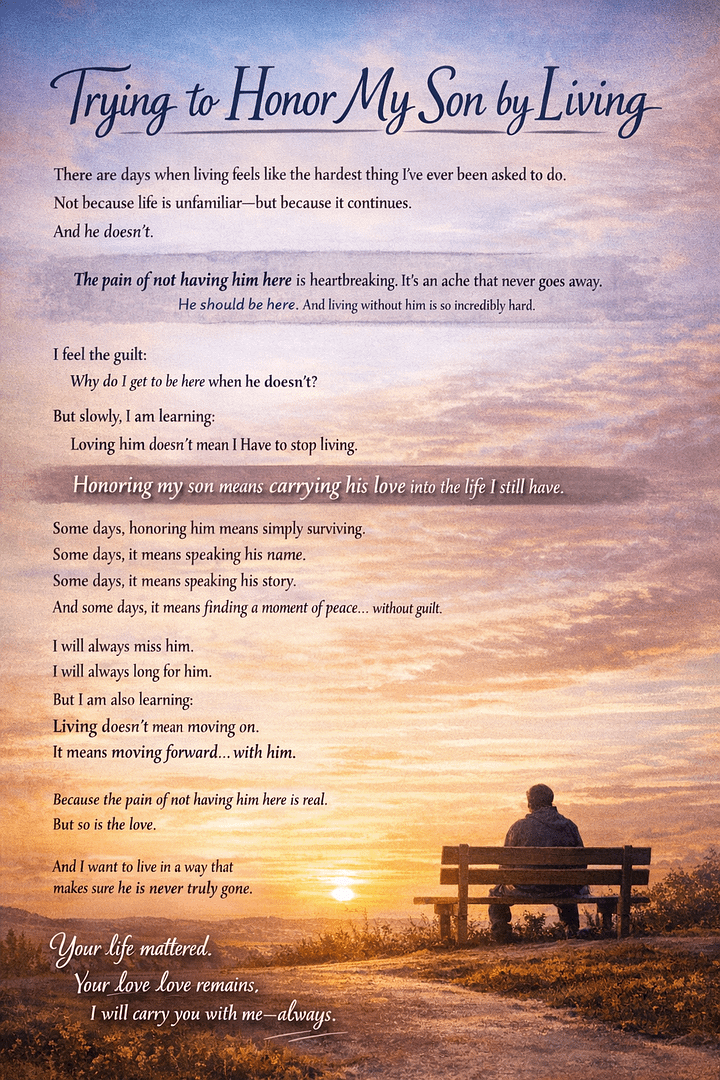
    There are days when living feels like the hardest thing I have ever been asked to do.

    Not because life is unfamiliar—but because it continues.

    And he doesn’t.

    That is the quiet, unbearable truth that grief lays at your feet every single morning. The world wakes up, the sun rises, people laugh, plans are made… and somehow, you are expected to step into that same rhythm carrying a loss that never sets down.

    But what people don’t always see—what is so hard to explain—is the pain of not having him here.

    It’s not just sadness.
    It’s not just missing someone.

    It is a deep, aching absence that lives in everything.

    It’s in the empty chair at the table.
    It’s in the silence where his voice should be.
    It’s in the moments you instinctively reach for your phone to call or text… and then remember you can’t.

    It’s the kind of pain that doesn’t ask permission. It shows up in the middle of ordinary moments—at the grocery store, driving down a familiar road, hearing a song, watching someone else’s child laugh.

    And suddenly, your chest tightens.

    Because he should be here.

    He should be living his life.
    He should be laughing, growing, becoming.
    He should be part of the everyday moments that now feel incomplete without him.

    There is a helplessness in that realization that cuts deeper than words can hold.

    You can’t fix it.
    You can’t change it.
    You can’t go back.

    All you can do is feel it.

    And the weight of that pain—it doesn’t fade the way people think it will. It doesn’t just “get better.” It changes shape, it moves, it softens in places over time… but it never truly leaves.

    Because he was never meant to leave.

    There are nights when the grief is loud.

    When memories replay over and over.
    When questions have no answers.
    When the ache of wanting just one more moment, one more conversation, one more hug becomes almost too much to carry.

    And in those moments, living doesn’t feel strong.

    It feels impossible.

    It feels unfair.

    It feels like you are being asked to walk forward while your heart is anchored in the past.

    There is a guilt that comes with surviving him.

    A guilt that whispers:

    Why do I get to be here when he doesn’t?
    Why do I get another day when he doesn’t?

    And that guilt can make even the smallest steps forward feel like betrayal.

    Smiling feels wrong.
    Laughing feels wrong.
    Feeling anything other than pain can feel like you are somehow letting him go.

    But the truth—the one that takes time, tears, and a thousand broken moments to begin to understand—is this:

    Loving him doesn’t mean I have to stop living.

    In fact, it may mean the opposite.

    Honoring my son is not found in staying frozen in the moment I lost him. It is not found in refusing joy or pushing away healing. It is found in choosing, even when it hurts, to carry his love into the life I still have.

    Because the pain of not having him here will always be real.

    I will always miss him.
    I will always wish he was here.
    There will always be moments that feel incomplete because he is not in them.

    But alongside that pain, there is also something else that refuses to die:

    Love.

    A love that didn’t end when his life did.
    A love that still moves through me, even on the hardest days.
    A love that asks me—not gently, but persistently—to do something with it.

    So I try.

    Some days, honoring him means simply surviving the day.
    Some days, it means speaking his name so he is never forgotten.
    Some days, it means sharing his story so others know he was here, that he mattered.
    And some days, it means allowing myself to feel a moment of peace… without guilt.

    Because if I stop living completely, then grief becomes the only thing left.

    And he was so much more than grief.

    He was laughter.
    He was light.
    He was love.

    And if I can carry even a small piece of that into the world—through kindness, through compassion, through simply showing up—then his life continues to matter in a way that reaches beyond his time here.

    Living will never be easy again.

    Not in the way it once was.

    There will always be a part of me that is missing.
    There will always be a part of my heart that belongs to him, frozen in time.

    But I am learning—slowly, imperfectly—that living doesn’t mean moving on.

    It means moving forward… with him.

    In every step I take.
    In every breath I draw.
    In every act of love I choose to give, even when I am hurting.

    Because the pain of not having him here is real.

    But so is the love.

    And that love is what keeps me going.

    Not because I want to live in a world without him…

    but because I want to live in a way that makes sure he is never truly gone.

    A Father’s Guide to Surviving the Loss of a Child
  • Grieving the Life Your Child Would Have Had

    Grieving the Life Your Child Would Have Had

    There is a grief that exists beyond what most people can see or fully understand.

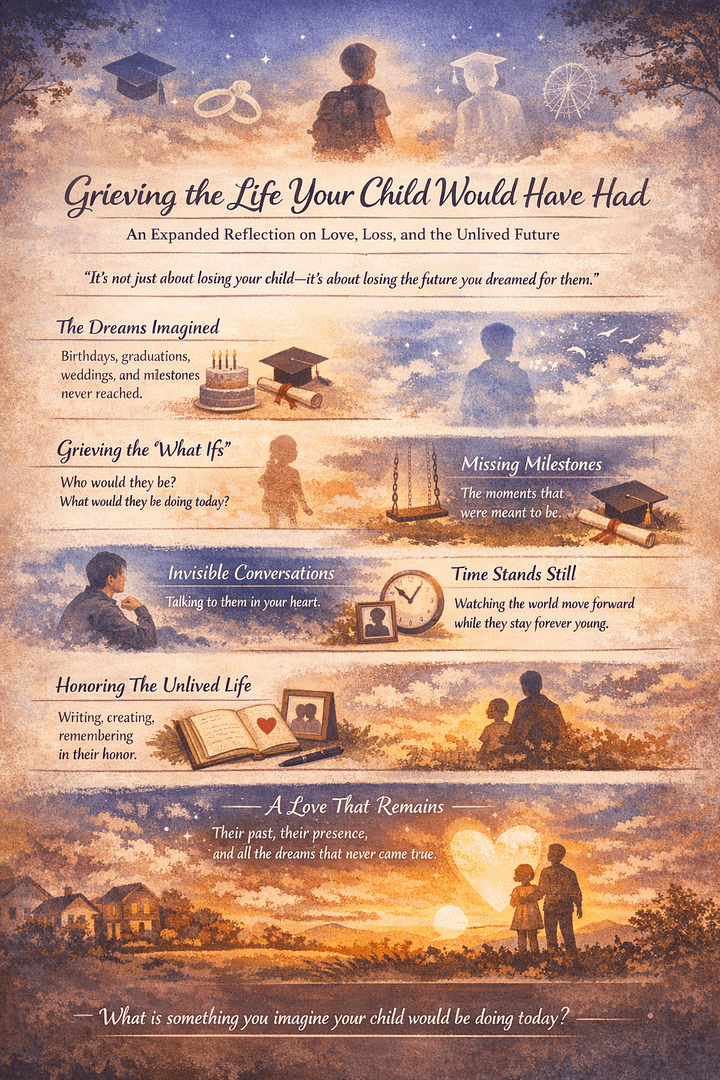
    It is not only the grief of losing your child—it is the grief of losing the life they were meant to live. It is mourning a future that once felt certain. A life that was imagined in quiet moments, built in your heart through dreams, hope, and love.

    This grief is not loud. It does not always show itself in tears or words.

    But it is constant.

    It lives in the spaces between what is… and what should have been.

    The Life You Began Imagining Before It Ever Happened

    When a child is born, so is a vision of their future.

    You don’t just hold your child—you begin to hold their possibilities.

    You picture:

    Their first steps turning into long walks into independence
    Their first words becoming conversations filled with personality
    Their small hands growing into capable, confident ones
    Their childhood unfolding into a life of purpose and identity

    You begin to imagine birthdays, friendships, challenges, achievements, and even the kind of person they will become.

    These are not unrealistic fantasies. They are part of what it means to love a child.

    And when that child is gone, those visions don’t disappear. They remain vivid, unfinished, and painfully suspended in time.

    A Future That Still Feels Real

    Grieving the life your child would have had is unique because that future never had the chance to become memory.

    It exists only in your heart and mind—but it feels just as real as anything that actually happened.

    You may find yourself wondering:

    What would they look like today?
    What would they be passionate about?
    Who would they love?
    What kind of life would they be building?

    These thoughts can come at any time—while driving, while watching others, while sitting in silence.

    You might see someone their age and instinctively measure time against what your child should be experiencing.

    And in those moments, the absence becomes overwhelming.

    Because you’re not just remembering—you’re imagining a life that deserved to exist.

    Grieving Milestones That Never Arrived

    Grief is often tied to anniversaries and dates—but for parents, it also attaches itself to milestones that never came.

    You grieve:

    The first day of school they never walked into
    The graduation they never celebrated
    The job they never got
    The family they never created
    The aging you will never witness

    Each milestone becomes a reminder—not just of loss, but of interruption.

    Life didn’t just end. It was cut off mid-story.

    And what makes this especially painful is that these milestones continue to happen all around you—for other children, other families, other lives moving forward.

    You are left standing still, holding a future that never got the chance to begin.

    The Invisible Conversations

    There are conversations that continue long after your child is gone.

    They happen quietly, internally, sometimes without words.

    You might:

    Talk to them in your thoughts
    Wonder what advice they would give you now
    Imagine their reactions to your life today
    Picture them sitting beside you in moments of joy or struggle

    These imagined interactions are not illusions.

    They are extensions of love.

    They are your heart’s way of keeping connection alive—even when the world has moved on.

    The Pain of Watching Time Move Forward

    Time becomes complicated after loss.

    The world continues. People grow older. Life evolves.

    But for you, your child remains at the age they were.

    And that creates a painful contrast.

    You may notice:

    Children their age growing up, while yours stays frozen in time
    Friends becoming parents, while your child never had that chance
    Years passing, while your memories remain anchored

    There is a quiet, almost surreal feeling in watching time move forward while part of your life stands still.

    It can feel like living in two realities at once.

    The Guilt That Sometimes Follows

    Grieving the life your child would have had can also bring unexpected emotions—like guilt.

    You might feel guilty for:

    Imagining a future they didn’t get to live
    Laughing or finding joy in your own life
    Moving forward while they cannot
    Wondering if you’re holding on too tightly or not enough

    These feelings are deeply human.

    But the truth is this:
    Loving your child includes loving the life they deserved.

    There is no guilt in remembering, imagining, or honoring what should have been.

    Learning to Carry Both Love and Loss

    Over time, you begin to understand that this grief is not something you “get over.”

    It is something you learn to carry.

    You carry:

    The child you knew
    The person they were becoming
    The future they never reached

    And somehow, you find space for all of it to exist together.

    There will be days when the weight feels unbearable.
    And there will be days when the love feels stronger than the pain.

    Both are part of the journey.

    Finding Ways to Honor the Unlived Life

    Many parents find meaning in honoring not just the life their child lived—but the life they were meant to have.

    This can look like:

    Writing letters to your child at different imagined ages
    Celebrating milestones in symbolic ways
    Creating something in their name—a scholarship, a cause, a tradition
    Sharing stories so others know who they were and who they could have been

    In doing this, you are not pretending.

    You are acknowledging that your child’s life mattered—and still does.

    The World May Not Understand—But You Do

    One of the hardest parts of this kind of grief is how invisible it can be to others.

    People may offer comfort focused only on the past:
    “They had a good life.”
    “At least you had the time you did.”

    But what often goes unspoken is the magnitude of the future that was lost.

    You carry that understanding alone at times.

    But it is real.
    It is valid.
    And it deserves to be acknowledged.

    A Love That Continues to Grow

    Even in absence, your love does not stop.

    In fact, it often grows.

    It grows in:

    The way you remember them
    The way you speak about them
    The way you carry their presence into your daily life

    Love does not need a future to exist.

    It only needs a connection.

    And that connection remains unbroken.

    Final Reflection

    Grieving the life your child would have had is one of the deepest forms of loss a heart can carry.

    It is not just about what was taken.

    It is about everything that never had the chance to be given.

    The laughter not heard.
    The dreams not lived.
    The life not fully written.

    And yet, in the middle of that unfinished story, something remains complete:

    Your love for them.

    A love that holds their past…
    their presence…
    and even the future they never got to live.

    A Father’s Guide to Surviving the Loss of a Child
  • When Faith, Justice, and Restraint Fight Loss, Pain, and Vengeance

    When Faith, Justice, and Restraint Fight Loss, Pain, and Vengeance

    There is a war that few people talk about—a war that leaves no visible scars, yet reshapes lives in ways that cannot be undone. It is not fought with weapons or witnessed by crowds. It is fought in silence, behind closed doors, in long nights and heavy mornings.

    It begins the moment loss enters your life.

    Not just any loss—but the kind that alters your identity. The kind that forces you to confront a reality you never prepared for. The kind that leaves you asking questions that have no easy answers.

    And in that moment, something awakens.

    Two opposing forces rise within you.

    One is fueled by loss, pain, and vengeance—intense, immediate, and consuming.
    The other is carried by faith, justice, and restraint—quiet, patient, and enduring.

    What follows is not just grief.

    It is a battle for your soul.

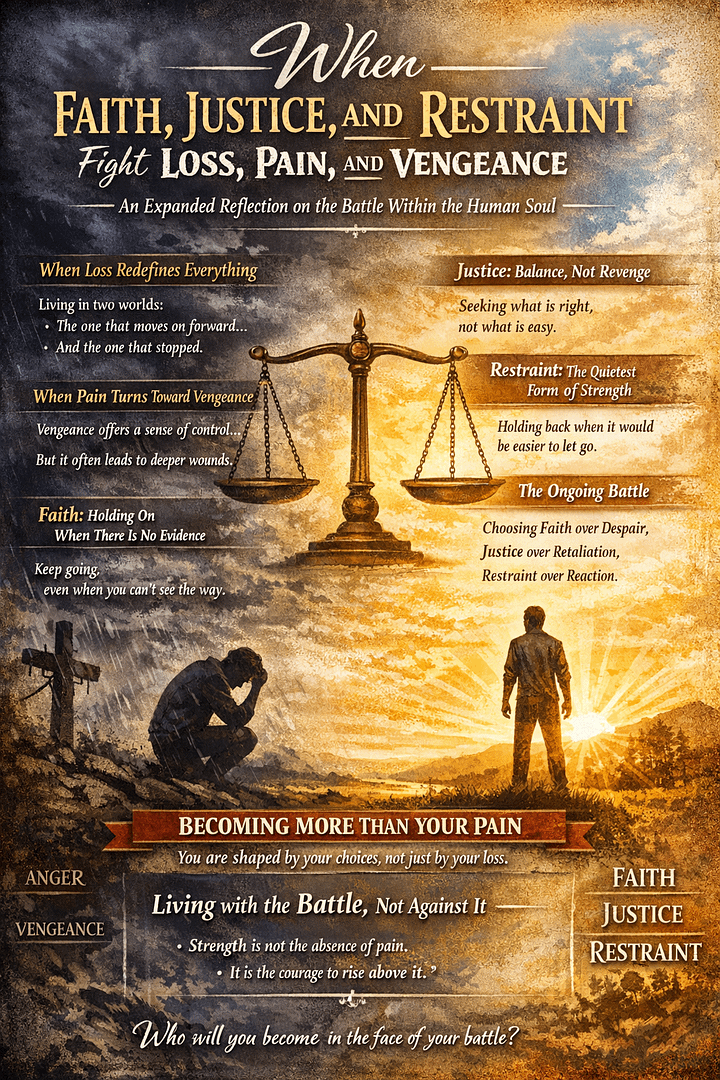
    When Loss Redefines Everything

    Loss does more than take something away—it changes how you see everything that remains.

    It reshapes your sense of safety.
    It fractures your understanding of fairness.
    It challenges your belief in what is right and what is just.

    For those who have lost deeply—especially a child, a partner, or someone who was a part of their everyday existence—the world no longer feels the same. The colors fade. The noise dulls. Even joy feels unfamiliar, like something meant for someone else.

    You begin to live in two worlds at once:

    The one that continues moving forward without pause
    And the one that stopped the moment your loss occurred

    And in that space, pain becomes your constant companion.

    The Nature of Pain: A Language Without Words

    Pain is not always loud.

    Sometimes it is quiet—so quiet that others cannot see it, yet so heavy that it becomes difficult to carry. It hides behind forced smiles, routine conversations, and the simple act of getting through the day.

    Pain speaks in different ways:

    In the silence of an empty room
    In the memory of a voice you can no longer hear
    In the ache of milestones that now feel incomplete

    It is unpredictable.

    A scent, a song, a date on the calendar—anything can trigger a wave that pulls you back into the depths of grief without warning.

    And when those waves hit, they bring with them something powerful:

    The need for an answer.
    The need for meaning.
    The need for justice.

    When Pain Turns Toward Vengeance

    When pain has nowhere to go, it begins to search for direction.

    And often, it finds it in vengeance.

    Vengeance does not always appear as rage. Sometimes it shows up as quiet resentment. Sometimes as a desire to see someone held accountable in a way that mirrors your own suffering.

    It tells you:

    They should not get to move on when I cannot.
    There should be consequences that match this pain.
    If I can make them feel this, maybe I will feel less.

    And in moments of deep hurt, that thinking can feel justified—even necessary.

    Because vengeance offers something grief often takes away:

    A sense of control.

    But vengeance is a deceptive force.

    It feeds on your pain while convincing you it is helping you release it. It keeps you tied to the very moment you are trying to escape. It can slowly transform your identity, replacing who you were with who your pain has made you.

    It feels powerful.

    But it often leads to deeper wounds.

    Faith: Holding On When There Is No Evidence

    Faith is often misunderstood as certainty.

    In truth, faith is choosing to believe when certainty no longer exists.

    It is standing in the middle of your pain and saying:

    There has to be something more than this.
    My story cannot end here.
    Even if I don’t understand, I will not give up.

    Faith does not remove grief. It does not answer every question. It does not promise immediate healing.

    What it does is give you something to hold onto when everything else feels like it is slipping away.

    For some, faith is rooted in spirituality or belief in a higher power.
    For others, it is found in purpose—in honoring a loved one, in helping others, in continuing forward despite the weight.

    Faith is not loud.

    It is a whisper that says, keep going—even when every part of you wants to stop.

    Justice: The Difference Between Balance and Revenge

    Justice is often confused with vengeance, but they are not the same.

    Vengeance is driven by emotion.
    Justice is grounded in principle.

    Vengeance asks, How can I make them feel what I feel?
    Justice asks, What is right, and how do we uphold it?

    True justice is not about causing suffering—it is about accountability, truth, and restoring balance where it has been broken.

    It is not always satisfying.
    It is not always immediate.
    And it does not always feel like enough.

    But justice protects something that vengeance cannot:

    Your integrity.

    It allows you to stand firm without becoming consumed. It gives structure to chaos. It provides a path forward that is not dictated by anger, but guided by fairness.

    Restraint: The Quietest Form of Strength

    Restraint is one of the most misunderstood forms of power.

    In a world that often celebrates reaction—quick responses, emotional outbursts, immediate action—restraint can look like weakness.

    But restraint is anything but weak.

    It is choosing not to act when acting would be easier.
    It is holding back words that cannot be taken back.
    It is refusing to let pain dictate your behavior.

    Restraint requires awareness.
    It requires discipline.
    And most of all, it requires courage.

    Because it is not easy to pause when everything inside you is demanding release.

    But in that pause, something important happens:

    You create space between who you are and what you feel.

    And in that space, you reclaim control.

    The Ongoing Battle: There Is No Final Victory

    This battle is not won in a single moment.

    It does not end with a decision or a realization.

    It is fought again and again—in small choices, in quiet thoughts, in how you respond to the world around you.

    Some days, pain will be louder than faith.
    Some days, vengeance will feel stronger than restraint.
    Some days, justice will feel too slow to matter.

    And that is part of being human.

    The goal is not perfection.

    The goal is awareness.

    Each time you choose:

    Faith over despair
    Justice over retaliation
    Restraint over reaction

    you are not eliminating the battle—you are strengthening the side that leads you forward.

    Becoming More Than Your Pain

    Pain has the power to define you—but only if you allow it to.

    Loss will always be a part of your story.
    Grief will always leave its mark.
    The memory of what was taken will never fully disappear.

    But you are more than what you have lost.

    You are more than what you have endured.

    And the choices you make in the face of that pain will determine who you become.

    You can become hardened—or you can become deeper.
    You can become consumed—or you can become compassionate.
    You can become reactive—or you can become intentional.

    Faith, justice, and restraint do not erase your pain.

    They transform how you carry it.

    Living With the Battle, Not Against It

    The truth is, the goal is not to silence loss, pain, or even the instinct for vengeance.

    Those emotions are part of being human.

    The goal is to not let them lead.

    To acknowledge them without becoming them.
    To feel them without being controlled by them.
    To understand them without acting on every impulse they create.

    Because strength is not the absence of pain.

    It is the ability to carry it without letting it destroy who you are.

    A Final Thought

    There will be moments when the weight feels unbearable.

    Moments when faith feels distant, justice feels delayed, and restraint feels impossible.

    In those moments, remember this:

    You do not have to win the entire battle today.

    You only have to choose, in this moment, which side you will stand on.

    And sometimes, that choice alone is enough to keep you moving forward.

    A Father’s Guide to Surviving the Loss of a Child
  • When Grief Stops You From Trying to Love

    When Grief Stops You From Trying to Love

    Grief has a way of rewriting who we are.

    It doesn’t just take away a person we love—it reshapes how we see connection, safety, and vulnerability. The world no longer feels predictable. Love no longer feels simple. And even when your heart begins to open again, there’s a quiet voice inside that asks, “What if I lose this too?”

    So you hesitate.

    But sometimes… you still try.

    You step into a relationship carrying both hope and fear, wanting to feel something again while still holding onto what you lost.

    And that’s where the real journey begins.

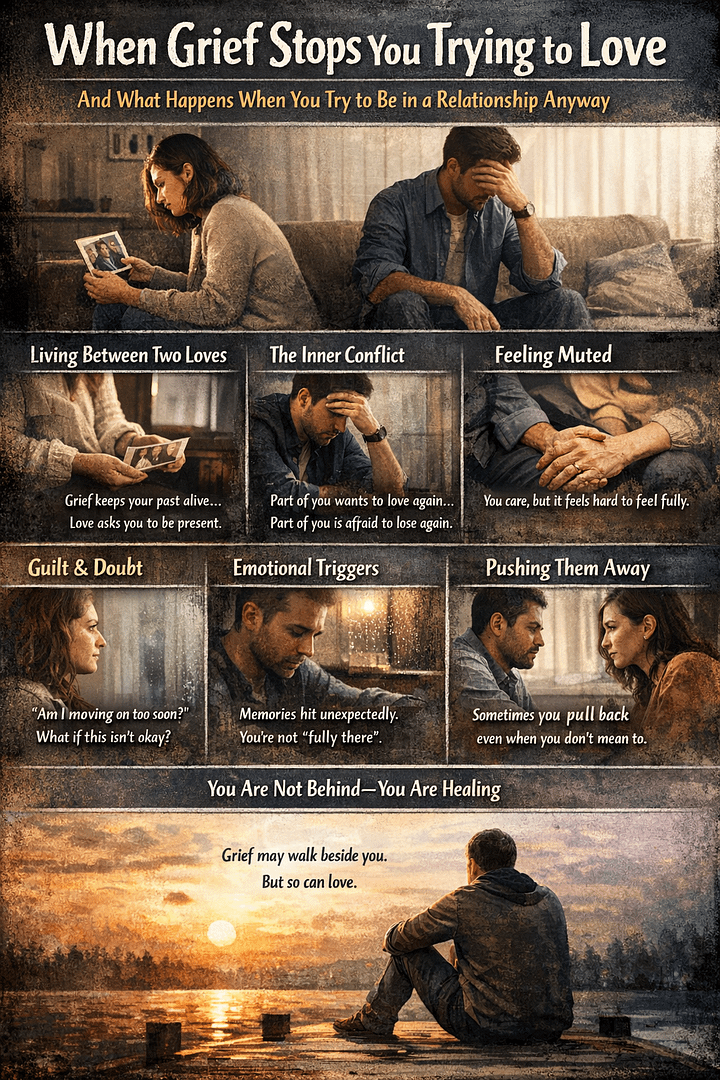
    Living Between Two Loves

    One of the hardest truths about loving after loss is that your heart doesn’t “move on”—it expands.

    You are not choosing between the person you lost and the person in front of you.

    You are carrying both.

    There will be moments when:

    A memory interrupts a happy moment
    You instinctively think of the person you lost first
    You wish, even briefly, that your new partner could understand them the way you did

    This doesn’t make you disloyal.

    It makes you human.

    Grief keeps your past alive, while love asks you to be present. Learning to live between those two spaces takes time—and grace.

    The Inner Conflict No One Sees

    From the outside, it may look like you’re “moving forward.”

    But internally, it can feel like a constant tug-of-war.

    Part of you wants to:

    Let your guard down
    Feel safe with someone again
    Build something new

    While another part of you is saying:

    Don’t get too attached
    You know how this can end
    Protect yourself this time

    This internal conflict can be exhausting.

    It can make you seem distant, inconsistent, or unsure in your relationship—even when you genuinely care.

    And sometimes, you may not even understand your own reactions.

    When You Want to Love… But Can’t Fully Feel It Yet

    There are moments in grief where your heart feels… muted.

    Not empty—but guarded. Slower to respond. Less expressive than it once was.

    You may:

    Care deeply about someone but struggle to show it
    Feel disconnected even during meaningful moments
    Wonder why the emotional intensity isn’t the same

    This can be one of the most frustrating parts of trying to be in a relationship while grieving.

    You want to give more.

    You just don’t always know how to access it yet.

    And that doesn’t mean the love isn’t real—it means your heart is still healing.

    The Pressure to Be “Okay”

    Sometimes the hardest part isn’t the grief itself—it’s the expectation to have it all figured out.

    You may feel pressure from:

    Your partner
    Friends or family
    Or even yourself

    To be “ready,” “healed,” or “fully present.”

    So you try to push your grief aside.

    You tell yourself to stop bringing it up. To stop feeling it so strongly. To just focus on the relationship in front of you.

    But grief doesn’t disappear when ignored.

    It waits.

    And often, it shows up stronger when it’s been pushed down too long.

    Loving Someone Who Is Learning You

    Your partner isn’t just getting to know you—they’re getting to know your grief too.

    They’re learning:

    What triggers you
    What silence means
    When you need space versus when you need comfort

    And that can be challenging.

    Because grief doesn’t come with a clear guidebook.

    There may be moments where they:

    Feel unsure of how to support you
    Take your distance personally
    Or feel like they’re competing with a memory

    That’s why patience—on both sides—is so important.

    A relationship in grief isn’t just about love.

    It’s about understanding, communication, and emotional flexibility.

    When You Push Them Away Without Meaning To

    Grief can create a reflex to retreat.

    Even in a healthy, caring relationship, you might:

    Shut down during emotional conversations
    Avoid deep vulnerability
    Create distance when things feel “too good”

    Not because you don’t care.

    But because part of you associates closeness with loss.

    This can lead to moments where your partner feels confused or hurt.

    And afterward, you may feel guilt—knowing you pushed them away, even though it wasn’t your intention.

    Recognizing this pattern is an important step.

    Not to judge yourself—but to gently start choosing differently when you can.

    The Courage It Takes to Stay

    Trying to love again after loss isn’t just about opening your heart once.

    It’s about choosing—over and over again—to stay open.

    Even when:

    Fear creeps in
    Memories hit unexpectedly
    Or vulnerability feels overwhelming

    Staying doesn’t mean ignoring your grief.

    It means allowing both to exist.

    It means saying:

    I am still healing… but I’m here
    I am still hurting… but I care
    I am still afraid… but I’m trying

    And that kind of honesty builds something real.

    Redefining What Love Looks Like

    Love after grief is not the same as love before loss.

    It is:

    More aware
    More intentional
    More fragile, but also more meaningful

    You may find yourself appreciating:

    Small moments of connection
    Honest conversations
    Simple presence

    More than you ever did before.

    Because now, you understand how quickly those things can be gone.

    You Are Not Behind—You Are Healing

    It’s easy to feel like you’re not doing it “right.”

    Like you should be further along.

    Like your heart should be more open, more ready, more certain.

    But healing is not linear.

    And love after loss is not something you rush—it’s something you grow into.

    At your pace.

    In your way.

    Love Doesn’t Ask You to Forget

    If you take anything from this, let it be this:

    You don’t have to leave your past behind to have a future.

    You don’t have to stop loving the person you lost to love someone new.

    And you don’t have to be fully healed to be worthy of connection.

    Grief may walk beside you.

    But so can love.

    And over time… they learn how to coexist.

    A Father’s Guide to Surviving the Loss of a Child
  • When Grief Changes the Meaning of Living

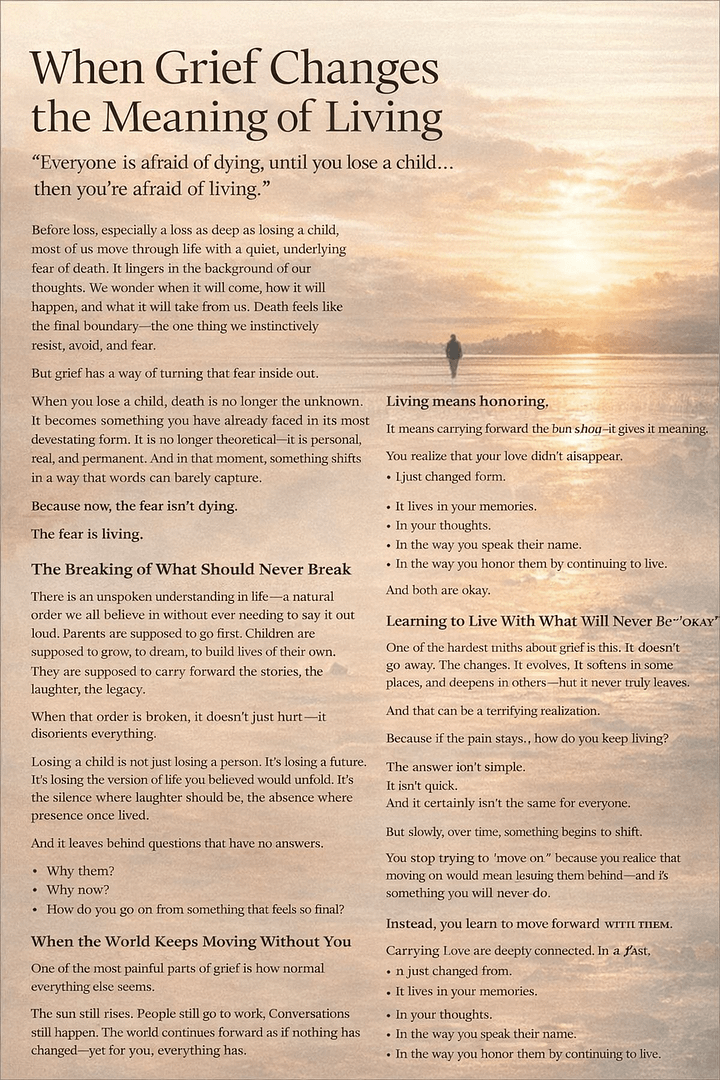
    When Grief Changes the Meaning of Living

    “Everyone is afraid of dying, until you lose a child… then you’re afraid of living.”

    There are some truths in life that don’t just touch you—they redefine you. This is one of them.

    Before loss, especially a loss as deep as losing a child, most of us move through life with a quiet, underlying fear of death. It lingers in the background of our thoughts. We wonder when it will come, how it will happen, and what it will take from us. Death feels like the final boundary—the one thing we instinctively resist, avoid, and fear.

    But grief has a way of turning that fear inside out.

    When you lose a child, death is no longer the unknown. It becomes something you have already faced in its most devastating form. It is no longer theoretical—it is personal, real, and permanent. And in that moment, something shifts in a way that words can barely capture.

    Because now, the fear isn’t dying.

    The fear is living.

    The Breaking of What Should Never Break

    There is an unspoken understanding in life—a natural order we all believe in without ever needing to say it out loud. Parents are supposed to go first. Children are supposed to grow, to dream, to build lives of their own. They are supposed to carry forward the stories, the laughter, the legacy.

    When that order is broken, it doesn’t just hurt—it disorients everything.

    Losing a child is not just losing a person. It’s losing a future. It’s losing the version of life you believed would unfold. It’s the silence where laughter should be, the absence where presence once lived.

    And it leaves behind questions that have no answers.

    Why them?
    Why now?
    How do you go on from something that feels so final?

    There is no preparation for this kind of loss. No roadmap. No set of steps that tell you how to rebuild when the foundation itself has been shaken.

    When the World Keeps Moving Without You

    One of the most painful parts of grief is how normal everything else seems.

    The sun still rises. People still go to work. Conversations still happen. The world continues forward as if nothing has changed—yet for you, everything has.

    Time becomes strange. Days blur together. Moments stretch longer than they should. And sometimes, it feels like you are standing still while everything around you moves in fast-forward.

    You learn quickly that grief is isolating.

    Not because people don’t care—but because they can’t fully understand. They may offer kind words, support, and presence, but the depth of your loss lives in a place that only you can truly feel.

    And so, you carry it.

    Everywhere.

    The Quiet Weight of Everyday Moments

    Grief is not always loud. In fact, most of the time, it’s painfully quiet.

    It shows up in the smallest, most unexpected ways:

    Seeing their favorite food at the store
    Hearing a song that reminds you of them
    Passing by a place where memories were made
    Watching others live the life your child should still have

    And then there are the milestones.

    Birthdays that arrive with no celebration.
    Holidays that feel incomplete.
    Anniversaries that mark not just time—but absence.

    These moments don’t ask for permission. They come when they come. And when they do, they bring with them a wave of emotion that can feel impossible to control.

    Some days, you can push through.

    Other days, survival looks like simply getting through the next hour.

    And both are okay.

    Learning to Live With What Will Never Be “Okay”

    One of the hardest truths about grief is this: it doesn’t go away.

    It changes. It evolves. It softens in some places and deepens in others—but it never truly leaves.

    And that can be a terrifying realization.

    Because if the pain stays… how do you keep living?

    The answer isn’t simple. It isn’t quick. And it certainly isn’t the same for everyone.

    But slowly, over time, something begins to shift.

    You stop trying to “move on,” because you realize that moving on would mean leaving them behind—and that’s something you will never do.

    Instead, you learn to move forward with them.

    Carrying Love Instead of Fighting Pain

    Grief and love are deeply connected. In fact, grief exists because love exists.

    The pain you feel is a reflection of the bond you shared. It is the echo of a connection that does not end just because a life has.

    And when you begin to see it that way, something changes.

    You realize that your love didn’t disappear.

    It just changed form.

    It lives in your memories.
    In your thoughts.
    In the way you speak their name.
    In the way you honor them by continuing to live.

    Carrying that love doesn’t make the pain disappear—but it gives it meaning.

    The Strength No One Sees

    There is a kind of strength that comes from grief that the world rarely talks about.

    It’s not loud. It doesn’t seek recognition. It doesn’t look like courage in the traditional sense.

    It looks like:

    Getting out of bed when you don’t want to
    Smiling when your heart feels heavy
    Showing up for others while carrying your own pain
    Choosing to keep going, even when everything inside you says to stop

    This strength is quiet—but it is powerful.

    And it deserves to be recognized.

    Because surviving loss like this is not something everyone understands—but it is something that requires everything you have.

    Living for Them, Not Without Them

    At some point, many who grieve begin to ask themselves a difficult question:

    What does it mean to live now?

    The answer often comes slowly.

    Living doesn’t mean forgetting.
    It doesn’t mean “getting over it.”
    It doesn’t mean pretending everything is okay.

    Living means honoring.

    It means carrying forward the love, the lessons, and the spirit of the person you lost.

    It means finding small ways to keep them present in your life—through your actions, your choices, and your heart.

    It means making it home safe.
    It means taking another step.
    It means continuing the story, even when it feels incomplete.

    When Fear Turns Into Purpose

    That fear of living may never completely disappear.

    But over time, it can transform.

    It can become a quiet determination.
    A reason to keep going.
    A way to honor a life that mattered deeply.

    Because while death may have taken them from this world…

    It did not take your love.
    It did not take your memories.
    It did not take the impact they had on your life.

    And it never will.

    Final Reflection

    Grief is not something you conquer.
    It is something you carry.

    And while that weight can feel unbearable at times, it also holds something incredibly powerful:

    Love that refuses to fade.

    So if you are walking this path—if you are living with a loss that has changed everything—know this:

    There is no right way to grieve.
    There is no timeline you must follow.
    There is no expectation you need to meet.

    There is only one thing that matters—

    That you keep going.

    Not perfectly.
    Not easily.
    But honestly.

    Because even in the fear…
    even in the pain…

    There is still life.

    And in that life, they are still with you—
    every step of the way.

    A Father’s Guide to Surviving the Loss of a Child
  • When a Loved One Passes Away

    When a Loved One Passes Away

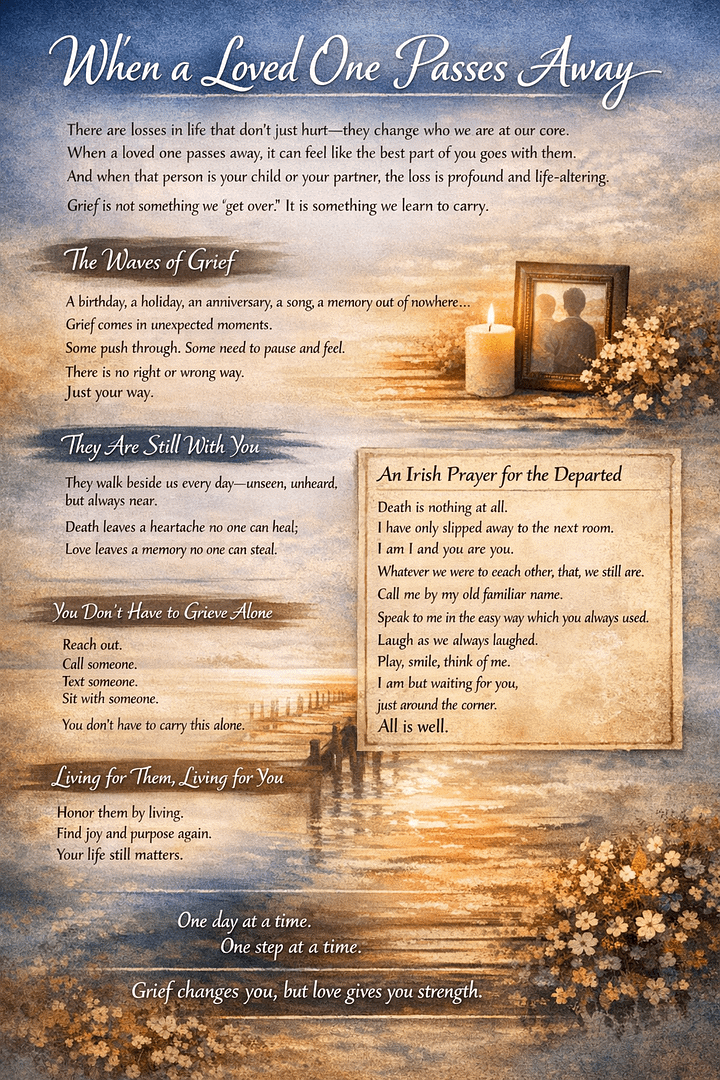
    There are losses in life that don’t just hurt—they change who we are at our core. When a loved one passes away, it can feel like the best part of you goes with them. And when that person is your child or your partner, the loss reaches into places within you that you didn’t even know existed. It doesn’t just break your heart—it reshapes your entire world.

    Because they weren’t just part of your life… they were part of you.

    Your routines, your thoughts, your plans, your identity—so much of it was tied to their presence. And when they are gone, you are left trying to understand who you are now, in a life that feels unfamiliar and incomplete.

    Grief is not something we “get over.” It is something we learn to carry, one breath at a time.

    The Weight of Loss

    In the beginning, everything feels heavy. The simplest tasks can feel overwhelming. Getting out of bed takes strength. Facing the day takes courage. There are moments when even breathing feels like work.

    You may find yourself replaying memories, conversations, or moments you wish you could relive. You may think about what you could have said differently, done differently, or held onto just a little longer.

    These thoughts are a natural part of grief.

    Because grief is love that no longer has a physical place to go.

    And that love doesn’t disappear—it searches for a new place to exist. Sometimes it becomes tears. Sometimes silence. Sometimes memories that flood your mind when you least expect it.

    There Is No Timeline for Grief

    One of the most important truths to understand is this: there is no timetable for grief.

    Some people begin to find a rhythm again in a few months. Others take years. Some carry a deep, ongoing grief that becomes part of their daily life forever.

    None of these paths are wrong.

    Grief is not something you measure. It is something you experience.

    It is deeply personal, shaped by your relationship, your memories, and the love you shared. No one else can define how long it should take, how it should look, or how you should feel.

    There will be days when you feel like you are making progress, and then suddenly, without warning, it feels like you are right back at the beginning.

    That is not failure.

    That is grief doing what grief does.

    The Waves That Come Without Warning

    Even when time has passed, grief does not simply disappear. It changes, but it remains.

    And sometimes, it returns in waves.

    A birthday. A holiday. An anniversary. A favorite song. A smell. A place you once shared. A random memory that appears out of nowhere.

    These moments can hit you just as hard as the day you lost them.

    One second you are functioning, moving through your day—and the next, you are overwhelmed by a feeling you cannot control.

    This is one of the most difficult parts of grief: the unpredictability.

    Some people can push through those moments and keep going. Others need to stop, sit, cry, and let it pass.

    Both responses are valid.

    There is no right or wrong way to survive those waves.

    There is only doing what you need to do to make it through the day.

    Learning to Live Without Them

    Perhaps the hardest part of grief is learning how to live without someone you never imagined living without.

    It is not about “moving on.” It is about moving forward—with them still in your heart.

    You begin to find ways to carry them with you:

    In the way you speak
    In the values they taught you
    In the memories you revisit
    In the love you continue to feel

    Over time, the pain does not necessarily disappear—but it softens. It becomes less sharp, less constant. It shifts from a wound into something quieter, something that lives alongside you instead of overwhelming you.

    You begin to smile at memories that once only made you cry.

    You begin to feel their presence not just in loss, but in love.

    They Are Still With You

    There is a quiet comfort in realizing that the people we love never truly leave us.

    They walk beside us every day—unseen, unheard, but always near.

    They are in the little things:

    The way you laugh
    The songs you still play
    The traditions you continue
    The lessons you carry forward

    Death leaves a heartache no one can heal, but love leaves a memory no one can steal.

    That love becomes part of you—woven into who you are, forever.

    An Irish Prayer for Comfort

    There is a beautiful Irish prayer that has brought comfort to many who are grieving. It reminds us that separation is not the end, but simply a pause:

    Death is nothing at all.
    I have only slipped away to the next room.
    I am I and you are you.
    Whatever we were to each other, that, we still are.
    Call me by my old familiar name.
    Speak to me in the easy way which you always used.
    Put no difference into your tone.
    Wear no forced air of solemnity or sorrow.
    Laugh as we always laughed
    at the little jokes we enjoyed together.
    Play, smile, think of me. Pray for me.
    Let my name be ever the household word that it always was.
    Let it be spoken without effect.
    Without the trace of a shadow on it.
    Life means all that it ever meant.
    It is the same as it ever was.
    There is absolute unbroken continuity.
    Why should I be out of mind because I am out of sight?
    I am but waiting for you,
    for an interval,
    somewhere very near,
    just around the corner.
    All is well.

    You Don’t Have to Do This Alone

    Grief can feel isolating. It can make you feel like no one truly understands what you are going through.

    But you do not have to carry it alone.

    Reach out.

    Call someone. Text someone. Sit with someone. Even if you don’t know what to say. Even if all you can do is be present.

    There is strength in allowing others to be there for you.

    Because while grief is personal, healing often happens in connection.

    Living for Them, and for Yourself

    The journey of grief never truly ends—but it evolves.

    And through that evolution, there is a quiet responsibility we carry: to live.

    Not just exist—but live.

    The people we love would not want us to stay stuck in our pain. They would not want us to walk this life alone or close ourselves off from the world.

    They would want us to wake up each day and keep going.

    To laugh again.
    To love again.
    To find meaning again.

    Not just for them—but for ourselves, and for the people who are still here.

    Because your life still matters.

    Even after loss.
    Even through pain.
    Even when it feels impossible.

    There is still purpose in your story.

    Final Thought

    Grief may take a part of you—but it does not take all of you.

    What remains is strength you didn’t know you had, love that will never fade, and a connection that even death cannot break.

    And in that space—between loss and love—you find a way forward.

    One day at a time. One step at a time.

    A Father’s Guide to Surviving the Loss of a Child

  • Dear Paul, My Son, My Hero

    Dear Paul, My Son, My Hero

    Dear Paul,

    I know you are looking down at me while I am writing this. Smiling and laughing that I am doing the one thing we both know that I rarely do. Opening up and letting my feelings out.

    In life and death, you are not just my son, you are also my hero.

    In life you led by example. You were a loving, caring, mature 21-year-old with an old soul. You cared about others and would help someone in any way you could. Not once did you ever say look what I did, you would say, Dad there was someone who needed help, and I helped them without letting others know so they wouldn’t be embarrassed. You would donate time, items, and other resources to help those in need. Just like your old man.

    You took care of me when I was having medical issues years ago. You would get up, make sure I took my medicine, cook breakfast, go to school, come home and make sure I had dinner and taking care of me all at the tender age of 15.

    I remember how you kept taking care of me all the way up until your death.

    It was just the two of us.

    You would never let me give up. You always knew what to say when things were not good or when you could tell I was not doing good. I miss those pep talk speeches.

    I remember there was times when you would use a speech from a movie and turn it to your own speech. Whatever I needed to hear, you had a knack to find out what was going on and knew what to say.

    I miss the meals you would cook. You always knew what meal would be good for us. Especially what meal would be good for me after a long day or a long night.

    I miss the conversations we would have about anything and everything. It was just not father-son conversations, but the best friends conversations that we would have.

    If it was not for you in life, I would not be here writing this letter to you.

    Thank you for taking care of me and pushing me to live and be better.

    In death, you are not just my son, my hero, but you are also my guardian angel.

    When I found out you had passed away, it broke me into a billion pieces. I could not talk, I could not move, I could not breath.

    I remember that the only thing I needed was you. I ended up going to the bar and numbing the pain of losing of you. I ended up back at home and was up all night and right before I slept for thirty minutes, the last thing I saw was you with wings.

    Ever since, you are the voice that guides me, the spirit that pushes me when I want to give up and the reason why I help people.

    When things get bad or I don’t know what to do, I look up for your guidance. Even in death, you know what to say to me.

    You know how much a pain in the rear you are and I know you are laughing and smiling right now. You know how much I do not like being pushed to do things. But if there is anyone who could get through to me, its you. Your guidance has helped me more than you know.

    I know it took me years to even think of living. Well, with your help, I am trying to live son. Not as much as you want for me, but at least I am trying.

    I know what you are saying to the other angels right now. You are saying,

    “You see how stubborn my old man is, he thinks he is living. He thinks that he tries something new a few times, asks someone out once or twice, writes some articles and helps people do what he needs to do is living. What he needs to do is fully open up to that person he opened up to once, stop hiding and live life, stop being scared of the unknown and get back up and fight to win like he did when I was there with him.”

    I know son. I felt that smack upside my head.

    I will do better. I will be better. I will lead by example. I will get that life you want for me.

    Thank you for taking care of me and pushing me to live and be better.

    Paul, I love you and I miss you every second. You always have been and will be forever my guardian angel.
    Forever my rock, forever my hero, forever my guardian angel, Forever my son.

    Paul, I miss you and I Love you. Till we meet again.

    A Father’s Guide to Surviving the Loss of a Child
  • When the Pain of Night Hits

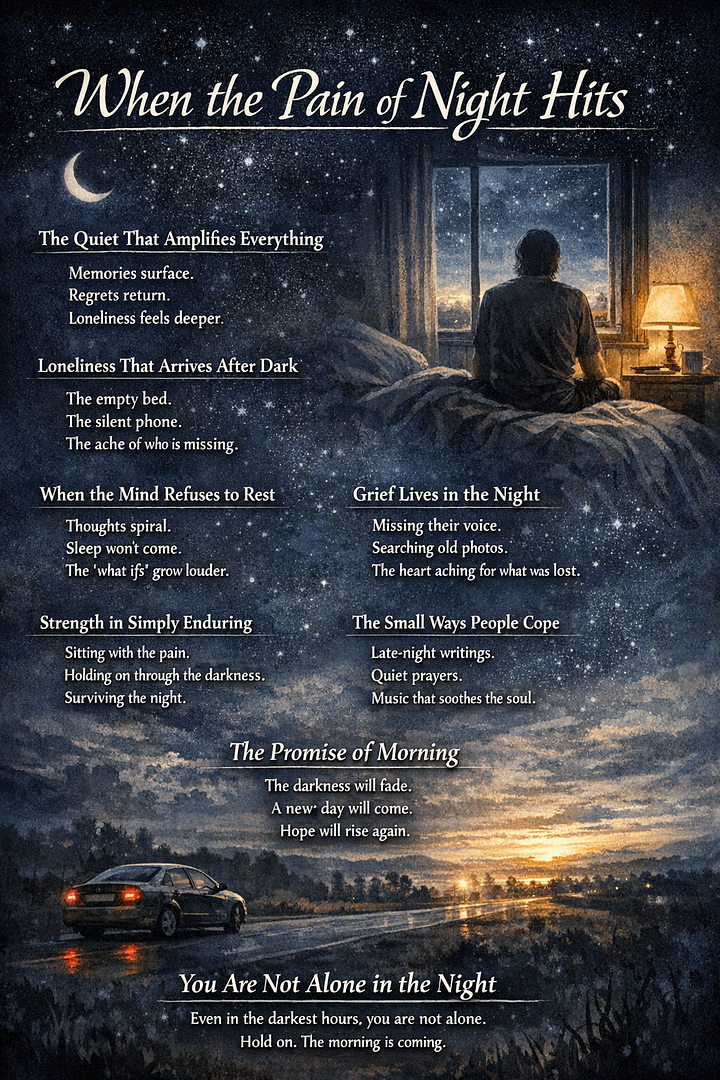
    When the Pain of Night Hits

    There is something about nighttime that can make pain feel deeper.

    During the day, life moves quickly. Responsibilities demand our attention. Phones ring, people talk, work needs to be done, and the noise of everyday life keeps our minds occupied. Even when we are hurting, the pace of the day gives us moments of distraction. It allows us to function, to push emotions aside long enough to get through what needs to be done.

    But night is different.

    When the sun sets and the world begins to quiet down, the distractions fade. Conversations end, streets empty, and the hum of daily activity slowly disappears. What remains is silence—and in that silence, emotions that were buried during the day often rise to the surface.

    For many people, the pain they have been holding inside all day finally shows itself once the night arrives.

    The Quiet That Amplifies Everything

    Nighttime has a unique way of magnifying thoughts and emotions. When everything around us becomes still, our minds begin to wander through places we sometimes try to avoid.

    Memories surface more vividly.

    You might think about someone you lost, replaying moments that once felt ordinary but now feel priceless. You might remember the sound of their voice, the way they laughed, or the conversations you wish you could have one more time.

    For others, the memories involve relationships that ended. The mind drifts back to happier moments, questioning where things went wrong. You revisit words that were said, words that were never spoken, and moments when everything could have gone differently.

    At night, the mind can become a storyteller, replaying scenes from the past over and over again.

    Sometimes it is comforting.

    But often, it hurts.

    The Loneliness That Arrives After Dark

    Loneliness often feels stronger at night.

    During the day, even if you feel alone inside, the world is filled with people. There are coworkers, strangers in stores, conversations in passing, and the simple awareness that life is happening all around you.

    But when night comes, the world grows quieter. Lights turn off in windows, phones stop buzzing, and social media feeds slow down. The outside world begins to rest.

    And suddenly, the emptiness feels louder.

    You might look around the room and feel the absence of someone who used to be there. A chair at the table, an empty side of the bed, or a quiet phone that once held conversations that meant everything.

    Loneliness at night is not always about being physically alone. Sometimes it is the emotional feeling of being disconnected from the person you wish was beside you.

    The person you want to talk to.

    The person you miss.

    The person who once made everything feel lighter.

    When the Mind Refuses to Rest

    One of the hardest parts about nighttime pain is how it interferes with sleep.

    When the body is tired but the mind is racing, rest can feel impossible. Thoughts move in circles, replaying past mistakes, unanswered questions, and fears about the future.

    “What if I had done things differently?”
    “Why did things turn out this way?”
    “Will things ever get better?”

    The ceiling becomes familiar as you stare into the darkness, hoping your mind will eventually quiet itself. But the more you try to force sleep, the more awake you feel.

    Hours pass slowly.

    And sometimes the night feels endless.

    Grief That Lives in the Night

    For those who are grieving, nighttime can be particularly difficult.

    Grief does not follow a schedule. It appears when it chooses, often catching us off guard. But night is when grief often finds the most space to speak.

    You might find yourself scrolling through old photos. Listening to songs that remind you of someone you lost. Re-reading messages you once took for granted.

    The quiet gives grief room to breathe.

    In those moments, the ache can feel overwhelming—not because the love is gone, but because it remains so strong while the person is no longer here.

    Grief is, in many ways, love that no longer has a place to land.

    And at night, that love often searches for somewhere to go.

    The Invisible Battles

    Many people fight battles at night that the outside world never sees.

    They may appear strong during the day. They may smile, laugh, work, and interact with others without anyone realizing the storm that waits for them once they are alone.

    But when the door closes and the lights dim, those hidden struggles can rise to the surface.

    Anxiety.
    Heartbreak.
    Regret.
    Fear of the future.
    Feelings of worthlessness or being unlovable.

    Night does not create these emotions, but it removes the distractions that normally keep them quiet.

    And for some, that silence can feel overwhelming.

    Strength in Simply Enduring

    One of the most overlooked forms of strength is endurance.

    When people think of strength, they often imagine dramatic moments—acts of bravery, bold decisions, or powerful words. But sometimes strength looks much quieter than that.

    Sometimes strength is simply surviving the night.

    It is allowing yourself to feel pain without letting it completely break you. It is sitting with difficult emotions and choosing to keep going even when the path forward feels uncertain.

    You may not feel strong in those moments. You may feel exhausted, vulnerable, or lost.

    But every night you make it through is proof that something inside you is still holding on.

    Even when it feels fragile.

    The Small Ways People Cope

    When the pain of night hits, people often search for small ways to make the darkness easier to carry.

    Some write their thoughts in journals, turning overwhelming emotions into words on a page. Others listen to music that understands their feelings better than conversation ever could.

    Some people watch movies or television simply to fill the silence. Others go for late-night drives, letting the motion of the road calm their racing thoughts.

    There are those who pray.
    Those who read.
    Those who cry quietly into pillows until the weight begins to ease.

    None of these actions erase pain completely. But they create small spaces of comfort inside the darkness.

    And sometimes, those small spaces are enough to get through another night.

    The Promise Hidden in Every Morning

    No matter how long a night feels, morning eventually arrives.

    It may come slowly, with the faint glow of early light pushing back the darkness. Or it may arrive suddenly, when the alarm clock rings and a new day demands your attention.

    The pain you carried through the night may still exist. Healing rarely happens instantly.

    But morning offers something important: perspective.

    It reminds you that the night did not last forever.

    It reminds you that time continues to move forward.

    And it reminds you that even when you felt completely alone in the darkness, you made it through.

    You Are Not Alone in the Night

    If you have ever laid awake while the world slept, carrying thoughts that felt too heavy for one heart to hold, know that you are not alone.

    Across cities, towns, and quiet homes around the world, there are countless people staring into the same darkness, fighting similar battles inside their own minds.

    Different stories.

    Different losses.

    Different struggles.

    But the same quiet hope that the pain will one day soften.

    Night can make pain feel overwhelming, but it can also reveal something powerful: the resilience of the human heart.

    Because even when the darkness feels endless, people continue to endure.

    They continue to breathe.

    They continue to hold on.

    And eventually, they continue to rise with the morning.

    A Father’s Guide to Surviving the Loss of a Child
  • When the Calendar Remembers: Facing the Anniversary of a Loved One’s Death

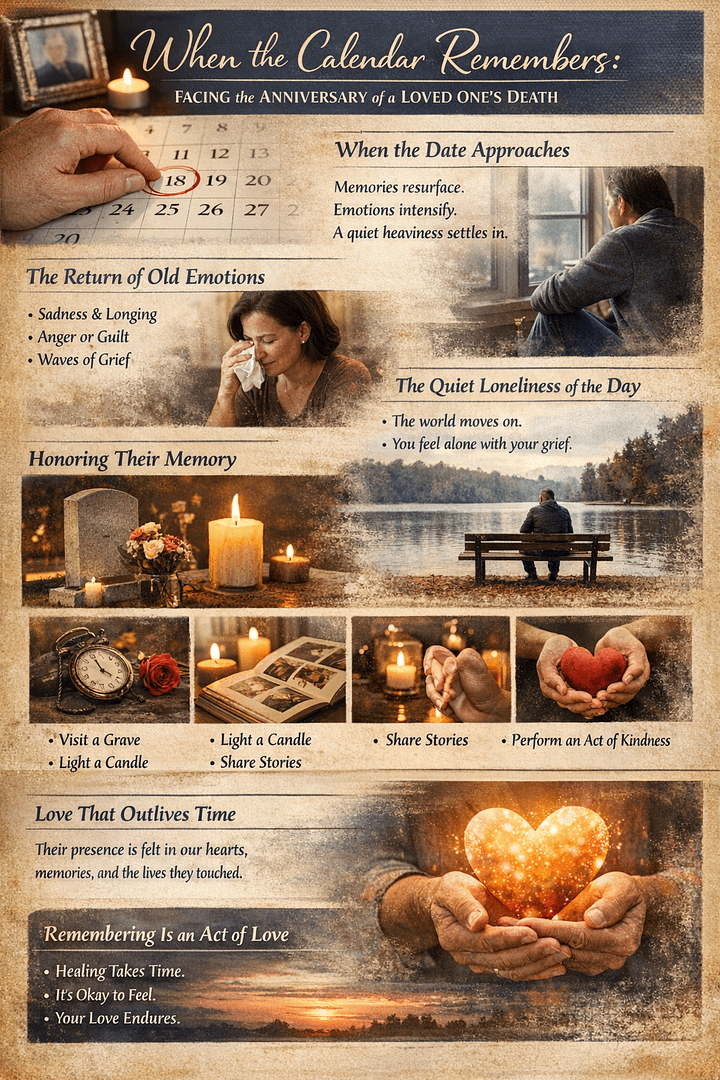
    When the Calendar Remembers: Facing the Anniversary of a Loved One’s Death

    There are dates on the calendar that most people barely notice—days that pass quietly and without meaning. But when you have lost someone you love, there is often one date that never fades into the background. It arrives each year carrying a quiet heaviness that can be felt long before the day itself appears.

    The anniversary of a loved one’s death is not just another day. It is a moment when memories return more vividly, emotions rise more easily, and the reality of loss feels closer than it might on ordinary days.

    For many people, it is one of the most difficult days of the year.

    When the Date Approaches

    Sometimes the anniversary begins affecting us even before we realize it. Days or weeks beforehand, you may notice subtle emotional shifts. You might feel more reflective, more sensitive, or unexpectedly sad. A sense of uneasiness can settle in without an obvious explanation.

    This is often called the “anniversary reaction.” Our minds and bodies remember the trauma of loss, even if we are not consciously thinking about the exact date.

    Memories may surface more frequently. You might find yourself replaying the final days you shared with your loved one, remembering conversations, moments, or details that once seemed small but now feel significant. The mind revisits those memories as if trying to understand them all over again.

    It can feel as though time briefly moves backward.

    The Return of Old Emotions

    Grief is not a straight path. It moves in waves, sometimes gentle and sometimes overwhelming. Even if years have passed since the loss, the anniversary can bring back emotions that feel surprisingly fresh.

    You may feel sadness, longing, anger, regret, or deep loneliness. Some people experience a renewed sense of disbelief, as if part of them still struggles to accept that their loved one is truly gone.

    Others feel a quiet emptiness.

    There can also be moments of guilt—guilt for moving forward with life, guilt for things left unsaid, or guilt for feeling happiness when the person they love is no longer here to share it.

    All of these feelings are normal. Grief is deeply personal, and no two people experience it in exactly the same way.

    The Memories That Surface

    On the anniversary of a loved one’s passing, memories often feel closer than usual. Simple things can trigger them—a familiar song, a photograph, a scent, or even a place you once visited together.

    You may remember the way they laughed, the way they spoke your name, or the small habits that made them uniquely themselves. Sometimes the memories bring smiles. Other times they bring tears.

    What can be surprising is how vivid those memories remain, even years later. It reminds us that the people we love leave permanent imprints on our hearts.

    They may no longer be physically present, but the connection we had with them continues to exist through memory.

    The Quiet Loneliness of the Day

    One of the hardest parts of anniversary days is that the world keeps moving forward while you feel pulled backward in time. For everyone else, it may seem like an ordinary day. But for you, it holds profound meaning.

    This can create a deep sense of isolation.

    Friends and coworkers may not realize what the day represents. Some people may want to acknowledge the loss but feel unsure of what to say. Others may simply not remember the date at all.

    Because of this, many people spend the anniversary quietly, carrying their memories privately.

    Yet it is important to remember that grief is shared by many, even when it feels lonely. Across the world, countless people mark similar days on their calendars—days that represent love, loss, and remembrance.

    Honoring Their Memory

    For some people, the anniversary becomes a day of remembrance rather than just sorrow. Many find comfort in honoring their loved one in ways that feel meaningful.

    Some visit a gravesite or memorial location. Others light a candle at home, say a prayer, or spend time looking through photographs and old letters. Some people listen to music their loved one enjoyed or cook a favorite meal that reminds them of shared moments.

    Others choose to honor the person by doing something kind—donating to a charity, helping someone in need, or simply performing an act of kindness in their memory.

    These rituals do not erase the pain, but they can transform the day into something more than grief alone. They become a way to acknowledge the love that still remains.

    When the Pain Still Feels Fresh

    People sometimes believe that grief should fade completely with time. In reality, the loss of someone deeply loved can stay with us for a lifetime.

    Even decades later, the anniversary may still stir powerful emotions.

    That does not mean you have failed to heal. It simply means the love you had for that person was real and meaningful.

    Healing does not mean forgetting. It means learning to carry the memories forward in a way that allows life to continue.

    Love That Outlives Time

    The anniversary of a loved one’s death reminds us of something both painful and beautiful: love does not end when life does.

    The bond you shared with that person continues through the memories you hold, the stories you tell, and the ways they shaped who you are. Their influence becomes woven into your life, quietly guiding your thoughts and actions.

    Even though they are no longer here physically, their presence remains in countless small ways—in the lessons they taught you, the laughter you shared, and the love that still lives in your heart.

    Moving Through the Day

    There is no right or wrong way to experience an anniversary of loss. Some people prefer to spend the day quietly reflecting. Others surround themselves with family or friends. Some choose to stay busy, while others allow themselves space to grieve openly.

    Whatever approach you take is valid.

    What matters most is allowing yourself to feel what you feel without judgment. Grief is not something that can be rushed or controlled. It unfolds at its own pace.

    Remembering Is an Act of Love

    When the anniversary arrives and the memories return, it may bring tears, reflection, or moments of quiet sadness. But those feelings also represent something deeply meaningful.

    They are reminders of the love that once existed and continues to exist.

    The calendar may mark the day someone left this world, but it also marks the enduring connection that remains.

    And in that way, remembering becomes more than grief—it becomes another expression of love that time can never erase.

    A Father’s Guide to Surviving the Loss of a Child
  • You Do Not Have to Grieve Alone

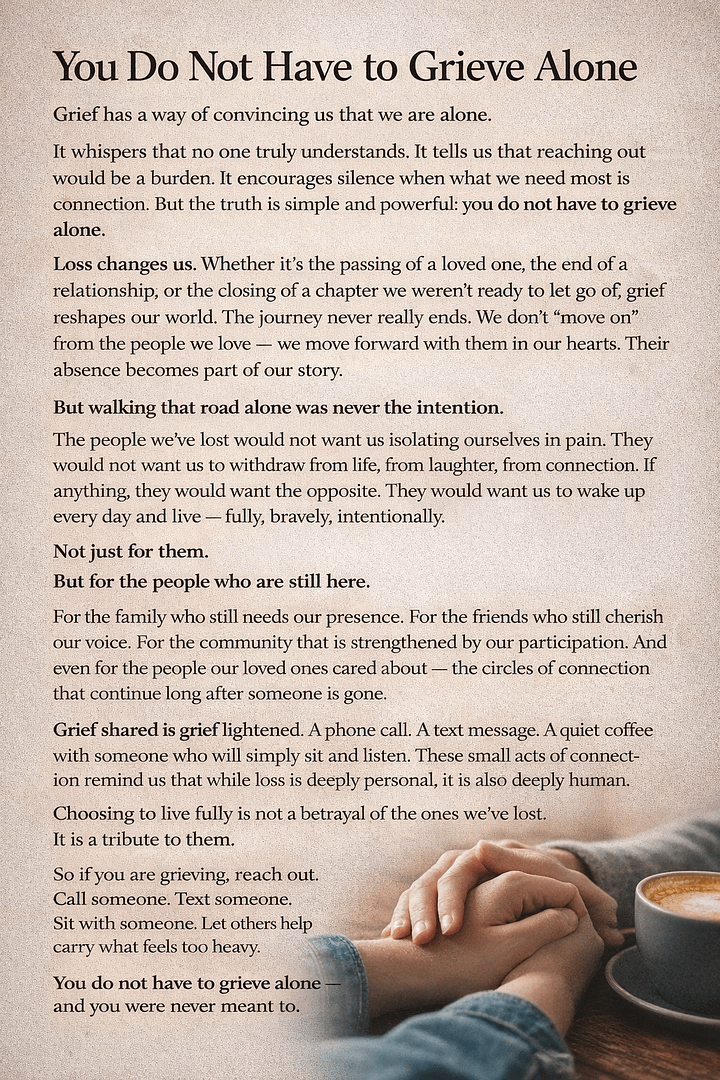
    You Do Not Have to Grieve Alone

    Grief has a way of convincing us that we are alone.

    It whispers that no one truly understands. It tells us that reaching out would be a burden. It encourages silence when what we need most is connection. But the truth is simple and powerful: you do not have to grieve alone.

    Loss changes us. Whether it’s the passing of a loved one, the end of a relationship, or the closing of a chapter we weren’t ready to let go of, grief reshapes our world. The journey never really ends. We don’t “move on” from the people we love — we move forward with them in our hearts. Their absence becomes part of our story.

    But walking that road alone was never the intention.

    The people we’ve lost would not want us isolating ourselves in pain. They would not want us to withdraw from life, from laughter, from connection. If anything, they would want the opposite. They would want us to wake up every day and live — fully, bravely, intentionally.

    Not just for them.

    But for the people who are still here.

    For the family who still needs our presence. For the friends who still cherish our voice. For the community that is strengthened by our participation. And even for the people our loved ones cared about — the circles of connection that continue long after someone is gone.

    Grief shared is grief lightened. A phone call. A text message. A quiet coffee with someone who will simply sit and listen. These small acts of connection remind us that while loss is deeply personal, it is also deeply human. We were not created to carry sorrow by ourselves.

    There is strength in vulnerability. There is courage in saying, “I’m not okay today.” And there is healing in allowing others to stand beside us in the storm.

    The journey of grief may never end, but it does evolve. The sharp edges soften. The memories become less painful and more precious. And slowly, life begins to feel like life again — not as it was, but as it is now.

    Choosing to live fully is not a betrayal of the ones we’ve lost. It is a tribute to them.

    So if you are grieving, reach out. Call someone. Text someone. Sit with someone. Let others help carry what feels too heavy.

    You do not have to grieve alone — and you were never meant to.

    A Father’s Guide to Surviving the Loss of a Child