
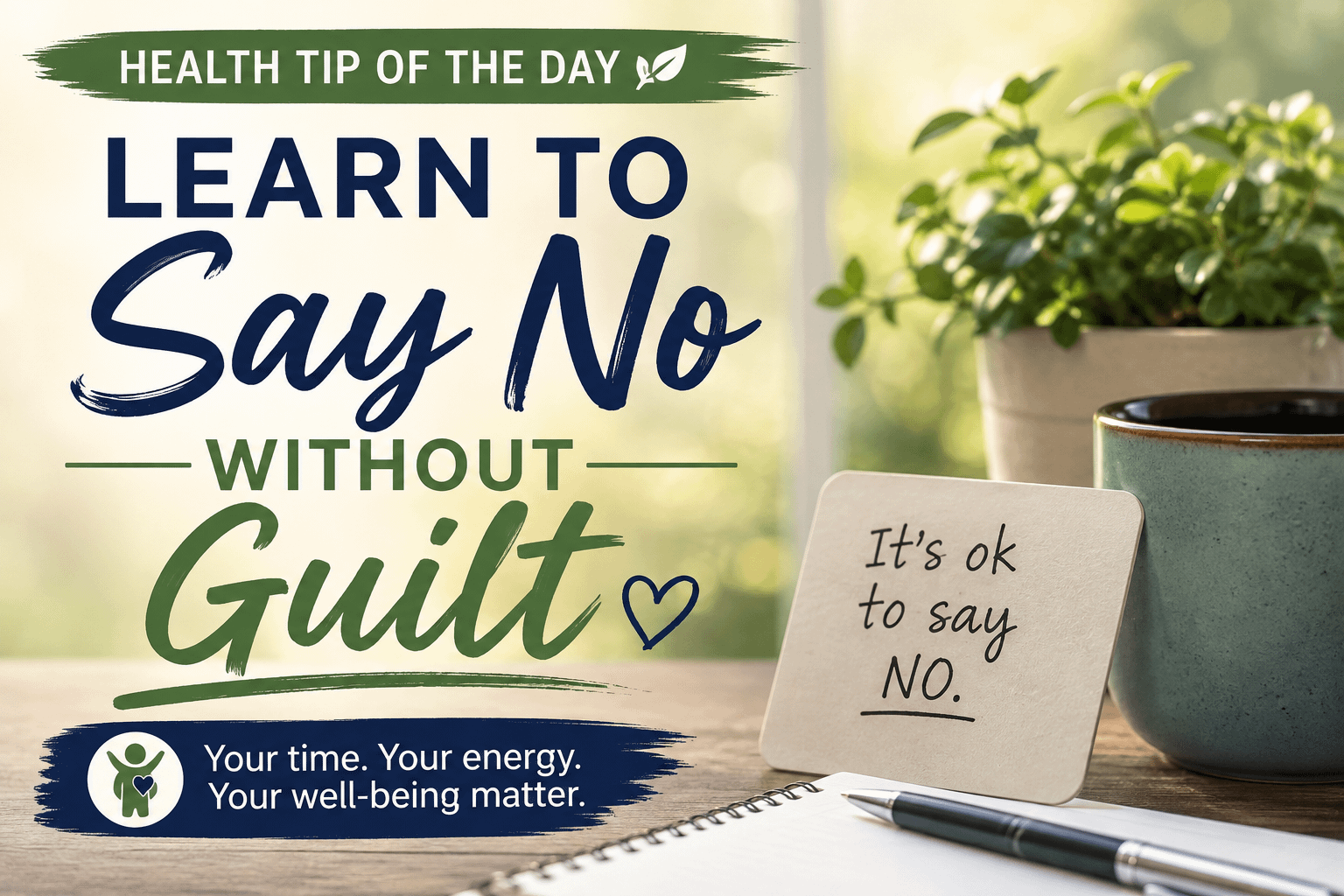
Saying “no” can be one of the smallest things you do for your health—and one of the hardest.
Many of us become accustomed to saying yes. We say yes because we want to help. We say yes because we don’t want to disappoint anyone. We say yes because we want people to like us. Sometimes, we even say yes because explaining why we don’t want to do something seems harder than simply agreeing to it.
But every yes has a cost.
When you constantly agree to things you don’t have the time, energy, or emotional capacity for, you can gradually become exhausted, stressed, frustrated, and even resentful.
That’s why today’s Health Tip of the Day is simple:
Learn to say no without feeling guilty about protecting your well-being.
Saying no doesn’t automatically make you selfish, uncaring, or difficult. Sometimes, saying no simply means recognizing your limits and respecting them.
Why Saying No Can Feel So Difficult
For such a short word, “no” can carry an incredible amount of emotional weight.
You might worry:
- Will they be upset with me?
- Will they think I don’t care?
- What if they stop asking me for things?
- What if I disappoint them?
- What if they think I’m selfish?
- What if saying no damages the relationship?
These concerns can make it tempting to say yes even when everything inside you wants to decline.
Some people have spent years being the dependable person everyone calls when they need something. When that becomes part of your identity, setting boundaries can feel uncomfortable.
You may even feel responsible for solving other people’s problems.
But being supportive doesn’t mean you have to be available every moment of every day.
You are allowed to have limits.
Your Time and Energy Are Limited
There are only so many hours in a day.
You also have a limited amount of physical and emotional energy.
Think about everything competing for that energy: work, family, relationships, household responsibilities, finances, errands, appointments, exercise, sleep, hobbies, friendships, and your own emotional needs.
Then someone asks for one more favor.
And another.
And another.
Eventually, something has to give.
Unfortunately, the first thing many people sacrifice is themselves.
They sleep less.
They skip exercise.
They don’t relax.
They cancel their personal plans.
They stop doing things they enjoy.
They spend their entire day helping everyone else and have nothing left for themselves.
That isn’t sustainable.
Protecting some of your time isn’t selfish. It’s necessary.
Saying Yes When You Mean No Creates Stress
Imagine someone asks you to do something on your only free afternoon.
You immediately want to decline.
Instead, you hear yourself saying:
“Sure, I can do that.”
Almost immediately, you regret it.
Now you’re thinking about everything you planned to accomplish. You may feel frustrated with the person who asked, even though technically you agreed.
This is one way poor boundaries can create unnecessary stress.
When we repeatedly say yes while internally wanting to say no, resentment can build.
Eventually, we may become irritated with people who aren’t necessarily aware they’re asking too much.
A healthier approach is communicating your limits before resentment develops.
You Don’t Need a Long Explanation
One reason people struggle with saying no is that they think they need an elaborate excuse.
You don’t.
A respectful response can be simple:
“I’m sorry, but I can’t today.”
“I appreciate you asking, but I’m not available.”
“I can’t take that on right now.”
“I have too much on my plate at the moment.”
“Thank you for thinking of me, but I’ll have to pass.”
Notice that none of these responses require an elaborate story.
You don’t have to create an excuse.
You don’t have to defend yourself.
You don’t have to convince the other person that your reason is important enough.
A polite no can be a complete answer.
Stop Automatically Saying Yes
If you’re accustomed to pleasing people, you might agree to requests before you’ve even considered whether you actually want to do them.
Someone asks for something and your automatic response is:
“Sure.”
Then five minutes later you’re wondering why you agreed.
One useful habit is to stop answering immediately.
Instead, say:
“Let me check and get back to you.”
That small pause gives you time to think.
Ask yourself:
Do I actually have time for this?
Do I have the energy?
Do I want to do it?
Will agreeing interfere with something important?
Am I saying yes because I genuinely want to help—or because I’m afraid of disappointing someone?
Giving yourself time before answering can prevent commitments you later regret.
Guilt Doesn’t Always Mean You’re Doing Something Wrong
This is an important distinction.
Feeling guilty doesn’t necessarily mean you’ve done something wrong.
Sometimes guilt appears simply because you’re doing something differently.
If you’ve spent years saying yes to everyone, saying no can feel uncomfortable at first.
Your mind may tell you:
“You should have helped.”
“You disappointed them.”
“You’re being selfish.”
But discomfort isn’t proof that your decision was wrong.
You may simply be learning a healthier way of protecting your time and energy.
With practice, saying no can become easier.
Boundaries Can Protect Your Mental Well-Being
Constantly feeling responsible for everyone else’s needs can become emotionally exhausting.
Healthy boundaries help define what you are—and aren’t—responsible for.
You can care about someone without solving every problem for them.
You can love someone without agreeing with everything they want.
You can support someone without sacrificing your own well-being.
You can be generous without being endlessly available.
Boundaries don’t have to be walls that push people away.
They can be guidelines that help relationships remain healthier.
Saying No Can Protect Your Physical Health Too
Stress isn’t only emotional.
When you’re constantly overwhelmed, your body can feel the effects as well. Ongoing stress can interfere with sleep, concentration, mood, appetite, and healthy routines.
If your schedule is overloaded because you’re constantly agreeing to additional responsibilities, you may also have less time for the basics that support your health.
Exercise gets postponed.
Healthy meals become less convenient.
Bedtime gets later.
Appointments get delayed.
Relaxation disappears.
Learning to say no occasionally can create room for activities that support your physical and emotional health.
Protect Your Rest
Rest is one area where boundaries are especially important.
Many people treat rest as something they are only allowed to have after everything else is finished.
But there’s always something else to do.
Another email.
Another chore.
Another favor.
Another phone call.
Another task.
If you wait until absolutely everything is finished before allowing yourself to rest, you may never truly rest.
Sometimes you have to intentionally protect that time.
You might have to say:
“No, I’m staying home tonight.”
“No, I can’t take another shift.”
“No, I can’t help this weekend.”
“No, I need some downtime.”
You don’t have to earn every moment of rest by completely exhausting yourself first.
Learn the Difference Between Helping and Overextending Yourself
Helping people can be deeply rewarding.
There is nothing wrong with generosity.
The problem begins when helping others consistently comes at the expense of your own health, responsibilities, or emotional well-being.
Before saying yes, ask yourself whether helping will genuinely fit into your life.
There’s a big difference between:
“I want to help.”
and
“I feel like I have no choice but to help.”
Healthy generosity involves choice.
If you’re constantly helping because you’re terrified of what people will think if you decline, that’s something worth examining.
Not Every Request Is Your Responsibility
Someone else’s emergency doesn’t automatically become your responsibility.
Someone else’s disappointment doesn’t necessarily mean you made the wrong decision.
Someone else’s poor planning doesn’t always require you to rearrange your entire schedule.
There will certainly be situations where helping is the compassionate thing to do.
But you can’t solve everything for everyone.
Part of setting healthy boundaries is recognizing where your responsibility ends.
You can care without carrying everything.
People May Need Time to Adjust
When you begin establishing boundaries, not everyone will immediately appreciate the change.
People who are accustomed to hearing yes may be surprised when you start saying no.
Someone may push back.
They may ask again.
They may want an explanation.
They may even try to make you feel guilty.
That doesn’t automatically mean your boundary is unreasonable.
Sometimes people simply need time to understand that your availability has changed.
Stay calm and respectful.
You don’t have to turn the situation into an argument.
You can simply repeat:
“I understand, but I can’t do that.”
Consistency matters.
Saying No Can Make Your Yes More Meaningful
When you say yes to everything, your commitments can become overwhelming.
But when you become selective, you can devote more attention to the things you genuinely care about.
You can give your time intentionally instead of reluctantly.
Your yes becomes meaningful because it’s actually a choice.
Instead of agreeing because you feel pressured, you agree because you genuinely want to participate.
That can make relationships, volunteer work, friendships, family time, and other commitments feel more rewarding.
Make Yourself Part of Your Own Priority List
Many people create long lists of people they need to care for.
Children.
Partners.
Parents.
Friends.
Coworkers.
Customers.
Neighbors.
Everyone gets a place on the list except themselves.
But your needs matter too.
That doesn’t mean your needs always come first.
It means they shouldn’t always come last.
You need sleep.
You need downtime.
You need enjoyable experiences.
You need opportunities to recharge.
You need time to think.
You need space to take care of your health.
Making yourself a priority occasionally doesn’t mean you’ve stopped caring about others.
It means you’re recognizing that you’re a person who needs care too.
Start With Small Boundaries
If saying no feels extremely uncomfortable, don’t expect yourself to become an expert overnight.
Start small.
Decline something minor.
Turn down an invitation when you’re exhausted.
Don’t answer a nonurgent message immediately when you’re resting.
Tell someone you’re unavailable instead of rearranging your entire day.
Say no to an extra responsibility when your schedule is already full.
Each small boundary helps build confidence.
Eventually, you may realize something surprising:
The world didn’t fall apart because you said no.
The people who genuinely respect you will usually learn to respect your boundaries too.
A Healthy No Can Sound Kind
Saying no doesn’t require being rude.
You can be compassionate and firm at the same time.
For example:
“Thank you for asking me, but I can’t commit to that right now.”
“I’d love to help, but I don’t have enough time to give it the attention it deserves.”
“I appreciate the invitation, but I’m going to stay home tonight.”
“I understand why you need help, but I’m not able to take this on.”
Kindness and boundaries can exist together.
Don’t Turn Every No Into a Negotiation
Some people hear no and immediately begin searching for another way to get a yes.
“But it will only take an hour.”
“Can’t you just do it this once?”
“I really need you.”
“Nobody else can help.”
If you’ve already decided that you can’t or don’t want to do something, you don’t necessarily have to keep debating your decision.
You can calmly repeat your answer.
“I understand, but I’m still not available.”
You don’t have to become angry.
You don’t have to justify yourself repeatedly.
Sometimes maintaining a boundary simply means refusing to negotiate against yourself.
Pay Attention to Resentment
Resentment can sometimes be a warning sign that your boundaries need attention.
If you constantly think:
“Why does everyone always ask me?”
“Why am I always the one helping?”
“Why doesn’t anyone care what I need?”
It may be worth asking whether you’re agreeing to things you don’t actually want to do.
Other people can’t always know you’ve reached your limit unless you communicate it.
Instead of waiting until you’re completely frustrated, try expressing your limits earlier.
You Can’t Pour From an Empty Cup
It’s a familiar saying because the idea is important.
If you’re physically exhausted, emotionally drained, stressed, and overwhelmed, your ability to support other people may eventually suffer anyway.
Taking care of yourself can help you show up more fully for the people and responsibilities that truly matter.
Rest.
Eat well.
Move your body.
Protect your sleep.
Spend time doing things you enjoy.
Give yourself moments when nobody needs anything from you.
Sometimes saying no to something else is exactly what makes those things possible.
Today’s Health Challenge
Before automatically agreeing to something today, give yourself a moment.
Pause.
Consider your schedule.
Consider your energy.
Consider your priorities.
And ask yourself:
“Do I genuinely want to say yes, or am I afraid to say no?”
If the answer is that you don’t have the time, energy, or desire to take something on, practice declining respectfully.
You don’t have to be harsh.
You don’t have to feel angry.
And you don’t need to provide a five-minute explanation.
Simply honor your limit.
Final Thoughts
Learning to say no without guilt is really about learning to respect yourself.
Your time has value.
Your energy has value.
Your peace has value.
Your health has value.
Being a caring person doesn’t require sacrificing yourself every time someone asks something of you.
There will always be moments when making sacrifices for the people you love is worthwhile. That’s part of relationships, family, friendship, and community.
But sacrifice shouldn’t become your permanent state of existence.
Sometimes the healthiest answer you can give is:
“No, I can’t do that right now.”
And then allow yourself to move forward without replaying the conversation, questioning your worth, or punishing yourself with guilt.
You can be kind and still have boundaries.
You can be generous and still protect your time.
You can care deeply about others and still take care of yourself.
What is one thing you need to start saying no to so you can make more room for your health, peace, and happiness?
Leave a ReplyCancel reply