
Love needs communication to survive. It needs honesty, patience, understanding, and the willingness to work through uncomfortable moments together.
Every relationship will experience disagreements. There will be moments when emotions become intense, someone says the wrong thing, or one person needs space before continuing a conversation. Taking time to calm down can actually be healthy.
But there is an important difference between taking space to regulate your emotions and deliberately becoming silent to punish someone.
When silence becomes a weapon, it stops being peaceful.
It becomes painful.
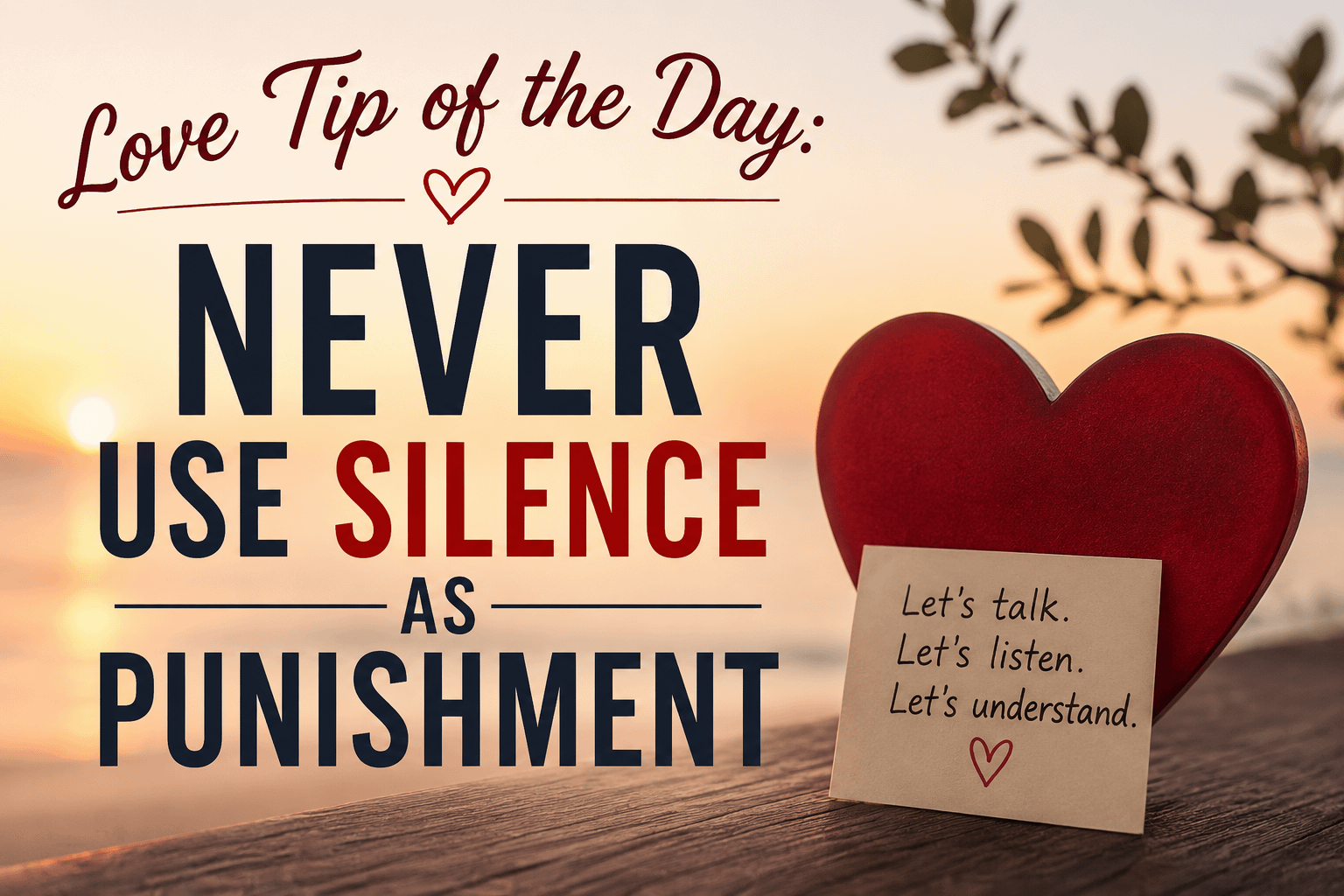
Today’s Love Tip of the Day is simple:
Never use silence as punishment.
If you love someone, communicate with them—even when the conversation is difficult.
Silence Can Say More Than Words
Silence isn’t always negative.
Sometimes silence between two people is comfortable. You can sit together without speaking and still feel completely connected. There is something beautiful about being with someone without feeling the need to fill every moment with conversation.
There are also times when silence is necessary during conflict.
You may recognize that you’re becoming angry and need a few minutes to collect your thoughts. You might need an hour to process what was said. Some people simply need more time than others before they can explain what they’re feeling.
That kind of silence can be healthy.
The problem begins when silence is intentionally used to hurt, manipulate, control, or punish another person.
Instead of saying:
“I’m upset and need some time to think.”
someone disappears emotionally.
They stop responding.
They refuse to acknowledge their partner.
They intentionally withhold affection.
They make the other person wonder what they did wrong and how long the silence will continue.
That isn’t healthy communication.
It’s emotional punishment.
Taking Space Is Different From Giving the Silent Treatment
These two behaviors can look similar from the outside, but the intention behind them is very different.
Healthy space communicates.
Punitive silence doesn’t.
Someone taking healthy space might say:
“I’m really upset right now, and I don’t want to say something I’ll regret. Can we talk about this tonight after I’ve had some time to calm down?”
That communicates several important things.
You’re upset.
You need space.
You’re not abandoning the relationship.
And you’re planning to return to the conversation.
Your partner doesn’t have to spend the next several hours wondering whether you’re leaving, whether you still love them, or whether you’ll ever speak to them again.
You created space without creating unnecessary fear.
The silent treatment works differently.
There is often no explanation.
No timeline.
No reassurance.
No communication.
The other person is left trying to figure everything out alone.
Don’t Make Someone Guess What You’re Feeling
Your partner cannot read your mind.
Even someone who knows you incredibly well will not always know exactly what you’re thinking or feeling.
If something bothers you, say it.
If something hurts you, explain it.
If you’re disappointed, talk about it.
If you need something from your partner, communicate it.
Expecting someone to figure out why you’re upset creates unnecessary frustration.
You may think:
“They should know why I’m angry.”
Maybe they should.
But maybe they genuinely don’t.
Relationships become much healthier when both people stop expecting mind-reading and start practicing honest communication.
Say what you feel.
Give the other person the opportunity to understand you.
Silence Can Create Anxiety
Imagine loving someone and suddenly having them stop communicating with you.
You ask what’s wrong.
Nothing.
You send a message.
No response.
You try again.
Still nothing.
Now your mind begins searching for answers.
“What did I do?”
“Are they leaving?”
“Did I say something wrong?”
“Do they still love me?”
“How long are they going to ignore me?”
What started as a disagreement can quickly become emotional distress.
When silence is repeatedly used as punishment, a partner may eventually begin walking on eggshells because they’re afraid of triggering another period of emotional withdrawal.
Love shouldn’t make someone constantly afraid that communication and affection will disappear whenever they make a mistake.
Healthy love creates emotional safety.
Talk About the Problem, Not Around It
Avoiding difficult conversations rarely makes problems disappear.
Usually, they wait.
Sometimes they grow.
Small misunderstandings become resentment.
Unspoken frustrations become bitterness.
Assumptions replace facts.
Eventually, something that could have been resolved through a twenty-minute conversation becomes a much larger relationship problem.
Communication doesn’t guarantee that every disagreement will be easy.
But it gives both people a chance to understand each other.
Sometimes your partner doesn’t need you to agree with everything they’re saying.
They simply need to know that you’re willing to listen.
Learn to Say, “I Need Some Time”
There is nothing wrong with needing space.
In fact, knowing when to temporarily step away from an argument can demonstrate emotional maturity.
The key is communicating what you’re doing.
Instead of disappearing emotionally, say:
“I love you, but I’m overwhelmed right now. I need a little time before we continue this conversation.”
Or:
“I’m frustrated, and I don’t think I’m communicating well right now. Give me an hour and let’s talk again.”
Or:
“I want to work this out. I just need some time to process what happened.”
Those statements create boundaries without creating abandonment.
Your partner knows where you stand.
You’re not refusing to communicate.
You’re preparing yourself to communicate better.
Don’t Withhold Love to Gain Control
Love should never become a bargaining chip.
Affection shouldn’t be something you give only when your partner behaves exactly how you want.
Healthy relationships still contain love during disagreements.
You can be angry and still care.
You can be disappointed and still be respectful.
You can disagree and still reassure someone that the relationship matters.
Sometimes one of the most powerful things you can say during an argument is:
“I’m upset with you right now, but I still love you. We will figure this out.”
Those words can completely change the emotional atmosphere.
The problem becomes something the two of you are facing together instead of something threatening the entire relationship.
Listen Without Preparing Your Defense
Communication isn’t only about talking.
It’s also about listening.
Sometimes couples technically communicate, but neither person is actually hearing the other.
While one person speaks, the other is already preparing their response.
They aren’t listening to understand.
They’re listening to defend themselves.
Try slowing down.
Listen to what your partner is actually saying.
Ask yourself:
What are they feeling?
Why might they feel that way?
Is there something I’m missing?
Could I have handled something differently?
Understanding someone’s feelings doesn’t automatically mean admitting that everything they believe is correct.
It simply means their emotions matter enough for you to hear them.
Don’t Let Pride Become More Important Than Love
Pride has ended conversations that could have saved relationships.
Sometimes people know they should speak first, apologize, send the message, or reach across the emotional distance between them.
But pride says:
“They can come to me.”
So both people wait.
Hours become days.
Days sometimes become weeks.
Resentment grows.
The relationship becomes colder.
All because neither person wanted to be the first to soften.
There are moments when being the first person to communicate isn’t weakness.
It’s strength.
If the relationship matters, sometimes you have to decide that connection matters more than winning.
Learn How Your Partner Handles Conflict
People process conflict differently.
Some people want to talk immediately.
Others need time.
One person may want reassurance during disagreements while another becomes quiet because they’re overwhelmed.
Neither approach automatically makes someone wrong.
The goal is understanding each other’s needs.
Talk about conflict when you’re not currently fighting.
Ask each other what helps.
Maybe your partner needs twenty minutes alone before continuing a difficult conversation.
Maybe you need reassurance that the relationship is okay while taking that break.
You can compromise.
For example:
“Let’s take thirty minutes to cool down, but we’ll come back and talk afterward.”
Now both people know what to expect.
Apologize When Your Silence Has Hurt Someone
If you’ve used silence as punishment before, you can change.
You don’t have to defend the behavior simply because it’s how you’ve always handled conflict.
Maybe silence was how disagreements were handled in your childhood.
Maybe you learned to shut down because speaking up never felt safe.
Maybe you simply never learned healthier conflict skills.
Understanding where a behavior comes from can help you change it.
You can say:
“I realize that when I’m upset, I shut you out. I understand that hurts you. I’m going to work on telling you when I need space instead of disappearing emotionally.”
Change doesn’t require perfection.
It requires awareness and effort.
Make Communication Safe
People are more likely to communicate honestly when they believe they can do so without being mocked, attacked, dismissed, or humiliated.
If you want your partner to open up, make it safe for them to do so.
Don’t use their vulnerabilities against them later.
Don’t laugh at their fears.
Don’t dismiss their emotions.
Don’t interrupt every time they say something uncomfortable.
Listen.
You don’t have to agree with every feeling to respect the person experiencing it.
When both people feel emotionally safe, difficult conversations become much easier.
Love Isn’t About Winning Arguments
Arguments sometimes become competitions.
Who is right?
Who started it?
Who apologized first?
Who has the better argument?
But relationships aren’t courtrooms.
You don’t receive a trophy for proving your partner wrong.
Sometimes you can win the argument and damage the relationship at the same time.
A healthier question is:
“How can we solve this together?”
That changes everything.
Instead of you versus your partner, it becomes both of you versus the problem.
Words Can Rebuild Connection
Never underestimate the power of a few sincere words.
“I’m sorry.”
“I understand.”
“Tell me what you’re feeling.”
“I didn’t realize that hurt you.”
“I need some time, but I promise we’ll talk.”
“I love you even though we’re upset.”
“Let’s figure this out.”
These aren’t complicated sentences.
But they can prevent hours or days of unnecessary emotional distance.
Communication doesn’t always need to be perfect.
It just needs to be honest.
Choose Connection Over Control
Using silence as punishment may temporarily make someone chase you, apologize repeatedly, or become desperate for your attention.
But fear isn’t connection.
Control isn’t intimacy.
A healthy relationship isn’t built on one person having emotional power over the other.
It’s built on mutual respect.
Both people should be able to express themselves.
Both people should feel heard.
Both people should know that disagreements won’t automatically result in emotional abandonment.
That’s the kind of security that allows love to deepen.
Healthy Love Comes Back to the Conversation
There will be arguments.
There will be misunderstandings.
There will be moments when you need space.
There will probably even be times when you say something badly and wish you could take it back.
Healthy relationships aren’t relationships without conflict.
They’re relationships where both people remain committed to repairing the connection after conflict.
Sometimes that means apologizing.
Sometimes it means listening.
Sometimes it means taking responsibility.
Sometimes it means forgiving.
And sometimes it means simply returning to the conversation after you’ve both had time to calm down.
The important part is returning.
Final Thoughts
Silence can be peaceful, comforting, and even healing.
But when silence is deliberately used to punish someone you love, it can create emotional distance where communication should exist.
You don’t have to solve every disagreement immediately.
You don’t have to talk while you’re angry.
You don’t have to pretend everything is fine when it isn’t.
You can take space.
You can set boundaries.
You can process your emotions.
Just communicate what you’re doing.
Say:
“I need some time, but I want to work this out.”
Those few words can make a tremendous difference.
Love isn’t about never becoming angry with each other.
It’s about learning how to remain respectful even when you’re angry.
It’s knowing when to step away and when to return.
It’s listening when talking feels uncomfortable.
It’s choosing understanding instead of punishment.
And it’s remembering that the person standing across from you isn’t your enemy.
They’re someone you love.
Love Tip of the Day: Never use silence as punishment. If you need space, communicate that need. Then, when you’re ready, come back to the conversation with the goal of understanding each other—not defeating each other.
When you’re hurt or angry with someone you love, do you find it easier to talk things through right away, or do you need some time alone before you’re ready to communicate?
Leave a ReplyCancel reply