Every day on the calendar carries pieces of the human story. Some dates are remembered for wars and political turning points. Others mark scientific breakthroughs, cultural achievements, exploration, social movements, or extraordinary human accomplishments.
August 8 brings together all of these themes.
Across the centuries, this date has witnessed dramatic battles, groundbreaking exploration, technological innovation, struggles for independence, political upheaval, international sporting celebrations, and the births of people who left lasting marks on science, entertainment, politics, and sports.
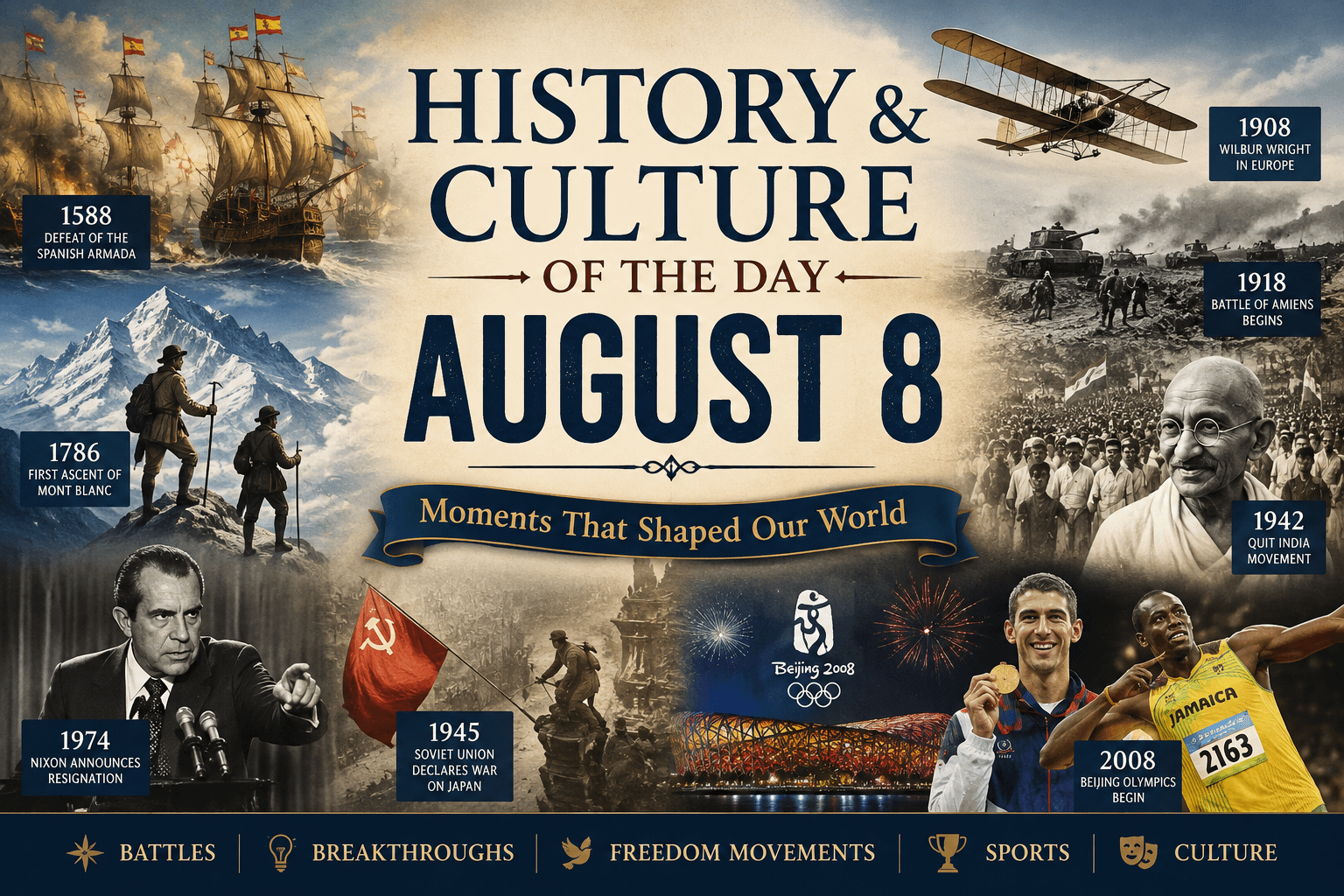
From the defeat of the Spanish Armada in the 16th century to the first successful ascent of Mont Blanc, from the final months of World War I to India’s independence movement, and from the Watergate era to the spectacular opening of the Beijing Olympics, August 8 offers a fascinating journey through world history and culture.
Here is a deeper look at the people, events, achievements, and cultural moments connected to August 8.
1588 – The Spanish Armada and the Battle of Gravelines
One of the most famous naval campaigns in European history unfolded during the summer of 1588.
King Philip II of Spain assembled a massive fleet known as the Spanish Armada as part of an effort against England under Queen Elizabeth I.
Religious, political, and economic tensions had been growing between Protestant England and Catholic Spain. English support for Dutch rebels fighting Spanish rule and English attacks against Spanish shipping added to the conflict.
The Armada sailed toward the English Channel with plans connected to transporting an invasion force from the Netherlands to England.
English ships repeatedly challenged the Spanish fleet.
During the night of August 7–8, English forces sent fireships toward the anchored Spanish vessels near Calais. The Spanish fleet scattered to avoid them.
The disruption contributed to the circumstances surrounding the Battle of Gravelines, fought on August 8 according to the modern Gregorian calendar.
English ships attacked the Spanish fleet, taking advantage of their maneuverability and naval tactics.
The Armada survived the engagement but could no longer effectively continue its original mission.
With its route south blocked, the Spanish fleet attempted to return home by sailing north around Scotland and Ireland.
Storms, difficult navigation, shortages, disease, and shipwrecks inflicted additional losses.
The Armada’s failure became one of the defining events of Elizabethan England.
Although Spain remained a major European power afterward, the campaign became deeply embedded in English national history and contributed to the growing mythology surrounding Elizabeth I’s reign.
1786 – Humans Reach the Summit of Mont Blanc
On August 8, 1786, two men accomplished something that helped change the way people viewed mountains.
Jacques Balmat and physician Michel-Gabriel Paccard successfully reached the summit of Mont Blanc.
Rising approximately 15,770 feet above sea level, Mont Blanc is the highest mountain in the Alps.
At the time, high mountains were not generally viewed as recreational destinations.
They were dangerous, mysterious, difficult environments that relatively few people had any reason to explore.
But scientific curiosity and adventure were beginning to change attitudes.
Naturalist Horace-Bénédict de Saussure had encouraged attempts to reach the summit and offered a reward for discovering a route.
Balmat and Paccard ultimately succeeded.
Their journey required extraordinary endurance and determination at a time when climbers did not have modern mountaineering equipment, weather forecasts, insulated clothing, GPS devices, or established routes.
Their ascent is frequently regarded as a foundational moment in the history of modern mountaineering.
Today, millions of people around the world participate in hiking, climbing, backpacking, and mountaineering.
The adventure culture surrounding mountains can trace part of its history back to pioneers willing to explore places that once seemed unreachable.
1876 – Thomas Edison and the Changing World of Printing
The late 19th century was an age of rapid technological development.
Industrialization was transforming transportation, communication, manufacturing, business, and everyday life.
Among the era’s most famous inventors was Thomas Edison.
On August 8, 1876, Edison received a patent related to his autographic printing system.
The technology contributed to developments associated with stencil duplication and what would eventually become widely known through mimeograph-style reproduction.
That may seem relatively ordinary from today’s perspective.
We live in a world where a document can be duplicated thousands of times, emailed across the planet, uploaded to the internet, or shared through social media almost instantly.
But efficient document reproduction once represented a major technological improvement.
Businesses could distribute information more easily.
Schools could reproduce educational materials.
Churches and community organizations could distribute newsletters.
Political organizations could spread messages.
Offices could create multiple copies of documents without manually rewriting every page.
Technologies like these were early steps toward the information-sharing world we now take for granted.
1908 – Wilbur Wright Shows Europe the Future of Flight
Five years after the Wright brothers’ historic 1903 flight at Kitty Hawk, powered aviation was still new and unfamiliar to much of the world.
Many people remained skeptical about what airplanes could actually accomplish.
That began changing rapidly.
On August 8, 1908, Wilbur Wright made an important public flight demonstration near Le Mans, France.
European aviation enthusiasts and observers watched closely.
What impressed them was not simply that Wright’s aircraft could leave the ground.
It could be controlled.
Wilbur demonstrated turns and maneuverability that showed aviation was developing beyond short experimental flights.
The demonstrations strengthened the Wright brothers’ international reputation.
Within a remarkably short period, airplanes would change civilization.
Aircraft would become tools of war.
They would carry mail.
They would transport passengers.
They would connect continents.
They would assist exploration and emergency response.
Eventually, aviation would make it possible for ordinary travelers to cross oceans in hours rather than spending weeks aboard ships.
The early flights of aviation pioneers such as Wilbur and Orville Wright helped open the door to that future.
1918 – The Battle of Amiens Begins
August 8 became one of the most important dates during the final year of World War I.
By 1918, Europe had endured nearly four years of devastating warfare.
Millions had been killed or wounded.
The Western Front had become associated with trenches, artillery bombardments, machine guns, barbed wire, mud, and enormous casualties.
But the military situation began changing dramatically during the summer of 1918.
On August 8, Allied forces launched the Battle of Amiens in France.
British, Australian, Canadian, French, and other Allied forces participated in the offensive.
The attack combined infantry, artillery, tanks, and aircraft in a coordinated operation.
Surprise played an important role.
Instead of relying on an extended preliminary bombardment that might warn the enemy, Allied planners attempted to conceal their intentions.
The offensive achieved significant gains.
Thousands of German soldiers were captured, and Allied forces advanced several miles in places.
German military commander Erich Ludendorff famously referred to August 8 as the “black day of the German Army.”
The phrase reflected more than battlefield losses.
German morale was deteriorating.
After years of warfare, shortages, casualties, and exhaustion, the ability of Germany to continue fighting was weakening.
The Battle of Amiens helped launch what became known as the Hundred Days Offensive.
Over the following months, Allied armies continued pushing German forces backward.
On November 11, 1918, an armistice ended the fighting on the Western Front.
August 8 therefore represents an important turning point during the final chapter of one of history’s deadliest conflicts.
1942 – Gandhi and the Quit India Movement
August 8 also holds enormous importance in the history of India’s struggle for independence.
For generations, India had been governed under British colonial rule.
By the early 20th century, demands for independence had become increasingly powerful.
One of the most influential leaders of the movement was Mahatma Gandhi, who promoted nonviolent resistance as a method of political struggle.
On August 8, 1942, the All India Congress Committee adopted the Quit India Resolution in Bombay, now Mumbai.
The resolution demanded an end to British rule.
During this period, Gandhi delivered his famous call to “Do or Die.”
The message represented determination to continue the independence struggle despite repression.
British authorities responded quickly.
Gandhi and other major leaders were arrested.
However, their arrests did not eliminate the movement.
Demonstrations, strikes, resistance, and political unrest spread.
The Quit India Movement did not immediately bring independence, but it became one of the major episodes in the final years of British colonial rule.
Five years later, in 1947, India achieved independence.
Today, the events surrounding August 8, 1942 remain an important part of the history of India’s independence movement.
1945 – The Soviet Union Declares War on Japan
August 8, 1945 occurred during one of the most dramatic weeks in modern history.
World War II had already ended in Europe following Nazi Germany’s surrender in May.
But fighting continued in Asia and the Pacific.
On August 6, the United States dropped an atomic bomb on Hiroshima.
Then, on August 8, the Soviet Union declared war on Japan.
Shortly afterward, Soviet forces launched a massive military offensive against Japanese forces in Manchuria.
The Soviet entry into the war dramatically changed Japan’s strategic situation.
Japan was now facing enormous pressure from multiple directions.
On August 9, the United States dropped a second atomic bomb on Nagasaki.
Days later, Emperor Hirohito announced Japan’s acceptance of Allied surrender terms.
World War II was coming to an end.
Historians continue to examine and debate the relative influence of the atomic bombings, Soviet entry into the war, Japan’s military position, diplomatic calculations, and other factors in the decision to surrender.
What is certain is that August 1945 transformed world history.
The war ended, but a new geopolitical era was beginning.
The United States and Soviet Union would emerge as competing superpowers, setting the stage for decades of Cold War rivalry.
1963 – Britain’s Great Train Robbery
Not every historical event involves governments, wars, or revolutions.
Some become famous because they capture the public imagination.
During the early hours of August 8, 1963, a Royal Mail train traveling from Glasgow toward London was stopped in Buckinghamshire.
A gang carried out what became known as the Great Train Robbery.
The criminals escaped with approximately £2.6 million, an extraordinary sum at the time.
The robbery immediately became a national sensation.
The scale of the theft, planning involved, police investigation, arrests, trials, escapes, and later lives of those involved fascinated the British public.
The crime eventually became more than a police case.
It entered popular culture.
Books were written about it.
Television documentaries examined it.
Movies and dramatizations revisited the story.
Decades later, the Great Train Robbery remains one of Britain’s most famous crimes.
1974 – Richard Nixon Announces His Resignation
On the evening of August 8, 1974, millions of Americans watched television as President Richard Nixon announced that he would resign from office.
The announcement followed the long-running Watergate scandal.
What began with the June 1972 break-in at the Democratic National Committee headquarters in Washington’s Watergate complex developed into a sprawling political scandal involving attempts to conceal wrongdoing and questions about presidential power.
Investigative journalists, congressional committees, prosecutors, courts, and eventually the Supreme Court all played roles in uncovering information related to the scandal.
By the summer of 1974, Nixon’s political support had collapsed.
Facing the strong possibility of impeachment and removal, he announced his resignation.
His presidency officially ended the following day.
Vice President Gerald Ford became president.
Nixon remains the only U.S. president to resign from office.
The consequences of Watergate reached far beyond Nixon’s presidency.
The scandal influenced journalism, campaign laws, government ethics rules, congressional oversight, political language, and public attitudes toward government.
Even the suffix “-gate” became widely used to describe later scandals.
Few political events have had such a lasting effect on American political vocabulary and culture.
1988 – The Cultural Fascination With 8/8/88
Sometimes a date becomes memorable because of its appearance.
August 8, 1988 could be written as:
8/8/88
The repetition made it visually distinctive.
But the number eight also has deep cultural significance, particularly in Chinese culture.
Eight is commonly associated with prosperity, success, and good fortune.
Because of those associations, dates containing multiple eights may be considered especially desirable for important events.
Couples may seek wedding dates containing the number.
Businesses may prefer phone numbers, addresses, or opening dates featuring eights.
The symbolic importance of the number would become particularly visible twenty years later.
2008 – The Beijing Olympics Begin on 8/8/08
On August 8, 2008, the world’s attention turned toward Beijing, China.
The opening ceremony of the 2008 Summer Olympic Games began at approximately 8:08 p.m. local time on 8/8/08.
The timing reflected the positive cultural associations surrounding the number eight.
The ceremony was an enormous production involving thousands of performers.
Directed by acclaimed filmmaker Zhang Yimou, it incorporated elements of Chinese history, philosophy, music, art, calligraphy, technology, and performance.
Mass choreography created spectacular visual displays.
Fireworks illuminated Beijing.
Historical themes were blended with modern technology.
For many international viewers, the ceremony became one of the defining cultural spectacles of the decade.
The Beijing Olympics were also significant beyond sports.
They represented China’s growing international presence and offered the country an enormous global stage.
Michael Phelps Makes Olympic History
One of the biggest stories to emerge from the Beijing Games involved American swimmer Michael Phelps.
Phelps arrived with an extraordinarily ambitious goal.
He attempted to win eight gold medals.
And he succeeded.
Phelps captured eight gold medals, surpassing Mark Spitz’s previous record of seven gold medals at a single Olympic Games.
Some victories were dominant.
Others came down to incredibly small margins.
His performance became one of the most celebrated achievements in Olympic history.
The number eight therefore became even more closely connected with the 2008 Games.
The Olympics opened on 8/8/08—and one of their greatest stars left Beijing with eight gold medals.
Usain Bolt Electrifies the World
Another athlete who became an international superstar during the Beijing Olympics was Jamaican sprinter Usain Bolt.
Bolt’s combination of speed, confidence, personality, and apparent ease captivated audiences.
He won the men’s 100-meter and 200-meter titles in world-record performances.
His achievements helped usher in a new era of global interest in sprinting.
Bolt eventually became one of the most recognizable athletes on the planet.
The Beijing Games therefore became more than a collection of competitions.
They produced sporting moments and personalities that became part of global popular culture.
Famous People Born on August 8
August 8 is also the birthday of influential figures from politics, science, entertainment, music, and sports.
Emiliano Zapata – Born August 8, 1879
Emiliano Zapata became one of the most famous leaders of the Mexican Revolution.
He championed agrarian reform and became strongly associated with the struggles of rural farmers.
His name and image remain powerful symbols in Mexican history and political culture.
More than a century later, Zapata continues to appear in murals, books, political movements, artwork, and popular culture.
Paul Dirac – Born August 8, 1902
British theoretical physicist Paul Dirac became one of the most important scientists involved in the development of quantum mechanics.
His mathematical work contributed significantly to humanity’s understanding of particles and atomic physics.
Dirac shared the 1933 Nobel Prize in Physics with Erwin Schrödinger.
His work helped lay foundations that remain important in modern physics.
Dustin Hoffman – Born August 8, 1937
Actor Dustin Hoffman became one of the most celebrated performers in American cinema.
His breakthrough role in The Graduate helped establish him as a major star.
He later appeared in acclaimed films including Midnight Cowboy, Kramer vs. Kramer, Tootsie, and Rain Man.
Hoffman’s career reflected changes occurring in Hollywood during the late 1960s and 1970s, when unconventional leading actors and more complicated characters became increasingly prominent.
The Edge – Born August 8, 1961
Guitarist David Howell Evans, better known as The Edge, was born on August 8, 1961.
As a founding member of U2, he helped create one of the most distinctive guitar sounds in modern rock.
His atmospheric use of delay and effects became an important part of U2’s musical identity.
The band’s albums, tours, activism, and cultural influence helped make U2 one of the most internationally recognized rock groups of its generation.
Roger Federer – Born August 8, 1981
Swiss tennis champion Roger Federer was born on August 8, 1981.
Federer’s graceful playing style, longevity, sportsmanship, and extraordinary success made him one of tennis’s most celebrated figures.
His rivalries with Rafael Nadal and Novak Djokovic helped define an extraordinary era in men’s tennis.
Together, they pushed one another to increasingly remarkable levels of achievement and attracted millions of new fans to the sport.
The Number Eight Across Cultures
The date August 8 also offers an opportunity to explore how numbers can develop cultural meanings.
Numbers are mathematical symbols, but human societies frequently give them additional significance.
The number eight is particularly important in Chinese culture.
Its pronunciation is associated with words and sounds connected to prosperity and wealth, contributing to its reputation as an auspicious number.
This can influence real-world decisions.
People may pay premiums for phone numbers containing multiple eights.
Businesses may choose dates containing eights for openings.
Couples may seek wedding dates involving the number.
Addresses, license plates, and other number combinations can sometimes become desirable because of their symbolic value.
The Beijing Olympics’ use of 8/8/08 at 8:08 p.m. demonstrated how ancient cultural symbolism could become part of a modern global event watched by billions of people.
August 8 Shows How Quickly the World Can Change
One fascinating aspect of studying a date across different centuries is seeing how dramatically civilization changes.
Imagine comparing August 8, 1588 with August 8, 2008.
In 1588, wooden sailing ships fought with cannons in the English Channel.
In 1786, reaching the summit of Mont Blanc was an extraordinary expedition into a largely unexplored environment.
In 1908, spectators were amazed simply to see a controlled airplane flight.
In 1918, armies fought across devastated European battlefields.
In 1942, independence movements challenged colonial empires.
In 1945, the world entered the atomic age.
In 1974, television carried a president’s resignation directly into American homes.
By 2008, billions of people around the planet could watch an Olympic ceremony unfold nearly instantaneously.
And today, people can hold a device in their hands capable of accessing more information than entire libraries once contained.
History is not only about what happened.
It is also about how dramatically human life changes between generations.
History Is Made by Ordinary People Too
Historical timelines naturally focus on presidents, kings, generals, inventors, athletes, explorers, and celebrities.
But most history was created by people whose names never appeared in textbooks.
Soldiers standing on the battlefield at Amiens had families waiting for them.
Workers helped construct early airplanes.
Ordinary Indians participated in demonstrations for independence.
Sailors struggled to survive dangerous voyages.
Engineers, laborers, artists, teachers, farmers, parents, children, immigrants, shopkeepers, nurses, and countless others lived through these moments.
Their experiences formed the fabric of history.
Every famous historical event contains millions of smaller human stories.
That is one reason history remains so meaningful.
It is ultimately the story of people.
What August 8 Can Teach Us
Looking across the events associated with August 8 reveals several recurring themes.
Courage can change what people believe is possible.
Balmat and Paccard climbed a mountain that many considered unreachable.
The Wright brothers challenged assumptions about human flight.
Political movements can reshape nations.
India’s independence movement demonstrated how determined people could challenge one of the world’s largest empires.
Wars can change direction quickly.
The Battle of Amiens showed how the military situation in World War I could shift dramatically after years of stalemate.
Technology changes culture.
From printing systems to airplanes to global television broadcasts, inventions alter how people communicate, travel, work, and experience the world.
Sports can become cultural history.
The Olympic achievements of Michael Phelps and Usain Bolt were more than athletic victories. They became shared global experiences remembered by millions.
And perhaps most importantly:
People living through history rarely know exactly how important their moment will become.
Imagine Witnessing August 8 Through the Centuries
Imagine standing near the English Channel in 1588 and watching ships disappear into smoke and cannon fire.
Imagine climbing through snow and ice toward the summit of Mont Blanc in 1786 without modern climbing equipment.
Imagine standing in France in 1908 and watching an airplane maneuver through the sky when powered flight was still almost unbelievable.
Imagine hearing the artillery at Amiens in 1918.
Imagine standing among crowds demanding independence in India in 1942.
Imagine sitting beside a radio in 1945 as news arrived that the Soviet Union had entered the war against Japan.
Imagine watching Richard Nixon announce his resignation on television in 1974.
Then imagine sitting in front of a high-definition television in 2008 as thousands of performers filled Beijing’s Olympic stadium.
Each generation experiences events that seem ordinary, frightening, exciting, confusing, or astonishing at the time.
Only later do we recognize which moments became history.
Why Learning History Still Matters
History does more than tell us what happened.
It helps explain why the world looks the way it does today.
Modern borders, political systems, technologies, cultural traditions, languages, social movements, conflicts, alliances, and institutions all have histories behind them.
Understanding those histories gives us context.
It also reminds us that societies are constantly changing.
Ideas once considered impossible can become normal.
Technologies once considered miraculous can become everyday objects.
Powerful governments can rise and fall.
Cultural attitudes can shift.
Records can be broken.
New movements can emerge.
History teaches us that the world we know today is not permanent.
Future generations will look back on our own era exactly as we look back on 1588, 1786, 1918, 1945, or 2008.
August 8: One Date, Centuries of Stories
From naval battles and mountaintop triumphs to independence movements, presidential resignations, technological breakthroughs, and Olympic glory, August 8 has witnessed an extraordinary range of human experiences.
The Spanish Armada struggled against England.
Jacques Balmat and Michel-Gabriel Paccard stood atop Mont Blanc.
Wilbur Wright demonstrated the possibilities of aviation.
Allied soldiers launched the Battle of Amiens.
Mahatma Gandhi’s independence movement entered a critical phase.
World War II moved closer to its conclusion.
Britain experienced one of its most famous robberies.
Richard Nixon announced his resignation.
And Beijing welcomed the world to an unforgettable Olympic Games.
Separated by centuries, these events share the same place on the calendar.
That is one of the fascinating things about history.
Every date contains layers of stories.
Some involve triumph.
Some involve tragedy.
Some represent courage.
Some represent conflict.
Some change nations.
Others change culture.
And together, they remind us that the story of humanity is still being written.
Final Thought
August 8 reminds us that history is not simply something buried in the past.
Every invention began as someone’s idea.
Every movement began with people who believed change was possible.
Every record began with someone willing to test their limits.
Every historical moment was once simply today.
The people who experienced the events of August 8 did not know how future generations would remember them.
And the same is true for us.
The decisions, discoveries, struggles, achievements, and stories happening around the world today are creating the history that someone else may read about generations from now.
History happened yesterday. Culture surrounds us today. And together, they help shape tomorrow.


Leave a Reply