Every date on the calendar carries stories from the past, and October 17 is no exception.
Across centuries, this date has witnessed political turning points, acts of resistance, scientific achievements, cultural milestones, and moments that changed how people understood the world around them.
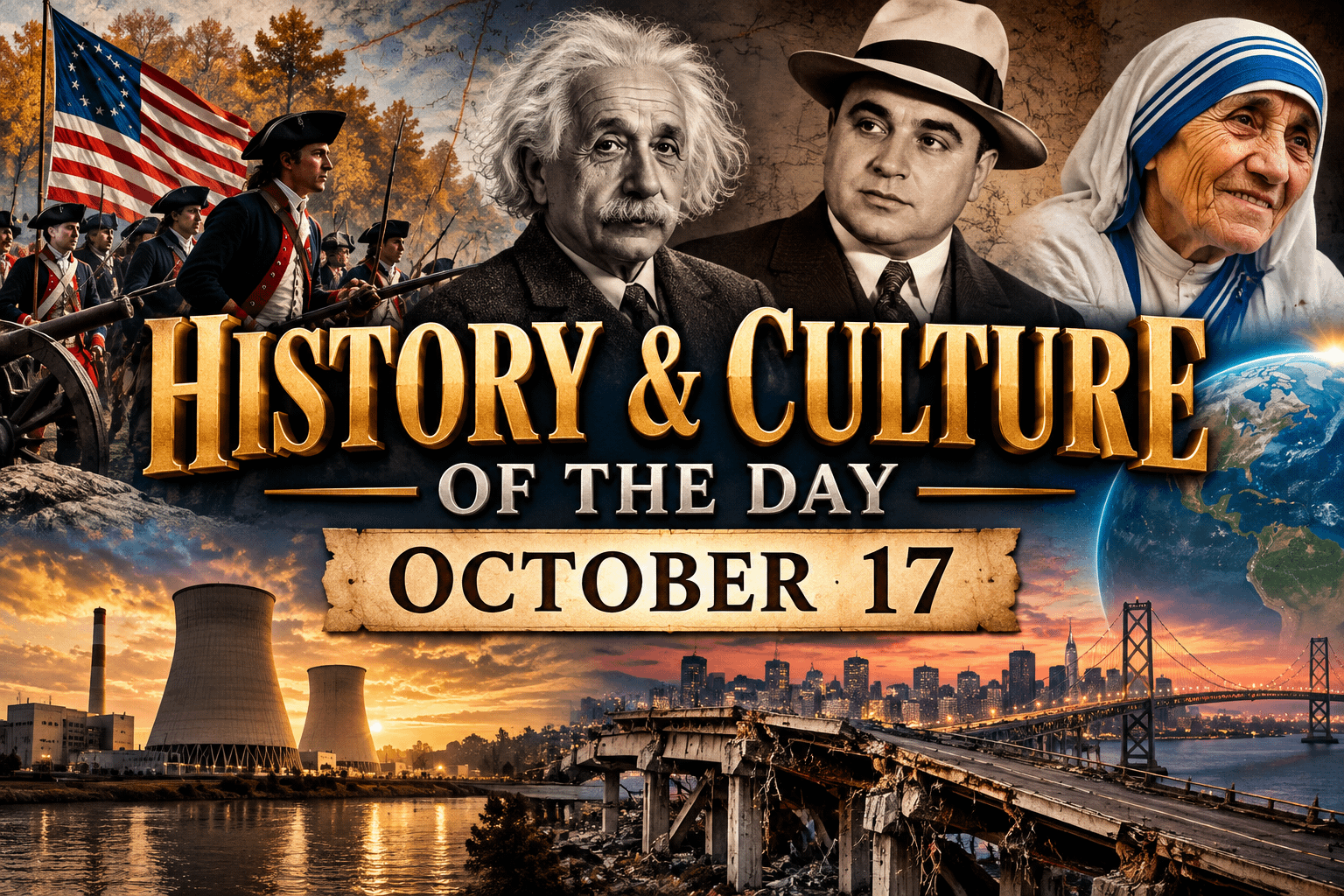
From the surrender of British forces at Saratoga during the American Revolution to Albert Einstein arriving in the United States, October 17 connects events separated by generations but united by their lasting influence.
It is also a day recognized internationally for the fight against poverty, reminding us that history is not only about what happened hundreds of years ago. History continues to be written through the choices societies make today.
Here is a closer look at some of the history, people, and culture connected with October 17.
1777 — British General Burgoyne Surrenders at Saratoga
One of the most important moments of the American Revolutionary War occurred on October 17, 1777.
British General John Burgoyne surrendered his army to American General Horatio Gates at Saratoga, New York, following a military campaign that had gone badly for British forces.
The surrender followed the Battles of Saratoga and represented a major American victory.
Before Saratoga, the American Revolution remained an uncertain struggle. The colonies had declared independence in 1776, but defeating one of the world’s major military powers was another matter entirely.
The American victory at Saratoga helped change international perceptions of the conflict.
Most importantly, the victory contributed to France’s decision to formally ally itself with the United States in 1778. French military forces, naval power, supplies, and financial assistance would eventually become extremely important to the American cause.
Because of those consequences, Saratoga is often considered one of the major turning points of the Revolutionary War.
The events surrounding October 17 demonstrate something frequently seen throughout history: a single military victory can have consequences far beyond the battlefield.
Saratoga did not end the American Revolution, but it helped transform it.
1814 — The London Beer Flood
Not every historical event remembered on October 17 involves war or politics.
Some are unusual tragedies that reveal what everyday urban life could be like during the Industrial Revolution.
On October 17, 1814, a massive vat containing beer ruptured at the Meux and Company brewery in London.
The failure caused other containers to rupture, releasing an enormous quantity of beer into the surrounding neighborhood.
A powerful wave rushed through nearby streets and buildings.
Eight people were killed.
The event became known as the London Beer Flood.
Today, the name can make the incident sound almost humorous, but the reality was tragic. People living near the brewery suddenly found their homes and neighborhood overwhelmed by a powerful industrial accident.
The disaster also provides a glimpse into rapidly growing nineteenth-century cities, where industrial facilities frequently operated extremely close to residential neighborhoods.
It remains one of the strangest industrial disasters associated with London history.
1931 — Al Capone Is Convicted of Tax Evasion
October 17 also holds an important place in American crime and law-enforcement history.
On October 17, 1931, notorious Chicago gangster Al Capone was convicted of federal income-tax evasion.
Capone had become one of America’s most infamous organized-crime figures during Prohibition.
His criminal organization was associated with bootlegging, gambling, and other illegal activities. Yet prosecuting him for many of the violent crimes associated with organized crime proved difficult.
Federal authorities eventually pursued a different strategy: taxes.
Capone’s conviction demonstrated that financial investigations could become powerful tools against organized crime.
He was later sentenced to 11 years in federal prison.
The case became one of the most famous examples in American history of prosecutors using financial crimes to pursue a criminal figure when convictions for other alleged offenses were more difficult to obtain.
Capone’s downfall also became deeply connected with the mythology and popular culture surrounding America’s Prohibition era.
Decades later, movies, television programs, books, documentaries, and fictional stories continue revisiting the world of gangsters, bootleggers, federal agents, and organized crime during the 1920s and early 1930s.
1933 — Albert Einstein Arrives in the United States
Another remarkable moment occurred on October 17, 1933.
Physicist Albert Einstein arrived in the United States, where he would eventually settle permanently.
Einstein was already internationally famous for his revolutionary contributions to physics.
But Europe had become increasingly dangerous.
Adolf Hitler and the Nazi Party had taken power in Germany earlier that year. Einstein, who was Jewish and publicly opposed Nazism, did not return to live in Germany.
He eventually became associated with the Institute for Advanced Study in Princeton, New Jersey.
Einstein’s life in America represents more than the story of one famous scientist.
His journey reflects the enormous intellectual and cultural consequences of political persecution.
During the Nazi era, Jewish scientists, scholars, writers, artists, doctors, musicians, and intellectuals were forced from positions and communities across Germany and other parts of Europe.
Many fled abroad.
The countries that received these refugees often gained extraordinary intellectual and cultural talent.
Einstein became one of the most recognizable examples.
His name eventually became almost synonymous with genius, while his appearance—especially his wild hair—became instantly recognizable throughout popular culture.
1956 — The World’s First Commercial Nuclear Power Station Opens
The twentieth century brought enormous technological changes, including humanity’s attempt to harness nuclear energy for civilian electricity production.
On October 17, 1956, Queen Elizabeth II officially opened Calder Hall in England.
Calder Hall is widely recognized as the world’s first nuclear power station to deliver electricity on a commercial scale.
The development represented the enormous optimism surrounding nuclear technology during the 1950s.
Only a decade earlier, the destructive potential of nuclear technology had been demonstrated through atomic weapons.
Scientists and governments were now exploring whether nuclear reactions could also provide large quantities of electricity.
Nuclear energy would become an important—but often controversial—part of the global energy system.
Supporters have emphasized its ability to generate large amounts of electricity with relatively low operational carbon emissions.
Critics and skeptics have raised concerns involving nuclear accidents, radioactive waste, cost, security, and long-term environmental consequences.
Those debates continue today.
1979 — Mother Teresa Receives the Nobel Peace Prize
On October 17, 1979, Mother Teresa was awarded the Nobel Peace Prize.
Born Anjezë Gonxhe Bojaxhiu in 1910, she became internationally known for her religious and charitable work in India.
She founded the Missionaries of Charity, which developed programs serving poor, sick, homeless, and dying people.
The Nobel Committee honored her work among impoverished communities.
Mother Teresa became one of the twentieth century’s most recognizable religious and humanitarian figures.
Her legacy has also been debated. Supporters emphasize her devotion to serving people living in extreme poverty, while critics have questioned aspects of the medical care, conditions, finances, and philosophy associated with facilities operated by her organization.
Her global influence, however, is undeniable.
She was canonized by the Catholic Church as Saint Teresa of Calcutta in 2016.
Her story remains closely connected with broader discussions about faith, poverty, charity, suffering, and what it means to dedicate one’s life to serving others.
1989 — The Loma Prieta Earthquake Strikes California
For people in the San Francisco Bay Area, October 17 carries another powerful historical memory.
At 5:04 p.m. on October 17, 1989, the Loma Prieta earthquake struck Northern California.
The magnitude 6.9 earthquake caused widespread destruction throughout the San Francisco Bay Area and surrounding regions.
Sixty-three people died, thousands were injured, and thousands of homes and businesses were damaged.
One of the most devastating locations was the Cypress Street Viaduct in Oakland, where a section of the double-deck freeway collapsed.
The earthquake also damaged the San Francisco–Oakland Bay Bridge.
One reason the disaster became especially memorable nationally was its timing.
The San Francisco Giants and Oakland Athletics were preparing to play Game 3 of the World Series at Candlestick Park.
Because millions of people were preparing to watch the game, television crews were already broadcasting from the region.
The earthquake therefore became one of the first major American natural disasters to receive extensive live television coverage as events unfolded.
For Bay Area residents, however, the earthquake was much more than a television event.
It became a shared regional memory.
People remember where they were, what they were doing, and what happened around them when the shaking began.
The disaster also influenced earthquake preparedness, infrastructure discussions, engineering practices, and public awareness throughout California.
October 17 — International Day for the Eradication of Poverty
October 17 also carries an important international meaning.
The United Nations recognizes the date as the International Day for the Eradication of Poverty.
Its origins are connected to an October 17, 1987 gathering in Paris, when more than 100,000 people assembled at the Trocadéro to honor victims of extreme poverty, hunger, violence, and fear.
The United Nations formally designated October 17 as an international observance in 1992.
The day encourages people and governments around the world to consider poverty not simply as a matter of income but as an issue involving dignity, opportunity, housing, food, education, health care, social participation, and human rights.
It also reminds us that history is still unfolding.
Future generations will judge today’s societies partly by how they respond to poverty, inequality, displacement, hunger, and human suffering.
October 17 in Popular Culture
History is not only made through wars, governments, disasters, and scientific discoveries.
Culture matters too.
Music, movies, television, sports, literature, fashion, technology, and entertainment all become pieces of the historical record.
People born on October 17 include several recognizable cultural figures.
Rita Hayworth, born October 17, 1918, became one of Hollywood’s biggest stars during the 1940s.
Her performances helped make her an enduring symbol of Hollywood’s Golden Age.
Actor Montgomery Clift, born October 17, 1920, became known for emotionally intense performances and helped influence a more naturalistic style of American film acting.
Motorcycle daredevil Evel Knievel, born October 17, 1938, became an American pop-culture phenomenon through his highly publicized motorcycle jumps and stunts.
Rapper Eminem, born October 17, 1972, became one of the most commercially successful and influential hip-hop artists of his generation.
Their careers show how entertainment itself becomes history.
The movies people watch, music they listen to, celebrities they follow, and stories they share can become cultural markers defining entire generations.
What October 17 Can Teach Us
Looking across the history of October 17 reveals an extraordinary range of human experiences.
There is revolution.
There is scientific discovery.
There is tragedy.
There is crime and justice.
There is technological progress.
There is humanitarian work.
There is natural disaster.
And there is culture.
The surrender at Saratoga reminds us that one event can change the direction of a war.
Albert Einstein’s arrival in America reminds us how persecution and migration can reshape intellectual and cultural history.
The opening of Calder Hall demonstrates humanity’s continuing effort to transform scientific discoveries into technologies capable of changing everyday life.
Mother Teresa’s Nobel Peace Prize brings attention to questions of service, poverty, faith, and human dignity.
And for Northern California, the Loma Prieta earthquake remains a reminder that history is not always something experienced by distant generations.
Sometimes history happens beneath our own feet.
History Is More Than Dates in a Book
One of the most interesting things about studying history is realizing that the people living through these events usually did not know exactly how important the moment would eventually become.
The American soldiers at Saratoga could not know everything their victory would ultimately mean for the creation of the United States.
People watching television before the 1989 World Series could not know that within seconds they would witness one of California’s most memorable earthquakes.
Scientists working with nuclear technology in the 1950s could not completely predict the decades of energy debates that would follow.
That is the nature of history.
People live through ordinary days until something happens that makes the date unforgettable.
October 17 reminds us that history isn’t simply a collection of names and dates to memorize.
It is the story of people—their victories, mistakes, discoveries, tragedies, courage, creativity, and determination.
And while we look backward to understand October 17, it is worth remembering that today’s ordinary moments are becoming tomorrow’s history.
Which October 17 event do you think had the greatest long-term impact on the world, and why?