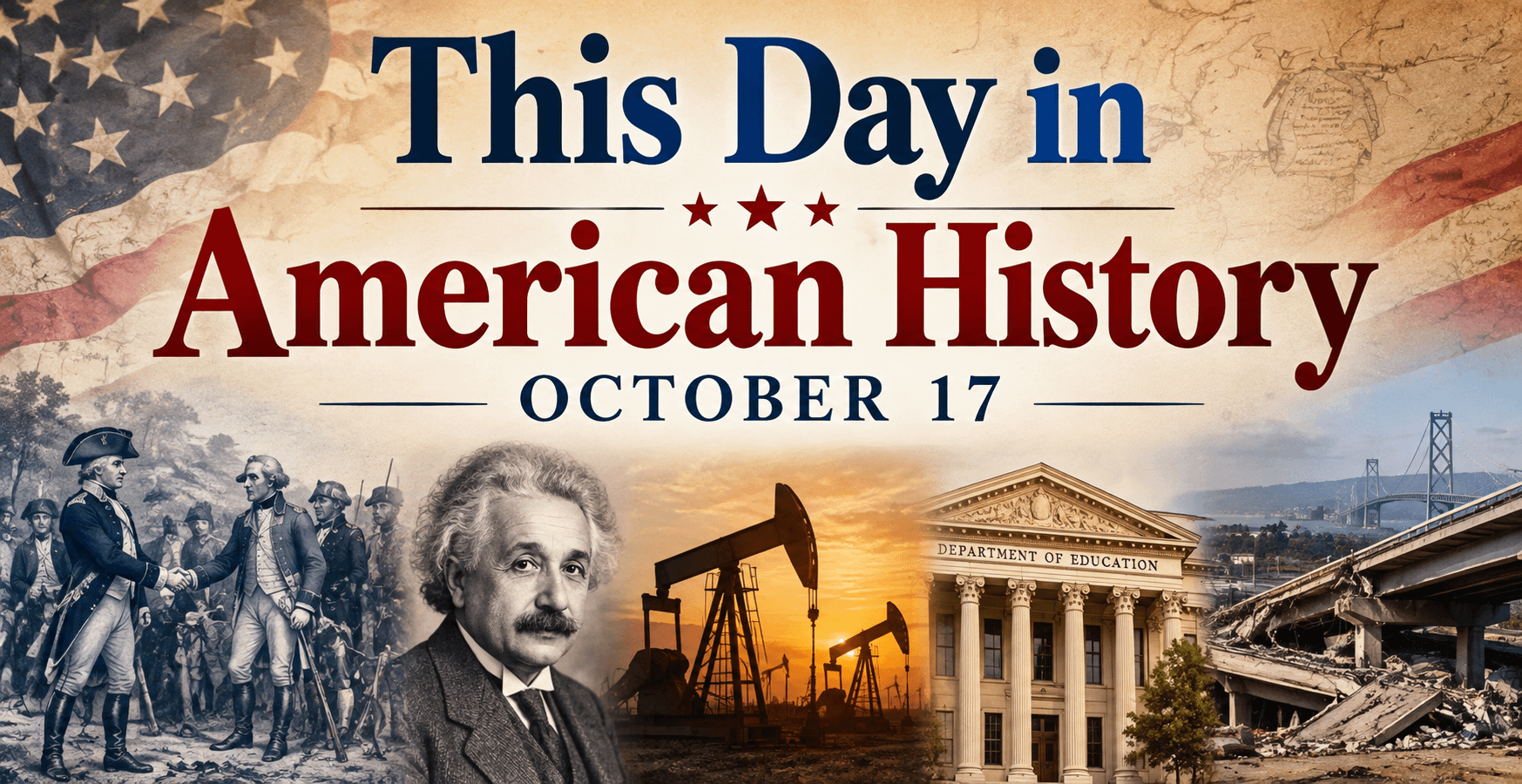
October 17 is a date that connects some remarkably different chapters of the American story. It includes a Revolutionary War victory that helped change the course of the fight for independence, the arrival of one of the world’s most famous scientists in the United States, an international oil crisis that changed how Americans thought about energy, the creation of a federal department that continues to shape education policy, and one of the most memorable earthquakes in California history.
From the surrender at Saratoga in 1777 to the devastating Loma Prieta earthquake in 1989, October 17 reminds us that American history is shaped not only by presidents and wars, but also by science, economics, natural disasters, and moments when the country’s future suddenly changed.
1777 — British General John Burgoyne Surrenders at Saratoga
One of the most important events of the American Revolution took place on October 17, 1777.
British General John Burgoyne surrendered his army to American General Horatio Gates following the Battles of Saratoga in New York. The Library of Congress records the surrender as taking place on October 17, following weeks of fighting between British and American forces.
The importance of Saratoga went far beyond the number of soldiers involved.
Britain had hoped to use its campaign through New York to separate New England from the other colonies. Burgoyne’s forces moved south from Canada, but the British campaign ultimately failed. American forces surrounded the weakened British army, leaving Burgoyne with few realistic options other than surrender.
The victory demonstrated that the American rebellion was capable of defeating a major British army.
Even more importantly, Saratoga helped convince France that the American cause had a serious chance of succeeding. The victory became a major factor in bringing active French support to the Americans.
French military and financial assistance would become crucial during the remainder of the Revolutionary War.
For that reason, Saratoga is frequently described as a turning point of the American Revolution.
It was not the end of the war—the fighting continued for several more years—but October 17, 1777, helped change the international and military circumstances surrounding America’s struggle for independence.
Saratoga Changed More Than a Battlefield
There are moments in history when a single event produces consequences far beyond the place where it happened.
Saratoga was one of those moments.
The surrender represented a significant military victory, but its diplomatic consequences may have been even more important. France’s involvement gave the Americans access to additional troops, weapons, money, supplies, and naval power.
The American Revolution was becoming more than a rebellion inside Britain’s North American colonies.
It was becoming part of a much larger international conflict.
That transformation helped create the circumstances that eventually contributed to American independence.
Today, John Trumbull’s famous painting Surrender of General Burgoyne hangs in the United States Capitol Rotunda, commemorating the event. The painting depicts Burgoyne’s surrender to Gates and represents the importance later generations placed on the American victory.
1931 — The Government’s Case Against Al Capone
October 17 is often associated with another famous chapter in American history: the federal government’s prosecution of Chicago gangster Al Capone.
Capone had become one of America’s most notorious organized-crime figures during Prohibition. Despite his reputation and criminal empire, authorities struggled for years to build cases that would put him behind bars for an extended period.
Federal investigators eventually pursued him through his finances.
Capone was tried on federal income-tax-evasion charges in 1931.
There is an interesting historical detail worth noting: October 17 is widely listed in historical calendars as the date associated with Capone’s conviction, while the FBI’s own historical account states that he was convicted after trial on October 18, 1931. The FBI records that he was later sentenced to 11 years in federal prison and fined $50,000, in addition to court costs and back taxes.
Regardless of that one-day discrepancy in historical references, the prosecution represented an important moment in the federal government’s campaign against organized crime.
The government had found a powerful strategy: criminals who were difficult to prosecute for their underlying activities could sometimes be pursued through financial records and tax violations.
Capone’s conviction helped bring down one of the most infamous figures of the Prohibition era.
1933 — Albert Einstein Arrives in America
On October 17, 1933, physicist Albert Einstein arrived in the United States as a refugee from Nazi Germany.
Einstein was already internationally famous.
His work in theoretical physics had transformed scientific understanding of space, time, gravity, energy, and the universe. But the rise of Adolf Hitler and Nazi persecution made remaining in Germany increasingly dangerous.
Einstein was Jewish and an outspoken opponent of Nazism.
He ultimately settled in Princeton, New Jersey, where he became associated with the Institute for Advanced Study.
His arrival represented something larger than the story of one scientist.
During the 1930s and 1940s, the United States became home to numerous scientists, intellectuals, artists, and scholars fleeing persecution and political upheaval in Europe.
Many would make enormous contributions to American science, medicine, education, technology, and culture.
Einstein became perhaps the most recognizable example.
1973 — The Oil Crisis Begins to Transform American Life
Another major event connected to October 17 occurred in 1973.
Against the backdrop of the Arab-Israeli war, Arab oil-producing countries announced reductions in oil production. U.S. State Department historical records show that on October 17 the 11 members of the Organization of Arab Petroleum Exporting Countries announced an immediate 5 percent production cut, followed by additional monthly reductions under specified conditions. Several producers subsequently announced or threatened a complete embargo against the United States.
The resulting energy crisis had a dramatic impact on American life.
Fuel prices rose.
Gasoline shortages developed.
Long lines appeared at gas stations.
Americans suddenly confronted the consequences of the country’s dependence on imported oil.
Energy policy became a much larger national issue.
The crisis encouraged discussions about conservation, domestic energy production, fuel efficiency, alternative energy sources, and America’s economic vulnerability to disruptions in global oil markets.
Images of automobiles waiting in long gasoline lines became some of the defining images of the 1970s.
October 17, 1973, therefore represents much more than an international economic dispute. It marks the beginning of a period that fundamentally changed the way many Americans thought about energy.
1979 — The Department of Education Is Created
Six years later, October 17 again became an important date in American public policy.
On October 17, 1979, President Jimmy Carter signed the Department of Education Organization Act into law.
Federal law records the establishment of an executive department known as the Department of Education under Public Law 96-88, dated October 17, 1979.
The legislation reorganized federal education responsibilities and established the Department of Education as a Cabinet-level department.
Carter had made the creation of the department one of his administration’s priorities.
At the signing ceremony, he discussed education as an important national investment and emphasized the federal government’s role in addressing educational challenges.
The creation of the department did not end debates about the proper federal role in education. Those debates have continued across different presidential administrations and Congresses.
But October 17, 1979, remains an important date in the history of American education policy because it marks the legal creation of the modern U.S. Department of Education.
1989 — The Loma Prieta Earthquake Strikes Northern California
For millions of Californians, October 17 is remembered for something entirely different.
At 5:04 p.m. Pacific Daylight Time on October 17, 1989, a magnitude 6.9 earthquake struck Northern California.
The epicenter was near Loma Prieta Peak in the Santa Cruz Mountains, roughly nine miles northeast of Santa Cruz and about 60 miles southeast of San Francisco.
The earthquake violently shook the San Francisco and Monterey Bay regions.
According to the U.S. Geological Survey, 63 people were killed and 3,757 were injured, while property damage was estimated at approximately $6 billion.
The destruction was widespread.
Buildings collapsed.
Roadways failed.
Homes were damaged.
Utilities were disrupted.
Sections of major transportation infrastructure suffered catastrophic damage.
One of the most tragic locations was the Cypress Street Viaduct in Oakland, where a portion of the double-deck freeway collapsed.
The disaster became one of the defining events in modern Bay Area history.
An Earthquake Seen by Millions
The timing of the Loma Prieta earthquake made the event even more unusual.
The Oakland Athletics and San Francisco Giants were preparing to play Game 3 of the 1989 World Series at Candlestick Park.
It was the famous “Bay Bridge Series.”
Because millions of people were preparing to watch the game, television crews were already positioned throughout the Bay Area.
Then the earthquake struck.
Instead of broadcasting baseball, television networks suddenly found themselves documenting a major natural disaster.
The World Series was postponed, and baseball became secondary as emergency crews responded to collapsed structures, fires, transportation failures, injuries, and deaths.
For people who lived through it, the earthquake became one of those events where many remembered exactly where they were when the shaking began.
The Lessons of Loma Prieta
The earthquake also changed how Californians thought about earthquake preparedness.
Loma Prieta was the strongest earthquake to strike the San Francisco Bay region since the devastating 1906 earthquake.
The destruction demonstrated vulnerabilities in older buildings, freeways, bridges, utilities, and transportation systems.
It also provided scientists with enormous amounts of information about earthquake behavior and ground shaking.
In the decades afterward, research conducted by the U.S. Geological Survey and other organizations improved understanding of seismic hazards throughout the Bay Area and contributed to efforts designed to reduce losses from future earthquakes.
For Bay Area residents especially, October 17 remains a reminder that earthquake preparedness is not simply theoretical.
The region sits in one of the most seismically active parts of the United States.
October 17 Across the American Story
Few dates demonstrate the variety of American history quite like October 17.
In 1777, British General John Burgoyne surrendered at Saratoga, helping transform the Revolutionary War.
In 1931, the federal prosecution of Al Capone reached the conviction stage during the government’s campaign against one of America’s most notorious gangsters.
In 1933, Albert Einstein arrived in the United States after fleeing Nazi Germany.
In 1973, decisions by Arab oil producers helped trigger an energy crisis that would affect American economics, politics, transportation, and everyday life.
In 1979, President Jimmy Carter signed legislation establishing the Department of Education.
And in 1989, the Loma Prieta earthquake shook Northern California and left a lasting mark on the San Francisco Bay Area.
These events have little in common on the surface.
One happened on a Revolutionary War battlefield.
Another involved organized crime.
Another involved a refugee scientist.
Another involved global energy markets.
Another concerned education policy.
And another happened deep beneath the mountains of Northern California.
Yet together they demonstrate what makes studying history so fascinating.
Why This Day in History Matters
History is more than remembering dates.
Dates give us markers, but the real value comes from understanding what happened before those moments and what changed afterward.
The surrender at Saratoga mattered because it influenced the international balance of the Revolutionary War.
Einstein’s arrival reminds us how political persecution and migration can reshape science and culture.
The 1973 oil crisis demonstrated how events thousands of miles away could quickly affect the price of gasoline and everyday life in American communities.
The creation of the Department of Education represented a significant change in the organization of the federal government.
And the Loma Prieta earthquake demonstrated both the destructive power of nature and the importance of preparing communities and infrastructure for disasters.
Each event left consequences that continued long after October 17 ended.
That is one of the most important lessons history teaches us.
Sometimes a single day becomes a dividing line between what came before and what comes next.
Remembering October 17
When we look back at October 17 in American history, two events especially stand out.
The first occurred in 1777, when the surrender at Saratoga helped give the American Revolution new momentum and international support.
The second occurred 212 years later, when the Loma Prieta earthquake shook Northern California and forever changed the lives of thousands of people across the Bay Area.
One helped shape the birth of the United States.
The other reminded Americans that even in a modern nation filled with highways, bridges, skyscrapers, technology, and communications systems, nature can change everything in seconds.
Between those two events are stories of science, immigration, crime, economics, education, and government.
That is the story of October 17.
Which October 17 event do you think had the greatest long-term impact on American history—and which one do you remember learning about or experiencing personally?