Category: History & Culture

  • History & Culture of the Day – August 25

    History & Culture of the Day – August 25

    Every date on the calendar carries stories from the past, but August 25 offers an especially interesting journey through history and culture. Across centuries, this date has been connected with ancient civilizations, religious developments, struggles for independence, scientific discoveries, conservation, war, liberation, space exploration, and cultural change.

    Some events associated with August 25 changed nations. Others changed how humanity understood the natural world. Still others remind us how information, beliefs, traditions, and technology influence society.

    From the ancient Roman world to the distant planet Neptune, August 25 provides a remarkable opportunity to explore how dramatically civilization has changed—and how certain human qualities have remained remarkably consistent.

    People have always been curious.

    People have always searched for freedom.

    People have always tried to understand the unknown.

    People have always preserved stories so future generations could remember what came before them.

    Here is a deeper look at the history and culture surrounding August 25.


    The Ancient World and the Story of Pompeii

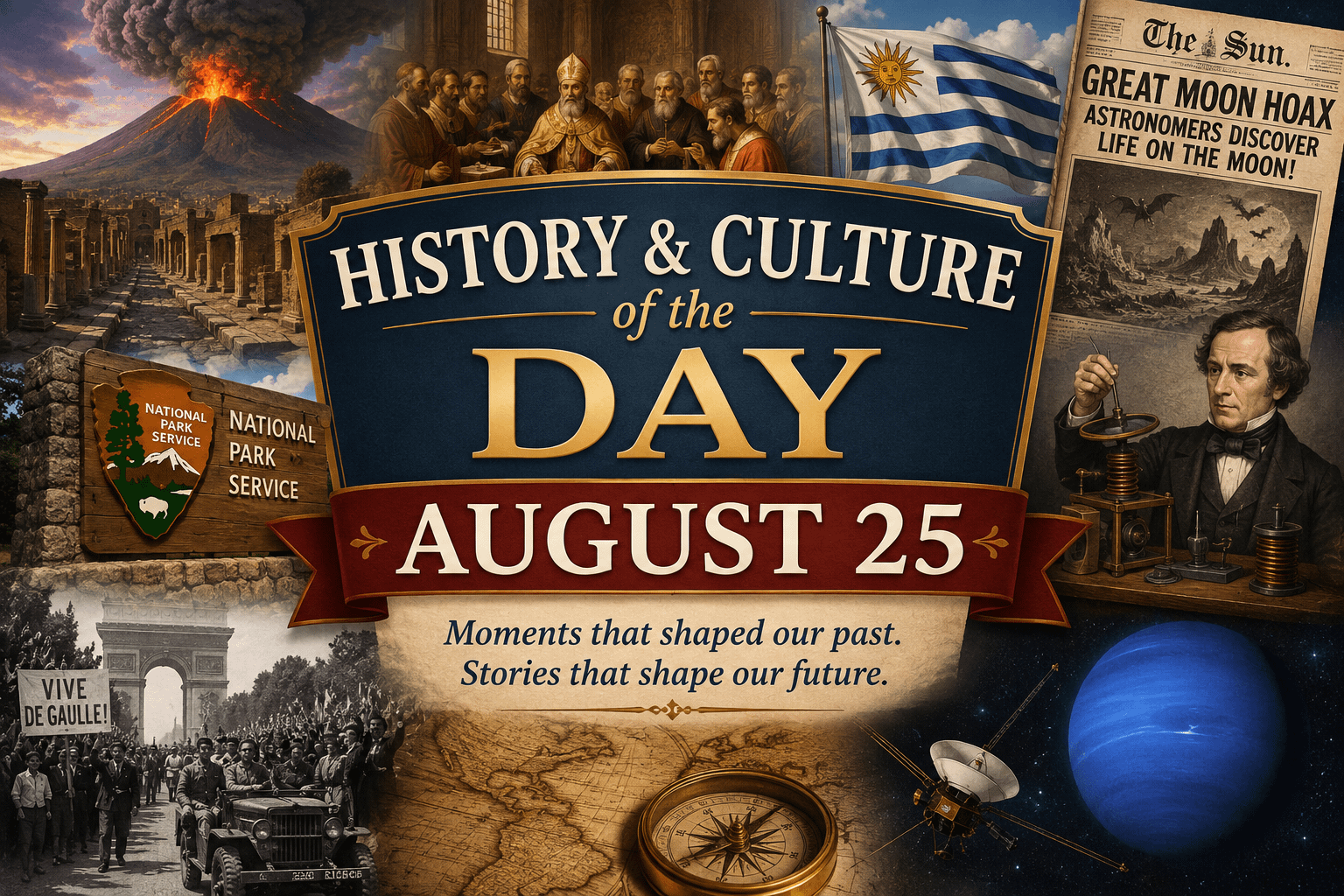
    One of history’s most famous natural disasters occurred in A.D. 79 when Mount Vesuvius erupted near the Bay of Naples in Italy.

    For generations, the eruption was traditionally dated to August 24, making August 25 part of the immediate aftermath of the catastrophe. Modern archaeological discoveries, however, have raised questions about whether the eruption actually happened later in the year.

    Regardless of the exact date, the destruction of Pompeii and neighboring communities remains closely associated with late August in traditional historical accounts.

    Before the eruption, Pompeii was a thriving Roman city.

    Its residents lived beneath Mount Vesuvius without understanding the enormous danger hidden beneath the mountain.

    Then Vesuvius exploded.

    Ash, pumice, volcanic gases, and other material poured from the volcano. Pompeii was buried, while nearby Herculaneum suffered devastating volcanic flows.

    For the people trapped in the disaster, it was an unimaginable tragedy.

    For historians nearly two thousand years later, however, the buried cities became extraordinary windows into Roman civilization.


    Pompeii Preserved Everyday Roman Life

    One reason Pompeii became so important is that it preserved much more than monumental architecture.

    It preserved ordinary life.

    Archaeologists uncovered streets where people walked, homes where families lived, businesses where merchants worked, bakeries where bread was prepared, public baths where residents gathered, temples where people worshiped, and theaters where audiences were entertained.

    Walls preserved political advertisements and graffiti.

    Homes contained artwork and decorative mosaics.

    Shops revealed information about commerce and food.

    Public buildings demonstrated how Roman cities were governed.

    Instead of learning only about emperors, generals, and wealthy elites, historians could examine evidence of daily life.

    That makes Pompeii culturally priceless.

    History is sometimes presented as the story of powerful people, but Pompeii reminds us that ordinary people create history too.

    The meals they prepared, the jokes they wrote, the businesses they operated, the homes they decorated, and the communities they created all became part of the historical record.


    The First Council of Nicaea and the Development of Christianity

    August 25 is also traditionally associated with the conclusion of the First Council of Nicaea in A.D. 325.

    The council was called by Roman Emperor Constantine I and brought Christian bishops together in Nicaea, located in present-day Turkey.

    The meeting occurred during a transformative period in Roman and Christian history.

    Only a relatively short time earlier, Christians had experienced periods of severe persecution under Roman authorities.

    By Constantine’s reign, Christianity’s position within the empire was changing dramatically.

    The council attempted to address theological disagreements that were creating divisions within Christianity.

    One of the major controversies involved questions concerning the nature and relationship of Jesus Christ and God the Father.

    These were not minor theological debates.

    For Christian leaders, they involved fundamental questions about the identity of Christ and the nature of God.


    The Lasting Cultural Influence of Nicaea

    The council contributed to the development of what became known as the Nicene Creed.

    Over time, the creed became one of Christianity’s most influential statements of faith.

    Versions of it continue to be recited in churches around the world.

    The significance of Nicaea therefore extends far beyond one meeting in the fourth century.

    Its influence can be seen in theology, church history, European history, art, literature, philosophy, politics, and culture.

    Christianity would eventually become one of the world’s largest religions, influencing civilizations across Europe, Africa, Asia, the Americas, and beyond.

    Understanding the Council of Nicaea helps us understand one chapter in that enormous historical development.

    It also demonstrates how debates over ideas can have consequences lasting centuries.


    August 25, 1825 – Uruguay Declares Independence

    August 25 holds tremendous national importance in Uruguay.

    On August 25, 1825, representatives declared the territory’s independence from Brazil during a complicated period of political and military struggle in South America.

    The region that became Uruguay had long been contested.

    Spain and Portugal competed for influence.

    Later, the territory became connected with Brazil.

    Local independence movements emerged as South America experienced revolutionary change during the early nineteenth century.

    The struggle eventually contributed to the establishment of Uruguay as an independent nation.

    Today, August 25 is celebrated as Uruguay’s Independence Day.


    Independence Days Are About More Than Politics

    National independence celebrations reveal how history becomes culture.

    Over time, a political event becomes part of a nation’s identity.

    People gather.

    Flags are displayed.

    Historical figures are remembered.

    Traditional foods may be prepared.

    Music is performed.

    Families and communities participate in celebrations.

    Children learn the story of their country.

    In this way, historical memory passes from generation to generation.

    August 25 in Uruguay therefore represents more than an event from 1825.

    It represents national identity and the continuing story of the Uruguayan people.


    August 25, 1835 – The Great Moon Hoax Begins

    Imagine opening your newspaper and discovering a report claiming that intelligent creatures had been discovered living on the Moon.

    That is essentially what happened to readers in New York in 1835.

    Beginning on August 25, The Sun published a series of sensational stories that became known as the Great Moon Hoax.

    The reports claimed that famous astronomer Sir John Herschel had used a powerful telescope to observe incredible features on the lunar surface.

    Readers encountered descriptions of strange animals, unusual landscapes, vegetation, and humanlike lunar beings.

    The stories were fictional.

    But many readers were fascinated.


    A Nineteenth-Century Lesson About Viral Information

    The Great Moon Hoax feels surprisingly familiar today.

    Modern society often associates misinformation and sensational headlines with social media and the internet.

    But those problems are much older.

    Newspapers in the nineteenth century competed intensely for readers.

    Extraordinary stories could attract attention and increase circulation.

    People shared remarkable claims with friends and family much as people share unusual stories online today.

    The technology changed.

    Human curiosity did not.

    The Great Moon Hoax demonstrates that people have long been attracted to stories that are shocking, mysterious, emotional, or unbelievable.

    It also provides a timeless lesson:

    An extraordinary claim deserves careful examination before we accept it as fact.

    That lesson may be even more important in the modern information age.


    Michael Faraday and the Electrical Revolution

    The early 1830s represented an extraordinary period in scientific history.

    During experiments in late August 1831, British scientist Michael Faraday made discoveries involving electromagnetic induction.

    Faraday demonstrated that changing magnetic conditions could produce electrical current.

    The discovery became foundational to electrical engineering.

    At the time, few people could have imagined how deeply electricity would eventually transform civilization.

    Today, electricity powers homes, hospitals, factories, communication systems, computers, transportation infrastructure, entertainment, refrigeration, lighting, and countless other technologies.

    Faraday’s experiments helped establish principles that would eventually make electric generators and transformers possible.


    Small Experiments Can Create Enormous Change

    Faraday’s story illustrates something important about scientific progress.

    A discovery does not always transform society immediately.

    Sometimes scientists discover a principle decades before engineers develop technologies capable of using it on a massive scale.

    One experiment creates another.

    One discovery raises another question.

    One invention makes another invention possible.

    Eventually, an entire technological revolution emerges.

    Faraday could not have predicted smartphones, electric vehicles, massive power grids, computers, satellites, or modern cities illuminated at night.

    Yet scientific principles connected with his work helped make our electrified civilization possible.


    August 25, 1916 – The National Park Service Is Created

    One of the most important American events associated with August 25 occurred in 1916.

    President Woodrow Wilson signed the legislation creating the National Park Service.

    The United States had already established national parks, including Yellowstone, which became the world’s first national park in 1872.

    As more protected lands were established, however, the federal government needed a more organized system for managing them.

    The National Park Service was created to help conserve America’s extraordinary natural scenery, wildlife, historic places, and cultural resources while allowing people to experience them.

    The idea was ambitious.

    Protect remarkable places today so they would still exist tomorrow.


    America’s National Parks Become Part of the National Identity

    Over the following century, national parks became deeply connected with American culture.

    Yellowstone.

    Yosemite.

    Grand Canyon.

    Zion.

    Great Smoky Mountains.

    Rocky Mountain.

    Acadia.

    Everglades.

    Joshua Tree.

    Death Valley.

    These places represent very different landscapes, but collectively they have helped shape how Americans think about wilderness, conservation, recreation, and national heritage.

    Millions of people have built family memories in national parks.

    Children have seen mountains for the first time.

    Families have camped beneath stars.

    Travelers have stood beside waterfalls, glaciers, deserts, forests, canyons, and oceans.

    Photographers have documented landscapes that seem almost impossible.

    Scientists have studied ecosystems.

    Historians have preserved important cultural locations.

    National parks are therefore more than tourist destinations.

    They are living classrooms.


    The National Park Service Preserves Human History Too

    The National Park Service does not protect only spectacular wilderness.

    It also preserves places connected with the American story.

    Historic homes, monuments, battlefields, archaeological sites, civil rights locations, military sites, memorials, and cultural landscapes help Americans explore both inspiring and difficult chapters of history.

    These places remind visitors that history happened somewhere.

    Standing where an important event occurred can create a different connection than simply reading about it.

    A battlefield can reveal the scale of conflict.

    A historic home can reveal how people lived.

    A preserved neighborhood can demonstrate cultural change.

    A memorial can transform statistics into human stories.

    Preservation helps keep those connections alive.


    August 25, 1944 – The Liberation of Paris

    August 25, 1944, became one of the most celebrated days of World War II.

    Paris had been under German occupation since 1940.

    For approximately four years, the people of the French capital lived under Nazi occupation while war consumed Europe.

    By June 1944, the Allied invasion of Normandy had opened a major Western front against Nazi Germany.

    Allied forces began pushing across France.

    Meanwhile, members of the French Resistance intensified their activities.

    In August, fighting erupted throughout Paris.

    French and Allied forces entered the capital.

    On August 25, the German commander in Paris surrendered.

    Paris was liberated.


    Celebration Returns to the Streets of Paris

    The emotional significance of liberation is difficult to overstate.

    Imagine living for years in a city controlled by an occupying army.

    Then suddenly the symbols of occupation begin disappearing.

    French flags return.

    Crowds gather.

    Soldiers arrive.

    Church bells ring.

    People realize that the occupation is ending.

    Scenes of celebration filled Paris.

    The following day, General Charles de Gaulle participated in a famous procession through the city along the Champs-Élysées.

    Images from those days became some of the most recognizable photographs of wartime Europe.


    Paris Was More Than a Military Prize

    Paris carried enormous cultural significance.

    For centuries, the city had been one of the world’s great centers of art, literature, fashion, architecture, philosophy, politics, cuisine, and intellectual life.

    Artists and writers from around the world had traveled there.

    Its museums contained priceless works of art.

    Its streets and buildings carried centuries of European history.

    The liberation of Paris therefore carried symbolic importance far beyond military strategy.

    It represented the return of freedom to one of Europe’s great cultural capitals.


    August 25, 1989 – Voyager 2 Reaches Neptune

    More than four decades after the liberation of Paris, August 25 became associated with an entirely different kind of exploration.

    Humanity reached Neptune.

    NASA’s Voyager 2 spacecraft made its closest approach to the distant planet on August 25, 1989.

    Voyager 2 had been launched from Earth in 1977.

    Its journey became one of the greatest exploration missions in human history.

    The spacecraft visited Jupiter.

    Then Saturn.

    Then Uranus.

    Finally, it reached Neptune.

    By the time Voyager 2 arrived, it had traveled billions of miles.


    Seeing Neptune Up Close for the First Time

    Before Voyager 2, Neptune was largely a distant point of light studied through telescopes.

    The spacecraft changed that.

    Its observations revealed a dynamic world.

    Scientists observed storms, powerful winds, rings, atmospheric features, and moons.

    Neptune’s brilliant blue appearance became familiar to millions through Voyager photographs.

    One particularly fascinating target was Triton, Neptune’s largest moon.

    Voyager 2 discovered evidence of active plumes erupting from Triton’s surface.

    Scientists had once imagined the distant outer solar system as relatively quiet and inactive.

    Instead, spacecraft repeatedly discovered worlds filled with unexpected activity.


    Voyager 2 Remains Alone

    As of today, Voyager 2 remains the only spacecraft ever to visit Neptune.

    Think about what that means.

    Nearly every close-up image humanity has ever obtained from Neptune came from one spacecraft during one brief encounter in 1989.

    The accomplishment becomes even more remarkable when we remember the technology involved.

    Voyager was designed decades before smartphones, modern personal computers, GPS navigation, and the internet became ordinary parts of everyday life.

    Engineers had to build a machine capable of surviving for years in deep space while communicating across billions of miles.

    And it worked.


    From Pompeii to Neptune

    Consider the extraordinary historical distance covered by the stories associated with August 25.

    In the ancient world, people looked toward mountains and wondered about the forces of nature.

    Centuries later, religious leaders gathered to debate theology.

    Nations struggled for independence.

    Newspapers discovered the power of sensational storytelling.

    Scientists uncovered the relationship between electricity and magnetism.

    Governments began protecting landscapes for future generations.

    Armies liberated cities.

    And eventually humanity sent robotic explorers across the solar system.

    That progression reveals something extraordinary about civilization.

    Human beings constantly build upon the knowledge of previous generations.


    History Is Not Just About Famous People

    When people hear the word “history,” they often imagine presidents, kings, generals, wars, and major political events.

    Those things certainly matter.

    But history is much larger.

    History includes the baker working in Pompeii.

    The family celebrating Uruguay’s independence.

    The newspaper reader wondering whether creatures really lived on the Moon.

    The scientist experimenting with magnets.

    The park ranger protecting a historic landscape.

    The Parisian celebrating liberation.

    The engineer watching Voyager’s signals arrive from Neptune.

    Ordinary people are constantly participating in history.

    Most simply don’t realize it at the time.


    Culture Gives History Meaning

    Culture determines how societies remember their past.

    We create monuments.

    We preserve buildings.

    We celebrate holidays.

    We tell stories.

    We prepare traditional foods.

    We sing songs.

    We display flags.

    We visit museums.

    We teach children about earlier generations.

    We preserve photographs.

    We write books.

    We protect historic places.

    Through these actions, history becomes more than information.

    It becomes memory.

    And memory helps communities understand who they are.


    What August 25 Can Teach Us About Progress

    The events associated with August 25 reveal that progress rarely follows a straight line.

    Civilizations rise and fall.

    Wars destroy communities.

    Natural disasters change landscapes.

    Political systems evolve.

    Scientific discoveries create new possibilities.

    Technology changes how people communicate.

    Exploration expands our understanding of the universe.

    Some generations experience extraordinary hardship.

    Others inherit opportunities created by people they never knew.

    Every generation receives something from the past and leaves something behind for the future.


    The Importance of Preserving History

    One of the strongest themes connecting these stories is preservation.

    Pompeii survived because volcanic material accidentally preserved much of the city.

    The National Park Service intentionally preserves landscapes and historical places.

    Photographs preserved images of liberated Paris.

    Scientific records preserved Faraday’s discoveries.

    Voyager preserved its observations by transmitting information back to Earth.

    Historical documents preserved the political struggles surrounding independence movements.

    Without preservation, enormous parts of human history would disappear.

    That is why archives, libraries, museums, archaeological sites, national parks, photographs, family records, oral histories, and historical writing matter.

    Future generations can only learn from the past if something survives for them to study.


    History Also Warns Us

    History isn’t valuable simply because it tells interesting stories.

    It can also provide warnings.

    Pompeii reminds us of the destructive power of nature.

    The Great Moon Hoax reminds us to question sensational claims.

    World War II reminds us of the devastating consequences of dictatorship, aggression, hatred, and war.

    Independence movements remind us how strongly people value self-determination.

    Scientific discoveries remind us that knowledge can transform civilization.

    Conservation efforts remind us that valuable places can disappear if nobody protects them.

    History cannot tell us exactly what will happen tomorrow.

    But it can help us recognize patterns.


    Imagine What Future Historians Will Say About Our Time

    People living through historical events rarely know how future generations will interpret them.

    Someone walking through Pompeii probably did not imagine archaeologists studying their neighborhood nearly two thousand years later.

    A newspaper reader in 1835 could not have imagined social media.

    Michael Faraday could not have imagined a world filled with billions of electronic devices.

    The people who created America’s early national parks could not know exactly how many generations would eventually visit them.

    Parisians celebrating liberation in 1944 could not know how Europe would change during the following decades.

    Voyager engineers could only imagine what future space missions might discover.

    The same is true today.

    We don’t know which events happening around us will eventually become defining moments in history.


    Every Generation Writes Another Chapter

    History never truly stops.

    The moment one chapter closes, another begins.

    Today’s discoveries become tomorrow’s textbooks.

    Today’s photographs become tomorrow’s historical archives.

    Today’s buildings may become tomorrow’s landmarks.

    Today’s struggles may become tomorrow’s lessons.

    Today’s technology may someday look ancient.

    And today’s ordinary lives may provide future generations with clues about what it was like to live in the early twenty-first century.

    That is one of the most fascinating things about studying history:

    We aren’t separate from history. We are living inside it.


    Why August 25 Matters

    August 25 gives us an opportunity to look across an enormous span of human experience.

    It connects ancient civilization with modern science.

    It connects faith with politics.

    It connects independence with national identity.

    It connects journalism with questions about truth.

    It connects conservation with responsibility.

    It connects war with freedom.

    And it connects Earth with the outer reaches of our solar system.

    Those connections remind us that history isn’t a collection of isolated events.

    Every generation influences the next.

    Ideas travel across centuries.

    Discoveries create opportunities.

    Mistakes become warnings.

    Traditions become culture.

    Memories become history.


    History & Culture Reflection of the Day

    Take a moment today to think about how much the world has changed.

    Humanity went from preserving stories on stone and parchment to transmitting photographs across billions of miles of space.

    We went from looking at planets as mysterious lights in the night sky to sending spacecraft to photograph them.

    We went from watching civilizations disappear beneath volcanic ash to carefully preserving entire landscapes and historic communities.

    Yet some things remain unchanged.

    We still wonder.

    We still explore.

    We still disagree.

    We still create.

    We still search for truth.

    We still fight for freedom.

    We still preserve memories.

    And we still hope to leave something meaningful behind.


    Final Thought

    History is the memory of humanity, and culture is how we keep that memory alive.

    August 25 reminds us that one date can contain stories spanning nearly two thousand years—from ancient cities buried beneath volcanic ash to a spacecraft traveling billions of miles across the solar system.

    Each generation inherits a world shaped by people who came before.

    And each generation has the responsibility to decide what it will contribute to those who come next.

    The people who lived through the events of August 25 throughout history did not always know that future generations would remember their experiences.

    Neither do we.

    That is why every day matters.

    Because somewhere, something happening today may eventually become the history and culture that people read about generations from now.

  • This Day in American History – August 25

    This Day in American History – August 25

    Every date on the calendar carries stories from America’s past, but August 25 connects several especially powerful themes in United States history: preservation, war, political tension, scientific exploration, national tragedy, and resilience.

    On this date in 1916, the United States created the National Park Service, establishing an agency that would eventually become responsible for protecting hundreds of America’s most treasured natural, cultural, and historic places.

    Twenty-eight years later, American troops joined French forces in the liberation of Paris from Nazi occupation.

    Decades after that, an American spacecraft reached Saturn, one of the most spectacular planets in our solar system.

    August 25 would later become associated with the death of astronaut Neil Armstrong and, in 2017, the devastating arrival of Hurricane Harvey on the Texas coast.

    Together, these events show just how varied American history can be.

    Let’s travel through the years and explore some of the most important events connected to August 25 in American history.


    1916 – The National Park Service Is Established

    One of the most lasting events associated with August 25 occurred in 1916, when President Woodrow Wilson signed the legislation establishing the National Park Service.

    The National Park Service was created within the U.S. Department of the Interior and given responsibility for protecting America’s growing collection of national parks and monuments.

    The idea of protecting extraordinary American landscapes had already existed for decades.

    Yellowstone became the world’s first national park in 1872, followed by other protected areas.

    But there was a problem.

    There wasn’t one unified federal agency specifically responsible for overseeing all of these special places.

    Different parks could be managed differently, and conservation advocates increasingly believed the country needed a permanent organization dedicated to protecting them.

    The National Park Service provided that organization.

    Its mission represented an ambitious promise: America’s most important natural and historic places should be enjoyed by people today while also being protected for generations that had not yet been born.

    That balance between public enjoyment and preservation remains at the heart of the National Park Service mission.


    The Idea That Some Places Should Belong to Everyone

    The creation of the National Park Service represented more than government administration.

    It represented an important American idea:

    Some places are so important that they should be protected for everyone.

    A spectacular canyon shouldn’t necessarily disappear because someone discovers a profitable use for the land.

    An important battlefield shouldn’t automatically become another subdivision.

    A historic building shouldn’t necessarily be demolished simply because something newer could replace it.

    And a wilderness area shouldn’t disappear without considering what future generations would lose.

    Preservation asks society to think beyond the present moment.

    It asks:

    What do we want to leave behind?

    The National Park Service became one of America’s most important answers to that question.


    America’s National Parks Become Part of the National Identity

    Over the following century, America’s national parks became recognized around the world.

    Places such as:

    • Yellowstone National Park
    • Yosemite National Park
    • Grand Canyon National Park
    • Great Smoky Mountains National Park
    • Rocky Mountain National Park
    • Acadia National Park
    • Everglades National Park
    • Zion National Park

    became destinations for generations of travelers.

    But the National Park Service protects far more than spectacular wilderness.

    The National Park System includes historic sites, battlefields, monuments, memorials, seashores, recreation areas, parkways, archaeological resources, and other culturally important locations.

    That means the National Park Service isn’t simply protecting beautiful scenery.

    It is protecting pieces of the American story.


    Preserving the Places Where History Happened

    Imagine learning American history without being able to visit the places where it occurred.

    Imagine Gettysburg only as a paragraph in a textbook.

    Imagine never standing near the places associated with the American Revolution.

    Imagine important civil rights landmarks disappearing.

    Imagine historic homes, military sites, archaeological areas, and memorials being destroyed.

    Physical places connect us to history differently than books can.

    When someone stands on a battlefield, walks through a historic home, visits a memorial, or explores a preserved landscape, history becomes more tangible.

    You realize:

    People actually stood here.

    Decisions were made here.

    Lives changed here.

    History happened here.

    That connection is one reason the establishment of the National Park Service on August 25, 1916, remains such an important moment.


    1944 – Paris Is Liberated from Nazi Occupation

    Another defining August 25 occurred during World War II.

    On August 25, 1944, Paris was liberated after approximately four years of German occupation.

    The liberation came less than three months after Allied forces landed in Normandy on D-Day.

    American troops played an important role alongside French forces.

    The French 2nd Armored Division and the U.S. 4th Infantry Division entered Paris as German control of the city collapsed.

    It became one of the most symbolic victories of the campaign to liberate Western Europe.


    Four Years of Occupation

    German forces had occupied Paris since 1940.

    For Parisians, occupation meant living under Nazi authority while the war continued across Europe.

    The French Resistance operated against the occupation despite enormous risks.

    By the summer of 1944, however, Germany’s position in France was rapidly deteriorating.

    The Allied invasion of Normandy on June 6 had established a foothold in Western Europe.

    What followed was an enormous and difficult military campaign.

    American, British, Canadian, French, and other Allied forces fought their way through Normandy.

    After breaking through German defensive positions, Allied armies began advancing more rapidly across France.

    Paris was increasingly within reach.


    The Battle for Paris

    Resistance fighters inside Paris began an uprising as Allied armies approached.

    Barricades appeared throughout the city.

    Fighting broke out between resistance fighters and German forces.

    Meanwhile, French forces under General Philippe Leclerc advanced toward the capital.

    Elements of the French 2nd Armored Division reached Paris on the evening of August 24.

    Then, on August 25, the main French force entered the city along with the American 4th Infantry Division.

    German positions were gradually overcome.

    The German military governor of Paris, General Dietrich von Choltitz, was captured and surrendered.

    After years of occupation, Paris was free.


    The American Role in the Liberation

    Although the liberation of Paris holds special importance in French history, it is also part of American military history.

    American troops had traveled thousands of miles from home to fight in Europe.

    Many had already endured intense combat in Normandy.

    The U.S. 4th Infantry Division had participated in the D-Day landings at Utah Beach before continuing the campaign across France.

    On August 25, its soldiers entered Paris as part of the liberation.

    The victory demonstrated how quickly the strategic situation had changed since June.

    Only weeks earlier, Allied troops had been struggling through the difficult Normandy countryside.

    Now they were helping liberate one of Europe’s great capitals.

    But the war was far from finished.

    Thousands more Americans would die before Germany surrendered in May 1945.


    A Powerful Symbol of Hope

    The liberation of Paris carried significance beyond its immediate military value.

    Paris was internationally recognized as a center of culture, politics, art, and history.

    Seeing the city freed from Nazi occupation provided a powerful psychological victory.

    Crowds welcomed the liberating forces.

    French flags appeared throughout the city.

    Church bells rang.

    Celebrations filled the streets.

    For people who had lived through years of occupation, freedom had returned.

    And for the Allies, the liberation offered another sign that Nazi Germany’s control of Western Europe was collapsing.


    1950 – President Truman Takes Control of America’s Railroads

    August 25 also became important during another war.

    In 1950, the United States was fighting in the Korean War.

    At home, a threatened railroad strike created a potentially serious national emergency.

    Railroads remained essential to American transportation.

    They moved food.

    They moved industrial materials.

    They moved military equipment.

    They moved troops.

    A widespread shutdown during wartime could have disrupted both the civilian economy and the American military effort.

    President Harry S. Truman responded dramatically.

    On August 25, he ordered the U.S. Army to take control of the nation’s railroads.


    Why Railroads Were So Important

    It’s easy to underestimate the importance railroads once had to the United States.

    Before the modern interstate highway system transformed transportation, railroads were among the country’s most important economic arteries.

    Factories depended on them.

    Farmers depended on them.

    Cities depended on them.

    The military depended on them.

    A national railroad shutdown could therefore create consequences far beyond frustrated passengers.

    During the Korean War, maintaining transportation infrastructure was considered a national security issue.

    Truman’s decision demonstrated the extraordinary powers presidents sometimes exercise during wartime emergencies.

    It also raised questions Americans have debated throughout their history:

    How much authority should the federal government have during a national emergency?

    That question continues to appear whenever the country faces war, economic crisis, natural disaster, or other major disruptions.


    1981 – Voyager 2 Encounters Saturn

    August 25 isn’t only connected to war and politics.

    It is also connected to one of humanity’s greatest adventures:

    the exploration of space.

    In August 1981, NASA’s Voyager 2 spacecraft made its historic encounter with Saturn.

    On August 25, the spacecraft entered Saturn’s magnetic environment as it approached the giant planet.

    Voyager 2 had already traveled an extraordinary distance from Earth.

    Yet its journey was only beginning.


    A Spacecraft Traveling Into the Unknown

    Voyager 2 launched in 1977.

    Its mission took advantage of a rare alignment of the outer planets that allowed the spacecraft to use planetary gravity to continue traveling deeper into the solar system.

    Before Saturn, Voyager 2 visited Jupiter.

    Then came Saturn.

    Later would come Uranus and Neptune.

    Voyager 2 would ultimately become the only spacecraft to visit all four giant outer planets.

    Think about what that meant.

    Scientists and engineers on Earth designed a robotic explorer capable of traveling billions of miles through an environment humans had never physically explored.

    They had to anticipate problems years before they might occur.

    Commands had to travel enormous distances.

    Scientific instruments had to survive years in space.

    And when the spacecraft reached its destinations, there was no repair crew waiting nearby.

    It had to work.


    Discovering a New Saturn

    Voyager 2 returned remarkable information about Saturn.

    Its instruments studied the planet’s atmosphere, magnetic environment, moons, and famous rings.

    The spacecraft helped reveal how extraordinarily complicated Saturn’s ring system really was.

    From Earth, Saturn’s rings appear almost smooth.

    Up close, they are incredibly complex.

    Voyager observations helped scientists better understand the numerous structures and divisions within the rings.

    The spacecraft also photographed several of Saturn’s moons.

    Every photograph represented information traveling across hundreds of millions of miles before reaching scientists on Earth.

    For the public, the images offered something equally powerful:

    They allowed ordinary people to see distant worlds with unprecedented detail.


    The Journey Didn’t Stop at Saturn

    Many spacecraft missions would have considered reaching Saturn an extraordinary conclusion.

    For Voyager 2, Saturn was another stop.

    The spacecraft continued outward.

    It reached Uranus in 1986.

    Then Neptune in 1989.

    No spacecraft had ever visited either planet before.

    No spacecraft has returned to them since.

    Voyager 2 therefore remains humanity’s only close-up visitor to Uranus and Neptune.

    Its journey represents one of the most extraordinary accomplishments in the history of American space exploration.

    And August 25, 1981, represents an important chapter in that journey.


    2012 – America Loses Neil Armstrong

    Another important moment in America’s space story occurred on August 25, 2012.

    Neil Armstrong died at age 82.

    For millions of Americans, Armstrong represented one of the greatest achievements in the nation’s history.

    On July 20, 1969, he became the first human being to walk on the Moon.

    But Armstrong’s story wasn’t simply about one famous step.

    It represented years of scientific research, engineering, risk, competition, and determination.


    The Race to the Moon

    During the Cold War, the United States and Soviet Union competed for technological and political leadership.

    Space became one of the most visible arenas for that competition.

    The Soviet Union achieved several early milestones.

    Then President John F. Kennedy challenged the United States to land a man on the Moon and return him safely to Earth before the end of the 1960s.

    At the time, the goal seemed almost impossible.

    The necessary spacecraft had not been built.

    Many of the technologies didn’t exist yet.

    Scientists still had enormous questions about space travel.

    But thousands upon thousands of Americans went to work solving those problems.

    Engineers designed rockets.

    Scientists studied the Moon.

    Computer specialists developed guidance systems.

    Technicians assembled spacecraft.

    Astronauts trained for missions that carried enormous risk.

    Eight years after Kennedy issued his challenge, Apollo 11 reached the Moon.


    Armstrong’s Legacy

    Neil Armstrong became the most recognizable member of Apollo 11 because he stepped onto the lunar surface first.

    But he frequently emphasized that the achievement belonged to a much larger team.

    That may be one of the most important lessons of Apollo.

    Extraordinary achievements rarely belong to one person.

    Behind Armstrong were astronauts, engineers, scientists, mathematicians, technicians, factory workers, mission controllers, contractors, and countless others.

    His death on August 25, 2012, gave Americans an opportunity to remember not only the man but the enormous national effort he represented.


    2017 – Hurricane Harvey Strikes Texas

    On August 25, 2017, another event entered American history.

    This one wasn’t a victory or scientific achievement.

    It was a natural disaster.

    Hurricane Harvey made landfall along the Texas coast as a powerful Category 4 hurricane.

    NOAA describes Harvey as one of the costliest hurricanes to affect the United States and the wettest tropical cyclone on record in the country, with more than 60 inches of rain recorded in some areas.

    The consequences were catastrophic.


    A Storm That Wouldn’t Leave

    Harvey’s destructive power wasn’t limited to its winds.

    Rain became the defining story.

    The storm slowed dramatically after reaching Texas, allowing enormous quantities of moisture to fall over the same areas.

    Floodwaters rose across southeastern Texas.

    Houston and surrounding communities experienced catastrophic flooding.

    Roadways disappeared beneath water.

    Homes flooded.

    Families became trapped.

    Thousands of people needed rescue.

    NOAA reports that Harvey displaced more than 30,000 people and prompted more than 17,000 rescues.


    Ordinary Americans Become Rescuers

    Natural disasters often produce stories of destruction.

    They also produce stories of courage.

    As Harvey’s floodwaters rose, professional first responders weren’t the only people helping.

    Ordinary citizens brought boats into flooded neighborhoods.

    Neighbors checked on neighbors.

    Volunteers helped evacuate families.

    Churches and community organizations provided shelter, clothing, meals, and supplies.

    People opened their homes to strangers.

    Americans traveled from other states to assist with rescue and recovery.

    These actions didn’t erase the devastation.

    But they demonstrated something repeatedly seen after American disasters:

    When communities are overwhelmed, ordinary people often step forward to help.


    Different Events, One American Story

    At first glance, these August 25 events might seem completely unrelated.

    What does the National Park Service have in common with the liberation of Paris?

    What does Voyager 2 have in common with Hurricane Harvey?

    What connects Neil Armstrong to a railroad crisis during the Korean War?

    The answer is that history isn’t one story.

    It is millions of stories overlapping one another.

    But several themes connect these events.


    Preservation

    The creation of the National Park Service reminds us that history and nature can disappear if people don’t intentionally protect them.

    Preservation requires looking beyond immediate needs and thinking about future generations.


    Sacrifice

    The liberation of Paris reminds us that freedom often carries an enormous price.

    American and Allied soldiers fought thousands of miles from home against Nazi Germany.

    Many never returned.

    Their sacrifices became part of the history of both America and Europe.


    Leadership

    President Truman’s railroad decision demonstrates the difficult choices leaders face during national emergencies.

    Leadership sometimes requires making decisions when every available option carries consequences.

    History allows later generations to examine those decisions and ask what they might have done differently.


    Exploration

    Voyager 2 and Neil Armstrong represent humanity’s desire to discover what lies beyond the horizon.

    For centuries, explorers crossed oceans.

    In the twentieth century, humanity began crossing space.

    The technology changed.

    The curiosity did not.


    Resilience

    Hurricane Harvey demonstrates another recurring theme in American history.

    Disasters can destroy buildings, businesses, roads, and entire neighborhoods.

    Recovery can take years.

    But people rebuild.

    Communities organize.

    Strangers help strangers.

    Life continues.

    That resilience becomes part of history too.


    Why Studying Dates Like August 25 Matters

    It’s tempting to think history is simply about memorizing dates.

    It isn’t.

    Dates give us reference points.

    The real value comes from understanding the people, decisions, consequences, and lessons behind those dates.

    August 25 asks several interesting questions.

    What should America preserve for future generations?

    What sacrifices are required to defend freedom?

    How should presidents respond to national emergencies?

    How far should humanity explore?

    How should communities respond when disaster strikes?

    Those aren’t questions limited to the past.

    We are still answering them today.


    History Is Happening Right Now

    There’s another lesson worth remembering whenever we study history.

    The people living through these events usually didn’t know exactly how history would remember them.

    On August 25, 1916, Americans couldn’t know what the National Park Service would look like more than a century later.

    Soldiers entering Paris in 1944 didn’t know exactly when World War II would end.

    Scientists working with Voyager 2 couldn’t fully predict how long the spacecraft’s extraordinary journey would continue.

    Families preparing for Hurricane Harvey couldn’t know how dramatically their lives were about to change.

    They were simply living through their present.

    We are doing the same thing.

    The events happening around us today will someday appear in history books, documentaries, museums, websites, and classrooms.

    Future generations will study our time just as we study theirs.


    Remembering August 25

    August 25 offers an extraordinary journey through American history.

    We remember August 25, 1916, when the National Park Service was established and America strengthened its commitment to preserving important natural and historic places.

    We remember August 25, 1944, when French and American forces helped liberate Paris from Nazi occupation.

    We remember the wartime decisions made by President Harry S. Truman during the Korean War.

    We remember Voyager 2’s exploration of Saturn, representing America’s extraordinary contribution to planetary science.

    We remember Neil Armstrong, whose journey to the Moon inspired generations to believe seemingly impossible goals could become reality.

    And we remember Hurricane Harvey, which struck Texas on August 25, 2017, bringing catastrophic destruction while inspiring remarkable acts of courage and compassion.

    These moments remind us that American history isn’t defined solely by presidents, wars, or elections.

    It is also defined by explorers.

    Scientists.

    Soldiers.

    First responders.

    Volunteers.

    Conservationists.

    Engineers.

    Families.

    Communities.

    And ordinary people facing extraordinary circumstances.

    Final Thought

    History gives us more than a record of what happened.

    It gives us an opportunity to understand why it happened, how people responded, and what we can learn from it.

    August 25 reminds us of America’s capacity to preserve, sacrifice, explore, endure, rebuild, and continue moving forward.

    The people who lived through these moments became part of history whether they realized it at the time or not.

    And perhaps that is one of history’s most important lessons:

    The choices we make today can become the history someone else learns from tomorrow.

    History Question of the Day

    If you could witness one August 25 event firsthand—the creation of the National Park Service, the liberation of Paris, Voyager 2’s Saturn encounter, or another moment—which would you choose and why?

  • History & Culture of the Day – August 24

    History & Culture of the Day – August 24

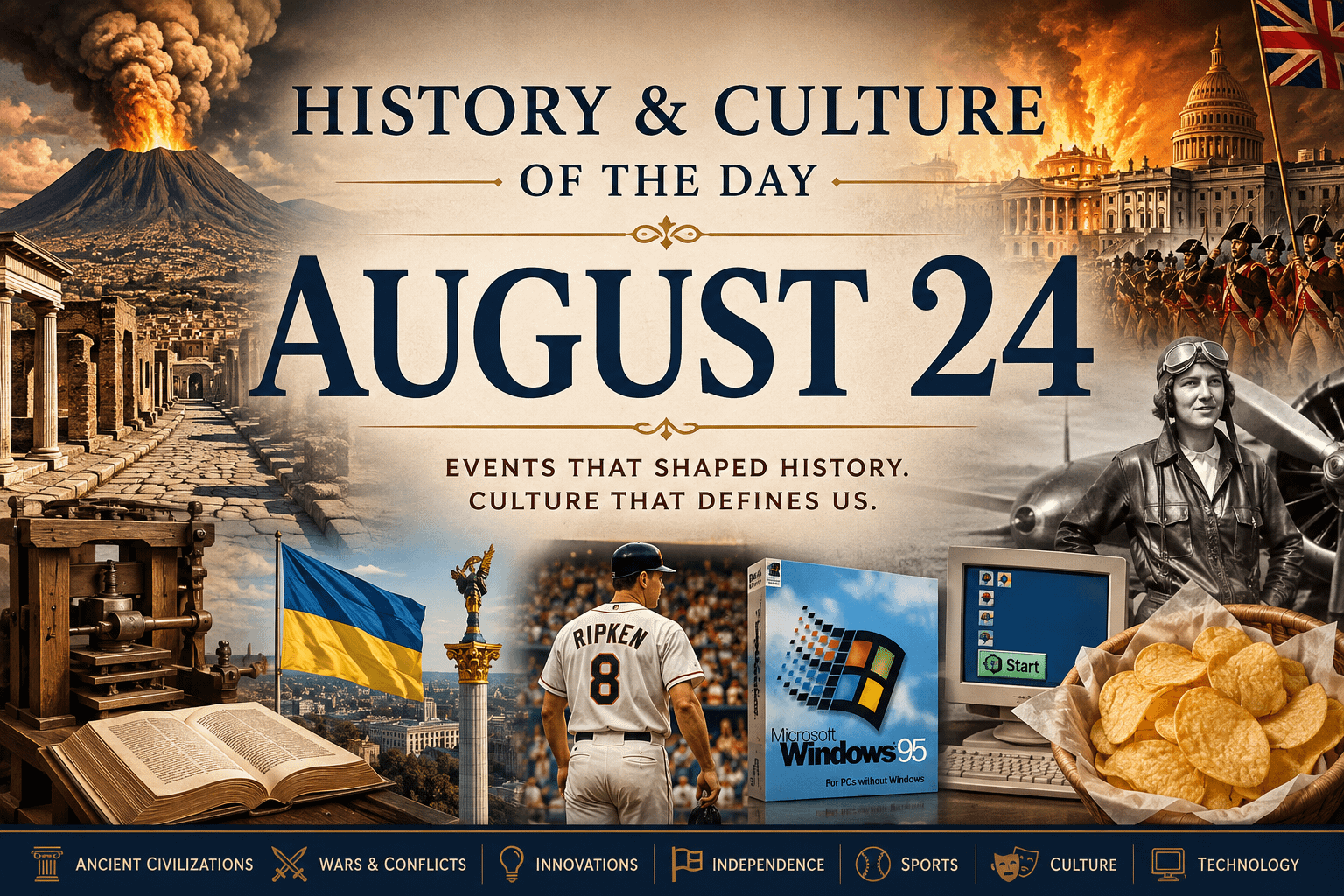
    Every date on the calendar contains layers of human history, and August 24 is a particularly fascinating example. Across thousands of years, this date has been associated with natural disasters, invasions, wars, political turning points, technological breakthroughs, national celebrations, aviation achievements, literature, sports, entertainment, and changing cultural traditions.

    Some events connected with August 24 transformed nations. Others changed how people communicated, traveled, entertained themselves, or understood the past.

    From the ancient Roman world and the destruction of Pompeii to the burning of Washington, D.C., during the War of 1812, the independence of Ukraine, and the arrival of Windows 95, August 24 provides a remarkable window into the constantly changing story of civilization.

    It is also a reminder that history is more than famous battles and political leaders. History includes the foods people ate, the books they read, the technologies they adopted, the music they enjoyed, the traditions they celebrated, and the everyday decisions that slowly shaped their societies.

    Let’s travel through the centuries and explore the history and culture of August 24.


    A.D. 79: The Catastrophic Eruption of Mount Vesuvius

    Perhaps the most famous ancient event traditionally associated with August 24 is the catastrophic eruption of Mount Vesuvius in A.D. 79.

    Located near the Bay of Naples in present-day Italy, Vesuvius erupted with devastating force and overwhelmed several Roman communities.

    The most famous was Pompeii.

    The city was covered by volcanic ash, pumice, and debris. Nearby Herculaneum suffered a different but equally devastating fate as extremely hot volcanic material swept through the community.

    For the people living around Vesuvius, the disaster must have been terrifying.

    Dark clouds rose above the volcano. Ash fell from the sky. Buildings began collapsing under accumulated volcanic material. Residents attempted to escape while conditions became increasingly dangerous.

    Many never made it out.

    Yet the destruction ultimately created one of history’s most remarkable archaeological time capsules.


    Pompeii: A Roman City Frozen in Time

    Pompeii’s archaeological importance comes from the extraordinary preservation of everyday life.

    When systematic excavations began centuries later, archaeologists uncovered streets, houses, temples, bathhouses, shops, theaters, taverns, bakeries, gardens, artwork, household objects, and public buildings.

    Even ancient graffiti survived.

    These discoveries allowed historians to study aspects of Roman life that traditional historical documents often overlooked.

    Researchers could examine how homes were decorated, what people ate, where they shopped, how businesses advertised, how streets were organized, and what ordinary residents wrote on walls.

    The city therefore became more than the site of a famous disaster.

    It became a window into everyday life nearly 2,000 years ago.

    Walking through Pompeii today allows visitors to see streets where ancient Romans once walked, storefronts where merchants conducted business, and homes where families lived generations before the modern world existed.

    Few archaeological locations provide such an immediate connection between the present and the ancient past.


    Was Vesuvius Really Erupting on August 24?

    There is an interesting historical mystery surrounding the traditional date.

    Much of what historians know about the eruption comes from letters written by Pliny the Younger, who witnessed the event from across the Bay of Naples.

    Centuries of historical tradition placed the eruption on August 24.

    However, some archaeological evidence suggests the eruption may have occurred later in the year.

    Researchers have pointed to seasonal foods, clothing, heating equipment, and other evidence that may indicate an autumn eruption. An inscription discovered at Pompeii has also contributed to arguments for a later date.

    As a result, some scholars believe the eruption may have occurred in October rather than August.

    The debate demonstrates an important lesson about history: our understanding of the past can change when new evidence is discovered.

    Even famous historical dates are sometimes reconsidered.


    410: The Visigoths Sack Rome

    More than three centuries after the destruction of Pompeii, another dramatic event shook the Roman world.

    In 410, Visigoth forces led by Alaric I entered Rome and sacked the city.

    Rome had not been successfully captured by a foreign enemy for centuries.

    Although the political center of the Western Roman Empire had shifted elsewhere, Rome remained enormously important symbolically.

    It represented imperial greatness.

    It represented civilization.

    It represented centuries of Roman power.

    When the Visigoths entered the city, the psychological impact was enormous.

    If Rome itself could be captured, people wondered, what did that mean for the future of the empire?


    The Decline of the Western Roman Empire

    The sack of Rome did not immediately destroy the Western Roman Empire.

    The empire continued for several more decades.

    However, the event became one of the great symbols of Rome’s declining power.

    The empire faced growing challenges, including political instability, economic difficulties, military pressure, internal conflict, and migrations of different peoples across its territories.

    In 476, the last Western Roman emperor was removed from power—a date traditionally used to mark the end of the Western Roman Empire.

    The Eastern Roman Empire, commonly called the Byzantine Empire by later historians, survived for nearly another thousand years.

    The events of 410 therefore represent a turning point rather than a sudden ending.

    Civilizations rarely disappear overnight.

    They change gradually through political, economic, military, cultural, and social forces.


    The Printing Revolution Changes Human Culture

    The 15th century brought a completely different kind of revolution.

    Rather than armies or natural disasters, this transformation came through technology.

    Johannes Gutenberg developed a system of movable-type printing in Europe that dramatically changed how information could be reproduced and distributed.

    His famous Gutenberg Bible, produced during the 1450s, became one of the most celebrated books in printing history.

    Before printing became widespread, producing books could require enormous amounts of time and labor.

    Many manuscripts were copied by hand.

    Books were expensive.

    Libraries were limited.

    Access to written knowledge was far more restricted than it would become in later centuries.

    Movable-type printing helped change all of that.


    How Printing Changed Civilization

    The printing revolution had consequences far beyond publishing.

    Books became easier to reproduce.

    Ideas traveled faster.

    Religious arguments could circulate across countries.

    Scientific discoveries could reach other scholars.

    Political opinions could spread among larger populations.

    Literature could find new audiences.

    Educational materials became increasingly available.

    Newspapers and other forms of mass communication eventually emerged from the same technological transformation.

    Printing helped create conditions that supported the Renaissance, Protestant Reformation, Scientific Revolution, and expansion of literacy.

    In many ways, Gutenberg’s printing technology performed a role similar to what the Internet would accomplish centuries later.

    Both technologies dramatically lowered barriers to distributing information.

    And whenever information becomes easier to distribute, culture begins changing.


    August 24, 1814: Washington, D.C., Burns

    One of the most dramatic events in American history occurred on August 24, 1814, during the War of 1812.

    British troops advanced toward Washington, D.C., after defeating American forces at the Battle of Bladensburg in Maryland.

    The road to the American capital was effectively open.

    President James Madison, government officials, military personnel, and residents faced an extraordinary situation.

    Enemy forces were approaching the capital of the United States.

    Washington was still a relatively young city, and the United States itself had existed as an independent nation for fewer than four decades.

    The capture of the capital represented both a military setback and a symbolic humiliation.


    British Forces Enter Washington

    British troops entered Washington on the evening of August 24.

    Several important government buildings were set on fire.

    Among them were the United States Capitol and the President’s House, later known as the White House.

    Flames illuminated the city.

    Government documents and valuable objects had been removed where possible, but many structures could not be saved.

    For Americans watching their young nation’s capital burn, the event must have raised frightening questions.

    Could the government survive?

    Could Washington continue functioning as the national capital?

    Could the United States withstand the war?

    The answer eventually proved to be yes.

    But on the night of August 24, the future was far less certain.


    Dolley Madison and the George Washington Portrait

    One of the most famous stories surrounding the burning of Washington involves First Lady Dolley Madison.

    As British forces approached, preparations were made to evacuate the President’s House.

    Before leaving, Dolley Madison was concerned about saving important national objects.

    Among the most famous was a large portrait of George Washington.

    The painting, based on Gilbert Stuart’s famous image of the first president, was removed from its frame and taken away before British forces reached the building.

    Over time, the story became one of the most memorable episodes of the War of 1812.

    The portrait represented more than artwork.

    George Washington had become a symbol of the American Revolution and the country’s founding.

    Saving his image while the capital was threatened carried powerful symbolic meaning.


    A Powerful Storm Strikes Washington

    Nature soon added another dramatic chapter to the story.

    On August 25, a powerful storm swept through Washington.

    Heavy rainfall helped extinguish fires.

    Accounts also described intense winds and tornado-like conditions that caused additional destruction.

    The British occupation of Washington was brief.

    British forces soon withdrew.

    The city had suffered severe damage, but the United States government remained intact.

    Washington was rebuilt.

    The Capitol was restored.

    The President’s House was reconstructed.

    And the capital continued growing into the political center Americans recognize today.


    The War of 1812 and American Identity

    Although sometimes overshadowed by the American Revolution and Civil War, the War of 1812 played an important role in developing American national identity.

    The war produced some of the country’s most enduring stories and symbols.

    The British attack on Washington became one.

    Another occurred weeks later at Fort McHenry, where Francis Scott Key witnessed the American flag still flying after a British bombardment.

    His experience inspired the poem that eventually became the lyrics of “The Star-Spangled Banner.”

    The War of 1812 therefore contributed to a growing collection of national symbols, songs, stories, and traditions.

    History and culture were becoming intertwined.


    1853: The Potato Chip Legend

    Not every historical story connected with August 24 involves war or political upheaval.

    Some involve food.

    One popular American legend places the creation of the potato chip in Saratoga Springs, New York, during the summer of 1853.

    According to the traditional story, cook George Crum prepared extremely thin slices of potato after a customer repeatedly complained that his fried potatoes were too thick.

    Crum supposedly sliced the potatoes exceptionally thin, fried them until crisp, and seasoned them heavily.

    Instead of being annoyed, the customer reportedly loved them.

    The thin potatoes became associated with Saratoga chips.


    Did George Crum Really Invent Potato Chips?

    The story is entertaining, but food historians have questioned whether potato chips were actually invented in Saratoga Springs.

    Recipes for thinly sliced fried potatoes existed before 1853.

    As with many famous food origin stories, the truth is probably more complicated than the legend.

    Nevertheless, George Crum and Saratoga Springs became permanently associated with potato-chip history.

    What began as a regional snack eventually became a massive part of American food culture.

    Today, potato chips are found at picnics, parties, restaurants, sporting events, school lunches, family gatherings, and grocery stores around the world.

    Sometimes cultural history can be found inside something as ordinary as a bag of chips.


    The Rise of Motion Pictures

    The late 1800s introduced technologies that eventually transformed global entertainment.

    Inventors across several countries experimented with ways to photograph movement and display sequences of images rapidly enough to create the illusion of motion.

    Thomas Edison and members of his laboratory contributed to this technological movement.

    Devices including the Kinetograph motion-picture camera and Kinetoscope viewing system helped demonstrate the possibilities of moving images.

    At first, motion pictures were short novelties.

    People watched brief scenes involving performers, athletes, dancers, workers, and everyday activities.

    But the technology evolved quickly.


    Movies Become a Global Cultural Force

    Within a few decades, movies became one of the world’s most powerful entertainment industries.

    Silent films attracted enormous audiences.

    Movie theaters appeared across cities and towns.

    Hollywood developed into an international center of filmmaking.

    Sound transformed cinema during the late 1920s.

    Color became increasingly common.

    Eventually television, home video, digital filmmaking, streaming platforms, and smartphones transformed visual entertainment again.

    What began as experimental moving photographs eventually became a universal language of storytelling.

    Movies influence fashion, music, language, politics, tourism, advertising, and popular culture.

    They allow audiences to visit imaginary worlds, experience historical events, laugh, cry, learn, and escape everyday life for a few hours.


    Amelia Earhart and the Spirit of Aviation

    August 24 also has an important place in aviation history.

    In 1932, pioneering aviator Amelia Earhart completed a remarkable nonstop transcontinental flight across the United States.

    Earhart had already made history earlier that year by becoming the first woman to fly solo nonstop across the Atlantic Ocean.

    Her achievements made her an international celebrity.

    But her significance extended far beyond aviation records.


    Amelia Earhart as a Cultural Icon

    During an era when many professions remained dominated by men, Earhart challenged assumptions about what women could accomplish.

    She encouraged women to pursue careers, adventure, independence, and opportunities traditionally denied to them.

    Her public image combined courage, confidence, intelligence, curiosity, and determination.

    She became a symbol of possibility.

    Earhart disappeared in 1937 while attempting to fly around the world.

    The circumstances surrounding her disappearance remain one of aviation’s most enduring mysteries.

    Yet her legacy has never depended entirely on that mystery.

    Her accomplishments continue to inspire pilots, explorers, adventurers, and generations of women seeking to break barriers.


    1949: NATO Formally Takes Effect

    The world that emerged after World War II looked dramatically different from the one that had existed before it.

    European countries had suffered extraordinary destruction.

    The United States and Soviet Union emerged as competing global powers.

    Political tensions grew between Western democracies and the Soviet-led communist bloc.

    Against this background, the North Atlantic Treaty entered into force on August 24, 1949.

    The treaty established the foundation for the North Atlantic Treaty Organization—NATO.


    A New Era of International Alliances

    NATO was built around the principle of collective defense.

    An attack against one member could be treated as an attack against the alliance.

    This concept became central to Western strategy during the Cold War.

    For decades, NATO and the Soviet-led Warsaw Pact represented competing military alliances across Europe.

    The Cold War influenced nearly every area of global culture and politics.

    It affected movies.

    It influenced literature.

    It shaped education.

    It drove technological competition.

    It fueled the space race.

    It influenced military spending.

    And it created the constant fear that a confrontation between nuclear powers could become catastrophic.

    Institutions created during that era continue influencing international affairs today.


    1950s America: Television Changes the Living Room

    By the 1950s, another cultural revolution was taking place inside people’s homes.

    Television ownership expanded rapidly.

    Families increasingly gathered around television sets for entertainment and news.

    Programs created shared national experiences.

    Millions of Americans could watch the same performers, news events, advertisements, sporting contests, and television shows.

    Television changed politics as well.

    Political candidates could speak directly to enormous audiences.

    Major historical events could be experienced almost immediately.

    The living room became connected to the wider world.


    The 1960s: A Decade of Cultural Transformation

    The 1960s became one of the most culturally transformative decades of the 20th century.

    The American civil rights movement challenged racial segregation and discrimination.

    The women’s movement challenged traditional gender roles.

    Young people questioned social conventions.

    The Vietnam War generated massive political debate.

    Rock music transformed popular culture.

    Television brought war, protests, political assassinations, and space exploration into people’s homes.

    And humanity reached the Moon.

    By the end of the decade, the world looked remarkably different from the one that had entered it.


    1960: Cal Ripken Jr. Is Born

    On August 24, 1960, future baseball legend Cal Ripken Jr. was born.

    Ripken would become one of the most respected players in Major League Baseball history.

    He spent his entire major-league career with the Baltimore Orioles.

    His greatest achievement came through extraordinary consistency and durability.

    Ripken eventually broke Lou Gehrig’s famous record for consecutive games played.

    On September 6, 1995, Ripken played in his 2,131st consecutive game, surpassing Gehrig’s record.

    He ultimately extended the streak to 2,632 games.

    The achievement became more than a baseball statistic.

    It came to symbolize reliability, perseverance, dedication, and showing up every day.


    1973: Dave Chappelle Is Born

    Comedian and actor Dave Chappelle was born on August 24, 1973.

    Over the following decades, Chappelle became one of the most prominent American stand-up comedians of his generation.

    His comedy frequently explored American culture, celebrity, race, politics, media, and everyday social behavior.

    Comedy has long played an important role in cultural history.

    Comedians do more than entertain audiences.

    They often examine uncomfortable subjects, challenge assumptions, and reflect the contradictions within society.

    The jokes a generation tells—and the subjects people debate through comedy—can reveal a great deal about the culture of a particular era.


    1980s Culture: Music Television and Personal Technology

    By the 1980s, technology was accelerating cultural change.

    Personal computers began entering homes.

    Video-game systems became increasingly popular.

    Cable television expanded entertainment choices.

    Music videos transformed how artists promoted songs.

    The portable cassette player allowed people to take music with them.

    Movies became enormous cultural events.

    Shopping malls became major gathering places for teenagers and families.

    Technology was becoming increasingly personal.

    Instead of simply consuming entertainment in theaters or public spaces, people could bring entertainment directly into their homes.

    That trend would accelerate dramatically during the following decade.


    1991: Ukraine Declares Independence

    One of the most significant modern events associated with August 24 occurred in 1991, during the collapse of the Soviet Union.

    On August 24, Ukraine’s parliament adopted an Act of Declaration of Independence.

    The decision followed political turmoil in Moscow and the failure of a coup attempt against Soviet leader Mikhail Gorbachev.

    Later that year, Ukrainian voters overwhelmingly supported independence in a nationwide referendum.

    Ukraine became an independent nation as the Soviet Union dissolved.


    August 24 Becomes Ukrainian Independence Day

    August 24 became Ukraine’s Independence Day, the country’s major national holiday.

    For Ukrainians, the date represents much more than a political declaration.

    It is connected with national identity, language, culture, history, traditions, family, music, literature, food, art, and sovereignty.

    National independence days often serve an important cultural function.

    They give people an opportunity to remember their country’s history while celebrating shared traditions.

    Flags appear throughout communities.

    Families gather.

    Public ceremonies take place.

    Music and cultural performances celebrate national heritage.

    History becomes something experienced collectively rather than simply studied.


    1995: Windows 95 Changes Personal Computing

    Another major milestone arrived on August 24, 1995, when Microsoft released Windows 95.

    The launch became one of the most famous technology events of the decade.

    Microsoft invested heavily in promoting the new operating system.

    Consumers lined up to purchase copies.

    Technology suddenly felt like a major cultural event.

    Windows 95 introduced or popularized several features that became familiar to millions of computer users.

    Most famously, it included the Start button and Start menu.

    For an entire generation, clicking “Start” became one of the basic actions associated with using a computer.


    The Internet Revolution Was Beginning

    Windows 95 arrived at almost exactly the right cultural moment.

    The Internet was beginning its transition from something primarily used by universities, governments, businesses, and technology enthusiasts into a mainstream consumer phenomenon.

    Millions of families purchased their first home computers.

    They connected through dial-up modems.

    They discovered email.

    They visited websites.

    They entered chat rooms.

    They downloaded files.

    They heard the now-famous sounds of a modem connecting to the Internet.

    For people who experienced the 1990s, going online could feel like entering an entirely new world.


    From Dial-Up Internet to Smartphones

    Looking back from today, the technological transformation is extraordinary.

    During the mid-1990s, many households shared a single desktop computer.

    Internet connections were slow.

    Digital cameras were uncommon.

    Cellphones were expensive and relatively limited.

    Streaming video barely existed as a practical consumer technology.

    Social media had not yet transformed communication.

    Today, smartphones combine capabilities that once required many separate devices.

    A phone can serve as a camera, television, music player, GPS navigator, newspaper, library, gaming system, shopping center, bank, calendar, and communication device.

    The release of Windows 95 represents an important stage in that journey toward a digitally connected society.


    August 24 and the Changing Meaning of Communication

    One fascinating way to compare different eras of August 24 is through communication.

    Ancient Romans wrote messages by hand.

    Medieval Europeans relied on manuscripts and messengers.

    Gutenberg helped make printed information easier to distribute.

    Telegraph and telephone technology accelerated long-distance communication.

    Radio allowed voices to travel across enormous distances.

    Television added moving images.

    Computers digitized information.

    The Internet connected people globally.

    Smartphones placed that network into billions of pockets.

    Social media transformed individuals into publishers.

    Human beings have always wanted to communicate.

    Technology simply keeps changing how quickly and widely our words can travel.


    August 24 Birthdays: Duke Kahanamoku

    Duke Kahanamoku, born August 24, 1890, became one of Hawaii’s most celebrated athletes and cultural figures.

    An exceptional swimmer, Kahanamoku won multiple Olympic medals.

    But his influence extended beyond competitive swimming.

    He became one of the most important figures in popularizing surfing outside Hawaii.

    As he traveled internationally, demonstrations of surfing introduced audiences around the world to an activity deeply connected with Hawaiian culture.

    Surfing eventually developed into a worldwide sport and lifestyle.

    Kahanamoku’s story demonstrates how individuals can help introduce cultural traditions to global audiences.


    Jorge Luis Borges and the World of Literature

    Argentine writer Jorge Luis Borges was born on August 24, 1899.

    Borges became one of the most influential literary figures of the 20th century.

    His stories frequently explored unusual ideas involving infinity, labyrinths, libraries, mirrors, dreams, identity, time, reality, and imagination.

    His writing influenced generations of authors and thinkers.

    Literature provides one of humanity’s most enduring connections across time.

    Through books, readers can experience ideas written decades, centuries, or even thousands of years earlier.

    Stories allow people from different cultures and generations to communicate across boundaries that would otherwise be impossible to cross.


    August 24 and the End-of-Summer Tradition

    Beyond famous historical events, August 24 occupies an interesting place culturally because of its position near the end of summer in the Northern Hemisphere.

    For generations, late August has represented transition.

    Vacations begin winding down.

    Families prepare for new routines.

    Students return to school.

    Teachers prepare classrooms.

    College students move onto campuses.

    Football seasons approach.

    Baseball enters an important part of its season.

    Stores begin replacing summer merchandise with autumn decorations.

    The evenings gradually become shorter.

    The atmosphere begins changing.

    Even though the calendar still says summer, many people begin thinking about fall.


    Back-to-School Culture

    Back-to-school season has become a major cultural tradition in its own right.

    Families shop for notebooks, backpacks, pencils, clothing, lunch supplies, and electronics.

    Children experience a mixture of excitement and nervousness.

    Teachers prepare lesson plans and classrooms.

    Parents adjust schedules.

    Communities return to routines that often disappear during summer.

    The first day of school becomes an annual milestone.

    Parents take photographs.

    Children meet new teachers.

    Friendships begin.

    New experiences unfold.

    Years later, seemingly ordinary school memories can become deeply nostalgic.

    That is another important aspect of cultural history: everyday experiences eventually become memories that define generations.


    How Everyday Objects Become Historical Artifacts

    Consider the objects surrounding you right now.

    A smartphone.

    A laptop.

    A television remote.

    A coffee mug.

    A pair of shoes.

    A grocery receipt.

    A restaurant menu.

    A family photograph.

    A social-media post.

    Most seem completely ordinary.

    But archaeologists studying Pompeii examine equally ordinary objects to understand ancient Roman society.

    Future historians may study our everyday objects in exactly the same way.

    They may examine smartphones to understand communication.

    They may study social-media archives to understand public opinion.

    They may analyze streaming entertainment to understand popular culture.

    They may examine food packaging to understand diets and consumer habits.

    Today’s ordinary objects are tomorrow’s historical artifacts.


    Food Is an Important Part of Cultural History

    Food provides one of the strongest connections between history and everyday life.

    Recipes are passed between generations.

    Immigrants bring culinary traditions to new countries.

    Ingredients travel across continents.

    Restaurants introduce communities to new flavors.

    Families associate particular dishes with holidays and celebrations.

    Food can reveal migration patterns, trade relationships, economic conditions, religious traditions, agricultural practices, and family customs.

    Even something as simple as the potato chip can become part of a larger cultural story.

    History isn’t only found in museums.

    Sometimes it is found at the dinner table.


    Music Preserves Generational Memories

    Music also plays an extraordinary role in cultural memory.

    A song can instantly transport someone back decades.

    People remember what they were doing when they first heard certain songs.

    They associate music with weddings, road trips, school dances, relationships, military service, sporting events, celebrations, and moments of loss.

    Each generation develops its own soundtrack.

    Jazz.

    Blues.

    Country.

    Rock and roll.

    Soul.

    Disco.

    Punk.

    Hip-hop.

    Pop.

    Electronic music.

    Each genre reflects the people and culture that produced it.

    Studying music therefore provides another way to understand history.


    Sports Become Cultural Traditions

    Sports also preserve cultural history.

    Baseball statistics connect generations of fans.

    Football games become family traditions.

    Olympic athletes become national heroes.

    Local teams become symbols of community identity.

    Children often learn sports from parents and grandparents.

    Records such as Cal Ripken Jr.’s consecutive-games streak become historical milestones because millions of people share the experience of watching them happen.

    Sports demonstrate how culture creates collective memory.

    People may forget what happened during an ordinary week decades ago, yet remember exactly where they were when their favorite team won a championship.


    History Is More Than Dates

    When we study August 24, it can be tempting to see history simply as a list:

    A.D. 79 — Vesuvius erupts.

    410 — Rome is sacked.

    1814 — Washington burns.

    1932 — Amelia Earhart completes a major flight.

    1949 — NATO takes effect.

    1991 — Ukraine declares independence.

    1995 — Windows 95 launches.

    But every date represents human experiences.

    People lived through these events.

    They were frightened.

    They celebrated.

    They struggled.

    They hoped.

    They made decisions without knowing what would happen next.

    That human element is what transforms historical facts into meaningful stories.


    People Rarely Know They’re Living Through History

    One of the most interesting lessons from studying the past is that people usually do not know how future generations will remember their time.

    A Roman shopkeeper in Pompeii probably did not imagine archaeologists studying his business nearly 2,000 years later.

    Residents watching Washington burn in 1814 could not know how powerful the United States would eventually become.

    Early computer users installing Windows 95 probably could not fully imagine smartphones, social media, artificial intelligence, or modern streaming technology.

    History becomes obvious only in hindsight.

    Today, we are experiencing events that future generations may study in textbooks, museums, documentaries, and digital archives.

    We simply don’t know which moments they will consider most important.


    What August 24 Teaches Us

    The stories associated with August 24 reveal several recurring themes.

    Civilizations can change unexpectedly.

    Pompeii disappeared beneath volcanic material within an incredibly short period.

    Power is never permanent.

    The sack of Rome demonstrated that even the world’s most famous empires can weaken.

    Nations can survive devastating setbacks.

    Washington burned in 1814, yet the United States government endured.

    Individuals can challenge expectations.

    Amelia Earhart proved that determination and courage could break social and technological barriers.

    People seek freedom and self-determination.

    Ukraine’s declaration of independence demonstrates the continuing importance of national identity and sovereignty.

    Technology changes culture.

    From Gutenberg’s printing innovations to personal computers and the Internet, communication technologies repeatedly reshape civilization.


    History Connects Us to People We Never Met

    Studying history allows us to connect with people separated from us by enormous distances and centuries.

    We may never know their names.

    Yet we can understand parts of their lives.

    A parent in ancient Pompeii worried about family.

    A soldier in 1814 feared battle.

    A teenager in the 1950s discovered new music.

    A family in 1995 connected to the Internet for the first time.

    Human circumstances change dramatically.

    Human emotions often do not.

    People have always loved.

    They have always worried.

    They have always dreamed.

    They have always celebrated.

    They have always mourned.

    They have always wondered what the future might bring.

    That continuity makes history deeply human.


    Why History & Culture Matter Today

    History helps explain why the modern world looks the way it does.

    Political borders have histories.

    Languages have histories.

    Foods have histories.

    Music has histories.

    Religions have histories.

    Technology has histories.

    Family traditions have histories.

    Even the words we use every day carry stories from generations before us.

    Understanding history does not mean memorizing every date.

    It means recognizing connections.

    It means asking why events happened, how people responded, and what consequences followed.

    Culture helps complete that picture by showing how ordinary people experienced their world.

    Together, history and culture tell the fuller story of humanity.


    Final Thoughts: History & Culture of the Day – August 24

    August 24 is a remarkable reminder of how much human history can be connected to a single date.

    It carries us from the ancient streets of Pompeii to the walls of Rome.

    It takes us to Washington, D.C., as flames consumed government buildings during the War of 1812.

    It introduces us to pioneers such as Amelia Earhart and Duke Kahanamoku.

    It reminds us of the importance of books, movies, sports, food, music, and technological innovation.

    It marks Ukraine’s declaration of independence.

    And it brings us into the digital age through the launch of Windows 95.

    Across these stories, one theme remains constant:

    Human beings continue to adapt.

    Cities are rebuilt.

    Nations recover.

    Technology advances.

    Cultures evolve.

    Traditions survive.

    New generations inherit stories from those who came before them and then create stories of their own.

    That is what makes studying history so powerful.

    History isn’t simply about what happened long ago.

    It explains where we came from, provides context for the world around us, and reminds us that our own lives are taking place within a much larger human story.

    Every photograph we take, tradition we preserve, story we tell, meal we share, invention we create, and memory we pass along becomes part of that story.

    And eventually, what we call today will simply be called history.

  • This Day in American History – August 24

    This Day in American History – August 24

    Every date on the calendar carries pieces of America’s story, but August 24 is connected to an especially wide range of historic moments. It has been a day of war and destruction, exploration and aviation, territorial expansion, international alliances, sporting controversy, scientific change, and one of the most devastating hurricanes ever to strike the United States.

    Perhaps the most dramatic August 24 event came in 1814, when British troops captured Washington, D.C., and set fire to some of the young nation’s most important government buildings. More than a century later, aviation pioneer Amelia Earhart took off on another record-setting journey. Then, in 1992, millions of Americans watched the destruction left behind after Hurricane Andrew struck South Florida as a Category 5 hurricane.

    Together, these events show just how much American history can be found in a single date.

    Let’s travel through the years and explore some of the most important events that happened on August 24 in American history.


    1775 – George Washington Takes an Early Step Toward American Naval Power

    Before the United States officially had a navy, General George Washington recognized that the American Revolution could not be fought entirely on land.

    Boston was under British control, and British ships supplied the troops occupying the city. Washington understood that intercepting those supply vessels could weaken British forces.

    On August 24, 1775, Washington took possession of the schooner Hannah, a fishing vessel that would be armed and used against British shipping.

    The vessel became part of a small group sometimes called Washington’s Navy.

    These ships were not yet the United States Navy. The Continental Navy would not be formally authorized until later in 1775. Nevertheless, Washington’s decision demonstrated how quickly the Revolution was expanding beyond battles fought by soldiers on land.

    America would eventually develop one of the most powerful naval forces in the world, but its beginnings were considerably more modest—small vessels attempting to interrupt British supply lines during the struggle for independence.


    1814 – British Troops Capture Washington, D.C.

    One of the most shocking moments in early American history occurred on August 24, 1814.

    The United States and Great Britain were fighting the War of 1812, a conflict that had begun two years earlier over several issues, including maritime rights, British interference with American trade, and the impressment of American sailors.

    By the summer of 1814, British forces were preparing an offensive against the American capital.

    On August 24, British troops confronted American forces at the Battle of Bladensburg, just outside Washington.

    The American defense collapsed.

    With little standing between the British army and Washington, government officials began evacuating the capital.

    President James Madison and members of his administration fled.

    The British marched into Washington that evening.

    What happened next became one of the most unforgettable scenes in American history.


    Washington Goes Up in Flames

    British troops deliberately targeted major government buildings.

    The United States Capitol was set on fire.

    The President’s House, which would later become widely known as the White House, was burned.

    The Treasury and other government buildings were also attacked.

    The Library of Congress was located inside the Capitol at the time, and its collection was destroyed when the building burned.

    The Library of Congress records that British troops entered Washington at about 8 p.m. after defeating American forces at Bladensburg. They focused much of their destruction on symbols of the federal government.

    Imagine what the scene must have looked like.

    The United States was still a relatively young nation. Washington itself had only recently become the permanent national capital.

    Now some of its most important buildings were engulfed in flames.

    For Americans watching the events unfold, the attack raised a frightening question:

    Could the young United States survive?


    Dolley Madison and the Escape From Washington

    One of the most famous stories from the burning of Washington involves First Lady Dolley Madison.

    As British troops approached the capital, government officials and residents prepared to flee.

    Dolley remained at the President’s House while waiting for her husband.

    Before leaving, efforts were made to save important government documents and valuable objects from falling into British hands or being destroyed.

    The Smithsonian notes that citizens—including Dolley Madison—helped preserve national treasures as the British approached Washington.

    One object became particularly famous: the large portrait of George Washington that hung in the President’s House.

    The portrait survived.

    The story of its rescue became one of the enduring legends surrounding the War of 1812.


    Why Did the British Burn Washington?

    The attack was not simply random destruction.

    British leaders viewed the burning partly as retaliation for American actions in Canada.

    American forces had burned public buildings at York, the capital of Upper Canada and present-day Toronto, during the war.

    When British troops reached Washington, they concentrated heavily on buildings representing the American government.

    The Library of Congress notes that most private property was left untouched while government buildings were deliberately targeted.

    The objective was both military and psychological.

    Burning the American capital sent a powerful message that the British Empire could strike directly at the center of the United States government.


    From Destruction Came a New Library of Congress

    The burning of Washington produced another important development.

    When the Capitol burned, the congressional library inside it was destroyed.

    Former President Thomas Jefferson owned one of the largest private libraries in the United States.

    Jefferson offered to sell his collection to Congress to replace what had been lost.

    In 1815, Congress purchased Jefferson’s collection of 6,487 volumes for $23,950.

    Those books became the foundation of the modern Library of Congress.

    It is one of history’s interesting examples of something important emerging from catastrophe.

    The British destroyed the congressional library.

    Yet that destruction eventually resulted in Congress acquiring Jefferson’s enormous and diverse collection.

    Today, the Library of Congress has grown into one of the world’s great repositories of knowledge and cultural history.


    1912 – Alaska Becomes an Organized U.S. Territory

    Almost a century after Washington burned, another important event occurred on August 24.

    On August 24, 1912, Alaska officially gained territorial status.

    America’s relationship with Alaska had begun decades earlier.

    The United States purchased Alaska from the Russian Empire in 1867 for approximately $7.2 million.

    Secretary of State William H. Seward strongly supported the purchase.

    Some critics mocked the acquisition.

    The deal was sometimes called “Seward’s Folly”, reflecting the belief among skeptics that the distant northern territory offered little value.

    History would prove otherwise.

    Alaska contained enormous natural resources and occupied an increasingly important strategic location.


    From Territory to Statehood

    The creation of the Alaska Territory in 1912 represented an important step toward eventual statehood.

    But Alaskans would have to wait nearly another half-century.

    On January 3, 1959, Alaska officially became the 49th state.

    Its admission dramatically increased the geographic size of the United States.

    Alaska remains the country’s largest state by land area.

    Its location between North America, the Arctic, and the Pacific has also given it enormous military and geopolitical importance.

    What some once dismissed as an unnecessary purchase eventually became one of America’s most strategically significant states.


    1932 – Amelia Earhart Takes Off Across America

    August 24 also marks an important chapter in aviation history.

    On August 24, 1932, Amelia Earhart took off on a flight across the continental United States.

    She departed Los Angeles and headed east toward Newark, New Jersey.

    When she completed the flight the following day, Earhart became the first woman to fly solo and nonstop across the continental United States.

    Her journey covered approximately 2,447 miles.

    Today, flying across the country is routine.

    Millions of passengers do it every year.

    In 1932, however, aviation remained dangerous and unpredictable.

    Aircraft lacked the navigation systems, weather forecasting capabilities, communications technology, and safety features available to modern pilots.

    Flying alone across an entire continent required tremendous skill and courage.


    Amelia Earhart Was Already Making History

    What makes the achievement even more remarkable is that it came only months after another historic flight.

    Earlier in 1932, Earhart had become the first woman to fly solo nonstop across the Atlantic Ocean.

    She landed in Northern Ireland after a flight lasting roughly 15 hours.

    That achievement had already made her an international celebrity.

    Yet Earhart continued flying and breaking records.

    Her transcontinental flight reinforced her reputation as one of the world’s leading aviators.


    More Than an Aviation Record

    Earhart’s accomplishments represented something larger than aviation.

    American women still faced enormous social and professional restrictions during the early 20th century.

    Many careers were considered inappropriate or unavailable to women.

    Aviation was particularly male dominated.

    Earhart challenged those expectations publicly.

    Every time she entered an airplane and attempted another record, she demonstrated that ability and determination were not determined by gender.

    Her accomplishments helped inspire women to pursue careers in aviation, science, exploration, engineering, and countless other fields.

    Her mysterious disappearance in 1937 would eventually become one of history’s greatest unsolved mysteries.

    But her accomplishments before that final flight ensured her place in American history.


    1942 – Americans Fight the Battle of the Eastern Solomons

    During World War II, August 24 became associated with another major conflict.

    On August 24, 1942, American and Japanese naval forces fought during the Battle of the Eastern Solomons.

    The battle was connected to the larger struggle for Guadalcanal.

    Only months earlier, Japan had suffered a major defeat at the Battle of Midway.

    American forces were beginning to move from primarily defensive operations toward offensive operations in the Pacific.

    Guadalcanal became one of the first major tests of that strategy.

    The Japanese wanted to reinforce their troops on the island.

    American forces were determined to prevent them from doing so.


    Aircraft Carriers Become Central to Pacific Warfare

    The fighting demonstrated something that had become increasingly clear during World War II:

    Aircraft carriers had transformed naval warfare.

    Enemy fleets no longer needed to come within the traditional firing range of battleships.

    Carrier-based aircraft could strike targets from hundreds of miles away.

    American aircraft attacked Japanese ships while Japanese aircraft launched strikes against American carriers.

    The USS Enterprise suffered significant damage during the battle but survived.

    The confrontation helped prevent Japan from successfully delivering major reinforcements to Guadalcanal.

    The Guadalcanal campaign would continue for months, eventually ending in an Allied victory.

    It represented another important step in the long American advance across the Pacific.


    1949 – NATO Comes Into Force

    Another major event occurred on August 24, 1949, this time during the early years of the Cold War.

    The North Atlantic Treaty officially came into force.

    The agreement created the foundation for the North Atlantic Treaty Organization—NATO.

    For the United States, joining the alliance represented a significant change in foreign policy.

    After previous wars, America had often been reluctant to enter permanent international military alliances.

    World War II changed that thinking.

    The Soviet Union’s growing power and influence convinced American and Western European leaders that collective defense was necessary.


    The Principle of Collective Defense

    The central idea behind NATO was simple but powerful.

    An attack against one member could be treated as an attack against them all.

    That principle became known as collective defense.

    Instead of facing potential aggression individually, member countries would stand together.

    The United States became the military backbone of the alliance.

    For decades, NATO played a central role in America’s strategy toward the Soviet Union.

    Even after the Cold War ended, the alliance continued and expanded.

    The decisions made during the late 1940s therefore continue to influence American foreign and defense policy generations later.


    1954 – The Communist Control Act

    Cold War tensions were also visible on another August 24.

    On August 24, 1954, President Dwight D. Eisenhower signed the Communist Control Act.

    The legislation reflected the intense fear of communism that existed in America during the early Cold War.

    The Soviet Union had emerged from World War II as a global superpower.

    Communist governments had taken control across Eastern Europe.

    China had become communist in 1949.

    The Korean War had recently been fought.

    Americans also learned that Soviet intelligence had conducted espionage operations inside the United States.

    These developments created genuine national security concerns.

    But fear also produced excesses.


    The Red Scare and American Civil Liberties

    The early 1950s became associated with the Red Scare and McCarthyism.

    People could face accusations of communist sympathies based on political associations, friendships, employment, or sometimes very limited evidence.

    Careers were destroyed.

    People were blacklisted.

    Congressional investigations attracted enormous public attention.

    The Communist Control Act attempted to restrict the Communist Party’s legal standing in the United States.

    The period remains an important reminder of the difficult balance between protecting national security and preserving constitutional freedoms.

    Democracies sometimes face their greatest tests not when everything is peaceful, but when fear makes limiting individual rights seem tempting.


    1989 – Pete Rose Receives a Lifetime Ban From Baseball

    August 24 also became an unforgettable day in American sports history.

    On August 24, 1989, baseball legend Pete Rose accepted permanent placement on Major League Baseball’s ineligible list amid allegations involving gambling on baseball.

    Few players had ever competed with Rose’s intensity.

    Nicknamed “Charlie Hustle,” Rose became famous for his aggressive style of play.

    During his career, he accumulated 4,256 hits, making him Major League Baseball’s all-time career hits leader.

    He had been a World Series champion, Most Valuable Player, batting champion, and one of the most recognizable athletes in America.

    But the gambling controversy changed his legacy forever.


    Baseball and Gambling

    Baseball has historically taken gambling extremely seriously.

    The sport’s attitude was heavily shaped by the 1919 Black Sox scandal, when members of the Chicago White Sox were accused of conspiring to intentionally lose the World Series.

    For professional sports to function, fans must believe that players and managers are trying to win.

    Anything suggesting that gambling could influence the outcome threatens that trust.

    Rose’s case therefore became much larger than one man’s career.

    It raised questions about integrity, punishment, forgiveness, and whether extraordinary accomplishments should outweigh violations of baseball’s rules.

    The debate surrounding his legacy continued for decades.


    1992 – Hurricane Andrew Strikes South Florida

    During the early morning hours of August 24, 1992, residents of South Florida experienced one of the most terrifying natural disasters in American history.

    Hurricane Andrew made landfall near Homestead in southern Florida.

    Andrew was later officially classified as a Category 5 hurricane, with maximum sustained winds estimated at 165 mph.

    The hurricane had intensified rapidly before reaching Florida.

    At approximately 5:05 a.m. Eastern Time, Andrew’s center made landfall near Homestead Air Force Base.

    Communities across southern Miami-Dade County were devastated.


    Neighborhoods Were Nearly Destroyed

    Andrew’s winds ripped roofs from houses.

    Walls collapsed.

    Vehicles were tossed around.

    Power lines fell.

    Trees snapped.

    Entire neighborhoods looked as though they had been struck by an enormous explosion.

    According to NOAA, approximately 125,000 homes in Dade County were damaged or destroyed, and at least 160,000 people were left homeless.

    The scale of the destruction was difficult to comprehend.

    Families emerged from bathrooms, closets, hallways, and other places where they had sheltered during the storm to discover that homes and neighborhoods they had known for years had been transformed.


    Andrew Changed Hurricane Preparedness

    The consequences of Hurricane Andrew went far beyond the immediate destruction.

    The disaster exposed weaknesses in construction standards, emergency planning, hurricane forecasting, communications, and disaster response.

    Building codes in South Florida were strengthened.

    Researchers studied why some structures survived while others failed.

    Hurricane forecasting technology improved dramatically in the decades that followed.

    NOAA has described Andrew as a storm that helped reshape the tools used to study, forecast, prepare for, and respond to hurricanes.

    Andrew’s legacy can therefore be found not only in photographs of destroyed neighborhoods but also in modern hurricane preparedness.

    Lessons learned from the disaster have helped communities prepare for later storms.


    2006 – Pluto Loses Its Planet Status

    August 24 even has a place in the history of science.

    On August 24, 2006, the International Astronomical Union adopted a formal definition of what qualifies as a planet.

    Under that definition, Pluto was reclassified as a dwarf planet.

    For generations of American schoolchildren, the solar system had nine planets:

    Mercury, Venus, Earth, Mars, Jupiter, Saturn, Uranus, Neptune, and Pluto.

    Suddenly, textbooks needed updating.

    The solar system officially had eight planets.

    The decision generated enormous public debate.

    Even today, people sometimes jokingly insist:

    “Pluto will always be a planet to me.”


    America’s Special Connection to Pluto

    Although Pluto’s reclassification was an international scientific decision, Americans had a special connection to the distant world.

    Pluto had been discovered in 1930 by American astronomer Clyde Tombaugh while he was working at Lowell Observatory in Arizona.

    The discovery represented a major achievement in American astronomy.

    Decades later, the United States would again play an important role in Pluto’s story.

    NASA’s New Horizons spacecraft flew past Pluto in 2015, giving humanity its first detailed close-up images of the dwarf planet.

    Those images revealed a surprisingly complex and beautiful world.

    So while Pluto may no longer officially be classified as a planet, its place in American scientific history remains secure.


    August 24 Through the Years

    When these events are placed together, August 24 becomes a remarkable snapshot of America’s history.

    1775: George Washington takes an early step toward creating American naval power.

    1814: British troops capture Washington, D.C., and burn the Capitol and President’s House.

    1912: Alaska officially gains territorial status.

    1932: Amelia Earhart begins her historic solo nonstop flight across the continental United States.

    1942: American and Japanese naval forces clash during the Battle of the Eastern Solomons.

    1949: The North Atlantic Treaty comes into force, strengthening America’s long-term alliance with Western Europe.

    1954: President Dwight D. Eisenhower signs the Communist Control Act.

    1989: Pete Rose accepts a lifetime ban from Major League Baseball.

    1992: Hurricane Andrew makes landfall in South Florida as a Category 5 hurricane.

    2006: Pluto is reclassified as a dwarf planet.

    These events could hardly be more different.

    Yet each tells us something about the American experience.


    What August 24 Teaches Us About America

    History is often presented as names, dates, wars, presidents, and laws.

    But history is really about people.

    Imagine being a resident of Washington watching government buildings burn in 1814.

    Imagine Amelia Earhart sitting alone in the cockpit of her airplane as thousands of miles of American landscape passed beneath her.

    Imagine a sailor aboard an American aircraft carrier during the Battle of the Eastern Solomons.

    Imagine waking before sunrise in South Florida as Hurricane Andrew’s winds tore apart homes around you.

    These weren’t simply historical events.

    They were moments experienced by real people.

    People felt fear.

    They demonstrated courage.

    They lost homes.

    They rebuilt communities.

    They took risks.

    They made mistakes.

    They pushed boundaries.

    And their experiences became part of the American story.


    History Is the Story of Resilience

    One theme appears repeatedly when looking at August 24:

    Resilience.

    Washington burned—but the capital was rebuilt.

    The congressional library was destroyed—but Thomas Jefferson’s collection helped create the foundation of a greater Library of Congress.

    Aviation seemed beyond the reach of many women—but Amelia Earhart challenged those expectations.

    American forces suffered tremendous challenges in the Pacific—but continued fighting until victory in World War II.

    Hurricane Andrew destroyed communities—but residents rebuilt, and lessons from the storm helped improve future hurricane preparedness.

    History does not promise that difficult things will not happen.

    It demonstrates what people can do afterward.


    Why This Day in American History Matters

    Learning history gives us perspective.

    The challenges facing America today may seem unprecedented, but previous generations also lived through wars, political divisions, economic hardship, natural disasters, technological revolutions, and enormous social change.

    They didn’t know how their stories would end.

    We have the advantage of looking backward.

    We know Washington survived the British invasion.

    We know Alaska eventually became a state.

    We know Earhart became an aviation legend.

    We know America and its allies eventually won World War II.

    We know South Florida rebuilt after Hurricane Andrew.

    But the people living through those moments didn’t know what tomorrow would bring.

    That is one of the most valuable lessons history can teach us.


    Remembering August 24

    August 24 is more than another date on the calendar.

    It represents moments when America was attacked, challenged, expanded, inspired, devastated, and transformed.

    The burning of Washington reminds us how vulnerable the young United States once was.

    Alaska’s territorial history reminds us how America’s geographic identity changed over time.

    Amelia Earhart reminds us of the power of courage and determination.

    World War II reminds us of the sacrifices made by generations before us.

    Hurricane Andrew reminds us both of nature’s destructive power and humanity’s ability to rebuild.

    Even Pluto’s reclassification reminds us that knowledge is never completely finished. Science changes as discoveries challenge old definitions and improve our understanding of the universe.


    Final Thoughts

    August 24 has earned an important place in American history.

    From the burning of the nation’s capital in 1814 to Amelia Earhart’s historic aviation achievement in 1932 and the catastrophic arrival of Hurricane Andrew in 1992, the events connected to this date span more than two centuries of the American experience.

    Some stories are inspiring.

    Some are tragic.

    Some changed government and international relations.

    Others changed sports, science, aviation, or the way Americans prepare for disasters.

    Together, they remind us that history isn’t something that exists only in textbooks.

    History is the accumulated story of ordinary and extraordinary people facing the events of their time.

    Every generation adds another chapter.

    And every date—including August 24—gives us an opportunity to look back, remember those who came before us, learn from their experiences, and better understand the nation America has become.

    On this day, we remember the victories, tragedies, discoveries, sacrifices, and defining moments that continue to shape the American story.

  • History & Culture of the Day – August 23

    History & Culture of the Day – August 23

    Every date on the calendar carries stories from the past, but August 23 offers an especially fascinating journey through world history and culture. Across centuries, this date has been connected to struggles for freedom, dramatic political decisions, scientific breakthroughs, wars that reshaped nations, the growth of modern celebrity culture, and humanity’s first attempts to look back at Earth from beyond its atmosphere.

    The events associated with August 23 stretch from medieval Scotland to revolutionary America, from the battlefields of Europe and Asia to the beginnings of Hollywood celebrity culture and the early years of space exploration.

    Some events represent courage and discovery. Others remind us of oppression, conflict, and the consequences of political power.

    Together, they demonstrate an important truth about studying history: the world we live in today was created gradually through countless decisions, discoveries, conflicts, and cultural changes made by generations before us.

    Let’s travel through some of the history and culture connected to August 23.


    Ancient History and the World Around Mount Vesuvius

    One of the most famous archaeological stories in history is associated with late August in AD 79—the catastrophic eruption of Mount Vesuvius in southern Italy.

    For centuries, the eruption was traditionally dated to August 24, AD 79, based partly on surviving copies of letters written by Pliny the Younger. Modern archaeological evidence, however, has raised questions about that traditional date, with some researchers believing the eruption may have happened later in the year.

    Regardless of the exact date, the destruction of Pompeii, Herculaneum, and surrounding communities became one of history’s most extraordinary archaeological time capsules.

    Mount Vesuvius erupted with devastating force, sending volcanic material high into the atmosphere and burying communities beneath ash, pumice, and debris.

    Thousands of people attempted to escape.

    Some succeeded.

    Others were overtaken by the disaster.

    For centuries, much of Pompeii remained hidden beneath the earth.

    When systematic excavations eventually began, archaeologists discovered something remarkable.

    They weren’t simply uncovering monumental temples or palaces belonging to emperors.

    They were uncovering ordinary Roman life.

    Homes still contained household objects.

    Walls displayed paintings and graffiti.

    Shops revealed evidence of commerce.

    Bakeries contained ovens.

    Public buildings showed how communities gathered.

    Streets revealed how people moved through the city.

    Even political advertisements painted on walls provided clues about elections and civic life.

    Pompeii became one of archaeology’s greatest windows into the ancient world because it preserved details that written histories often ignored.

    History usually records emperors, generals, wars, and political decisions.

    Pompeii helped preserve the lives of merchants, workers, families, artists, cooks, children, and ordinary citizens.

    That is what makes the site culturally priceless.


    1305 – William Wallace Is Executed

    On August 23, 1305, Scottish resistance leader William Wallace was executed in London.

    Wallace had become one of the leading figures in Scotland’s struggle against English domination during the Wars of Scottish Independence.

    His reputation grew dramatically following the Battle of Stirling Bridge in 1297.

    Scottish forces led by Wallace and Andrew Moray defeated a larger English army by taking advantage of the battlefield and the narrow bridge crossing.

    The victory transformed Wallace into a symbol of Scottish resistance.

    Eventually, however, Wallace was defeated, captured, transported to London, tried for treason, and brutally executed.

    Yet his death did not destroy the Scottish independence movement.

    Instead, Wallace became something larger than a military commander.

    He became a national symbol.

    His story survived through chronicles, poetry, folklore, monuments, books, and eventually movies and television.

    Centuries later, people who know little about medieval Scottish politics still recognize the name William Wallace.

    His legacy demonstrates how history and culture interact.

    A historical figure can gradually become a cultural symbol representing ideas far larger than the person’s individual life.

    For many Scots, Wallace came to represent courage, resistance, independence, and national identity.


    1514 – The Battle of Chaldiran Changes the Balance of Power

    On August 23, 1514, the Ottoman Empire fought the Safavid Empire at the Battle of Chaldiran.

    The battle occurred in what is now eastern Turkey and became one of the most important confrontations between two powerful empires.

    The Ottomans, led by Sultan Selim I, possessed a significant technological advantage.

    Their military made effective use of gunpowder weapons, artillery, and firearms.

    The Safavid forces relied heavily on cavalry.

    The Ottoman victory demonstrated something that was becoming increasingly clear throughout the early modern world:

    Gunpowder was transforming warfare.

    For centuries, battlefield success had depended heavily on cavalry, swords, bows, fortifications, and traditional military tactics.

    Cannons and firearms changed that equation.

    Governments capable of manufacturing, purchasing, organizing, and deploying gunpowder weapons gained enormous military advantages.

    The Battle of Chaldiran also strengthened Ottoman influence throughout parts of the Middle East.

    The rivalry between the Ottoman and Safavid empires would continue influencing political, cultural, and religious developments across the region for generations.


    1775 – King George III Declares the American Colonies in Rebellion

    By the summer of 1775, fighting had already begun between American colonists and British forces.

    The Battles of Lexington and Concord had occurred in April.

    The Battle of Bunker Hill followed in June.

    Yet despite the bloodshed, many American colonists still hoped reconciliation with Britain might be possible.

    The Continental Congress sent King George III what became known as the Olive Branch Petition.

    The petition represented one final attempt to repair relations.

    But reconciliation was quickly becoming impossible.

    On August 23, 1775, King George III issued the Proclamation of Rebellion, declaring that the American colonies were in open rebellion against the Crown.

    The proclamation represented an important psychological turning point.

    The conflict was no longer simply a disagreement over taxes or parliamentary authority.

    Britain increasingly viewed the colonies as actively rebelling against royal authority.

    Meanwhile, growing numbers of Americans began questioning whether reconciliation was even desirable.

    Within months, Thomas Paine’s enormously influential pamphlet Common Sense would openly argue for independence.

    And on July 4, 1776, the Continental Congress adopted the Declaration of Independence.

    The transformation was extraordinary.

    Many colonists who once considered themselves loyal British subjects gradually began imagining themselves as citizens of a new country.

    August 23, 1775, represents one step in that dramatic transformation.


    1833 – Britain Takes a Major Step Toward Abolishing Slavery

    August 23 also falls within a crucial moment in the history of abolition.

    In 1833, Britain’s Parliament approved legislation that would become the Slavery Abolition Act.

    The legislation received royal assent days later and took effect in 1834.

    It abolished slavery throughout much of the British Empire, although the reality was considerably more complicated than a simple declaration of freedom.

    Many formerly enslaved people were forced into an “apprenticeship” system that continued restricting their freedom.

    Even more controversially, the British government provided financial compensation to slave owners for the supposed loss of their “property.”

    The people who had actually suffered under slavery generally received no comparable compensation.

    These details matter.

    History becomes distorted when major reforms are presented as simple moments where injustice suddenly disappeared.

    The abolition of slavery resulted from decades of activism, resistance, testimony, political organizing, religious advocacy, petitions, publications, and pressure.

    Enslaved people themselves resisted slavery in countless ways.

    Formerly enslaved individuals told their stories.

    Abolitionists organized campaigns.

    Citizens signed petitions.

    Political leaders faced growing pressure.

    The abolition movement demonstrated how social change often develops gradually before reaching a political breakthrough.


    The International Day for the Remembrance of the Slave Trade and Its Abolition

    August 23 also carries profound historical significance because it is recognized by UNESCO as the International Day for the Remembrance of the Slave Trade and its Abolition.

    The date commemorates the beginning of the uprising in Saint-Domingue in August 1791, an event that became part of the Haitian Revolution.

    The Haitian Revolution was extraordinary.

    Enslaved people rose against a brutal plantation system and ultimately helped create the independent nation of Haiti.

    The revolution challenged assumptions held by powerful governments and slaveholding societies throughout the Atlantic world.

    It demonstrated that enslaved people were not passive victims of history.

    They were active participants in their own liberation.

    The Haitian Revolution became one of the most important—and for many years one of the most underappreciated—events in modern history.

    Remembering the Atlantic slave trade requires acknowledging both the enormous suffering it caused and the courage of those who resisted it.


    1904 – Innovation Helps the Automobile Age

    At the beginning of the twentieth century, automobiles were still relatively new.

    Driving was nothing like it is today.

    Many roads were unpaved.

    Mud could make travel nearly impossible.

    Snow and ice created enormous challenges.

    Mechanical breakdowns were common.

    Automobile infrastructure barely existed.

    On August 23, 1904, inventor Harry D. Weed received a patent associated with tire chains designed to improve traction.

    It might sound like a relatively small invention compared with the automobile itself.

    But innovations like tire chains helped make automobiles practical.

    The automobile eventually transformed almost every aspect of American culture.

    Cities changed.

    Suburbs expanded.

    Road systems developed.

    Gas stations appeared.

    Motels became common.

    Roadside restaurants grew.

    Drive-in theaters emerged.

    Family road trips became part of American culture.

    Eventually, the Interstate Highway System connected communities across the nation.

    The automobile didn’t simply provide transportation.

    It changed where people lived, where they worked, how they vacationed, how businesses operated, and how communities developed.


    1914 – Japan Declares War on Germany

    On August 23, 1914, Japan declared war on Germany during the opening weeks of World War I.

    Many people primarily associate World War I with trenches in France and Belgium.

    But the conflict was truly global.

    European empires controlled territories around the world, which meant fighting and political maneuvering extended into Africa, Asia, the Middle East, and the Pacific.

    Japan had an alliance with Britain and saw Germany’s Asian and Pacific territories as strategically important.

    Japanese forces eventually captured German possessions, including the German-controlled port of Qingdao in China.

    Japan’s involvement in World War I also contributed to the country’s growing international influence.

    The conflict demonstrated how rapidly a European political crisis could become a worldwide war.

    Alliances created connections between countries.

    Empires created connections between continents.

    Technology made transportation and communication faster.

    The world had become interconnected enough that conflict in one region could quickly affect millions of people thousands of miles away.


    1926 – Hollywood Loses Rudolph Valentino

    On August 23, 1926, one of the first international movie superstars died.

    Rudolph Valentino was only 31 years old.

    During the silent-film era, Valentino became enormously popular through movies including The Four Horsemen of the Apocalypse, The Sheik, and Blood and Sand.

    His fame demonstrated the extraordinary cultural power of motion pictures.

    Before movies, performers could become famous through theater, newspapers, or traveling performances.

    Cinema changed celebrity.

    A movie star’s face could appear on screens across the country—and eventually across the world.

    Millions of people could watch the same performer.

    Fans could develop emotional attachments to celebrities they had never met.

    Valentino’s death demonstrated the intensity of this emerging celebrity culture.

    Large crowds gathered to mourn him.

    Newspapers extensively covered his death.

    Fans were devastated.

    The phenomenon foreshadowed the enormous celebrity culture that would develop through radio, television, magazines, music videos, the internet, and eventually social media.

    Modern influencer culture may seem new.

    But the emotional relationship between audiences and famous personalities has roots stretching back more than a century.


    1939 – The Molotov-Ribbentrop Pact

    On August 23, 1939, Nazi Germany and the Soviet Union shocked the world by signing a nonaggression agreement.

    The agreement became known as the Molotov-Ribbentrop Pact, named after Soviet foreign minister Vyacheslav Molotov and German foreign minister Joachim von Ribbentrop.

    Publicly, Germany and the Soviet Union agreed not to attack one another.

    Secret protocols went much further.

    They divided parts of Eastern Europe into German and Soviet spheres of influence.

    The consequences came quickly.

    On September 1, 1939, Nazi Germany invaded Poland.

    Britain and France declared war on Germany.

    The Soviet Union invaded eastern Poland later that month.

    World War II had begun in Europe.

    The conflict would eventually become the deadliest war in human history.

    Cities were destroyed.

    Millions of soldiers and civilians died.

    The Holocaust murdered six million Jews and millions of other victims of Nazi persecution.

    Entire countries were occupied.

    Families were displaced.

    Borders changed.

    Political systems collapsed.

    And when the war finally ended in 1945, the international balance of power had been fundamentally transformed.


    August 23 – A European Day of Remembrance

    Because the Molotov-Ribbentrop Pact was signed on August 23, the date later became associated with remembrance of people who suffered under totalitarian and authoritarian regimes.

    The European Day of Remembrance for Victims of All Totalitarian and Authoritarian Regimes encourages reflection on people who experienced political persecution, imprisonment, deportation, forced labor, repression, and murder.

    These commemorations highlight an important responsibility when studying history.

    History should celebrate human achievement.

    But it must also remember human suffering.

    Remembering victims ensures that political statistics never completely replace individual human stories.

    Behind every number was a person.

    Someone had a family.

    Someone had dreams.

    Someone had friends.

    Someone had a future they expected to live.

    Historical remembrance restores humanity to events that can otherwise become nothing more than dates in textbooks.


    1944 – Romania Changes Sides

    On August 23, 1944, Romania experienced a dramatic political transformation.

    King Michael I participated in a coup that removed dictator Ion Antonescu from power.

    Romania subsequently moved away from its alliance with Nazi Germany and joined the Allied side.

    This was strategically important.

    Romania possessed valuable oil resources that had helped support Germany’s war effort.

    The country’s change of allegiance complicated Germany’s military situation in southeastern Europe.

    But the story did not end when World War II ended.

    Romania later came under communist rule.

    August 23 became an important political holiday during the communist era, and the meaning of the 1944 events was repeatedly shaped by political propaganda.

    This demonstrates another fascinating aspect of history:

    Historical events do not always have one permanent interpretation.

    Governments, political movements, historians, and later generations frequently debate what events mean.

    Sometimes the struggle over historical memory becomes nearly as important as the original event.


    1946 – Humanity Photographs Earth From Space

    One of the most extraordinary events connected with August 23 happened not on a battlefield or inside a government building—but high above Earth.

    In 1946, a camera carried aboard a modified V-2 rocket captured photographs of Earth from an altitude beyond the atmosphere reached by previous photography.

    The images were grainy.

    They were black and white.

    They were primitive compared with modern satellite photographs.

    But their meaning was enormous.

    For thousands of years, humanity had looked upward toward the heavens.

    Now technology allowed us to begin looking back at ourselves.

    It represented the beginning of a completely new perspective.


    1966 – Earth Seen From Near the Moon

    Twenty years later, that perspective became even more dramatic.

    On August 23, 1966, NASA’s Lunar Orbiter 1 transmitted a historic photograph showing Earth from the vicinity of the Moon.

    The image showed our planet above the lunar horizon.

    Later Apollo missions would produce even more famous photographs.

    Apollo 8 astronauts captured the celebrated Earthrise photograph in 1968.

    Apollo 17 produced the famous Blue Marble image in 1972.

    These photographs became more than scientific records.

    They became cultural icons.

    For the first time in human history, enormous numbers of people could see Earth as a single world floating in darkness.

    No national borders were visible.

    No political boundaries appeared.

    Earth simply looked like one fragile planet.

    Those images influenced environmental movements and helped reinforce the idea that humanity shares responsibility for protecting the planet.

    Sometimes a photograph can change culture almost as powerfully as a speech or political movement.


    1973 – The Stockholm Hostage Crisis Begins

    On August 23, 1973, a robbery at a bank in Stockholm, Sweden, developed into a hostage crisis.

    During the standoff, observers became fascinated by the complicated relationships that appeared to develop between some hostages and their captors.

    The event eventually contributed to the popularization of the phrase “Stockholm syndrome.”

    The term became widely used in popular culture to describe situations in which hostages or victims appear to develop sympathy or emotional attachments toward captors or abusers.

    However, the concept remains debated among psychologists, and it is not universally accepted as a clearly defined clinical diagnosis.

    Still, the phrase became firmly embedded in popular language.

    It appears in movies, television programs, books, news reports, and everyday conversation.

    This is an interesting example of how a single historical event can create terminology that lasts for generations.


    1990 – East Germany Chooses Reunification

    One of the defining political stories of the twentieth century was the division of Germany.

    Following World War II, Germany became divided into East and West.

    West Germany aligned with Western democratic countries.

    East Germany became part of the Soviet-dominated communist bloc.

    Berlin itself became divided.

    The Berlin Wall, constructed in 1961, became perhaps the most recognizable physical symbol of the Cold War.

    Families were separated.

    People attempting to escape East Germany sometimes risked—and lost—their lives.

    Then, in November 1989, the Berlin Wall opened.

    The political landscape changed with astonishing speed.

    On August 23, 1990, East Germany’s parliament voted for accession to the Federal Republic of Germany.

    On October 3, 1990, German reunification officially occurred.

    For people who had spent decades believing the division might last indefinitely, reunification was extraordinary.

    The event demonstrated how quickly political systems that appear permanent can sometimes collapse.


    August 23 and the Baltic Struggle for Freedom

    August 23 also holds enormous significance for Estonia, Latvia, and Lithuania.

    On August 23, 1989—the 50th anniversary of the Molotov-Ribbentrop Pact—approximately two million people joined hands across the Baltic republics.

    The demonstration became known as the Baltic Way or Baltic Chain.

    Imagine the scene.

    People formed an enormous human chain stretching hundreds of miles across Estonia, Latvia, and Lithuania.

    Families participated.

    Young people participated.

    Older generations participated.

    Ordinary citizens stood together to demand freedom and greater recognition of their national independence.

    The demonstration was peaceful but enormously powerful.

    It showed the world that millions of people rejected Soviet domination.

    Within two years, the Baltic nations would restore their independence as the Soviet Union collapsed.

    The Baltic Way remains one of history’s most remarkable examples of peaceful mass political protest.


    August 23 and the Power of Peaceful Protest

    The Baltic Way offers an important cultural lesson.

    Political power is often associated with armies, governments, police forces, money, and institutions.

    But history repeatedly demonstrates another kind of power:

    the power of ordinary people acting together.

    A single person standing alone may seem insignificant.

    Millions of people standing together become impossible to ignore.

    Civil rights marches, labor movements, independence campaigns, women’s suffrage movements, anti-apartheid activism, democracy movements, and countless other campaigns have demonstrated this principle.

    Culture changes when enough people decide that the existing system should change.


    Technology Changes Culture

    Looking across the history associated with August 23 reveals another fascinating pattern.

    Technology continually changes human culture.

    Consider the progression.

    In medieval Europe, news might travel only as quickly as a horse or ship could carry it.

    By the nineteenth century, telegraphs allowed information to travel almost instantly across long distances.

    Railroads transformed transportation.

    Photography allowed people to preserve visual moments.

    Automobiles transformed personal mobility.

    Radio brought voices into homes.

    Movies created international celebrities.

    Airplanes connected continents.

    Television allowed millions of people to witness major events simultaneously.

    Rockets carried cameras into space.

    Satellites made global communication possible.

    Computers transformed information.

    The internet connected billions of people.

    Smartphones placed cameras, maps, libraries, newspapers, entertainment systems, and communication networks into people’s pockets.

    Technology does more than provide new tools.

    It changes behavior.

    And when behavior changes across entire societies, culture changes with it.


    How Everyday Life Becomes History

    One of the most interesting lessons from studying history is that people living through historical events rarely know exactly how future generations will remember them.

    A person walking through Pompeii probably wasn’t thinking about archaeology.

    A colonist living in 1775 couldn’t know exactly how the American Revolution would end.

    Someone watching Rudolph Valentino in a theater in the 1920s couldn’t imagine Netflix or smartphones.

    A German standing near the Berlin Wall in the 1970s couldn’t know precisely when the wall would disappear.

    History feels inevitable when we read about it afterward.

    But it wasn’t inevitable to the people living through it.

    They faced uncertainty just as we do.

    That makes history more human.


    Culture Is More Than Famous Events

    When people hear the word “history,” they often imagine wars, presidents, kings, revolutions, and political documents.

    But culture includes much more.

    Culture includes:

    • Food
    • Music
    • Fashion
    • Language
    • Religion
    • Sports
    • Entertainment
    • Family traditions
    • Technology
    • Art
    • Architecture
    • Holidays
    • Transportation
    • Work
    • Education
    • Community customs

    Understanding history means understanding how ordinary people lived.

    What did they eat?

    What music did they enjoy?

    How did families spend evenings together?

    What jobs did people perform?

    How did children learn?

    What did people believe?

    How did they celebrate?

    What frightened them?

    What made them laugh?

    What did they dream about?

    These questions bring history to life.


    Imagine August 23 Across the Centuries

    Imagine waking up on August 23 hundreds of years ago.

    In medieval Scotland, your world might consist primarily of villages, farms, castles, churches, and dangerous roads.

    In colonial America, news from another colony might take days or weeks to reach you.

    In 1904, seeing an automobile drive down the street could still attract attention.

    In 1926, going to the movies might feel like experiencing one of the world’s newest forms of entertainment.

    In 1946, the idea of photographing Earth from space sounded almost like science fiction.

    In 1966, seeing Earth photographed from near the Moon offered humanity a perspective no previous generation had possessed.

    By 1990, television could broadcast political revolutions around the world.

    Today, someone can watch an event happening thousands of miles away almost instantly on a smartphone.

    Human civilization has transformed dramatically within only a few generations.


    What August 23 Teaches Us About History

    The events connected with August 23 offer several powerful lessons.

    Freedom Is Rarely Given Easily

    From William Wallace to the Haitian Revolution and the Baltic Way, history repeatedly shows people struggling for political freedom and human dignity.

    Technology Can Reshape Civilization

    Gunpowder changed warfare.

    Automobiles changed transportation.

    Movies changed entertainment.

    Rockets changed humanity’s perspective of Earth.

    Political Decisions Have Long Consequences

    The decisions made by governments in 1775, 1939, 1944, and 1990 affected millions of lives.

    Culture Preserves Memory

    Movies, monuments, photographs, books, museums, traditions, and commemorations keep historical stories alive.

    Ordinary People Matter

    History is not created exclusively by presidents, kings, generals, and celebrities.

    Workers, parents, soldiers, activists, inventors, teachers, artists, immigrants, business owners, and families all contribute to the story of civilization.


    The Importance of Remembering Difficult History

    History isn’t always comfortable.

    Some chapters contain extraordinary cruelty.

    War.

    Slavery.

    Genocide.

    Political persecution.

    Discrimination.

    Oppression.

    Human suffering.

    It may be tempting to focus only on inspiring historical stories.

    But understanding difficult history is equally important.

    Remembering suffering honors those who endured it and helps future generations understand how societies can fail.

    History cannot guarantee that humanity will avoid repeating mistakes.

    But forgetting history makes repeating those mistakes much easier.


    History Is Still Being Written

    There is something fascinating about studying dates such as August 23.

    We can look backward and identify important events because we already know what happened afterward.

    But imagine historians writing about our own time 100 or 200 years from now.

    What will they consider important?

    Which inventions will transform civilization?

    Which political decisions will have lasting consequences?

    Which cultural movements will disappear?

    Which will survive?

    Which ordinary people living today will eventually become famous historical figures?

    We don’t know.

    That uncertainty is exactly what people throughout history experienced.

    Every generation lives in the present before becoming part of the past.


    Why August 23 Matters

    August 23 connects stories from very different periods of human history.

    It remembers resistance through William Wallace.

    It reflects the transformation of warfare through the Battle of Chaldiran.

    It captures America’s movement toward independence through King George III’s Proclamation of Rebellion.

    It encourages remembrance of slavery and resistance through the International Day for the Remembrance of the Slave Trade and its Abolition.

    It shows the globalization of conflict through Japan’s entry into World War I.

    It reveals the beginnings of modern celebrity culture through Rudolph Valentino.

    It reminds us of the dangerous political agreements preceding World War II through the Molotov-Ribbentrop Pact.

    It demonstrates peaceful resistance through the Baltic Way.

    It celebrates humanity’s growing technological perspective through early photographs of Earth from space.

    And it reflects the dramatic end of Europe’s Cold War division through German reunification.

    Few dates contain only one story.

    History is a collection of millions of interconnected stories.

    August 23 gives us another opportunity to discover them.


    A Thought for Today

    History is sometimes described as the story of the past.

    But perhaps it is better understood as a conversation between the past, present, and future.

    The people who came before us made decisions that shaped our world.

    We inherited the consequences.

    Now we make decisions that future generations will inherit from us.

    Someday, our present will become someone’s history lesson.

    The question is not whether we will become part of history.

    We already are.

    The question is what kind of history we are creating.


    History & Culture Question of the Day

    If you could travel back in time and personally witness one moment in world history without changing anything, what event would you choose—and why?

    Would you watch the construction of the pyramids?

    Witness the signing of the Declaration of Independence?

    Stand among the crowds when the Berlin Wall opened?

    Watch humanity’s first steps on the Moon?

    Or visit an ordinary city thousands of years ago simply to experience what everyday life was really like?

    History gives us the opportunity to travel through time without leaving the present—and every story we discover helps us understand a little more about how humanity arrived where we are today.

  • This Day in American History – August 23

    This Day in American History – August 23

    Every date on the calendar carries pieces of the American story, and August 23 is no exception. Across more than two centuries, this date has been connected to revolution, the Civil War, debates about justice and immigration, Hollywood history, international events that eventually changed the United States, and America’s extraordinary exploration of space.

    Some August 23 events changed the country almost immediately. Others seemed less significant at the time but became important when viewed through the larger story of American history.

    From King George III declaring the American colonies in rebellion in 1775 to the Union capture of Fort Morgan during the Civil War, the controversial execution of Sacco and Vanzetti, the birth of Hollywood legend Gene Kelly, and America’s pioneering exploration of the Moon, August 23 offers a fascinating journey through the nation’s past.

    Here is an expanded look at this day in American history – August 23.


    1775 – King George III Declares the American Colonies in Rebellion

    One of the most important events associated with August 23 occurred before the United States officially existed.

    On August 23, 1775, King George III issued the Proclamation for Suppressing Rebellion and Sedition, declaring that the American colonies were in a state of “open and avowed Rebellion.”

    By this point, relations between Britain and its North American colonies had deteriorated dramatically.

    For years, colonists had protested British taxation and parliamentary policies. Disputes surrounding measures such as the Stamp Act, Townshend Acts and Tea Act had contributed to growing resentment toward British authority.

    The situation escalated further after the Boston Tea Party in December 1773.

    Britain responded with a series of measures known in the colonies as the Intolerable Acts, further increasing tensions.

    By the spring of 1775, political disagreements had turned into armed conflict.

    Lexington and Concord Change Everything

    On April 19, 1775, British troops and colonial militia fought at Lexington and Concord in Massachusetts.

    The battles marked the beginning of open warfare between Britain and the colonies.

    Two months later, American and British forces fought again during the Battle of Bunker Hill.

    Although the British technically won the battle, they suffered heavy casualties.

    The fighting demonstrated that colonial forces were capable of mounting serious resistance against one of the world’s most powerful militaries.

    Yet even after blood had been shed, many American leaders were not immediately demanding independence.

    Some still hoped reconciliation with Britain could be achieved.

    The Olive Branch Petition

    In July 1775, the Continental Congress approved the Olive Branch Petition, appealing directly to King George III in hopes of avoiding a complete break with Britain.

    The petition represented one of the final major attempts at reconciliation.

    But the king’s August proclamation made Britain’s position increasingly clear.

    Rather than treating the conflict as a political disagreement that could be negotiated, the British government regarded the armed resistance as rebellion.

    The proclamation called upon British officials and loyal subjects to assist in suppressing the uprising.

    The possibility of peaceful reconciliation was disappearing.

    Why August 23, 1775, Matters

    The proclamation did not immediately create American independence.

    But it helped push the colonies closer toward it.

    Over the following months, increasing numbers of colonists began considering an idea that once seemed almost unimaginable:

    Perhaps reconciliation with Britain was no longer possible.

    Perhaps independence was the only answer.

    Less than eleven months later, on July 4, 1776, the Continental Congress adopted the Declaration of Independence.

    Thirteen British colonies announced that they considered themselves free and independent states.

    August 23, 1775, therefore represents an important moment on America’s road toward becoming a nation.


    1814 – Washington Prepares for a British Attack

    Nearly four decades after declaring independence, the young United States again found itself fighting Britain.

    During the War of 1812, British forces launched a campaign against the Chesapeake region and began advancing toward Washington, D.C.

    By August 23, 1814, the danger facing the nation’s capital was becoming increasingly serious.

    Government officials and residents realized that British troops could soon reach Washington.

    President James Madison left the President’s House to meet with military leaders as preparations were made to defend the capital.

    First Lady Dolley Madison remained behind for a time, preparing important documents and possessions for evacuation.

    The next day would become one of the most dramatic days in Washington’s history.

    The Burning of Washington

    On August 24, British forces defeated American defenders at the Battle of Bladensburg.

    The road to Washington was now largely open.

    British troops entered the capital and burned several important government buildings, including the Capitol and the President’s House.

    The attack remains one of the rare occasions when a foreign military occupied the American capital.

    Dolley Madison had escaped shortly before the British arrived.

    One of the most famous stories from the episode involves the large portrait of George Washington painted by Gilbert Stuart.

    The portrait was removed from the President’s House before the British arrived, preventing it from being destroyed.

    A Famous White House Myth

    A popular legend claims that the President’s House became known as the White House because it was painted white after the British burned it.

    That story is inaccurate.

    The building had already been covered with a white lime-based coating years before the attack to protect its sandstone exterior.

    The building was called several names during the nineteenth century, including the President’s House and Executive Mansion.

    President Theodore Roosevelt officially established “White House” as its formal name in 1901.

    The events surrounding August 23 and 24, 1814, nevertheless remain a powerful reminder of how vulnerable the young United States still was during its early decades.


    1864 – Union Forces Capture Fort Morgan

    One of the most significant American military events occurring directly on August 23 happened during the Civil War.

    On August 23, 1864, Union forces captured Fort Morgan in Alabama.

    The victory helped break Confederate control over Mobile Bay and strengthened the Union blockade of the South. The Library of Congress describes the capture as breaking Confederate dominance of the Gulf of Mexico’s ports.

    But the story really begins several weeks earlier.

    The Battle of Mobile Bay

    Mobile, Alabama, was an important Confederate port.

    By 1864, the Union blockade had closed or severely restricted many Southern ports, making the remaining routes increasingly valuable to the Confederacy.

    On August 5, 1864, Union Admiral David G. Farragut led a fleet into Mobile Bay.

    His force included wooden warships and ironclads.

    Confederate defenses included Fort Morgan, Fort Gaines, Confederate warships and underwater mines.

    At the time, underwater mines were commonly called torpedoes.

    One Union ironclad, the USS Tecumseh, struck one of these mines and sank.

    The disaster created confusion among the Union ships.

    Farragut ordered his fleet forward.

    His command became associated with one of the most famous phrases in American naval history:

    “Damn the torpedoes!”

    The Union fleet continued through the dangerous waters and eventually defeated the Confederate naval resistance.

    Fort Morgan Holds Out

    Although the Union Navy controlled Mobile Bay, Fort Morgan remained in Confederate hands.

    Union forces surrounded and bombarded the fort.

    After enduring heavy fire, the Confederate garrison finally surrendered on August 23, 1864.

    The victory strengthened Union control of the Gulf Coast and further restricted the Confederacy’s ability to receive supplies from overseas.

    Why the Victory Mattered Politically

    The military importance of Mobile Bay was considerable, but the timing also mattered politically.

    President Abraham Lincoln was running for reelection in 1864.

    Earlier that summer, many Northerners were frustrated by the enormous casualties of the Civil War and the lack of an obvious end to the fighting.

    Military victories helped restore confidence that the Union could win the war.

    Farragut’s victory at Mobile Bay, followed by other Union successes, contributed to a changing national mood.

    Lincoln won reelection in November.

    Five months later, the Confederacy’s military collapse accelerated, and the Civil War approached its conclusion.


    1912 – Gene Kelly Is Born

    August 23 also marks the birthday of one of America’s most influential entertainers.

    Eugene Curran “Gene” Kelly was born on August 23, 1912, in Pittsburgh, Pennsylvania.

    Kelly would become an actor, dancer, singer, choreographer and director whose work helped redefine Hollywood musicals.

    A Different Kind of Hollywood Dancer

    Before Kelly, movie dancing was often associated with elegance and formal movement.

    Kelly developed a more muscular and athletic approach.

    His dancing incorporated elements of ballet, tap and popular American movement.

    He wanted dance to appear accessible rather than something reserved exclusively for elite performers.

    Kelly eventually became one of the defining entertainers of Hollywood’s golden age.

    Among his most famous movies were:

    • Anchors Aweigh
    • On the Town
    • An American in Paris
    • Singin’ in the Rain

    Singin’ in the Rain

    Kelly’s performance in the 1952 film Singin’ in the Rain became one of the most recognizable sequences in movie history.

    His dancing, choreography and filmmaking helped demonstrate how movement, music and cinematography could work together to tell a story.

    Kelly continued working in entertainment for decades and died in 1996.

    His influence remains visible in movie musicals, Broadway productions, dance and popular entertainment.

    August 23 therefore marks the birthday of an artist who helped shape an important chapter of American cultural history.


    1926 – America Mourns Rudolph Valentino

    On August 23, 1926, silent-film superstar Rudolph Valentino died in New York at only 31 years old.

    Although Valentino had been born in Italy, his career became deeply connected to the growth of the American film industry.

    During the 1920s, movies were becoming one of America’s most powerful forms of mass entertainment.

    Hollywood celebrities were becoming internationally recognized personalities.

    Valentino became one of the era’s greatest stars.

    Movies including The Four Horsemen of the Apocalypse, The Sheik and Blood and Sand helped transform him into a cultural phenomenon.

    America’s First Celebrity Culture

    Valentino’s popularity demonstrated how quickly Hollywood was creating a new kind of fame.

    Fans did not simply watch actors on screen.

    They followed their personal lives, collected photographs, read magazine stories and developed emotional attachments to movie stars.

    When Valentino suddenly died, enormous crowds gathered to mourn him.

    The reaction demonstrated the growing power of celebrity culture in America.

    The phenomenon that seems normal today—millions of people closely following entertainers they have never personally met—was still relatively new.

    Valentino’s career and death became early examples of the enormous influence Hollywood would eventually have on American and global culture.


    1927 – Sacco and Vanzetti Are Executed

    One year after Valentino’s death, August 23 again became associated with Italian immigrants in America—but under dramatically different circumstances.

    Shortly after midnight on August 23, 1927, Nicola Sacco and Bartolomeo Vanzetti were executed in the electric chair at Charlestown State Prison in Massachusetts.

    Their case became one of the most controversial criminal cases in American history.

    The Crime

    On April 15, 1920, a paymaster and security guard connected to a shoe company were killed during an armed robbery in South Braintree, Massachusetts.

    More than $15,000 was stolen.

    Sacco and Vanzetti, both Italian immigrants and anarchists, were arrested.

    They were eventually convicted of murder and sentenced to death.

    But questions surrounding their trial quickly generated controversy.

    America During the Red Scare

    The case unfolded during a period of intense political and social tension.

    Following World War I and the Russian Revolution, many Americans feared communist and anarchist movements.

    This period became known as the First Red Scare.

    At the same time, anti-immigrant sentiment was widespread.

    Sacco and Vanzetti were both immigrants and openly held radical political beliefs.

    Supporters argued that these factors influenced how authorities, the court and the public viewed them.

    A Worldwide Cause

    Over the following years, the case attracted international attention.

    Writers, intellectuals, activists and ordinary citizens questioned whether the two men had received a fair trial.

    Demonstrations demanding clemency occurred around the world.

    Despite appeals and protests, Massachusetts Governor Alvan T. Fuller refused to stop their executions.

    Sacco and Vanzetti were electrocuted on August 23, 1927.

    The Debate Continues

    Questions surrounding the case did not disappear after their deaths.

    Historians, lawyers and researchers continued examining the evidence.

    In 1977, Massachusetts Governor Michael Dukakis issued a proclamation declaring that Sacco and Vanzetti had not received fair treatment and that stigma should be removed from their names. The proclamation did not simply settle the historical question of guilt; instead, it emphasized concerns about the fairness of the proceedings.

    Nearly a century later, the case remains a symbol in debates about immigration, political prejudice, due process and the American justice system.


    1939 – The Molotov-Ribbentrop Pact Changes the World

    On August 23, 1939, Nazi Germany and the Soviet Union signed the German-Soviet Nonaggression Pact, commonly known as the Molotov-Ribbentrop Pact.

    The agreement occurred in Europe, but its consequences eventually transformed the United States.

    Germany and the Soviet Union publicly agreed not to attack one another.

    A secret protocol also divided parts of Eastern Europe into spheres of influence.

    Only days later, on September 1, 1939, Germany invaded Poland.

    Britain and France declared war on Germany.

    World War II had begun in Europe.

    America Initially Stays Out

    Many Americans wanted to avoid another European war.

    Memories of World War I remained powerful, and isolationist sentiment was significant.

    President Franklin D. Roosevelt gradually increased American assistance to nations fighting Nazi Germany, particularly Britain.

    But the United States did not formally enter the war until after Japan attacked Pearl Harbor on December 7, 1941.

    The following day, Congress declared war on Japan.

    Germany subsequently declared war on the United States.

    America was now fully involved in World War II.

    How World War II Changed America

    The war transformed nearly every part of American society.

    Factories converted to wartime production.

    Millions of Americans entered the armed forces.

    Women entered industrial jobs in enormous numbers.

    Scientific and technological research accelerated.

    American military forces fought across Europe, North Africa, the Pacific and Asia.

    By the end of the war in 1945, the United States had emerged as one of the world’s dominant military and economic powers.

    An agreement signed thousands of miles from America on August 23, 1939, therefore belongs to the larger chain of events that eventually transformed American history.


    1966 – Lunar Orbiter 1 and America’s Journey to the Moon

    The 1960s introduced another extraordinary chapter in American history.

    The United States and Soviet Union were competing for technological and political dominance in what became known as the Space Race.

    President John F. Kennedy had challenged the United States to land astronauts on the Moon and return them safely to Earth before the decade ended.

    Achieving that goal required far more than building a powerful rocket.

    NASA needed detailed information about the lunar surface.

    That was one purpose of the Lunar Orbiter program.

    Photographing the Moon

    Lunar Orbiter 1 became the first American spacecraft designed specifically to orbit the Moon.

    Its mission included photographing potential landing areas for future Apollo astronauts.

    During August 1966, the spacecraft also captured a historic view of Earth from the vicinity of the Moon.

    The photograph helped give humanity a new perspective on its home planet.

    Instead of seeing Earth as an enormous world stretching beyond the horizon, people could increasingly see it as a distant object suspended in space.

    From Lunar Orbiter to Apollo

    The Lunar Orbiter missions contributed important photographic information that helped NASA plan future lunar missions.

    Three years later, the dream became reality.

    On July 20, 1969, Apollo 11 astronauts Neil Armstrong and Buzz Aldrin landed on the Moon while Michael Collins remained in lunar orbit.

    Armstrong became the first human to step onto another celestial body.

    The achievement became one of the defining moments of twentieth-century American history.


    August 23 Through the Generations

    Looking across these events reveals something fascinating about American history.

    August 23 touches almost every major theme in the nation’s story.

    There is revolution in 1775.

    There is the vulnerability of the young republic during the War of 1812.

    There is Civil War and the struggle to preserve the Union in 1864.

    There is the rise of American entertainment and celebrity culture through Gene Kelly and Rudolph Valentino.

    There are difficult questions involving immigration, political beliefs and justice surrounding Sacco and Vanzetti.

    There is America’s reluctant journey into World War II.

    And eventually there is the extraordinary technological achievement of the Space Age.

    Each story represents a different America.

    Yet all are chapters in the same larger national journey.


    The Most Important August 23 Turning Point

    Of all these events, the proclamation issued by King George III in 1775 may have had the greatest long-term significance for the future United States.

    The colonies had already begun fighting.

    But independence was not inevitable.

    Many colonists still considered themselves British subjects and hoped their disputes could somehow be resolved.

    The king’s declaration that the colonies were in rebellion made reconciliation increasingly difficult.

    The conflict was becoming something larger than a disagreement about taxation.

    Americans were beginning to face a fundamental question:

    Should the colonies remain part of the British Empire, or should they become an independent nation?

    Within months, Thomas Paine’s Common Sense would make an enormously influential argument for independence.

    Then came July 1776.

    Representatives meeting in Philadelphia adopted the Declaration of Independence.

    A rebellion had become a revolution.

    Colonies were becoming states.

    And a new country was emerging.


    Why This Day in History Still Matters

    Studying history is about more than memorizing dates.

    History helps explain how the world around us came to exist.

    The United States was not created in a single moment.

    It was shaped over generations by soldiers, presidents, immigrants, workers, activists, inventors, artists, scientists and millions of ordinary people.

    Some made decisions that strengthened the country.

    Others made mistakes that future generations would struggle to understand or correct.

    History contains extraordinary achievements alongside painful controversies.

    Both deserve to be remembered.

    August 23 demonstrates that perfectly.

    It contains stories of independence and war, courage and controversy, entertainment and exploration.

    Together they remind us that America’s history has never been a simple straight line.

    It has been a continuing journey filled with conflict, change, setbacks, discoveries and transformation.


    Final Thoughts

    August 23 has earned an important place on the American historical calendar.

    On this date, events unfolded that touched the birth of the nation, the survival of the Union, America’s justice system, the development of popular culture, the nation’s emergence as a global power and humanity’s journey beyond Earth.

    From the American Revolution to the Space Age, August 23 reminds us how dramatically the United States has changed across generations.

    The colonists declared rebels by a king in 1775 could never have imagined that their descendants would someday send spacecraft across hundreds of thousands of miles to photograph another world.

    Yet those stories are connected.

    They are chapters in the continuing story of America.

    And every day provides another opportunity to remember the people, struggles, decisions and achievements that helped shape the nation we know today.

    History Question of the Day

    Which August 23 event do you believe had the greatest impact on the United States—and why?

  • History & Culture of the Day – August 22

    History & Culture of the Day – August 22

    Every date on the calendar carries stories from the past, but August 22 is especially rich with moments involving freedom, revolution, humanitarian progress, political change, technological innovation, and cultural transformation.

    Across different centuries, events connected to August 22 have influenced nations and helped shape the modern world. The date is associated with the early stages of the Haitian Revolution, the signing of the first Geneva Convention, the beginnings of Cadillac, the emergence of the automobile in American political life, the death of Irish revolutionary Michael Collins, Brazil’s entry into World War II, and many other moments worth remembering.

    These events may seem unrelated at first. One involves enslaved people fighting for freedom. Another involves nations attempting to make warfare more humane. Others involve transportation, political independence, global conflict, and changing cultural identities.

    Yet they share an important theme:

    Human societies are constantly changing.

    Sometimes change begins with rebellion. Sometimes it begins with an invention. Sometimes it happens through diplomacy. Sometimes it comes through tragedy, war, or political compromise.

    August 22 provides an opportunity to explore those changes and remember the people who lived through them.


    1791 – The Haitian Revolution Begins

    One of the most historically significant events associated with August 22 occurred in Saint-Domingue, the French Caribbean colony that eventually became Haiti.

    During the night of August 22–23, 1791, a massive uprising by enslaved people began.

    It became the opening stage of the Haitian Revolution, one of the most extraordinary struggles for freedom in modern history.

    Saint-Domingue was enormously profitable for France. Plantations produced sugar, coffee, indigo, and other commodities that generated tremendous wealth.

    But that wealth depended heavily upon the brutal exploitation of enslaved Africans.

    Enslaved people endured forced labor, violence, family separation, punishment, and extremely harsh living conditions.

    By the late eighteenth century, tensions throughout the colony were reaching a breaking point.

    Ideas about liberty were also spreading across the Atlantic world.

    The American Revolution had demonstrated that colonies could challenge imperial authority, while the French Revolution proclaimed ideals of liberty and equality.

    For enslaved people in Saint-Domingue, however, there was an obvious contradiction.

    How could European societies celebrate liberty while millions of people remained enslaved?

    Eventually, resistance exploded into revolution.

    The Fight for Freedom

    The uprising beginning in August 1791 quickly grew.

    Plantations were attacked, colonial authorities struggled to regain control, and the conflict developed into a complicated struggle involving enslaved people, free people of color, French colonial forces, European powers, and competing political factions.

    Among the leaders who eventually emerged was Toussaint Louverture, who became one of the most important figures of the Haitian Revolution.

    The struggle continued for more than a decade.

    France formally abolished slavery in its colonies in 1794, although political circumstances continued changing.

    When Napoleon Bonaparte later attempted to restore stronger French control over Saint-Domingue, resistance intensified again.

    French forces were ultimately defeated.

    On January 1, 1804, Haiti declared independence.

    It became the first independent Black republic of the modern era and the first independent nation created through a successful large-scale revolt of enslaved people.

    Why the Haitian Revolution Changed the World

    The Haitian Revolution sent shockwaves across the Atlantic.

    Slaveholding societies feared that similar uprisings could occur elsewhere.

    Enslaved people throughout the Americas heard stories about Haiti and recognized that slavery was not necessarily permanent.

    Abolitionists saw powerful evidence that enslaved people desired freedom and were willing to fight for it.

    Colonial governments recognized that their systems could be challenged.

    The revolution also influenced international politics and the future of North America.

    The loss of Saint-Domingue weakened Napoleon’s ambitions in the Western Hemisphere. In 1803, France sold the Louisiana Territory to the United States in the Louisiana Purchase, dramatically expanding the size of the young American nation.

    The events beginning during the night of August 22–23 therefore influenced not only Haiti but the broader political geography of the Americas.

    Today, the anniversary is closely connected with international remembrance of slavery and resistance to the slave trade.

    It reminds us that freedom has often required enormous courage and sacrifice.


    1846 – The United States Annexes New Mexico During the Mexican-American War

    August 22 also falls within an important period of American territorial expansion.

    During the Mexican-American War, American forces under General Stephen Watts Kearny entered Santa Fe in August 1846 and claimed New Mexico for the United States.

    The conflict ultimately resulted in enormous territorial changes after the Treaty of Guadalupe Hidalgo in 1848.

    Mexico ceded a vast amount of territory to the United States, including land that would eventually become all or portions of California, Nevada, Utah, Arizona, New Mexico, Colorado, and Wyoming.

    The Cultural Consequences of Expansion

    Territorial expansion changed the United States dramatically.

    But the story cannot be understood simply by looking at maps.

    People were already living throughout these territories.

    Indigenous nations had inhabited these lands for generations. Spanish and Mexican communities had established towns, farms, ranches, religious traditions, and cultural institutions.

    When political borders changed, those communities did not disappear.

    Their cultures became part of the expanding United States.

    That influence remains visible today in architecture, place names, food, language, music, religious traditions, ranching culture, and countless other aspects of life throughout the American Southwest.

    History reminds us that borders can change much faster than cultures do.


    1864 – The First Geneva Convention Is Signed

    On August 22, 1864, representatives of European nations signed the first Geneva Convention, formally titled the Convention for the Amelioration of the Condition of the Wounded in Armies in the Field.

    The agreement represented an important development in international humanitarian law.

    Its central principle was remarkably simple:

    Even war should have limits.

    Soldiers wounded on the battlefield should receive medical care.

    Medical personnel caring for wounded soldiers should be protected.

    Hospitals and medical facilities should receive special recognition.

    And humanitarian assistance should not depend entirely upon which side of a conflict someone fought for.

    Henry Dunant and the Battle of Solferino

    The movement leading to the Geneva Convention was strongly influenced by Swiss businessman Henry Dunant.

    In 1859, Dunant witnessed the aftermath of the Battle of Solferino in northern Italy.

    Thousands of wounded and dying soldiers were left across the battlefield with inadequate medical care.

    Dunant helped organize local civilians to care for wounded soldiers regardless of nationality.

    The experience profoundly affected him.

    He later published A Memory of Solferino, describing the suffering he witnessed and proposing the creation of voluntary relief organizations that could assist wounded soldiers during wartime.

    His ideas contributed to the creation of the organization that became the International Committee of the Red Cross.

    A Revolutionary Humanitarian Idea

    War had existed throughout human history.

    But the Geneva Convention represented a growing international belief that governments could collectively establish humanitarian standards even during armed conflict.

    The original convention would later be expanded and revised.

    Modern Geneva Conventions protect wounded soldiers, prisoners of war, civilians, medical personnel, and others affected by conflict.

    They cannot prevent every atrocity.

    But they establish an important principle:

    Human dignity does not disappear simply because nations are at war.

    That idea remains one of the most important legacies connected with August 22.


    1902 – Cadillac Begins Its Journey

    August 22 also has an important place in American automotive history.

    In 1902, the company that became Cadillac was organized in Detroit.

    Its creation came from the remains of another automobile venture connected with Henry Ford.

    After Ford departed following disagreements with investors, the remaining company appeared headed toward liquidation.

    Engineer Henry M. Leland was brought in to evaluate the machinery.

    Instead of simply recommending that everything be sold, Leland convinced investors that the operation could continue producing automobiles using an engine he had developed.

    The reorganized company became Cadillac.

    Why the Name Cadillac?

    The company was named after Antoine de la Mothe Cadillac, the French explorer associated with the founding of Detroit.

    The name connected the new automobile manufacturer with the history of the city that was rapidly becoming America’s automotive capital.

    Cadillac would eventually become known for luxury, engineering, precision manufacturing, and technological innovation.

    General Motors acquired the company in 1909, and Cadillac became GM’s prestigious luxury division.

    Innovation and American Culture

    The rise of Cadillac was part of something much larger.

    At the beginning of the twentieth century, automobiles were still relatively uncommon.

    Within a few decades, they transformed the United States.

    Cars changed how people traveled.

    They changed where families lived.

    They influenced the development of suburbs.

    They encouraged highway construction.

    They created new industries.

    Gas stations appeared across the country.

    Motels developed along highways.

    Roadside restaurants became part of American culture.

    Drive-in theaters emerged.

    Family road trips became traditions.

    Entire communities developed around automobile transportation.

    The automobile became more than a machine.

    It became a symbol of mobility, independence, status, adventure, and personal freedom.


    1902 – Theodore Roosevelt and the Automobile Age

    The year 1902 also marked an interesting cultural milestone involving President Theodore Roosevelt.

    On August 22, Roosevelt made a highly publicized automobile appearance in Hartford, Connecticut, an event widely remembered as the first public automobile ride by a sitting U.S. president.

    Today, seeing political leaders traveling in motorcades seems completely ordinary.

    In 1902, it was anything but ordinary.

    Automobiles were still new technology.

    Many Americans had never ridden in one.

    Some people viewed cars as dangerous, noisy machines that frightened horses and disrupted traditional transportation.

    Others saw them as exciting symbols of progress.

    A president publicly traveling by automobile helped demonstrate that the technology was becoming part of mainstream American life.

    From Horse-Drawn Carriages to Presidential Motorcades

    The transformation happened quickly.

    Within a generation, automobiles began replacing horses as the primary form of personal transportation in many American communities.

    Government infrastructure adapted.

    Roads improved.

    Traffic laws appeared.

    Driver licensing systems developed.

    Gasoline distribution expanded.

    Automobile manufacturing became one of America’s most important industries.

    A presidential automobile ride in 1902 therefore represented more than a novelty.

    It symbolized the arrival of a new technological era.


    1922 – Michael Collins Is Killed

    On August 22, 1922, Irish revolutionary leader Michael Collins was killed in an ambush at Béal na Bláth in County Cork during the Irish Civil War.

    Collins was only 31 years old.

    Despite his short life, he became one of the most influential figures in modern Irish history.

    Ireland’s Struggle for Independence

    For centuries, Ireland had been under British rule.

    Irish nationalist movements repeatedly sought greater independence or complete separation from Britain.

    The struggle intensified during the early twentieth century.

    The Easter Rising of 1916 became an important turning point, followed by the Irish War of Independence beginning in 1919.

    Collins played a central role in the revolutionary movement.

    He became known for intelligence operations, organization, guerrilla strategy, and political leadership.

    Eventually, negotiations between Irish representatives and the British government produced the Anglo-Irish Treaty of 1921.

    The treaty created the Irish Free State.

    But it also divided the independence movement.

    Some viewed the agreement as a practical step toward greater independence.

    Others believed it compromised the goal of a completely independent Irish republic.

    Those disagreements eventually erupted into civil war.

    The Death of Michael Collins

    Collins supported the treaty and became a leading figure in the new Irish Free State.

    During the civil war, he traveled through County Cork despite warnings about the danger.

    His convoy was ambushed on August 22, 1922.

    Collins was killed during the fighting.

    His death transformed him into one of Ireland’s most enduring historical figures.

    Even today, debates continue over his political decisions, revolutionary tactics, and decision to support the treaty.

    His story demonstrates one of history’s difficult realities:

    Winning independence does not necessarily end political conflict.

    Sometimes the question of what comes after revolution can be almost as difficult as the revolution itself.


    1942 – Brazil Declares War on Germany and Italy

    On August 22, 1942, Brazil declared war on Germany and Italy during World War II.

    Brazil had initially attempted to maintain a degree of neutrality.

    But German and Italian submarine attacks against Brazilian merchant ships increased public anger and political pressure.

    Brazil eventually joined the Allied war effort.

    Brazil Goes to War

    Brazil’s participation became more significant than simply issuing a declaration.

    The country eventually organized the Brazilian Expeditionary Force, which sent thousands of troops to fight in Europe.

    Brazilian forces participated in the Italian campaign alongside Allied armies.

    Brazilian pilots also flew combat missions.

    The country’s participation demonstrates the truly global nature of World War II.

    The conflict was not simply European.

    It affected countries across North America, South America, Africa, Asia, the Middle East, the Caribbean, and the Pacific.

    Cultural Impact in Brazil

    Brazil’s participation also affected the country’s national identity.

    Returning veterans became symbols of Brazil’s contribution to the Allied victory.

    The war strengthened political, economic, and military ties between Brazil and the United States.

    It also accelerated modernization in parts of Brazilian society.

    World War II reshaped international relationships far beyond the battlefields most commonly remembered in popular history.


    1962 – The Attempt on Charles de Gaulle

    August 22, 1962, brought another dramatic political moment.

    French President Charles de Gaulle survived an assassination attempt when gunmen attacked his presidential vehicle near Paris.

    De Gaulle had become one of France’s most important twentieth-century political figures.

    He had led the Free French movement during World War II and later returned to political leadership during a period of crisis.

    The assassination attempt was connected with intense opposition to his policies concerning Algerian independence.

    France had ruled Algeria for more than a century, and the Algerian War became a deeply divisive conflict.

    When Algeria achieved independence in 1962, some extremist opponents considered de Gaulle a traitor.

    The failed assassination illustrates how decolonization created enormous political tensions throughout Europe and its former empires.


    1968 – A Changing America

    The late 1960s were among the most turbulent years in modern American history.

    By August 1968, the United States was struggling with the Vietnam War, civil rights battles, political assassinations, generational conflict, protests, and rapidly changing cultural expectations.

    The Democratic National Convention was about to begin in Chicago, where demonstrations and confrontations would soon capture national attention.

    Young Americans were questioning traditional institutions.

    Music was changing.

    Fashion was changing.

    Attitudes toward authority were changing.

    Television brought war and political unrest directly into American homes.

    The events surrounding this era remind us that culture can change remarkably quickly.

    Ideas considered radical by one generation can become mainstream for another.


    August 22 and the History of Freedom

    When we examine the stories associated with August 22, one word repeatedly appears:

    Freedom.

    In Haiti, enslaved people fought against one of history’s most brutal systems of exploitation.

    In Ireland, revolutionaries struggled over national independence.

    During World War II, countries confronted military expansion and dictatorship.

    The Geneva Convention represented another form of freedom—the belief that individuals retain basic human dignity even when governments go to war.

    And the automobile introduced a cultural form of freedom by allowing ordinary people greater control over where and when they traveled.

    Freedom can mean different things in different historical circumstances.

    It can mean freedom from slavery.

    Freedom from colonial rule.

    Freedom from oppression.

    Freedom to travel.

    Freedom to participate in government.

    Freedom to build a different future.

    History demonstrates that freedom is rarely permanent unless people are willing to defend and preserve it.


    Technology Changes More Than Machines

    The automobile stories connected with August 22 also reveal something important about technological change.

    New technology rarely changes only one part of society.

    Consider what automobiles eventually changed:

    Transportation became faster.

    Cities expanded outward.

    Suburbs grew.

    Road networks expanded.

    Businesses moved toward highways.

    Tourism increased.

    People could live farther from their workplaces.

    Dating and social life changed because young adults had greater mobility.

    Drive-through restaurants emerged.

    Roadside advertising became an industry.

    Car culture influenced music, movies, fashion, sports, and advertising.

    Even architecture changed as homes began including garages and communities were designed around roads.

    A machine invented primarily for transportation ultimately transformed American culture.

    The same pattern can be seen today with smartphones, artificial intelligence, social media, and other technologies.

    Technology changes how people live, but eventually it can also change how people think, communicate, work, socialize, and understand the world.


    Why Studying Culture Matters Alongside History

    History tells us what happened.

    Culture helps us understand how those events changed people’s lives.

    A treaty can change political borders.

    But culture tells us what happens when families suddenly live under a different government.

    A revolution can create a new nation.

    But culture tells us how people remember that revolution through holidays, monuments, music, stories, and national traditions.

    An invention can transform transportation.

    But culture shows us how that invention changes neighborhoods, relationships, entertainment, and everyday routines.

    Understanding both history and culture allows us to see the past as something more than a collection of dates.

    The people who lived through these events had hopes, fears, families, jobs, beliefs, traditions, disagreements, and dreams.

    They experienced history as everyday life.


    History Is Happening Around Ordinary People

    One of the most fascinating things about studying a date like August 22 is realizing that most people living through historical events did not know how important those events would eventually become.

    Imagine being in Saint-Domingue in August 1791.

    Few people could have predicted that the uprising would eventually produce an independent Haiti.

    Imagine watching one of the earliest automobiles travel through an American city.

    Most people probably could not have imagined interstate highways filled with millions of cars.

    Imagine hearing about the first Geneva Convention.

    Few people could have predicted the enormous international legal system that would eventually develop around humanitarian protections.

    History often looks inevitable when viewed backward.

    It rarely feels inevitable while people are living through it.

    That is important because the same thing is happening today.

    The technologies we use, political decisions being made, cultural movements developing, and challenges facing communities today will someday become chapters in history books.


    August 22: A Day of Courage

    Another theme connecting many August 22 stories is courage.

    The enslaved men and women who rebelled in Saint-Domingue faced extraordinary danger.

    Humanitarian reformers such as Henry Dunant challenged governments to rethink how wounded soldiers should be treated.

    Political revolutionaries in Ireland risked their lives pursuing independence.

    Brazilian soldiers traveled across the Atlantic to fight in Europe.

    Inventors and entrepreneurs risked failure while developing technologies that had never existed before.

    Courage does not always look the same.

    Sometimes courage means fighting.

    Sometimes it means negotiating.

    Sometimes it means helping wounded strangers.

    Sometimes it means challenging an accepted injustice.

    Sometimes it simply means believing that something better is possible.


    August 22: A Day of Reinvention

    August 22 also contains stories of reinvention.

    Haiti transformed itself from a slave colony into an independent nation.

    International humanitarian organizations began developing new standards for warfare.

    Cadillac emerged from the remains of another automobile company.

    Ireland struggled to transform revolutionary victory into functioning government.

    Brazil moved from neutrality into active participation in a global war.

    Each story demonstrates that history is filled with turning points.

    Sometimes an ending becomes a beginning.

    Sometimes a defeat produces unexpected opportunities.

    Sometimes a crisis forces people to reconsider what they believed was possible.

    And sometimes the future begins quietly, long before anyone recognizes its significance.


    What August 22 Can Teach Us Today

    The events associated with August 22 offer several lessons that remain relevant.

    Freedom should never be taken for granted.

    Many freedoms enjoyed today exist because previous generations struggled to obtain them.

    Human dignity matters even during conflict.

    The principles behind the Geneva Conventions remind us that humanity should not disappear simply because people become enemies.

    Innovation often comes from uncertainty.

    Cadillac’s beginnings demonstrate how something valuable can emerge from what initially appears to be failure.

    Political victories can create new challenges.

    Ireland’s experience reminds us that winning independence does not automatically create unity.

    Technology transforms culture.

    The automobile changed far more than transportation. It reshaped American communities and lifestyles.

    History is global.

    Brazil’s participation in World War II and Haiti’s revolution remind us that world history cannot be understood by studying only a handful of powerful nations.


    Connecting the Past With the Present

    One reason to study history is not simply to remember what happened.

    It is to understand the present.

    Many modern political borders were shaped by wars and treaties.

    Many cultural traditions developed through migration and colonialism.

    Modern human-rights laws developed partly in response to historical atrocities.

    Modern transportation systems evolved from technological revolutions that began generations ago.

    Questions about freedom, equality, immigration, national identity, warfare, technological change, and political power are not new.

    Every generation faces them in different forms.

    The details change.

    The technologies change.

    The names change.

    But many fundamental human questions remain remarkably familiar.


    Final Thought: We Are Living Tomorrow’s History

    August 22 reminds us that history is not merely something that happened long ago.

    History is the continuing story of human choices.

    The enslaved people who rose against oppression in 1791 could not know exactly how their actions would reshape the Atlantic world.

    The diplomats signing the Geneva Convention in 1864 could not fully predict how international humanitarian law would develop.

    The engineers building early automobiles could not imagine modern highways, electric vehicles, GPS navigation, and autonomous-driving technology.

    Michael Collins could not know exactly how Ireland would develop after his death.

    Brazilian soldiers heading toward Europe could not know what the postwar world would become.

    They were simply living through their present.

    Just as we are today.

    The decisions societies make now—about technology, freedom, war, peace, equality, the environment, education, and human rights—will eventually become history.

    Future generations will study our era just as we study theirs.

    That may be the greatest lesson history can offer:

    The future is shaped by what people choose to do in the present.

    August 22 is therefore more than another date on the calendar.

    It is a reminder of revolution and independence.

    It is a reminder of humanitarian progress.

    It is a reminder of innovation and technological transformation.

    It is a reminder of political struggle and sacrifice.

    And above all, it is a reminder that ordinary days can become extraordinary chapters in the human story.

    History & Culture Question of the Day

    Which August 22 event do you believe had the greatest influence on the world we live in today—the Haitian Revolution, the Geneva Convention, the rise of the automobile, Ireland’s struggle for independence, Brazil’s entry into World War II, or another event from this date? Why?

  • This Day in American History – August 22

    This Day in American History – August 22

    August 22 is a date connected to several fascinating chapters in American history. From the struggle for independence during the American Revolution to the arrival of the automobile age and the fight for better conditions for American farmworkers, events occurring on this date reflect how dramatically the United States has changed over the centuries.

    Some August 22 events involved armies fighting for control of the young nation. Others involved inventions and industries that transformed everyday life. Still others involved workers standing together and demanding dignity, representation, and better treatment.

    Together, these moments remind us that American history is not simply a collection of famous dates. It is an ongoing story shaped by soldiers, presidents, inventors, entrepreneurs, workers, families, activists, and countless ordinary people.

    Here is a closer look at this day in American history—August 22.


    1776 – British Forces Arrive on Long Island

    One of the most important stories associated with late August 1776 unfolded around New York, only weeks after the Continental Congress approved the Declaration of Independence.

    British forces had assembled around New York with the goal of defeating General George Washington’s Continental Army and bringing the rebellion under control.

    In August, British troops began crossing from Staten Island to Long Island in preparation for a major attack. The Library of Congress records approximately 20,000 British troops facing Washington’s roughly 23,000 men, many of whom were militia rather than experienced professional soldiers.

    The situation was extremely dangerous for the Americans.

    Declaring independence was one thing.

    Defending that declaration against one of the world’s most powerful military forces was another.

    New York Becomes a Crucial Battlefield

    New York was strategically important to both sides.

    Its harbor and waterways made it a valuable military and commercial center. British control of New York could provide an important base for operations while potentially helping isolate New England from other colonies.

    Washington understood the danger and attempted to defend the region.

    But the Continental Army faced enormous disadvantages.

    Many American soldiers lacked extensive military training. Equipment and supplies could be inconsistent, and enlistments created constant challenges.

    The British, meanwhile, brought professional soldiers and Hessian troops from German states to support their campaign.

    The confrontation was becoming one of the first enormous military tests of the newly declared United States.


    August 27, 1776 – The Battle of Long Island

    The British buildup culminated several days later.

    On August 27, 1776, British forces attacked American positions during the Battle of Long Island, also known as the Battle of Brooklyn.

    The Americans suffered a serious defeat.

    British troops maneuvered around portions of the American defenses and forced Washington’s army to retreat toward Brooklyn Heights. The Library of Congress records that the American lines retreated while some forces, including those commanded by Lord Stirling, continued resisting before surrendering.

    The situation could have become disastrous.

    Washington’s army was vulnerable, and losing a substantial portion of the Continental Army so early in the Revolution could have dramatically altered the war.

    But Washington managed to save his forces.


    Washington’s Remarkable Escape from Long Island

    During the night of August 28–29, Washington organized a quiet evacuation of his troops across the East River from Brooklyn to Manhattan.

    The operation was conducted largely under the cover of darkness and fog.

    Thousands of soldiers, along with weapons, horses, and supplies, had to be transported across the river without alerting the British.

    The evacuation succeeded.

    The Library of Congress describes Washington’s army as escaping almost certain capture by Howe’s forces.

    Washington had lost the battle, but he had preserved his army.

    That distinction mattered enormously.

    The American Revolution would contain many defeats. Washington’s greatest strength was sometimes not defeating the British outright but ensuring that his army survived long enough to continue fighting.

    As long as the Continental Army remained intact, the Revolution remained alive.


    1777 – The Revolutionary War Continues Around New York

    A year after the British campaign on Long Island, fighting continued.

    On August 22, 1777, American forces under Major General John Sullivan conducted a raid against British and Loyalist positions on Staten Island.

    The Americans hoped to surprise enemy forces and capture prisoners and supplies.

    Although Sullivan’s troops achieved some early success, the operation became complicated. British and Loyalist forces responded, and difficulties surrounding the American withdrawal prevented the raid from becoming the decisive success Sullivan hoped to achieve.

    The engagement illustrates something important about the Revolutionary War.

    American independence was not won through one continuous series of victories.

    The Continental Army experienced defeats, failed operations, shortages, retreats, illnesses, desertions, and periods when the future of the Revolution looked extremely uncertain.

    Yet the Americans continued fighting.

    That persistence eventually became one of the defining characteristics of the Revolutionary struggle.


    1902 – Theodore Roosevelt Makes Presidential Transportation History

    Jump ahead more than a century and August 22 becomes connected to an entirely different American revolution—the rise of the automobile.

    On August 22, 1902, President Theodore Roosevelt traveled publicly through Hartford, Connecticut, in a Columbia Electric Victoria Phaeton.

    The event is remembered as the first time a sitting American president publicly rode in an automobile, although President William McKinley had previously ridden in one privately.

    Thousands of people reportedly lined the streets to see Roosevelt.

    Today, a presidential motorcade is an expected sight.

    In 1902, it was extraordinary.

    Cars were still relatively new technology, and American transportation remained heavily dependent on horses, trains, bicycles, streetcars, and walking.

    Roosevelt’s appearance offered Americans a glimpse of the transportation future.


    The President Was Riding in an Electric Car

    One particularly interesting detail is that Roosevelt’s automobile was electric.

    Electric vehicles are often discussed as though they are a modern invention, but electric automobiles were already competing with gasoline and steam-powered vehicles around the beginning of the 20th century.

    Connecticut History notes that the Columbia Electric Victoria Phaeton used two 20-volt batteries weighing approximately 800 pounds and could reach a top speed of about 13 miles per hour.

    That might sound painfully slow compared with today’s vehicles.

    But in 1902, simply watching the president travel through a city without horses pulling his carriage represented something remarkable.

    The presidential automobile would eventually become standard.

    Motorcades would become sophisticated security operations.

    And the automobile itself would transform nearly every aspect of American society.


    How the Automobile Changed America

    The importance of the automobile extends far beyond transportation.

    Cars changed where Americans could live.

    They changed where people worked.

    They encouraged the development of suburbs.

    They contributed to the construction of highways, gas stations, motels, roadside restaurants, repair shops, dealerships, parking facilities, and countless other businesses.

    Automobile manufacturing also created enormous demand for steel, rubber, glass, petroleum, machinery, and other materials.

    Entire communities became connected economically to automobile production.

    The American road trip eventually became part of the country’s culture.

    All of those developments were still largely in the future when Theodore Roosevelt climbed aboard that electric vehicle in Hartford in 1902.


    1902 – Cadillac Is Founded

    Remarkably, August 22, 1902, was also important in the history of the American automobile industry for another reason.

    The Cadillac Automobile Company was established on August 22, 1902.

    The company emerged from the remnants of the Henry Ford Company after Henry Ford left following disagreements with investors. Engineer Henry M. Leland was brought in to evaluate the remaining factory and equipment.

    Instead of simply liquidating the operation, Leland encouraged investors to continue producing automobiles using an engine he had developed.

    The result was Cadillac.

    The company took its name from Antoine de la Mothe Cadillac, the French explorer associated with the founding of Detroit.


    Cadillac Becomes an American Automotive Icon

    Cadillac eventually became one of America’s most famous luxury automobile brands.

    Its early reputation was closely tied to engineering and precision manufacturing.

    One particularly important development involved standardized interchangeable components.

    Cadillac later earned the prestigious Dewar Trophy for demonstrating the interchangeability of automobile parts, helping establish its reputation for engineering quality.

    Other innovations followed.

    Cadillac became associated with advancements including electric starting systems and V8 engines.

    General Motors acquired Cadillac in 1909, and the brand continued developing as GM’s luxury division.

    The company’s history demonstrates how quickly the automobile industry developed.

    In 1902, cars were still novelties to many Americans.

    Within only a few decades, automobiles would become central to American life.


    August 22, 1902 – A Remarkable Day for the Automobile

    The coincidence is fascinating.

    On the same date that Cadillac traces its founding, President Theodore Roosevelt was publicly riding through Hartford in an electric automobile.

    One event represented the automobile entering presidential life.

    The other represented the birth of a company that would become an important name in America’s automotive industry.

    Few people watching Roosevelt’s motorcade could have imagined just how completely automobiles would reshape the United States.

    The automobile would influence everything from city planning to family vacations.

    Roads would connect communities.

    Highways would cross states.

    Suburbs would grow.

    Drive-in restaurants and theaters would emerge.

    Service stations, repair shops, dealerships, motels, and roadside attractions would become familiar features of the American landscape.

    August 22, 1902, therefore provides an interesting snapshot of America standing near the beginning of the automobile age.


    1966 – A Historic Moment for America’s Farmworkers

    More than six decades later, August 22 became associated with another major chapter of American history.

    This time, the story was about labor and civil rights.

    On August 22, 1966, the National Farm Workers Association and the Agricultural Workers Organizing Committee consolidated to become the United Farm Workers Organizing Committee.

    The organization would eventually become the United Farm Workers of America.

    The Library of Congress identifies the consolidation as a significant moment in the development of the farmworker movement.

    The movement was closely associated with Cesar Chavez, Dolores Huerta, Filipino farmworker organizers, and thousands of agricultural workers seeking improved conditions.


    The Difficult Lives of Farmworkers

    Agricultural workers performed—and continue to perform—some of the most physically demanding labor in America.

    Workers could spend long hours planting, maintaining, and harvesting crops under difficult conditions.

    Historically, many farmworkers faced extremely low wages and limited workplace protections.

    Yet the food they harvested traveled to grocery stores and dinner tables throughout the country.

    The farmworker movement sought to make Americans think about the people behind that food.

    Who picked the grapes?

    Who harvested the vegetables?

    Who worked in the fields?

    And what conditions did those workers experience?

    Those questions became increasingly difficult for the nation to ignore.


    Cesar Chavez, Dolores Huerta, and the Farmworker Movement

    Cesar Chavez and Dolores Huerta had established the National Farm Workers Association in 1962.

    But another critical part of the movement came from Filipino farmworkers.

    Members of the Agricultural Workers Organizing Committee helped initiate the Delano grape strike in 1965.

    Rather than allowing ethnic divisions to weaken the labor movement, Filipino and Mexican American workers increasingly joined forces.

    That cooperation became crucial.

    The eventual consolidation of the organizations in 1966 represented a stronger, more unified labor movement.


    The Power of the Grape Boycott

    One of the movement’s most effective strategies was the consumer boycott.

    Organizers realized that they could expand the farmworkers’ struggle beyond California’s agricultural fields.

    Consumers across America could participate.

    People were encouraged not to purchase certain grapes until growers negotiated with workers.

    Organizers stood outside supermarkets.

    Volunteers distributed information.

    Supporters carried signs.

    Churches, students, civil rights activists, labor organizations, and ordinary consumers became involved.

    According to the Library of Congress timeline, organizers carried the grape boycott across the United States and Canada while also building awareness in Europe.

    The strategy demonstrated something powerful:

    Consumers could influence labor disputes through their purchasing decisions.

    A person living thousands of miles away from California’s vineyards could participate simply by deciding what not to put into a grocery cart.


    The Farmworker Movement and Civil Rights

    The farmworker struggle was not simply about wages.

    It became connected to larger questions about dignity, representation, equality, immigration, working conditions, and civil rights.

    The 1960s were already a period of enormous social transformation in America.

    The Civil Rights Movement challenged racial segregation.

    Women increasingly demanded equal opportunities.

    Young Americans questioned political and social institutions.

    Labor activists continued fighting for workplace protections.

    Farmworkers became part of that broader national conversation.

    Their movement reminded Americans that civil rights and economic rights were often deeply connected.


    Ordinary People Can Change History

    The August 22 story of the farmworker movement offers an important lesson about how change happens.

    Most workers involved were not wealthy.

    They were not powerful politicians.

    They did not control large corporations.

    Many were people whose work was largely invisible to the consumers who benefited from it.

    But organization gave them power.

    Solidarity gave them power.

    Public attention gave them power.

    And consumers who supported their cause gave them additional leverage.

    It demonstrated one of the recurring themes of American history:

    Ordinary people working together can influence powerful institutions.


    Different Centuries, Similar Themes

    At first glance, the events connected with August 22 appear unrelated.

    What does George Washington’s struggle against the British have to do with Theodore Roosevelt riding in an electric automobile?

    What does the founding of Cadillac have to do with farmworkers organizing in California?

    The answer lies in the larger story.

    Each event represents Americans confronting change.

    1776 – Survival

    The Revolution was fighting for survival.

    The United States existed more as an idea and declaration than an established nation.

    1902 – Innovation

    America was entering the automobile age.

    Technology was beginning to change how Americans traveled, worked, lived, and built their communities.

    1966 – Workers’ Rights

    Farmworkers were demanding greater recognition and dignity.

    Their movement became part of the broader struggle over labor and civil rights in modern America.

    Different generations faced different challenges.

    But each generation contributed something to the nation that followed.


    Imagine Witnessing August 22 Through the Centuries

    One of the most fascinating ways to appreciate history is to imagine what these moments looked like to ordinary people experiencing them.

    Imagine standing near New York in August 1776.

    British ships fill the waterways.

    Thousands of enemy soldiers are arriving.

    Only weeks earlier, representatives of the colonies had declared independence.

    No one knows whether the Revolution will succeed.

    The United States could disappear before it truly begins.

    Now move forward to Hartford in 1902.

    People crowd the streets.

    Instead of a traditional horse-drawn presidential carriage, Theodore Roosevelt passes by in a strange electric machine.

    Some spectators may have wondered whether automobiles were merely a passing novelty.

    Others may have realized they were witnessing the future.

    Then imagine California farmworkers in the 1960s.

    Families are struggling to make ends meet.

    Workers spend long days in agricultural fields.

    Organizers tell them that conditions can change if they stand together.

    A movement begins growing.

    None of these people knew exactly what would happen next.

    That is something we often forget when studying history.

    People living through history do not know the ending.


    The People History Books Don’t Always Name

    American history is often told through famous individuals.

    George Washington.

    Theodore Roosevelt.

    Cesar Chavez.

    Dolores Huerta.

    Their contributions deserve recognition.

    But major historical events also depend upon thousands of people whose names may never appear in textbooks.

    There were soldiers standing beside Washington whose families would never know exactly what they experienced.

    There were mechanics, engineers, machinists, and factory workers who helped build America’s automobile industry.

    There were farmworkers who walked picket lines and risked their livelihoods for better conditions.

    There were consumers who quietly participated in boycotts.

    History belongs to them too.

    The American story has always been larger than its most famous names.


    Why “This Day in American History” Matters

    Looking back at history one day at a time provides a unique perspective.

    A date such as August 22 becomes a doorway into several eras.

    We can move from Revolutionary battlefields to early automobiles and then to 20th-century labor movements.

    Along the way, we discover that history isn’t simply something that happened long ago.

    Many things we experience today have roots in these earlier events.

    The independence Americans celebrate today exists because earlier generations defended it.

    Modern transportation exists because inventors, engineers, manufacturers, and consumers embraced new technologies.

    Many workplace protections exist because generations of workers organized and demanded change.

    Our present was shaped by their past.


    History Is Still Being Written

    There is another reason to study dates such as August 22.

    Someday, historians will study our time in exactly the same way.

    They will examine the political decisions we made.

    They will study our technology.

    They will analyze our social movements.

    They will look at how we responded to crises.

    They will study how ordinary people lived.

    Events that feel routine today may someday be considered important turning points.

    We cannot always recognize history while we are living through it.

    The people watching Theodore Roosevelt’s automobile in 1902 could not fully understand the transportation revolution ahead.

    The soldiers facing British forces in 1776 could not know that the United States would survive for centuries.

    Farmworkers organizing in the 1960s could not know exactly how their movement would be remembered.

    They simply acted in their own moment.

    And by doing so, they helped shape ours.


    August 22 in American History – Quick Timeline

    1776: British forces move onto Long Island as preparations intensify for the Battle of Long Island and the struggle for control of New York.

    1777: American forces under Major General John Sullivan conduct an operation against British and Loyalist forces on Staten Island.

    1902: President Theodore Roosevelt publicly rides through Hartford, Connecticut, in an electric automobile, an event remembered as the first public presidential automobile ride.

    1902: The Cadillac Automobile Company is established, beginning the history of one of America’s best-known automotive brands.

    1966: The National Farm Workers Association and Agricultural Workers Organizing Committee consolidate into the United Farm Workers Organizing Committee, strengthening the American farmworker movement.


    Lessons We Can Take From August 22

    History becomes more meaningful when we consider what it can teach us.

    Perseverance Matters

    Washington’s army suffered serious setbacks during the Revolutionary War.

    But defeat did not automatically mean failure.

    Sometimes survival itself was victory.

    Innovation Can Transform Everyday Life

    The automobile began as an unusual new technology.

    Eventually, it transformed America.

    Today’s experimental technology may become tomorrow’s everyday necessity.

    Progress Often Requires Cooperation

    The farmworker movement gained strength when workers from different backgrounds organized together.

    Unity turned individual struggles into collective power.

    Ordinary People Matter

    History is not created only in government buildings or corporate boardrooms.

    It is also created in fields, factories, neighborhoods, military camps, schools, churches, homes, and communities.

    Change Takes Time

    Many of America’s greatest transformations unfolded over decades.

    The Revolution took years.

    The automobile revolution developed over generations.

    The struggle for workers’ rights continues even today.

    Progress is rarely immediate.


    Final Thoughts

    August 22 is a remarkable day in American history because it connects several very different chapters of the nation’s story.

    In the 1770s, Americans were struggling to determine whether their newly declared independence could survive against the British Empire.

    In 1902, Americans were entering a technological era that would fundamentally reshape transportation and daily life.

    By 1966, agricultural workers were organizing to demand greater dignity, representation, and opportunity.

    Each generation faced its own challenges.

    Each generation made decisions without knowing exactly where those decisions would lead.

    And each generation left something behind for the next.

    That may be one of history’s greatest lessons.

    History is not simply about remembering what happened. It is about understanding how the choices, struggles, courage, inventions, failures, and victories of people who came before us helped create the world we live in today.

    On this day, August 22, we remember Revolutionary soldiers fighting for the survival of a new nation, innovators helping usher America into the automobile age, workers standing together for better treatment, and the countless ordinary people whose names may never appear in history books but whose lives helped build the United States.

    Their stories are different.

    Their eras are different.

    But together, they are part of the continuing story of America.

    That is what makes August 22 a day worth remembering in American history.

  • History & Culture of the Day: August 21

    History & Culture of the Day: August 21

    Every day on the calendar carries a story. Some dates are remembered because of a single world-changing event, while others connect seemingly unrelated moments across centuries. August 21 is one of those dates where politics, exploration, art, music, science, sports, and cultural change come together.

    Across history, August 21 has witnessed the rise of military government in medieval Japan, European exploration in the Pacific, major debates over slavery in the United States, one of history’s most famous art thefts, Hawaii becoming America’s 50th state, struggles for democracy and independence, and an extraordinary solar eclipse that brought millions of people together beneath the same sky.

    The people connected to August 21 are equally remarkable. Jazz legend Count Basie, basketball giant Wilt Chamberlain, country music icon Kenny Rogers, and sprinting superstar Usain Bolt were all born on this date.

    Taken together, these stories show us something important about history: human civilization is constantly changing, but our desire to explore, create, compete, understand, and build a better future remains remarkably consistent.

    Let’s travel through some of the most fascinating history and culture connected to August 21.


    1192 — Minamoto no Yoritomo and the Rise of the Shogunate

    On August 21, 1192, Minamoto no Yoritomo was appointed shogun of Japan.

    His appointment represented an important development in Japanese history because it helped establish the political system associated with the Kamakura shogunate.

    For centuries, Japan had been ruled formally through the imperial court. The emperor remained an important cultural and religious figure, but political realities were changing.

    Powerful warrior families had grown increasingly influential.

    Yoritomo emerged victorious from conflicts between rival clans and established his military government in Kamakura.

    Instead of eliminating the emperor, the shogunate created a system in which military leaders exercised much of the practical political authority.

    This helped usher in an era when the samurai warrior class became central to Japanese government and society.

    The Cultural Legacy of the Samurai

    Over time, the samurai became one of the most recognizable symbols of Japanese history.

    Their historical reality was far more complicated than the heroic warriors often portrayed in movies and popular culture. Samurai served as soldiers, administrators, landholders, political leaders, and retainers.

    Concepts later associated with bushido, or “the way of the warrior,” emphasized values such as loyalty, discipline, courage, honor, and duty.

    The influence of samurai culture continues to appear in literature, film, martial arts, philosophy, television, and video games.

    Yoritomo’s rise therefore represents more than a political transition. It helped begin a period of military government that would influence Japan for centuries.


    1770 — James Cook Claims Australia’s Eastern Coast for Great Britain

    On August 21, 1770, British explorer James Cook claimed the eastern coast of Australia for Great Britain.

    Cook had been traveling aboard the HMS Endeavour during an ambitious scientific and exploratory voyage through the Pacific.

    After charting portions of the eastern coastline, he claimed the territory for Britain and named it New South Wales.

    From the European perspective, Cook’s expedition represented exploration and geographic discovery.

    But the complete historical story is much older.

    Australia Before European Exploration

    Aboriginal and Torres Strait Islander peoples had lived throughout Australia and its surrounding islands for tens of thousands of years before Cook arrived.

    They developed hundreds of distinct cultural groups, languages, traditions, systems of knowledge, spiritual beliefs, and relationships with the environment.

    Their knowledge of geography, plants, animals, seasons, waterways, and navigation had developed across countless generations.

    This is why modern discussions of Cook’s voyage increasingly distinguish between European exploration and the much deeper Indigenous history of Australia.

    Cook’s claim eventually contributed to British colonization beginning in 1788.

    Colonization dramatically transformed the continent and resulted in displacement, disease, violence, loss of land, and profound disruption for Indigenous communities.

    Understanding August 21, 1770 therefore requires recognizing both the history of European exploration and the much older cultures that already existed.


    1858 — The Lincoln-Douglas Debates Begin

    On August 21, 1858, Abraham Lincoln and Stephen A. Douglas met in Ottawa, Illinois, for the first of seven debates during their campaign for a United States Senate seat.

    Few political debates in American history have become as historically significant.

    At the time, Douglas was already one of America’s most prominent politicians.

    Lincoln was respected in Illinois but had not yet achieved the national fame that would eventually carry him to the presidency.

    The central issue dividing the country was slavery, particularly whether slavery should be allowed to expand into western territories.

    A Nation Moving Toward Crisis

    America during the 1850s was deeply divided.

    The Missouri Compromise, Compromise of 1850, Kansas-Nebraska Act, violence in “Bleeding Kansas,” and the Supreme Court’s Dred Scott decision had intensified disagreements over slavery.

    Douglas advocated popular sovereignty, arguing that settlers in territories should determine whether slavery would be permitted.

    Lincoln opposed the expansion of slavery, although his positions during this period must also be understood within the racial attitudes and political limitations of the 19th century.

    Their debates drew enormous crowds and received national newspaper coverage.

    Lincoln ultimately lost the Senate race because state legislatures still selected U.S. senators.

    But politically, something important had happened.

    America had noticed Abraham Lincoln.

    Only two years later, he became the Republican presidential nominee and won the election of 1860.

    The Lincoln-Douglas debates therefore became an important stepping stone toward Lincoln’s presidency — and toward the national crisis that erupted into the Civil War.


    1911 — The Mona Lisa Disappears

    Imagine walking into one of the world’s greatest museums and discovering that one of its paintings had simply vanished.

    That is essentially what happened on August 21, 1911.

    Leonardo da Vinci’s Mona Lisa was stolen from the Louvre Museum in Paris.

    Today, the painting is so famous that its disappearance seems almost unimaginable.

    But at the time, the Mona Lisa had not yet reached the level of global celebrity it enjoys today.

    The theft helped change that.

    The Mystery Begins

    Museum employees eventually realized that the painting was missing.

    The Louvre closed temporarily as investigators searched the enormous museum.

    The disappearance became international news.

    Newspapers followed the investigation closely, and speculation spread around the world.

    Even famous figures became associated with the investigation.

    French poet Guillaume Apollinaire was questioned, and artist Pablo Picasso was also drawn into the controversy because of connections involving previously stolen Louvre artifacts.

    Neither man had stolen the Mona Lisa.

    The actual thief was Vincenzo Peruggia, an Italian who had previously worked at the Louvre.

    The Painting Was Hidden for More Than Two Years

    Peruggia kept the painting hidden until 1913.

    He apparently believed that Leonardo’s masterpiece belonged in Italy and eventually attempted to arrange its return through an art dealer in Florence.

    That decision exposed him.

    The painting was recovered, displayed briefly in Italy, and eventually returned to France.

    Ironically, stealing the Mona Lisa helped transform it into one of the most famous paintings on Earth.

    The mystery generated enormous publicity.

    People who might never have cared about Renaissance art suddenly knew Leonardo’s mysterious portrait.

    Today, millions of visitors travel to the Louvre each year hoping to see it.

    The theft demonstrates how news, mystery, crime, and popular culture can dramatically change the public reputation of a work of art.


    1959 — Hawaii Becomes America’s 50th State

    One of the most significant events in United States history associated with August 21 occurred in 1959, when Hawaii officially became the 50th state.

    President Dwight D. Eisenhower had signed the Hawaii Admission Act earlier that year.

    Hawaiian voters overwhelmingly supported statehood, and on August 21 Hawaii formally joined the Union.

    The addition of Hawaii established the familiar 50-state United States we know today.

    But Hawaii’s history stretches far beyond 1959.


    Hawaii Before Statehood

    Long before European and American involvement, Native Hawaiians had developed a sophisticated Polynesian civilization.

    Ancient Polynesian navigators crossed enormous stretches of the Pacific Ocean using their understanding of stars, currents, winds, waves, birds, and other natural indicators.

    Hawaiian communities developed agriculture, fishing systems, political structures, spiritual traditions, music, storytelling, and cultural practices deeply connected to the islands.

    Eventually, Hawaii became a unified kingdom.

    King Kamehameha I united much of the Hawaiian Islands under his rule in the late 18th and early 19th centuries.

    The Hawaiian Kingdom later developed international diplomatic relationships and became recognized as a sovereign nation.


    The Overthrow of the Hawaiian Monarchy

    By the late 19th century, American and European business interests had become increasingly influential in Hawaii.

    In 1893, Queen Liliʻuokalani, the last reigning monarch of the Hawaiian Kingdom, was overthrown.

    The circumstances surrounding the overthrow remain an important and painful part of Hawaiian history.

    The United States annexed Hawaii in 1898.

    Hawaii then became an American territory before finally achieving statehood in 1959.

    Because of this complicated history, discussions about Hawaiian statehood often include broader conversations about colonization, sovereignty, Native Hawaiian rights, cultural preservation, and political identity.


    Hawaiian Culture and Its Global Influence

    Hawaii’s cultural influence extends far beyond the islands.

    The Hawaiian language, traditional navigation, hula, music, surfing, food, storytelling, and community traditions have influenced people around the world.

    One of the best-known Hawaiian words is aloha.

    While often used as a greeting or farewell, its cultural meaning can reach much deeper, expressing concepts involving love, compassion, kindness, affection, and mutual respect.

    Another important Hawaiian concept is ʻohana, commonly associated with family and extended community.

    Hawaii’s history reminds us that becoming America’s 50th state is only one chapter in a story stretching back many centuries.


    1961 — Patsy Cline Records “Crazy”

    August 21 also holds a special place in American music history.

    In 1961, country singer Patsy Cline recorded “Crazy,” written by a young songwriter named Willie Nelson.

    At the time, Nelson was still establishing himself as a songwriter.

    Cline was already becoming one of country music’s most distinctive voices.

    Her performance transformed “Crazy” into an enduring classic.

    The song blended country music with polished pop influences and helped demonstrate the crossover potential of the emerging Nashville Sound.

    Cline’s emotional delivery gave the song extraordinary staying power.

    Tragically, she died in a plane crash in 1963 at only 30 years old.

    Despite her short life, her influence on country music has lasted for generations.

    Willie Nelson, meanwhile, would become one of America’s most celebrated country musicians and songwriters.

    Their connection through “Crazy” represents one of those moments when two legendary careers intersected.


    1968 — The Prague Spring Is Crushed

    During the night of August 20–21, 1968, Soviet-led Warsaw Pact forces invaded Czechoslovakia.

    The invasion effectively ended many of the reforms associated with the Prague Spring.

    Earlier that year, Czechoslovak leader Alexander Dubček had introduced reforms intended to create a more open version of socialism.

    Restrictions on the press were relaxed.

    Public discussion expanded.

    Economic and political reforms were considered.

    For many Czechoslovak citizens, it appeared that greater personal and political freedom might finally be possible.

    Soviet leaders saw the situation differently.

    They feared that Czechoslovakia’s reforms could weaken communist control and encourage similar movements elsewhere in Eastern Europe.

    Warsaw Pact forces entered the country.

    Tanks appeared in the streets of Prague.

    Citizens protested and resisted, but the military power confronting them was overwhelming.

    The Prague Spring was suppressed.

    Yet its memory survived.

    Twenty-one years later, the Velvet Revolution of 1989 peacefully ended communist rule in Czechoslovakia.

    The Prague Spring remains an enduring historical symbol of the human desire for political freedom.


    1983 — The Assassination of Benigno “Ninoy” Aquino Jr.

    On August 21, 1983, Philippine opposition leader Benigno “Ninoy” Aquino Jr. returned to the Philippines after years abroad.

    He never made it out of the airport alive.

    Aquino had been one of the most prominent critics of President Ferdinand Marcos.

    Despite knowing the risks of returning, Aquino believed he could play a role in restoring democracy.

    Shortly after leaving his aircraft in Manila, he was assassinated.

    His death shocked the country.

    Instead of silencing political opposition, the assassination intensified it.

    Millions of Filipinos became increasingly critical of the Marcos government.

    Aquino’s widow, Corazon Aquino, eventually emerged as a major opposition leader.

    In 1986, the People Power Revolution brought massive peaceful demonstrations to the streets.

    Marcos left power, and Corazon Aquino became president.

    Ninoy Aquino’s assassination therefore became one of the defining moments in modern Philippine history.

    August 21 is now observed in the Philippines as Ninoy Aquino Day.


    1991 — Latvia Restores Its Independence

    August 21 also marks an important moment in the collapse of Soviet power.

    On August 21, 1991, Latvia restored its full independence from the Soviet Union.

    Latvia had first declared independence in 1918.

    During World War II, however, the country was occupied and incorporated into the Soviet Union.

    For decades, Latvians lived under Soviet rule.

    By the late 1980s, political reforms under Soviet leader Mikhail Gorbachev allowed independence movements to gain momentum.

    Latvia, Lithuania, and Estonia became increasingly determined to restore their sovereignty.

    One of the most memorable demonstrations occurred in 1989 when approximately two million people formed a massive human chain across the Baltic states.

    Known as the Baltic Way, the peaceful demonstration stretched hundreds of miles.

    It became an extraordinary symbol of national identity and peaceful resistance.

    By August 1991, Soviet authority was collapsing.

    Latvia restored its independence, and before the end of the year the Soviet Union itself ceased to exist.


    2017 — The Great American Eclipse

    On August 21, 2017, millions of Americans stopped what they were doing and looked toward the sky.

    A total solar eclipse traveled across the continental United States from Oregon to South Carolina.

    It became widely known as the Great American Eclipse.

    For people located inside the path of totality, the experience was unforgettable.

    The Moon moved directly between Earth and the Sun.

    Daylight faded.

    Temperatures dropped.

    Bright stars and planets became visible.

    Animals sometimes reacted as though evening had suddenly arrived.

    Then, for a few extraordinary moments, the Moon completely covered the bright surface of the Sun.

    Around the dark lunar silhouette appeared the glowing solar corona.

    A Rare Shared Experience

    The eclipse became more than an astronomical event.

    It became a cultural phenomenon.

    Families traveled hundreds of miles to reach the path of totality.

    Hotels filled.

    Communities organized eclipse festivals.

    Schools held viewing events.

    Scientists launched experiments.

    Television networks broadcast the eclipse across the country.

    Social media filled with photographs and reactions.

    People from different political beliefs, backgrounds, religions, and communities shared the same experience.

    For a brief moment, millions of people were simply looking upward together.

    That may be one of the most beautiful cultural lessons of the Great American Eclipse.

    Nature has the ability to remind us how much we share.


    August 21 Birthdays That Influenced Culture

    History isn’t shaped only by wars, governments, discoveries, and political movements.

    Individuals also transform culture through music, athletics, entertainment, and creativity.

    August 21 produced several remarkable figures.


    Count Basie — Born August 21, 1904

    William James “Count” Basie became one of the greatest bandleaders in American jazz history.

    Born in Red Bank, New Jersey, Basie became famous during the swing era.

    The Count Basie Orchestra developed a distinctive sound built around rhythm, blues influences, improvisation, and powerful ensemble performances.

    Basie’s music helped make Kansas City an important center of jazz culture.

    His influence extended across generations of musicians.

    Jazz is one of America’s great cultural contributions to the world, and Count Basie played an enormous role in its development.


    Wilt Chamberlain — Born August 21, 1936

    Few athletes have dominated their sport quite like Wilt Chamberlain.

    Born on August 21, 1936, Chamberlain became one of basketball’s greatest players.

    He was exceptionally tall, powerful, athletic, and skilled.

    His statistical achievements often sound almost impossible.

    The most famous came on March 2, 1962.

    Playing for the Philadelphia Warriors against the New York Knicks, Chamberlain scored 100 points in a single NBA game.

    No NBA player has matched the record.

    Chamberlain’s career helped transform professional basketball and remains a major part of NBA history.


    Kenny Rogers — Born August 21, 1938

    Country music legend Kenny Rogers was also born on August 21.

    Rogers became one of the most recognizable voices in American popular music.

    His career crossed musical boundaries, blending country, pop, folk, and storytelling.

    Songs such as “Lucille,” “Lady,” “Islands in the Stream,” and “The Gambler” became classics.

    “The Gambler,” in particular, grew beyond music and became part of popular culture.

    Its message about recognizing when to continue, when to change direction, and when to walk away resonated with listeners far beyond the world of country music.

    Rogers demonstrated the power of storytelling through song.


    Usain Bolt — Born August 21, 1986

    On August 21, 1986, Usain Bolt was born in Jamaica.

    He would eventually earn the nickname “Lightning Bolt.”

    Bolt became one of the fastest human beings ever recorded.

    He dominated international sprinting, winning Olympic gold medals and setting world records.

    His 100-meter world record of 9.58 seconds, set in 2009, remains one of the most extraordinary achievements in athletics.

    But Bolt’s cultural influence extended beyond his speed.

    His confidence, humor, celebrations, and famous lightning-bolt pose made him one of the world’s most recognizable athletes.

    He helped bring enormous international attention to Jamaica and track and field.


    August 21 and the Human Desire to Explore

    One of the most interesting themes connecting the history of August 21 is exploration.

    Think about how dramatically exploration has changed.

    In the 18th century, James Cook crossed enormous stretches of ocean aboard a wooden sailing ship.

    Navigation depended on maps, astronomical observations, instruments, experience, and knowledge of winds and currents.

    Two centuries later, humanity was launching robotic spacecraft toward planets billions of miles away.

    The technology changed completely.

    The destination changed from distant coastlines to distant planets.

    But the motivation remained familiar.

    What is out there?

    That question has driven humanity for thousands of years.

    We climb mountains.

    We cross oceans.

    We explore caves.

    We study the deepest parts of the sea.

    We build telescopes.

    We launch spacecraft.

    And we continue looking toward places we have never been.


    August 21 and the Struggle for Freedom

    Another theme connecting many August 21 events is the struggle for freedom.

    The Lincoln-Douglas debates reflected America’s growing conflict over slavery.

    The Prague Spring represented an attempt to create greater freedom within communist Czechoslovakia.

    Ninoy Aquino’s assassination became a catalyst in the Philippine struggle against authoritarian government.

    Latvia’s independence represented the restoration of national sovereignty after decades of Soviet control.

    These events occurred in different countries, centuries, and political systems.

    Yet they reveal a recurring pattern.

    People repeatedly challenge systems they believe deny them freedom, representation, dignity, or self-determination.

    Sometimes those movements succeed immediately.

    Sometimes they fail.

    Sometimes the people who begin them never live to see the results.

    But ideas can survive longer than governments.

    That is one of history’s most powerful lessons.


    August 21 and the Power of Culture

    Politics may shape borders and governments, but culture shapes how people understand themselves.

    August 21 gives us remarkable examples.

    The Mona Lisa became a global cultural icon.

    Patsy Cline helped redefine country music.

    Count Basie shaped jazz.

    Kenny Rogers turned storytelling into songs recognized around the world.

    Usain Bolt transformed athletic achievement into global entertainment.

    Hawaiian culture influenced surfing, music, food, language, tourism, and popular culture far beyond the Pacific.

    Culture travels.

    A painting created in Renaissance Italy can become famous worldwide.

    Jazz developed in America can inspire musicians across continents.

    A Jamaican sprinter can become an international icon.

    A Hawaiian word can become recognizable around the globe.

    Human creativity constantly crosses borders.


    What August 21 Teaches Us About History

    Looking at August 21 across the centuries reveals something larger than individual events.

    History is not a straight line.

    Civilizations rise and change.

    Political systems appear and disappear.

    Technology transforms how people live.

    Ideas travel across borders.

    Music evolves.

    Scientific understanding expands.

    Generations inherit problems from the people who came before them while creating opportunities for those who will come afterward.

    The people living through historical events rarely know exactly how important those moments will eventually become.

    When the Mona Lisa disappeared in 1911, few could have predicted that the theft itself would help make the painting even more famous.

    When Abraham Lincoln debated Stephen Douglas in 1858, Americans could not know that Lincoln would soon become president during the nation’s greatest constitutional crisis.

    When protesters challenged communist authority during the Prague Spring, they could not know that communist rule in Czechoslovakia would eventually collapse.

    When millions watched the eclipse in 2017, they became part of a shared historical memory that future generations will read about.

    History often becomes clear only after time has passed.


    History Is More Than Dates

    It is easy to think of history as something contained in textbooks.

    Dates.

    Names.

    Battles.

    Presidents.

    Kings.

    Discoveries.

    But history is really about people.

    Someone stood beneath the shadow of the 2017 eclipse and watched daylight disappear.

    Someone listened to Patsy Cline sing “Crazy” when it was new.

    Someone opened a newspaper in 1911 and discovered that the Mona Lisa had vanished.

    Someone stood in Ottawa, Illinois, listening to Abraham Lincoln and Stephen Douglas debate the future of slavery.

    Someone watched tanks enter Prague in 1968.

    Someone marched for democracy in the Philippines.

    Someone celebrated Latvia’s restored independence.

    Someone in Hawaii witnessed the American flag change after the islands became the 50th state.

    For those people, these weren’t historical events.

    They were simply today.

    That is worth remembering.

    Because the events happening around us right now will eventually become the history studied by generations who have not yet been born.


    A Cultural Reflection for August 21

    August 21 invites us to think about three important ideas:

    Where have we been?

    Understanding history allows us to recognize the achievements, mistakes, struggles, sacrifices, and creativity of previous generations.

    Who are we today?

    Culture connects us to our families, communities, nations, languages, music, food, beliefs, traditions, and shared experiences.

    Where are we going?

    Exploration and innovation remind us that humanity’s story is unfinished.

    There are still discoveries to make.

    There are still injustices to address.

    There are still songs to write.

    There are still stories to tell.

    There are still places to explore.

    And there are still chapters of history waiting to be written.


    Final Thoughts: Remembering August 21

    August 21 is a remarkable date in history and culture because its stories stretch across continents, centuries, and nearly every part of the human experience.

    It connects medieval Japan with modern democracy.

    It connects ocean exploration with humanity’s fascination with the universe.

    It connects political struggle with the continuing pursuit of freedom.

    It connects Hawaiian history with America’s development.

    It connects Leonardo da Vinci’s Renaissance masterpiece with modern celebrity culture.

    It connects jazz, country music, basketball, and Olympic athletics.

    And it connects millions of people through the unforgettable experience of watching the Moon temporarily block the Sun.

    Perhaps the greatest lesson from August 21 is that history is never truly finished.

    Every generation inherits a world shaped by those who came before.

    We inherit their discoveries.

    We inherit their traditions.

    We inherit their accomplishments.

    We also inherit their mistakes and unfinished struggles.

    Then we add our own chapter.

    Someday, people will look back at the world we are living in now and call it history.

    They will study our discoveries, our challenges, our culture, and the decisions we made.

    That is why learning history matters.

    It doesn’t simply tell us where humanity has been.

    It helps us understand who we are — and reminds us that what we do today can help shape the world of tomorrow.

  • This Day in American History – August 21

    This Day in American History – August 21

    Every date on the calendar carries pieces of America’s story, but August 21 stands out for events that touched some of the nation’s biggest themes: slavery and resistance, the political struggle that preceded the Civil War, territorial expansion, statehood, and the continuing evolution of the United States.

    On August 21, 1831, Nat Turner began one of the most consequential rebellions against slavery in American history. Twenty-seven years later, Abraham Lincoln and Stephen A. Douglas faced each other in the first of their famous debates over issues that included slavery’s expansion. Then, on August 21, 1959, Hawaii officially became the 50th state.

    Separated by generations, these moments tell very different stories. Yet each helps us understand how the United States changed through conflict, political debate, resistance, expansion, and decisions about who belonged within the American nation.

    Let’s travel through history and explore some of the most significant events that happened on this day in American history — August 21.


    1831 – Nat Turner’s Rebellion Begins in Virginia

    One of the most significant events associated with August 21 began in Southampton County, Virginia, in 1831.

    Nat Turner was an enslaved Black man and preacher who became the leader of what would become one of the best-known rebellions against slavery in American history.

    Turner was deeply religious and believed that signs and visions were directing him toward a confrontation with the institution of slavery.

    On the night of August 21, 1831, Turner and several other enslaved men began their uprising.

    As they traveled through Southampton County, their numbers grew. The rebels attacked white households, ultimately killing roughly 55 to 60 white people before authorities suppressed the rebellion.

    The uprising lasted only a short period, but its consequences stretched far beyond those few days.

    Understanding the World Nat Turner Lived In

    To understand the significance of the rebellion, it is necessary to understand the institution Turner was resisting.

    By 1831, slavery had become deeply embedded in the economy and social structure of much of the American South.

    Enslaved people were legally treated as property. Families could be separated through sale. People could be forced to labor without compensation and subjected to physical punishment, restrictions on movement, and numerous laws designed to prevent them from exercising basic freedoms.

    Despite these conditions, enslaved Americans resisted slavery in many different ways.

    Resistance could involve preserving family and cultural traditions, secretly learning to read, escaping, slowing work, sabotaging property, helping others escape, or openly rebelling.

    Turner’s rebellion represented one of the most dramatic forms of that resistance.

    The Rebellion Spreads Fear Across the South

    The uprising caused enormous fear among white slaveholding communities throughout Virginia and beyond.

    Authorities organized militias and pursued Turner and the other participants. The rebellion itself was suppressed relatively quickly, but Turner initially escaped.

    He remained hidden for more than two months before finally being captured on October 30, 1831.

    Turner was subsequently tried, convicted, and executed on November 11.

    But the violence did not end with the suppression of the rebellion.

    In the aftermath, white mobs and militias killed Black people, including individuals who had not participated in the uprising.

    The rebellion also led lawmakers in Virginia and elsewhere to strengthen restrictions affecting both enslaved and free Black Americans.

    Instead of dismantling the system that had produced the uprising, Southern governments increasingly attempted to control education, religious gatherings, movement, and communication among Black communities.

    The Historical Legacy of Nat Turner’s Rebellion

    Nat Turner’s rebellion became part of the growing national struggle over slavery.

    For slaveholders, the uprising intensified fears that the institution could produce additional rebellions.

    For opponents of slavery, it demonstrated the desperation created by a system that denied millions of people their freedom.

    The rebellion remains a difficult and complex historical event because it involved violence and innocent deaths while taking place within the much larger system of violence and oppression created by slavery.

    Understanding the event requires acknowledging both realities.

    Most importantly, Nat Turner’s rebellion reminds us that enslaved Americans were not passive participants in history. They resisted slavery in countless ways and continually fought for control over their own lives.


    1858 – The First Lincoln-Douglas Debate

    Twenty-seven years after Nat Turner’s rebellion, another historic August 21 event placed slavery at the center of America’s political conversation.

    On August 21, 1858, Abraham Lincoln and Stephen A. Douglas met in Ottawa, Illinois, for the first of seven debates during their campaign for a United States Senate seat.

    At the time, Lincoln was not yet president.

    He was an Illinois lawyer, former congressman, and rising figure within the relatively new Republican Party.

    Douglas, meanwhile, was one of America’s most influential politicians and the incumbent senator from Illinois.

    Their campaign became much larger than a typical Senate contest.

    The debates provided a national stage for arguments about the future of slavery in the United States.

    America Was Becoming Increasingly Divided

    By the late 1850s, disagreements over slavery had become increasingly difficult for the country to contain.

    One of the biggest questions concerned whether slavery would be permitted to expand into new western territories.

    Every new territory raised political questions.

    Would it eventually enter the Union as a free state?

    Would it allow slavery?

    And how would new states affect the balance of political power between free and slave states?

    Douglas had promoted the concept of popular sovereignty, arguing that residents of territories should determine whether slavery would be permitted.

    Lincoln opposed the expansion of slavery into the territories, although his positions on racial equality reflected significant limitations and prejudices common among many white Americans of his era.

    The debates therefore provide historians with an important opportunity to examine Lincoln as he actually was in 1858 rather than only through the reputation he developed later as president.


    August 21, 1858 – Ottawa, Illinois

    The first Lincoln-Douglas debate was held in Ottawa.

    Thousands of spectators arrived to watch the two candidates confront each other.

    Political debates in the nineteenth century were very different from the tightly timed television debates Americans know today.

    The Lincoln-Douglas format was lengthy.

    One candidate spoke for approximately an hour. The other responded for about an hour and a half. The first candidate then received roughly 30 minutes for a closing response.

    That meant audiences could listen to approximately three hours of political argument.

    And they came by the thousands.

    The debates became major public events, with supporters traveling to hear the candidates speak and newspapers publishing extensive accounts of their arguments.


    Seven Debates That Captured National Attention

    Lincoln and Douglas eventually debated seven times across Illinois:

    • August 21 — Ottawa
    • August 27 — Freeport
    • September 15 — Jonesboro
    • September 18 — Charleston
    • October 7 — Galesburg
    • October 13 — Quincy
    • October 15 — Alton

    The debates focused heavily on slavery, its expansion, the meaning of the Declaration of Independence, federal authority, states’ rights, and the political future of the nation.

    Although Illinois voters did not directly elect U.S. senators at the time, the state legislative elections determined which party would control the legislature and therefore choose the senator.

    Douglas ultimately retained his Senate seat.

    But Lincoln gained something politically invaluable:

    national recognition.


    The Debates Helped Prepare Lincoln for the Presidency

    Losing an election does not always mean losing politically.

    For Abraham Lincoln, the 1858 Senate campaign became an important step toward the presidency.

    Newspapers carried reports of his speeches and debates beyond Illinois.

    Republicans across the country began paying greater attention to the Illinois politician.

    Lincoln’s ability to articulate arguments against the expansion of slavery helped strengthen his reputation within the Republican Party.

    Two years later, Republicans selected him as their presidential nominee.

    In November 1860, Abraham Lincoln was elected the 16th president of the United States.

    His election intensified the sectional crisis.

    Southern states began seceding from the Union, and by April 1861, the United States had entered the Civil War.

    The political arguments heard during the Lincoln-Douglas debates therefore belonged to a much larger national confrontation that would soon become a military conflict.


    1959 – Hawaii Becomes America’s 50th State

    More than a century after the first Lincoln-Douglas debate, August 21 became associated with another defining chapter in American history.

    On August 21, 1959, Hawaii officially became the 50th state of the United States.

    President Dwight D. Eisenhower issued the proclamation admitting Hawaii into the Union.

    The event established the modern map of the United States.

    America had added two states in 1959.

    Alaska became the 49th state on January 3.

    Then, just months later, Hawaii became number 50.

    No additional states have been admitted since.


    Hawaii Before Statehood

    Hawaii’s history did not begin with American statehood.

    Long before sustained European and American involvement, Native Hawaiians had developed a complex society, culture, political system, and spiritual traditions across the Hawaiian Islands.

    The islands eventually became unified under King Kamehameha I around the beginning of the nineteenth century.

    For much of the nineteenth century, Hawaii existed internationally as an independent kingdom.

    However, increasing American economic and political influence dramatically changed the islands.

    Sugar production became particularly important, and American business interests gained considerable influence.

    These developments eventually contributed to one of the most controversial chapters in the history of Hawaii.


    The Overthrow of Queen Liliʻuokalani

    In 1893, the Hawaiian monarchy was overthrown.

    Queen Liliʻuokalani, Hawaii’s last reigning monarch, attempted to strengthen the authority of the monarchy through a proposed new constitution.

    A group composed largely of American and European business interests opposed her efforts.

    The monarchy was overthrown in January 1893 with the involvement and presence of U.S. representatives and military forces.

    The overthrow remains a deeply significant event, particularly in Native Hawaiian history.

    Many Native Hawaiians opposed annexation and sought to preserve Hawaiian sovereignty.

    Their resistance is documented through petitions and other historical records that demonstrate substantial opposition to the islands becoming part of the United States.


    The United States Annexes Hawaii

    In 1898, during the Spanish-American War era, the United States annexed Hawaii.

    Hawaii officially became a U.S. territory in 1900.

    Over the following decades, residents repeatedly debated the islands’ political future.

    Statehood supporters argued that Hawaii’s residents deserved the same congressional representation and political rights enjoyed by residents of existing states.

    Opponents raised a variety of political, cultural, racial, economic, and sovereignty-related concerns.

    The debate continued for decades.


    The Hawaii Admission Act

    By the 1950s, momentum toward statehood had increased.

    Congress passed the Hawaii Admission Act in March 1959.

    President Eisenhower signed the legislation on March 18, 1959.

    But congressional approval alone did not immediately make Hawaii a state.

    Hawaiian voters were asked to decide whether they wanted the islands admitted into the Union under the terms approved by Congress.

    On June 27, 1959, voters overwhelmingly supported statehood.

    The final step came less than two months later.

    On August 21, 1959, Eisenhower signed the proclamation officially admitting Hawaii as the 50th state.


    America’s Flag Needed Another Star

    Hawaii’s admission meant another change to one of America’s most recognizable national symbols.

    The American flag had recently been changed following Alaska’s admission.

    For a short period, the United States officially had a 49-star flag.

    Hawaii’s admission required yet another star.

    The new 50-star American flag became official on July 4, 1960.

    The stars were arranged in nine alternating rows of six and five stars.

    That basic design remains the official American flag today.

    Because no additional state has entered the Union since Hawaii, the 50-star flag has become the longest-serving version of the American flag.


    Hawaii’s Statehood Has a Complicated Legacy

    Celebrating Hawaii’s statehood should not erase the complicated history that preceded it.

    For many Americans, August 21 represents the completion of the modern 50-state United States.

    For many Native Hawaiians, however, conversations about statehood cannot be separated from the overthrow of the Hawaiian Kingdom, annexation, loss of sovereignty, cultural suppression, and continuing debates over Native Hawaiian rights.

    History rarely fits neatly into a single interpretation.

    Understanding Hawaii’s statehood requires examining both the enthusiasm surrounding admission in 1959 and the much longer history of the islands and their Indigenous people.

    That fuller perspective makes the story more complete.


    August 21 and the Changing Meaning of America

    When we place the major events of August 21 next to one another, an interesting pattern emerges.

    The events involve fundamental questions that Americans have confronted throughout the nation’s history:

    Who is free?

    Who has political power?

    Who belongs within the nation?

    Who determines America’s future?

    Nat Turner’s rebellion occurred within a nation that proclaimed liberty while maintaining human slavery.

    The Lincoln-Douglas debates occurred as Americans struggled over whether slavery would continue expanding across the country.

    Hawaii’s statehood occurred after decades of American territorial expansion and political transformation in the Pacific.

    Different centuries.

    Different people.

    Different circumstances.

    Yet all three stories involve the changing definition of the United States.


    1831 to 1858 – The Growing Crisis Over Slavery

    There is an especially important connection between the events of August 21, 1831, and August 21, 1858.

    Nat Turner’s rebellion demonstrated the instability and brutality surrounding slavery.

    Twenty-seven years later, Lincoln and Douglas stood before thousands of Americans debating questions surrounding the future of that same institution.

    By then, political compromises designed to contain sectional conflict were breaking apart.

    The United States had expanded dramatically westward.

    Each expansion created another question about slavery.

    The Mexican-American War had added enormous western territories.

    The Compromise of 1850 attempted to settle disagreements.

    The Kansas-Nebraska Act of 1854 reopened the conflict.

    Violence erupted in Kansas.

    The Supreme Court’s Dred Scott decision in 1857 further intensified national tensions by ruling that Black Americans could not claim U.S. citizenship under the Constitution as interpreted by the Court at that time and limiting congressional authority over slavery in the territories.

    By the time Lincoln and Douglas met in Ottawa, the nation was moving closer to a crisis that political compromise would ultimately fail to prevent.


    From Political Debate to Civil War

    Within three years of the first Lincoln-Douglas debate, Americans were fighting each other on Civil War battlefields.

    Lincoln won the presidency in 1860.

    Southern secession followed.

    Confederate forces attacked Fort Sumter in April 1861.

    The Civil War began.

    By the end of the conflict in 1865, approximately four million enslaved people had gained freedom as slavery was abolished nationally through the 13th Amendment.

    The political arguments of 1858 had become part of a much larger transformation of the United States.

    The country survived, but at an extraordinary human cost.


    From Civil War America to the 50-State Nation

    The America of 1959 looked dramatically different from the country Lincoln and Douglas had known.

    The nation had expanded across the continent and far into the Pacific.

    Industrialization had transformed the economy.

    Millions of immigrants had reshaped American communities.

    The country had fought two world wars.

    The United States had emerged from World War II as a global superpower.

    At home, the modern Civil Rights Movement was challenging segregation and racial discrimination.

    Against that backdrop, Alaska and Hawaii joined the Union.

    The admission of Hawaii symbolized another transformation of America’s geographic and cultural identity.

    The United States was no longer simply a continental nation stretching from the Atlantic to the Pacific.

    Its 50th state sat thousands of miles into the Pacific Ocean.


    Why Studying Dates Like August 21 Matters

    “This Day in History” is about much more than memorizing dates.

    Dates provide entry points into larger stories.

    When we examine what happened on a particular day, we discover connections between people and events that might otherwise appear completely unrelated.

    August 21 gives us an opportunity to examine slavery, resistance, democracy, political debate, territorial expansion, Indigenous history, statehood, and national identity.

    It also reminds us that history is rarely simple.

    People living through historical events did not know how their stories would end.

    Nat Turner could not know what the United States would look like three decades after his rebellion.

    Lincoln could not know on August 21, 1858, that he would soon become president and lead the country through its greatest internal conflict.

    Americans celebrating Hawaii’s statehood in 1959 could not know that the country would still have exactly 50 states more than six decades later.

    History unfolds one decision and one day at a time.


    Remembering August 21 in American History

    August 21 offers a remarkable journey through more than a century of American history.

    On August 21, 1831, Nat Turner and his followers began an uprising against slavery in Southampton County, Virginia.

    On August 21, 1858, Abraham Lincoln and Stephen A. Douglas met in Ottawa, Illinois, for the first of seven debates that brought national attention to Lincoln and exposed America’s deepening conflict over slavery.

    On August 21, 1959, Hawaii officially entered the Union as the 50th state, completing the modern 50-state United States.

    Each event changed America in a different way.

    One exposed the desperation and violence created by slavery.

    One helped elevate a future president while revealing a nation approaching Civil War.

    One changed the nation’s map and added a new state with its own rich and complicated history.

    Together, they demonstrate why looking back matters.


    This Day in American History – August 21

    American history is filled with triumphs, tragedies, conflicts, courageous actions, political battles, and moments of extraordinary change.

    August 21 contains all of those elements.

    The stories associated with this date remind us that the United States has never been a finished project. Every generation has faced questions about freedom, equality, representation, citizenship, and the meaning of the nation itself.

    Studying these events does not require us to view the past as either entirely heroic or entirely shameful.

    Instead, it challenges us to understand the people who came before us, recognize the consequences of their decisions, acknowledge difficult truths, and appreciate the progress that occurred along the way.

    History cannot be changed.

    But it can be remembered, studied, discussed, and learned from.

    And on August 21, we remember another collection of events that helped shape the story of the United States.

    What August 21 event do you believe had the greatest impact on American history — Nat Turner’s rebellion, the beginning of the Lincoln-Douglas debates, or Hawaii becoming the 50th state?