
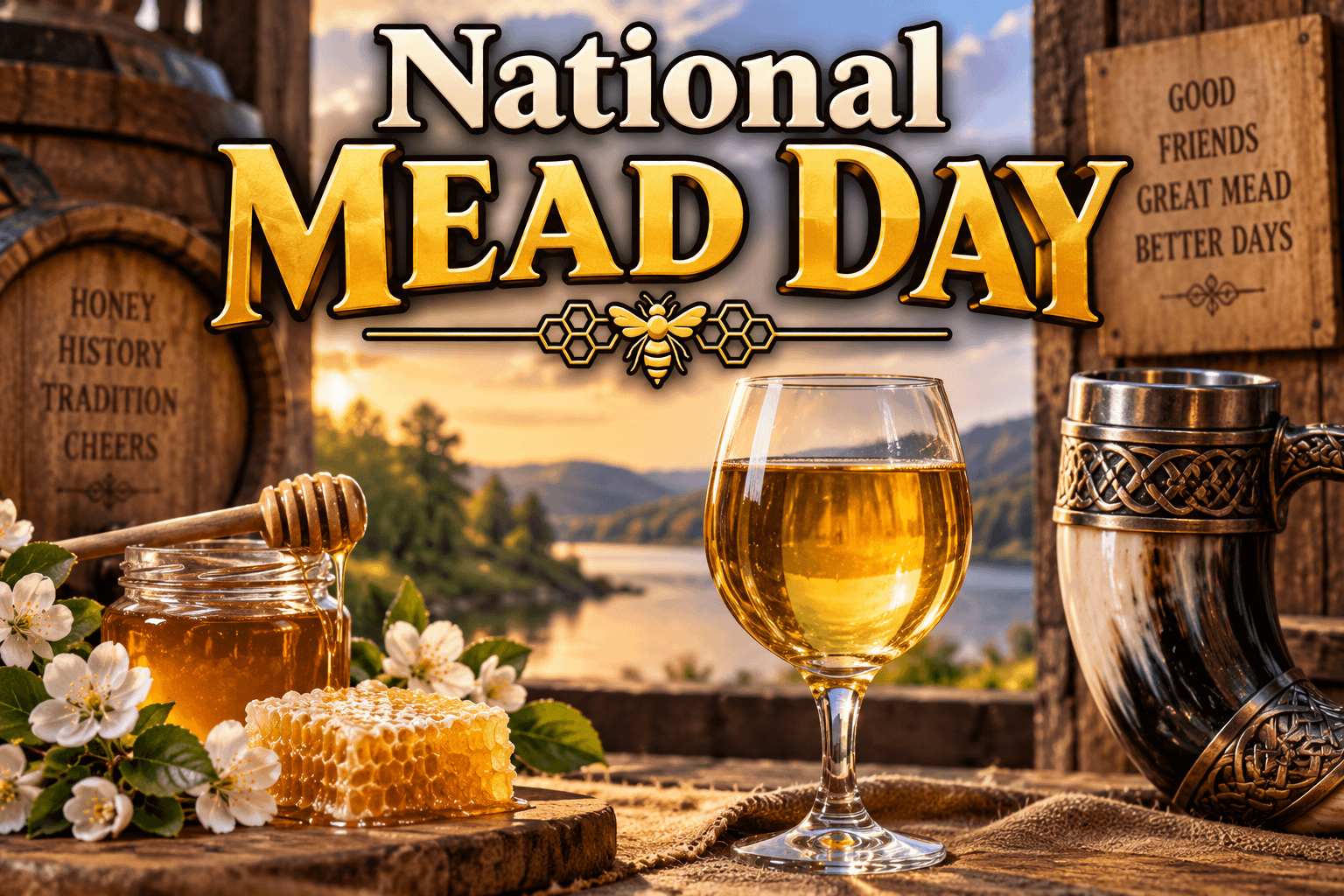
Every year, National Mead Day gives people an opportunity to raise a glass to one of humanity’s oldest fermented beverages. Made primarily from honey, water, and yeast, mead has been enjoyed in different forms for thousands of years and has connections to cultures across Europe, Africa, and Asia.
While beer, wine, and spirits dominate modern conversations about alcoholic drinks, mead occupies a fascinating category of its own. It can be sweet or dry, still or sparkling, light and refreshing or rich and complex. Fruits, herbs, spices, and other ingredients can transform a basic honey mead into something entirely different.
National Mead Day is a celebration of that history, but it is also an opportunity to discover the growing world of modern meadmaking.
When Is National Mead Day?
National Mead Day is traditionally celebrated on the first Saturday in August.
The observance has become especially popular among homebrewers, meadmakers, history enthusiasts, and people interested in traditional fermentation.
Because the date changes from year to year, National Mead Day isn’t tied to one particular calendar date. Instead, the first Saturday of August provides an annual opportunity for people to learn about mead, taste different varieties, visit a local meadery, or even try making their own.
What Exactly Is Mead?
At its simplest, mead is a fermented beverage produced using honey, water, and yeast.
Yeast consumes fermentable sugars from the honey and converts them primarily into alcohol and carbon dioxide. The process sounds straightforward, but changing the ingredients, fermentation methods, sweetness, aging, and flavor additions can produce dramatically different beverages.
This versatility is one reason describing mead as simply “honey wine” doesn’t tell the entire story.
Although the phrase is commonly used because it helps people understand what mead is, mead has its own traditions, terminology, and production methods.
A traditional mead might allow honey to take center stage, while another could include berries, apples, cinnamon, cloves, vanilla, peppers, or other ingredients.
There isn’t just one way for mead to taste.
An Ancient Beverage
One of the most fascinating things about mead is its long history.
Humans have harvested and consumed honey since prehistoric times, and archaeological evidence shows that fermented beverages containing honey existed thousands of years ago.
Ancient peoples didn’t necessarily produce beverages using the standardized recipes and fermentation equipment available today. Fermentation could happen naturally when wild yeast encountered sugars under favorable conditions.
Over generations, people learned how to intentionally create and improve fermented drinks.
Honey became an especially valuable ingredient because of its sweetness and its importance in cultures where refined sugar wasn’t readily available.
Different forms of honey-based fermented beverages eventually appeared around the world.
Mead and Ancient Cultures
Mead is frequently associated with northern Europe, particularly the Norse and Viking worlds.
That connection is real, but the history of fermented honey beverages extends considerably beyond Scandinavia.
Honey-based alcoholic drinks appeared in numerous cultures, sometimes independently of one another.
Different societies combined locally available ingredients with honey and fermentation techniques, creating beverages that reflected their environments.
The result wasn’t necessarily identical to the mead found at a modern meadery.
Instead, these ancient beverages demonstrate something universal about human history: people have experimented with fermentation for a very long time.
Mead and Norse Tradition
Few historical associations with mead are as famous as the Vikings.
Mead appears throughout Norse mythology and literature, helping create the modern image of warriors gathering inside enormous halls and drinking from horns.
One particularly famous myth concerns the Mead of Poetry.
According to Norse mythology, this extraordinary mead was associated with wisdom and poetic inspiration. The story became part of a larger tradition connecting mead with knowledge, celebration, storytelling, and social gatherings.
Modern popular culture has strengthened the Viking-mead connection even further.
Historical festivals, Viking-themed restaurants, fantasy entertainment, Renaissance fairs, and craft beverage producers have all helped introduce new generations to mead.
Mead in Medieval Europe
Mead continued to be consumed during the medieval period, although its importance varied considerably by location and era.
Honey was extremely valuable.
It wasn’t merely something people stirred into food for sweetness. Honey could be used for cooking, preservation, medicine, and fermentation, while beeswax had numerous practical uses.
As agriculture expanded and other fermented beverages became easier or less expensive to produce, beer and wine increasingly dominated many regions.
Mead never completely disappeared, however.
Traditional meadmaking survived in different places, eventually becoming part of the modern craft fermentation revival.
Why Did Mead Become Less Common?
If mead has such a long history, why isn’t it as common as beer or wine?
Economics provides part of the explanation.
Making substantial quantities of mead requires substantial amounts of honey.
Producing beer from grain or wine from grapes became practical on large scales in regions suited to those agricultural products. Changing farming systems, trade networks, consumer preferences, and industrial production eventually allowed beer and wine to dominate much of the alcoholic beverage market.
Honey remained valuable.
That made producing mead comparatively expensive in many circumstances.
Today, however, its relative rarity is part of its appeal.
The Modern Mead Revival
Craft beverage culture has brought renewed attention to mead.
Just as small breweries helped introduce consumers to unusual styles of beer, modern meaderies are experimenting with honey varieties, fruit, spices, aging techniques, carbonation, and fermentation.
Some producers create traditional meads designed to showcase the character of a particular honey.
Others take an experimental approach.
You might encounter meads flavored with:
- Blueberries
- Blackberries
- Raspberries
- Cherries
- Apples
- Peaches
- Cinnamon
- Vanilla
- Ginger
- Cloves
- Coffee
- Chocolate
- Hot peppers
- Herbs
The possibilities are enormous because honey works with many different flavor profiles.
Not All Honey Tastes the Same
One of the most interesting things to discover about mead is the importance of honey itself.
Honey isn’t simply sugar.
Its aroma, flavor, color, and character can vary depending on the flowers visited by the bees, geographic location, season, processing, and other factors.
Orange blossom honey can taste very different from buckwheat honey.
Clover honey can be different from wildflower honey.
A skilled meadmaker can select honey much like a winemaker chooses particular grapes.
In traditional meads, where relatively few additional flavors are present, those differences can become especially noticeable.
Different Types of Mead
Learning a few traditional terms makes exploring mead even more interesting.
Traditional Mead: Primarily made with honey, water, and yeast, allowing the honey character to remain prominent.
Melomel: Mead made with fruit.
Cyser: Mead made with apples or apple juice.
Pyment: Mead produced with grapes or grape juice.
Metheglin: Mead flavored with herbs or spices.
Braggot: A beverage combining characteristics of mead and beer, generally involving honey and malted grain.
There are numerous variations within these broad categories.
Modern meadmakers aren’t necessarily restricted by historical definitions either. Creativity has become an important part of contemporary mead culture.
Sweet Mead vs. Dry Mead
A common misconception is that every mead must be extremely sweet because it begins with honey.
That’s not necessarily true.
During fermentation, yeast consumes sugars. Depending on the recipe and fermentation process, the finished mead can range from very dry to intensely sweet.
A dry mead may have little residual sweetness while still retaining floral aromas and characteristics from the honey.
Semi-sweet mead falls somewhere between the two extremes.
Dessert-style meads can intentionally preserve considerable sweetness.
Someone who tries one sweet mead and doesn’t enjoy it shouldn’t necessarily assume they dislike mead altogether.
Another style could taste completely different.
Still or Sparkling?
Mead can also be produced as either still or carbonated.
Still mead has little or no carbonation and may resemble wine in presentation.
Sparkling mead introduces carbonation, creating an entirely different drinking experience.
Some modern producers also make lighter, lower-alcohol carbonated meads designed to be refreshing and easy to drink.
This diversity is one of the biggest reasons National Mead Day is worth celebrating.
There’s always another style to discover.
How Mead Is Made
The basic process starts by combining honey and water to create a fermentable mixture sometimes called a must.
Yeast is introduced, and fermentation begins.
From there, meadmaking becomes considerably more complex.
Temperature, yeast strain, honey selection, nutrient management, sanitation, acidity, fermentation time, sweetness, and aging can all influence the finished product.
Fruit, spices, or other ingredients may be incorporated at different stages.
Once fermentation is complete, the mead may be clarified and aged before packaging.
Some meads can be enjoyed relatively young, while others benefit from extended aging.
Honey Is the Star
Wine begins with grapes.
Beer traditionally begins with grain.
Mead begins with honey.
That relationship makes mead particularly interesting because it connects fermentation with agriculture, flowers, landscapes, and beekeeping.
The plants surrounding a hive influence the nectar available to bees.
The nectar influences the honey.
And the honey can influence the finished mead.
A bottle of traditional mead can therefore reflect its ingredients and place of origin in surprisingly complex ways.
How to Celebrate National Mead Day
You don’t have to be an experienced mead drinker to participate.
National Mead Day is actually a perfect opportunity to try it for the first time.
Visit a local meadery and order a tasting flight if one is available. Sampling several small pours allows you to compare dry, semi-sweet, fruit, spiced, and traditional styles.
You can also look for mead at specialty beverage shops.
Another option is learning about home meadmaking. Experienced homebrewers may use National Mead Day as an excuse to begin a new batch or share previous creations with friends.
You could even turn the day into a history lesson.
Read about ancient fermentation, beekeeping, Norse mythology, medieval drinking traditions, or the science behind honey.
There is much more behind a glass of mead than simply alcohol.
Host a Mead Tasting
One enjoyable way to celebrate is by hosting a small mead tasting.
Choose several noticeably different styles.
For example, you might compare:
Traditional Mead – highlights honey.
Berry Melomel – showcases fruit.
Cyser – combines honey and apple.
Metheglin – introduces spices or herbs.
Sparkling Mead – provides a lighter carbonated experience.
Pour small tasting portions and compare aroma, sweetness, acidity, honey character, fruitiness, and finish.
Remember that alcohol percentages can vary considerably between products, so check each label and serve responsibly.
Pairing Mead With Food
Mead can also be fascinating at the dinner table.
The best pairing depends heavily on the mead’s sweetness, acidity, alcohol content, and added flavors.
Dry meads may pair well with roasted meats, poultry, seafood, or cheese.
Fruit meads can complement barbecue, charcuterie, desserts, and dishes featuring similar fruits.
Spiced meads can work beautifully with autumn meals containing cinnamon, cloves, nutmeg, roasted vegetables, or savory herbs.
Sweet dessert meads may pair nicely with pastries, fruit desserts, chocolate, or strong cheeses.
Experimentation is part of the fun.
Mead and the Importance of Bees
National Mead Day can also be an opportunity to appreciate the extraordinary creatures responsible for its essential ingredient.
Honeybees collect nectar from flowers and transform it into honey inside the hive.
Their activities also contribute to pollination in agricultural and natural ecosystems.
Without bees, there would be no traditional honey mead.
Buying honey from local beekeepers, planting pollinator-friendly flowers where appropriate, learning about responsible beekeeping, and supporting healthy habitats are all ways people can deepen their appreciation for the connection between honey and the environment.
Mead Is History You Can Taste
Perhaps the most compelling thing about mead is the way it connects modern drinkers with an extremely old human tradition.
Imagine people thousands of years ago discovering that honey mixed with water could ferment.
They didn’t understand yeast microbiology the way we do today.
But they understood the result.
A naturally occurring biological process transformed simple ingredients into something entirely new.
Generations refined those discoveries.
Today, modern meadmakers combine that ancient idea with precise fermentation equipment, microbiology, temperature control, sanitation practices, and creative ingredients.
The technology changed.
The basic magic of fermentation remained.
Raise a Glass to National Mead Day
National Mead Day isn’t simply an excuse to drink something different.
It’s a celebration of honey, fermentation, craftsmanship, history, agriculture, and human curiosity.
From ancient fermented honey beverages to Viking legends and medieval traditions to today’s innovative craft meaderies, mead has traveled an extraordinary path.
And despite being thousands of years old, it continues to evolve.
Modern meadmakers are proving that one of humanity’s oldest fermented beverages still has plenty of room for experimentation.
So on the first Saturday in August, consider discovering what mead has to offer.
Try a traditional mead. Compare different honey varieties. Visit a meadery. Learn about bees. Explore the history behind your glass.
And if you’re sharing that glass with friends, take a moment to appreciate just how long humans have been gathering together around fermented honey.
Have you ever tried mead, and if so, do you prefer it sweet, dry, fruity, spiced, or sparkling?
Leave a ReplyCancel reply