Category: Inspiration & Motivation

  • When You Get Disappointed and Hurt: Learning to Breathe Through the Break

    When You Get Disappointed and Hurt: Learning to Breathe Through the Break

    Disappointment and hurt rarely announce themselves with noise. They don’t always arrive as dramatic endings or explosive confrontations. More often, they slip quietly into moments that were supposed to feel safe, meaningful, or hopeful. A promise that wasn’t kept. A person who didn’t show up. An outcome that fell painfully short of what you believed was possible.

    And suddenly, something inside you tightens.

    Disappointment is not just about what happened—it’s about what should have been. It is the gap between expectation and reality. Hurt is what follows when that gap cuts deeper than we anticipated. Together, they form a kind of emotional ache that doesn’t always have words, but carries weight all the same.

    We all live with expectations, whether we admit it or not. We expect honesty when we offer trust. We expect care when we give love. We expect effort when we invest time, energy, and emotion. These expectations are not unreasonable—they are human. They come from our desire to connect, to belong, and to believe that what we give to the world will, in some form, be returned.

    But life does not always meet us where we stand.

    Sometimes people fall short of what we hoped they would be. Sometimes circumstances undo our best plans. Sometimes dreams we nurtured quietly for years dissolve in a single moment. And when that happens, the pain can feel personal, even when it isn’t meant to be.

    What makes disappointment especially heavy is that it rarely exists in isolation. It often reawakens old wounds—past betrayals, broken relationships, moments when you felt overlooked, abandoned, or misunderstood. One new hurt can echo a hundred old ones. You may find yourself thinking, Here it is again. This always happens. Why do I keep believing?

    That question can be more painful than the event itself.

    When you are disappointed, it’s easy to turn inward with blame. You might question your judgment. You might replay conversations, searching for the moment where things went wrong. You might wonder if you expected too much, trusted too easily, or cared more than you should have. Hurt has a way of making us doubt not only others—but ourselves.

    Yet disappointment does not mean you were foolish for hoping. Hurt does not mean you were weak for caring. In fact, these emotions are evidence of something profoundly human within you: your capacity to believe in better, to invest emotionally, and to imagine possibilities beyond what already exists. The pain is there because something mattered.

    Still, knowing this doesn’t always make it easier to carry.

    There are days when disappointment feels heavy in your chest, when it follows you into quiet moments and interrupts your thoughts. You may withdraw, emotionally or physically, as a form of self-protection. You may become cautious with your words, guarded with your heart, afraid of opening yourself up to another letdown. This instinct to protect yourself is natural. Pain teaches us to be careful.

    But there is a difference between protecting your heart and building walls around it.

    When hurt hardens into isolation, it can begin to limit your life. You may stop sharing your hopes. You may avoid deep connections. You may settle for less than you truly want simply to avoid the possibility of being disappointed again. In trying to prevent pain, you may also prevent joy, intimacy, and growth.

    Healing does not mean pretending you are unaffected. It does not mean forcing yourself to “be strong” or telling yourself that it doesn’t matter. Healing begins with honesty—allowing yourself to feel what you feel without minimizing it.

    Name the disappointment. Acknowledge the hurt. Write it out. Sit with it in stillness. Speak it to someone you trust. Emotions lose some of their power when they are brought into the light rather than buried in silence. You do not have to justify your pain for it to be real.

    It is also important to gently separate what happened from who you are. Being disappointed does not mean you are unworthy. Being hurt does not mean you are broken. Sometimes it simply means that two realities did not align. People make choices from their own fears, limitations, and struggles—many of which have little to do with your value as a person.

    Not every loss is a reflection of your inadequacy. Not every rejection is proof that you are “too much” or “not enough.” Often, it is simply evidence that something—or someone—was not able to meet you at the depth you deserved.

    Over time, disappointment can become a teacher.

    It reveals what you truly need, not just what you hoped for. It shows you where your boundaries need strengthening and where your expectations need clarity. It helps you distinguish between those who are capable of showing up consistently and those who are not. And sometimes, it redirects you—away from paths that were never meant to sustain you, and toward ones that better align with who you are becoming.

    This doesn’t make the pain meaningless, but it can make it purposeful.

    There is also a quiet strength that grows from surviving emotional hurt. You learn that you can endure moments that once felt unbearable. You learn how to hold grief without letting it define you. You learn that vulnerability is not a flaw, but a form of courage. Each time you choose to keep going—to keep trusting, to keep caring—you prove that disappointment does not get to write the final chapter of your story.

    And yes, you will be disappointed again. Life is imperfect. People are imperfect. Dreams sometimes unravel. But you will also experience moments of unexpected kindness, deep connection, and quiet fulfillment. You will meet people who show up in ways you never imagined. You will find meaning in places you once overlooked. You will discover that your heart, though wounded at times, is also remarkably resilient.

    Most importantly, do not let disappointment convince you to stop hoping.

    Hope is not naïve—it is brave. It is the choice to believe in possibility even after you’ve been let down. It is the decision to remain open in a world that has given you reasons to close off. Every time you allow yourself to hope again, you are choosing life over fear.

    When you are disappointed and hurt, be gentle with yourself. You are not weak for feeling deeply. You are not wrong for wanting more than what was offered. You are human, navigating a world that does not always make sense.

    And one day, what once broke your heart will simply be a chapter—a reminder that even in the midst of disappointment and hurt, you kept breathing, kept believing, and kept becoming.

    Read More Of Inspiration & Motivation
  • Everything Starts With Honesty

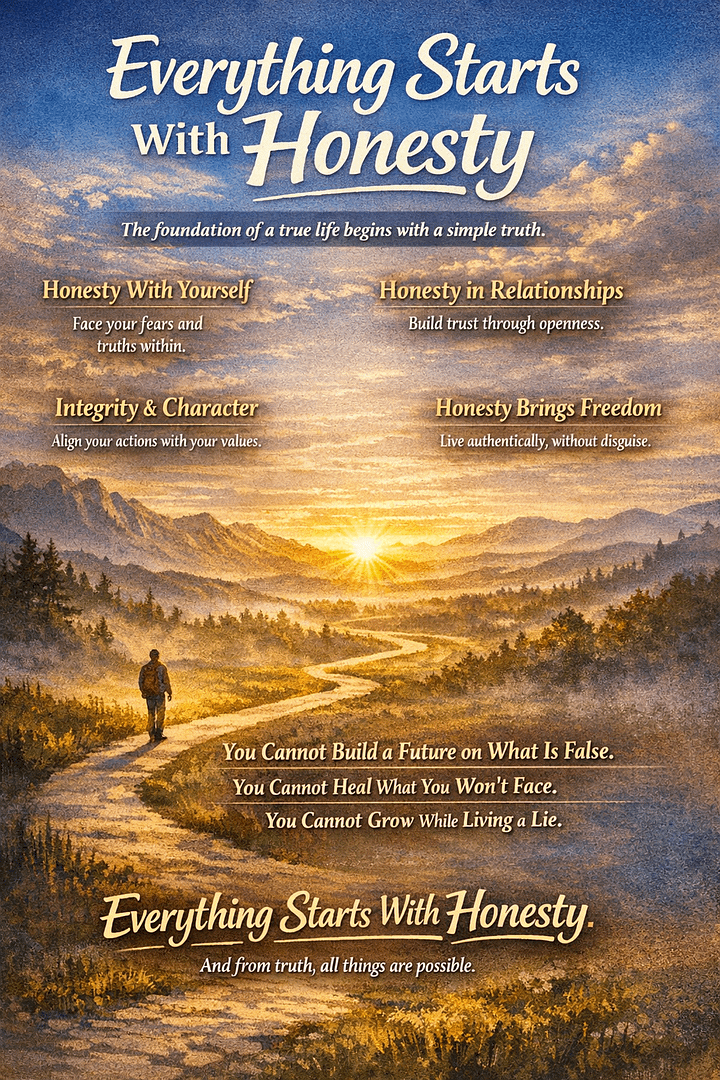
    Everything Starts With Honesty

    Honesty is often described as a virtue, a character trait, or a moral expectation. But in reality, it is something far more fundamental: it is the starting point of everything that truly matters. Before trust can be built, before healing can begin, before success can last, and before relationships can deepen, there must be truth. Without honesty, progress is an illusion. With it, even the most difficult realities become workable.

    We live in a world that often rewards appearances over authenticity. Social media filters reality. Professional environments sometimes value performance over transparency. Even in personal relationships, people hide parts of themselves to avoid rejection, conflict, or vulnerability. But while dishonesty may feel safer in the moment, it always comes at a cost. Eventually, what is hidden becomes heavier than what is revealed.

    Everything starts with honesty—especially the life you are trying to build.

    The Courage to Be Honest With Yourself

    The most important truth is also the hardest: the truth you tell yourself.

    Self-honesty requires facing uncomfortable realities. It means acknowledging when you are unhappy instead of pretending everything is fine. It means admitting when you are afraid, when you have made mistakes, or when you are holding onto something that no longer fits who you are becoming. It means recognizing patterns that repeat in your life and accepting your role in them.

    Many people avoid this kind of honesty because it threatens the stories they have built about themselves. We tell ourselves we are “just tired,” when we are actually burned out. We say “this is fine,” when something inside us knows it is not. We blame circumstances, other people, or bad luck when the deeper truth is that we are afraid to change.

    But growth does not begin with motivation. It begins with truth.

    You cannot heal what you refuse to acknowledge. You cannot improve what you will not examine. Self-honesty is not about self-judgment—it is about clarity. Once you are honest about where you are, you finally gain the power to choose where you are going.


    Honesty in Relationships: Where Trust Is Born

    Every meaningful relationship stands or falls on honesty. Trust is not built through perfection; it is built through truth. People do not need you to be flawless—they need you to be real.

    Dishonesty in relationships does not always appear as obvious lies. Sometimes it shows up as silence when something matters, avoidance when conflict is needed, or half-truths meant to “keep the peace.” Over time, these small omissions create emotional distance. What is not said becomes heavier than what is.

    Honesty does not mean brutal honesty. It does not mean speaking without care or compassion. True honesty is rooted in respect—it is about sharing truth in a way that seeks understanding, not harm. It means expressing your needs instead of expecting others to guess them. It means addressing problems before resentment grows. It means being willing to have difficult conversations because the relationship matters more than temporary comfort.

    When honesty is present, relationships gain stability. When it is absent, even the strongest bonds begin to fracture.


    Integrity: When Honesty Becomes Action

    Honesty is not only about what you say—it is about what you do. This is where honesty becomes integrity.

    Integrity is the alignment between your values and your behavior. It is choosing what is right even when no one is watching. It is keeping your word, admitting when you are wrong, and taking responsibility when it would be easier to shift blame.

    In a culture that often celebrates shortcuts and appearances, integrity can feel slow and inconvenient. But what is built without honesty is never secure. Success that depends on deception eventually collapses. Relationships built on falsehood eventually break. A reputation created through manipulation eventually fades.

    A life built on honesty, however, endures.

    When your actions reflect your values, you gain something more valuable than approval: self-respect. And self-respect is the foundation of confidence, leadership, and lasting influence.


    Honesty and Emotional Freedom

    There is a unique kind of freedom that comes from telling the truth. When you stop pretending, hiding, or performing, your mind becomes lighter. You no longer carry the burden of maintaining versions of yourself for different people. You simply exist as who you are.

    Honesty allows you to set boundaries. It gives you permission to say no without guilt, to ask for help without shame, and to walk away from what does not align with your well-being. It teaches you that protecting your truth is not selfish—it is necessary.

    Living honestly also means accepting your limitations. You are not required to be everything to everyone. You are allowed to admit when something is too much, when you are uncertain, or when you need time to grow. This kind of honesty fosters emotional maturity and strengthens resilience.

    When you live in truth, you no longer waste energy maintaining what is false. You use that energy to build what is real.


    Honesty in Healing and Growth

    Every journey of healing begins with acknowledgment. Whether the pain comes from loss, betrayal, failure, or personal struggle, progress does not start with positivity—it starts with honesty.

    You must first name what hurts.

    Avoidance delays healing. Minimizing pain does not make it disappear. But when you allow yourself to say, “This affected me,” or “I am not okay,” you take back control. Honesty gives pain a voice, and once something has a voice, it can be understood, processed, and eventually transformed.

    The same is true for personal growth. Change does not begin with ambition alone. It begins with an honest assessment of where you are, what you need, and what must change. Without that clarity, goals remain fantasies. With it, they become plans.


    Choosing Honesty Every Day

    Honesty is not a single decision—it is a daily practice. It shows up in small moments: telling the truth when it would be easier to stay silent, admitting mistakes instead of defending them, and choosing transparency over image.

    This practice requires courage. Truth is not always comfortable. It may disrupt relationships, challenge routines, or force you to confront realities you would rather avoid. But discomfort is temporary. The consequences of dishonesty last far longer.

    Every time you choose honesty, you strengthen the foundation of your life. You create relationships that are real, goals that are achievable, and a sense of self that does not depend on approval or illusion.


    The Foundation of Everything

    You cannot build a future on what is false.
    You cannot repair what you refuse to acknowledge.
    You cannot become who you are meant to be while hiding from who you are.

    Whether you are trying to rebuild trust, heal old wounds, pursue a new path, or redefine your identity, the starting point is always the same.

    Everything starts with honesty.

    And from that truth, everything else becomes possible.

    Read More Of Love & Relationships

    Read More Of Inspiration & Motivation
  • I’m Not Going to Take It Anymore Day: Reclaiming Your Voice, Boundaries, and Self-Respect

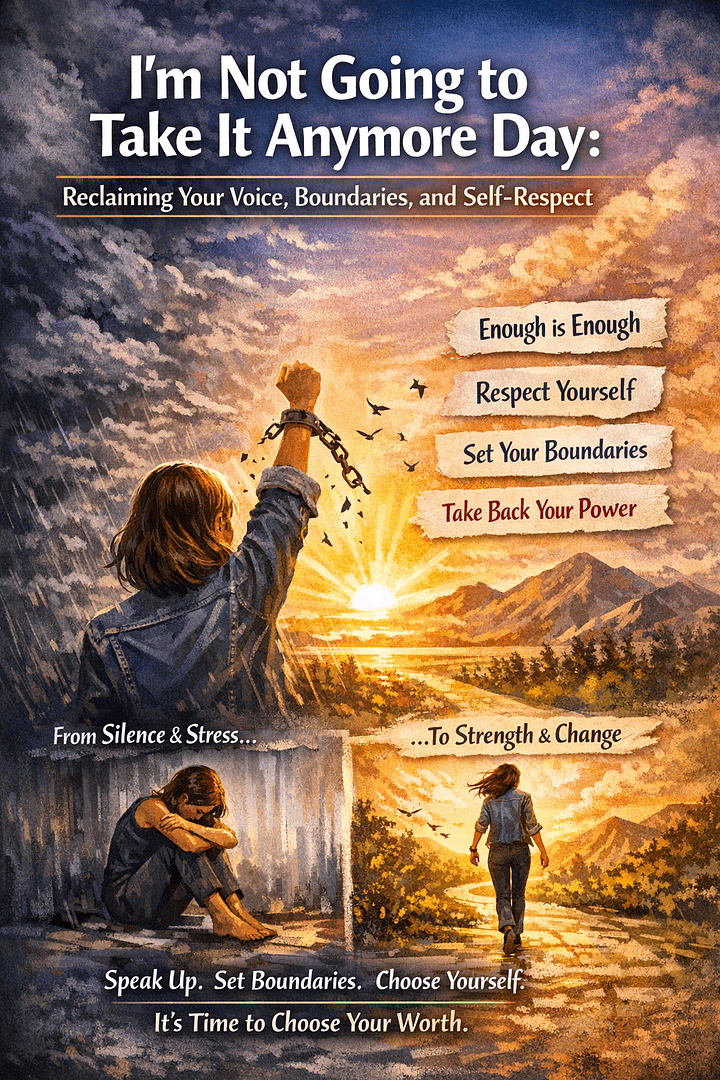
    I’m Not Going to Take It Anymore Day: Reclaiming Your Voice, Boundaries, and Self-Respect

    There comes a moment in every life when endurance stops feeling noble and starts feeling harmful. When “just getting through it” costs more than it gives. I’m Not Going to Take It Anymore Day exists for that moment—the quiet, powerful turning point when you realize that something in your life is no longer sustainable, no longer healthy, and no longer worthy of your energy.

    This day is not about rage, rebellion, or dramatic ultimatums. It is about awareness. It is about finally listening to the voice inside that has been whispering—sometimes for years—that you deserve better. It is the day when survival is no longer enough, and self-respect begins to take its rightful place.


    When Endurance Turns into Self-Neglect

    We are often praised for how much we can handle. For staying strong, being patient, “keeping the peace,” and pushing through discomfort. Endurance is treated like a virtue, even when it costs us our mental health, our sense of identity, or our joy.

    But there is a difference between resilience and self-abandonment.

    Resilience helps you rise after hardship.
    Self-abandonment keeps you trapped inside it.

    Many people remain in situations that slowly erode them—unhealthy relationships, draining jobs, emotional neglect, or even harmful habits—because leaving feels scary, confrontational, or uncertain. We tell ourselves: It could be worse. I should be grateful. I don’t want to rock the boat. And so we stay, shrinking a little more each day.

    “I’m Not Going to Take It Anymore Day” reminds us that reaching your limit is not a failure. It is awareness. It is the moment you stop numbing yourself to what hurts and start honoring what matters.


    Naming What You’re Done Accepting

    This day invites honest reflection—without guilt, without judgment.

    What have you been tolerating that quietly drains you?

    • A relationship where your needs are consistently dismissed.

    • A workplace that values productivity over your well-being.

    • A cycle of people-pleasing that leaves you exhausted and unseen.

    • A pattern of negative self-talk that tells you to settle for less.

    Sometimes what we’re “not taking anymore” isn’t something outside of us—it’s something we’ve been carrying within. Old beliefs that say you must earn love by overgiving. Fear that tells you change is too risky. Guilt that convinces you to stay where you are uncomfortable so others can remain comfortable.

    Letting go of these patterns is not selfish. It is necessary.


    The Courage to Say “Enough”

    Saying “I’m not going to take it anymore” does not always mean confrontation or walking away. Sometimes it means making a quiet but firm decision inside yourself: I will no longer ignore my needs.

    It can look like:

    • Speaking up instead of staying silent.

    • Asking for respect instead of accepting disregard.

    • Creating space where you’ve always felt crowded.

    • Choosing rest where you once chose burnout.

    This kind of courage is often invisible to the outside world, but it changes everything on the inside. It shifts the way you see yourself—from someone who endures to someone who chooses.


    Boundaries: The Language of Self-Respect

    At the heart of this day is the concept of boundaries. Boundaries are not punishments. They are not walls built out of anger. They are expressions of clarity and self-worth.

    When you say:

    • “I will not tolerate being spoken to this way,”

    • “I need balance in my life,”

    • “This situation is no longer healthy for me,”

    you are not being difficult—you are being honest.

    Healthy boundaries teach others how to treat you, but more importantly, they teach you that your time, energy, and emotional well-being matter. Every boundary you set is a declaration that you value yourself enough to protect what is precious.


    Change Doesn’t Have to Be Loud to Be Real

    Not every turning point comes with dramatic exits or bold announcements. Sometimes change begins in quiet, steady ways:

    • Choosing not to respond to what drains you.

    • Taking one small step toward something better.

    • Releasing one obligation that no longer fits who you are becoming.

    You don’t need to have everything figured out to begin. You only need the willingness to stop betraying your own needs.

    “I’m Not Going to Take It Anymore Day” is not about perfection or instant transformation. It is about momentum. About choosing, again and again, not to return to what diminishes you.


    Choosing Peace Over Approval

    One of the hardest parts of change is the fear of disappointing others. We worry about being misunderstood. About being labeled “too sensitive,” “too much,” or “selfish.” But choosing yourself will always upset any system that benefits from your silence.

    And that is okay.

    You were never meant to live your life solely to meet expectations that cost you your peace. Growth often requires discomfort—both yours and others’. But the discomfort of change is temporary. The discomfort of staying where you are unhappy can last a lifetime.


    Your Turning Point

    “I’m Not Going to Take It Anymore Day” is an invitation. Not to fight the world—but to stand with yourself. To stop carrying what is not yours to bear. To choose dignity over endurance, clarity over fear, and self-respect over quiet suffering.

    Whatever you have been tolerating that no longer aligns with who you are becoming—today is a day to acknowledge it. To honor your limits. To remind yourself that you are allowed to change your mind, rewrite your story, and step away from what no longer serves you.

    Because the moment you decide you will not accept what diminishes you is the moment you begin to reclaim your life.

    Read More Health & Wellness

    Read More Of Inspiration & Motivation
  • Motivation and Inspiration Day: Finding the Spark That Keeps Us Moving Forward

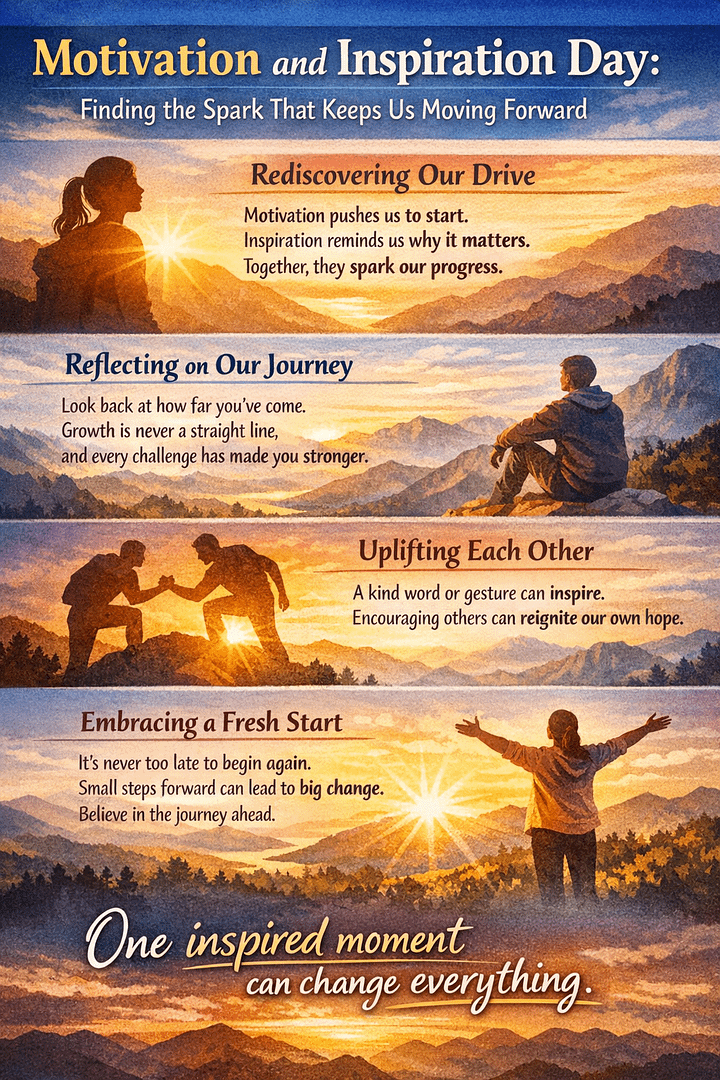
    Motivation and Inspiration Day: Finding the Spark That Keeps Us Moving Forward

    Motivation and Inspiration Day serves as a meaningful reminder that no matter where we are in life, we all need encouragement to keep going. In a world filled with constant noise, pressure, and comparison, it’s easy to feel stuck, exhausted, or unsure of our direction. This day invites us to slow down, reconnect with our purpose, and rediscover the spark that fuels progress and hope.

    Motivation is often born from within. It’s the inner drive that pushes us to begin, to try again, and to take responsibility for our own growth. Some days, motivation feels strong and effortless. Other days, it’s quiet and fragile, requiring intention and patience to uncover. Motivation doesn’t always appear as excitement or ambition—it can show up as discipline, resilience, or simply the decision not to give up.

    Inspiration complements motivation by reminding us why our efforts matter. Inspiration often comes from outside ourselves: a story of perseverance, a quote that resonates deeply, a moment of beauty, or witnessing someone else rise after hardship. These moments can shift our perspective and help us see possibilities beyond our current struggles. Inspiration doesn’t demand perfection; it encourages belief—belief that change is possible and that our dreams are worth pursuing.

    Motivation and Inspiration Day is also a time for reflection. It encourages us to look back at the challenges we’ve faced and recognize the strength it took to overcome them. Growth rarely follows a straight line. Setbacks, pauses, and detours are part of every journey. Honoring how far we’ve come—even when progress feels slow—builds confidence and renews our sense of purpose.

    This day reminds us of the power we hold in uplifting others. A kind message, a word of encouragement, or simply acknowledging someone’s effort can have a lasting impact. Motivation is contagious, and inspiration multiplies when shared. Sometimes, being a source of hope for someone else helps reignite our own sense of meaning.

    Most importantly, Motivation and Inspiration Day reassures us that it’s never too late to start again. Whether you’re pursuing a new goal, healing from loss, redefining your path, or just trying to get through the day, your journey matters. Let this day be a gentle reminder that even small steps create momentum—and that within you, and around you, there is always something worth believing in.

    Because one inspired thought, one motivated action, can be the beginning of lasting change.

    Read More Holidays & National Days

    Read More Of Inspiration & Motivation