
Communication is often called the foundation of every successful relationship. While speaking honestly is important, there is another skill that is even more powerful—and often overlooked.
Listening.
Not just hearing someone’s words, but truly listening with the intention of understanding what they’re feeling, thinking, and experiencing.
Today’s love tip is simple but incredibly meaningful:
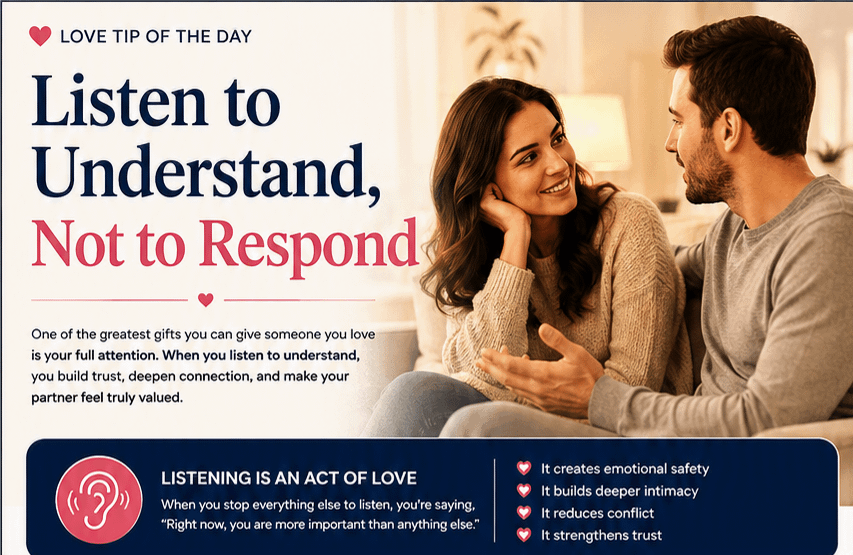
Listen to understand, not to respond.
Many relationship conflicts don’t begin because two people don’t love each other. They begin because two people stop feeling heard.
When your partner believes you’re only waiting for your turn to talk, conversations become frustrating. But when they know you’re genuinely trying to understand them, walls begin to fall, trust grows, and love deepens.
Listening is one of the purest ways to tell someone, “You matter to me.”
Why Listening Is an Act of Love
Love is often expressed through hugs, kisses, gifts, and kind words.
But one of the greatest demonstrations of love is giving someone your undivided attention.
In today’s world, distractions are everywhere. Phones buzz. Notifications appear. Televisions play in the background. Work follows us home. Social media constantly competes for our attention.
Yet nothing makes someone feel more important than knowing they have your full focus.
When you stop everything else to listen, you’re saying:
“Right now, you are more important than anything else.”
That message creates emotional security.
Everyone longs to feel seen.
Everyone longs to feel heard.
Everyone longs to know that what they say matters.
Hearing Isn’t the Same as Listening
Many people believe they’re good listeners simply because they stay quiet while someone else talks.
But silence alone isn’t listening.
There are several levels of communication:
Hearing
You notice the words.
Listening
You understand the message.
Empathetic Listening
You understand both the message and the emotions behind it.
Empathetic listening is where relationships flourish.
Instead of asking:
“What should I say next?”
You begin asking:
“What is my partner really trying to tell me?”
Those are two completely different conversations.
Why We Often Listen to Respond
Most of us learned communication habits long before we entered relationships.
When conversations become emotional, our brains naturally begin preparing a response.
We might think:
- “That’s not what happened.”
- “I need to defend myself.”
- “I have a better explanation.”
- “They’re wrong.”
- “Here’s how to fix this.”
Instead of listening, we’re mentally building our argument.
By the time our partner finishes speaking, we’ve missed half of what they actually said.
Unfortunately, they notice.
Nothing is more discouraging than pouring out your heart to someone who was never really listening.
Understanding Doesn’t Mean Agreeing
One of the biggest misconceptions about listening is believing that understanding someone’s feelings means admitting they’re right.
It doesn’t.
You can understand someone’s emotions without agreeing with every conclusion they’ve reached.
For example:
“I understand why that hurt you.”
is very different from saying:
“You’re right about everything.”
Healthy couples validate emotions before debating facts.
Feelings deserve acknowledgment.
Facts can be discussed later.
When someone feels emotionally understood, they’re usually far more willing to hear your perspective.
Your Partner Doesn’t Always Need a Solution
Many people—especially those who naturally enjoy solving problems—immediately begin offering advice.
Sometimes advice is helpful.
Sometimes it’s exactly what your partner needs.
But often, people aren’t looking for answers.
They’re looking for comfort.
Imagine your partner comes home after a difficult day at work.
Instead of immediately saying:
“You should quit.”
or
“Here’s what I’d do.”
Try asking:
“Do you want advice, or do you just need me to listen?”
That simple question can completely change the conversation.
It tells your partner that you’re willing to meet their emotional needs rather than assuming what they need.
The Power of Feeling Heard
Think back to a time when someone truly listened to you.
Maybe they:
- Maintained eye contact.
- Didn’t interrupt.
- Asked thoughtful questions.
- Remembered small details.
- Allowed silence without rushing you.
- Made you feel understood.
How did that make you feel?
Probably respected.
Valued.
Important.
Safe.
Now imagine giving your partner that same experience every day.
That’s the power of intentional listening.
Listening Creates Emotional Safety
Emotional safety is the ability to be yourself without fear of judgment, ridicule, or rejection.
When emotional safety exists, people share:
- Their fears.
- Their dreams.
- Their insecurities.
- Their mistakes.
- Their hopes.
- Their disappointments.
Without emotional safety, people slowly begin hiding parts of themselves.
They stop talking.
They stop opening up.
They stop trusting.
Eventually, emotional distance replaces emotional intimacy.
Listening is one of the fastest ways to rebuild that safety.
Learn to Listen Beyond the Words
People don’t always say exactly what they mean.
Sometimes the words only hint at what’s happening underneath.
When your partner says:
“I’m fine.”
Are they actually fine?
Or are they tired?
Overwhelmed?
Lonely?
Hurt?
Pay attention to:
- Facial expressions
- Eye contact
- Tone of voice
- Energy level
- Body language
- Long pauses
- Changes in routine
Sometimes silence says more than words ever could.
Avoid These Common Listening Mistakes
Even loving couples accidentally damage conversations through poor listening habits.
Interrupting
Allow your partner to finish completely before responding.
Interruptions communicate:
“My thoughts are more important than yours.”
Minimizing Feelings
Avoid saying:
- “It’s not that bad.”
- “You’re overreacting.”
- “You’ll get over it.”
Even if your intention is encouragement, these statements can make someone feel dismissed.
Comparing Experiences
Instead of saying:
“That happened to me too.”
Ask:
“Tell me more about what you’re feeling.”
Sometimes people simply want their experience to stand on its own.
Turning the Conversation Toward Yourself
Not every story needs your own story in return.
Sometimes your role is simply to listen.
Looking at Your Phone
Nothing destroys meaningful conversation faster than divided attention.
If your phone is more interesting than your partner, your relationship will eventually reflect that.
Ask Better Questions
Curiosity strengthens relationships.
Instead of making assumptions, ask thoughtful questions like:
- “How did that make you feel?”
- “What was the hardest part?”
- “What were you hoping would happen?”
- “What do you need from me right now?”
- “How can I support you?”
- “Can you help me understand your perspective?”
Great questions communicate genuine care.
Reflect Back What You Hear
One of the most effective communication techniques is reflective listening.
Repeat back what you believe your partner said.
For example:
“So you’re saying that when I answered work emails during dinner, you felt like I wasn’t present with you. Did I understand that correctly?”
This accomplishes several things:
- Prevents misunderstandings.
- Makes your partner feel heard.
- Gives them a chance to clarify.
- Slows emotional reactions.
Often, simply hearing their own words reflected back helps people feel validated.
Listen During the Good Times Too
Listening isn’t only important during disagreements.
Celebrate everyday conversations.
Listen when your partner talks about:
- Their hobbies.
- Their dreams.
- Their childhood memories.
- Their favorite books.
- Their work successes.
- Their funny stories.
The strongest relationships are built through thousands of ordinary conversations—not just the difficult ones.
Put Away the Need to Win
Arguments shouldn’t have winners and losers.
If one partner “wins,” the relationship often loses.
Instead of asking:
“How do I prove my point?”
Ask:
“How do we solve this together?”
Healthy couples remember they’re on the same team.
Understanding each other is more valuable than winning an argument.
Listening During Conflict
Conflict isn’t the enemy.
Poor communication is.
When emotions become intense:
- Take a deep breath before responding.
- Let your partner finish speaking.
- Avoid interrupting.
- Focus on understanding first.
- Validate their emotions.
- Speak calmly.
- Stay respectful.
Most arguments calm down when one person chooses understanding over defensiveness.
A Daily Listening Challenge
For the next week, practice these simple habits every day:
- Give your partner five uninterrupted minutes to talk.
- Maintain eye contact.
- Put your phone away.
- Ask at least one follow-up question.
- Repeat back what you heard before responding.
- Thank them for sharing their thoughts.
- Resist the urge to immediately solve the problem.
You may discover that your conversations become deeper, your conflicts become fewer, and your emotional connection grows stronger.
Small changes practiced consistently create lasting relationships.
Love Grows Where Understanding Lives
Every relationship experiences misunderstandings.
No couple communicates perfectly.
What separates thriving relationships from struggling ones isn’t the absence of conflict.
It’s the willingness to understand each other.
Listening requires humility.
It requires patience.
It requires putting another person’s heart ahead of your own desire to be right.
But the reward is worth it.
A relationship built on understanding becomes a place where both people feel safe to be themselves.
And that’s where love grows strongest.
Final Thoughts
Listening is one of the greatest expressions of love because it tells another person:
“Your thoughts matter.”
“Your feelings matter.”
“Your experiences matter.”
“You matter.”
The next time your partner begins speaking, resist the urge to prepare your reply. Slow down. Stay present. Listen with your ears, your mind, and your heart.
You may discover that the words they needed most weren’t the ones you planned to say—but the silence that allowed them to feel truly heard.
Real love isn’t just about speaking from the heart.
It’s about listening with it.
Love Challenge of the Day
Today, spend at least 15 uninterrupted minutes talking with your partner. Put away every distraction, ask open-ended questions, and focus solely on understanding their thoughts and feelings. Don’t offer advice unless they ask for it. Simply listen with empathy and intention.
Quote of the Day
“The deepest conversations begin when we stop listening for our turn to speak and start listening for the chance to understand. Love grows strongest where hearts feel heard.” — Brett Murphy
Leave a ReplyCancel reply