Category: Love

  • The Message I’ll Never Send: Loving in Silence

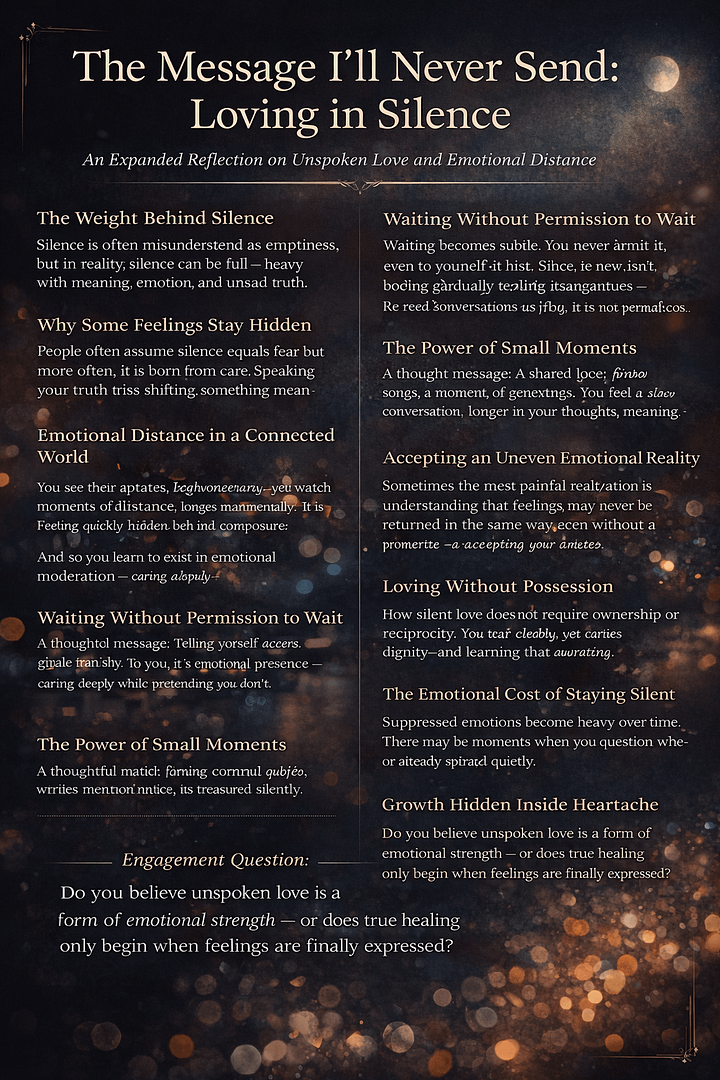
    The Message I’ll Never Send: Loving in Silence

    A Reflection on Unspoken Love and Emotional Distance

    There are words we rehearse endlessly in our minds — sentences shaped perfectly in quiet moments, confessions imagined during sleepless nights, messages typed and erased before they ever reach another person’s screen. These are the messages we never send. Not because they are unimportant, but because they carry the power to change everything.

    Unspoken love exists in a delicate emotional space. It is where longing meets restraint, where honesty battles fear, and where the heart learns how to feel deeply while remaining outwardly calm. It is one of the most human experiences: loving someone while knowing your feelings may never fully belong in their world.

    The Weight Behind Silence

    Silence is often misunderstood as emptiness, but in reality, silence can be full — heavy with meaning, emotion, and unsaid truth. When feelings remain hidden, every quiet moment becomes louder internally.

    You begin to notice absence differently. A delayed reply feels longer than it should. A missed conversation lingers in your thoughts. You replay interactions, searching for meaning in tone, timing, or choice of words.

    What others experience as normal communication becomes emotionally charged for you. Not because you expect more, but because your heart is invested in ways you never admitted aloud.

    This is the paradox: silence protects the relationship externally while intensifying emotions internally.

    Why Some Feelings Stay Hidden

    People often assume silence equals fear, but more often, it is born from care. Speaking your truth risks shifting dynamics — friendships could become uncomfortable, closeness could fade, or connection could disappear entirely.

    Sometimes the bond you already have feels too valuable to gamble.

    So you choose restraint.

    You convince yourself that being present matters more than being understood. You accept partial closeness instead of risking total loss. And in doing so, you carry both gratitude and grief at the same time.

    Unspoken love is rarely about lacking courage; it is about protecting something meaningful, even at personal cost.

    Emotional Distance in a Connected World

    Modern communication makes silent love even more complicated. Technology keeps people constantly connected, yet emotionally distant.

    You see their updates. You know when they are online. You watch moments of their life unfold in real time — and yet, there is a boundary you cannot cross.

    The closeness feels real, but incomplete.

    You may talk every day, laugh together, share stories and thoughts, but beneath it all lives an invisible truth: your emotional depth exceeds what the relationship was ever meant to hold.

    And so you learn to exist in emotional moderation — caring deeply while pretending you don’t.

    Waiting Without Permission to Wait

    Waiting becomes subtle. You never admit it, even to yourself at first.

    You check your phone casually, telling yourself it doesn’t matter. You reread conversations longer than necessary. You feel a small lift of happiness when their name appears — a feeling quickly hidden behind composure.

    And when messages don’t come, disappointment arrives quietly. Not dramatic, not overwhelming — just a soft ache you carry privately.

    This waiting teaches patience but also reveals vulnerability. It shows how connection can anchor us emotionally, even without promises or labels.

    The Power of Small Moments

    When love is unspoken, small moments become monumental.

    A thoughtful message. A shared joke. A moment of genuine understanding. These experiences feel larger because they are all you allow yourself to claim.

    You listen more carefully. You remember details others forget — favorite songs, passing comments, worries mentioned once. Their words become meaningful artifacts, proof of connection you treasure silently.

    To them, it may be ordinary conversation. To you, it is emotional presence.

    And that difference is both beautiful and heartbreaking.

    Accepting an Uneven Emotional Reality

    Eventually, awareness settles in. You begin to understand that your feelings may never be mirrored in the same way.

    Acceptance does not arrive suddenly. It comes gradually — through small realizations, subtle disappointments, and moments of clarity. You recognize the emotional imbalance, yet the connection still matters.

    This stage is not about giving up love; it is about redefining it.

    You learn to appreciate what exists instead of mourning what cannot. You stop expecting transformation and begin valuing presence. Their companionship becomes enough, even if your heart once wished for more.

    It is a quiet form of emotional maturity.

    Loving Without Possession

    One of the deepest lessons of silent love is understanding that love does not always require ownership or reciprocity. Sometimes love exists simply because it does — independent of outcomes.

    You care about their happiness, even when it does not include you romantically. You celebrate their wins, support their struggles, and remain kind without expecting emotional return.

    This form of love is gentle, almost invisible. It asks for nothing yet gives freely.

    And while it may carry pain, it also carries dignity.

    The Emotional Cost of Staying Silent

    However, silent love is not without consequence. Suppressed emotions can become heavy over time. There may be moments when you question whether silence protects you or slowly erodes parts of your emotional well-being.

    You might wonder:

    What if honesty would have brought clarity?

    What if fear prevented something real?

    What if silence became its own form of heartbreak?

    These questions do not always have answers. Sometimes growth comes not from resolution, but from reflection.

    Learning when to hold feelings and when to release them is one of life’s most complex emotional decisions.

    Growth Hidden Inside Heartache

    Even when unspoken love never becomes a relationship, it changes you. It deepens empathy. It teaches emotional awareness. It reveals your capacity to care beyond convenience.

    You learn patience. You learn emotional responsibility. You learn that love is not always measured by outcomes, but by authenticity.

    And perhaps most importantly, you learn about yourself — what you value, what you need, and how deeply you are capable of feeling.

    Silent love often prepares the heart for future honesty.

    The Message That Lives Within Us

    Everyone carries at least one message they will never send. A confession unsaid. A truth carefully protected. A feeling preserved in memory rather than spoken into reality.

    These messages do not disappear. They become part of who we are — reminders of vulnerability, courage restrained, and love experienced quietly.

    Sometimes the message remains unsent because timing was wrong. Sometimes because circumstances were complicated. And sometimes because loving someone gently from afar felt kinder than asking them to carry feelings they did not share.

    In the end, the unsent message is not wasted emotion. It is proof that the heart dared to feel deeply, even without guarantees.

    And maybe that is its own kind of beauty — caring softly, loving honestly, and learning that even unseen love leaves a lasting imprint on the soul.

    Read More Of Love & Relationships

  • When Your Heart Is Ready, Come Find Me – A Reflection on Patience, Timing, and the Kind of Love That Waits Without Losing Itself

    When Your Heart Is Ready, Come Find Me – A Reflection on Patience, Timing, and the Kind of Love That Waits Without Losing Itself

    There is a kind of love that speaks loudly through silence. It does not beg for attention, demand commitment, or force answers before someone is ready to give them. Instead, it stands gently at the edge of possibility and says, “When your heart is ready, come find me.”

    These words carry more depth than they first appear. They are not about waiting helplessly or putting life on hold. They are about understanding that love — real love — cannot grow under pressure. It must arrive freely, willingly, and fully awake.

    This is the story of patience, emotional maturity, and the rare courage it takes to love someone without trying to control the outcome.

    The Difference Between Wanting and Being Ready

    Many people confuse desire with readiness. Someone can deeply care for you, feel connected to you, even imagine a future with you — and still not be emotionally prepared to step into love completely.

    Readiness is not measured by feelings alone. It is shaped by healing, self-awareness, and timing.

    A heart becomes ready when:

    past wounds no longer dictate present choices,

    fear stops speaking louder than hope,

    and vulnerability feels safer than isolation.

    Until then, even the right person can feel overwhelming.

    “When your heart is ready” acknowledges that emotional timing matters just as much as emotional connection.

    It recognizes that love is not only about meeting the right person — it is also about becoming the right version of yourself.

    Loving Someone Enough to Let Them Grow

    One of the hardest truths about love is this: sometimes the most loving action is stepping back.

    Not disappearing.
    Not giving up.
    But allowing space.

    Space allows growth without expectation. It removes pressure and replaces it with freedom — freedom for someone to discover who they are without feeling responsible for someone else’s happiness.

    This kind of love says:

    I will not rush your healing.
    I will not compete with your fears.
    I will not ask you to choose me before you choose yourself.

    It is a love rooted in respect rather than urgency.

    And paradoxically, respect often strengthens connection more than closeness ever could.

    Waiting Without Losing Yourself

    Waiting has a bad reputation because it is often misunderstood. Healthy waiting does not mean emotional suspension or quiet suffering. It does not mean refusing new experiences or living in constant longing.

    Healthy waiting looks like growth.

    It means:

    continuing to pursue your goals,

    building your own happiness,

    discovering peace independent of another person’s decision.

    You are not standing still; you are walking your own path while leaving the door unlocked behind you.

    The statement “come find me” carries an important implication — you are not chasing. You trust that if the connection is genuine, effort will eventually meet effort halfway.

    Waiting becomes powerful when it transforms from attachment into acceptance.

    The Role of Timing in Love

    Timing is often the invisible force behind relationships. Two people may share undeniable chemistry, deep understanding, and emotional compatibility — yet still fail because their lives are moving in different emotional seasons.

    One may be rebuilding after heartbreak.
    Another may be discovering independence for the first time.
    One may crave stability while the other is learning self-trust.

    Love alone cannot erase unfinished personal journeys.

    Time, however, can align them.

    Life has a way of circling people back toward each other once lessons have been learned and emotional walls have softened. When reunion happens after growth, conversations feel easier, trust feels natural, and love feels less fragile.

    It is no longer potential — it becomes readiness.

    The Strength Behind an Open Door

    Leaving space for someone to return requires bravery. There is vulnerability in admitting that someone matters enough to be welcomed back into your life someday.

    But an open door is not the same as waiting in the doorway.

    You continue living fully. You laugh, heal, evolve, and become stronger. The invitation remains, but your life does not revolve around whether it is accepted.

    This balance is the essence of emotional maturity:
    loving deeply while remaining whole on your own.

    It transforms love from dependency into choice.

    And love chosen freely is always stronger than love chosen out of fear.

    When Hearts Finally Align

    If the day comes when two people meet again after growth, something subtle changes. There is less uncertainty and more calm recognition. Conversations carry honesty instead of hesitation. Presence replaces doubt.

    You no longer wonder if love will survive — you feel that it already has.

    Because distance did not destroy it.
    Time refined it.

    And when a heart finally becomes ready, it does not arrive halfway. It arrives with clarity.

    That reunion, if it happens, feels less like a beginning and more like a continuation that was always meant to unfold.

    The Meaning Behind the Words

    “When your heart is ready, come find me” is ultimately an expression of faith — not blind faith in another person, but faith in growth, timing, and authenticity.

    It says:

    I believe in what we felt.
    I respect where you are.
    I trust what is meant for us will not need to be forced.

    It is love without pressure.
    Hope without desperation.
    Connection without possession.

    And perhaps the most beautiful part is this:

    Whether they return or not, the person who speaks these words has already learned the greatest lesson love can teach — how to care deeply while still choosing peace.

    Because sometimes love’s greatest strength is not holding on tightly…

    but knowing exactly when to let time do its work.

    Read More Of Love & Relationships

  • I Love With All My Heart

    I Love With All My Heart

    Love is often spoken about casually — in text messages, in passing conversations, in songs that drift through everyday moments. Yet the words “I love with all my heart” carry a weight far beyond romance or habit. They describe a way of living, a way of giving, and a way of seeing another person with sincerity that leaves nothing hidden.

    To love with all your heart is not simply to feel strongly. It is to choose depth over distance, honesty over comfort, and connection over emotional safety. It is love without calculation — affection that is not measured, negotiated, or withheld.

    It is love that says: I am fully here.

    The Meaning of Loving Completely

    Wholehearted love begins with presence. In a world filled with distraction and emotional guardedness, giving someone your full attention becomes one of the purest forms of care.

    Loving completely means:

    Listening not just to respond, but to understand.

    Seeing someone’s struggles without trying to fix or judge them.

    Remaining emotionally present even during difficult conversations.

    It is an active awareness of another person’s humanity — their joys, fears, imperfections, and dreams.

    When love is whole, it stops being about possession and becomes about partnership.

    The Courage Required to Love Deeply

    Loving with all your heart is brave because it involves risk. Every person carries memories of disappointment or loss, and the heart naturally learns to protect itself. Yet wholehearted love asks us to soften anyway.

    It requires courage to:

    Trust again after heartbreak.

    Express feelings without knowing how they will be received.

    Care deeply in a world that sometimes rewards emotional detachment.

    Courageous love does not ignore fear; it moves forward despite it. It recognizes that vulnerability is not a flaw but the doorway through which real connection enters.

    Love as a Daily Practice

    Many imagine love as a powerful emotion that sustains itself effortlessly. In truth, lasting love is built through consistent actions rather than dramatic moments.

    Loving with all your heart looks like ordinary devotion:

    Checking in after a long day.

    Offering patience during stress.

    Remembering small details that matter to someone else.

    Choosing kindness when misunderstandings arise.

    Grand gestures may create memories, but small acts create trust. Over time, these quiet choices become the foundation of enduring love.

    Love is less about intensity and more about reliability.

    Vulnerability: The Heart Without Armor

    To love fully is to allow yourself to be seen — not just at your best, but in uncertainty, insecurity, and imperfection.

    This openness can feel uncomfortable because it removes emotional shields. Yet vulnerability creates intimacy. When someone sees your authentic self and stays, love deepens into something steady and real.

    Wholehearted love says:

    “I trust you with the parts of me that are still healing.”

    And often, that shared honesty becomes the space where both people grow stronger.

    Loving Without Losing Yourself

    A common misunderstanding is that loving deeply means giving everything away. True wholehearted love does not erase identity; it strengthens it.

    Healthy love includes:

    Boundaries that protect emotional well-being.

    Mutual respect for individuality.

    Encouragement of personal growth.

    Space for both closeness and independence.

    When love is genuine, it expands who you are rather than asking you to shrink. You become more yourself, not less.

    The Quiet Power of Steady Love

    The strongest love is rarely dramatic. It does not always announce itself loudly or demand attention. Instead, it appears in consistency — in the person who stays through ordinary days and difficult seasons alike.

    It is found in:

    Shared silence that feels comfortable.

    Support offered without being asked.

    Forgiveness that values connection over pride.

    Steady love becomes a safe place, a reminder that someone chooses you not just during happiness but during uncertainty.

    Loving Through Imperfection

    To love with all your heart is also to accept imperfection — both yours and another person’s. Real relationships include misunderstandings, growth, and moments of doubt.

    Wholehearted love understands that people evolve. It allows room for mistakes while still holding onto respect and compassion.

    Love does not demand flawlessness; it invites effort.

    And sometimes, loving fully means learning when to heal together — and when to grow individually while still caring deeply.

    Love Beyond Romance

    Although often associated with romantic relationships, loving with all your heart extends beyond romance. It appears in friendships, family bonds, and even acts of kindness toward strangers.

    It is present when:

    A friend listens without judgment.

    A parent sacrifices quietly for a child’s future.

    Someone offers compassion to another person in pain.

    Wholehearted love is ultimately a way of moving through the world — choosing empathy over indifference.

    A Final Reflection: Living With an Open Heart

    To say “I love with all my heart” is not a promise of perfection. It is a commitment to sincerity. It means showing up honestly, loving bravely, and allowing connection to matter — even when vulnerability feels uncomfortable.

    In the end, wholehearted love becomes less about what we receive and more about who we become through giving it.

    Because a fully open heart does something extraordinary:
    it transforms ordinary moments into meaningful ones, relationships into safe spaces, and life itself into something richer and more deeply felt.

    Loving with all your heart is not simply an emotion — it is a way of being alive.

    Read More Of Love & Relationships
  • You’re Special to Me: The Quiet Power of Being Someone’s Person

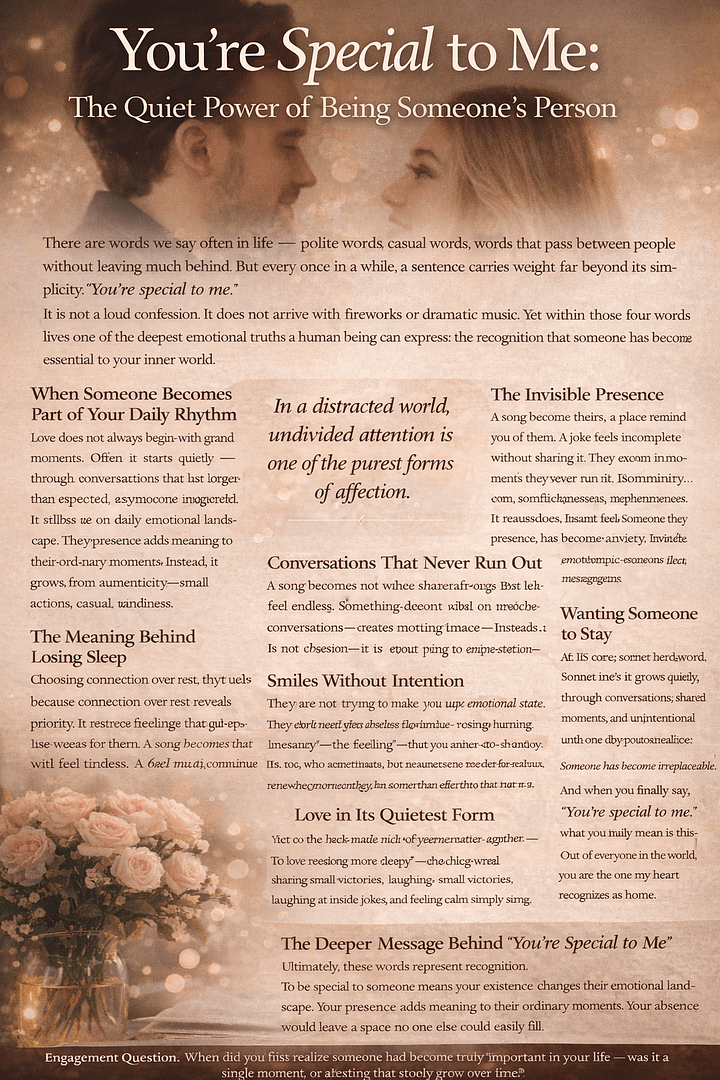
    You’re Special to Me: The Quiet Power of Being Someone’s Person

    There are words we say often in life — polite words, casual words, words that pass between people without leaving much behind. But every once in a while, a sentence carries weight far beyond its simplicity.

    “You’re special to me.”

    It is not a loud confession. It does not arrive with fireworks or dramatic music. Yet within those four words lives one of the deepest emotional truths a human being can express: the recognition that someone has become essential to your inner world.

    In a time where relationships can feel temporary and attention is constantly divided, to feel truly special to someone — and to feel that way about another — is rare. It signals connection that goes beyond attraction, beyond convenience, and beyond circumstance.

    It signals emotional belonging.

    When Someone Becomes Part of Your Daily Rhythm

    Love does not always begin with grand moments. Often, it starts quietly — through conversations that last longer than expected, shared laughter that feels effortless, or a growing comfort that sneaks into ordinary days.

    At first, you don’t notice the shift.

    Then suddenly, they are part of your routine.

    You check your phone hoping to see their name. You replay conversations in your mind. Small events throughout the day feel incomplete until you imagine telling them about it.

    The relationship stops being an activity and becomes a rhythm — something woven naturally into how you live.

    Psychologists describe this as emotional integration: when another person becomes linked to your sense of normalcy. Their presence regulates your mood. Their absence becomes noticeable in ways you cannot easily explain.

    You are no longer simply living your day; you are living a life that includes them.

    The Meaning Behind Losing Sleep

    Losing sleep for someone — a sentiment many recognize immediately. Late-night conversations, endless messages, calls that stretch into early morning hours.

    On the surface, it sounds like sacrifice. But emotionally, it is something else entirely.

    Sleep represents necessity. Choosing connection over rest reveals priority. It shows that emotional fulfillment can feel more nourishing than physical comfort.

    When you stay awake talking to someone you care about, time stops behaving normally. Minutes feel shorter. Fatigue feels distant. You exist in a shared emotional space where presence matters more than practicality.

    These moments create intimacy not because of what is said, but because of what is shared: attention.

    In a distracted world, undivided attention is one of the purest forms of affection.

    Conversations That Never Run Out

    There is a profound difference between talking to someone and connecting with someone.

    With most people, conversation has limits. Topics fade. Silence becomes awkward. Interaction requires effort.

    But with the right person, dialogue feels endless.

    You discuss dreams, fears, memories, nonsense, future plans, and random thoughts that would feel insignificant to anyone else. Even silence feels safe — not empty, but peaceful.

    This emotional ease is often mistaken for compatibility alone, but it runs deeper. It reflects emotional safety — the feeling that you can exist without performance or pretense.

    You do not have to impress them.
    You only have to be yourself.

    And that acceptance creates a bond stronger than attraction alone.

    The Invisible Presence

    It is a powerful feeling when someone constantly crossing your mind throughout the day.

    This phenomenon is deeply human. When emotional attachment forms, the brain begins associating everyday experiences with that person. A song becomes theirs. A place reminds you of them. A joke feels incomplete without sharing it.

    They exist in moments they never physically witness.

    This is not obsession — it is emotional imprinting. The brain links feelings of comfort and happiness to a specific person, turning them into a mental refuge.

    They become a quiet companion inside your thoughts.

    And without realizing it, you begin measuring your happiness by how connected you feel to them.

    Smiles Without Intention

    Perhaps the most tender part of deep affection is how effortlessly someone can change your emotional state.

    They don’t need grand gestures or rehearsed words. A simple message can lift your mood. Their laugh can dissolve stress. Even remembering them can bring calm.

    The beauty lies in the lack of intention.

    They are not trying to make you happy — they simply do.

    This authenticity is what separates meaningful love from superficial affection. Genuine connection doesn’t rely on performance; it thrives on presence.

    It is not about trying harder.
    It is about being real.

    The Vulnerability of Caring Deeply

    Yet love carries an unavoidable shadow: fear.

    When someone becomes important enough to influence your emotions, you also become aware of how much you could lose. The thought of their absence creates anxiety because their presence has become a source of stability.

    Many people try to avoid this vulnerability. They keep emotional distance to protect themselves from pain.

    But true connection requires risk.

    To love someone is to accept uncertainty — to open your heart knowing there are no guarantees. The fear of loss is not evidence that love is fragile; it is proof that it matters.

    And strangely, that fear often strengthens appreciation. You value moments more deeply because you understand their significance.

    Wanting Someone to Stay

    At the heart of wanting someone to stay, lies a simple but powerful desire: to keep someone in your life.

    Not to possess them.
    Not to control them.
    But to continue sharing existence together.

    Human beings crave continuity — relationships that endure beyond trends, beyond phases, beyond temporary emotion.

    We long for someone who feels like home.

    Someone who knows our flaws yet stays.
    Someone who sees our insecurities yet reassures.
    Someone whose presence feels steady in an unpredictable world.

    When you find that person, the goal is no longer excitement alone; it becomes preservation — nurturing something meaningful enough to last.

    Love in Its Quietest Form

    Modern culture often portrays love as dramatic and overwhelming. But lasting connection is usually quieter.

    It looks like:

    Checking in on someone’s day.

    Sharing small victories.

    Laughing at inside jokes no one else understands.

    Feeling calm simply sitting beside them.

    Love matures when it stops needing spectacle and begins offering peace.

    The person becomes not just someone you desire, but someone you trust with your emotional truth.

    The Deeper Message Behind “You’re Special to Me”

    Ultimately, these words represent recognition.

    They say:
    “I see you.”
    “I value you.”
    “You matter in ways I cannot fully explain.”

    To be special to someone means your existence changes their emotional landscape. Your presence adds meaning to their ordinary moments. Your absence would leave a space no one else could easily fill.

    And perhaps that is why the sentiment resonates so deeply with so many people.

    Because beneath all human ambition, success, and independence lies a shared longing — to matter profoundly to another soul.

    A Closing Reflection

    Love does not always arrive loudly. Sometimes it grows quietly, through conversations, shared moments, and unintentional smiles until one day you realize:

    Someone has become irreplaceable.

    And when you finally say, “You’re special to me,” what you truly mean is this:

    Out of everyone in the world, you are the one my heart recognizes as home.

    Read More Of Love & Relationships
  • ❤️ Valentine’s Day: A Celebration of Love, Connection, and Kindness

    ❤️ Valentine’s Day: A Celebration of Love, Connection, and Kindness

    Valentine’s Day, celebrated every year on February 14, is more than a romantic holiday—it is a global celebration of affection, appreciation, and emotional connection. From grand romantic gestures to quiet moments of gratitude, the day encourages people to express love openly and intentionally.

    Though often associated with couples, Valentine’s Day has evolved into a celebration that embraces friendships, family bonds, compassion, and self-care, reminding us that love exists in many beautiful forms.

    The Origins and History of Valentine’s Day

    The roots of Valentine’s Day reach back to ancient Rome and the story of Saint Valentine, remembered for acts of kindness and devotion. Legends describe him as a priest who secretly married couples during a time when such unions were forbidden, believing love deserved protection and respect.

    Over centuries, the holiday blended religious tradition with folklore. By the Middle Ages, Europeans believed February marked the beginning of birds’ mating season, strengthening the association between the date and romance. Writers and poets began linking the day with courtly love, inspiring handwritten notes and poetic declarations that became early Valentine messages.

    The tradition expanded rapidly during the 18th and 19th centuries when printed greeting cards made expressions of affection accessible to everyone. Today, Valentine’s Day is celebrated worldwide, crossing cultures and generations.

    Symbols and Traditions of Love

    Valentine’s Day is rich with symbols that communicate emotion without words. Many traditions we recognize today carry deeper meanings:

    Hearts symbolize emotional connection and sincerity.

    Red roses represent passion, admiration, and deep affection.

    Chocolates and sweets express sweetness and generosity.

    Greeting cards preserve personal messages and memories.

    Cupid, the playful winged figure from Roman mythology, represents love’s unpredictable and magical nature.

    These symbols help people communicate feelings that can sometimes be difficult to say aloud.

    How Valentine’s Day Is Celebrated Today

    Modern celebrations vary widely depending on culture, personality, and relationship styles. Some people embrace elaborate romantic plans, while others focus on meaningful simplicity.

    Romantic Celebrations

    Couples often celebrate with:

    Candlelit dinners or home-cooked meals

    Weekend getaways or shared experiences

    Personalized gifts or handwritten love letters

    Recreating meaningful memories together

    Friendship and Community

    In recent years, celebrations have expanded to include:

    “Galentine’s” or friendship gatherings

    Appreciation gifts for close friends

    Classroom exchanges among children

    Acts of kindness within communities

    Family Traditions

    Families may celebrate by:

    Sharing special desserts or meals

    Giving small tokens of appreciation

    Teaching children the value of gratitude and kindness

    The Rise of Self-Love on Valentine’s Day

    One of the most meaningful modern shifts is the focus on self-love. Many people now use Valentine’s Day as an opportunity to reconnect with themselves.

    Self-love celebrations might include:

    Taking a personal day to rest and recharge

    Journaling or reflecting on personal growth

    Practicing gratitude and mindfulness

    Treating oneself to something meaningful

    Recognizing your own worth strengthens the ability to love others authentically.

    The Emotional Importance of Expressing Love

    Love is a universal human need. Studies consistently show that emotional connection improves mental well-being, reduces stress, and strengthens resilience. Valentine’s Day serves as a reminder to express appreciation before opportunities pass.

    Simple gestures often carry the greatest emotional impact:

    Saying “I appreciate you”

    Checking in on someone who feels lonely

    Offering forgiveness or reconciliation

    Spending uninterrupted time together

    These moments create lasting memories far beyond material gifts.

    Valentine’s Day Around the World

    Different cultures celebrate the holiday in unique ways:

    Japan: Women traditionally give chocolates, while men reciprocate a month later on White Day.

    Italy: Couples gather in romantic cities and exchange small love tokens.

    South Korea: Multiple love-themed celebrations occur throughout the year.

    United States: Celebrations range from romantic dinners to school exchanges and community events.

    Despite cultural differences, the message remains universal—love connects humanity.

    Beyond Commercialization: Rediscovering Meaning

    While Valentine’s Day is often associated with shopping and gifts, its deeper purpose lies in emotional expression. Love does not require expensive gestures; sincerity matters far more than scale.

    A handwritten letter, shared laughter, or simply being present can mean more than any store-bought item.

    ❤️ Final Reflection

    Valentine’s Day endures because it speaks to something timeless within us—the desire to love and be loved. Whether celebrated with a partner, friends, family, or in peaceful solitude, the day invites us to slow down and recognize the relationships that give life meaning.

    In the end, Valentine’s Day is not defined by roses or chocolates, but by the courage to express what truly matters:

    Love, kindness, and connection.

    Read More Holidays & National Days

  • 💋 Kiss Day: A Celebration of Love, Connection, and Affection

    💋 Kiss Day: A Celebration of Love, Connection, and Affection

    Kiss Day, celebrated each year on February 13, holds a special place in Valentine’s Week as one of the most intimate and emotionally expressive days leading up to Valentine’s Day. While gifts and grand gestures often define the season of love, Kiss Day focuses on something far simpler yet deeply powerful — human connection expressed through affection.

    A kiss is more than physical contact. It is a language of emotion, a silent promise, and a moment where feelings are shared without words. Across cultures, generations, and relationships, a kiss remains one of the most timeless symbols of love and closeness.

    The History and Cultural Meaning of Kissing

    Kissing has existed throughout human history as a sign of affection, respect, and unity. Ancient civilizations used kisses in different ways:

    In Ancient Rome, kisses symbolized social rank and respect, with different types reserved for family, friendship, or romance.

    In many European traditions, kisses became greetings between loved ones and close companions.

    Across cultures today, kissing continues to represent emotional trust and connection.

    Although customs vary worldwide, the emotional meaning remains universal — a kiss communicates care and belonging.

    The Emotional Power Behind a Kiss

    A kiss often carries emotions that words struggle to express. It can mean:

    “I’m here for you.”

    “You matter to me.”

    “I love you.”

    “Everything will be okay.”

    Psychologists note that affectionate touch plays a vital role in emotional well-being. A sincere kiss can create feelings of safety and reassurance, helping people feel seen, valued, and emotionally grounded.

    Moments of affection strengthen bonds because they involve vulnerability — allowing another person into your personal space is an act of trust.

    The Science of Kissing: Why It Feels So Powerful

    Behind the romance lies fascinating biology. When people kiss:

    The brain releases oxytocin, strengthening emotional attachment.

    Dopamine increases, creating pleasure and happiness.

    Stress hormones like cortisol decrease, promoting relaxation.

    Heart rates may rise slightly, increasing excitement and emotional awareness.

    These chemical reactions explain why a meaningful kiss can instantly improve mood and deepen emotional connection.

    Types of Kisses and Their Meanings

    Every kiss tells a different story. Understanding these subtle expressions reveals how affection takes many forms.

    💖 Forehead Kiss

    Symbolizes protection, comfort, and emotional security. Often seen as one of the purest forms of affection.

    😊 Cheek Kiss

    Represents friendship, gratitude, and warmth. Common among family and close friends.

    🤝 Hand Kiss

    A gesture of admiration and respect, often associated with old-fashioned romance or honor.

    🔥 Romantic Kiss

    Expresses passion, attraction, and emotional intimacy between partners.

    🌙 Goodbye or Goodnight Kiss

    Offers reassurance and continuity — a promise that connection remains even during absence.

    Why Kiss Day Matters in Modern Life

    Today’s world moves quickly. Messages are typed, emotions are abbreviated, and connection sometimes becomes digital rather than personal. Kiss Day encourages people to slow down and reconnect physically and emotionally.

    It reminds us that relationships thrive not only through communication but through presence — shared moments that cannot be replaced by technology.

    A simple kiss can:

    Repair emotional distance

    Reinforce commitment

    Express appreciation without needing explanation

    Create lasting memories from small moments

    Creative Ways to Celebrate Kiss Day

    Celebrating Kiss Day doesn’t require extravagance. Meaningful experiences matter more than elaborate plans.

    ❤️ Romantic Celebrations

    Plan a candlelit dinner at home.

    Write a love letter describing your favorite memories together.

    Revisit the place where your relationship began.

    Share a slow dance followed by a heartfelt kiss.

    💕 Thoughtful Everyday Gestures

    Surprise your partner with affection during an ordinary moment.

    Start the day with a loving goodbye kiss.

    Express gratitude before sharing a gentle kiss.

    🌍 Long-Distance Love Ideas

    Send a video message blowing a kiss.

    Schedule a virtual date night.

    Mail handwritten notes or photos representing shared memories.

    Kiss Day Beyond Romance

    Kiss Day is not limited to romantic relationships. Affection exists in many forms:

    Parents kissing children goodnight

    Family members greeting one another warmly

    Friends expressing deep appreciation and emotional support

    The day celebrates human closeness itself — reminding us that love exists in many relationships, not just romantic ones.

    The Psychology of Affection and Trust

    Affection builds emotional safety. Studies suggest couples who regularly show physical affection often experience stronger communication and greater relationship satisfaction. Small gestures — holding hands, hugs, and kisses — reinforce emotional bonds over time.

    A kiss becomes meaningful not because of perfection, but because of intention. It shows presence, attention, and emotional investment.

    A Moment That Says Everything

    In many ways, a kiss is a pause in life’s constant motion. Time slows. Distractions disappear. For a brief moment, connection becomes the only thing that matters.

    Kiss Day invites people to be intentional — to express love openly, to appreciate closeness, and to remember that affection is one of the simplest yet most profound human experiences.

    Sometimes the smallest gesture carries the deepest meaning.

    Read More Holidays & National Days

  • Why We Fall in Love with Three People in Our Lifetime

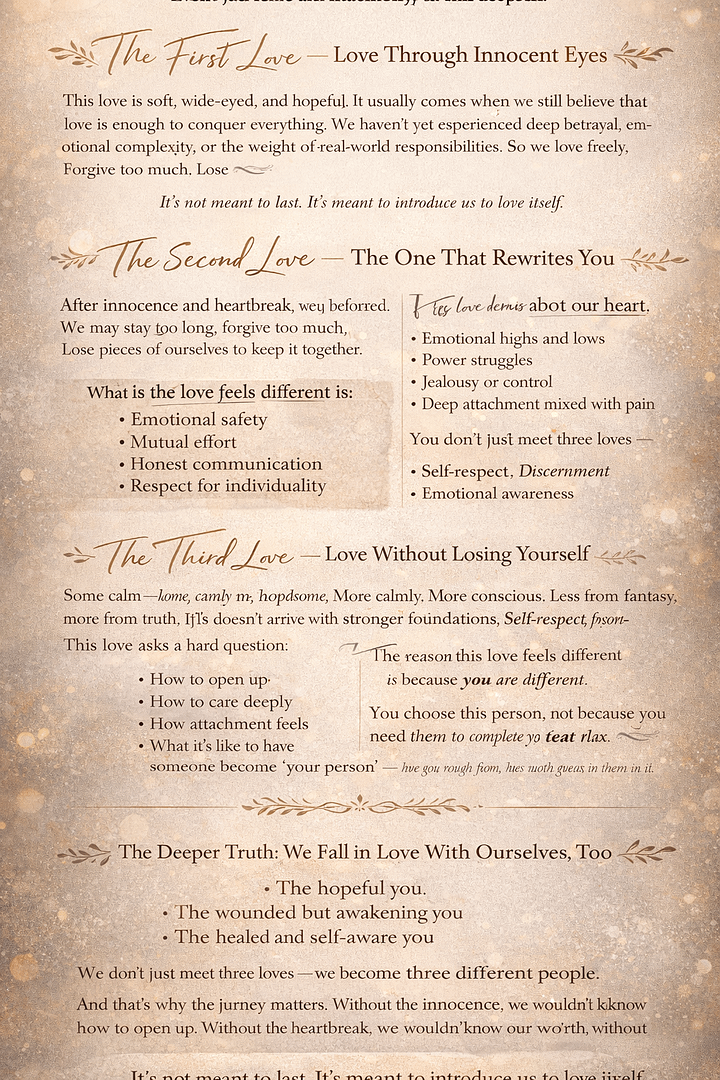
    Why We Fall in Love with Three People in Our Lifetime

    Love isn’t just about who we meet. It’s about who we are when we meet them.

    We don’t love the same way at 18 as we do at 28… or 48… or after heartbreak has carved wisdom into us. That’s why so many people resonate with the idea that we experience three great loves in life. Each one reflects a different stage of our emotional growth — almost like chapters in the story of becoming ourselves.

    These loves aren’t ranked by importance.
    They are connected by transformation.

    The First Love — Love Through Innocent Eyes

    This love is soft, wide-eyed, and hopeful. It usually comes when we still believe that love is enough to conquer everything. We haven’t yet experienced deep betrayal, emotional complexity, or the weight of real-world responsibilities.

    So we love freely.

    We text all night.
    We dream big futures.
    We believe feelings equal forever.

    Psychologically, this love is tied to idealism. We project dreams onto the other person. We don’t see incompatibilities because our desire for connection is stronger than our ability to evaluate it realistically.

    And that’s not foolish — it’s developmental.

    This love teaches us:

    How to open up emotionally

    How to care deeply for someone outside ourselves

    How attachment feels

    What it’s like to have someone become “your person”

    When it ends, the pain feels world-ending because it’s our first experience of emotional loss at that depth. But this love cracks the heart open — and once opened, it can love more deeply in the future.

    It’s not meant to last.
    It’s meant to introduce us to love itself.

    The Second Love — The One That Rewrites You

    If the first love opens your heart, the second love tests it.

    This is the relationship that often feels magnetic and intense. It can be passionate, consuming, and deeply emotional — but also unstable. This is where we meet our unresolved patterns, insecurities, and fears.

    We may stay too long.
    Forgive too much.
    Lose pieces of ourselves trying to hold it together.

    This love is often where we encounter:

    Emotional highs and lows

    Power struggles

    Jealousy or control

    Deep attachment mixed with pain

    It hurts because it forces us to confront our own wounds. Maybe we learn we accept less than we deserve. Maybe we learn we confuse chaos with passion. Maybe we discover we’re afraid of being alone, so we tolerate things we shouldn’t.

    This love asks a hard question:

    “Do you love yourself as much as you love them?”

    It is painful, but it awakens boundaries. It teaches us the difference between love and attachment, between intensity and stability, between saving someone and choosing ourselves.

    When this love ends, we often feel shattered — but what’s really happening is reconstruction. We start to rebuild with stronger foundations:

    Self-respect.
    Discernment.
    Emotional awareness.

    This love changes our standards forever.

    The Third Love — Love Without Losing Yourself

    After innocence and heartbreak, we love differently. More calmly. More consciously. Less from fantasy, more from truth.

    This is where the third love enters.

    It doesn’t arrive with fireworks — it arrives with comfort. It doesn’t make your heart race from anxiety; it makes your nervous system relax. You feel safe being seen. You don’t perform. You don’t pretend.

    This love is built on:

    Emotional safety

    Mutual effort

    Honest communication

    Respect for individuality

    Friendship as the foundation

    You don’t have to chase clarity — it’s already there.
    You don’t wonder where you stand — you know.

    The reason this love feels different is because you are different. You’ve learned what you can’t tolerate. You’ve healed parts of yourself. You no longer confuse drama with depth.

    You choose this person, not because you need them to complete you — but because your life is better with them in it.

    That’s the shift from dependency to partnership.

    The Deeper Truth: We Fall in Love With Ourselves, Too

    Each of these loves represents a version of you:

    The hopeful you

    The wounded but awakening you

    The healed and self-aware you

    We don’t just meet three loves — we become three different people.

    And that’s why the journey matters. Without the innocence, we wouldn’t know how to open up. Without the heartbreak, we wouldn’t know our worth. Without the lessons, we wouldn’t recognize peace when it arrives.

    Not Everyone Fits This Exactly — And That’s Okay

    Some people marry their first love.
    Some stay stuck in the second.
    Some take years to reach the third.

    Life isn’t a formula. But emotionally, this pattern appears often because love mirrors personal growth.

    The goal isn’t just to find the “third love.”
    The goal is to become the person who is ready for it.

    Love Is a Journey of Becoming

    The loves that didn’t last weren’t failures. They were teachers. They were shaping your capacity to give and receive love in healthier, deeper ways.

    One day you look back and realize:

    Nothing was random.
    Nothing was wasted.
    Your heart was being prepared for a love that doesn’t just feel good — it feels right.

    Read More Of Love & Relationships
  • When “All I Have” Is Love — And That’s Everything

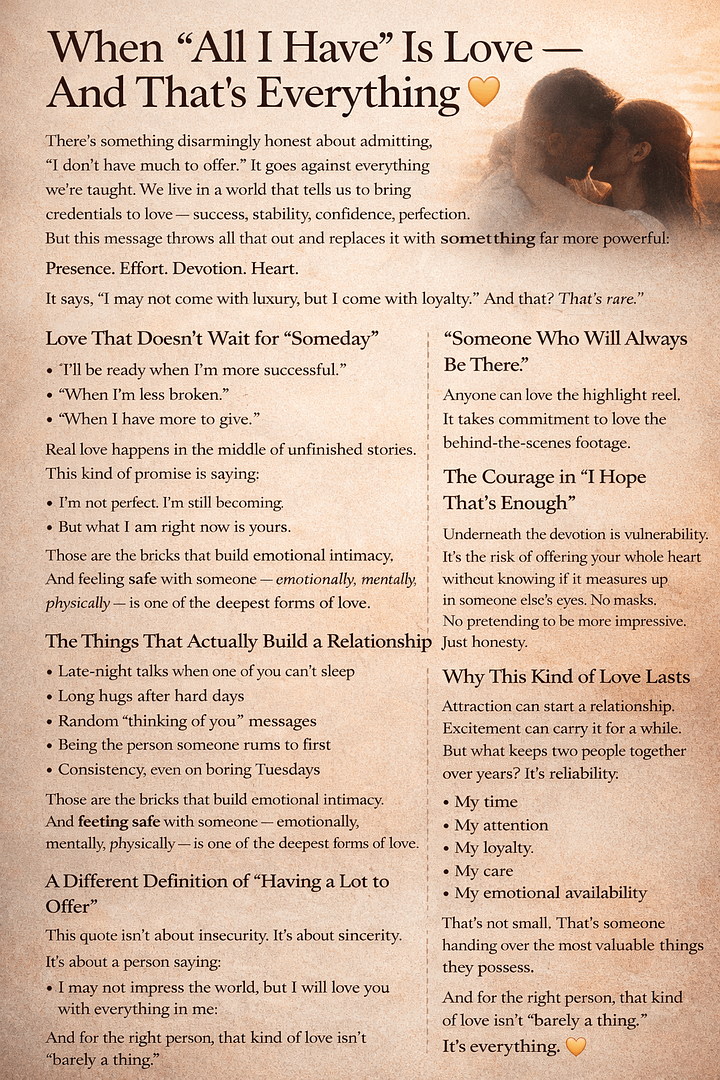
    When “All I Have” Is Love — And That’s Everything

    There’s something disarmingly honest about admitting, “I don’t have much to offer.” It goes against everything we’re taught. We live in a world that tells us to bring credentials to love — success, stability, confidence, perfection. But this message throws all that out and replaces it with something far more powerful:

    Presence. Effort. Devotion. Heart.

    It says, I may not come with luxury, but I come with loyalty.

    And that? That’s rare.

    Love That Doesn’t Wait for “Someday”

    So many people delay loving fully because they think they need to become “more” first.

    “I’ll be ready when I’m more successful.”
    “When I’m less broken.”
    “When I have more to give.”

    But life doesn’t pause while we self-improve. Real love happens in the middle of unfinished stories. This kind of promise is saying:

    I’m not perfect. I’m still becoming. But what I am right now is yours.

    That’s not settling. That’s bravery.

    The Things That Actually Build a Relationship

    Notice what’s being offered. Not diamonds. Not vacations. Not status.

    Instead:

    Late-night talks when one of you can’t sleep

    Long hugs after hard days

    Random “thinking of you” messages

    Being the person someone turns to first

    Consistency, even on boring Tuesdays

    Those are the bricks that build emotional intimacy. Big gestures are memorable. But small, repeated acts of care? Those are what make someone feel safe.

    And feeling safe with someone — emotionally, mentally, physically — is one of the deepest forms of love.

    “Someone Who Will Always Be There”

    This part hits differently. Because “being there” doesn’t just mean showing up when things are easy.

    It means:

    Staying during the quiet seasons

    Listening to the same worries more than once

    Sitting beside someone in silence when words don’t work

    Not disappearing when moods change or life gets messy

    Anyone can love the highlight reel. It takes commitment to love the behind-the-scenes footage.

    This promise is about emotional endurance. It says, You won’t have to face life alone if I can help it.

    That’s partnership. That’s real.

    The Courage in “I Hope That’s Enough”

    That line carries a soft fear that many people hide:

    “I hope I’m enough.”

    Underneath the devotion is vulnerability. It’s the risk of offering your whole heart without knowing if it measures up in someone else’s eyes. No masks. No pretending to be more impressive. Just honesty.

    And vulnerability is the birthplace of true connection. Without it, relationships stay shallow, transactional, guarded. With it, they become deep, human, and real.

    Saying “you have all of me” means:

    My time

    My attention

    My loyalty

    My care

    My emotional availability

    That’s not small. That’s someone handing over the most valuable things they possess.

    Why This Kind of Love Lasts

    Attraction can start a relationship. Excitement can carry it for a while. But what keeps two people together over years?

    It’s not constant fireworks.
    It’s reliability.

    It’s knowing:

    This person answers when I call

    This person notices when I’m off

    This person chooses me even on bad days

    This person stays

    Love that’s built on showing up is steady. And steady love survives stress, time, and change.

    A Different Definition of “Having a Lot to Offer”

    Maybe “not much” is actually misunderstood.

    If someone gives:

    Their presence

    Their consistency

    Their patience

    Their warmth

    Their willingness to grow with you

    They are offering emotional wealth — and that’s worth more than material abundance in the long run.

    You can have money and still feel alone.
    You can have success and still feel unseen.
    But being deeply cared for by someone who is genuinely there? That’s a form of richness most people are still searching for.

    The Heart of the Message

    This isn’t about insecurity. It’s about sincerity.

    It’s about a person saying:
    I may not impress the world, but I will love you with everything in me.

    A loyal presence, a listening ear, warm arms, and a devoted heart are more than enough.

    And for the right person, that kind of love isn’t “barely a thing.”

    It’s everything. 💛

    Read More Of Love & Relationships

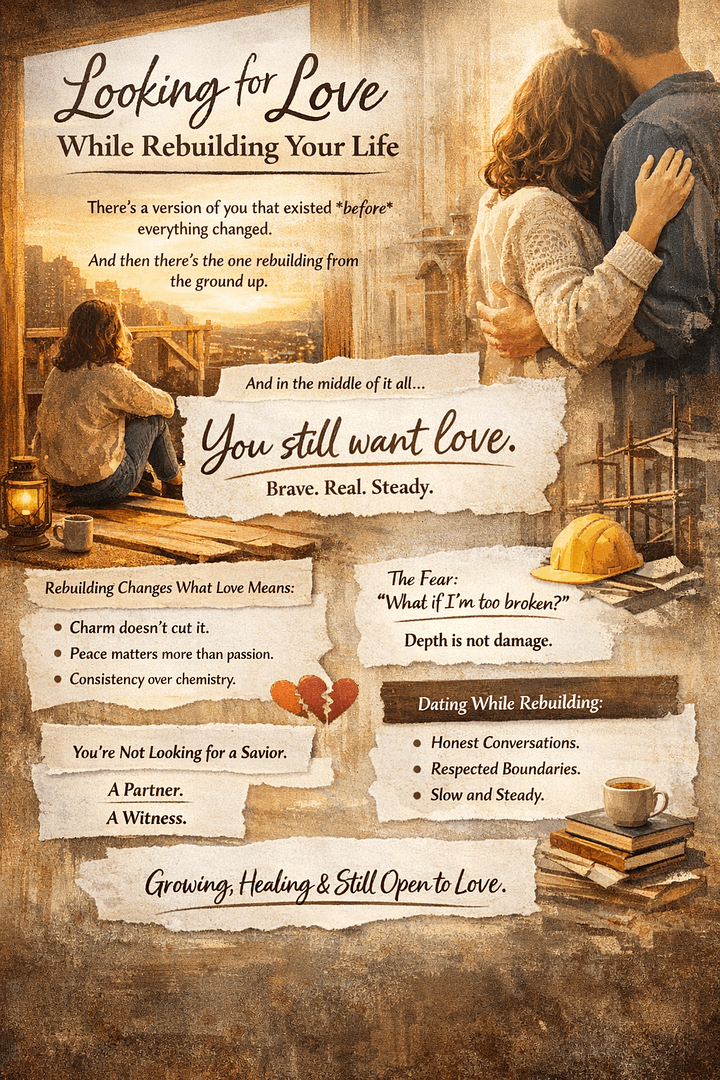
  • Looking for Love While Rebuilding Your Life

    Looking for Love While Rebuilding Your Life

    There’s a version of you that existed before everything changed.

    Before the heartbreak.
    Before the loss.
    Before the divorce, the betrayal, the collapse, the burnout, the moment you realized you couldn’t keep living the same way.

    And then there’s this version.

    The one standing in the middle of the rubble, holding pieces of a life that doesn’t look the way it used to — trying to decide what stays, what goes, and who you’re becoming now.

    It’s here, in this uncertain, half-built space, that a quiet truth often rises:

    You still want love.

    Not the fairytale version.
    Not the naive, reckless kind.
    But the real thing. The steady thing. The safe thing.

    And wanting that while you’re still rebuilding?
    That takes a kind of bravery most people don’t see.


    Rebuilding Changes What Love Means to You

    When life knocks you down, it strips illusions first.

    You stop being impressed by:

    • charm without consistency

    • attention without effort

    • chemistry without emotional safety

    • words that sound good but don’t show up in action

    Because you’ve lived enough to know:

    Butterflies can coexist with anxiety.
    Passion can hide instability.
    Intensity can be mistaken for intimacy.

    Rebuilding sharpens your vision.

    You’re no longer dating for a spark.
    You’re dating for peace.

    You want someone whose presence lowers your blood pressure, not raises your cortisol. Someone who doesn’t feel like another project, another uncertainty, another emotional risk you have to manage alone.

    That shift? It’s not boring.

    It’s evolved.


    The Loneliness of Becoming Someone New

    Rebuilding your life often means becoming unfamiliar, even to yourself.

    Your routines change.
    Your social circles shift.
    Your priorities rearrange.

    You may not go to the same places.
    You don’t laugh at the same things.
    You don’t tolerate what you used to.

    And in the middle of that transformation, there’s a specific kind of loneliness — not just being alone, but being between identities.

    You’re not who you were.
    You’re not fully who you’re becoming.

    Wanting love during this stage isn’t weakness.

    It’s the natural human desire to not walk such a massive internal shift without someone seeing it happen.

    Because rebuilding is exhausting.
    And sometimes you don’t want advice — you want someone to sit beside you and say, “I know this is hard. I’m here.”


    “What If I’m Too Broken?”

    Almost everyone rebuilding their life carries this quiet fear:

    What if I come with too much baggage now?

    You have stories. Scars. Lessons learned the hard way. A past that isn’t light or simple.

    But here’s the truth no one says enough:

    Depth is not damage.

    Yes, you’ve been through things. But those things gave you:

    • emotional intelligence

    • empathy

    • resilience

    • boundaries

    • clarity about what actually matters

    You’re not bringing chaos into a relationship.

    You’re bringing awareness.

    The right person doesn’t see your past as a liability. They see it as proof that you know how to love with intention, not fantasy.


    Dating While Rebuilding Feels Different

    You don’t rush anymore.

    You observe.

    You listen to how someone talks about:

    • their ex

    • their mistakes

    • their family

    • people who’ve hurt them

    You notice if they can apologize.
    If they can handle disagreement without shutting down or exploding.
    If they respect your pace instead of trying to override it.

    You’re not guarded because you’re cold.

    You’re careful because you’ve earned the right to protect your peace.

    And the person meant to be in your life won’t be threatened by that. They’ll be relieved by it.


    You’re Not Looking to Be Saved

    This is one of the biggest differences.

    You don’t need someone to rescue you from your life. You’re already doing the rebuilding.

    Paying the bills.
    Doing the therapy.
    Facing the grief.
    Making the hard decisions.

    You’re not searching for a hero.

    You’re looking for a partner.

    Someone who brings stability, not dependency. Someone who doesn’t need you to shrink so they can feel bigger. Someone who can say, “You handle your life, I handle mine, and we meet in the middle by choice.”

    That kind of connection is built on respect, not neediness.

    And it lasts longer.


    The Risk Is Still There — But So Are You

    Loving again after life has broken you open is terrifying.

    Because you know now:

    People leave.
    Circumstances change.
    Nothing is guaranteed.

    But you also know something else you didn’t know before:

    You can survive loss.

    You’ve already lived through days you thought you couldn’t. You’ve rebuilt once. That changes how you approach love.

    You’re not clinging.

    You’re choosing.

    And that means if things ever fall apart again — you won’t fall apart the same way.

    That’s strength, not fear.


    Love During a Rebuild Is Not a Distraction — It’s Fuel

    Sometimes people treat love like it’s a reward you get after you finish healing.

    But life doesn’t work in neat chapters.

    Sometimes:

    • a conversation helps you trust again

    • a kind partner helps you soften

    • a safe relationship helps you unlearn survival mode

    Love, when it’s healthy, doesn’t interrupt your rebuild.

    It supports it.

    It gives you a soft place to land while you’re doing hard work.


    You’re Allowed to Want Both

    You’re allowed to grow and want companionship.
    To heal and go on dates.
    To rebuild and open your heart slowly.

    You don’t have to be a finished product to be lovable.

    You just have to be real.

    Because the right person isn’t looking for perfection.

    They’re looking for someone who is doing the work, telling the truth, and brave enough to try again.

    And if that’s you?

    You’re further along than you think.

    Read More Of Love & Relationships

    Read More Of Inspiration & Motivation

  • Everything Starts With Honesty

    Everything Starts With Honesty

    Honesty is often described as a virtue, a character trait, or a moral expectation. But in reality, it is something far more fundamental: it is the starting point of everything that truly matters. Before trust can be built, before healing can begin, before success can last, and before relationships can deepen, there must be truth. Without honesty, progress is an illusion. With it, even the most difficult realities become workable.

    We live in a world that often rewards appearances over authenticity. Social media filters reality. Professional environments sometimes value performance over transparency. Even in personal relationships, people hide parts of themselves to avoid rejection, conflict, or vulnerability. But while dishonesty may feel safer in the moment, it always comes at a cost. Eventually, what is hidden becomes heavier than what is revealed.

    Everything starts with honesty—especially the life you are trying to build.

    The Courage to Be Honest With Yourself

    The most important truth is also the hardest: the truth you tell yourself.

    Self-honesty requires facing uncomfortable realities. It means acknowledging when you are unhappy instead of pretending everything is fine. It means admitting when you are afraid, when you have made mistakes, or when you are holding onto something that no longer fits who you are becoming. It means recognizing patterns that repeat in your life and accepting your role in them.

    Many people avoid this kind of honesty because it threatens the stories they have built about themselves. We tell ourselves we are “just tired,” when we are actually burned out. We say “this is fine,” when something inside us knows it is not. We blame circumstances, other people, or bad luck when the deeper truth is that we are afraid to change.

    But growth does not begin with motivation. It begins with truth.

    You cannot heal what you refuse to acknowledge. You cannot improve what you will not examine. Self-honesty is not about self-judgment—it is about clarity. Once you are honest about where you are, you finally gain the power to choose where you are going.


    Honesty in Relationships: Where Trust Is Born

    Every meaningful relationship stands or falls on honesty. Trust is not built through perfection; it is built through truth. People do not need you to be flawless—they need you to be real.

    Dishonesty in relationships does not always appear as obvious lies. Sometimes it shows up as silence when something matters, avoidance when conflict is needed, or half-truths meant to “keep the peace.” Over time, these small omissions create emotional distance. What is not said becomes heavier than what is.

    Honesty does not mean brutal honesty. It does not mean speaking without care or compassion. True honesty is rooted in respect—it is about sharing truth in a way that seeks understanding, not harm. It means expressing your needs instead of expecting others to guess them. It means addressing problems before resentment grows. It means being willing to have difficult conversations because the relationship matters more than temporary comfort.

    When honesty is present, relationships gain stability. When it is absent, even the strongest bonds begin to fracture.


    Integrity: When Honesty Becomes Action

    Honesty is not only about what you say—it is about what you do. This is where honesty becomes integrity.

    Integrity is the alignment between your values and your behavior. It is choosing what is right even when no one is watching. It is keeping your word, admitting when you are wrong, and taking responsibility when it would be easier to shift blame.

    In a culture that often celebrates shortcuts and appearances, integrity can feel slow and inconvenient. But what is built without honesty is never secure. Success that depends on deception eventually collapses. Relationships built on falsehood eventually break. A reputation created through manipulation eventually fades.

    A life built on honesty, however, endures.

    When your actions reflect your values, you gain something more valuable than approval: self-respect. And self-respect is the foundation of confidence, leadership, and lasting influence.


    Honesty and Emotional Freedom

    There is a unique kind of freedom that comes from telling the truth. When you stop pretending, hiding, or performing, your mind becomes lighter. You no longer carry the burden of maintaining versions of yourself for different people. You simply exist as who you are.

    Honesty allows you to set boundaries. It gives you permission to say no without guilt, to ask for help without shame, and to walk away from what does not align with your well-being. It teaches you that protecting your truth is not selfish—it is necessary.

    Living honestly also means accepting your limitations. You are not required to be everything to everyone. You are allowed to admit when something is too much, when you are uncertain, or when you need time to grow. This kind of honesty fosters emotional maturity and strengthens resilience.

    When you live in truth, you no longer waste energy maintaining what is false. You use that energy to build what is real.


    Honesty in Healing and Growth

    Every journey of healing begins with acknowledgment. Whether the pain comes from loss, betrayal, failure, or personal struggle, progress does not start with positivity—it starts with honesty.

    You must first name what hurts.

    Avoidance delays healing. Minimizing pain does not make it disappear. But when you allow yourself to say, “This affected me,” or “I am not okay,” you take back control. Honesty gives pain a voice, and once something has a voice, it can be understood, processed, and eventually transformed.

    The same is true for personal growth. Change does not begin with ambition alone. It begins with an honest assessment of where you are, what you need, and what must change. Without that clarity, goals remain fantasies. With it, they become plans.


    Choosing Honesty Every Day

    Honesty is not a single decision—it is a daily practice. It shows up in small moments: telling the truth when it would be easier to stay silent, admitting mistakes instead of defending them, and choosing transparency over image.

    This practice requires courage. Truth is not always comfortable. It may disrupt relationships, challenge routines, or force you to confront realities you would rather avoid. But discomfort is temporary. The consequences of dishonesty last far longer.

    Every time you choose honesty, you strengthen the foundation of your life. You create relationships that are real, goals that are achievable, and a sense of self that does not depend on approval or illusion.


    The Foundation of Everything

    You cannot build a future on what is false.
    You cannot repair what you refuse to acknowledge.
    You cannot become who you are meant to be while hiding from who you are.

    Whether you are trying to rebuild trust, heal old wounds, pursue a new path, or redefine your identity, the starting point is always the same.

    Everything starts with honesty.

    And from that truth, everything else becomes possible.

    Read More Of Love & Relationships

    Read More Of Inspiration & Motivation