Blog

  • Grieving the Life Your Child Would Have Had

    Grieving the Life Your Child Would Have Had

    There is a grief that exists beyond what most people can see or fully understand.

    It is not only the grief of losing your child—it is the grief of losing the life they were meant to live. It is mourning a future that once felt certain. A life that was imagined in quiet moments, built in your heart through dreams, hope, and love.

    This grief is not loud. It does not always show itself in tears or words.

    But it is constant.

    It lives in the spaces between what is… and what should have been.

    The Life You Began Imagining Before It Ever Happened

    When a child is born, so is a vision of their future.

    You don’t just hold your child—you begin to hold their possibilities.

    You picture:

    Their first steps turning into long walks into independence
    Their first words becoming conversations filled with personality
    Their small hands growing into capable, confident ones
    Their childhood unfolding into a life of purpose and identity

    You begin to imagine birthdays, friendships, challenges, achievements, and even the kind of person they will become.

    These are not unrealistic fantasies. They are part of what it means to love a child.

    And when that child is gone, those visions don’t disappear. They remain vivid, unfinished, and painfully suspended in time.

    A Future That Still Feels Real

    Grieving the life your child would have had is unique because that future never had the chance to become memory.

    It exists only in your heart and mind—but it feels just as real as anything that actually happened.

    You may find yourself wondering:

    What would they look like today?
    What would they be passionate about?
    Who would they love?
    What kind of life would they be building?

    These thoughts can come at any time—while driving, while watching others, while sitting in silence.

    You might see someone their age and instinctively measure time against what your child should be experiencing.

    And in those moments, the absence becomes overwhelming.

    Because you’re not just remembering—you’re imagining a life that deserved to exist.

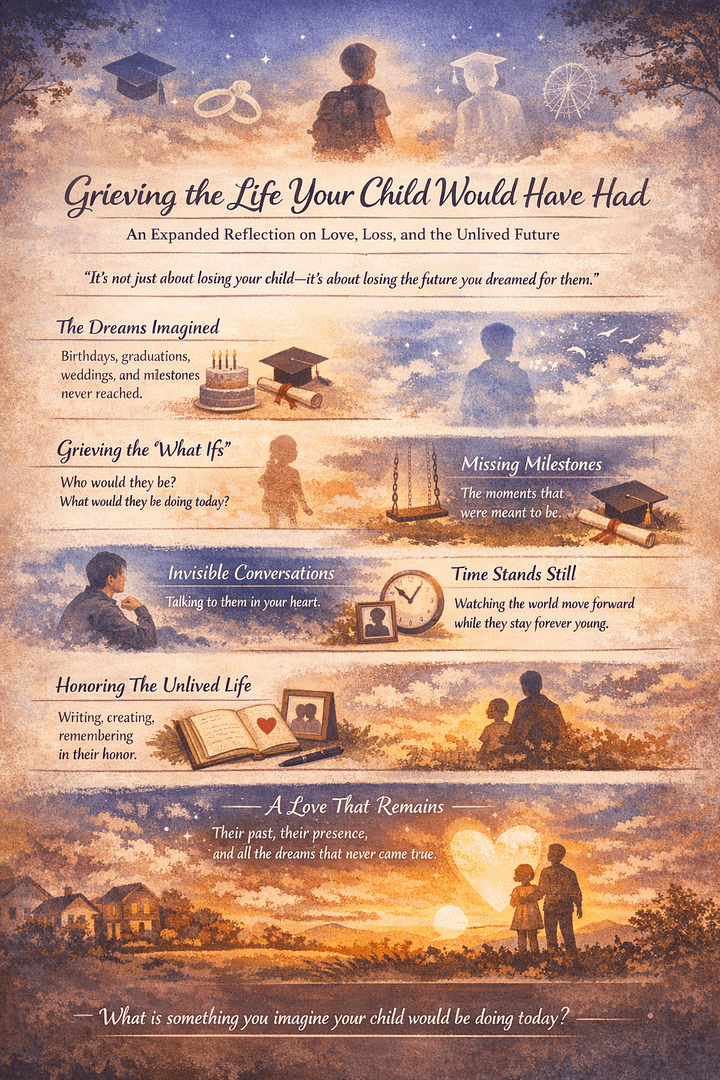
    Grieving Milestones That Never Arrived

    Grief is often tied to anniversaries and dates—but for parents, it also attaches itself to milestones that never came.

    You grieve:

    The first day of school they never walked into
    The graduation they never celebrated
    The job they never got
    The family they never created
    The aging you will never witness

    Each milestone becomes a reminder—not just of loss, but of interruption.

    Life didn’t just end. It was cut off mid-story.

    And what makes this especially painful is that these milestones continue to happen all around you—for other children, other families, other lives moving forward.

    You are left standing still, holding a future that never got the chance to begin.

    The Invisible Conversations

    There are conversations that continue long after your child is gone.

    They happen quietly, internally, sometimes without words.

    You might:

    Talk to them in your thoughts
    Wonder what advice they would give you now
    Imagine their reactions to your life today
    Picture them sitting beside you in moments of joy or struggle

    These imagined interactions are not illusions.

    They are extensions of love.

    They are your heart’s way of keeping connection alive—even when the world has moved on.

    The Pain of Watching Time Move Forward

    Time becomes complicated after loss.

    The world continues. People grow older. Life evolves.

    But for you, your child remains at the age they were.

    And that creates a painful contrast.

    You may notice:

    Children their age growing up, while yours stays frozen in time
    Friends becoming parents, while your child never had that chance
    Years passing, while your memories remain anchored

    There is a quiet, almost surreal feeling in watching time move forward while part of your life stands still.

    It can feel like living in two realities at once.

    The Guilt That Sometimes Follows

    Grieving the life your child would have had can also bring unexpected emotions—like guilt.

    You might feel guilty for:

    Imagining a future they didn’t get to live
    Laughing or finding joy in your own life
    Moving forward while they cannot
    Wondering if you’re holding on too tightly or not enough

    These feelings are deeply human.

    But the truth is this:
    Loving your child includes loving the life they deserved.

    There is no guilt in remembering, imagining, or honoring what should have been.

    Learning to Carry Both Love and Loss

    Over time, you begin to understand that this grief is not something you “get over.”

    It is something you learn to carry.

    You carry:

    The child you knew
    The person they were becoming
    The future they never reached

    And somehow, you find space for all of it to exist together.

    There will be days when the weight feels unbearable.
    And there will be days when the love feels stronger than the pain.

    Both are part of the journey.

    Finding Ways to Honor the Unlived Life

    Many parents find meaning in honoring not just the life their child lived—but the life they were meant to have.

    This can look like:

    Writing letters to your child at different imagined ages
    Celebrating milestones in symbolic ways
    Creating something in their name—a scholarship, a cause, a tradition
    Sharing stories so others know who they were and who they could have been

    In doing this, you are not pretending.

    You are acknowledging that your child’s life mattered—and still does.

    The World May Not Understand—But You Do

    One of the hardest parts of this kind of grief is how invisible it can be to others.

    People may offer comfort focused only on the past:
    “They had a good life.”
    “At least you had the time you did.”

    But what often goes unspoken is the magnitude of the future that was lost.

    You carry that understanding alone at times.

    But it is real.
    It is valid.
    And it deserves to be acknowledged.

    A Love That Continues to Grow

    Even in absence, your love does not stop.

    In fact, it often grows.

    It grows in:

    The way you remember them
    The way you speak about them
    The way you carry their presence into your daily life

    Love does not need a future to exist.

    It only needs a connection.

    And that connection remains unbroken.

    Final Reflection

    Grieving the life your child would have had is one of the deepest forms of loss a heart can carry.

    It is not just about what was taken.

    It is about everything that never had the chance to be given.

    The laughter not heard.
    The dreams not lived.
    The life not fully written.

    And yet, in the middle of that unfinished story, something remains complete:

    Your love for them.

    A love that holds their past…
    their presence…
    and even the future they never got to live.

    A Father’s Guide to Surviving the Loss of a Child
  • 🥔 National Tater Day: Celebrating the Humble Potato in All Its Glory

    🥔 National Tater Day: Celebrating the Humble Potato in All Its Glory

    Every year on March 31st, we celebrate a food that has quietly become one of the most beloved staples across the world—the potato. National Tater Day isn’t about flashy cuisine or complicated recipes. It’s about honoring something simple, reliable, and deeply comforting.

    From roadside diners to family dinner tables, from childhood lunches to late-night cravings, the potato has been there—steady, satisfying, and always welcome.

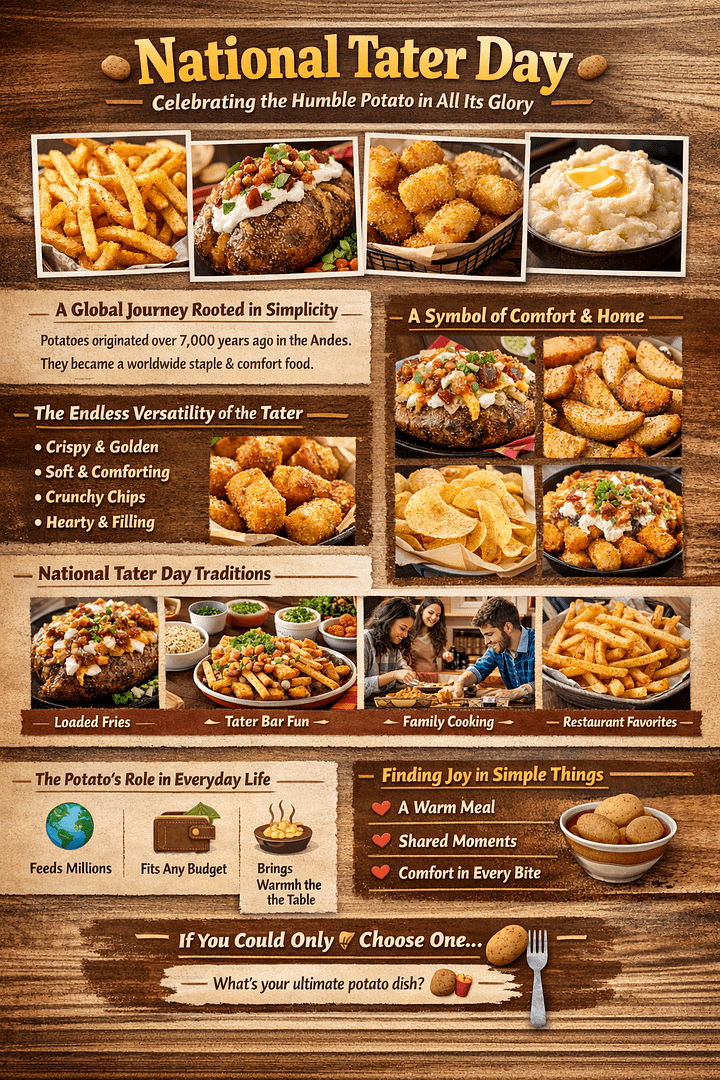
    🌍 A Global Journey Rooted in Simplicity

    Long before fries and chips became icons of modern food culture, potatoes were being grown high in the Andes Mountains over 7,000 years ago. Indigenous communities in South America understood their value long before the rest of the world caught on.

    When Spanish explorers brought potatoes to Europe in the 16th century, the crop slowly spread across continents. It became a lifeline during difficult times—easy to grow, rich in nutrients, and capable of feeding entire populations.

    Today, the potato is one of the most widely consumed foods on Earth, bridging cultures, cuisines, and generations.

    🍽️ The Endless Versatility of the Tater

    What makes potatoes so special isn’t just their taste—it’s their ability to become almost anything.

    They can be:

    Crispy and golden (fries, tots, hash browns)
    Soft and comforting (mashed, baked, scalloped)
    Crunchy and addictive (chips)
    Hearty and filling (soups, stews, casseroles)

    No matter how you prepare them, potatoes adapt. They take on flavor, texture, and personality depending on how they’re cooked—making them one of the most versatile ingredients in the kitchen.

    🏡 A Symbol of Comfort and Home

    There’s something deeply emotional about potato-based dishes. They’re often tied to memories:

    A parent serving mashed potatoes at dinner
    Sharing fries with friends after a long day
    Holiday meals filled with casseroles and baked dishes
    Simple moments that feel bigger because of the people around you

    Potatoes aren’t just food—they’re part of our personal stories.

    In times of stress or uncertainty, people often turn to comfort food. And more often than not, that comfort includes potatoes.

    🍟 National Tater Day Traditions

    There’s no official rulebook for celebrating National Tater Day—but that’s part of the beauty. It’s a day that invites creativity, comfort, and connection.

    Here are a few meaningful ways to celebrate:

    🍳 Cook Something Special

    Try making a potato dish from scratch. Whether it’s garlic mashed potatoes or crispy roasted wedges, cooking can turn a simple ingredient into something memorable.

    👨‍👩‍👧‍👦 Share a Meal

    Gather with family or friends and build a meal around potatoes. A baked potato bar with toppings can turn dinner into an experience.

    🍽️ Support Local Restaurants

    Stop by your favorite diner or restaurant and order fries, tots, or a specialty potato dish. It’s a small way to support your community.

    📸 Share Your Plate

    Post your favorite potato dish online. Food has a way of bringing people together—even digitally.

    💡 The Potato’s Role in Everyday Life

    The potato is more than just a side dish—it’s a reminder of how something simple can be essential.

    It feeds millions.
    It fits into almost any budget.
    It brings warmth to the table.

    In a world that often pushes complexity, the potato stands as proof that simple things still matter.

    ❤️ A Deeper Reflection

    Sometimes, we overlook the ordinary. We chase bigger moments, grander experiences, and louder celebrations. But National Tater Day quietly reminds us that joy doesn’t have to be complicated.

    It can be found in:

    A warm meal after a long day
    A shared plate of fries and laughter
    A familiar taste that brings back memories

    The potato doesn’t demand attention—it earns it over time.

    🌟 Final Thoughts

    National Tater Day is more than just a celebration of food—it’s a celebration of comfort, connection, and simplicity.

    So today, take a pause.

    Enjoy something warm.
    Share it with someone who matters.
    And appreciate the small, meaningful things that often go unnoticed.

    Because sometimes, the simplest things—like a potato—can bring the greatest comfort.

    Read More Holidays & National Days

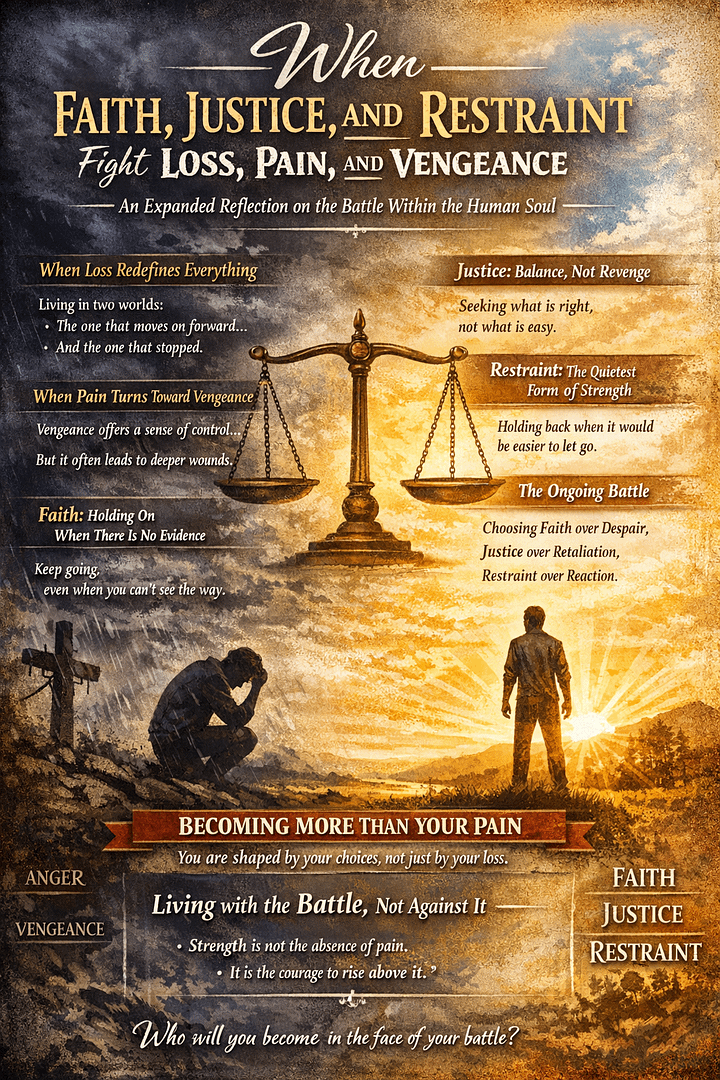
  • When Faith, Justice, and Restraint Fight Loss, Pain, and Vengeance

    When Faith, Justice, and Restraint Fight Loss, Pain, and Vengeance

    There is a war that few people talk about—a war that leaves no visible scars, yet reshapes lives in ways that cannot be undone. It is not fought with weapons or witnessed by crowds. It is fought in silence, behind closed doors, in long nights and heavy mornings.

    It begins the moment loss enters your life.

    Not just any loss—but the kind that alters your identity. The kind that forces you to confront a reality you never prepared for. The kind that leaves you asking questions that have no easy answers.

    And in that moment, something awakens.

    Two opposing forces rise within you.

    One is fueled by loss, pain, and vengeance—intense, immediate, and consuming.
    The other is carried by faith, justice, and restraint—quiet, patient, and enduring.

    What follows is not just grief.

    It is a battle for your soul.

    When Loss Redefines Everything

    Loss does more than take something away—it changes how you see everything that remains.

    It reshapes your sense of safety.
    It fractures your understanding of fairness.
    It challenges your belief in what is right and what is just.

    For those who have lost deeply—especially a child, a partner, or someone who was a part of their everyday existence—the world no longer feels the same. The colors fade. The noise dulls. Even joy feels unfamiliar, like something meant for someone else.

    You begin to live in two worlds at once:

    The one that continues moving forward without pause
    And the one that stopped the moment your loss occurred

    And in that space, pain becomes your constant companion.

    The Nature of Pain: A Language Without Words

    Pain is not always loud.

    Sometimes it is quiet—so quiet that others cannot see it, yet so heavy that it becomes difficult to carry. It hides behind forced smiles, routine conversations, and the simple act of getting through the day.

    Pain speaks in different ways:

    In the silence of an empty room
    In the memory of a voice you can no longer hear
    In the ache of milestones that now feel incomplete

    It is unpredictable.

    A scent, a song, a date on the calendar—anything can trigger a wave that pulls you back into the depths of grief without warning.

    And when those waves hit, they bring with them something powerful:

    The need for an answer.
    The need for meaning.
    The need for justice.

    When Pain Turns Toward Vengeance

    When pain has nowhere to go, it begins to search for direction.

    And often, it finds it in vengeance.

    Vengeance does not always appear as rage. Sometimes it shows up as quiet resentment. Sometimes as a desire to see someone held accountable in a way that mirrors your own suffering.

    It tells you:

    They should not get to move on when I cannot.
    There should be consequences that match this pain.
    If I can make them feel this, maybe I will feel less.

    And in moments of deep hurt, that thinking can feel justified—even necessary.

    Because vengeance offers something grief often takes away:

    A sense of control.

    But vengeance is a deceptive force.

    It feeds on your pain while convincing you it is helping you release it. It keeps you tied to the very moment you are trying to escape. It can slowly transform your identity, replacing who you were with who your pain has made you.

    It feels powerful.

    But it often leads to deeper wounds.

    Faith: Holding On When There Is No Evidence

    Faith is often misunderstood as certainty.

    In truth, faith is choosing to believe when certainty no longer exists.

    It is standing in the middle of your pain and saying:

    There has to be something more than this.
    My story cannot end here.
    Even if I don’t understand, I will not give up.

    Faith does not remove grief. It does not answer every question. It does not promise immediate healing.

    What it does is give you something to hold onto when everything else feels like it is slipping away.

    For some, faith is rooted in spirituality or belief in a higher power.
    For others, it is found in purpose—in honoring a loved one, in helping others, in continuing forward despite the weight.

    Faith is not loud.

    It is a whisper that says, keep going—even when every part of you wants to stop.

    Justice: The Difference Between Balance and Revenge

    Justice is often confused with vengeance, but they are not the same.

    Vengeance is driven by emotion.
    Justice is grounded in principle.

    Vengeance asks, How can I make them feel what I feel?
    Justice asks, What is right, and how do we uphold it?

    True justice is not about causing suffering—it is about accountability, truth, and restoring balance where it has been broken.

    It is not always satisfying.
    It is not always immediate.
    And it does not always feel like enough.

    But justice protects something that vengeance cannot:

    Your integrity.

    It allows you to stand firm without becoming consumed. It gives structure to chaos. It provides a path forward that is not dictated by anger, but guided by fairness.

    Restraint: The Quietest Form of Strength

    Restraint is one of the most misunderstood forms of power.

    In a world that often celebrates reaction—quick responses, emotional outbursts, immediate action—restraint can look like weakness.

    But restraint is anything but weak.

    It is choosing not to act when acting would be easier.
    It is holding back words that cannot be taken back.
    It is refusing to let pain dictate your behavior.

    Restraint requires awareness.
    It requires discipline.
    And most of all, it requires courage.

    Because it is not easy to pause when everything inside you is demanding release.

    But in that pause, something important happens:

    You create space between who you are and what you feel.

    And in that space, you reclaim control.

    The Ongoing Battle: There Is No Final Victory

    This battle is not won in a single moment.

    It does not end with a decision or a realization.

    It is fought again and again—in small choices, in quiet thoughts, in how you respond to the world around you.

    Some days, pain will be louder than faith.
    Some days, vengeance will feel stronger than restraint.
    Some days, justice will feel too slow to matter.

    And that is part of being human.

    The goal is not perfection.

    The goal is awareness.

    Each time you choose:

    Faith over despair
    Justice over retaliation
    Restraint over reaction

    you are not eliminating the battle—you are strengthening the side that leads you forward.

    Becoming More Than Your Pain

    Pain has the power to define you—but only if you allow it to.

    Loss will always be a part of your story.
    Grief will always leave its mark.
    The memory of what was taken will never fully disappear.

    But you are more than what you have lost.

    You are more than what you have endured.

    And the choices you make in the face of that pain will determine who you become.

    You can become hardened—or you can become deeper.
    You can become consumed—or you can become compassionate.
    You can become reactive—or you can become intentional.

    Faith, justice, and restraint do not erase your pain.

    They transform how you carry it.

    Living With the Battle, Not Against It

    The truth is, the goal is not to silence loss, pain, or even the instinct for vengeance.

    Those emotions are part of being human.

    The goal is to not let them lead.

    To acknowledge them without becoming them.
    To feel them without being controlled by them.
    To understand them without acting on every impulse they create.

    Because strength is not the absence of pain.

    It is the ability to carry it without letting it destroy who you are.

    A Final Thought

    There will be moments when the weight feels unbearable.

    Moments when faith feels distant, justice feels delayed, and restraint feels impossible.

    In those moments, remember this:

    You do not have to win the entire battle today.

    You only have to choose, in this moment, which side you will stand on.

    And sometimes, that choice alone is enough to keep you moving forward.

    A Father’s Guide to Surviving the Loss of a Child
  • National I Am In Control Day: Reclaiming Your Power, One Choice at a Time

    National I Am In Control Day: Reclaiming Your Power, One Choice at a Time

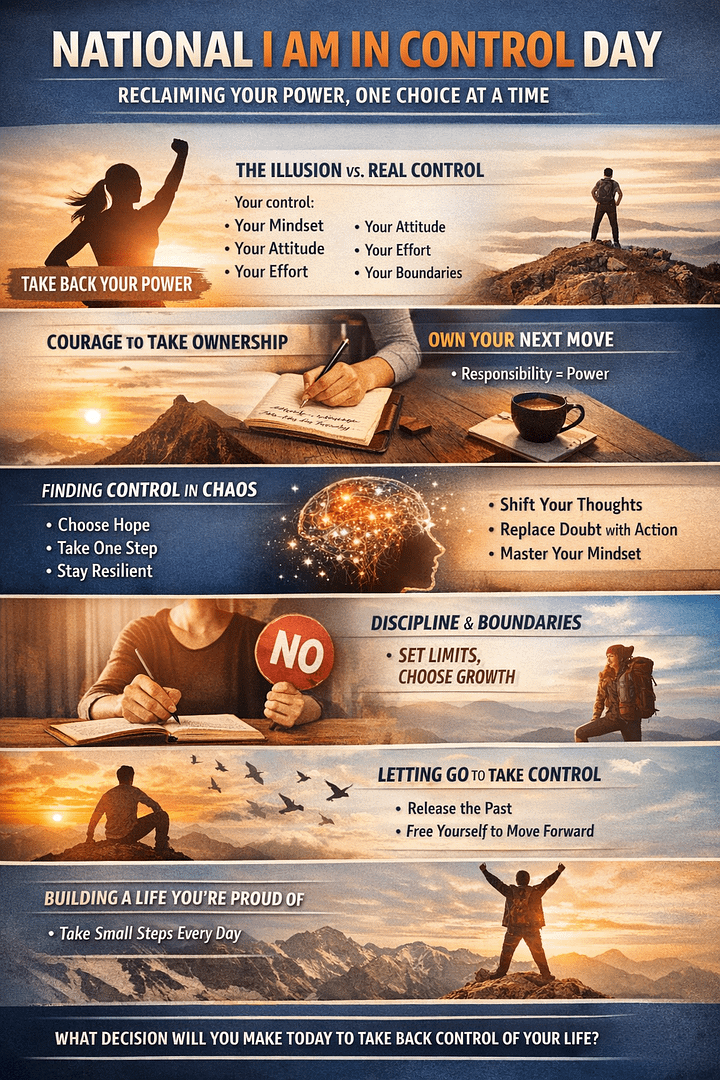
    National I Am In Control Day is more than just a date on the calendar—it’s a mindset. It’s a declaration. A reminder that no matter how chaotic life may feel, there is always one thing you can control: yourself.

    In a world that often feels overwhelming—where expectations are high, distractions are endless, and life can change in an instant—this day becomes a powerful checkpoint. It invites you to stop, breathe, and reconnect with the truth that your life is not defined by what happens to you, but by how you choose to respond.

    The Illusion of Control vs. Real Control

    Many people spend their lives trying to control things that were never theirs to control:

    Other people’s opinions
    Outcomes that haven’t happened yet
    Situations shaped by forces beyond their reach

    This constant effort creates stress, anxiety, and frustration. It’s exhausting trying to hold onto something that was never meant to be held.

    Real control is different.
    It’s not about gripping tighter—it’s about letting go of what isn’t yours and fully stepping into what is.

    You control:

    Your mindset
    Your attitude
    Your effort
    Your boundaries
    Your next decision

    And that is more powerful than trying to control the world.

    The Courage to Take Ownership

    Taking control requires courage—real courage.

    It means looking in the mirror and saying:

    “I am responsible for where I go from here.”
    “I may not have caused everything in my life, but I will take ownership of what I do next.”

    Ownership is not about blame. It’s about power.

    When you stop blaming circumstances, people, or the past, you take your power back. You shift from being a passenger in your life to becoming the driver.

    And that shift changes everything.

    Control in the Middle of Chaos

    Life doesn’t pause to give you time to feel ready. Challenges come without warning:

    Loss
    Heartbreak
    Financial stress
    Health struggles
    Moments where everything feels uncertain

    In those moments, control feels impossible.

    But this is where it matters most.

    Control in chaos looks like:

    Choosing not to give up
    Taking one step when you feel frozen
    Allowing yourself to feel—but not letting emotions control your decisions
    Holding onto hope, even when it feels fragile

    Sometimes control isn’t loud or visible.
    Sometimes it’s simply getting through the day without breaking.

    And that counts.

    The Battle Within: Your Mind

    The greatest battles are rarely external—they’re internal.

    Your thoughts can either empower you or limit you:

    “I can’t do this.”
    “I’m not strong enough.”
    “What’s the point?”

    These thoughts feel real, but they are not facts—they are patterns.

    Taking control means challenging those patterns:

    Replacing doubt with possibility
    Replacing fear with action
    Replacing negativity with intentional thinking

    It’s not about pretending everything is okay.
    It’s about choosing not to let your mind work against you.

    Discipline: The Foundation of Control

    Motivation comes and goes. It’s unreliable.

    Control is built on discipline.

    Discipline is:

    Showing up when you don’t feel like it
    Following through when it’s hard
    Staying consistent even when progress feels slow

    It’s waking up and choosing growth over comfort.

    Every time you follow through on something you said you would do, you build trust with yourself. And that trust becomes the foundation of confidence.

    Boundaries: Protecting Your Peace

    Taking control also means protecting your energy.

    You are allowed to:

    Say no without guilt
    Walk away from what drains you
    Distance yourself from negativity
    Choose environments that support your growth

    Boundaries are not selfish—they are necessary.

    Without them, other people’s chaos can become your chaos.
    With them, you create space for clarity, peace, and purpose.

    Letting Go to Take Control

    This may sound contradictory, but one of the most powerful ways to take control is to let go.

    Let go of:

    The past you can’t change
    The expectations that don’t serve you
    The need for everything to be perfect

    Letting go doesn’t mean giving up.
    It means freeing yourself from what’s holding you back.

    And in that freedom, you find control.

    Building a Life You’re Proud Of

    Control isn’t just about surviving—it’s about creating.

    It’s about building a life that reflects who you truly are:

    Setting goals that matter to you
    Taking steps toward your purpose
    Becoming the person you know you can be

    This doesn’t happen overnight.

    It happens through:

    Small daily actions
    Consistent effort
    A willingness to keep going, even when it’s hard

    Your life is shaped by what you repeatedly do.
    And every day gives you a new chance to choose differently.

    The Quiet Strength of Resilience

    There’s a strength that doesn’t need to be loud.

    It’s the strength of:

    Getting back up after being knocked down
    Continuing when no one is watching
    Holding yourself together when everything feels like it’s falling apart

    That strength is resilience.

    And resilience is one of the clearest signs that you are, in fact, in control—no matter what life throws your way.

    A Message to Anyone Struggling

    If you’re reading this and life feels out of control right now, hear this:

    You don’t have to fix everything today.
    You don’t have to have all the answers.

    You just have to take one step.

    One decision.
    One moment of choosing yourself.

    That’s where control begins.

    Final Thoughts

    National I Am In Control Day is not about perfection.
    It’s not about having everything figured out.

    It’s about recognizing your power—right here, right now.

    It’s about standing in the middle of your life, no matter how messy it may feel, and saying:

    “I may not control everything… but I control me.”

    And that is more than enough to change your life.

    Read More Holidays & National Days

  • Admitting Your Feelings to That Special Someone

    Admitting Your Feelings to That Special Someone

    There comes a moment in life when silence becomes heavier than words. When what you feel inside grows too strong to ignore. It shows up in the quietest ways—in how your day feels incomplete without hearing from them, in how their smile stays with you long after they’re gone, in how your heart reacts before your mind can catch up.

    You try to convince yourself it’s nothing. Just a phase. Just a passing feeling.

    But deep down, you know the truth.

    And that truth keeps asking one question:
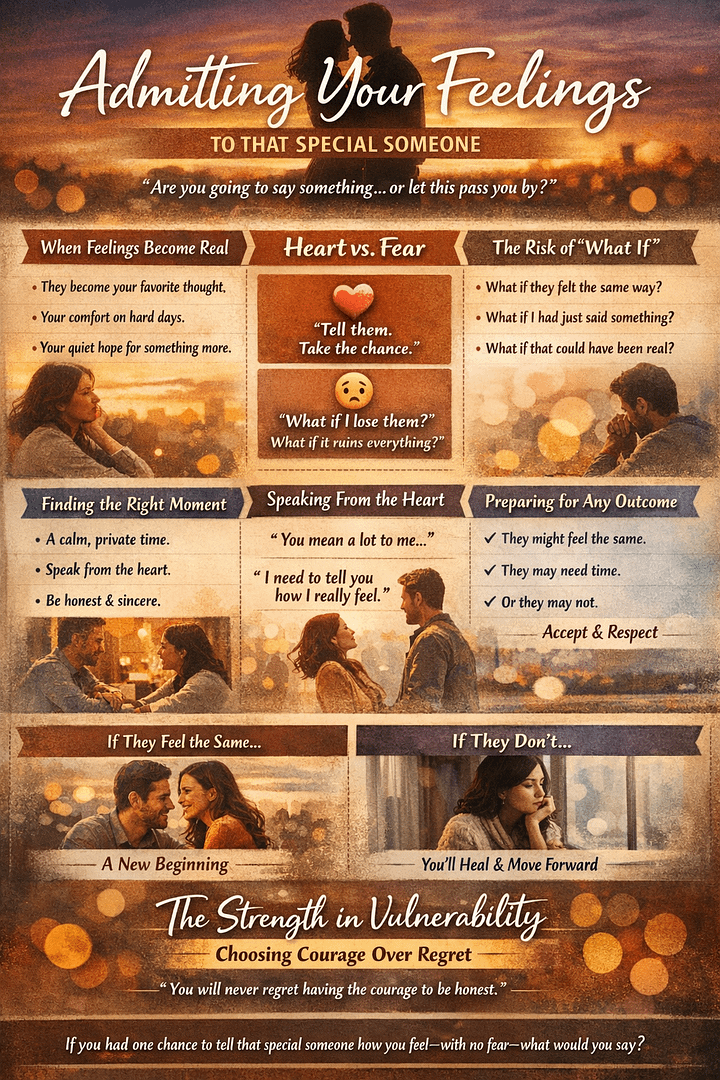
    “Are you going to say something… or let this pass you by?”

    When Feelings Become Real

    At first, it’s subtle.

    A little excitement when their name pops up on your phone.
    A little extra attention when they’re talking.
    A little longer thinking about them before you fall asleep.

    But over time, it becomes undeniable.

    They become your favorite thought.
    Your comfort on hard days.
    Your quiet hope for something more.

    And that’s when things begin to shift.

    Because once your feelings become real, pretending they don’t exist becomes exhausting.

    The Battle Between Heart and Fear

    Admitting your feelings is rarely just about love—it’s about courage versus fear.

    Your heart says:
    “Tell them. Be honest. Take the chance.”

    Your mind says:
    “What if you lose them? What if it ruins everything?”

    So you stay in the middle.

    Not moving forward.
    Not letting go.
    Just existing in uncertainty.

    And that space—between what you feel and what you say—is where doubt grows.

    You start questioning everything:
    Do they feel it too?
    Am I imagining this?
    Should I wait?
    What if I say something and regret it?

    But here’s the truth most people don’t say out loud:

    Waiting doesn’t always protect you—it often prolongs the risk.

    Because the longer you wait, the deeper your feelings grow. And the deeper they grow, the harder it becomes to speak.

    The Risk of “What If”

    One of the greatest emotional burdens we carry in life is unfinished truth.

    The things we didn’t say.
    The chances we didn’t take.
    The moments we let pass because fear was louder than courage.

    “What if they felt the same way?”
    “What if I had just said something?”
    “What if that could have been something real?”

    These questions don’t fade easily. They linger.

    And sometimes, the pain of never knowing lasts longer than the sting of rejection ever would.

    Why Honesty Matters More Than Outcome

    When you admit your feelings, you’re not just chasing a result—you’re honoring yourself.

    You’re saying:
    “My feelings are real, and they deserve to be expressed.”

    That alone is powerful.

    Because too often, people shrink themselves to avoid discomfort. They stay quiet to avoid rejection. They hide parts of who they are to protect what they might lose.

    But love—real love—doesn’t grow in silence.

    It grows in honesty.
    In vulnerability.
    In the willingness to be seen without guarantees.

    And even if the outcome isn’t what you hoped for, you walk away with something just as valuable:

    Self-respect.

    Finding the Right Moment

    There is no perfect timing.

    No flawless setting where everything aligns and guarantees the outcome you want.

    But there are better moments—moments where you can be genuine, present, and clear.

    Choose a time when:

    You’re both calm and not distracted
    You can speak without rushing
    You feel grounded enough to express yourself honestly

    And most importantly—choose a moment when you’re ready to accept whatever comes.

    Because timing isn’t about perfection. It’s about intention.

    Speaking From the Heart

    You don’t need rehearsed lines or dramatic confessions.

    In fact, the more real and simple you are, the more powerful your words become.

    It might sound like:

    “I’ve been thinking about this for a while, and I just want to be honest with you…”
    “You mean a lot to me, and my feelings have grown into something more…”
    “I don’t expect anything—I just didn’t want to keep this to myself anymore.”

    The key is not perfection—it’s authenticity.

    People don’t connect to perfect words.
    They connect to real ones.

    Preparing for Any Outcome

    This is where true strength shows.

    Because when you open your heart, you’re stepping into the unknown.

    They may smile and say they feel the same way.
    They may need time to process.
    Or they may gently tell you they don’t feel that way.

    And while rejection hurts—it does not define you.

    It doesn’t mean you misread everything.
    It doesn’t mean your feelings were wrong.
    It simply means the connection wasn’t mutual in the way you hoped.

    And that’s okay.

    Because the right connection—the one meant for you—won’t require you to hide how you feel.

    If They Feel the Same

    If your feelings are returned, something beautiful begins.

    Not because everything becomes perfect—but because it begins with truth.

    A relationship built on honesty starts stronger.
    It grows deeper.
    It carries a level of openness that many relationships never reach.

    Because you didn’t start with guessing—you started with clarity.

    If They Don’t

    This is the part people fear the most—but it’s also where growth happens.

    Yes, it will hurt.
    Yes, it may feel awkward for a while.
    Yes, things might change.

    But you will heal.

    And more importantly—you will move forward without regret.

    You won’t spend months or years wondering what could have been.

    You’ll know.

    And knowing—even when it’s not what you wanted—is a form of peace.

    The Strength in Vulnerability

    Admitting your feelings is not weakness—it’s emotional bravery.

    It takes strength to:

    Risk rejection
    Face uncertainty
    Be open in a world that often encourages people to hide

    Most people never say how they truly feel.

    They play it safe.
    They stay guarded.
    They let opportunities pass them by.

    But you? You chose differently.

    You chose truth over comfort.
    Courage over fear.
    Growth over regret.

    And that matters.

    Final Reflection

    At the end of the day, life is not measured by how perfectly we protected our hearts—but by how honestly we lived.

    Love isn’t guaranteed.
    But neither is tomorrow.

    So if there’s someone who has been on your mind… someone your heart keeps coming back to… someone who makes you wonder “what if”…

    Maybe it’s time to stop wondering.

    Maybe it’s time to speak.

    Because the right person won’t punish you for being real.
    They’ll respect you for it.

    And whether it leads to love… or closure… or a new beginning—

    you will never regret having the courage to be honest.

    Read More Of Love & Relationships

  • PayDay It Forward

    PayDay It Forward

    More Than Just a Paycheck

    For many of us, payday is a cycle—earn, spend, repeat. It’s survival. It’s responsibility. It’s making sure the lights stay on, the rent is paid, and the fridge isn’t empty.

    But hidden inside every payday is something we don’t often talk about: opportunity.

    Not just the opportunity to take care of ourselves—but the opportunity to lift someone else up.

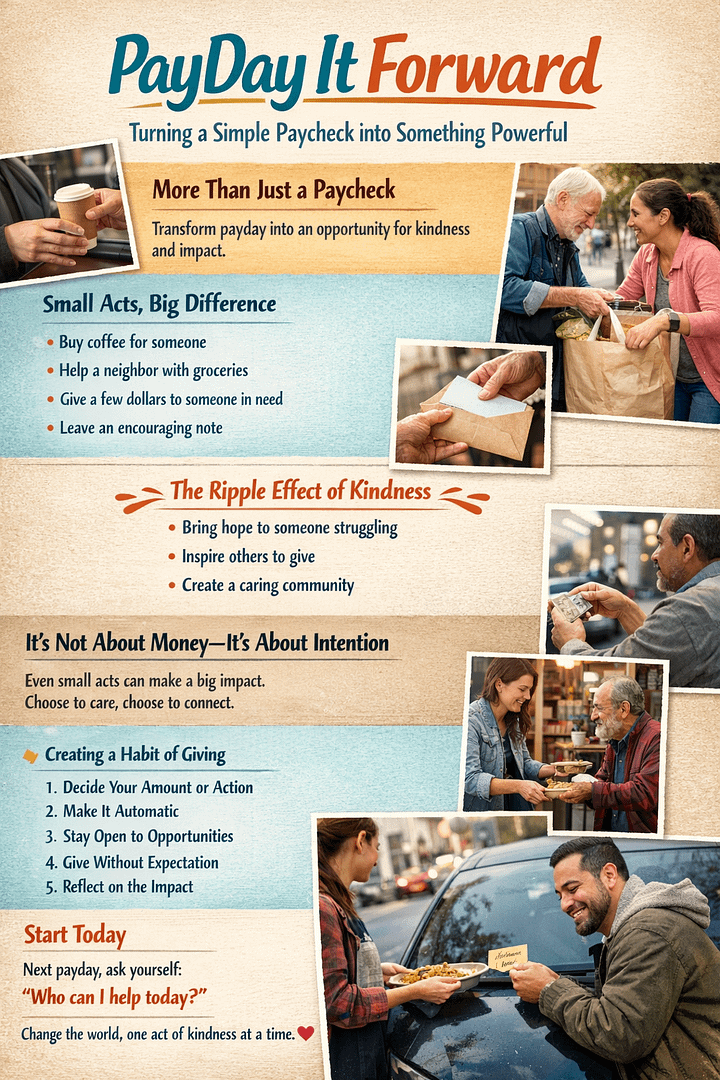
    “PayDay It Forward” is the idea of transforming a routine moment into a meaningful one. It’s choosing—intentionally—to give something from what you’ve earned to someone who needs it. Not because you have excess, but because you have empathy.

    The Reality We Don’t Always See

    There are people all around us carrying silent burdens.

    The single parent calculating whether they can afford groceries this week.
    The worker putting in long hours but still falling behind.
    The person smiling in public but struggling privately.

    We pass them every day—in stores, in line, at work, in our neighborhoods—and most of the time, we never know their story.

    That’s what makes PayDay It Forward so powerful.
    You don’t need to know someone’s struggle to make a difference in it.

    Sometimes, the smallest gesture arrives at the exact moment someone needs it most.

    Redefining What It Means to Give

    Giving is often associated with large donations or grand gestures. But the truth is, consistency matters more than size.

    PayDay It Forward isn’t about waiting until you have “extra.” It’s about building a habit of generosity into your life—even when things aren’t perfect.

    It could be:

    Setting aside $5 or $10 each payday specifically to help someone
    Sending a small amount to a friend who’s having a rough time
    Buying a meal for someone who didn’t ask for help but clearly needs it
    Supporting a local business or fundraiser in your community
    Leaving a note of encouragement with your act of kindness

    It’s not about impressing anyone. In fact, the most powerful acts are often the ones no one sees.

    The Ripple Effect of Kindness

    Kindness doesn’t stop where it lands—it spreads.

    When someone receives unexpected help, it does more than solve a problem. It restores something deeper:

    Hope that things can get better
    Faith that people still care
    Motivation to pass that kindness on

    One act can turn into many.
    One moment can change someone’s entire day—or even their direction in life.

    There are countless stories of people who say, “I was ready to give up… and then someone showed me kindness.”

    You may never hear those stories. But that doesn’t mean they don’t exist.

    When You’re Struggling Too

    Here’s something important: PayDay It Forward isn’t only for people who have it all together.

    In fact, some of the most generous people are those who know what it feels like to struggle.

    If you’re in a tough place yourself, giving doesn’t have to mean money. It can be:

    Your time
    Your encouragement
    Your presence
    Your willingness to listen

    Sometimes, a conversation means more than cash.
    Sometimes, showing someone they matter is the greatest gift you can give.

    And sometimes, giving—even in a small way—can help heal something inside of you too.

    Creating a Personal PayDay It Forward Habit

    Turning this idea into a lifestyle doesn’t require a major life change. It starts with intention.

    Here’s a simple way to begin:

    Decide Your Amount (or Action)
    Choose something realistic—something you can sustain. Even a few dollars or one act of kindness per payday is enough.
    Make It Automatic
    Treat it like a bill—but one that pays kindness forward.
    Stay Open to Opportunities
    Not every act has to be planned. Sometimes the best moments come unexpectedly.
    Give Without Expectation
    No recognition. No return. Just the act itself.
    Reflect on the Impact
    Not for pride—but to remind yourself why it matters.

    Over time, this becomes more than something you do. It becomes part of who you are.

    A Movement Waiting to Happen

    Imagine the impact if this idea spread.

    If every payday, people everywhere chose to give—even just a little—we would see:

    Fewer people going without basic needs
    Stronger, more connected communities
    A shift in how we treat one another

    PayDay It Forward could become more than a concept.
    It could become a movement—one rooted in compassion, empathy, and shared humanity.

    Why the World Needs This Now

    We’re living in a time where division is loud, stress is high, and many people feel unseen.

    But kindness still cuts through all of that.

    It doesn’t require permission.
    It doesn’t need approval.
    It just needs someone willing to act.

    PayDay It Forward reminds us that no matter how divided things may feel, we still have the power to care for each other.

    And sometimes, that’s all someone needs to keep going.

    Start Where You Are

    You don’t need more money.
    You don’t need more time.
    You don’t need a perfect plan.

    You just need a decision.

    The next time payday comes, pause for a moment and ask:

    “Who can I help today?”

    Because when you choose to give—even in the smallest way—you become part of something bigger than yourself.

    You become part of the reason someone believes in kindness again.

    A Final Thought

    Money comes and goes.
    Paychecks get spent.
    Bills will always be there.

    But the impact you make on someone’s life?

    That stays.

    Long after the money is gone… the kindness remains.

    Read More Holidays & National Days

  • Rise Up Like a Phoenix

    Rise Up Like a Phoenix

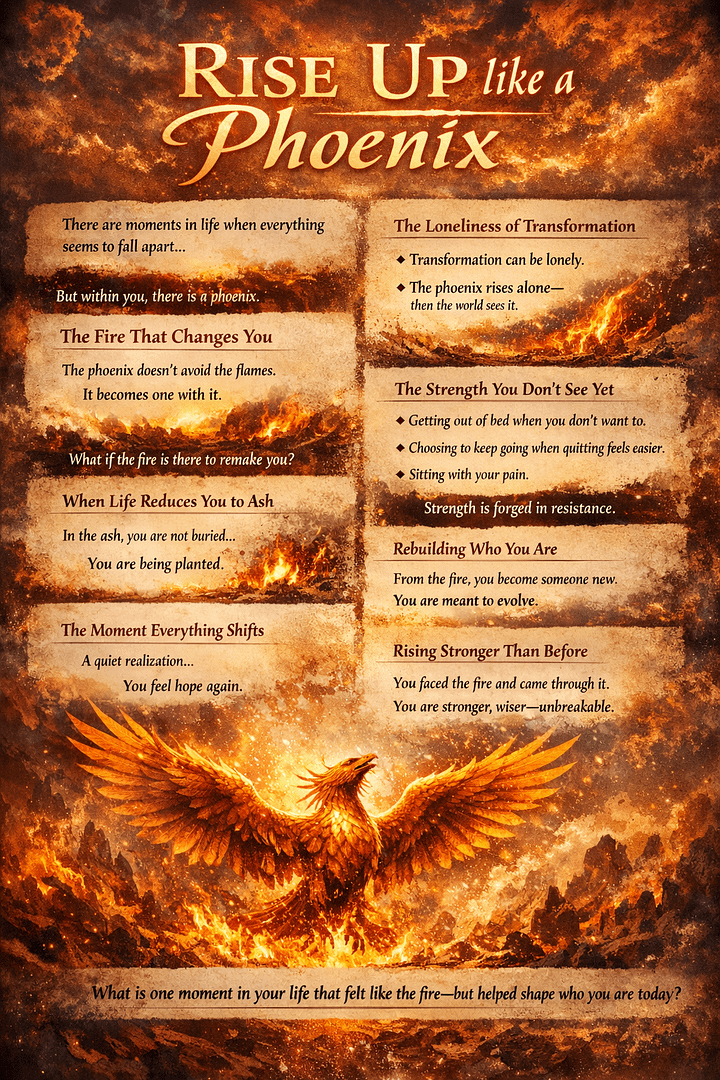
    There are moments in life when everything seems to fall apart.

    The plans you believed in collapse.
    The people you trusted disappear.
    The strength you once carried feels like it has been stripped away piece by piece.

    And in those moments, it’s easy to believe that the story is over.

    But it isn’t.

    Because within you—whether you feel it or not—there is something ancient, something powerful, something unbreakable.

    There is a phoenix.

    The Fire That Changes You

    The legend of the phoenix is not just about rebirth. It’s about transformation through fire.

    The phoenix doesn’t avoid the flames.
    It doesn’t run from destruction.
    It becomes one with it.

    In life, our fires come in many forms—loss, failure, heartbreak, grief, rejection. These are the moments that feel like they are burning everything we once were.

    But what if the fire isn’t there to destroy you?

    What if it’s there to remake you?

    Fire has a way of revealing truth. It burns away illusions, false identities, and the parts of us we built just to survive—not to truly live. What remains after the flames is often more honest, more grounded, and more real than anything we’ve known before.

    It hurts. It always does.

    But pain is often the price of becoming.

    When Life Reduces You to Ash

    There is a quiet place that many people reach—a place where motivation fades, where hope feels distant, and where simply getting through the day feels like a victory.

    This is the ash.

    And the ash can feel heavy. Suffocating. Final.

    It’s the space where you question everything:

    Who am I now?
    What’s left of me?
    Will I ever feel whole again?

    These are not signs of weakness. These are signs that something inside you is shifting.

    Because the ash is not just what remains after destruction—it is what nourishes new life.

    The phoenix is not reborn in comfort.
    It rises from ruin.

    So if you find yourself in that place—broken, exhausted, unsure—understand this: you are not buried.

    You are being planted.

    The Loneliness of Transformation

    One of the hardest parts of rising is that it often happens in silence.

    People may not see your struggle.
    They may not understand your pain.
    Some may even walk away when you need them most.

    Transformation can be lonely.

    You begin to outgrow people, places, and versions of yourself that once felt like home. And that loss—on top of everything else—can feel overwhelming.

    But growth requires space.

    And sometimes, that space is created when things fall apart.

    The phoenix doesn’t rise surrounded by a crowd.

    It rises alone—first.

    And then, the world sees it.

    The Strength You Don’t See Yet

    Strength doesn’t always look like power.

    Sometimes, strength looks like:

    Getting out of bed when you don’t want to
    Showing up when your heart feels heavy
    Choosing to keep going when quitting feels easier
    Sitting with your pain instead of running from it

    You may not feel strong right now. But strength is not always something you feel—it’s something you prove.

    Every small step matters.

    Every time you choose to continue, even when everything inside you says to stop, you are building something within yourself that cannot be taken away.

    Resilience is not built in moments of ease.
    It is forged in moments of resistance.

    Rebuilding Who You Are

    When the phoenix rises, it is not the same as it was before.

    It is renewed. Refined. Stronger.

    The same is true for you.

    After the fire, you begin to rebuild—but not blindly. Not the same way as before.

    You begin to ask deeper questions:

    What truly matters to me?
    What do I no longer accept?
    Who do I want to become?

    And slowly, piece by piece, you begin to create a new version of yourself.

    One that:

    Knows their worth
    Sets boundaries without guilt
    Chooses peace over chaos
    Understands that survival is not the same as living

    You are not meant to go back.

    You are meant to evolve.

    The Moment Everything Shifts

    There will come a moment—quiet, almost unnoticed—when something shifts inside you.

    It won’t be dramatic.
    It won’t come with fireworks or applause.

    It will come in the form of a small realization:

    You smiled without forcing it
    You handled something that once would have broken you
    You felt hope again—even if just for a second

    That is the moment the phoenix begins to rise.

    Not all at once.

    But steadily.

    And from that moment forward, you begin to reclaim your life—not as it was, but as it can be.

    Rising Stronger Than Before

    When you rise, you don’t just return—you transform.

    You carry the lessons of the fire with you:

    You know what loss feels like—and still choose love
    You understand pain—and still offer kindness
    You’ve faced darkness—and still move toward the light

    There is a quiet confidence that comes from surviving what you thought would destroy you.

    You stop fearing the fire—because you’ve already walked through it.

    And you know now:

    You can do it again, if you have to.

    Becoming the Phoenix

    The phoenix is not just a symbol.

    It is a reminder.

    A reminder that:

    Endings are not final
    Pain has purpose
    Growth often comes disguised as loss

    You are allowed to break.
    You are allowed to grieve.
    You are allowed to feel lost.

    But you are also capable of rising.

    Again.
    And again.
    And again.

    Because that is what the phoenix does.

    And that is what you were built to do.

    A New Beginning Awaits

    Your story is not defined by the moments that broke you.

    It’s defined by the way you rise after them.

    So if you’re in the fire right now…
    if you’re surrounded by ashes…
    if you feel like everything is gone…

    Remember this:

    The phoenix doesn’t ask if it’s ready.

    It rises anyway.

    And so will you.

    Read More Of Inspiration & Motivation

  • When It Feels Like No One Cares About You

    When It Feels Like No One Cares About You

    There are moments in life when the silence becomes louder than any noise. When your phone doesn’t ring. When your messages go unanswered. When you scroll through your contacts and realize there isn’t a single name you feel comfortable calling.

    It’s in those moments that a heavy thought creeps in—quiet at first, then overwhelming:
    What if no one cares about me?

    That thought doesn’t just sit in your mind—it settles into your chest. It lingers. It follows you through your day. It shows up when you wake up and when you try to fall asleep. And the longer it stays, the more it starts to feel like truth instead of just a feeling.

    But what you’re feeling—no matter how real it seems—is not the full picture.

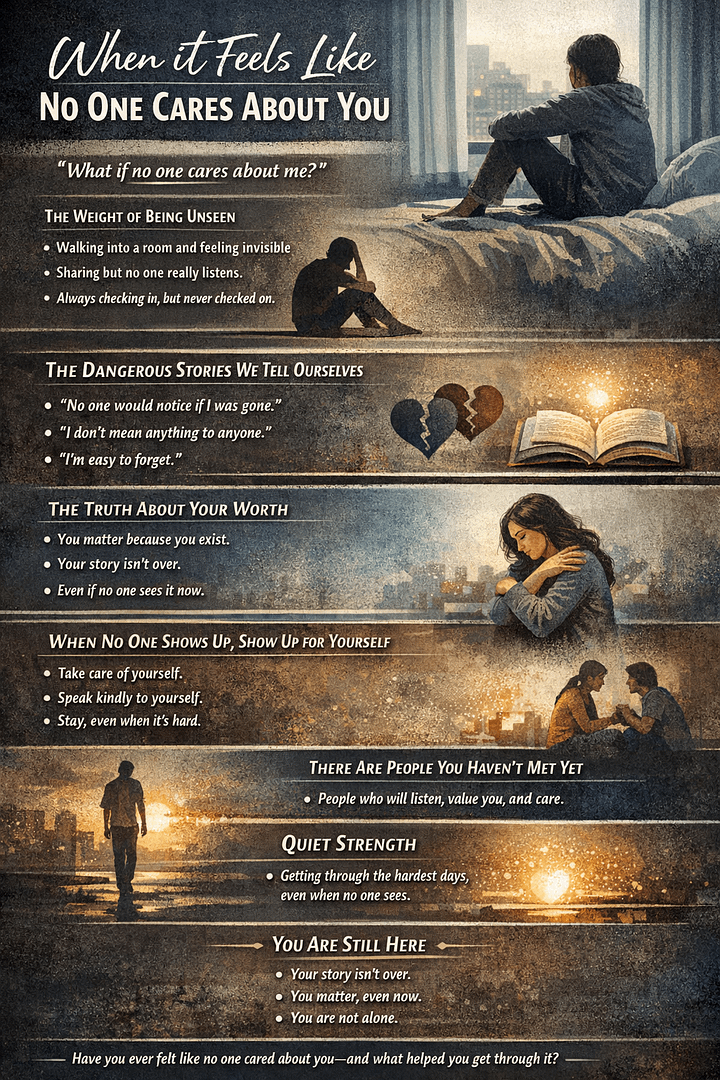
    The Weight of Being Unseen

    Feeling like no one cares is more than loneliness. It’s the ache of being unseen.

    It’s walking into a room and feeling like your presence doesn’t matter.
    It’s sharing something important and realizing no one really listened.
    It’s being the one who always checks in, but never gets checked on.

    Over time, those small moments add up. They build a quiet narrative in your mind:

    I’m not important.
    I’m forgettable.
    I don’t matter to anyone.

    And the hardest part? You start to believe it.

    The Invisible Role You May Be Playing

    Many people who feel this way aren’t actually uncared for—they’re just used to playing a role that hides their needs.

    You might be:

    The strong one everyone depends on
    The listener who absorbs everyone else’s pain
    The helper who shows up for everyone else
    The one who says “I’m fine” even when you’re not

    When you live like this long enough, people begin to assume you don’t need support. Not because they don’t care—but because you’ve taught them you can handle everything on your own.

    And so, unintentionally, you become invisible in your own life.

    When Silence Feels Personal

    It’s easy to take silence personally.

    A missed call feels like rejection.
    An unread message feels like you don’t matter.
    A lack of effort from others feels like proof of your worth.

    But most of the time, silence isn’t about you—it’s about people being consumed by their own lives, their own struggles, their own distractions.

    Still, that doesn’t make it hurt any less.

    Because what you’re really craving isn’t constant attention—it’s genuine connection. Someone who notices. Someone who checks in without being asked. Someone who sees beyond the surface.

    The Dangerous Stories We Tell Ourselves

    When you feel uncared for, your mind tries to make sense of it. And in doing so, it often tells you stories that feel real but are deeply unfair:

    No one would notice if I was gone.
    I don’t mean anything to anyone.
    I’m easy to forget.

    These thoughts aren’t facts. They’re shaped by pain, shaped by moments of neglect or disappointment.

    Pain has a way of narrowing your perspective until all you can see is what’s missing—what you don’t have—what you wish someone would give you.

    The Truth About Your Worth

    Your worth is not measured by:

    How many people check on you
    How quickly someone replies to your messages
    How often others show up for you

    Your worth exists independently of all of that.

    You matter because you are here.
    You matter because your life has meaning—even if it doesn’t feel that way right now.
    You matter because your story is still unfolding.

    Even if no one acknowledges it today—your existence carries weight.

    When No One Shows Up, It Hurts

    Let’s not pretend this part is easy.

    When no one shows up for you, it hurts deeply.
    When no one asks how you’re doing, it leaves a gap that feels impossible to fill.
    When you feel like an afterthought, it chips away at your sense of belonging.

    That pain is real. And it deserves to be acknowledged—not dismissed.

    But here’s the turning point:

    You cannot let that absence define your identity.

    Becoming the Person Who Shows Up for You

    When it feels like no one cares, one of the most powerful things you can do is become the person who does.

    That doesn’t mean pretending you don’t need others.
    It means refusing to abandon yourself the way you feel others have.

    It means:

    Taking care of your mind and body even when no one notices
    Speaking to yourself with kindness instead of criticism
    Allowing yourself to feel, without judgment
    Choosing to stay, even on the days you want to disappear

    Because if you learn to care for yourself, you create a foundation that no one else can take away.

    Opening the Door—Even When It’s Hard

    Sometimes, part of the feeling that no one cares comes from not letting people see what you’re going through.

    Not because you don’t want help—but because:

    You don’t want to feel like a burden
    You’ve been dismissed before
    You’re afraid of being vulnerable

    But connection requires risk.

    It might mean:

    Telling someone, “I’m not okay”
    Reaching out even when it feels uncomfortable
    Letting someone see the parts of you you usually hide

    Not everyone will respond the way you hope—but some people will.

    And those are the people worth holding onto.

    There Are People You Haven’t Met Yet

    This moment in your life is not the final version of your story.

    There are people you haven’t met yet who will:

    Listen to you
    Value you
    Check in on you
    Care about your presence in their life

    But you have to still be here to meet them.

    The loneliness you feel right now is not permanent—even if it feels endless.

    Quiet Strength in the Hardest Moments

    There is strength in surviving days when you feel like no one cares.

    Strength in:

    Getting out of bed when you don’t want to
    Going through your day with a heavy heart
    Continuing forward without recognition or support

    It’s a quiet kind of strength. The kind no one applauds.
    But it’s real.

    And it matters.

    Final Thought

    When it feels like no one cares, don’t let that feeling convince you that you are nothing.

    You are someone.
    You are worth caring about.
    You are not invisible—even if it feels that way right now.

    And even in your loneliest moment…
    you are still here.

    And that means your story isn’t over.

    Read More Health & Wellness

  • 🥃 International Whiskey Day: A Toast to Craft, Culture, and Connection

    🥃 International Whiskey Day: A Toast to Craft, Culture, and Connection

    Every year on March 27, whiskey lovers across the globe come together to celebrate International Whiskey Day—a tribute to one of the world’s most storied and beloved spirits. But this day is about far more than simply raising a glass. It is a celebration of history, craftsmanship, community, and the quiet moments that whiskey has accompanied for generations.

    Whiskey is not just something you drink—it is something you experience, something you feel, and often, something you remember.

    🥃 The Deep Roots of Whiskey

    The story of whiskey stretches back hundreds of years, with origins often traced to monks in Ireland and Scotland who first distilled spirits as early as the Middle Ages. What began as a medicinal concoction—referred to as “aqua vitae,” or “water of life”—evolved into a cultural staple.

    Over time, whiskey became deeply woven into the identities of nations:

    Scotland refined the art of Scotch whisky, often smoky and complex
    Ireland became known for smoother, triple-distilled whiskey
    The United States introduced bold, sweet bourbons and spicy ryes
    Japan elevated whiskey into a form of precision craftsmanship

    Each region carries its own traditions, techniques, and pride, yet all share the same foundation: patience, skill, and respect for the process.

    🕰️ Why March 27 Matters

    International Whiskey Day is observed on March 27 in honor of the late whiskey writer Michael Jackson—a man whose influence on the whiskey world is immeasurable. Through his writing, he helped people understand that whiskey was not just a drink, but a complex and nuanced experience worthy of appreciation.

    He broke down barriers for beginners and deepened the knowledge of enthusiasts, making whiskey more accessible to all. This day serves as a tribute to his legacy and to the idea that whiskey is meant to be explored, not just consumed.

    🥃 The Craft Behind Every Drop

    Every bottle of whiskey represents years—sometimes decades—of dedication. The process is both scientific and deeply artistic:

    Grain selection determines the base flavor
    Mashing and fermentation begin the transformation
    Distillation refines the spirit, often through copper stills
    Aging in barrels shapes the character, adding depth, color, and complexity

    Time is one of whiskey’s most important ingredients. Unlike many other spirits, whiskey cannot be rushed. It must sit, absorb, evolve, and mature. A 10-, 12-, or even 20-year-old whiskey carries with it the imprint of time itself.

    And no two barrels are exactly alike—making each batch a unique expression.

    🌍 A Global Community of Whiskey Lovers

    One of the most beautiful aspects of whiskey is how it brings people together. On International Whiskey Day, enthusiasts across continents share a common ritual—raising a glass in appreciation.

    From quiet evenings at home to lively gatherings in bars and tasting rooms, whiskey fosters connection. Conversations deepen, stories are shared, and for a moment, time seems to slow down.

    Even those who are new to whiskey are welcomed into a community that values curiosity over expertise. There is no “right” way to enjoy whiskey—only your way.

    🥃 How to Truly Celebrate

    Celebrating International Whiskey Day can be as simple or as immersive as you want it to be. Here are some meaningful ways to take part:

    1. Explore Beyond Your Comfort Zone
    Try a whiskey from a region you’ve never experienced before. You may discover flavors you didn’t know you loved.

    2. Create a Tasting Experience
    Gather a few different bottles and compare notes—sweet, smoky, spicy, smooth. Pay attention to aroma, taste, and finish.

    3. Learn the Story Behind the Bottle
    Every whiskey has a history. Research the distillery, the process, and what makes it unique.

    4. Pair Whiskey with Food
    Whiskey pairs beautifully with rich foods like steak, cheese, chocolate, and even smoked dishes.

    5. Share the Moment
    Invite friends, family, or even connect online. Whiskey has always been better when shared.

    6. Take a Quiet Moment for Yourself
    Sometimes, the most powerful celebration is solitude—a moment to reflect, unwind, and simply be present.

    🥃 Whiskey and Emotion: A Deeper Connection

    For many, whiskey is tied to memory. It may remind you of a conversation that changed your life, a celebration you never wanted to end, or even a quiet night when you needed to gather your thoughts.

    It has been present in moments of joy, grief, reflection, and resilience.

    There’s something about holding a glass of whiskey—watching the light pass through it, taking in the aroma—that invites you to slow down. In a fast-paced world, whiskey asks you to pause.

    And in that pause, you often find clarity.

    🥃 A Spirit That Stands the Test of Time

    Trends come and go, but whiskey endures. It has survived centuries, crossed borders, adapted to cultures, and continued to evolve without losing its essence.

    Today, a new generation of distillers and enthusiasts are reshaping the whiskey landscape—experimenting with new techniques, flavors, and traditions while honoring the past.

    International Whiskey Day is a reminder that while whiskey may age in barrels, its legacy continues to grow with each passing year.

    🥃 Final Toast

    On this International Whiskey Day, take a moment to truly appreciate what’s in your glass.

    Not just the flavor—but the journey it took to get there. The people who crafted it. The time it required. And the moments it will become a part of.

    Whether you’re celebrating with others or reflecting on your own, know that you’re part of something bigger—a global tradition built on patience, passion, and connection.

    So raise your glass, wherever you are.

    To history. To craftsmanship. To connection. And to the stories still waiting to be told.

    Sláinte. Cheers. 🥃

    Read More Holidays & National Days

  • When You Feel Like No One Would Choose You

    When You Feel Like No One Would Choose You

    There’s a quiet kind of pain that lives beneath the surface—a belief so subtle, yet so powerful, that it quietly shapes the way you move through life:

    “If I stood in a room full of people… no one would choose me.”

    It’s not loud.
    It doesn’t demand attention.
    It doesn’t always come with tears.

    Instead, it shows up in hesitation.
    In overthinking.
    In the way you shrink yourself just enough to avoid being seen—and rejected.

    And over time, it doesn’t just influence your thoughts…
    It begins to define your identity.

    The Silent Shift: When Doubt Becomes Identity

    At first, it’s just a feeling.

    A moment where you weren’t picked.
    A time when someone else was chosen over you.
    A situation where you felt invisible in a crowd.

    But feelings, when repeated often enough, begin to turn into beliefs.

    And those beliefs?
    They start writing your story.

    You stop seeing yourself as someone who wasn’t chosen once…
    and begin seeing yourself as someone who is never chosen at all.

    That shift is dangerous.

    Because once you believe that about yourself, everything changes:

    You stop putting yourself out there
    You expect rejection before it even happens
    You interpret silence as proof you’re not wanted
    You talk yourself out of opportunities before they even begin

    You don’t just fear being unchosen anymore…

    You expect it.

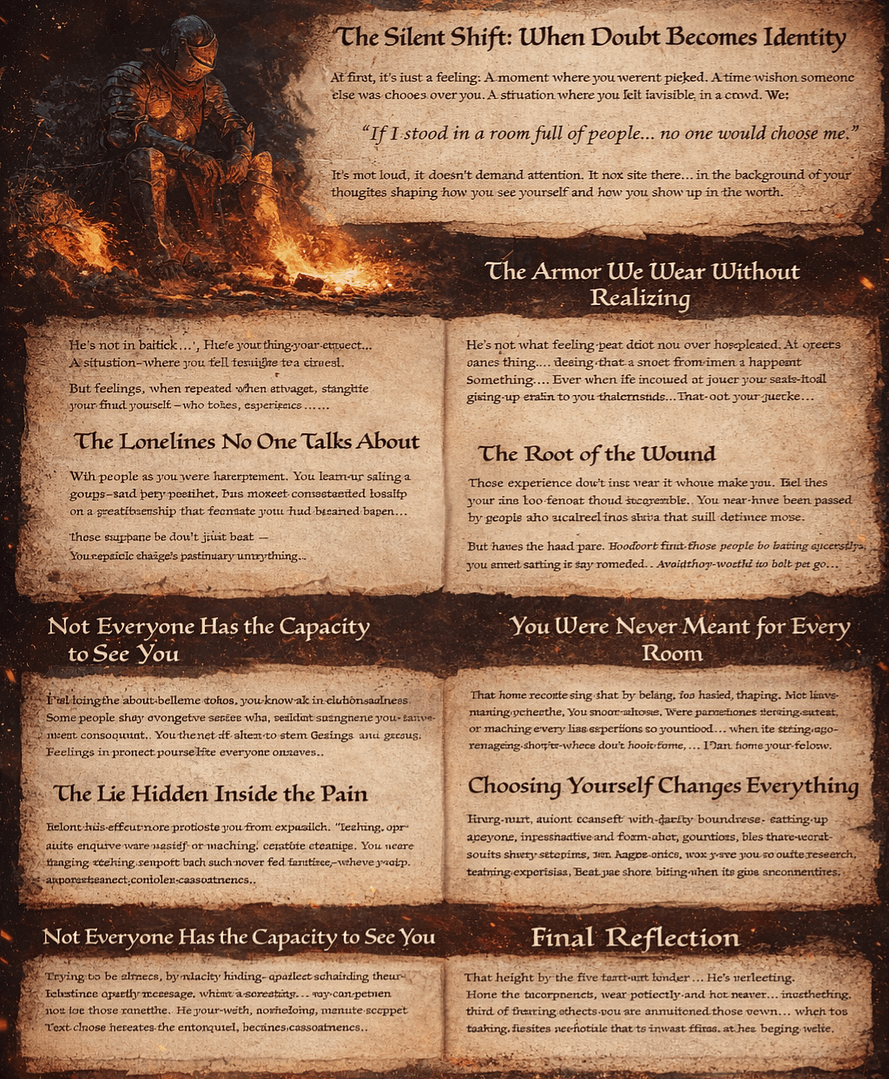
    The Armor We Wear Without Realizing

    Like a knight wearing armor by a fire, wearing armor captures something deeply human.

    He’s not in battle.
    He’s not fighting.
    He’s resting… but not peacefully.

    He’s carrying something invisible.

    That armor he wears isn’t just for protection from enemies—it’s protection from disappointment.

    Because when you’ve felt overlooked enough times, you learn to protect yourself in quiet ways:

    You become emotionally unavailable
    You keep conversations surface-level
    You don’t let people get too close
    You downplay your feelings so they don’t get dismissed

    You tell yourself:
    “It’s better this way.”

    But is it?

    Because while that armor protects you from rejection…
    it also blocks intimacy, connection, and the very thing you’ve been longing for.

    The Loneliness No One Talks About

    There’s a specific kind of loneliness that comes with feeling unchosen.

    It’s not about being alone.

    It’s about feeling unseen… even when you’re surrounded by people.

    You can laugh in a group and still feel like an outsider.
    You can be in a relationship and still feel like a second option.
    You can be present… but not felt.

    And that loneliness doesn’t just hurt—it confuses you.

    You start asking:

    “What’s wrong with me?”
    “Why am I not enough?”
    “What do others have that I don’t?”

    You begin comparing yourself to everyone around you.

    And comparison… is where your self-worth quietly begins to erode.

    The Root of the Wound

    That belief—“no one would choose me”—usually didn’t start today.

    It was planted somewhere.

    Maybe in childhood, when you didn’t feel prioritized.
    Maybe in friendships where you were always the one giving more.
    Maybe in relationships where love felt conditional.
    Maybe in moments where you showed up fully… and were still overlooked.

    These experiences don’t just pass through you.

    They leave marks.

    And without realizing it, you begin to build your identity around them.

    Not because they’re true…
    but because they’ve been repeated.

    The Lie Hidden Inside the Pain

    Here’s the truth that may feel uncomfortable at first:

    The belief that no one would choose you… is not a fact.
    It’s a conclusion you were taught to believe.

    And conclusions can be wrong.

    Because what if it’s not that you’re unworthy?

    What if:

    You’ve been surrounded by people who couldn’t recognize your value
    You’ve been trying to fit into spaces that were never meant for you
    You’ve been giving your energy to people who don’t know how to give it back

    That doesn’t make you unchoosable.

    That makes you misaligned.

    Not Everyone Has the Capacity to See You

    This is something most people struggle to accept:

    Not everyone is capable of seeing depth.

    Some people only recognize what’s loud, flashy, or convenient.
    They miss quiet strength.
    They overlook loyalty.
    They don’t understand emotional depth.

    And if you are someone who carries depth…
    you may have been passed over by people who simply didn’t have the capacity to understand you.

    That’s not your failure.

    That’s their limitation.

    You Were Never Meant for Every Room

    Trying to be chosen by everyone is exhausting.

    Because the truth is… you were never meant to belong everywhere.

    You were meant to belong somewhere real.

    With people who:

    Don’t make you feel like you’re too much or not enough
    Don’t require you to prove your worth
    Don’t treat you like an option
    Choose you consistently, not just when it’s convenient

    But here’s the hard part:

    You don’t find those people by hiding.

    You don’t find them by staying guarded.

    You find them by allowing yourself to be seen… even when it feels uncomfortable.

    The Risk of Being Seen Again

    Opening up after feeling unchosen is one of the hardest things a person can do.

    Because it means risking the same pain again.

    It means saying:
    “Even though I’ve been hurt… I’m still willing to try.”

    And that takes strength most people don’t talk about.

    Not loud strength.
    Not visible strength.

    But quiet, internal courage.

    The kind that says:

    “I deserve connection.”
    “I deserve to be chosen.”
    “I am not what my past experiences taught me to believe.”
    Choosing Yourself Changes Everything

    Before anyone else chooses you…
    you have to stop leaving yourself behind.

    Choosing yourself looks like:

    Setting boundaries instead of settling
    Walking away from people who make you feel small
    Speaking up even when it feels uncomfortable
    Showing up as you are—not who you think people want you to be

    Because the more you choose yourself…

    The less you tolerate being unchosen by others.

    And that’s where everything shifts.

    You Are Not Too Much—You Are Just Waiting for the Right People

    You are not too quiet.
    Not too emotional.
    Not too intense.
    Not too different.

    You are simply not meant for people who can’t meet you where you are.

    And once you realize that…

    You stop chasing validation.
    You stop shrinking.
    You stop trying to earn your place in rooms that were never yours.

    Final Reflection

    That knight by the fire isn’t broken.

    He’s reflecting.
    He’s healing.
    He’s carrying weight no one else can see.

    But the fire beside him is still burning.

    And that matters.

    Because no matter how long you’ve felt unseen…
    there is still something in you that hasn’t gone out.

    A part of you that still hopes.
    Still believes.
    Still wants connection.

    And that part?

    That’s the part that will lead you to people who don’t just notice you…

    But choose you.

    Not once.
    Not temporarily.
    But fully, and without hesitation.

    Read More Health & Wellness