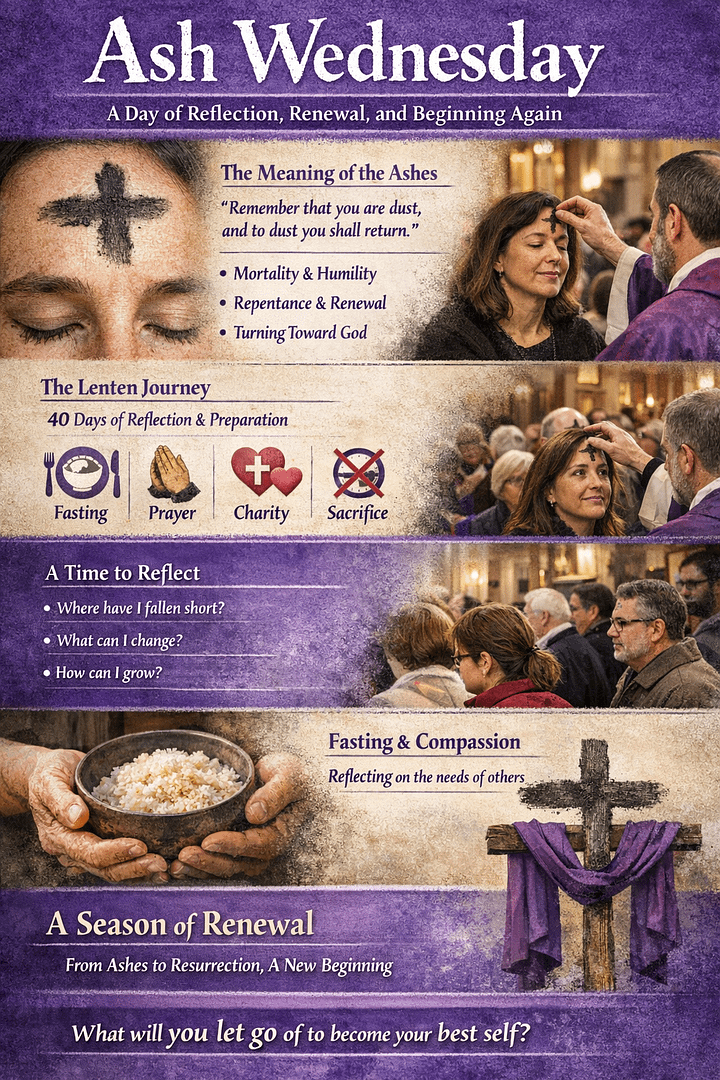
Ash Wednesday stands as one of the most profound and symbolic days in the Christian calendar — a sacred invitation to pause, reflect, and begin again. Observed by millions of Christians across denominations worldwide, the day marks the official beginning of Lent, a 40-day spiritual journey leading toward Easter. It is not a celebration filled with music or festivity, but rather a moment of quiet honesty — a time when believers confront both human frailty and divine hope.
In a culture that often encourages constant motion and distraction, Ash Wednesday calls people to stillness. It asks individuals to look inward, acknowledge imperfection, and rediscover purpose through humility, repentance, and renewal.
The Sacred Symbolism of Ashes
The most recognizable element of Ash Wednesday is the ash cross placed upon the forehead. During worship services, clergy gently press ashes onto each participant while speaking ancient words of remembrance:
“Remember that you are dust, and to dust you shall return,” or
“Repent and believe in the Gospel.”
These words are not meant to inspire fear, but awareness. The ashes symbolize several spiritual truths:
Mortality — a reminder that life is temporary and precious
Repentance — acknowledging mistakes and seeking transformation
Humility — recognizing humanity’s need for grace
Renewal — embracing the possibility of change
Traditionally, the ashes are created by burning palm branches from the previous year’s Palm Sunday services. This powerful cycle connects celebration and reflection — joy transformed into contemplation, reminding believers that faith includes both triumph and struggle.
The ash cross is worn publicly throughout the day, quietly declaring a personal commitment to reflection and growth.
The Beginning of the Lenten Journey
Ash Wednesday opens the season of Lent, a period lasting 40 days (excluding Sundays) that prepares Christians for Easter. The number 40 carries deep biblical significance, representing times of testing, preparation, and spiritual transformation:
Moses fasted for 40 days on Mount Sinai.
The Israelites wandered 40 years in the wilderness.
Jesus fasted 40 days before beginning His ministry.
Lent mirrors these experiences, encouraging believers to step away from distractions and focus on spiritual renewal.
Common Lenten practices include:
1. Fasting
Many Christians reduce meals or abstain from certain foods as an act of discipline and mindfulness. Fasting is less about deprivation and more about creating space for spiritual awareness.
2. Prayer
Individuals often deepen prayer lives through daily devotionals, scripture reading, or moments of silence.
3. Sacrifice
Giving something up — social media, sweets, unhealthy habits, or negative attitudes — becomes a symbolic act of self-reflection.
4. Charity and Service
Acts of kindness and generosity emphasize that faith is lived through compassion toward others.
A Call to Honest Self-Reflection
Ash Wednesday invites a rare level of honesty. It asks difficult questions:
Where have I fallen short?
What habits no longer serve my life?
How can I grow spiritually, emotionally, or morally?
Rather than focusing on guilt, the day emphasizes transformation. The acknowledgment of imperfection becomes the first step toward healing.
For many, this reflection extends beyond religion. Even those outside Christian traditions often find meaning in the universal themes of renewal and accountability. The day reminds humanity that growth begins when we are willing to confront ourselves with sincerity.
The Power of Public Faith
One unique aspect of Ash Wednesday is the visibility of the ash cross. Unlike private prayer, this outward sign turns personal belief into a shared experience.
People carry the ashes into workplaces, schools, and communities — an unspoken reminder that everyone carries struggles, hopes, and the desire for renewal. The symbol often sparks conversations about faith, purpose, and identity.
In a society where vulnerability is sometimes hidden, the ashes represent humility worn openly.
Fasting, Compassion, and Social Awareness
Fasting on Ash Wednesday is traditionally paired with abstinence from meat and simplified meals. The purpose extends beyond spiritual discipline; it fosters empathy.
Hunger becomes a reminder of those who live with scarcity every day. Many churches encourage donating money saved from meals to charities or local outreach programs, transforming personal sacrifice into collective compassion.
This connection reinforces a central teaching: spiritual growth must lead to love in action.
Ash Wednesday Around the World
While the core meaning remains the same, Ash Wednesday is observed in diverse ways globally:
In many European and Latin American countries, churches remain open throughout the day so people can receive ashes before or after work.
Some cities hold outdoor services, bringing worship into public spaces.
Increasingly, clergy offer “ashes to go,” meeting people in streets, train stations, and public squares — symbolizing faith meeting people where they are.
These evolving traditions demonstrate how ancient practices continue adapting to modern life while preserving their spiritual depth.
A Season of Letting Go and Beginning Again
Ash Wednesday does not end with ashes; it begins a journey. Lent becomes a season of gradual transformation — a time to release burdens, repair relationships, and rediscover hope.
The ashes symbolize endings: ego, regret, distraction, and spiritual complacency. Yet they also point toward resurrection — the promise that renewal follows surrender.
In many ways, Ash Wednesday reflects a universal human longing: the chance to start over.
It reminds us that growth is not found in perfection but in willingness — the willingness to change, to forgive, and to move forward with intention.
Why Ash Wednesday Still Matters Today
In an age defined by speed, comparison, and constant digital noise, Ash Wednesday offers something deeply countercultural:
silence instead of distraction
reflection instead of reaction
humility instead of self-promotion
hope instead of despair
Its message transcends centuries because it speaks to timeless human needs — meaning, forgiveness, and renewal.
Whether observed through religious devotion or personal reflection, Ash Wednesday encourages a powerful truth:
Every ending carries the possibility of a new beginning.
Read More Holidays & National Days
Leave a Reply