Author: Brett Murphy

  • National Spouses Day – Celebrating the Person Who Walks Beside You

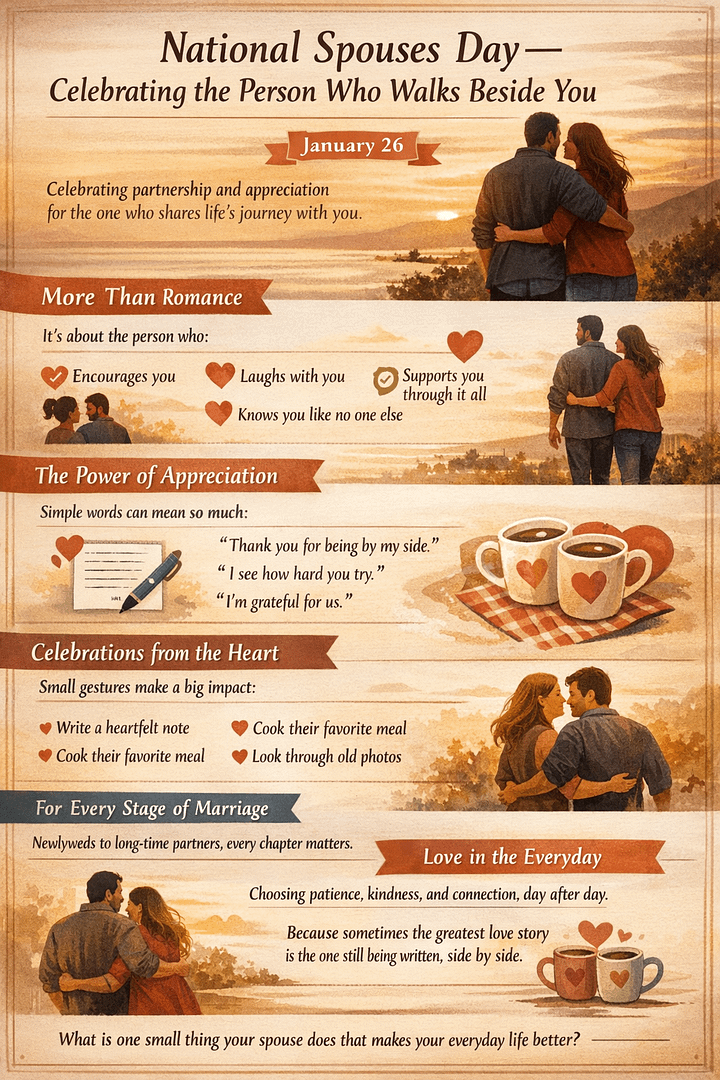
    National Spouses Day – Celebrating the Person Who Walks Beside You

    Every year on January 26, National Spouses Day offers a meaningful reminder to pause and truly appreciate the person who shares life’s everyday moments with us — our spouse. While holidays like Valentine’s Day often spotlight romance, flowers, and grand gestures, this day focuses on something quieter yet even more powerful: partnership, loyalty, and the shared journey of building a life together.

    It is a celebration not just of love, but of presence — the person who stands beside you through the ordinary days that, strung together, become a lifetime.


    More Than Romance

    Marriage or long-term partnership isn’t sustained by dramatic moments alone. It’s built in the small spaces of daily life: early mornings, shared responsibilities, tired conversations at the end of long days, and the comfort of silent understanding. Romance may light the spark, but companionship keeps the fire going.

    National Spouses Day recognizes the emotional teamwork that often goes unnoticed. It honors the spouse who:

    • Encourages you when self-doubt creeps in

    • Supports the family in seen and unseen ways

    • Laughs with you during stressful seasons

    • Stays when life feels uncertain

    It’s about the person who knows how you take your coffee, senses when something is wrong before you speak, and remembers the dreams you mentioned years ago.


    The Strength of a Shared Life

    A spouse is more than a romantic partner — they are often a confidant, co-parent, financial teammate, problem-solver, and emotional anchor. Together, couples navigate career changes, health challenges, parenting stress, aging parents, losses, and transitions that reshape life in ways neither could fully predict.

    National Spouses Day acknowledges that marriage is not simply about happiness; it’s about resilience. It’s about choosing to work through misunderstandings, learning how to communicate better, and growing not only as individuals but as a team.

    In a world that often highlights independence, this day celebrates interdependence — two people choosing to carry life’s weight together.


    The Power of Feeling Seen

    Over time, familiarity can blur appreciation. It’s easy to assume your spouse “already knows” how much they mean to you. But spoken gratitude carries emotional weight. Feeling valued strengthens trust and deepens connection.

    A sincere expression of appreciation can:

    • Increase emotional closeness

    • Reduce resentment

    • Strengthen partnership during stressful seasons

    • Reinforce a sense of being loved and understood

    Sometimes, the most powerful words are the simplest:
    “Thank you for standing by me.”
    “I see how hard you try.”
    “I’m grateful we’re doing life together.”


    Celebration Doesn’t Have to Be Elaborate

    The beauty of National Spouses Day lies in its simplicity. It isn’t about expensive gifts or social media posts — it’s about intention. Meaningful gestures often come from thoughtfulness rather than cost.

    Ways to honor your spouse might include:

    • Writing a heartfelt letter about what you admire most in them

    • Recreating your first date at home

    • Cooking their favorite meal or dessert

    • Unplugging from devices and spending uninterrupted time together

    • Looking through old photos and remembering shared milestones

    • Offering help with something that normally stresses them

    These small acts communicate: “You matter. Our relationship matters.”


    Every Stage of Marriage Matters

    Whether you’re newly married, years into partnership, or decades into a shared life, this day holds value.

    • New couples can use it to establish a habit of appreciation early.

    • Mid-life couples can reconnect amid the busyness of careers and family life.

    • Long-married partners can reflect on everything they’ve survived together — the storms weathered, the memories made, the ways they’ve grown side by side.

    Even relationships that have faced difficulty can use this day as a reset — a moment to recognize effort, forgiveness, and the courage to keep choosing one another.


    Love in the Everyday

    National Spouses Day reminds us that love is not just a feeling that appears effortlessly. It’s a series of daily choices:

    Choosing patience during disagreements.
    Choosing kindness when stress is high.
    Choosing to listen instead of withdraw.
    Choosing connection, even when life feels overwhelming.

    The most meaningful love stories are rarely dramatic. They are steady. They are built on shared routines, mutual respect, and the quiet comfort of knowing someone is walking the path with you.


    A Moment to Pause

    Life moves fast. Responsibilities pile up. Days blend together. National Spouses Day creates space to slow down and acknowledge the person who has been there through it all — not only in the highlight moments, but in the ordinary chapters that truly shape a life.

    Because sometimes the greatest love story isn’t the loudest one.
    It’s the one still being written, side by side.

    Read More Holidays & National Days

  • National Irish Coffee Day: A Warm Embrace in a Glass

    National Irish Coffee Day: A Warm Embrace in a Glass

    Every year on January 25, National Irish Coffee Day offers an invitation to slow down, savor the moment, and indulge in a drink that feels as much like an experience as it does a recipe. Irish coffee isn’t just a cocktail—it’s comfort, history, and hospitality layered into a single glass.

    On cold winter days, when the air bites and the evenings stretch long, few drinks feel as reassuring. Irish coffee meets you where you are: tired, reflective, in need of warmth. It doesn’t rush you. It encourages you to linger.

    Born from Hospitality and Heart

    The story of Irish coffee begins in the 1940s at Foynes Airbase in County Limerick, Ireland—then a major transatlantic travel hub. Flights were often delayed or turned back due to weather, leaving passengers exhausted and chilled.

    Chef Joe Sheridan, working at the airport restaurant, wanted to offer something more than a cup of coffee. He added Irish whiskey for warmth, sugar for comfort, and topped it with a layer of cream. The drink wasn’t meant to impress—it was meant to care.

    When a traveler asked whether the drink was Brazilian coffee, Sheridan’s reply was simple and proud: “No, it’s Irish coffee.” In that moment, a classic was born.

    Why Irish Coffee Endures

    Irish coffee has survived decades of cocktail trends not because it’s flashy, but because it’s honest.

    It doesn’t hide its ingredients. Each element serves a purpose:

    • The coffee grounds you

    • The whiskey warms you

    • The sugar comforts you

    • The cream softens everything

    The experience is sensory and intentional. You don’t stir the cream in—you sip through it. Hot meets cold. Bitter meets sweet. Strong meets smooth. Each sip feels deliberate, almost meditative.

    A Drink That Matches the Season

    There’s a reason National Irish Coffee Day falls in January. Winter has a way of making us crave warmth—not just physically, but emotionally. Irish coffee fits the season perfectly. It’s the drink you reach for after a long day, during a quiet evening, or when you want to turn an ordinary moment into something special.

    It pairs just as well with conversation as it does with solitude. It’s equally at home at a cozy dinner party or enjoyed alone by the window on a cold night.

    The Art of Making It Right

    While Irish coffee is simple, it rewards care and attention.

    Classic Irish Coffee Ingredients:

    • Freshly brewed hot coffee (strong, not bitter)

    • Quality Irish whiskey

    • Brown or white sugar

    • Lightly whipped heavy cream

    The secret is balance. The coffee should be robust but smooth. The whiskey should complement, not overpower. The cream should be lightly whipped—thick enough to float, but still pourable.

    The final touch is restraint. Irish coffee isn’t about embellishment; it’s about respect for the original.

    Creative Twists with Respect for Tradition

    As Irish coffee has traveled the world, variations have naturally followed. Some honor the original with subtle updates:

    • Maple syrup instead of sugar for a deeper sweetness

    • Vanilla-infused cream for added aroma

    • A light dusting of cocoa or nutmeg on top

    • Cold brew Irish coffee for warmer climates or summer evenings

    Each variation tells a personal story while staying true to the drink’s soul.

    More Than a Cocktail

    Irish coffee is less about alcohol and more about intention. It’s about taking a pause. About warmth offered freely. About slowing down in a world that rarely asks you to.

    It’s a reminder that comfort doesn’t have to be complicated. Sometimes it’s a hot cup, a familiar flavor, and a moment to breathe.

    On National Irish Coffee Day, you’re not just celebrating a drink—you’re honoring a tradition built on kindness, care, and the simple joy of making people feel welcome.

    So raise a glass. Sip slowly. And let this classic remind you that sometimes the best things are the ones that warm you from the inside out.

    Sláinte.

    Read More Holidays & National Days
  • When It’s the Anniversary of Your Divorce

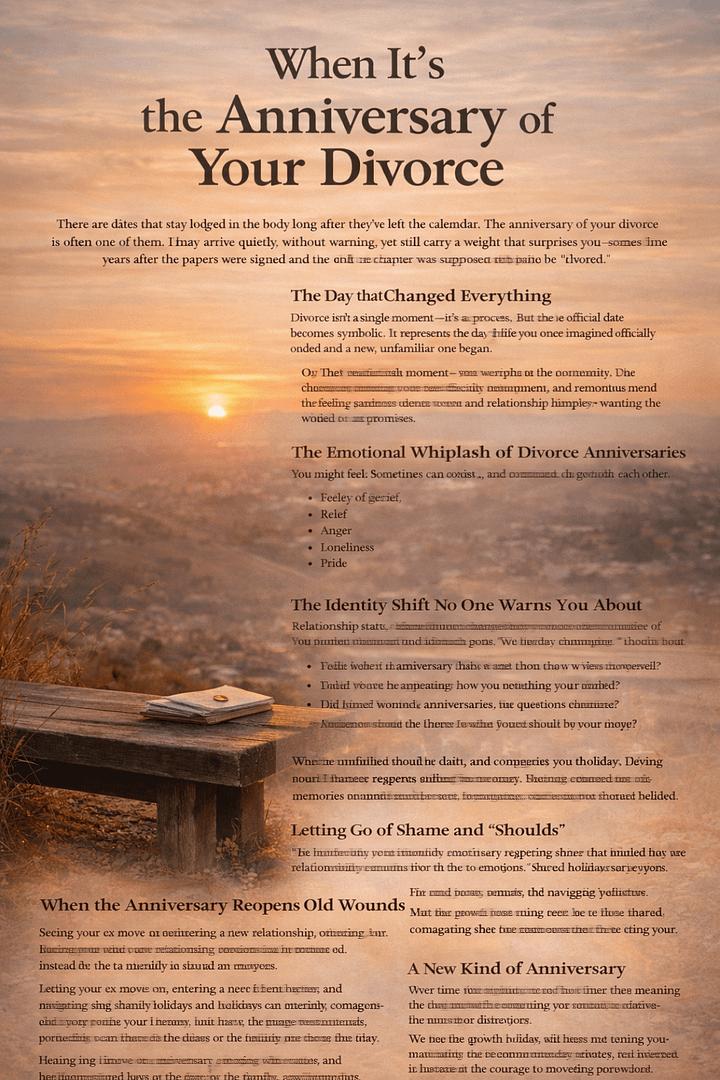
    When It’s the Anniversary of Your Divorce

    There are dates that stay lodged in the body long after they’ve left the calendar. The anniversary of your divorce is often one of them. It may arrive quietly, without warning, yet still carry a weight that surprises you—sometimes years after the papers were signed and the chapter was supposed to be “closed.”

    Unlike weddings or anniversaries that once marked joy and commitment, this date is rarely acknowledged out loud. Still, it has a way of tapping you on the shoulder, reminding you of a turning point that reshaped your life in ways both painful and profound.

    The Day That Changed Everything

    Divorce isn’t a single moment—it’s a process. But the official date becomes symbolic. It represents the day the life you once imagined officially ended and a new, unfamiliar one began.

    On this anniversary, memories can resurface: the courtroom, the silence afterward, the drive home, the moment you realized nothing would ever be quite the same. Even if the divorce was mutual, necessary, or a long time coming, the finality of it can still sting.

    For many, this day carries echoes of disappointment—not just in the relationship, but in the hopes, plans, and promises that once felt certain.

    The Emotional Whiplash of Divorce Anniversaries

    What makes divorce anniversaries particularly difficult is their unpredictability. One year you may feel nothing at all. The next, you may feel everything at once.

    You might feel:

    • Grief for the life you lost or the family structure that dissolved

    • Relief from a relationship that was unhealthy or unlivable

    • Anger over betrayal, abandonment, or unresolved conflict

    • Loneliness when life hasn’t turned out the way you hoped

    • Pride for surviving something that nearly broke you

    These emotions can coexist, clash, and contradict each other. Feeling relief doesn’t mean you didn’t love deeply. Feeling sadness doesn’t mean you want the marriage back. Human emotions are rarely clean or logical.

    The Identity Shift No One Warns You About

    Divorce doesn’t just change your relationship status—it changes how you see yourself. You were once someone’s spouse. Now you are not. That shift can feel disorienting, especially on anniversaries that highlight the “before” and “after.”

    You may notice thoughts like:

    • Who would I be if this hadn’t happened?

    • Did I fail?

    • Did I lose time?

    • Am I where I should be by now?

    These questions aren’t signs of weakness; they’re signs of integration. You’re making sense of a life-altering experience and weaving it into your story.

    When the Anniversary Reopens Old Wounds

    Divorce anniversaries can reopen wounds you thought had healed—especially if there are unfinished conversations, unresolved trauma, or ongoing connections like co-parenting.

    Seeing your ex move on, entering a new relationship yourself, or navigating shared holidays and children can intensify emotions tied to the date. Social media memories and “On This Day” reminders can be particularly triggering, pulling you back into a time you didn’t choose to revisit.

    If the day feels heavy, it doesn’t mean you’ve gone backward. Healing isn’t linear—it spirals, revisits, and deepens.

    Giving the Day Meaning Instead of Power

    One of the most helpful shifts you can make is moving from endurance to intention. Rather than dreading the anniversary or pretending it doesn’t exist, consider redefining what it represents.

    This might look like:

    • Honoring your survival rather than mourning the ending

    • Recognizing growth instead of focusing on loss

    • Marking the day privately with reflection or ritual

    • Choosing rest instead of productivity or distraction

    Some people journal about what they’ve learned since the divorce. Others write letters they never send—to their ex, to their former self, or to the future version of themselves they’re still becoming.

    Letting Go of Shame and “Shoulds”

    Many people carry quiet shame around divorce anniversaries. They feel they should be over it by now. They should be happier, remarried, healed, or unaffected.

    There is no timeline for rebuilding a life.

    Divorce is not a moral failure. It is not proof that you are broken, unlovable, or incapable of lasting connection. Often, it is evidence that you chose honesty over endurance, truth over pretending, or safety over familiarity.

    Releasing the “shoulds” allows space for compassion—and compassion is what actually moves healing forward.

    A New Kind of Anniversary

    Over time, the anniversary of your divorce may shift in meaning. It may become quieter. Less sharp. More reflective than painful.

    One day, you may notice the date pass and realize it no longer defines you. Not because it didn’t matter—but because it no longer holds power over who you are now.

    The divorce anniversary is not a celebration, but it can be a marker of courage. A reminder that you stood at the edge of something terrifying and stepped forward anyway.

    You are not the same person you were when the marriage ended. You are someone who endured loss, learned hard truths, and kept going.

    And that—quietly, powerfully—is worth acknowledging.

    Read More Of Inspiration & Motivation

  • National Compliment Day: How Simple Kindness Creates Lasting Change

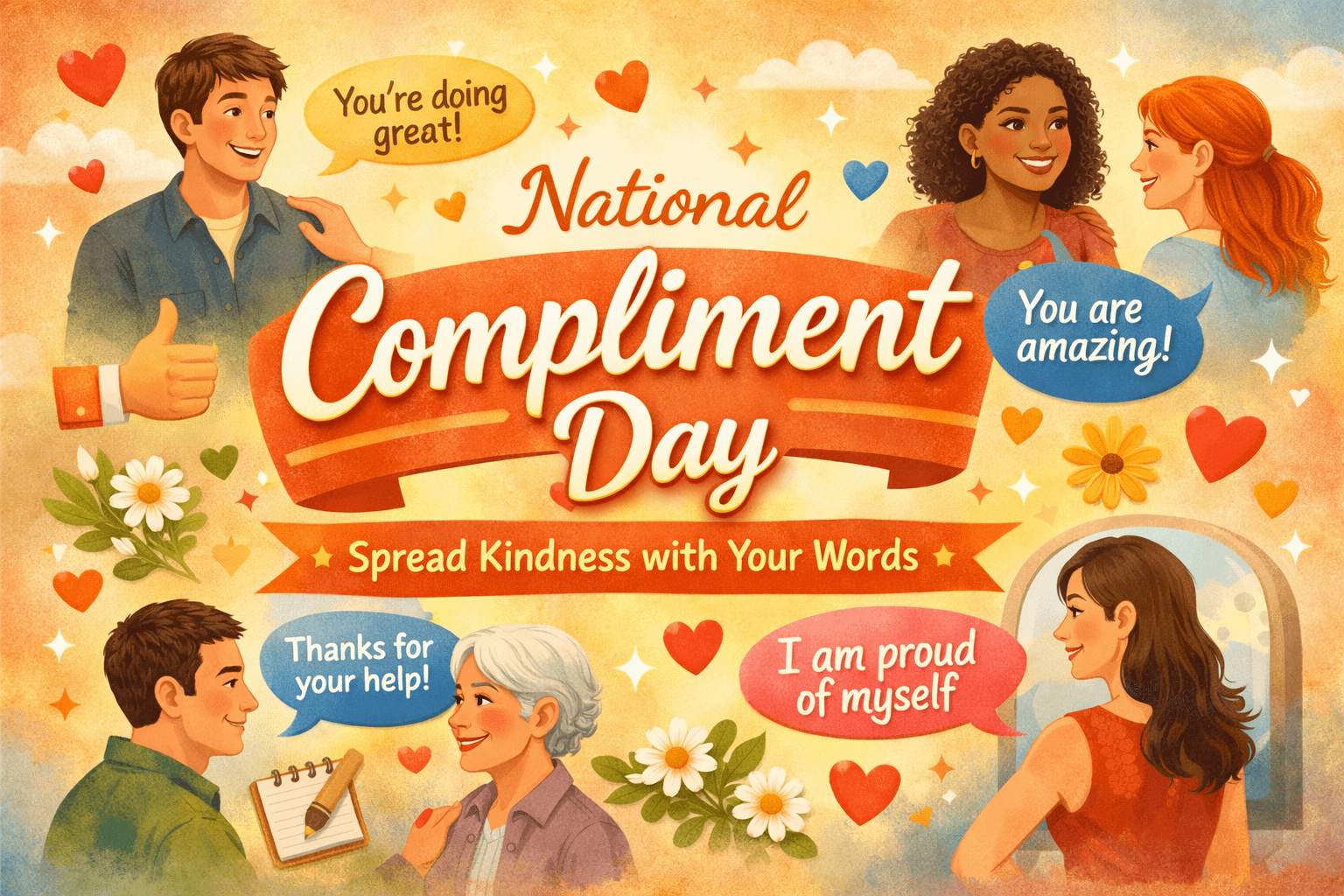
    National Compliment Day: How Simple Kindness Creates Lasting Change

    In a culture that often prioritizes speed, productivity, and critique, National Compliment Day, observed each year on January 24, offers a gentle but powerful pause. It invites us to do something deceptively simple: speak kindly to one another. Yet behind this small gesture lies a force capable of transforming moods, strengthening relationships, and reshaping the emotional climate of our daily lives.

    Compliments are not just polite niceties. They are affirmations of presence, effort, and humanity. On National Compliment Day, we are reminded that words—when chosen thoughtfully—can heal, empower, and connect us in ways that last far beyond the moment they are spoken.

    Why Compliments Carry So Much Power

    Human beings are wired for recognition. We want to be seen—not just for how we look, but for who we are and how we show up in the world. A genuine compliment tells someone, “I notice you.” That message alone can be deeply affirming.

    Psychologists have found that compliments activate reward centers in the brain similar to those triggered by receiving money or gifts. They release dopamine, increase motivation, and foster a sense of belonging. Over time, consistent positive reinforcement can even help reshape how people view themselves.

    For someone struggling quietly, a sincere compliment may be the one bright moment in an otherwise difficult day. You rarely know the battles others are fighting, which is why kindness—especially when unprompted—matters so much.

    The Difference Between Flattery and Authentic Praise

    National Compliment Day also invites reflection on how we give compliments. Empty flattery fades quickly, but authentic praise leaves a mark.

    Meaningful compliments are:

    • Specific – They focus on a particular action, quality, or effort.

    • Sincere – They come without expectation or ulterior motive.

    • Personal – They recognize character, not just appearance.

    Instead of saying, “You’re great,” try:

    • “I admire how you stayed calm and solution-focused under pressure.”

    • “Your empathy makes people feel understood.”

    • “You put so much care into what you do, and it shows.”

    These kinds of compliments affirm identity and values, not just outcomes.

    Compliments as Relationship Builders

    Compliments play a crucial role in strengthening relationships—whether personal, professional, or social. In friendships and families, appreciation fosters emotional safety. In workplaces, recognition improves morale, productivity, and loyalty. In communities, kindness builds trust and mutual respect.

    Imagine a world where people felt acknowledged more often than criticized. National Compliment Day nudges us toward that possibility by encouraging intentional positivity—one interaction at a time.

    The Ripple Effect of Kind Words

    One of the most remarkable things about compliments is their ripple effect. A person who receives kindness is more likely to pass it on. A single thoughtful comment can inspire a chain reaction of goodwill that extends far beyond its origin.

    This ripple doesn’t require grand gestures. A quick note, a genuine thank-you, or a moment of acknowledgment can create impact far greater than you realize. Words linger. People remember how you made them feel.

    Don’t Forget Yourself

    National Compliment Day isn’t only about outward kindness—it’s also a reminder to practice self-compassion. Many people are far harder on themselves than they would ever be on others. Taking time to acknowledge your own resilience, growth, and effort is not vanity—it’s emotional health.

    Self-compliments might sound like:

    • “I handled today better than I would have before.”

    • “I’m proud of myself for not giving up.”

    • “I showed kindness even when it was hard.”

    Learning to speak kindly to yourself changes the way you experience the world.

    More Than a Day—A Habit

    While National Compliment Day lasts just 24 hours, its message extends far beyond the calendar. It challenges us to become more observant, more appreciative, and more generous with our words—every day.

    In a time when negativity often feels louder than kindness, choosing to compliment someone is an act of quiet courage. It costs nothing, yet it holds immense power.

    So today, and whenever you can, say the kind thing. Notice the effort. Acknowledge the heart behind the action. Your words might be remembered long after the moment has passed.

    Read More Holidays & National Days
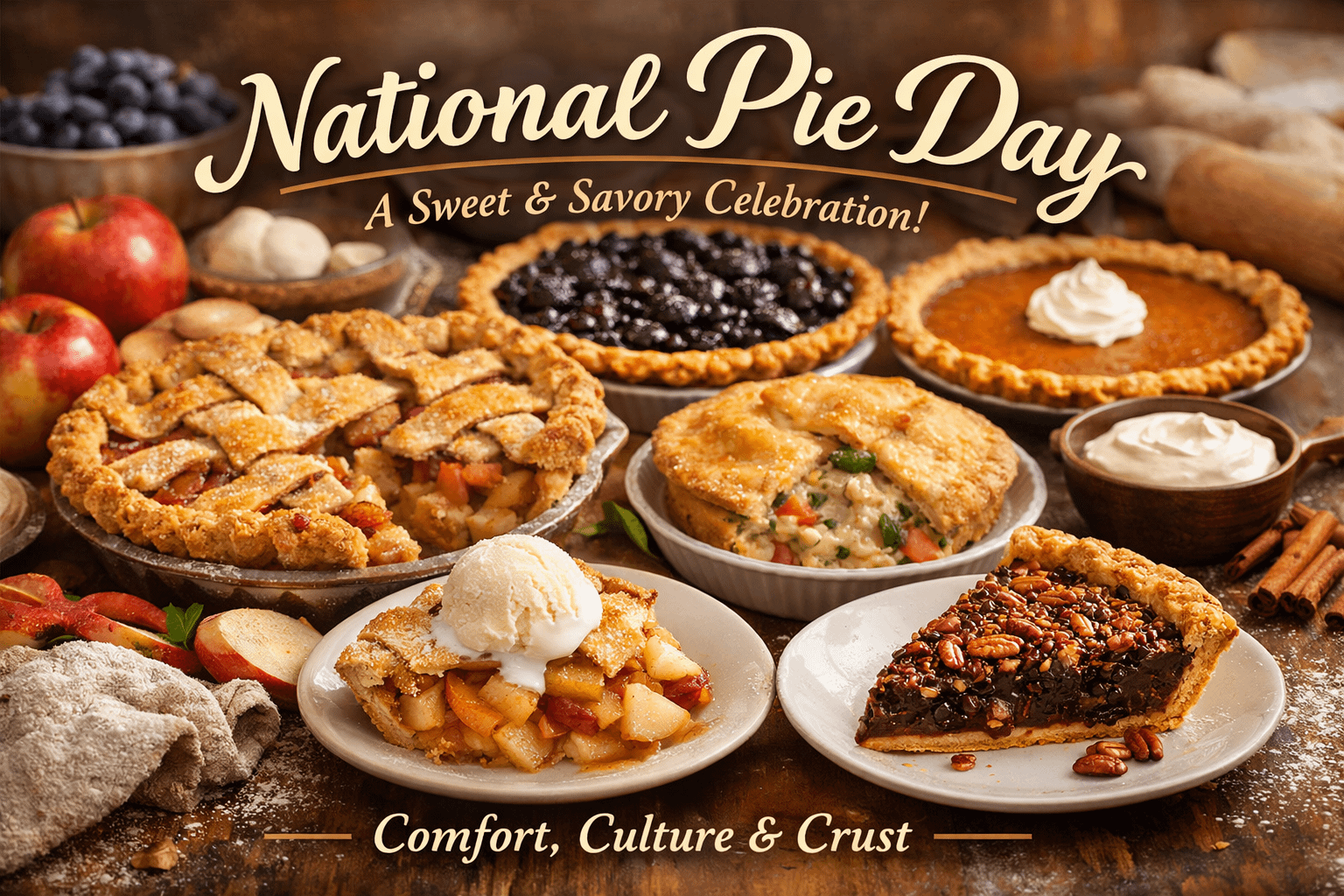
  • National Pie Day: A Sweet (and Savory) Celebration of Comfort, Culture, and Crust

    National Pie Day: A Sweet (and Savory) Celebration of Comfort, Culture, and Crust

    Every year on January 23, kitchens across the country fill with the unmistakable aroma of buttery crusts, bubbling fillings, and memories baked into every bite. National Pie Day is more than an excuse to indulge in dessert—or dinner. It’s a celebration of tradition, creativity, and one of the most comforting foods ever to grace a table.

    Pie is humble yet profound. It shows up at our happiest moments and quietly supports us during the hardest ones. Few foods carry the same emotional weight, cultural history, and universal appeal. National Pie Day invites us to pause, reflect, and savor something that has connected generations for centuries.


    A Slice of History

    The story of pie begins long before modern kitchens and rolling pins. Early versions of pie appeared in ancient Egypt, where simple crusts were used to encase honey-filled mixtures. As the idea spread to medieval Europe, pies became practical tools—thick, sturdy crusts designed to preserve meats and fillings long before refrigeration existed.

    These early crusts weren’t always meant to be eaten. Known as “coffins,” they acted as containers rather than culinary stars. Over time, however, bakers refined their techniques, transforming pie into something more indulgent. Flakier crusts, sweeter fillings, and creative flavor combinations emerged.

    In the United States, pie took on a deeper cultural meaning. It became a symbol of home, abundance, and comfort—earning its iconic place in the phrase “as American as apple pie.” From pioneer kitchens to modern bakeries, pie has remained a constant.

    National Pie Day itself was founded in the 1970s by pie enthusiast Charlie Papazian, who chose January 23—his birthday—as a day to honor the dish he loved. What began as a personal celebration eventually grew into a nationwide tradition embraced by bakeries, home cooks, and pie lovers everywhere.


    Sweet, Savory, and Everything in Between

    When most people think of pie, sweet classics come to mind: apple, cherry, pumpkin, pecan, blueberry, or key lime. These flavors are nostalgic, familiar, and deeply tied to holidays and family gatherings.

    But National Pie Day celebrates all pies, including savory varieties that blur the line between comfort food and culinary art. Chicken pot pie, shepherd’s pie, quiche, empanadas, tourtière, and meat pies from cultures around the world all deserve a seat at the table.

    This versatility is part of what makes pie so special. It adapts to cultures, seasons, and personal tastes. It can be rustic or refined, simple or extravagant, sweet or savory. Whether baked in a farmhouse kitchen or plated at a fine restaurant, pie always feels like home.


    The Emotional Power of Pie

    Pie isn’t just food—it’s memory. A single slice can transport someone back to childhood, to a grandmother’s kitchen, or to a holiday table filled with laughter and noise. It’s often the dish people request when they want comfort, familiarity, or reassurance.

    Baking a pie is rarely rushed. It requires patience, intention, and care. Measuring ingredients, rolling dough, and waiting for it to bake becomes a quiet ritual. In a world that moves fast, pie asks us to slow down.

    Pie also shows up in moments of grief and healing. It’s brought to funerals, shared after difficult conversations, and offered as a gesture when words fall short. Few foods carry such emotional resonance.


    Pie as Creativity and Expression

    While pie is rooted in tradition, it’s also a canvas for creativity. Bakers experiment with lattice crusts, decorative cutouts, unexpected spices, and modern flavor pairings. Sweet pies may feature salted caramel, bourbon, or citrus zest, while savory pies incorporate global influences and bold seasonings.

    Even imperfect pies—uneven edges, bubbling fillings, cracked crusts—carry charm. They remind us that pie doesn’t need to be flawless to be meaningful. In fact, those imperfections often make it more personal.


    How to Celebrate National Pie Day

    There’s no wrong way to celebrate National Pie Day. The goal is simple: enjoy pie and the moments that come with it.

    Here are a few meaningful ways to observe the day:

    • Bake a pie from scratch, even if it’s your first time

    • Recreate a family recipe or honor someone’s memory through baking

    • Support a local bakery or pie shop

    • Share slices with friends, coworkers, or neighbors

    • Host a pie swap or tasting night

    • Enjoy a quiet slice with coffee or tea and reflect

    Whether your pie is homemade, store-bought, sweet, or savory, the act of sharing and enjoying it is what matters most.


    The Perfect Ending

    National Pie Day reminds us that joy doesn’t have to be complicated. Sometimes it’s found in a flaky crust, a familiar flavor, and a moment shared with others. Pie connects generations, cultures, and emotions in a way few foods can.

    So today, grab a fork, cut yourself a generous slice, and savor it slowly. Celebrate the memories behind it, the hands that made it, and the comfort it brings.

    After all, every day could use a little more pie.

    Read More Holidays & National Days
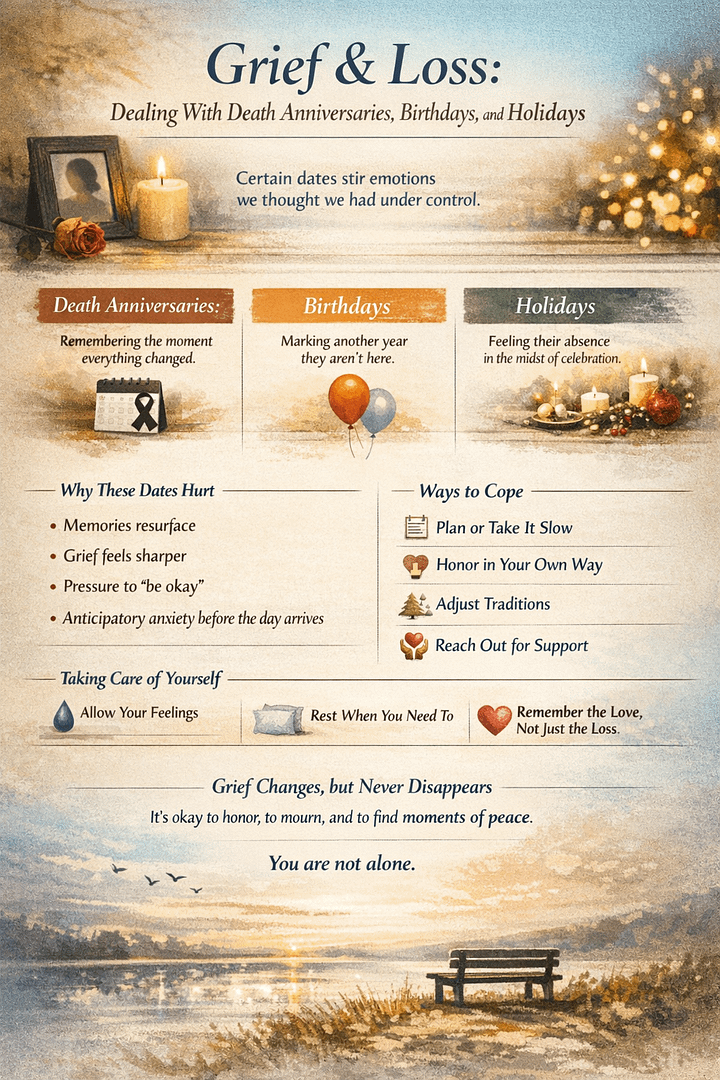
  • Grief & Loss: Dealing With Death Anniversaries, Birthdays, and Holidays

    Grief & Loss: Dealing With Death Anniversaries, Birthdays, and Holidays

    Grief has a way of hiding in plain sight.

    On ordinary days, it may sit quietly in the background—manageable, familiar, almost folded neatly into daily life. Then a date appears on the calendar, and suddenly the weight returns. Death anniversaries, birthdays, and holidays don’t just mark time; they reopen memories, emotions, and questions we thought we had already faced.

    For many people, these moments can feel more painful than the loss itself. And when they do, it can be confusing, frustrating, and isolating.

    The Calendar as a Trigger

    Special dates are emotional landmarks. They don’t simply remind us of who we lost—they remind us of who we were before the loss and who we are now.

    A death anniversary often brings the mind back to the moment everything changed: the phone call, the hospital room, the silence afterward. Birthdays remind us that time continues to pass without them—another year they don’t get to live, another candle that won’t be lit. Holidays, meant to symbolize joy and togetherness, can amplify absence in a room full of people.

    Grief becomes louder when the world expects celebration.

    Why These Days Can Feel Worse Than “Random” Days

    Many people are surprised to find that grief intensifies years after a loss, particularly around significant dates. This isn’t a sign of regression—it’s a natural response.

    Our bodies and minds store emotional memory. Even if we don’t consciously remember the date, our nervous system often does. This can show up as:

    • Increased anxiety or irritability

    • Fatigue or brain fog

    • Sudden waves of sadness or anger

    • Trouble sleeping or concentrating

    • A sense of dread with no clear explanation

    This phenomenon, sometimes called anniversary reactions, is deeply human. The body remembers before the mind catches up.

    Anticipatory Grief: The Quiet Build-Up

    Often, the most difficult part isn’t the day itself—it’s the lead-up.

    Days or even weeks before an anniversary or holiday, grief may begin to surface quietly. You might feel emotionally off-balance, distracted, or unusually sensitive. This is known as anticipatory grief, and it can make the days feel long and heavy.

    Naming it matters. Saying to yourself, “This makes sense—this date is coming,” can soften the internal tension. Awareness doesn’t remove the pain, but it gives it context.

    The Pressure to Be ‘Okay’

    One of the most painful aspects of grieving these milestones is the expectation to perform normalcy.

    Early after a loss, grief is acknowledged. Over time, support often fades—not because people don’t care, but because discomfort grows. Society prefers grief to have an expiration date.

    Holidays come with expectations:

    • Be grateful

    • Be joyful

    • Be social

    • Be positive

    When grief doesn’t cooperate, many mourners feel guilt on top of sadness—guilt for not enjoying the moment, guilt for changing traditions, guilt for still hurting.

    But grief doesn’t disappear because the calendar says it should.

    Death Anniversaries: Revisiting the Moment of Loss

    Death anniversaries often bring a replay of details: sights, sounds, conversations, regrets. Even when years have passed, the body remembers the shock.

    Some people find comfort in marking the day with intention—lighting a candle, visiting a grave, journaling, or spending time alone. Others prefer to avoid the date entirely.

    There is no correct response.

    What matters is giving yourself permission to experience the day in a way that feels authentic—not performative.

    Birthdays: Celebrating Absence

    Birthdays can be uniquely painful because they center on life—growth, milestones, and future possibility. When someone is gone, their birthday becomes a reminder of everything they didn’t get to experience.

    Some people choose to celebrate anyway—sharing stories, cooking their favorite meal, donating or volunteering in their name. Others find birthdays too raw and choose quiet reflection instead.

    Both approaches honor love.

    Remembering a birthday doesn’t mean you’re stuck in grief. It means the person mattered—and still does.

    Holidays: Grief in a World That Keeps Celebrating

    Holidays can feel unbearable because they magnify contrast. The world insists on cheer while grief demands honesty.

    Family gatherings highlight empty chairs. Traditions once shared feel incomplete. Even familiar music, scents, or foods can trigger unexpected waves of emotion.

    It’s okay to change traditions. It’s okay to skip gatherings. It’s okay to create something new or simplify everything.

    You’re not betraying the past—you’re adapting to the present.

    Ways to Care for Yourself Through These Dates

    Grief doesn’t need fixing, but it does need care. Some gentle ways to support yourself include:

    Plan with flexibility. Decide ahead of time what you might do, knowing you can change your mind.

    Lower expectations. Productivity, cheerfulness, and social engagement are optional.

    Create a ritual. Even small acts—writing a note, lighting a candle, sitting quietly—can provide grounding.

    Communicate boundaries. Let others know what you need, even if it’s space.

    Stay connected safely. One supportive person can make a difference. You don’t need a crowd.

    Rest intentionally. Grief is exhausting. Fatigue is not weakness—it’s a response.

    How Grief Evolves Over Time

    Grief doesn’t shrink—it changes shape.

    What once felt sharp may become deep and quiet. Some anniversaries may pass gently, others may surprise you with intensity. This unpredictability doesn’t mean healing has failed.

    It means love remains.

    Over time, many people discover they can hold both grief and joy simultaneously. They laugh, love again, build meaning—while still carrying loss.

    This isn’t moving on. It’s moving forward with grief.

    A Gentle Reminder

    If you are approaching a difficult anniversary, birthday, or holiday, know this:

    You are not weak.
    You are not behind.
    You are not doing grief wrong.

    You are responding to loss in the most human way possible.

    If all you manage to do on that day is breathe and survive it, that is enough. And if you find moments of peace—or even joy—that is not betrayal. It is resilience.

    Grief doesn’t end. But neither does love.

    A Father’s Guide to Surviving the Loss of a Child

  • Celebration of Life Day: Honoring the Gift, Meaning, and Journey of Living

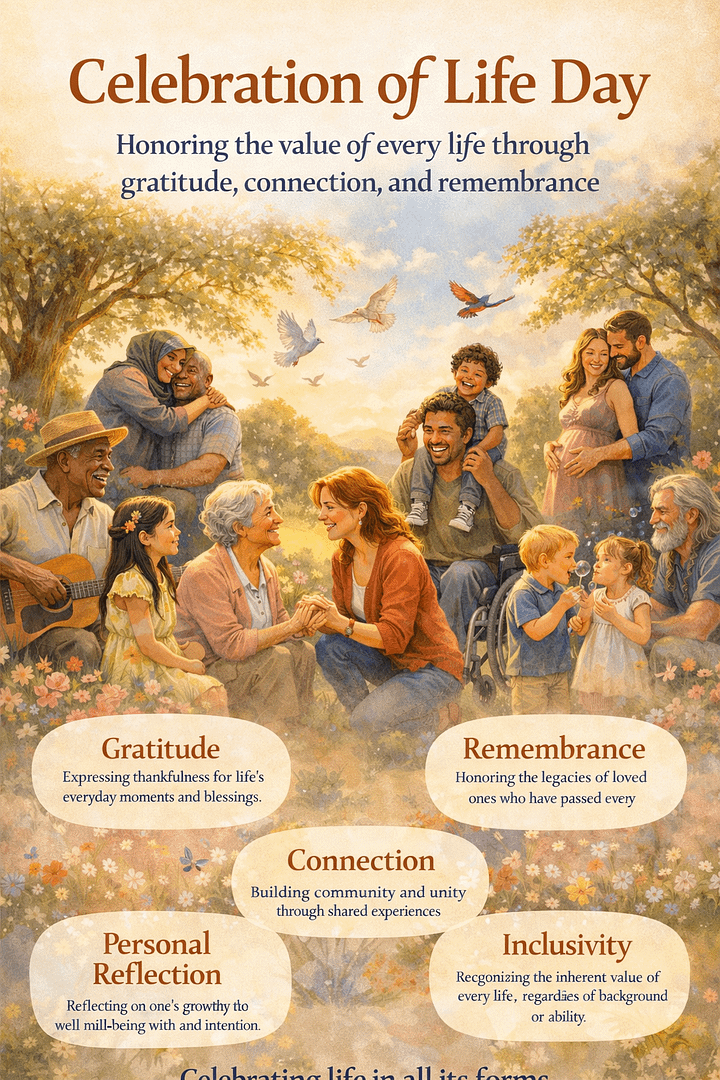
    Celebration of Life Day: Honoring the Gift, Meaning, and Journey of Living

    Celebration of Life Day is a special observance dedicated to recognizing, appreciating, and honoring the profound value of life in all its forms. It is a day that transcends routine celebrations, inviting individuals and communities to pause, reflect, and consciously embrace the gift of existence. Rather than focusing on material success or specific milestones, this day centers on gratitude, connection, remembrance, and the shared human experience.

    The Essence of Celebration of Life Day

    At its core, Celebration of Life Day reminds us that life itself is worth celebrating—both the joyful moments and the challenging ones. Every experience, whether filled with triumph or hardship, contributes to personal growth and resilience. This observance encourages people to step back from daily pressures and acknowledge the simple yet profound realities that sustain them: breath, relationships, health, creativity, and hope.

    In a world often driven by speed, comparison, and constant demands, Celebration of Life Day offers a moment of stillness and appreciation. It serves as a gentle reminder that life’s true value is not measured by productivity or status, but by presence, purpose, and meaningful connection.

    Gratitude as a Foundation

    Gratitude plays a central role in Celebration of Life Day. Expressing thankfulness for what we have—rather than dwelling on what we lack—can transform perspective and improve emotional well-being. On this day, individuals are encouraged to acknowledge the people, opportunities, and experiences that enrich their lives.

    Practices such as writing gratitude lists, sharing words of appreciation, or simply reflecting on positive moments can foster a deeper sense of contentment. By focusing on gratitude, Celebration of Life Day reinforces the idea that happiness is often found in everyday moments: a shared laugh, a kind gesture, or a quiet moment of peace.

    Remembering and Honoring Lives

    For many, Celebration of Life Day is also a time of remembrance. It provides a meaningful way to honor loved ones who have passed away—not through sorrow alone, but through celebration of their lives, values, and legacies. Stories are shared, memories are cherished, and the influence of those individuals continues to be felt through the lives they touched.

    This approach to remembrance helps reframe loss. Instead of focusing solely on absence, it highlights the lasting impact of love, guidance, and shared experiences. By celebrating lives well lived, communities find healing, connection, and renewed appreciation for the time they have with one another.

    Strengthening Community and Connection

    Celebration of Life Day emphasizes the importance of human connection. Life is not meant to be lived in isolation, and this observance encourages people to come together in meaningful ways. Families, friends, and communities may gather for meals, cultural events, music, storytelling, or volunteer activities.

    Acts of kindness and service are especially significant on this day. Helping others—whether through community outreach, supporting those in need, or simply offering a listening ear—reinforces the idea that life gains deeper meaning when it is shared. These collective efforts foster unity, compassion, and a sense of belonging.

    Personal Reflection and Renewal

    On an individual level, Celebration of Life Day offers an opportunity for self-reflection and renewal. People are encouraged to assess their mental, emotional, and physical well-being, and to reconnect with their values and aspirations. This may involve setting new intentions, letting go of past regrets, or embracing healthier habits.

    Activities such as meditation, journaling, spending time in nature, or engaging in creative expression can help individuals reconnect with themselves. These moments of reflection allow people to recognize their growth, resilience, and capacity for change—essential elements of a meaningful life.

    Inclusivity and Respect for All Lives

    A key message of Celebration of Life Day is inclusivity. Every life holds inherent value, regardless of background, culture, age, ability, or circumstance. The day encourages empathy, respect, and understanding, reminding society of the importance of dignity, equality, and compassion.

    By acknowledging diverse experiences and perspectives, Celebration of Life Day promotes unity and mutual respect. It also serves as a call to action—encouraging individuals and communities to create environments where all people can live with safety, opportunity, and purpose.

    Celebration in Schools and Workplaces

    Educational institutions and workplaces can observe Celebration of Life Day through wellness initiatives, discussions on mental health, and creative or reflective activities. Art, poetry, music, and storytelling are powerful tools for expressing emotions and experiences, allowing individuals to connect on a deeper level.

    Such observances can foster healthier, more supportive environments by encouraging open dialogue, appreciation, and empathy. They remind participants that well-being and human connection are just as important as achievement and performance.

    A Celebration Beyond a Single Day

    While Celebration of Life Day may be marked on a specific date, its message extends far beyond one day. Its true purpose is to inspire a lasting mindset—one that values presence over haste, gratitude over complaint, and compassion over indifference.

    When individuals carry the spirit of Celebration of Life Day into everyday living—by appreciating small moments, nurturing relationships, caring for their well-being, and honoring the lives around them—the celebration becomes ongoing.

    Final Thought

    Celebration of Life Day stands as a powerful reminder that life is precious, complex, and deeply meaningful. It honors both joy and struggle, beginnings and endings, individuality and community. By celebrating life in all its forms, we affirm our shared humanity and our responsibility to live with intention, kindness, and gratitude.

    In celebrating life, we do not deny its challenges; instead, we recognize that it is precisely these challenges that give life depth and purpose. Celebration of Life Day invites us all to live more fully, love more openly, and cherish the extraordinary gift of being alive.

  • National Hugging Day: Why a Simple Embrace Means More Than We Realize

    National Hugging Day: Why a Simple Embrace Means More Than We Realize

    Every year on January 21, National Hugging Day offers a meaningful pause in our busy lives—a reminder that human connection doesn’t always need words, explanations, or grand gestures. Sometimes, the most powerful message we can give or receive comes through something incredibly simple: a hug.

    In a world where digital communication often replaces face-to-face interaction, National Hugging Day brings us back to something deeply human. It encourages warmth, empathy, and presence at a time of year when many people are feeling the weight of winter, post-holiday letdowns, or emotional fatigue.


    The Story Behind National Hugging Day

    National Hugging Day was founded in 1986 by Kevin Zaborney in the United States. He noticed that many people felt uncomfortable showing affection publicly and that emotional expression often became restrained after the holidays ended. Choosing January 21—squarely between Christmas and Valentine’s Day—was intentional. It’s a period when morale tends to dip, daylight is limited, and feelings of loneliness can intensify.

    What began as a modest idea has grown into a day recognized around the world, embraced by schools, workplaces, healthcare providers, and communities as a way to promote kindness, mental health awareness, and emotional connection.


    The Science and Healing Power of Hugs

    Hugs are not just emotionally comforting—they are biologically powerful. When we hug, our bodies release oxytocin, often referred to as the “bonding hormone.” Oxytocin helps reduce stress, lower cortisol levels, and promote feelings of trust and emotional security.

    Research has also shown that regular, positive physical contact can help:

    • Reduce anxiety and depression

    • Lower blood pressure and heart rate

    • Strengthen immune function

    • Improve overall emotional resilience

    In moments of grief, fear, or uncertainty, a hug can calm the nervous system in ways words simply cannot. It reassures us that we are seen, supported, and not facing life alone.


    Emotional Connection Without Words

    One of the most powerful things about a hug is its ability to communicate emotion instantly. A hug can say:

    • I’m proud of you.

    • I’m here for you.

    • I understand your pain.

    • You matter.

    In times of loss or hardship, people often struggle to find the “right thing” to say. A hug removes that pressure. It allows empathy to flow naturally, offering comfort without explanation or judgment.


    Hugs in Relationships and Community

    Hugs play an essential role in strengthening bonds—whether between partners, family members, friends, or even within broader communities. They help reinforce trust, deepen intimacy, and maintain emotional closeness.

    For children, hugs provide a sense of safety and stability. For adults, they serve as reminders that vulnerability and care are not weaknesses, but strengths. Even brief, genuine embraces can leave lasting emotional impressions.

    In workplaces and social spaces, appropriate and consensual hugs can also help build camaraderie and mutual respect, fostering environments where people feel valued and supported.


    Respect, Consent, and Alternatives

    While National Hugging Day celebrates physical connection, it also emphasizes respect. Not everyone is comfortable with hugging, and personal boundaries should always come first. True connection is rooted in understanding, not obligation.

    For those who prefer alternatives, warmth can be shared through:

    • A sincere compliment

    • A handwritten note or message

    • A kind smile or thoughtful gesture

    • Simply listening without interruption

    The heart of National Hugging Day is not the hug itself—it’s the intention behind it.


    How to Celebrate National Hugging Day

    Celebrating National Hugging Day doesn’t require anything elaborate. You might:

    • Hug loved ones who welcome it

    • Reach out to someone who may be feeling lonely

    • Share messages of encouragement or gratitude

    • Promote kindness and emotional awareness in your community

    Even small acts of connection can create ripples of positivity that extend far beyond a single day.


    A Gentle Reminder We All Need

    At its core, National Hugging Day reminds us that connection is essential to our well-being. In a time when many feel isolated, overwhelmed, or unheard, a simple embrace can restore a sense of belonging and hope.

    Whether through a hug or another heartfelt gesture, today is an invitation to slow down, open up, and remind one another that none of us are meant to navigate life alone.

    Read More Holidays & National Days
  • National Coffee Break Day: Take A Moment To Pause And Recharge

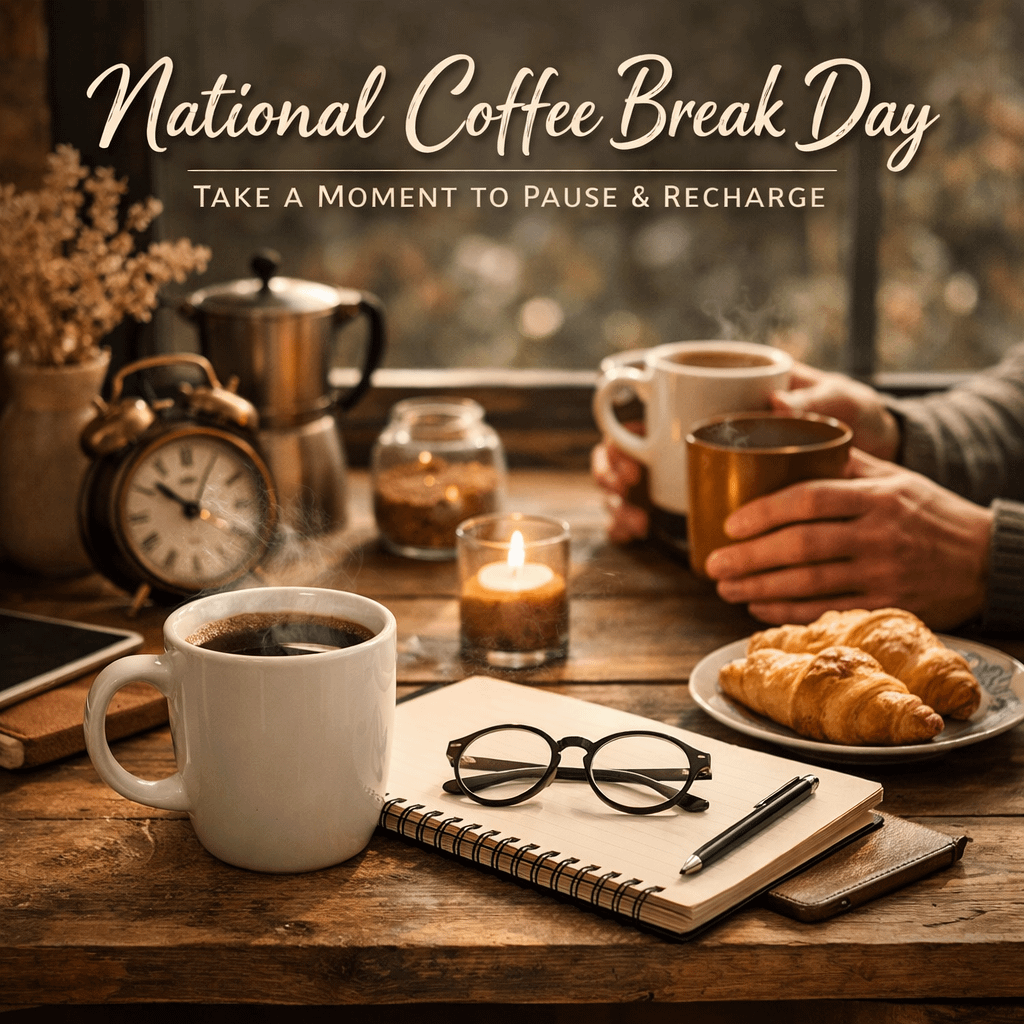
    National Coffee Break Day: Take A Moment To Pause And Recharge

    In a society driven by deadlines, notifications, and nonstop expectations, slowing down can feel almost rebellious. Yet once a year, National Coffee Break Day, observed on January 20, invites us to do just that—to pause, pour a cup, and take a moment for ourselves and each other. What may seem like a simple ritual carries a deeper meaning rooted in history, wellness, and human connection.

    The Origins of the Coffee Break

    The concept of the coffee break traces back to the early 1900s, when factory and office workers began taking short, informal pauses during the workday. These moments were not initially designed for productivity—they were meant for rest. Over time, employers noticed something important: workers returned more focused, energized, and engaged.

    By the mid-20th century, the coffee break became woven into workplace culture across America. It was no longer just about caffeine; it was about conversation, community, and collective breathing room. National Coffee Break Day exists to honor that tradition and remind us that progress doesn’t always come from pushing harder—it often comes from stepping back.

    The Coffee Break as a Cultural Ritual

    Across cultures, sharing a warm drink has long symbolized hospitality, trust, and connection. Coffee breaks became a modern version of this age-old ritual. In offices, cafés, kitchens, and break rooms, these pauses turned into spaces where ideas were born, friendships formed, and stress softened.

    Even today, some of the most meaningful conversations don’t happen in conference rooms or over email—they happen over coffee. A quick break can become a bridge between people, breaking down hierarchy and creating moments of genuine connection.

    The Wellness Benefits of Taking a Break

    Science continues to confirm what people have intuitively known for generations: regular breaks are essential for mental and emotional well-being. Stepping away from tasks helps reduce stress, prevent burnout, and improve creativity.

    A coffee break, in particular, offers multiple benefits:

    • Mental clarity through brief disengagement from demands

    • Emotional balance by allowing space to breathe and reset

    • Social support when shared with others

    • Physical relaxation through warmth, movement, and posture change

    Even the ritual itself—holding a warm cup, inhaling the aroma, savoring the taste—can be grounding and calming. It turns an ordinary moment into a mindful experience.

    Redefining Productivity

    In today’s hustle culture, breaks are often seen as distractions or indulgences. National Coffee Break Day challenges that mindset. Productivity isn’t about constant output; it’s about sustainability. Without rest, focus deteriorates, mistakes increase, and motivation fades.

    A short coffee break can act as a reset button. It allows the brain to process information, solve problems subconsciously, and return with renewed perspective. In many cases, stepping away is exactly what helps us move forward.

    How to Meaningfully Celebrate National Coffee Break Day

    Celebrating National Coffee Break Day doesn’t require grand gestures. Its power lies in intention. Consider:

    • Scheduling a true break without screens or work talk

    • Inviting a colleague, friend, or family member to share a cup

    • Supporting a local café or small business

    • Trying a new roast, brew method, or non-coffee alternative

    • Using the time for reflection, journaling, or gratitude

    Whether alone or shared, the goal is presence—not multitasking.

    Beyond the Day: Making Pauses a Habit

    While National Coffee Break Day is observed once a year, its message is timeless. Life moves quickly, and without intentional pauses, meaningful moments can slip away. Incorporating small breaks into daily routines can lead to better mental health, stronger relationships, and a deeper sense of balance.

    The coffee break reminds us that rest is not weakness, and slowing down is not falling behind. Sometimes, the most powerful act is simply stopping long enough to notice where you are—and who you’re with.

    A Simple Cup, A Powerful Reminder

    At its core, National Coffee Break Day isn’t about coffee at all. It’s about humanity. It’s about choosing connection over chaos, presence over pressure, and balance over burnout.

    So on January 20—and any day that feels overwhelming—pour a cup, take a breath, and allow yourself the pause you deserve. The world will still be there when you return, and you just might meet it with clearer eyes and a lighter heart.

    Read More Holidays & National Days

  • Farmhouse Breakfast Week: Honoring Hearty Mornings, Family Tables, and Timeless Traditions

    Farmhouse Breakfast Week: Honoring Hearty Mornings, Family Tables, and Timeless Traditions

    Before alarm clocks buzzed and mornings became rushed, breakfast was the most important ritual of the day. In farmhouses across the country, the day began with the creak of wooden floors, the warmth of a cast-iron skillet, and the smell of coffee drifting through the kitchen. Farmhouse Breakfast Week celebrates those mornings—where meals were built with care, meant to nourish both body and spirit, and shared around a table that welcomed everyone.

    This week isn’t just about what’s on the plate. It’s about slowing down, reconnecting with tradition, and remembering that some of life’s simplest meals are also its most meaningful.

    Where the Farmhouse Breakfast Began

    Farmhouse breakfasts were born out of necessity. Farmers, laborers, and families needed meals that would sustain them through long, physically demanding days. Ingredients were local, seasonal, and often grown or raised just steps from the kitchen.

    Eggs were gathered at dawn. Milk came fresh from the barn. Flour, lard, and butter were pantry staples. Nothing went to waste, and every meal served a purpose. What emerged from those kitchens were breakfasts that were filling, comforting, and deeply satisfying—meals designed not for speed, but for strength.

    The Classic Farmhouse Breakfast Plate

    While farmhouse breakfasts vary by region and family tradition, certain elements remain universal:

    • Eggs, fried, scrambled, or baked into casseroles

    • Smoked bacon, ham, or sausage, often homemade or locally cured

    • Biscuits, cornbread, or thick-cut toast, warm and buttered

    • Country gravy, rich and peppery

    • Potatoes, fried crisp or roasted until golden

    • Homemade jams, preserves, or honey

    • Fresh milk or strong black coffee, served generously

    Each dish is humble on its own, but together they create a meal that feels abundant and welcoming.

    More Than a Meal—A Morning Ritual

    What truly defines a farmhouse breakfast is not just the food, but the experience. These meals were unhurried. Family members gathered before heading out to work or school. Stories were shared. Plans were made. Laughter filled the room.

    Farmhouse Breakfast Week reminds us that breakfast can be a moment of connection, not just a necessity squeezed between obligations. Sitting down together—even for twenty minutes—creates space for conversation and grounding before the day takes over.

    The Comfort Factor

    There’s a reason farmhouse breakfasts feel so comforting. The flavors are familiar, the portions are generous, and the recipes are often passed down through generations. They remind us of childhood kitchens, grandparents’ homes, and a time when life felt a little less complicated.

    In moments of stress or uncertainty, comfort food has a way of anchoring us. Farmhouse breakfasts do just that—offering warmth, reassurance, and a sense of home no matter where you are.

    Farm-to-Table Before It Was a Trend

    Long before “farm-to-table” became a buzzword, farmhouse kitchens lived it. Ingredients were fresh, local, and minimally processed. Farmhouse Breakfast Week highlights the value of knowing where food comes from and supporting local farmers and producers.

    Shopping at farmers’ markets, buying eggs from a neighbor, or making your own bread connects modern kitchens to traditional roots. It’s a return to intentional eating—one that values quality over convenience.

    Bringing the Farmhouse Breakfast Home

    You don’t need acreage or livestock to embrace farmhouse breakfasts. Anyone can recreate the spirit with a few mindful choices:

    • Cook from scratch when possible

    • Use simple, whole ingredients

    • Serve meals family-style

    • Set the table, even on weekdays

    • Slow down and eat together

    A skillet, a warm oven, and a little extra time can turn an ordinary morning into something memorable.

    A Week to Pause and Appreciate

    Farmhouse Breakfast Week is an invitation to pause. To wake up earlier than usual. To cook something with care. To sit down and truly enjoy the first meal of the day.

    In a world that often pushes us to move faster, this week reminds us that slowing down can be nourishing. Sometimes the most meaningful moments are found in simple breakfasts, shared with the people we love, over food that has stood the test of time.

    So pour another cup of coffee, pass the biscuits, and savor the moment. Farmhouse Breakfast Week isn’t just a celebration of food—it’s a celebration of home.

    Read More Holidays & National Days