Author: Brett Murphy

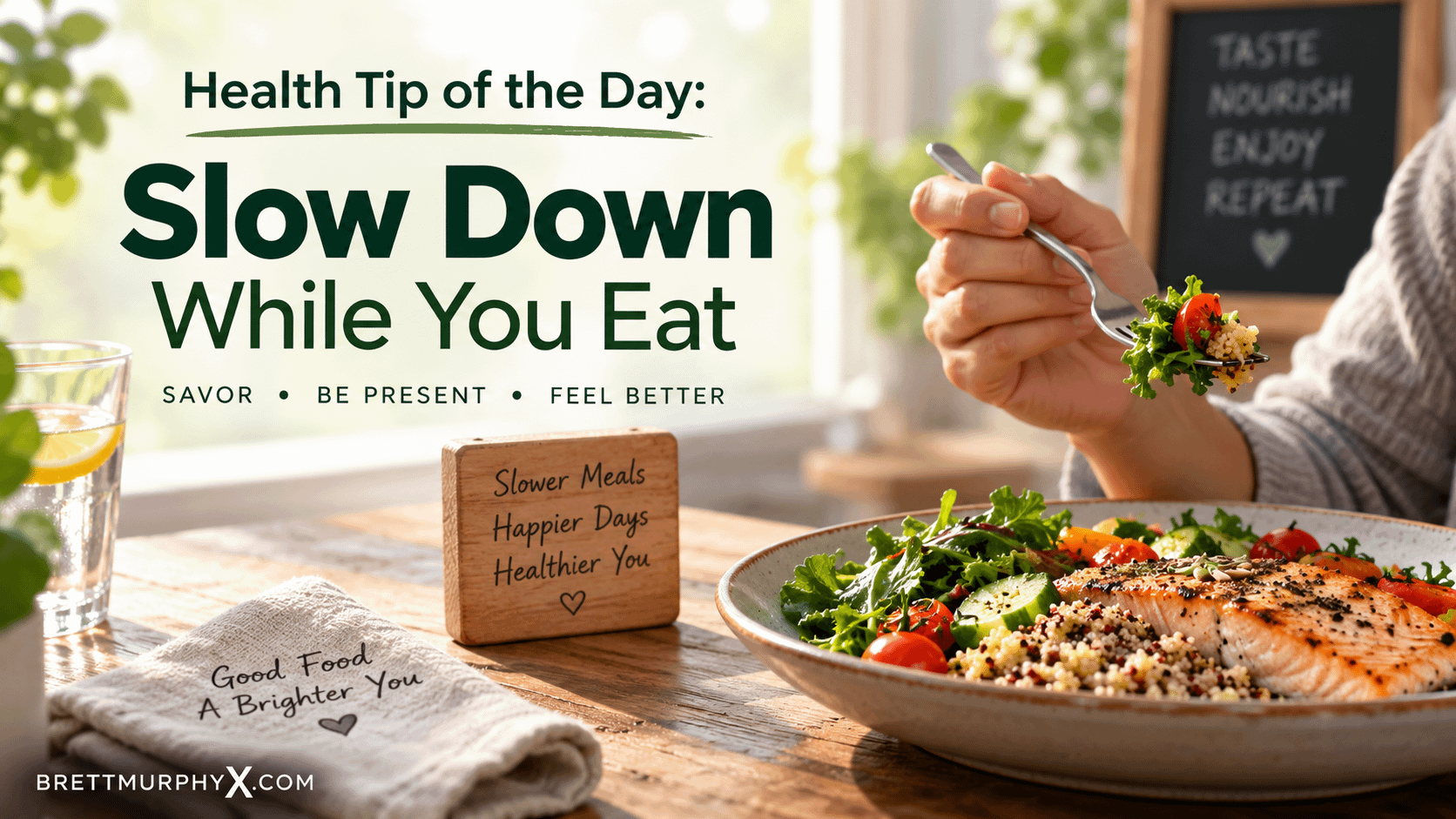
  • Health Tip of the Day: Slow Down While You Eat

    Health Tip of the Day: Slow Down While You Eat

    Eating is something most of us do several times every day, yet it is surprisingly easy to rush through a meal without really paying attention to it.

    Breakfast might be eaten while getting ready for work.

    Lunch might happen at a desk while answering emails.

    Dinner might be eaten in front of the television.

    Snacks might disappear while scrolling through a phone without us even realizing how much we have eaten.

    Modern life encourages us to move quickly, and eating has become another activity we often try to squeeze into an already busy schedule.

    But today’s Health Tip of the Day is remarkably simple:

    Slow down while you eat.

    You do not need a complicated diet plan.

    You do not need special foods.

    You do not need to count every calorie.

    You do not need to completely change what is on your plate.

    Simply paying more attention to how quickly you eat can help make meals more intentional and enjoyable.

    Slowing down gives you an opportunity to actually taste your food, recognize your body’s hunger and fullness signals, and turn eating back into an experience rather than another task you are trying to finish as quickly as possible.

    How Fast Do You Actually Eat?

    Think about your last few meals.

    How long did they take?

    Did you sit at a table?

    Were you watching television?

    Were you looking at your phone?

    Were you working?

    Did you take time to chew your food thoroughly?

    Did you notice when you began feeling satisfied?

    Or did you simply continue eating until everything on your plate was gone?

    Many people have become so accustomed to eating quickly that they don’t realize they’re doing it.

    You may have learned the habit years ago.

    Maybe your lunch breaks have always been short.

    Perhaps you grew up in a busy household.

    Maybe your work schedule requires you to eat whenever you get an opportunity.

    Or perhaps you simply developed the habit of finishing meals quickly.

    Whatever the reason, slowing down can be practiced.

    Your Meal Doesn’t Have to Be a Race

    There is usually no prize for being the first person to finish dinner.

    Yet watch people eating together and you will often notice dramatically different eating speeds.

    One person may still have most of their meal remaining while another person’s plate is already empty.

    Fast eating can happen automatically.

    Take a bite.

    Chew quickly.

    Swallow.

    Immediately take another bite.

    Repeat.

    Before long, the entire meal is gone.

    Try changing the rhythm.

    Take a bite.

    Put your fork down.

    Chew.

    Taste the food.

    Finish the bite before preparing the next one.

    Take a drink.

    Have a conversation.

    Then continue eating.

    You’re still enjoying exactly the same meal, but you’re giving yourself more time to experience it.

    Give Your Body Time to Recognize Fullness

    Hunger and fullness are not simply on-and-off switches.

    You can experience different levels of hunger.

    You might be extremely hungry, moderately hungry, slightly hungry, comfortable, satisfied, very full, or uncomfortably stuffed.

    When you eat very quickly, it can be easier to move from hungry to overly full before you’ve paid much attention to what your body is telling you.

    Slowing down creates more opportunities to check in with yourself.

    Halfway through your meal, ask:

    Am I still hungry?

    That is different from asking:

    Is there still food on my plate?

    Those two questions do not necessarily have the same answer.

    You may discover that you are comfortably satisfied even though food remains.

    Or you may discover that you’re still genuinely hungry and want to continue eating.

    The goal isn’t to follow a rigid rule.

    The goal is awareness.

    Learn the Difference Between Satisfied and Stuffed

    Many of us were taught to finish everything on our plates.

    There are understandable reasons for that lesson. Nobody wants food wasted, and parents often want children to eat enough.

    But adulthood gives us an opportunity to become more aware of our body’s signals.

    There is a difference between feeling comfortably satisfied and feeling completely stuffed.

    Think about how you feel after overeating.

    Your stomach may feel uncomfortable.

    You might feel sluggish.

    You may want to loosen your belt or lie down.

    Instead of automatically eating until you reach that point, try noticing the earlier signal that says:

    I’ve had enough.

    You don’t have to wait until you physically cannot imagine another bite.

    Put Your Fork Down Between Bites

    One of the easiest ways to slow your eating is also one of the simplest.

    Put your fork or spoon down occasionally.

    Many people prepare their next bite while they are still chewing the previous one.

    The fork becomes a conveyor belt between the plate and mouth.

    Instead, take a bite and put the utensil down.

    Chew.

    Swallow.

    Take a breath.

    Then pick your utensil back up.

    It may feel strange at first because you’re interrupting an automatic habit.

    That’s exactly the point.

    You’re making eating intentional again.

    Actually Taste Your Food

    Imagine ordering one of your favorite meals.

    The food arrives looking incredible.

    You’re hungry.

    You immediately start eating.

    Five minutes later, half of it is gone.

    Did you really experience the flavor?

    Slowing down gives you an opportunity to notice what you’re eating.

    Pay attention to the temperature.

    Notice the texture.

    Taste the seasoning.

    Notice sweetness, saltiness, acidity, bitterness, richness, or spice.

    Think about what you enjoy about the meal.

    Food is not only fuel.

    It can also be one of life’s simple pleasures.

    If you’re eating something you enjoy, give yourself enough time to actually enjoy it.

    Chew Your Food Thoroughly

    Chewing is the first physical step of digestion.

    Yet when people eat quickly, chewing can become rushed too.

    You don’t need to count every chew or turn dinner into a mathematical exercise.

    Simply become more aware of it.

    Instead of taking several quick chews and immediately swallowing, chew until the food is comfortably broken down.

    This is especially useful with foods that naturally require more chewing, such as vegetables, meats, whole grains, nuts, and certain fruits.

    Slower chewing naturally reduces the pace of your meal.

    It also forces you to pay attention to what you’re doing.

    Remove Some Distractions

    Think about how often eating happens while something else has most of your attention.

    Television.

    Phones.

    Computers.

    Social media.

    Videos.

    Work.

    Emails.

    Games.

    None of these things automatically makes a meal unhealthy.

    But distraction can make it much easier to eat without paying attention.

    You reach for another bite while watching the screen.

    Then another.

    Then another.

    Suddenly the plate is empty, and you barely remember eating it.

    Try having some meals without a screen.

    You don’t necessarily have to ban electronics from every meal forever.

    Start small.

    Put your phone away for the first ten minutes.

    Turn off the television during breakfast.

    Step away from your computer during lunch.

    Sit at the table for dinner.

    Give the food some of your attention.

    Don’t Wait Until You’re Absolutely Starving

    Think about what happens when you become extremely hungry.

    Patience tends to disappear.

    You aren’t thinking about eating slowly.

    You’re thinking:

    Give me food now.

    Extreme hunger can make it much harder to slow down because your body wants energy quickly.

    When practical, try to avoid allowing yourself to become overwhelmingly hungry before eating.

    Regular meals and appropriately timed snacks can make it easier to approach food calmly rather than feeling desperate to eat everything immediately.

    Your schedule will not always cooperate, but recognizing the pattern can help.

    Start With a Smaller Portion and Get More If Needed

    Large portions can sometimes encourage us to keep eating simply because the food is there.

    One strategy is to begin with a reasonable amount.

    Eat slowly.

    Then wait a few minutes.

    If you’re still hungry, you can always have more.

    This is very different from telling yourself that certain foods are forbidden or that you aren’t allowed seconds.

    You’re simply giving your body an opportunity to provide feedback.

    Maybe you want more.

    Maybe you don’t.

    Either answer is fine.

    The important part is making the decision intentionally rather than automatically.

    Take a Short Pause Halfway Through Your Meal

    Try this experiment.

    When you are approximately halfway through your meal, stop eating for a minute.

    Take a drink of water.

    Talk to someone.

    Look around.

    Then ask yourself:

    How hungry am I right now?

    You might discover that you still have plenty of appetite.

    Continue eating.

    Or you might realize that you’re beginning to feel satisfied.

    Continue more slowly and see how you feel.

    This small pause interrupts autopilot.

    Eat at a Table When You Can

    Meals can happen almost anywhere.

    In the car.

    At a desk.

    On the couch.

    Standing over the kitchen counter.

    Sometimes that’s unavoidable.

    But when possible, sitting at a table can help create a clearer beginning and end to your meal.

    You sit down.

    You eat.

    You finish.

    Then you leave.

    That structure can make eating feel more deliberate.

    It may also help separate eating from other habits, such as automatically snacking whenever you watch television.

    You don’t need a beautifully decorated dining room.

    A kitchen table works.

    A break-room table works.

    A picnic table works.

    The goal is simply to give the meal its own space.

    Make Meals Social When Possible

    Eating with other people can naturally slow the pace of a meal.

    You take a bite.

    Someone says something.

    You respond.

    You laugh.

    You continue eating.

    Conversation creates natural pauses.

    Shared meals can also provide something beyond nutrition: connection.

    Invite your family to sit together.

    Have lunch with a coworker.

    Meet a friend for breakfast.

    Prepare dinner with someone you care about.

    Instead of everyone eating separately while looking at different screens, occasionally make the meal an opportunity to connect.

    Slow Eating Isn’t About Perfection

    There will be days when you have ten minutes for lunch.

    There will be mornings when you’re running late.

    There will be road trips, work emergencies, appointments, family responsibilities, and unpredictable schedules.

    You don’t need to eat every meal at an incredibly slow pace.

    Health habits don’t need to be perfect to be useful.

    If you normally finish dinner in seven minutes, maybe your first goal is simply to make it last ten.

    Then perhaps twelve.

    Small changes matter.

    Don’t Turn Eating Into Another Source of Stress

    Health advice sometimes becomes so complicated that eating starts feeling like homework.

    Count this.

    Measure that.

    Avoid this.

    Track that.

    Never eat this.

    Always eat that.

    For some people, this creates unnecessary anxiety around meals.

    Today’s tip is intentionally different.

    You aren’t being asked to label foods as good or bad.

    You’re simply being encouraged to pay attention.

    Slow down.

    Taste your meal.

    Notice your hunger.

    Notice your fullness.

    Enjoy what you’re eating.

    Then continue with your day.

    Try the 20-Minute Meal Experiment

    For one meal today, see whether you can make the experience last approximately 20 minutes.

    Don’t obsess over the clock.

    The purpose is simply to slow your normal pace.

    You might:

    • Take smaller bites.
    • Chew thoroughly.
    • Put your fork down periodically.
    • Take occasional sips of water.
    • Have a conversation.
    • Pause halfway through the meal.
    • Keep your phone away.
    • Pay attention to the flavor.
    • Notice when your hunger begins disappearing.

    At the end of the meal, compare the experience with how you normally eat.

    Did you enjoy your food more?

    Did you notice flavors you normally ignore?

    Did you recognize fullness sooner?

    Did the meal feel more satisfying?

    Those observations can teach you more about your eating habits.

    Use the First Few Bites as a Reminder

    You don’t have to remember dozens of rules.

    Create one simple habit:

    Make the first three bites slow.

    Take the first bite and really taste it.

    Chew thoroughly.

    Pause.

    Take another bite.

    Do the same thing.

    Then a third.

    Those first few intentional bites can help establish a slower rhythm for the rest of the meal.

    This is especially helpful if you tend to attack your plate when you’re hungry.

    Pay Attention to Hunger Before You Eat

    Before eating, briefly ask yourself:

    How hungry am I?

    There’s no right answer.

    You may be very hungry.

    You may be moderately hungry.

    You may realize you’re eating because you’re bored.

    Maybe you’re stressed.

    Maybe someone else is eating.

    Maybe food simply happens to be available.

    Again, this doesn’t mean you’re forbidden from eating unless you’re physically hungry.

    It simply helps you recognize why you’re reaching for food.

    Awareness gives you information.

    Information gives you choices.

    Enjoy Foods You Love Without Rushing Them

    Slowing down becomes especially meaningful when you’re eating something you really enjoy.

    If you’ve been looking forward to a piece of cake, why finish it in ninety seconds?

    Enjoy it.

    If you’re eating your favorite pizza, taste it.

    If you’ve ordered an incredible steak, don’t rush through it.

    If you’re enjoying fresh fruit at its peak, notice the sweetness.

    Sometimes slowing down allows a smaller amount of something enjoyable to feel more satisfying because you’re actually experiencing every bite.

    Make Water Part of the Meal

    Keeping water nearby can create natural pauses while you’re eating.

    Take a few bites.

    Have a sip.

    Continue eating.

    You don’t need to force yourself to drink excessive amounts of water during meals.

    Simply having a glass available can help interrupt the rapid bite-after-bite rhythm that often happens when we’re extremely hungry.

    Notice Your Eating Environment

    Your surroundings can influence your pace more than you realize.

    Are you standing?

    Are you rushing?

    Is the television loud?

    Are you scrolling through stressful news?

    Are you trying to answer work emails?

    Are you eating directly from a large container?

    Creating a calmer environment doesn’t require candles and relaxing music at every meal.

    Sometimes it simply means sitting down and putting the phone away.

    Teach Children That Meals Don’t Have to Be Rushed

    Families can also practice slower meals together.

    Children often learn eating habits by watching adults.

    If everyone at the table eats quickly while staring at phones, that becomes normal.

    Instead, create opportunities for conversation.

    Ask about everyone’s day.

    Talk about something funny that happened.

    Let dinner become a moment when people reconnect.

    Healthy eating habits aren’t only about which vegetables are served.

    They’re also about the relationship we develop with food and meals.

    Give Yourself Permission to Leave Food

    You are allowed to stop eating when you’re satisfied.

    That can be difficult for people who were raised with a strict “clean your plate” rule.

    Food waste isn’t ideal, but eating beyond comfortable fullness doesn’t undo the waste.

    When practical, leftovers can be saved.

    Restaurant meals can be taken home.

    Large portions can become tomorrow’s lunch.

    Listening to your body doesn’t mean disrespecting food.

    It means recognizing that your stomach doesn’t have to become the storage container for everything remaining on the plate.

    Slowing Down Can Make Healthy Eating Feel Simpler

    Healthy living is often presented as a massive transformation.

    Join a gym.

    Completely change your diet.

    Meal prep every Sunday.

    Track everything you eat.

    Exercise every day.

    Drink enormous amounts of water.

    Never eat your favorite foods again.

    That approach can feel overwhelming.

    But meaningful health habits can also be incredibly simple.

    Take a walk.

    Drink water.

    Eat vegetables.

    Get enough sleep.

    Stretch.

    Spend time outside.

    And slow down when you eat.

    You don’t have to completely reinvent your life overnight.

    Sometimes the habits that stick are the ones small enough to repeat.

    Try It at Your Next Meal

    Your next meal gives you an opportunity to practice.

    You don’t have to wait until Monday.

    You don’t need to buy anything.

    You don’t need an app.

    You don’t need special equipment.

    When your food is ready, sit down if possible.

    Put your phone aside.

    Take a bite.

    Chew.

    Taste it.

    Put your fork down occasionally.

    Take a drink.

    Pause halfway through.

    Ask yourself whether you’re still hungry.

    Then continue eating according to what your body is telling you.

    That’s it.

    Simple doesn’t mean meaningless.

    Health Tip of the Day: Give Your Meal More Time

    Today, make one meal a little slower than usual.

    You don’t have to dramatically change what you eat.

    Instead, change how you eat it.

    Give yourself enough time to notice the food in front of you.

    Taste the flavors.

    Chew thoroughly.

    Take a few pauses.

    Pay attention to your hunger.

    Notice when you begin feeling satisfied.

    Put distractions away when possible.

    Most importantly, stop treating every meal like another item you need to cross off your schedule.

    Food provides nourishment, but meals can also provide enjoyment, conversation, connection, and a much-needed pause during a busy day.

    Your health is shaped by countless small decisions repeated over time.

    Slowing down while you eat is one of the simplest experiments you can try.

    At your next meal, don’t race toward the final bite.

    Give yourself permission to slow down and enjoy the ones along the way.

    How long does it usually take you to finish a meal, and do you think you could slow it down today?


  • Love Tip of the Day: Learn to Listen Without Trying to Fix Everything

    Love Tip of the Day: Learn to Listen Without Trying to Fix Everything

    Love is often expressed through words, affection, loyalty, and the things we do for another person. But one of the most powerful ways we can show someone we love them is surprisingly simple:

    Listen.

    Not listen while preparing your response.

    Not listen while deciding who is right.

    Not listen only long enough to offer advice.

    Really listen.

    Today’s Love Tip of the Day is about learning to listen to the person you love without immediately trying to fix everything they are going through.

    Sometimes the person you love doesn’t need you to solve the problem. They need to know they don’t have to face the problem alone.

    Listening Is One of the Most Underrated Forms of Love

    When we think about romance, we often picture dates, flowers, thoughtful gifts, physical affection, and beautiful words.

    Those things can certainly make a relationship special.

    But everyday love is often much quieter.

    It can look like sitting beside someone at the end of a difficult day and giving them your full attention.

    It can mean putting your phone down when they begin telling you something important.

    It can mean allowing them to explain how they feel without interrupting them.

    It can mean hearing something uncomfortable without immediately becoming defensive.

    Those moments may not seem romantic, but they can build tremendous emotional intimacy.

    Being heard makes people feel valued.

    Being understood makes people feel connected.

    And knowing that someone genuinely cares about what is happening inside your heart can create a sense of security that expensive gifts could never replace.

    Not Every Problem Needs an Immediate Solution

    Many of us naturally want to help the people we love.

    When our partner tells us about a problem, our minds immediately start looking for solutions.

    Someone at work upset them?

    Here’s what they should say tomorrow.

    They’re stressed about money?

    Let’s create a budget.

    They’re frustrated with a family member?

    Here’s how they should handle the situation.

    They’re overwhelmed?

    Let’s figure out how to reorganize everything.

    Our intentions may be completely loving.

    But sometimes that’s not what the other person needs.

    They may already know what they’re going to do.

    They may not be ready to decide.

    They may simply need somewhere safe to release everything they’ve been carrying.

    Instead of immediately offering solutions, try asking:

    “Do you want my advice, or do you just need me to listen?”

    That one question can completely change a conversation.

    It communicates something important:

    I’m here for what you need, not just for what I think you need.

    Listen to Understand, Not to Respond

    There is a major difference between hearing someone and understanding them.

    Hearing requires ears.

    Understanding requires attention.

    When we’re truly listening, we’re trying to see the situation from the other person’s perspective.

    We’re paying attention to their words, emotions, body language, and what might be underneath everything they’re saying.

    Maybe your partner says:

    “I’m exhausted.”

    You could hear that as a simple statement about being tired.

    But perhaps what they’re really communicating is:

    “I’ve been carrying too much lately, and I don’t know how much longer I can keep doing everything.”

    Or maybe they say:

    “You haven’t spent much time with me lately.”

    It might be tempting to respond:

    “That’s not true. We watched television together yesterday.”

    But the deeper message might be:

    “I miss feeling connected to you.”

    Listening for the emotion behind the words allows you to understand what your partner is actually trying to communicate.

    Put Away the Distractions

    It’s difficult to make someone feel heard when your attention is divided.

    Phones have made this especially challenging.

    Your partner may be telling you about something important while you’re scrolling social media, checking messages, reading emails, or watching television.

    You might technically hear every word.

    But what message does your divided attention communicate?

    Possibly:

    Whatever is happening on this screen is just as important as what you’re telling me.

    When possible, put the phone down.

    Look at your partner.

    Give them your attention.

    You don’t have to spend hours doing this every day. Even ten or fifteen minutes of completely focused conversation can be more meaningful than an entire evening spent together while both people are distracted.

    Attention is valuable.

    Giving someone your undivided attention tells them:

    You matter to me.

    Don’t Turn Every Conversation Into a Debate

    Relationships involve disagreements.

    Two people aren’t going to see everything exactly the same way.

    But communication becomes difficult when every difference of opinion turns into a courtroom.

    Your partner explains how something made them feel, and suddenly you’re building your defense.

    “But that’s not what happened.”

    “You misunderstood me.”

    “That’s not what I meant.”

    “You’re making it sound worse than it was.”

    Maybe you’re technically correct.

    But before defending yourself, listen.

    If something you did hurt the person you love, understanding their feelings doesn’t necessarily mean you’re admitting malicious intent.

    You can say:

    “I didn’t mean to make you feel that way, but I understand why it hurt.”

    Intent and impact aren’t always identical.

    Sometimes loving someone means caring about how your actions affected them, even when hurting them wasn’t your intention.

    Don’t Interrupt the Difficult Parts

    Some conversations are uncomfortable.

    Your partner may need to tell you something you don’t want to hear.

    Maybe they feel neglected.

    Maybe something you’ve been doing has been bothering them.

    Maybe they need more affection.

    Maybe they feel disconnected.

    Maybe they’re worried about the direction of the relationship.

    Our natural reaction may be to interrupt and defend ourselves.

    Try resisting that impulse.

    Let them finish.

    You might discover that what you thought they were going to say isn’t actually what they meant.

    Interrupting can also teach someone that opening up isn’t safe.

    If every difficult conversation results in defensiveness, anger, or interruption, eventually they may stop bringing difficult things to you.

    And silence isn’t necessarily a sign that everything is okay.

    Sometimes silence means someone has stopped believing that talking will help.

    Healthy relationships create room for uncomfortable conversations.

    Validate Feelings Without Pretending You Agree With Everything

    Validation doesn’t mean agreeing with every interpretation your partner has.

    It means acknowledging that their feelings are real.

    There is a difference between:

    “You shouldn’t feel that way.”

    and:

    “I can understand why that made you feel that way.”

    One dismisses the emotion.

    The other acknowledges it.

    You might see the situation completely differently and still respect what your partner is feeling.

    For example:

    “I remember that situation differently, but I understand why it upset you.”

    That’s mature communication.

    Both people’s perspectives can exist in the same conversation.

    Love doesn’t require identical thoughts.

    It requires respect.

    Ask Better Questions

    Good listening isn’t always silent.

    Sometimes the best way to show someone you’re listening is to ask thoughtful questions.

    Instead of immediately offering advice, ask:

    “What happened after that?”

    “How did that make you feel?”

    “What’s bothering you most about it?”

    “What do you think you want to do?”

    “Is there anything I can do to help?”

    These questions encourage conversation instead of taking control of it.

    They also help your partner process what they’re experiencing.

    Sometimes people discover their own answer simply because someone gave them the space to talk through the problem.

    Remember the Little Things They Tell You

    Listening becomes especially meaningful when you remember.

    Your partner mentions an important meeting coming up next week.

    Ask them afterward how it went.

    They tell you they’re worried about something happening with their family.

    Check in later.

    They mention something they’re excited about.

    Remember it.

    They tell you their favorite dessert, movie, restaurant, song, or place.

    Store those little details somewhere in your heart.

    Remembering tells someone:

    I wasn’t just waiting for you to stop talking. I cared about what you said.

    Small details often create some of the biggest emotional connections in relationships.

    Sometimes They Need Comfort More Than Advice

    Imagine your partner comes home after a terrible day.

    Everything went wrong.

    They’re frustrated.

    They’re exhausted.

    They’re overwhelmed.

    You could immediately explain how they should handle everything tomorrow.

    Or you could say:

    “That sounds like a really rough day. Come here.”

    Sometimes a hug does more than a strategy.

    Sometimes sitting beside someone does more than giving them five solutions.

    Sometimes hearing:

    “I’m here.”

    is exactly what they need.

    Love doesn’t always remove the problem.

    Sometimes love simply refuses to let someone carry the problem alone.

    Men and Women Can Both Fall Into the Fix-It Trap

    The desire to fix problems isn’t exclusive to one gender.

    People who care deeply about others often want to make their pain disappear.

    When someone we love is hurting, doing nothing can feel uncomfortable.

    We want action.

    We want solutions.

    We want to make things better.

    But listening isn’t doing nothing.

    Listening is an action.

    Being emotionally present is an action.

    Offering comfort is an action.

    Giving someone a safe place to talk is an action.

    You may not be able to solve what happened at their job, repair their difficult family relationship, erase their anxiety about tomorrow, or change something painful from their past.

    But you can make sure they aren’t emotionally alone while facing it.

    That matters.

    Don’t Use Their Vulnerability Against Them Later

    This is one of the most important parts of emotional safety.

    When someone tells you something deeply personal, they are trusting you with a vulnerable part of themselves.

    Protect it.

    Don’t save their insecurities as ammunition for your next argument.

    Don’t mock something they admitted when they were struggling.

    Don’t tell other people something they shared privately unless they’ve given you permission or there is a genuine safety concern requiring outside help.

    Trust can take years to build and seconds to damage.

    When someone knows their vulnerability is safe with you, they’re more likely to continue opening their heart.

    That’s how emotional intimacy grows.

    Listen Even When You’ve Heard the Story Before

    Sometimes the person we love needs to talk about the same thing more than once.

    A difficult situation.

    A disappointment.

    A loss.

    A fear.

    A painful memory.

    You might think:

    We’ve already talked about this.

    But emotions don’t always disappear after one conversation.

    People process experiences differently.

    Sometimes they need to revisit something before they fully understand how they feel about it.

    Patience can be another form of love.

    You don’t have to pretend you’ve never heard the story.

    You simply have to recognize that if they’re bringing it up again, something about it may still matter to them.

    Make Emotional Check-Ins Normal

    Couples shouldn’t have to wait until something is terribly wrong before talking about their relationship.

    Ask each other questions occasionally.

    “How are you really doing?”

    “Is there anything you’ve been stressed about lately?”

    “Do you feel like we’ve been spending enough time together?”

    “Is there anything I could be doing better?”

    “What have you been enjoying about us lately?”

    These conversations can prevent small issues from quietly becoming major problems.

    They also remind both people that the relationship deserves attention.

    Love isn’t something we put on autopilot.

    It needs maintenance.

    Communication is part of that maintenance.

    Listening Can Help Keep Small Problems Small

    Many relationship conflicts don’t begin as enormous problems.

    They grow.

    Someone feels overlooked but says nothing.

    Someone feels unappreciated but doesn’t know how to explain it.

    Someone wants more affection but worries about sounding needy.

    Someone is frustrated about a recurring behavior but keeps pushing the feeling down.

    Eventually, a small problem carries months of emotion behind it.

    Regular listening creates opportunities for those feelings to come out earlier.

    A conversation today might prevent an argument three months from now.

    Don’t Assume You Already Know What They’re Thinking

    Long-term couples can become so familiar with each other that they begin making assumptions.

    “I know exactly what they’re going to say.”

    “I already know what they’re thinking.”

    “They always react this way.”

    Maybe.

    But people change.

    Their feelings change.

    Their priorities change.

    Their fears change.

    Their dreams change.

    The person you love today isn’t exactly the same person they were five or ten years ago.

    Keep getting to know them.

    Ask questions.

    Stay curious.

    Listen to who they are becoming instead of assuming you already know everything about them.

    Your Partner Should Feel Safe Talking to You

    One of the strongest foundations a relationship can have is the knowledge that both people can come to each other.

    When life is exciting, they want to tell you.

    When something funny happens, they want to tell you.

    When they’re scared, they can tell you.

    When they make a mistake, they can tell you.

    When they’re struggling, they can tell you.

    When something is bothering them about the relationship, they can tell you.

    That kind of openness doesn’t happen automatically.

    It’s built through hundreds of conversations where each person learns:

    My feelings matter here.

    My voice matters here.

    I can be honest here.

    I can be vulnerable here.

    I will be heard here.

    That is emotional safety.

    And emotional safety can make love much stronger.

    Listening Doesn’t Mean Losing Yourself

    Healthy listening doesn’t mean one person’s feelings always take priority.

    Both partners deserve to be heard.

    There may be times when you need to say:

    “I want to talk about this, but I’m too upset to have a productive conversation right now. Can we come back to it later?”

    That’s okay.

    There may also be conversations where boundaries are necessary.

    Listening doesn’t mean tolerating insults, manipulation, threats, or disrespect.

    Healthy communication requires respect from both sides.

    The goal isn’t for one person to become silent while the other talks endlessly.

    The goal is to create a relationship where both people know their voices matter.

    Try This Love Tip Today

    At some point today, ask the person you love:

    “How was your day—really?”

    Then listen.

    Put your phone down.

    Don’t interrupt.

    Don’t immediately give advice.

    Don’t turn the conversation toward yourself.

    Ask a question or two.

    Pay attention.

    And if they’re struggling, ask:

    “Do you want me to help you figure it out, or would you rather I just listen?”

    You might be surprised by how powerful such a simple moment can become.

    Love Often Looks Like Being Present

    Grand romantic gestures have their place.

    Anniversary dinners are wonderful.

    Flowers are beautiful.

    Surprises are exciting.

    Vacations create memories.

    But relationships are mostly built in ordinary moments.

    The conversation in the kitchen.

    The drive home.

    The few minutes before falling asleep.

    The phone call during a difficult afternoon.

    The quiet moment when someone finally admits:

    “I’m having a hard time.”

    Those moments may never appear in photographs.

    Nobody else may know they happened.

    But they’re often where the deepest parts of a relationship are built.

    Final Thoughts

    Today’s Love Tip of the Day is simple:

    Learn to listen without trying to fix everything.

    The person you love will sometimes need your advice.

    Sometimes they’ll need your help.

    Sometimes they’ll need you to step in and take action.

    But other times, they’ll simply need you.

    Your attention.

    Your patience.

    Your understanding.

    Your presence.

    There is tremendous comfort in knowing that when the world becomes overwhelming, there is one person you can sit beside and speak honestly with.

    You don’t have to have every answer.

    You don’t have to solve every problem.

    You don’t always need the perfect words.

    Sometimes love simply says:

    “I’m here. Tell me what’s going on. I’m listening.”

    And sometimes that’s exactly enough.

    When the person you love is having a difficult day, are you more likely to offer solutions right away—or give them the space to simply be heard?

  • Grief of the Day: When You Have Something to Tell Them but They’re Gone

    Grief of the Day: When You Have Something to Tell Them but They’re Gone

    Grief has a way of showing up in moments you never expected.

    Sometimes it arrives on the difficult days—the birthdays, anniversaries, holidays, and dates permanently marked on your heart.

    But sometimes grief appears during an ordinary moment when something happens and your first thought is:

    I need to tell them.

    Maybe something good happened.

    Maybe you accomplished something you had been working toward.

    Maybe someone said something funny.

    Maybe you heard a song they would have loved.

    Maybe your favorite team won.

    Maybe something happened in the family.

    Maybe you had a terrible day and simply wanted to talk to the one person who always understood.

    For a split second, your heart forgets.

    You think about calling them.

    You imagine sending them a text.

    You picture telling them the story.

    And then reality returns.

    They aren’t here.

    That realization can hurt no matter how much time has passed.

    Because grief isn’t only missing someone’s physical presence.

    Sometimes grief is having a thousand things left to say and no longer being able to hear their answer.

    The Instinct to Tell Them Doesn’t Simply Disappear

    When someone is an important part of your life, communication with them becomes almost automatic.

    You don’t have to consciously decide that they’re one of your people.

    They simply are.

    Something happens, and you think of them.

    You hear a joke and know exactly how they would react.

    You receive good news and imagine their excitement.

    You have a difficult day and know what they would probably say.

    That connection becomes part of the rhythm of your life.

    Then death interrupts the relationship physically, but it doesn’t immediately change the habits of your heart.

    You may still reach for your phone.

    You may still think, Wait until I tell them about this.

    You may still imagine their reaction before remembering that you cannot actually make the call.

    Those moments can feel like tiny heartbreaks hidden inside otherwise normal days.

    Good News Can Trigger Grief Too

    People often associate grief with sadness.

    But some of the strongest grief can appear during moments when you should be happy.

    You receive a promotion.

    You accomplish something you worked hard for.

    You finally reach a goal.

    Something wonderful happens in your family.

    You experience a moment you have been waiting years to experience.

    Everyone around you may be celebrating.

    And you are happy.

    But somewhere inside that happiness is another thought:

    I wish they were here to see this.

    That is one of grief’s strange contradictions.

    Joy can make you miss someone.

    Success can make you cry.

    A beautiful moment can reveal an absence more clearly than a difficult one.

    You can be genuinely grateful for what is happening while simultaneously heartbroken because someone important isn’t there to experience it with you.

    Both emotions can exist at the same time.

    Sometimes You Want to Hear Them Say, “I’m Proud of You”

    There are certain people whose approval means something different.

    Maybe they encouraged you when you didn’t believe in yourself.

    Maybe they saw potential in you that you couldn’t see.

    Maybe they were the person who celebrated your smallest victories.

    Maybe they reminded you to keep going when you wanted to quit.

    After losing someone like that, accomplishments can feel incomplete.

    Other people may congratulate you.

    They may tell you they’re proud.

    You appreciate their words.

    But somewhere in your heart, you’re waiting for a voice you can no longer hear.

    You want them to say it.

    You want to see their smile.

    You want to hear their excitement.

    You want to experience that familiar moment when they remind you that they always believed you could do it.

    And sometimes there is simply no substitute for that.

    Bad Days Can Make You Want Them Even More

    The opposite happens too.

    Something goes wrong.

    You’re overwhelmed.

    Someone hurts you.

    Life becomes complicated.

    You’re frustrated, exhausted, angry, disappointed, or afraid.

    And suddenly you want the person you lost.

    Not because they could magically solve everything.

    Sometimes you simply want to talk.

    You want the familiar voice on the other end of the phone.

    You want someone who already knows the entire story.

    Someone you don’t have to explain yourself to.

    Someone who understands your history.

    Someone who knows when you’re pretending you’re okay.

    Loss takes away more than a person.

    It can take away a confidant.

    A supporter.

    A listener.

    A source of comfort.

    Someone who made the difficult parts of life feel a little less difficult simply because they were there.

    You Still Know What They Would Probably Say

    One of the strange things about loving someone deeply is that sometimes you can still hear their answer in your mind.

    You know their personality.

    You know their expressions.

    You know their sense of humor.

    You know the advice they repeatedly gave.

    You know which situations would make them laugh.

    You know when they would roll their eyes.

    You know what they would tell you when you were struggling.

    Sometimes you’ll experience something and immediately think:

    I know exactly what they would say right now.

    That doesn’t replace having them here.

    But it says something beautiful about the relationship you shared.

    You knew them.

    They knew you.

    Their voice became part of your internal world.

    And some of what they taught you remains long after their physical voice became silent.

    The Phone Can Become One of Grief’s Hardest Objects

    Before loss, a phone is ordinary.

    After loss, it can hold an entire world.

    Old text messages.

    Pictures.

    Videos.

    Voicemails.

    Call histories.

    Contact information.

    Messages you once considered completely ordinary can suddenly become priceless.

    You may scroll through old conversations just to remember what it felt like to talk to them.

    You may read a simple message like “Okay” or “Love you” differently than you ever did when they were alive.

    At the time, it was just another message.

    Now it is evidence of a life you shared.

    Sometimes you may even open their contact and stare at their name.

    You know you cannot call.

    You know they won’t answer.

    But for a moment, seeing their name can bring you back to when calling them was still possible.

    That can be comforting.

    It can also hurt tremendously.

    There Are Conversations You Never Got to Have

    Death can leave conversations unfinished.

    There may be questions you wish you had asked.

    Stories you wish you had heard.

    Things you wish you had said.

    Maybe you wanted to apologize for something.

    Maybe you wanted to thank them.

    Maybe you simply wanted another opportunity to say:

    “I love you.”

    Loss can make us replay conversations and imagine different endings.

    We wonder whether they knew how much they meant to us.

    We wonder whether we said enough.

    We wonder whether we should have called more often, stayed longer, listened more closely, or asked more questions.

    These thoughts are common in grief.

    But relationships aren’t built from one final conversation.

    They’re built from thousands of moments.

    Love is expressed across years through actions, presence, sacrifice, laughter, forgiveness, encouragement, and countless ordinary interactions.

    The final conversation doesn’t define the entire relationship.

    You Can Still Talk to Them

    You may not be able to have the conversation you want, but that doesn’t mean you have to stop talking to the person you lost.

    Some people talk to their loved one quietly.

    Some talk while driving.

    Some speak at the cemetery.

    Some talk while looking at photographs.

    Some write letters.

    Some keep journals.

    Some pray.

    Some simply say a few words when a memory suddenly appears.

    There is no requirement that you stop expressing what remains in your heart.

    If something wonderful happens, you can say:

    “I wish you were here. You would have loved this.”

    If you’re struggling, you can say:

    “I could really use you today.”

    If you’re thinking about them, you can simply say:

    “I miss you.”

    Grief doesn’t need to follow someone else’s rules.

    Write the Things You Wish You Could Tell Them

    Writing can provide somewhere for all those unsaid words to go.

    You could keep a notebook specifically for the person you lost.

    Write about your day.

    Tell them what’s happening.

    Write down family updates.

    Tell them what has changed.

    Write about things that made you laugh.

    Tell them about the moments that made you miss them.

    Write about your anger.

    Your sadness.

    Your accomplishments.

    Your fears.

    Your hopes.

    Your memories.

    You aren’t pretending they are physically present.

    You’re giving your love and grief somewhere to exist.

    Sometimes putting the words on paper can make the weight inside your heart slightly easier to carry.

    Keep Sharing Their Stories Too

    There is another way to continue the conversation.

    Talk about them.

    When something reminds you of them, tell the story.

    When someone mentions something they loved, say their name.

    Tell younger family members about them.

    Share their jokes.

    Remember their personality.

    Talk about their accomplishments.

    Tell people about the ordinary things that made them special.

    There can be pressure after someone dies to stop mentioning them because other people worry that talking about them will make you sad.

    But many grieving people are already thinking about the person they lost.

    Hearing their name doesn’t create the grief.

    The grief is already there.

    Sometimes hearing their name reminds you that someone else remembers too.

    The Relationship Changes, but Love Doesn’t End

    Death changes the way you have a relationship with someone.

    You can no longer call them.

    You cannot meet them for lunch.

    You cannot send them a funny picture.

    You cannot ask their opinion.

    You cannot hear their response.

    That reality is painful.

    But the influence of the relationship continues.

    Their words may influence decisions you make today.

    Their example may shape the way you treat other people.

    Their encouragement may help you keep moving when life becomes difficult.

    Their mistakes may have taught you lessons.

    Their kindness may inspire your kindness.

    Their love may continue affecting how you love others.

    Someone can be absent physically while remaining deeply present in who you’ve become.

    Milestones Can Bring the Conversations Back

    Milestones often make this kind of grief stronger.

    Birthdays.

    Graduations.

    Weddings.

    New jobs.

    Retirement.

    Moving.

    Buying a home.

    Welcoming a child or grandchild.

    Reaching an age or goal you once discussed together.

    These moments can create imaginary conversations.

    You wonder what they would think.

    What would they say?

    Would they be surprised?

    Would they laugh?

    Would they be proud?

    What advice would they give?

    Sometimes the questions themselves are painful.

    But they also demonstrate how important that person remains to you.

    You still imagine them being part of your life because, in your heart, they still matter.

    You May Catch Yourself Reaching for Your Phone Years Later

    Grief doesn’t obey a calendar.

    You may think the impulse to call them will eventually disappear.

    Sometimes it does become less frequent.

    But then something happens.

    A particular joke.

    A family announcement.

    A memory.

    A stressful day.

    A major accomplishment.

    And without thinking, your mind goes straight to them.

    Years may have passed, yet for one second the instinct returns.

    That doesn’t mean you have failed to heal.

    It means the relationship was significant enough that your mind still associates certain parts of life with that person.

    Love creates habits.

    Some habits take a very long time to change.

    Missing Their Advice Can Be Especially Difficult

    As life continues, you encounter situations you never faced while they were alive.

    You may desperately wish you could ask:

    “What would you do?”

    There isn’t always an easy answer.

    But sometimes you can think about what they taught you.

    What values did they live by?

    What advice did they repeatedly give you?

    How did they approach difficult situations?

    What did they believe mattered most?

    You may discover that some of the guidance you’re looking for was already given to you.

    It lives in the lessons you remember.

    Let Their Words Continue Helping You

    Think about something encouraging your loved one once told you.

    Maybe they told you not to give up.

    Maybe they reminded you that you were stronger than you realized.

    Maybe they believed in a dream you had.

    Maybe they told you they loved you.

    Maybe they told you they were proud of you.

    Those words still matter.

    Death doesn’t cancel them.

    You are allowed to carry them forward.

    On difficult days, remember them.

    When you doubt yourself, remember how they saw you.

    When you accomplish something, imagine the pride they would have felt.

    Their physical voice may be gone, but the things they taught you can continue speaking into your life.

    Don’t Let the Things You Cannot Say Become Things You Never Express

    Grief can teach us something important about the people who are still here.

    Make the call.

    Send the text.

    Say “I love you.”

    Tell someone you’re proud of them.

    Thank the people who have helped you.

    Have the conversation you’ve been postponing.

    Take the picture.

    Spend the afternoon together.

    Ask the questions.

    Listen to the stories.

    We often assume there will be another opportunity.

    Loss teaches us how fragile that assumption can be.

    We cannot change the conversations we didn’t get to have with someone who died.

    But we can allow that lesson to change how we communicate with the people who are still here.

    Carry the Conversation Forward Through Your Life

    Perhaps one of the most meaningful ways to continue a relationship after loss is through the way you live.

    If they encouraged you, encourage someone else.

    If they showed kindness, continue that kindness.

    If they helped people, help people.

    If they believed in you, keep trying.

    If they loved their family deeply, continue loving your family deeply.

    If they made people laugh, tell their stories and keep that laughter alive.

    You cannot call them and tell them what happened today.

    But you can allow what they gave you yesterday to influence what you do tomorrow.

    That is one way love becomes legacy.

    When You Have Something to Tell Them Today

    Maybe something happened recently and they were the first person you wanted to tell.

    Maybe today was difficult.

    Maybe today was wonderful.

    Maybe you achieved something and desperately wish they could see it.

    Maybe nothing significant happened at all.

    Maybe you simply miss talking to them.

    Whatever brought their memory to you today, don’t be ashamed of it.

    Your instinct to share life with them exists because they were important.

    There was once a time when telling them about your day was completely ordinary.

    Now you would give almost anything for one more ordinary conversation.

    That is one of the painful lessons grief teaches us:

    Sometimes the things we miss most aren’t the extraordinary moments.

    They’re the ordinary ones we never realized would someday end.

    Grief of the Day Reminder

    If you have something you wish you could tell someone who died, say it anyway.

    Speak it quietly.

    Write it down.

    Pray about it.

    Tell their photograph.

    Visit a place that reminds you of them.

    Share the story with someone who remembers them.

    You don’t have to force your love into silence simply because they are no longer physically here.

    And when you catch yourself thinking, I need to tell them about this, don’t criticize yourself.

    For a moment, your heart remembered the relationship before it remembered the loss.

    That’s love.

    The phone call may no longer be possible.

    The text may never be answered.

    The conversation may exist only inside your heart.

    But the person mattered.

    The relationship mattered.

    The things you still want to tell them matter.

    And so does the love behind every word you never got the chance to say.

    If you could have one more conversation with the person you miss, what is the first thing you would want to tell them?

  • Inspiration of the Day: You Are Allowed to Become Someone New

    Inspiration of the Day: You Are Allowed to Become Someone New

    There comes a point in life when you realize you don’t have to remain the person you have always been.

    You are allowed to change.

    You are allowed to grow.

    You are allowed to change your priorities, rethink your dreams, leave old habits behind, and build a life that looks different from the one you once imagined.

    Sometimes we become so attached to who we used to be that we forget we are still becoming.

    We think we have to continue down the same road because we’ve already spent years traveling it.

    We think we have to keep chasing the same goals because we once said they mattered.

    We think we have to remain the same person because that is who everyone around us expects us to be.

    But life changes us.

    Experience changes us.

    Success changes us.

    Failure changes us.

    Love changes us.

    Loss changes us.

    Time changes us.

    And sometimes the greatest thing you can do for yourself is accept that the person you’re becoming may be different from the person you once thought you would be.

    You don’t have to apologize for growing.

    You are allowed to become someone new.

    You Are Not Required to Stay the Same

    Think about who you were ten years ago.

    Your priorities may have been different.

    Your relationships may have been different.

    Your goals may have been different.

    Your understanding of life may have been completely different.

    There are probably things you believed strongly back then that you see differently today.

    That’s not necessarily inconsistency.

    That’s growth.

    We learn through experience.

    We discover what matters.

    We discover what doesn’t.

    We make mistakes.

    We change direction.

    We meet people who influence us.

    We lose people who change us forever.

    We experience moments that completely rearrange our priorities.

    Life teaches lessons that cannot always be learned from books or advice.

    Sometimes you have to live through something before you truly understand it.

    And once you’ve learned something important, you’re allowed to change because of it.

    Growth Sometimes Means Outgrowing Your Old Life

    Growth sounds exciting until you realize that growing sometimes requires letting go.

    You may outgrow certain habits.

    You may outgrow certain goals.

    You may outgrow certain relationships.

    You may outgrow environments that once felt comfortable.

    You may even outgrow a version of yourself that you once worked very hard to become.

    That can feel confusing.

    You might wonder:

    “Why doesn’t this make me happy anymore?”

    “Why don’t I want the things I used to want?”

    “Why do I feel like something needs to change?”

    Maybe nothing is wrong.

    Maybe you’re growing.

    A seed doesn’t remain a seed forever.

    Growth requires transformation.

    Your life may be asking you to become something different.

    Don’t be afraid to listen.

    Your Past Does Not Get to Control Your Future

    Your past is part of your story, but it doesn’t have to become the blueprint for everything that comes next.

    Maybe you’ve made mistakes.

    Maybe you’ve trusted people you shouldn’t have trusted.

    Maybe you’ve stayed somewhere too long.

    Maybe you’ve walked away too soon.

    Maybe you’ve wasted time.

    Maybe you’ve missed opportunities.

    Maybe you’ve allowed fear to make decisions for you.

    Maybe you’ve spent years believing things about yourself that were never true.

    You can’t rewrite what happened.

    But you can decide what happens next.

    That’s one of the most powerful freedoms we have.

    Today can be the day you begin making different choices.

    You can become more disciplined.

    More patient.

    More compassionate.

    More courageous.

    More forgiving.

    More confident.

    More intentional.

    More grateful.

    Your past can explain parts of you without defining all of you.

    You are still becoming.

    You Don’t Have to Carry Every Version of Yourself Forward

    There are pieces of our past that deserve to come with us.

    Lessons.

    Memories.

    Wisdom.

    Love.

    Values.

    Experiences.

    But there are other things we don’t need to carry forever.

    Resentment.

    Bitterness.

    Shame.

    Fear.

    Old insecurities.

    Unhealthy habits.

    Other people’s expectations.

    The belief that we’re incapable of changing.

    Imagine trying to climb a mountain while carrying a backpack filled with rocks.

    Eventually, the weight becomes exhausting.

    Sometimes moving forward requires asking yourself:

    “What am I carrying that I no longer need?”

    Maybe you’re carrying guilt from something you’ve already learned from.

    Maybe you’re carrying someone’s criticism from years ago.

    Maybe you’re carrying disappointment over a plan that didn’t work.

    Maybe you’re carrying anger toward someone who is no longer part of your life.

    Maybe you’re carrying expectations created by a younger version of yourself.

    You don’t have to carry everything into your next chapter.

    Some things can be put down.

    Changing Your Mind Isn’t Always Quitting

    There is a difference between giving up because something is difficult and changing direction because you’ve gained wisdom.

    Maybe you spent years pursuing a particular career and realized it isn’t fulfilling anymore.

    Maybe you once dreamed about living somewhere that no longer appeals to you.

    Maybe your definition of success has changed.

    Maybe you once believed money was the most important measure of achievement and now value peace, purpose, family, or time more.

    Maybe something you thought you wanted simply isn’t what you want anymore.

    You’re allowed to reconsider.

    You’re allowed to say:

    “This mattered to me once, but it doesn’t anymore.”

    Life isn’t a contract requiring you to fulfill every dream you’ve ever had.

    Sometimes wisdom means recognizing that the destination no longer fits the person you’ve become.

    Stop Living for Other People’s Expectations

    One reason people resist change is because they’re worried about what everyone else will think.

    “What will my family say?”

    “What will my friends think?”

    “What if people don’t understand?”

    “What if someone thinks I’m making a mistake?”

    Those questions can become a prison.

    Advice can be valuable.

    Wisdom from people who care about you can be incredibly important.

    But ultimately, you are the person who has to live your life.

    Other people don’t wake up inside your circumstances every morning.

    They don’t carry your responsibilities.

    They don’t feel your disappointments.

    They don’t experience your dreams.

    They don’t know every private battle you’ve fought.

    Listen to wise counsel, but don’t surrender your entire life to other people’s expectations.

    Sometimes becoming who you’re meant to become requires disappointing someone’s idea of who they thought you should be.

    You Can Start Again Without Starting From Nothing

    Starting again can feel frightening because it looks like you’re returning to the beginning.

    But you aren’t.

    You carry experience with you.

    You carry lessons.

    You carry knowledge.

    You carry strength you didn’t have before.

    You carry a better understanding of yourself.

    Imagine reading a book for the second time.

    You notice things you missed before because you already understand more of the story.

    Life can work the same way.

    When you begin again, you aren’t the same person who began the first time.

    You’re beginning with experience.

    That matters.

    A new beginning isn’t proof that the previous chapter failed.

    Sometimes it’s proof that you learned enough to write the next chapter differently.

    Reinvention Doesn’t Have to Be Dramatic

    When people hear the phrase “reinvent yourself,” they sometimes imagine changing everything overnight.

    Moving across the country.

    Starting an entirely new career.

    Ending every relationship.

    Changing everything about their lifestyle.

    But transformation doesn’t have to be dramatic.

    Sometimes becoming someone new begins quietly.

    You wake up thirty minutes earlier.

    You start reading.

    You begin exercising.

    You stop answering messages that constantly disturb your peace.

    You learn a new skill.

    You start saving money.

    You reconnect with your faith.

    You spend more time with people who matter.

    You stop speaking negatively about yourself.

    You begin saying no when something isn’t right for you.

    You start pursuing something you’ve been afraid to try.

    Small changes can eventually create an entirely different life.

    You don’t have to transform everything today.

    Change one thing.

    Then another.

    Then another.

    Months later, you may look back and realize how far you’ve come.

    Give Yourself Permission to Dream Differently

    Some dreams belong to younger versions of ourselves.

    That’s okay.

    Maybe your dream at twenty isn’t your dream at forty.

    Maybe what mattered at thirty isn’t what matters at fifty.

    Life changes our definition of success.

    There may have been a time when success meant having more.

    More money.

    More recognition.

    More possessions.

    More accomplishments.

    Then life teaches you that success can also mean something quieter.

    Peace.

    Freedom.

    Purpose.

    Meaningful relationships.

    Time with people you love.

    Making a difference in someone’s life.

    Waking up without dreading the day ahead.

    Being proud of the person you’ve become.

    There is nothing wrong with ambition.

    But there is also nothing wrong with discovering that the finish line you’ve been chasing isn’t where you want to finish anymore.

    You can choose another direction.

    Hard Seasons Can Change What Matters to You

    Some experiences divide life into “before” and “after.”

    After those moments, you don’t see the world exactly the same way.

    Things that once seemed incredibly important suddenly feel small.

    Things you overlooked become precious.

    You become more aware of time.

    More aware of relationships.

    More aware that tomorrow isn’t guaranteed.

    More aware that life should not be endlessly postponed.

    Difficult experiences can change your priorities.

    They can make you ask questions you once avoided:

    Am I spending my time on what really matters?

    Am I telling people I love them?

    Am I pursuing something meaningful?

    Am I living according to my values?

    Am I becoming someone I’m proud to be?

    Those questions can change your direction.

    And maybe they should.

    You Are More Than What Happened to You

    Life leaves marks on us.

    Some experiences become important parts of our identity.

    But nothing you’ve experienced has to become the entirety of who you are.

    You are more than your failures.

    You are more than your heartbreak.

    You are more than your disappointments.

    You are more than the opportunities you missed.

    You are more than someone’s rejection.

    You are more than your hardest season.

    You are more than the worst thing someone has said about you.

    And you are more than the worst thing you’ve ever believed about yourself.

    Your story contains what happened.

    But it also contains what you do next.

    There are chapters you haven’t written yet.

    There are people you haven’t met.

    There are lessons you haven’t learned.

    There are places you haven’t been.

    There are opportunities you haven’t discovered.

    There are versions of yourself you haven’t become yet.

    Don’t judge your entire story by the chapter you’re currently living.

    You Don’t Need Everyone to Understand Your Growth

    Growth can make people uncomfortable.

    Especially people who benefited from the old version of you.

    When you begin setting boundaries, someone may call you difficult.

    When you stop constantly saying yes, someone may call you selfish.

    When you become more confident, someone may say you’ve changed.

    When you pursue bigger goals, someone may think you’re unrealistic.

    When you walk away from unhealthy situations, someone may accuse you of giving up.

    When you begin protecting your peace, someone may not understand.

    That’s okay.

    Not everyone has to understand every decision you make.

    Sometimes people only understand the version of you they were comfortable with.

    You can appreciate the people who have been part of your journey without allowing them to determine your destination.

    Becoming Someone New Doesn’t Mean Forgetting Who You Were

    Growth isn’t about erasing yourself.

    It’s about building upon what you’ve learned.

    Honor the person you used to be.

    That person survived things you now understand differently.

    That person made decisions with the knowledge they had at the time.

    That person carried you to where you are today.

    Maybe they weren’t perfect.

    Neither are you.

    None of us are.

    Instead of being ashamed of your past self, try being grateful for what that version of you taught you.

    Then keep growing.

    You can appreciate where you’ve been without wanting to live there forever.

    Your Next Chapter Can Be Different

    Sometimes we accidentally assume the future will simply be a continuation of the present.

    If life is difficult today, we imagine it will always be difficult.

    If we feel stuck, we assume we’ll always be stuck.

    If something hasn’t worked yet, we assume it never will.

    But life can change.

    One decision can change your direction.

    One conversation can create an opportunity.

    One new habit can transform your health.

    One introduction can lead to a relationship.

    One idea can become a business.

    One moment of courage can change years of hesitation.

    You don’t know everything waiting ahead.

    That’s part of what makes hope powerful.

    Hope doesn’t promise that everything will happen exactly the way you want.

    Hope says there are still possibilities you cannot see.

    Stop Waiting for Permission

    Maybe you’ve been waiting.

    Waiting until you’re more confident.

    Waiting until someone believes in you.

    Waiting until you have more money.

    Waiting until life becomes easier.

    Waiting until everyone agrees with your decision.

    Waiting for someone to tell you:

    “Go ahead. You’re allowed to change.”

    Here it is:

    You’re allowed.

    You’re allowed to build something different.

    You’re allowed to pursue something meaningful.

    You’re allowed to change your priorities.

    You’re allowed to become healthier.

    You’re allowed to become more disciplined.

    You’re allowed to protect your peace.

    You’re allowed to discover new interests.

    You’re allowed to walk a different road.

    You’re allowed to become someone new.

    You don’t need to wait until every doubt disappears.

    Begin while you’re still figuring things out.

    Become Someone Your Future Self Will Thank

    Imagine yourself one year from today.

    What would you want that person to be able to say?

    “I’m glad I started.”

    “I’m glad I didn’t quit.”

    “I’m glad I finally believed in myself.”

    “I’m glad I walked away from what was hurting me.”

    “I’m glad I took the chance.”

    “I’m glad I stopped worrying so much about everyone’s opinion.”

    “I’m glad I took better care of myself.”

    “I’m glad I spent more time with the people I love.”

    “I’m glad I stopped postponing my life.”

    The decisions you make today are creating that future person.

    You don’t need to make every decision perfectly.

    You simply need to start making choices that move you toward the person you want to become.

    Let Your Values Guide the Person You’re Becoming

    Change for the sake of change isn’t always growth.

    Real growth has direction.

    Ask yourself what kind of person you want to become.

    Not what you want to own.

    Not what title you want.

    Not how many people you want to impress.

    Who do you want to be?

    Someone trustworthy?

    Someone compassionate?

    Someone courageous?

    Someone dependable?

    Someone generous?

    Someone who keeps their word?

    Someone who makes others feel valued?

    Someone who doesn’t give up easily?

    Someone whose faith remains strong during difficult seasons?

    Someone who leaves people better than they found them?

    Those qualities matter more than any status symbol.

    Your life will eventually become the result of countless choices.

    Make choices that build character as well as accomplishments.

    Give Yourself Time

    Becoming someone new doesn’t happen overnight.

    You will have good days and bad days.

    Some days you’ll feel incredibly motivated.

    Other days you’ll question everything.

    You may return to old habits occasionally.

    You may make mistakes.

    You may need to start again more than once.

    That’s part of growth.

    Don’t abandon your transformation because you had an imperfect day.

    One bad day doesn’t erase months of progress.

    One mistake doesn’t mean you’ve returned to the beginning.

    One setback doesn’t determine your destination.

    Keep going.

    Transformation is rarely a straight line.

    Look How Much You’ve Already Changed

    Sometimes we’re so focused on becoming better that we forget to notice how much we’ve already grown.

    Think about the things that once overwhelmed you.

    Think about problems you once believed you couldn’t handle.

    Think about lessons you’ve learned.

    Think about people you’ve learned to walk away from.

    Think about boundaries you’ve learned to establish.

    Think about fears you’ve confronted.

    Think about responsibilities you’ve learned to carry.

    Think about everything life has taught you.

    You’re already different.

    You may not notice it because you’ve experienced the transformation one day at a time.

    But the person reading these words today isn’t exactly the same person who existed years ago.

    Give yourself credit for that.

    Today Is Another Opportunity to Become

    You don’t need January 1.

    You don’t need Monday.

    You don’t need your birthday.

    You don’t need a perfect moment.

    Today works.

    Today you can make one decision differently.

    Today you can begin one habit.

    Today you can forgive yourself for something.

    Today you can make one phone call.

    Today you can write the first page.

    Today you can apply for the opportunity.

    Today you can tell someone you love them.

    Today you can pray.

    Today you can learn.

    Today you can begin.

    The calendar doesn’t create new beginnings.

    Decisions do.

    Inspiration of the Day

    You are not finished becoming.

    No matter how old you are.

    No matter how many mistakes you’ve made.

    No matter how many times life has changed your plans.

    No matter how long you’ve felt stuck.

    There is still room to grow.

    There is still room to learn.

    There is still room to dream.

    There is still room to rebuild.

    There is still room to discover something meaningful.

    There is still room to become a person you haven’t met yet.

    Don’t allow your past to convince you that you’ve already seen everything your life can become.

    You haven’t.

    There are parts of your story still waiting to unfold.

    Maybe the next chapter won’t look anything like the life you once imagined.

    Maybe that’s okay.

    Maybe you’ve learned things the younger version of you couldn’t possibly understand.

    Maybe your priorities are different now.

    Maybe success means something different.

    Maybe happiness means something different.

    Maybe your purpose is becoming clearer.

    You don’t need to become someone completely unrecognizable.

    You simply need to keep becoming someone wiser, stronger, kinder, more courageous, more intentional, and more aligned with what truly matters to you.

    Honor where you’ve been.

    Learn from what happened.

    Carry the love.

    Carry the lessons.

    Carry the wisdom.

    But don’t be afraid to leave behind what no longer belongs in your future.

    Your life isn’t finished.

    Your growth isn’t finished.

    Your story isn’t finished.

    And neither are you.

    You are allowed to become someone new.

    If you could change one thing about the person you’re becoming over the next year, what would it be?

  • Motivation of the Day: Finish What You Started

    Motivation of the Day: Finish What You Started

    Starting something new can be exciting.

    There is energy in a new beginning. A new goal brings possibilities. A new plan makes us imagine how different life could become. When we first decide to improve our health, build a business, learn a skill, change a habit, save money, repair a relationship, or chase a dream, motivation can feel almost effortless.

    The harder part often comes later.

    The excitement fades.

    Progress slows down.

    Life gets busy.

    Obstacles appear.

    Results take longer than expected.

    Suddenly, the thing you were once excited about becomes something you have to convince yourself to continue.

    That is where today’s motivation becomes important:

    Finish what you started.

    You don’t have to finish everything today. You don’t have to move at an incredible pace. You don’t even have to feel motivated every moment.

    But if the goal still matters, don’t abandon it simply because the excitement of starting has disappeared.

    Sometimes the greatest accomplishment isn’t beginning something new.

    It’s having the discipline to finish what you already began.

    Starting Is Exciting, Finishing Requires Discipline

    Think about how many things people start with good intentions.

    New Year’s resolutions.

    Workout programs.

    Diets.

    Books.

    Home projects.

    Business ideas.

    Savings plans.

    Online courses.

    Creative projects.

    Personal goals.

    At the beginning, enthusiasm carries us forward.

    We imagine the result.

    We picture ourselves succeeding.

    We tell ourselves, “This time I’m going to do it.”

    Then reality arrives.

    The workout gets difficult.

    The business doesn’t grow as quickly as expected.

    The project becomes complicated.

    The scale doesn’t move.

    The savings account grows slowly.

    The new habit becomes inconvenient.

    That’s when enthusiasm alone is no longer enough.

    You need discipline.

    Discipline is continuing to do what needs to be done after the excitement has disappeared.

    It’s showing up when nobody is applauding.

    It’s doing another hour of work when you’d rather relax.

    It’s making the responsible choice when the easier choice is available.

    It’s remembering that the goal you were excited about at the beginning still matters during the difficult middle.

    The Middle Is Where Many Goals Are Lost

    Beginning and finishing receive most of the attention, but the middle is where the real work happens.

    Imagine climbing a mountain.

    At the bottom, you’re excited about the adventure.

    At the top, you’ll celebrate reaching the summit.

    But between those two moments are hours of climbing.

    That’s where you become tired.

    That’s where your legs hurt.

    That’s where you wonder how much farther you have to go.

    That’s where turning around starts sounding reasonable.

    Goals are often the same way.

    The beginning is exciting.

    The finish is rewarding.

    The middle can feel repetitive, frustrating, slow, and uncertain.

    Don’t mistake that feeling for failure.

    It may simply mean you’re in the part of the journey where discipline matters most.

    Remember Why You Started

    When you’re tempted to walk away from something important, return to the beginning.

    Ask yourself:

    Why did I start?

    What was I hoping to change?

    What problem was I trying to solve?

    What kind of life was I trying to build?

    What would completing this mean to me?

    Sometimes we become so focused on today’s frustration that we forget yesterday’s reason.

    Your original reason may still matter.

    Maybe you started exercising because you wanted more energy.

    Maybe you started saving because you wanted financial security.

    Maybe you started a business because you wanted more freedom.

    Maybe you started writing because you had something meaningful to share.

    Maybe you started learning because you wanted new opportunities.

    Maybe you started rebuilding your life because you knew you deserved a future that wasn’t permanently controlled by your past.

    Whatever your reason was, reconnect with it.

    Your “why” can give you strength when your motivation is running low.

    Stop Looking at How Far You Have Left

    One reason people quit is because they constantly focus on the distance remaining.

    You have 40 pounds left to lose.

    You have months left before graduation.

    You have thousands of dollars left to save.

    You have hundreds of pages left to write.

    You have years before reaching a major financial goal.

    Looking at the entire distance can make the goal feel overwhelming.

    Instead, look at what is directly in front of you.

    What can you accomplish today?

    One workout.

    One page.

    One phone call.

    One application.

    One healthy meal.

    One hour of studying.

    One bill paid.

    One difficult conversation.

    One task crossed off the list.

    One more step.

    You don’t climb a staircase by jumping from the bottom to the top.

    You climb one step at a time.

    Your goals work the same way.

    Progress Doesn’t Have to Be Fast to Matter

    We live in a world that celebrates fast results.

    People share dramatic transformations.

    Overnight success stories spread quickly.

    Social media can make it appear that everyone else is achieving incredible things faster than you.

    That can make slow progress feel disappointing.

    But slow progress isn’t meaningless progress.

    If you’re moving forward, you’re getting closer.

    Imagine improving just a little every week.

    It might not look impressive after seven days.

    But after six months?

    A year?

    Five years?

    Small improvements accumulate.

    A few dollars saved repeatedly become hundreds or thousands.

    A few pages written regularly become a book.

    A short daily walk can become hundreds of miles over time.

    A small amount of practice repeated consistently can develop an entirely new skill.

    Don’t underestimate what consistency can accomplish simply because today’s improvement seems small.

    Don’t Let One Bad Day Become a Bad Month

    Everyone gets off track.

    You miss the workout.

    You overspend.

    You procrastinate.

    You eat something you didn’t plan to eat.

    You skip studying.

    You lose your temper.

    You waste an afternoon.

    You don’t accomplish what you intended.

    The mistake isn’t necessarily the problem.

    What happens afterward matters more.

    One missed workout doesn’t erase months of exercise.

    One expensive purchase doesn’t destroy an entire financial plan.

    One unproductive day doesn’t mean you’ve become lazy.

    One mistake doesn’t require you to abandon the goal.

    Reset.

    Start again tomorrow.

    Or better yet, start again today.

    Don’t turn one bad decision into permission to make ten more.

    You Are Allowed to Change the Plan

    Finishing what you started doesn’t mean stubbornly following a plan that clearly isn’t working.

    Sometimes you need to adjust.

    You may discover a better method.

    Your circumstances may change.

    You may learn something you didn’t know when you began.

    That’s okay.

    Change the strategy without automatically abandoning the destination.

    If one approach isn’t working, try another.

    If the schedule is unrealistic, adjust it.

    If you need help, ask for it.

    If you need more time, give yourself more time.

    If the goal needs to become smaller temporarily, make it smaller.

    Flexibility isn’t failure.

    Sometimes changing the plan is exactly what allows you to finish.

    Stop Starting Over

    There’s another trap that prevents people from accomplishing their goals: constantly starting something new.

    A new idea appears more exciting.

    A new program promises faster results.

    A new strategy sounds easier.

    So you abandon the old plan and start again.

    Then another idea appears.

    And you start again.

    And again.

    Eventually, you become very experienced at beginning but never experience the satisfaction of finishing.

    Before chasing the next new thing, ask yourself:

    What unfinished commitment deserves my attention first?

    You might already have enough ideas.

    You might already have enough plans.

    You might already know what you need to do.

    What you need now may simply be execution.

    Finish Even When Nobody Is Watching

    Some of your most important work will happen quietly.

    Nobody will congratulate you for getting up early.

    Nobody may notice the money you didn’t spend.

    Nobody may applaud the hour you spent practicing.

    Nobody may see the difficult choices you make behind closed doors.

    That’s okay.

    Not every important accomplishment needs an audience.

    You aren’t doing the work for applause.

    You’re doing it because the result matters to your life.

    Learn to be proud of the progress nobody else sees.

    Those quiet decisions often create the visible results people notice later.

    Don’t Compare Your Finish Line to Someone Else’s

    Comparison can destroy motivation.

    Someone else may be progressing faster.

    They may have started after you and already seem farther ahead.

    They may have more resources, experience, support, connections, or opportunities.

    That doesn’t mean you’re failing.

    You don’t know everything about their circumstances.

    More importantly, their journey doesn’t determine yours.

    Your job isn’t to finish before everyone else.

    Your job is to finish.

    If it takes longer than expected, keep going.

    If you need to slow down, slow down.

    If you need to learn along the way, learn.

    There is no prize for reaching someone else’s timeline.

    Sometimes Finishing Means Letting Go

    There is an important difference between quitting because something is difficult and intentionally deciding something no longer deserves your time.

    Not every goal needs to be completed.

    Sometimes your priorities change.

    Sometimes circumstances reveal that a goal is no longer healthy, realistic, useful, or aligned with the person you’re becoming.

    Walking away from the wrong goal can sometimes create room for the right one.

    The key is making that decision intentionally rather than emotionally.

    Don’t quit because today was difficult.

    Don’t abandon something meaningful because progress was slow.

    But if you’ve thoughtfully decided the goal no longer belongs in your future, give yourself permission to release it.

    Then put your energy toward something that does.

    Build the Identity of Someone Who Finishes

    Every time you keep a commitment to yourself, you’re building trust with yourself.

    You said you’d exercise, and you did.

    You said you’d finish the project, and you finished.

    You said you’d save money, and you followed the plan.

    You said you’d make the call, and you made it.

    These actions might seem small individually, but together they create something powerful:

    Self-confidence.

    Not the kind of confidence that comes from motivational quotes or compliments.

    The kind that comes from evidence.

    You begin believing in yourself because you’ve proven that your word means something.

    You know that when you make a commitment, you’ll do your best to honor it.

    That’s powerful.

    Your Future Self Is Waiting for You to Keep Going

    Imagine yourself six months from now.

    A year from now.

    Five years from now.

    What would that future version of you want you to do today?

    Would they want you to quit because this week was difficult?

    Or would they want you to keep going?

    Every choice you make today contributes to the life that future version of you will experience.

    You don’t have to solve your entire future today.

    But you can do something your future self will appreciate.

    Finish the task.

    Make the call.

    Go to the gym.

    Write the page.

    Save the money.

    Apply for the opportunity.

    Study another chapter.

    Work another hour.

    Take another step.

    You May Be Closer Than You Realize

    One of the frustrating things about pursuing a goal is that you don’t always know how close you are to a breakthrough.

    You could be months away.

    You could be weeks away.

    You could be one conversation away.

    One opportunity.

    One idea.

    One connection.

    One more attempt.

    That’s why quitting too early can be so costly.

    You may never know what would have happened if you’d continued.

    Of course, there are no guarantees.

    Hard work doesn’t guarantee every goal will work exactly as planned.

    But quitting guarantees you won’t finish that particular path.

    Give yourself the chance to discover what happens when you keep going.

    Today’s Motivation Challenge

    Think about something important you’ve started but haven’t finished.

    Don’t choose ten things.

    Choose one.

    Then ask:

    What is the next action required to move this closer to completion?

    Not the next 20 actions.

    Just the next one.

    Do it today if possible.

    Then identify tomorrow’s step.

    Continue breaking the goal into pieces until something that once seemed overwhelming becomes manageable.

    You don’t need an incredible burst of motivation.

    You need forward movement.

    Finish What You Started

    There will always be another distraction.

    Another excuse.

    Another easier option.

    Another day when you don’t feel motivated.

    That’s why finishing matters.

    Finishing teaches you patience.

    It develops discipline.

    It builds confidence.

    It proves that you can continue when things become difficult.

    And sometimes the greatest reward isn’t even the thing you accomplish.

    It’s the person you become while refusing to give up.

    You become someone who follows through.

    Someone who keeps commitments.

    Someone who can handle frustration.

    Someone who understands that meaningful results require time.

    Someone who doesn’t need everything to be easy before taking action.

    Today, look at the unfinished goals in your life.

    Choose one that still matters.

    Don’t worry about doing everything at once.

    Don’t worry about how long the journey has already taken.

    Don’t worry about whether someone else finished faster.

    Take the next step.

    Then take another.

    You already had the courage to begin.

    Now give yourself the opportunity to experience the satisfaction of finishing.

    What is one thing you’ve started that you’re determined to finish?

  • Dessert of the Day: Salted Caramel Apple Cheesecake Bars

    Dessert of the Day: Salted Caramel Apple Cheesecake Bars

    There are some desserts that seem to capture an entire season in one bite. Salted Caramel Apple Cheesecake Bars are one of them.

    These decadent dessert bars combine a buttery graham cracker crust, rich and creamy cheesecake, cinnamon-spiced apples, a golden crumb topping, and a drizzle of salted caramel. Every layer brings something different to the dessert, creating the perfect balance of creamy, crunchy, sweet, tart, buttery, and slightly salty flavors.

    As the weather begins transitioning toward fall, apples and warm spices start finding their way back into kitchens everywhere. While classic apple pie will always deserve a place at the table, these cheesecake bars offer another delicious way to enjoy one of America’s favorite fruits.

    They’re impressive enough for a holiday dessert table but easy enough to prepare for a weekend treat.

    If you love cheesecake, apple crisp, caramel apples, or practically anything involving cinnamon and brown sugar, today’s Dessert of the Day deserves a spot on your recipe list.

    Why You’ll Love Salted Caramel Apple Cheesecake Bars

    The best desserts often combine contrasting textures and flavors, and that’s exactly what makes these bars special.

    At the bottom is a buttery graham cracker crust that provides a slightly crunchy foundation.

    Next comes a thick layer of smooth vanilla cheesecake.

    Fresh apples tossed with cinnamon, brown sugar, and nutmeg sit on top of the cheesecake, bringing a sweet and lightly tart fruit flavor.

    A buttery brown sugar crumble adds another layer of texture.

    Finally, salted caramel is drizzled over the finished bars.

    That final touch transforms an already delicious apple cheesecake into something truly special.

    Another advantage is that cheesecake bars are generally easier to serve than a traditional cheesecake. There’s no worrying about cutting perfect wedges. Simply chill the dessert, slice it into squares or rectangles, and serve.

    They’re especially convenient for parties, potlucks, family gatherings, football weekends, Thanksgiving celebrations, and fall get-togethers.

    Ingredients

    For the Graham Cracker Crust

    • 2 cups graham cracker crumbs
    • 6 tablespoons unsalted butter, melted
    • 3 tablespoons granulated sugar
    • 1/2 teaspoon ground cinnamon
    • Pinch of salt

    For the Cheesecake Filling

    • 16 ounces cream cheese, softened
    • 1/2 cup granulated sugar
    • 2 large eggs
    • 1 teaspoon vanilla extract
    • 1/4 cup sour cream
    • Pinch of salt

    For the Cinnamon Apples

    • 2 medium apples, peeled, cored, and diced
    • 2 tablespoons brown sugar
    • 1 tablespoon granulated sugar
    • 1 teaspoon ground cinnamon
    • 1/8 teaspoon ground nutmeg
    • 1 teaspoon lemon juice
    • 1 teaspoon all-purpose flour

    For the Crumb Topping

    • 3/4 cup all-purpose flour
    • 1/2 cup old-fashioned rolled oats
    • 1/2 cup packed brown sugar
    • 1/2 teaspoon ground cinnamon
    • 6 tablespoons unsalted butter, melted
    • Pinch of salt

    For Serving

    • 1/3 to 1/2 cup salted caramel sauce
    • Optional whipped cream
    • Optional vanilla ice cream
    • Optional chopped pecans

    Choosing the Best Apples

    Apples are one of the stars of this dessert, so choosing the right variety makes a noticeable difference.

    You want an apple that can withstand baking without completely turning into applesauce.

    Granny Smith apples are an excellent option because their tartness balances the sweetness of the cheesecake and caramel.

    Honeycrisp apples provide a sweeter flavor while still maintaining a pleasant texture.

    Braeburn, Pink Lady, and Fuji can also work well.

    You can even combine two varieties. Mixing a tart Granny Smith apple with a sweeter Honeycrisp gives the apple layer additional flavor complexity.

    Whatever variety you choose, dice the apples relatively small so they’ll soften properly while the cheesecake bars bake.

    Step 1: Prepare the Baking Pan

    Preheat your oven to 350°F.

    Line a 9-by-9-inch baking pan with parchment paper, leaving some parchment hanging over the sides.

    The parchment paper will make removing the chilled cheesecake bars considerably easier.

    Lightly grease any exposed sides of the pan.

    Step 2: Make the Graham Cracker Crust

    Place the graham cracker crumbs in a medium bowl.

    Add the granulated sugar, cinnamon, and pinch of salt.

    Pour in the melted butter.

    Stir until everything is evenly combined and the crumbs resemble wet sand.

    Transfer the mixture into your prepared baking pan.

    Use the bottom of a measuring cup or drinking glass to firmly press the crumbs into an even layer.

    A firmly packed crust is important because it helps prevent the bars from falling apart when sliced.

    Bake the crust for approximately 8 to 10 minutes.

    Remove it from the oven and allow it to cool slightly while you prepare the remaining layers.

    Reduce the oven temperature to 325°F.

    Step 3: Prepare the Cinnamon Apples

    Peel and core your apples.

    Cut them into small cubes, approximately 1/4 to 1/2 inch in size.

    Place the diced apples into a bowl.

    Add the brown sugar, granulated sugar, cinnamon, nutmeg, lemon juice, and flour.

    Gently toss everything together until the apple pieces are evenly coated.

    The lemon juice provides a little acidity while the flour helps absorb some of the liquid released by the apples during baking.

    Set the apples aside.

    Step 4: Make the Cheesecake Filling

    Place the softened cream cheese into a large mixing bowl.

    Beat it until smooth and creamy.

    Add the sugar and continue mixing until combined.

    Add the eggs one at a time, mixing just until incorporated.

    Next, add the vanilla extract, sour cream, and a small pinch of salt.

    Mix until smooth.

    Try not to excessively beat the cheesecake filling once you’ve added the eggs. Too much air can cause cheesecake to rise significantly during baking and then collapse as it cools.

    The filling should be creamy and relatively smooth.

    Step 5: Make the Crumb Topping

    In another bowl, combine:

    • Flour
    • Rolled oats
    • Brown sugar
    • Cinnamon
    • Salt

    Pour the melted butter over the mixture.

    Stir everything together until crumbs begin forming.

    You want a mixture containing both small crumbs and some larger clusters.

    Those larger pieces become especially delicious once they’re baked and golden brown.

    Step 6: Assemble the Cheesecake Bars

    Pour the cheesecake filling over the partially baked graham cracker crust.

    Spread it evenly with a spatula.

    Scatter the cinnamon apple mixture over the cheesecake layer.

    Try to distribute the apples evenly so every bar contains plenty of fruit.

    Sprinkle the crumb topping over the apples.

    Don’t press the crumble down. Keeping it loose allows the topping to develop its characteristic crumbly texture.

    Step 7: Bake

    Place the pan into the preheated 325°F oven.

    Bake for approximately 40 to 50 minutes.

    The edges should look set while the center may still have a slight jiggle.

    Avoid baking until the center becomes completely firm. Cheesecake continues setting as it cools.

    Remove the pan from the oven and place it on a cooling rack.

    Allow the cheesecake bars to cool completely at room temperature.

    Step 8: Chill the Cheesecake

    This might be the hardest part of the entire recipe.

    You have to wait.

    Once the bars have reached room temperature, cover the pan and refrigerate them for at least 4 hours.

    For the best texture, refrigerate them overnight.

    Chilling allows the cheesecake filling to fully set, making the bars much easier to slice.

    Step 9: Add the Salted Caramel

    Once the cheesecake is completely chilled, lift it from the baking pan using the parchment paper.

    Place it onto a cutting board.

    Drizzle salted caramel sauce generously across the top.

    You can add the caramel before slicing or drizzle a little over each individual serving.

    For an extra finishing touch, sprinkle a tiny pinch of flaky sea salt over the caramel.

    The combination of salt and caramel helps balance the sweetness of the entire dessert.

    How to Get Clean Cheesecake Slices

    Beautiful cheesecake bars aren’t difficult to achieve.

    The most important thing is making sure they’re thoroughly chilled.

    Use a large, sharp knife and dip it into hot water.

    Dry the knife and make your first cut.

    Wipe the blade clean between cuts and repeat the hot-water process when necessary.

    This prevents cheesecake filling, caramel, and crumbs from accumulating on the knife.

    It takes a little extra time, but the finished bars will look much cleaner.

    Don’t Skip the Sour Cream

    Sour cream might seem like a minor ingredient, but it makes a big difference in cheesecake.

    Cream cheese alone can create a very dense filling.

    Adding sour cream gives the cheesecake a slightly softer, smoother texture while introducing just enough tanginess to balance the sugar.

    Full-fat sour cream will generally produce the richest result, although reduced-fat sour cream can be substituted if necessary.

    Make Sure the Cream Cheese Is Soft

    Cold cream cheese is one of the most common reasons cheesecake filling becomes lumpy.

    Remove your cream cheese from the refrigerator approximately 30 to 60 minutes before baking.

    Room-temperature cream cheese blends much more easily with sugar and the other ingredients.

    The eggs and sour cream can also be brought closer to room temperature for an especially smooth filling.

    Delicious Variations

    One reason this dessert is worth keeping in your recipe collection is how easily it can be customized.

    Apple Pecan Cheesecake Bars

    Add approximately 1/2 cup of chopped toasted pecans to the crumb topping.

    Pecans complement apples, cinnamon, brown sugar, and caramel beautifully.

    Caramel Pear Cheesecake Bars

    Replace the apples with firm ripe pears.

    Pear cheesecake has a slightly softer, more delicate flavor that still works wonderfully with caramel.

    Extra Cinnamon Cheesecake Bars

    Add approximately 1/2 teaspoon of cinnamon directly to the cheesecake filling.

    You’ll get cinnamon flavor throughout every layer.

    Apple Pie Cheesecake Bars

    Increase the cinnamon slightly and add a tiny pinch of ground cloves or allspice to the apple mixture.

    This creates a flavor closer to traditional apple pie filling.

    Chocolate Caramel Apple Cheesecake Bars

    Drizzle melted semisweet or dark chocolate over the finished dessert along with the salted caramel.

    Chocolate and caramel create an especially indulgent variation.

    What to Serve With Apple Cheesecake Bars

    These bars are delicious straight from the refrigerator, but you can turn them into a full plated dessert.

    Place one cheesecake bar onto a dessert plate and add a small scoop of vanilla ice cream beside it.

    Drizzle both with warm caramel sauce.

    Add a spoonful of whipped cream and perhaps a few chopped toasted pecans.

    The contrast between the cold cheesecake and slightly warm caramel is fantastic.

    For something simpler, serve the bars alongside hot coffee.

    They also pair beautifully with chai tea, hot apple cider, or a cold glass of milk.

    Make Them Ahead for Parties

    Salted Caramel Apple Cheesecake Bars are an excellent make-ahead dessert.

    In fact, making them the day before you’re planning to serve them can actually be preferable.

    Prepare and bake the cheesecake bars in the evening.

    Allow them to cool before refrigerating overnight.

    The following day, remove them from the refrigerator, drizzle them with caramel, slice, and serve.

    That means you won’t have to worry about baking dessert immediately before guests arrive.

    How to Store Cheesecake Bars

    Because these bars contain cream cheese and eggs, they should be stored in the refrigerator.

    Place leftovers in an airtight container or tightly cover the baking dish.

    They should remain delicious for approximately 4 to 5 days when properly refrigerated.

    If you’re stacking bars inside a container, place parchment or wax paper between the layers.

    For the best presentation, consider adding additional caramel just before serving rather than heavily coating all the bars before storage.

    Can You Freeze Them?

    Yes.

    Cheesecake bars freeze surprisingly well.

    For best results, freeze them before adding the final caramel drizzle.

    Place the chilled and sliced bars on a parchment-lined baking sheet and freeze until firm.

    Transfer them into a freezer-safe container, separating layers with parchment paper.

    They can generally be frozen for up to about 2 months.

    Thaw the bars overnight in the refrigerator.

    Once thawed, add fresh salted caramel before serving.

    Why Salt Makes Caramel Better

    Salted caramel has become a dessert favorite for good reason.

    Caramel is intensely sweet. A small amount of salt creates contrast and prevents that sweetness from becoming overwhelming.

    Salt can also enhance the perception of other flavors.

    In this dessert, salted caramel helps bring together the tart apples, tangy cream cheese, cinnamon, brown sugar, and buttery crumble.

    You don’t need much.

    A small amount provides plenty of contrast.

    Homemade or Store-Bought Caramel?

    Either works.

    If you enjoy making homemade caramel sauce, this is certainly a dessert worthy of it.

    Homemade caramel made from sugar, butter, heavy cream, vanilla, and sea salt can take these bars to another level.

    However, a good-quality prepared salted caramel sauce makes the recipe significantly easier and still tastes delicious.

    Warm thick caramel sauce slightly before drizzling so that it flows easily across the crumb topping.

    Don’t make it too hot, especially if you’re serving the cheesecake directly from the refrigerator.

    Perfect for the Beginning of Fall

    September is one of those interesting months when summer hasn’t completely disappeared, but fall is clearly approaching.

    That’s part of what makes apple desserts so appealing right now.

    Cinnamon, caramel, apples, brown sugar, and buttery crumble bring those familiar autumn flavors without requiring you to make a full Thanksgiving-style dessert.

    These cheesecake bars would be right at home at a Labor Day gathering, September birthday, football watch party, family dinner, potluck, Halloween celebration, Thanksgiving dessert table, or simply as a weekend baking project.

    A Dessert With a Little Bit of Everything

    Some people love cheesecake.

    Others would choose apple crisp.

    Some can’t resist salted caramel.

    Salted Caramel Apple Cheesecake Bars eliminate the need to choose.

    You get the crunchy graham cracker crust of a classic cheesecake, the creamy richness of cheesecake filling, the warm cinnamon apples of apple pie, the buttery topping of apple crisp, and the irresistible sweetness of salted caramel.

    It’s several classic desserts coming together in one pan.

    And somehow, every layer belongs.

    Dessert of the Day

    Today’s Salted Caramel Apple Cheesecake Bars are the kind of dessert that looks impressive without requiring complicated decorating skills.

    The layers do most of the work.

    Once you cut into the chilled cheesecake, you can see the crust, creamy filling, apples, and crumble stacked together. Add a glossy drizzle of salted caramel, and you’ve created a dessert that looks every bit as good as it tastes.

    Whether you’re making them for your family, bringing dessert to a gathering, preparing for the beginning of fall, or simply craving something sweet, these bars are worth trying.

    Creamy cheesecake.

    Cinnamon apples.

    Buttery crumble.

    Salted caramel.

    Sometimes the best Dessert of the Day isn’t one dessert at all—it’s several favorites combined into one unforgettable bite.

    Would you eat your Salted Caramel Apple Cheesecake Bar cold from the refrigerator, or warm it slightly and add a scoop of vanilla ice cream?

  • Healthy Recipe of the Day: Ginger Sesame Tofu and Broccoli Sheet-Pan Dinner

    Healthy Recipe of the Day: Ginger Sesame Tofu and Broccoli Sheet-Pan Dinner

    A satisfying dinner does not need to depend on heavy sauces, large amounts of cheese, or complicated preparation. Sometimes the most enjoyable meals begin with a handful of simple ingredients, a dependable sheet pan, and a flavorful homemade sauce.

    This Ginger Sesame Tofu and Broccoli Sheet-Pan Dinner brings together golden tofu, roasted broccoli, sweet red bell pepper, fresh ginger, garlic, and a glossy sesame sauce. The tofu develops lightly crisp edges in the oven while remaining tender inside. The vegetables become caramelized around the edges, and the ginger-sesame sauce adds the perfect balance of savory, sweet, tangy, and aromatic flavors.

    The result is a colorful plant-based dinner that feels substantial without being excessively heavy.

    It is also wonderfully adaptable. Serve the tofu and vegetables over brown rice for a complete grain bowl, spoon them over quinoa, pair them with noodles, or enjoy them as they are for a lighter meal. You can change the vegetables, adjust the sweetness, add extra heat, or substitute another protein when desired.

    Best of all, the oven handles most of the cooking. While the tofu and vegetables roast, you can prepare the sauce and any sides you plan to serve. That makes this healthy sheet-pan dinner especially practical for busy evenings.

    What Makes This Recipe Special?

    Tofu sometimes has an unfair reputation for being bland. On its own, it does have a mild flavor, but that is one of its greatest advantages. It readily takes on the seasonings and sauces paired with it.

    The secret is preparing it properly.

    Pressing the tofu removes excess moisture, allowing the surface to brown more effectively. A light coating of cornstarch helps create crisp edges without requiring deep-frying. Giving the tofu room on the sheet pan allows hot air to circulate instead of trapping steam.

    The ginger-sesame sauce supplies layers of flavor:

    • Reduced-sodium soy sauce provides the savory foundation.
    • Fresh ginger adds warmth and brightness.
    • Garlic contributes a deep aromatic quality.
    • Rice vinegar adds acidity and prevents the sauce from tasting overly sweet.
    • Pure maple syrup or honey rounds out the salty and tangy ingredients.
    • Toasted sesame oil provides a rich, nutty finish.
    • Cornstarch thickens the sauce so it lightly coats the roasted tofu and vegetables.

    Broccoli is an ideal vegetable for this recipe because roasting transforms its texture and flavor. The stems become tender, the florets develop crisp tips, and the natural flavor becomes more concentrated. Red bell pepper adds sweetness, color, and another tender-crisp texture.

    Together, these ingredients create a dinner with enough contrast to keep every bite interesting.

    Why You’ll Love This Ginger Sesame Tofu Dinner

    This recipe offers several practical advantages:

    • It is naturally meatless.
    • It contains plenty of vegetables.
    • The tofu provides satisfying plant-based protein.
    • Most of the cooking happens on one sheet pan.
    • The sauce is easy to prepare with familiar pantry ingredients.
    • You can adjust the sweetness, saltiness, and spice level.
    • The leftovers work well for lunch.
    • It can be served with rice, quinoa, noodles, or additional vegetables.
    • The ingredients are available in most supermarkets.
    • It delivers the flavor of takeout-inspired food with greater control over the ingredients.

    This is also a useful recipe for anyone who wants to include more plant-based meals without preparing something that feels incomplete. The combination of tofu, vegetables, and an optional whole-grain side produces a filling dinner with plenty of flavor and texture.

    Practical Recipe Details

    Preparation time: 20 minutes
    Optional tofu pressing time: 20 to 30 minutes
    Cooking time: 30 to 35 minutes
    Total time: Approximately 55 minutes
    Servings: 4
    Cooking method: Oven-roasted sheet-pan dinner
    Oven temperature: 425°F

    Helpful Equipment

    • Large rimmed sheet pan
    • Parchment paper
    • Clean kitchen towel or paper towels
    • Cutting board
    • Sharp knife
    • Large mixing bowl
    • Small saucepan
    • Whisk
    • Measuring cups and spoons
    • Silicone spatula or large spoon

    Using a sufficiently large sheet pan is important. If the tofu and vegetables are crowded together, they will release moisture and steam instead of developing properly roasted edges.

    Ingredients

    For the Tofu and Vegetables

    • 1 package extra-firm tofu, approximately 14 to 16 ounces
    • 6 cups broccoli florets, cut into similar-sized pieces
    • 1 large red bell pepper, seeded and sliced
    • 2 tablespoons avocado oil or olive oil, divided
    • 2 tablespoons cornstarch
    • 1/2 teaspoon garlic powder
    • 1/4 teaspoon ground black pepper
    • 1/8 teaspoon salt, optional

    For the Ginger-Sesame Sauce

    • 1/4 cup reduced-sodium soy sauce or tamari
    • 3 tablespoons water
    • 2 tablespoons unseasoned rice vinegar
    • 1 1/2 tablespoons pure maple syrup or honey
    • 2 teaspoons toasted sesame oil
    • 1 tablespoon freshly grated ginger
    • 2 cloves garlic, finely minced
    • 2 teaspoons cornstarch
    • 1 teaspoon sriracha or chili-garlic sauce, optional

    For Finishing

    • 2 green onions, thinly sliced
    • 2 teaspoons sesame seeds
    • Lime wedges, optional

    Optional Serving Suggestions

    • Cooked brown rice
    • Steamed jasmine rice
    • Quinoa
    • Cauliflower rice
    • Soba noodles
    • Rice noodles

    How to Make Ginger Sesame Tofu and Broccoli

    Step 1: Press the Tofu

    Drain the tofu and remove it from its package.

    Wrap the block in a clean kitchen towel or several layers of paper towels. Place it on a plate or shallow dish, then position a heavy skillet, cutting board, or several canned goods on top.

    Allow the tofu to press for 20 to 30 minutes.

    Pressing removes water from inside the tofu. This improves its texture and helps it brown rather than steam in the oven.

    If you have a dedicated tofu press, follow its instructions. You can also purchase vacuum-packed extra-firm tofu, which sometimes contains less water and requires less pressing.

    Step 2: Preheat the Oven

    Preheat the oven to 425°F.

    Line a large rimmed sheet pan with parchment paper. The parchment prevents sticking and makes cleanup easier.

    If you prefer slightly deeper browning, you can roast directly on a lightly oiled metal sheet pan. Just be prepared to loosen the tofu carefully with a thin spatula when turning it.

    Step 3: Cut and Season the Tofu

    After pressing, cut the tofu into cubes approximately 3/4 to 1 inch wide.

    Try to keep the cubes similar in size so they cook evenly.

    Place the tofu in a large mixing bowl. Drizzle it with 1 tablespoon of the oil and gently toss. Sprinkle the cornstarch, garlic powder, black pepper, and optional salt over the tofu.

    Fold everything together carefully until the tofu is lightly and evenly coated. Avoid stirring too aggressively because the cubes can crumble.

    The tofu should not have a heavy white coating. The goal is simply to apply a thin layer of cornstarch that will help the exterior become lightly crisp.

    Step 4: Begin Roasting the Tofu

    Arrange the tofu cubes in a single layer on one side of the prepared sheet pan. Leave a little space between the pieces.

    Bake for 15 minutes.

    Remove the pan from the oven and carefully turn the tofu cubes. They may not look completely golden yet, but the bottoms should be beginning to set and develop color.

    Starting the tofu before adding the vegetables gives it additional time to brown.

    Step 5: Prepare the Vegetables

    While the tofu begins roasting, cut the broccoli into medium florets. Very large florets may remain too firm, while extremely small ones can burn before the tofu is ready.

    Slice the red bell pepper into strips of approximately equal thickness.

    Place the broccoli and bell pepper in the same mixing bowl used for the tofu. Drizzle with the remaining tablespoon of oil and toss until lightly coated.

    You can add a small amount of black pepper, but avoid adding much salt because the ginger-sesame sauce already contains soy sauce.

    Step 6: Add the Vegetables

    After turning the tofu, spread the broccoli and red bell pepper over the empty portion of the sheet pan.

    Keep everything in a relatively even layer. Some overlap is fine, but avoid piling the vegetables on top of one another.

    Return the sheet pan to the oven and roast for another 15 to 20 minutes.

    Turn the vegetables once during cooking if you want more even browning. The dinner is ready for the sauce when the tofu is golden around the edges, the broccoli is tender with lightly charred tips, and the pepper has softened while retaining some texture.

    Step 7: Make the Ginger-Sesame Sauce

    While the tofu and vegetables finish roasting, combine the reduced-sodium soy sauce, water, rice vinegar, maple syrup or honey, toasted sesame oil, ginger, garlic, cornstarch, and optional sriracha in a small saucepan.

    Whisk thoroughly before turning on the heat. The cornstarch blends more easily while the liquid is still cool.

    Place the saucepan over medium heat. Cook while whisking frequently until the mixture begins to simmer and thicken, approximately 2 to 4 minutes.

    Once the sauce is glossy and thick enough to coat the back of a spoon, remove it from the heat.

    Do not walk away from the saucepan. The sauce can move from thin to thick very quickly.

    If it becomes too thick, whisk in another tablespoon of water. If it remains thin after simmering, continue cooking for another minute.

    Step 8: Combine Everything

    Remove the sheet pan from the oven.

    Drizzle approximately two-thirds of the ginger-sesame sauce over the hot tofu and vegetables. Toss gently on the pan until everything is lightly coated.

    Add more sauce as needed, or reserve the remaining sauce for serving.

    Return the pan to the oven for 2 to 3 minutes. This brief final roasting time helps the sauce cling to the tofu and vegetables.

    Avoid leaving the coated ingredients in the oven too long. The maple syrup or honey in the sauce can burn under high heat.

    Step 9: Garnish and Serve

    Remove the finished sheet-pan dinner from the oven.

    Sprinkle sliced green onions and sesame seeds over the top. Serve immediately with lime wedges if you enjoy a bright citrus finish.

    Spoon the tofu and vegetables over brown rice, quinoa, noodles, or your preferred base. Drizzle each serving with any reserved ginger-sesame sauce.

    Tips for Perfectly Roasted Tofu

    Start With Extra-Firm Tofu

    Extra-firm tofu holds its shape better than soft or silken varieties. Soft tofu contains more water and is likely to break apart during tossing and roasting.

    Firm tofu can work, but it generally needs additional pressing.

    Do Not Skip Pressing

    Pressing tofu may seem like an unnecessary extra step, but it makes a noticeable difference. Excess moisture prevents browning and can dilute the seasonings.

    Even 15 minutes of pressing is better than none when time is limited.

    Use a Light Hand When Tossing

    Tofu becomes more delicate after it is cut. Use a silicone spatula or your hands to fold the oil and cornstarch around the cubes.

    A vigorous stirring motion can turn neat cubes into small broken pieces.

    Give the Tofu Space

    Proper roasting depends on dry heat circulating around the food. Tofu cubes packed tightly together will trap steam.

    Use two sheet pans if your primary pan is small. It is better to wash an additional pan than to end up with soggy tofu and vegetables.

    Sauce the Tofu Near the End

    Adding the sauce at the beginning may seem convenient, but the maple syrup, garlic, ginger, and soy sauce can become excessively dark during a long roasting time.

    Roast the tofu until crisp first, then add the sauce near the end. This preserves the texture and prevents the glaze from burning.

    How to Prevent Soggy Broccoli

    Broccoli contains a significant amount of water, so a few details can improve the roasted texture.

    Wash the broccoli in advance and dry it thoroughly. Water clinging to the florets creates steam in the oven.

    Cut the florets into similar sizes. Leave some flat surfaces where you slice through larger florets. Placing those flat sides against the hot pan encourages caramelization.

    Use just enough oil to coat the broccoli lightly. Too little oil can make the florets dry, but too much may leave them greasy.

    Finally, do not overcrowd the pan. Spread the vegetables out as much as possible.

    Substitutions and Variations

    Make It Gluten-Free

    Use certified gluten-free tamari instead of traditional soy sauce. Check the labels on any chili sauce and serving noodles as well.

    Add More Vegetables

    This recipe can accommodate many vegetables, including:

    • Sliced carrots
    • Snow peas
    • Sugar snap peas
    • Mushrooms
    • Zucchini
    • Cauliflower
    • Green beans
    • Baby corn
    • Thinly sliced red onion

    Consider the cooking time of each vegetable. Firm vegetables such as carrots should be cut thinly or added earlier. Fast-cooking vegetables such as snow peas can be added during the final several minutes.

    Make It Spicier

    Add extra sriracha, chili-garlic sauce, or crushed red pepper flakes to the sauce.

    You can also finish each serving with chili crisp, but remember that some prepared chili oils can add considerable sodium.

    Make It Less Sweet

    Reduce the maple syrup or honey to 2 teaspoons. The sauce will taste more savory and tangy but will still coat the ingredients.

    Replace the Tofu

    If tofu is not your preference, use bite-sized pieces of chicken breast or boneless chicken thighs.

    Chicken must be cooked to a safe internal temperature of 165°F. Because raw chicken requires careful handling, use a separate bowl and utensils when seasoning it.

    Tempeh is another plant-based alternative. Cut it into small triangles or cubes and follow a similar roasting method.

    Try a Different Sauce Finish

    For a citrus variation, add fresh orange zest and replace one tablespoon of the water with orange juice.

    For a peanut-sesame version, whisk one tablespoon of natural peanut butter into the sauce. You may need another tablespoon of water to maintain a pourable consistency.

    Serving Ideas

    For a balanced grain bowl, place cooked brown rice in each bowl and top it with the ginger-sesame tofu, broccoli, and bell pepper. Add shredded cabbage or cucumber for a cool, crisp contrast.

    Quinoa is another practical option. Its mild, nutty flavor works well with sesame and ginger.

    For a noodle dinner, serve the mixture over soba noodles, whole-wheat spaghetti, or rice noodles. Prepare a little extra sauce so there is enough to coat the noodles.

    For a lighter meal, use cauliflower rice or serve the tofu and vegetables over mixed greens. Allow the roasted ingredients to cool slightly before placing them on delicate lettuce.

    You can also serve this meal family-style. Place the sheet pan in the center of the table with bowls of rice, sliced green onions, sesame seeds, lime wedges, and extra sauce. Everyone can assemble a serving according to their preferences.

    Make-Ahead Guidance

    Several parts of this recipe can be prepared ahead of time.

    Press and cube the tofu up to one day in advance. Store it in a covered container in the refrigerator. Wait to add the cornstarch until shortly before roasting.

    Cut the broccoli and bell pepper one or two days ahead. Keep them dry and refrigerated in separate airtight containers.

    The ginger-sesame sauce can be prepared up to four days in advance. Store it in the refrigerator and gently reheat it before using. The chilled sauce may become thicker, so whisk in a teaspoon or two of water as it warms.

    Rice or quinoa can also be cooked ahead, cooled promptly, and refrigerated in a shallow covered container.

    With these components prepared, the dinner can be assembled and roasted with very little active work.

    Storage and Reheating

    Allow leftovers to cool before transferring them to an airtight container.

    Store the tofu and vegetables in the refrigerator for up to four days. Keep cooked rice or noodles in a separate container when possible. Separating the components helps maintain their textures and makes reheating easier.

    The tofu will soften in the refrigerator, but it will still taste delicious.

    For the best reheated texture, spread the leftovers on a sheet pan and warm them in a 375°F oven for approximately 8 to 12 minutes. An air fryer also works well.

    You can use a microwave when convenience matters most. Heat individual portions in short intervals, stirring between each one. The tofu will not be as crisp, but the meal will remain flavorful.

    Freezing is possible, although tofu changes texture after being frozen and thawed. Some people enjoy its firmer, more porous consistency, while others prefer freshly cooked tofu. The broccoli may also become softer after freezing.

    For the most dependable quality, refrigerating rather than freezing is recommended.

    A Colorful Dinner for Busy Evenings

    Ginger Sesame Tofu and Broccoli Sheet-Pan Dinner proves that a meatless meal can be flavorful, filling, and approachable.

    The tofu brings satisfying substance, the roasted vegetables provide color and texture, and the homemade ginger-sesame sauce ties everything together. Because the ingredients can be prepared ahead and customized easily, the recipe works just as well for weekly meal preparation as it does for a relaxed family dinner.

    Serve it over a warm grain, pair it with noodles, or enjoy it straight from the sheet pan. However you build your plate, you will have a wholesome dinner filled with crisp edges, tender vegetables, fresh aromatics, and a delicious balance of savory and sweet flavors.

    Would you serve this Ginger Sesame Tofu and Broccoli Sheet-Pan Dinner with brown rice, quinoa, noodles, or extra roasted vegetables?

  • Recipe of the Day: Crispy Coconut-Lime Chicken with Mango Salsa

    Recipe of the Day: Crispy Coconut-Lime Chicken with Mango Salsa

    Golden coconut-crusted chicken and colorful mango salsa create a dinner that looks impressive, tastes vibrant, and remains practical enough for an ordinary weeknight. The chicken has a crunchy toasted coating seasoned with lime, garlic, and gentle spices, while the fresh salsa brings sweetness, acidity, and a touch of heat.

    Each bite offers an appealing contrast: juicy chicken beneath a crisp coconut crust, ripe mango against tangy lime, and fresh cilantro alongside savory seasonings. Although the finished plate feels restaurant-worthy, everything can be prepared with familiar ingredients and straightforward techniques.

    Serve this crispy coconut-lime chicken with coconut rice for a tropical-inspired meal, tuck sliced pieces into warm tortillas, or pair it with a simple salad when you want something lighter. It is an adaptable recipe that can become a relaxed family dinner, a colorful weekend meal, or an inviting centerpiece for casual entertaining.

    What Makes This Coconut-Lime Chicken Special?

    The best recipes bring contrasting flavors and textures into balance. This dish accomplishes that through three main elements.

    First, the chicken is coated with a combination of panko breadcrumbs and shredded coconut. Panko creates a light, airy crunch, while the coconut adds texture, sweetness, and rich toasted flavor.

    Second, fresh lime appears throughout the recipe. Lime zest seasons the coating without adding moisture, and lime juice brightens the mango salsa. Its acidity keeps the coconut and fruit from making the dish taste overly sweet.

    Finally, the homemade mango salsa offers a cool, juicy contrast to the warm chicken. Ripe mango, red bell pepper, red onion, jalapeño, cilantro, and lime create a topping that is simultaneously sweet, tart, fresh, and lightly spicy.

    The chicken is baked instead of deep-fried, making preparation and cleanup easier. A wire rack allows hot air to circulate beneath each cutlet, helping the bottom remain crisp without requiring a skillet full of oil.

    Recipe Details

    • Prep time: 25 minutes
    • Cook time: 18–22 minutes
    • Resting time: 5 minutes
    • Total time: Approximately 50 minutes
    • Yield: 4 servings
    • Cooking method: Oven-baked
    • Recommended internal temperature: 165°F in the thickest part of the chicken

    Equipment You Will Need

    • Large rimmed baking sheet
    • Oven-safe wire rack
    • Three shallow bowls or plates
    • Cutting board
    • Sharp knife
    • Meat mallet or rolling pin
    • Instant-read thermometer
    • Medium mixing bowl
    • Whisk or fork
    • Nonstick cooking spray

    The wire rack is helpful but not essential. If you do not have one, place the chicken directly on a parchment-lined baking sheet and carefully turn each piece halfway through cooking.

    Ingredients

    For the Mango Salsa

    • 2 medium ripe mangoes, peeled and cut into ¼-inch cubes
    • ½ cup finely diced red bell pepper
    • ¼ cup finely diced red onion
    • 1 small jalapeño, seeded and finely minced
    • ¼ cup loosely packed fresh cilantro, chopped
    • 2 tablespoons freshly squeezed lime juice
    • 1 teaspoon finely grated lime zest
    • ¼ teaspoon kosher salt
    • ⅛ teaspoon freshly ground black pepper

    For the Coconut-Lime Chicken

    • 2 large boneless, skinless chicken breasts, approximately 1½ pounds total
    • ¾ teaspoon kosher salt, divided
    • ½ teaspoon freshly ground black pepper
    • ½ cup all-purpose flour
    • 1 teaspoon garlic powder
    • ½ teaspoon smoked paprika
    • 2 large eggs
    • 1 tablespoon freshly squeezed lime juice
    • ¾ cup unsweetened shredded coconut
    • ¾ cup panko breadcrumbs
    • 2 teaspoons finely grated lime zest
    • 2 tablespoons neutral cooking oil or melted coconut oil
    • Nonstick cooking spray

    Optional Garnishes

    • Fresh cilantro leaves
    • Thinly sliced green onions
    • Lime wedges
    • Additional diced mango
    • Thinly sliced jalapeño

    Selecting the Best Mangoes

    A properly ripened mango gives the salsa its juicy texture and natural sweetness. Gently press the fruit near the stem. It should yield slightly without feeling mushy. A hard mango will be difficult to cut and may taste sour, while an extremely soft one can become watery when mixed.

    Color is not always a reliable indication of ripeness because different varieties develop different shades. Texture and aroma are better guides. A ripe mango often has a sweet, fruity fragrance near the stem.

    If your mangoes are still firm, leave them at room temperature for a day or two. Placing them inside a loosely closed paper bag can help speed the ripening process.

    How to Make Crispy Coconut-Lime Chicken with Mango Salsa

    Step 1: Prepare the Mango Salsa

    Combine the diced mango, red bell pepper, red onion, jalapeño, cilantro, lime juice, lime zest, salt, and black pepper in a medium bowl.

    Fold the ingredients together gently so the mango retains its shape. Taste and adjust the seasoning as needed. Depending on the sweetness of the fruit, you may want another small squeeze of lime or pinch of salt.

    Cover the bowl and refrigerate the salsa while preparing the chicken. This brief resting period allows the flavors to blend.

    Step 2: Heat the Oven and Prepare the Pan

    Preheat the oven to 425°F.

    Place an oven-safe wire rack on a rimmed baking sheet. Coat the rack lightly with nonstick cooking spray. The elevated rack exposes more of the coating to circulating heat, producing a crispier result.

    If you are baking the chicken directly on the pan, line the baking sheet with parchment paper and lightly coat it with cooking spray.

    Step 3: Prepare the Chicken Cutlets

    Slice each chicken breast horizontally through the center to create four thinner cutlets.

    Place one cutlet between two sheets of parchment paper or plastic wrap. Use the flat side of a meat mallet or a rolling pin to gently pound it to an even ½-inch thickness. Repeat with the remaining pieces.

    Uniform thickness is important because it helps every cutlet cook at approximately the same speed. Pat the chicken dry with paper towels, then season both sides with ½ teaspoon of the salt and all the black pepper.

    Step 4: Arrange the Breading Station

    Place three shallow bowls in a row.

    In the first bowl, combine the flour, garlic powder, smoked paprika, and remaining ¼ teaspoon salt.

    In the second bowl, whisk the eggs with 1 tablespoon of lime juice until completely blended.

    In the third bowl, combine the shredded coconut, panko breadcrumbs, and lime zest. Drizzle the oil over the mixture and toss thoroughly. Coating the crumbs with a little oil encourages even browning in the oven.

    Step 5: Bread the Chicken

    Working with one cutlet at a time, dredge the chicken in the seasoned flour. Turn it until both sides are lightly coated, then shake away the excess.

    Dip the floured chicken into the egg mixture, allowing any extra egg to drip back into the bowl.

    Place the chicken in the coconut-panko mixture. Press the crumbs gently onto both sides and around the edges. Set the coated cutlet on the prepared rack and repeat with the remaining chicken.

    Wash your hands and sanitize any utensils or surfaces that contacted raw chicken before proceeding.

    Step 6: Bake Until Golden and Crisp

    Lightly mist the top of each cutlet with cooking spray.

    Bake for 10 minutes, then carefully turn the chicken using a thin spatula or tongs. Spray the second side lightly and continue baking for 8–12 minutes.

    The exact cooking time depends on the thickness of the cutlets and your oven. The coating should appear deeply golden, and the chicken must reach an internal temperature of 165°F at its thickest point.

    If the chicken reaches the proper temperature before the coating is as brown as desired, broil it for 30–60 seconds. Watch continuously because coconut can darken quickly under direct heat.

    Step 7: Rest and Serve

    Transfer the chicken to a clean platter and let it rest for five minutes. Resting helps preserve the juices when the cutlets are sliced.

    Spoon some mango salsa over or beside the chicken immediately before serving. Garnish with cilantro and lime wedges, if desired. Keep extra salsa at the table so everyone can add their preferred amount.

    Tips for the Crispiest Coconut Coating

    Pat the Chicken Dry

    Excess surface moisture prevents the flour from adhering properly. Thoroughly drying the cutlets creates a better foundation for the egg and crumb layers.

    Maintain Even Thickness

    A thick center may still be undercooked when the coating is ready, while thin edges can become dry. Pounding the cutlets to approximately ½ inch gives you more predictable results.

    Use Unsweetened Coconut

    Sweetened coconut can cause the coating to taste dessert-like and may brown too quickly. Unsweetened shredded coconut supplies natural richness and subtle sweetness without overwhelming the savory seasonings.

    Press the Coating Firmly

    Do not simply drop the chicken into the crumbs and immediately remove it. Gently pressing the coconut mixture onto every surface creates more complete coverage and helps prevent loose patches.

    Add Oil to the Crumbs

    A small quantity of oil improves color and texture without deep-frying. Toss until the oil is distributed rather than concentrated in a few damp spots.

    Avoid Crowding the Pan

    Leave space between the cutlets. Crowding traps steam, which softens the coating and interferes with browning.

    Measure Temperature, Not Color

    A golden exterior does not guarantee that the center is fully cooked. Use an instant-read thermometer and test the thickest section of every cutlet.

    Adjusting the Heat

    The jalapeño makes the salsa gently spicy, but its heat level can vary considerably.

    For a mild salsa, remove the seeds and white interior membranes before mincing the pepper. You can also use only half of the jalapeño or omit it completely.

    For more heat, leave some seeds in the salsa or replace the jalapeño with a minced serrano pepper. A pinch of cayenne can also be added to the coconut coating.

    When serving people with different heat preferences, prepare the salsa without jalapeño and offer sliced peppers or hot sauce separately.

    Ingredient Substitutions

    Chicken Thighs

    Boneless, skinless chicken thighs can replace the breasts. Pound them only enough to create an even thickness and expect the cooking time to vary. They still need to reach at least 165°F internally.

    Regular Breadcrumbs

    Traditional breadcrumbs work when panko is unavailable, although the coating will be finer and slightly less crunchy.

    Gluten-Free Option

    Replace the flour with a gluten-free all-purpose blend and use certified gluten-free panko or crushed rice cereal. Check every packaged seasoning for ingredients that do not meet your needs.

    Pineapple Salsa

    Replace one or both mangoes with finely diced fresh pineapple. Pineapple creates a more acidic, tropical salsa that pairs especially well with coconut.

    Peach Salsa

    Ripe peaches provide a softer texture and floral sweetness. They are an excellent seasonal substitute when fresh mangoes are unavailable.

    Cilantro Alternative

    If you do not enjoy cilantro, use chopped flat-leaf parsley. Fresh mint or basil can also work, although either herb will change the character of the salsa.

    Air-Fryer Method

    Preheat the air fryer to 390°F. Arrange the breaded cutlets in a single layer, leaving space between them. Cook for approximately 10–14 minutes, turning halfway through, until crisp and cooked to 165°F. Work in batches if necessary.

    Delicious Recipe Variations

    Coconut-Lime Chicken Tacos

    Slice the cooked chicken into narrow strips and place them in warmed corn or flour tortillas. Add mango salsa, shredded cabbage, avocado, and a drizzle of lime crema.

    Tropical Chicken Bowls

    Build bowls with coconut rice, sliced chicken, mango salsa, black beans, shredded lettuce, and avocado. Finish them with lime juice and toasted coconut.

    Coconut-Lime Chicken Sandwiches

    Serve the chicken on toasted brioche buns with lettuce, mango salsa, and chili-lime mayonnaise. Choose thinner cutlets so the sandwiches are easy to eat.

    Bite-Sized Coconut Chicken

    Cut the chicken into strips or nuggets before breading. Reduce the baking time and check the pieces early because smaller portions cook faster. Serve them with mango salsa or a sweet chili dipping sauce.

    Macadamia-Coconut Chicken

    Replace ¼ cup of the panko with finely chopped roasted macadamia nuts. The nuts add buttery flavor and additional crunch.

    What to Serve with Coconut-Lime Chicken

    Coconut Rice

    Cook jasmine rice with a combination of water and unsweetened coconut milk. Its creamy texture complements the crunchy coating without competing with the mango salsa.

    Cilantro-Lime Rice

    For something lighter, stir lime juice, lime zest, cilantro, and a pinch of salt into freshly cooked rice.

    Black Beans

    Simply seasoned black beans add protein and make the meal more filling. Flavor them with cumin, garlic, and lime.

    Roasted Vegetables

    Roasted zucchini, bell peppers, asparagus, or broccoli offer a warm and savory contrast to the fruit salsa.

    Crisp Green Salad

    Mixed greens with cucumber, avocado, and a lime vinaigrette make a refreshing side. Keep the dressing tart and light so the meal remains balanced.

    Grilled Corn

    Fresh corn develops a smoky sweetness on the grill. Finish it with lime juice, chili powder, and a light sprinkle of salt.

    Preparing the Recipe Ahead

    The mango salsa can be prepared up to four hours before serving. Refrigerate it in a covered container and stir gently before bringing it to the table. Preparing it too far ahead may cause the mango to soften and release excess liquid.

    The chicken can be trimmed, sliced, and pounded one day in advance. Store it in an airtight container in the refrigerator. Mix the dry flour seasoning and coconut-panko coating separately, but wait to bread the chicken until shortly before baking.

    Breading the cutlets too early allows moisture from the chicken and egg to soak into the crumbs, reducing their crunch.

    Storing Leftovers

    Allow leftover chicken to cool, then refrigerate it in a shallow airtight container within two hours. Store it for up to three or four days.

    Keep the mango salsa in a separate container. It is best within two days because the fruit and vegetables gradually release liquid.

    The cooked chicken may be frozen without the salsa. Arrange cooled cutlets on a parchment-lined tray and freeze until firm. Transfer them to a freezer-safe container with parchment between the layers and freeze for up to two months.

    Thaw frozen chicken overnight in the refrigerator before reheating.

    How to Reheat Coconut Chicken

    The oven or air fryer will restore more of the original crunch than the microwave.

    To use the oven, place the chicken on a wire rack over a baking sheet and heat it at 375°F for approximately 10–15 minutes, or until thoroughly hot.

    In an air fryer, reheat the chicken at 350°F for approximately 4–6 minutes.

    A microwave is convenient, but it will soften the coconut coating. If you use one, heat the chicken in short intervals to avoid drying it out.

    Always add cold mango salsa after the chicken has been reheated.

    A Colorful Dinner Worth Sharing

    Crispy Coconut-Lime Chicken with Mango Salsa transforms familiar chicken breasts into something bright, crunchy, and memorable. The baked coconut-panko coating provides the satisfying texture of fried chicken without the inconvenience of deep-frying, while lime keeps every component fresh and balanced.

    The mango salsa is more than a garnish. Its juicy sweetness, crisp vegetables, herbs, and acidity complete the dish, bringing contrast to the warm coconut crust. Together, the chicken and salsa create a meal that feels tropical without requiring unusual equipment or difficult techniques.

    Serve it with rice and vegetables for a complete dinner, turn it into tacos for a casual gathering, or prepare colorful chicken bowls for an easy meal. However it reaches the table, this recipe delivers abundant flavor, inviting color, and plenty of possibilities for customization.

    Would you serve this crispy coconut-lime chicken with rice, in tacos, or as part of a fresh tropical bowl?

  • Breakfast of the Day: Apple Cheddar Scones

    Breakfast of the Day: Apple Cheddar Scones

    There is something especially inviting about a breakfast that brings sweet and savory flavors together. These Apple Cheddar Scones do exactly that, combining tender pieces of fresh apple, sharp cheddar cheese, cold butter, and a lightly seasoned dough in one warm, flaky breakfast pastry.

    The apples add gentle sweetness and moisture without turning the scones into dessert. The cheddar brings a rich, savory flavor that becomes even better as the edges of the cheese toast in the oven. A touch of brown sugar and cinnamon rounds everything out, while the buttery layers give each scone the tender, crumbly texture that makes a freshly baked scone so satisfying.

    These homemade apple cheddar scones are special enough for a weekend breakfast or holiday brunch, but they are also practical enough to prepare ahead for a busy morning. You can serve them warm with butter, drizzle them with honey, pair them with eggs, or enjoy one alongside a hot cup of coffee. They are filling without being too heavy, familiar without being ordinary, and easy to customize depending on what you already have in the kitchen.

    If you are looking for a breakfast recipe that feels comforting, seasonal, and just a little different, Apple Cheddar Scones deserve a place at your table.

    What Makes Apple Cheddar Scones Special?

    Apple and cheddar may sound like an unexpected combination if you have never tried them together, but the pairing has a wonderful balance. Crisp apples bring brightness and natural sweetness, while sharp cheddar adds a salty richness. Neither flavor needs to overpower the other. When the ingredients are used in the right proportions, they create a scone that works equally well with sweet or savory breakfast foods.

    The texture also makes this recipe memorable. Small pieces of cold butter create steam as the scones bake, helping form tender pockets and flaky layers. Finely diced apple softens in the oven while still giving the crumb a little texture. Shredded cheddar melts throughout the dough and creates crisp, golden spots along the edges.

    Unlike a sugary bakery scone covered in icing, this version is only lightly sweetened. That means you can serve it with maple butter or apple preserves when you want something sweeter, or pair it with bacon, sausage, or eggs when you want a hearty savory breakfast.

    This recipe is also pleasantly simple. You do not need yeast, a mixer, or special baking equipment. A bowl, a pastry cutter or fork, a baking sheet, and a few basic ingredients are enough to make a batch.

    Choosing the Best Apples and Cheddar

    The best apples for these scones are firm varieties that hold their shape when baked. Honeycrisp, Pink Lady, Braeburn, Fuji, and Granny Smith are all good choices. A tart apple such as Granny Smith creates a stronger contrast with the cheese, while Honeycrisp or Fuji gives the scones a slightly sweeter flavor.

    Avoid apples that are especially soft or mealy because they may release too much moisture and disappear into the dough. Peel the apple if you want the most tender texture, then dice it into small pieces about one-quarter inch wide. Large chunks can make the scones difficult to shape and may create wet pockets in the crumb.

    For the cheese, use a sharp or extra-sharp cheddar. Mild cheddar will melt nicely, but its flavor can get lost beside the apple and butter. White or yellow cheddar both work well. For the best texture, shred the cheese from a block rather than using packaged preshredded cheese. Freshly shredded cheese melts more evenly because it does not contain the same anti-caking coating.

    Ingredients for Apple Cheddar Scones

    This recipe makes 8 generous scones.

    • 2 1/2 cups all-purpose flour
    • 1/4 cup packed light brown sugar
    • 1 tablespoon baking powder
    • 1/2 teaspoon ground cinnamon
    • 1/2 teaspoon fine salt
    • 1/4 teaspoon ground black pepper, optional
    • 1/2 cup cold unsalted butter, cut into small cubes
    • 1 cup shredded sharp cheddar cheese, divided
    • 1 cup peeled and finely diced firm apple
    • 2 large eggs, divided
    • 2/3 cup cold heavy cream, plus more if needed
    • 1 teaspoon pure vanilla extract
    • 1 teaspoon Dijon mustard, optional
    • 1 tablespoon coarse sugar for topping, optional

    Optional Maple Butter

    • 4 tablespoons softened salted butter
    • 1 tablespoon pure maple syrup
    • Pinch of cinnamon

    The black pepper and Dijon mustard are optional, but both ingredients quietly deepen the savory side of the scones. They should not make the scones spicy or taste strongly of mustard. Instead, they help the cheddar stand out.

    How to Make Apple Cheddar Scones

    1. Prepare the Baking Sheet and Oven

    Line a large baking sheet with parchment paper. Set it aside, but do not preheat the oven yet if your kitchen is warm. Giving the shaped scones a short chill before baking helps the butter remain cold and improves their texture.

    2. Combine the Dry Ingredients

    In a large mixing bowl, whisk together the flour, brown sugar, baking powder, cinnamon, salt, and black pepper. Break up any lumps of brown sugar so the mixture is evenly combined.

    Do not add extra flour simply because the dough will eventually feel a little sticky. Too much flour is one of the most common reasons homemade scones turn out dry.

    3. Cut in the Cold Butter

    Add the cold butter cubes to the flour mixture. Use a pastry cutter, two forks, or your fingertips to work the butter into the dry ingredients until the mixture resembles coarse crumbs. Some pieces of butter should be very small, while a few should remain about the size of peas.

    Those visible butter pieces are important. They melt in the oven and release steam, which helps create a tender, flaky crumb. If the butter begins to soften while you work, place the bowl in the refrigerator for 10 minutes before continuing.

    4. Add the Apple and Cheese

    Reserve about 1/4 cup of the shredded cheddar for the tops. Add the remaining cheddar and the finely diced apple to the bowl. Toss gently until the apple and cheese are coated with the flour mixture. Coating the apple in flour helps distribute it more evenly and limits the amount of moisture that gathers in one spot.

    5. Mix the Wet Ingredients

    In a separate small bowl or measuring cup, whisk one whole egg with the heavy cream, vanilla, and Dijon mustard, if using. Keep the second egg refrigerated because it will be used to brush the tops.

    Pour the cream mixture over the dry ingredients. Use a fork or flexible spatula to stir just until a shaggy dough begins to form. If dry flour remains at the bottom of the bowl, add extra cream one teaspoon at a time. The dough should hold together when pressed but should not look wet or smooth.

    6. Shape the Dough

    Turn the dough onto a lightly floured work surface. Gently press the loose pieces together. Fold the dough over itself two or three times to help create layers, but do not knead it as you would bread dough.

    Shape the dough into a round disk about 7 inches wide and 1 inch thick. Use a sharp knife or bench scraper to cut the disk into 8 equal wedges. Press straight down rather than sawing through the dough, which can compress the edges.

    Arrange the wedges on the prepared baking sheet, leaving about 2 inches between them.

    7. Chill the Scones

    Place the baking sheet in the refrigerator for 20 to 30 minutes. Meanwhile, preheat the oven to 400 degrees Fahrenheit.

    Chilling is a small step with a big payoff. It firms the butter, relaxes the dough, and helps the scones rise upward instead of spreading outward.

    8. Add the Topping

    Whisk the remaining egg with 1 teaspoon of water. Brush a thin layer over the top of each chilled scone. Sprinkle the reserved cheddar over the tops. If you enjoy a more noticeable sweet-and-savory contrast, add a light sprinkle of coarse sugar as well.

    Keep the egg wash mainly on the tops. If it runs heavily down the cut sides, it can seal the layers and limit the rise.

    9. Bake Until Golden

    Bake the scones for 18 to 23 minutes, or until the tops are deeply golden and the centers look set. Because ovens vary, begin checking after 17 minutes. A toothpick inserted into the center should come out without wet dough, although it may pick up melted cheese or soft apple.

    Let the scones cool on the pan for 5 minutes, then transfer them to a wire rack. They are best served warm, after the crumb has had a few minutes to settle.

    How to Make Maple Butter

    While the scones bake, stir the softened salted butter, maple syrup, and cinnamon together in a small bowl. Mix until creamy and uniform. Taste and add a little more maple syrup if you prefer a sweeter spread.

    The maple butter is optional, but it complements both the apple and the cheddar. Spread a small amount over a warm scone so it melts into the flaky center. Regular salted butter, whipped honey butter, or apple butter are also excellent choices.

    Tips for Tender, Flaky Scones

    Keep Everything Cold

    Cold butter is the key to a flaky scone. Use butter directly from the refrigerator and cold cream and eggs. If your kitchen is warm, chill the flour mixture and mixing bowl for 10 minutes before starting.

    Measure the Flour Carefully

    Spoon flour into the measuring cup and level it with a knife instead of scooping directly from the bag. Scooping can pack too much flour into the cup, producing a dense or dry scone. A kitchen scale is even more accurate; 2 1/2 cups of all-purpose flour weighs approximately 300 grams.

    Dice the Apple Small

    Small apple pieces distribute more evenly and soften at the same rate as the dough bakes. After dicing, blot especially juicy apples with a paper towel. Do not grate the apple unless you squeeze out excess moisture, as grated apple can make the dough sticky.

    Handle the Dough Gently

    Stir only until the ingredients come together, then shape the dough with a light touch. Overmixing develops gluten and warms the butter, which can make the scones tough instead of tender.

    Do Not Skip the Chill

    Even 20 minutes in the refrigerator can improve the finished shape. If you need to keep the scones chilled longer, cover them loosely and refrigerate for up to 8 hours before baking.

    Use a Hot Oven

    Make sure the oven is fully preheated before the baking sheet goes in. The initial heat encourages a strong rise and quickly begins browning the cheese and butter.

    Substitutions and Variations

    One advantage of this apple cheddar scone recipe is how easily it can be adapted.

    Change the Cheese

    Sharp cheddar gives the best classic flavor, but smoked cheddar adds a deeper savory note. Gruyère provides a nutty flavor, while Monterey Jack makes the scones milder. You can also use half cheddar and half Parmesan for a saltier finish.

    Add Bacon or Ham

    Fold in 1/3 cup of cooked, crumbled bacon or finely diced ham for a heartier breakfast. Make sure the meat is cool and fairly dry before adding it to the dough.

    Add Fresh Herbs

    Finely chopped chives, rosemary, or thyme pair beautifully with apple and cheddar. Start with 1 tablespoon of chives or 1 teaspoon of rosemary or thyme because stronger herbs can quickly dominate the flavor.

    Try a Different Fruit

    Firm pear can replace the apple for a softer, more delicate sweetness. Dried cranberries also work well, especially when paired with orange zest. If using dried fruit, reduce the amount to about 2/3 cup.

    Make Them More Savory

    Reduce the brown sugar to 2 tablespoons, omit the vanilla and coarse sugar, and add another pinch of pepper. A small amount of garlic powder or smoked paprika can also be added.

    Make Them Sweeter

    Increase the brown sugar to 1/3 cup and add 1/4 teaspoon of nutmeg. After baking, drizzle the cooled scones with a simple glaze made from powdered sugar and apple cider. Keep the glaze light so the cheddar flavor still comes through.

    Make Mini Scones

    Divide the dough into two smaller disks and cut each disk into 6 wedges. Begin checking the 12 mini scones after 13 minutes. Mini scones are useful for brunch buffets, family gatherings, and grab-and-go breakfasts.

    Serving Ideas

    Apple Cheddar Scones can be the centerpiece of breakfast or part of a larger spread. For a simple morning meal, serve a warm scone with maple butter and coffee or tea. Add fresh berries, grapes, or orange slices for a little color and freshness.

    For a more filling breakfast, pair the scones with softly scrambled eggs, a vegetable omelet, bacon, breakfast sausage, or sliced ham. The sweet apple and sharp cheddar also go particularly well with a bowl of creamy tomato soup if you want to serve the scones for brunch or lunch.

    For a fall brunch board, arrange the scones with apple slices, cheddar cubes, toasted pecans, hard-boiled eggs, preserves, honey, and softened butter. Let everyone choose whether to take the sweeter or more savory route.

    You can also split a warm scone and fill it with a folded egg and a thin slice of ham. Because the scones are more delicate than biscuits, open them gently with a serrated knife and avoid overfilling.

    Make-Ahead Instructions

    There are several convenient ways to prepare these scones ahead of time.

    The dry ingredients can be whisked together and stored in an airtight container at room temperature for up to one week. You can also cut the butter into the dry mixture, cover the bowl, and refrigerate it overnight. Add the apple, cheese, and wet ingredients when you are ready to shape the dough.

    For freshly baked scones in the morning, shape the wedges, arrange them on the lined baking sheet, cover them, and refrigerate overnight. Add the egg wash and cheese topping immediately before baking. They may need one or two additional minutes in the oven because they are starting very cold.

    The unbaked scones can also be frozen. Freeze the shaped wedges on a baking sheet until solid, then transfer them to a freezer-safe bag for up to two months. Bake them directly from frozen at 400 degrees, adding approximately 4 to 7 minutes to the baking time. Apply the egg wash and cheese topping just before they go into the oven.

    Storage and Reheating

    Let leftover scones cool completely before storing them. Keep them in an airtight container at room temperature for up to two days or in the refrigerator for up to five days. Refrigeration preserves them longer, but it can make the crumb feel firmer.

    For the best texture, reheat a scone in a 325-degree oven or toaster oven for 6 to 10 minutes. The exterior will become lightly crisp again while the interior warms. A microwave works in a hurry, but use short 10- to 15-second intervals so the scone does not become rubbery.

    Baked scones can be frozen for up to two months. Wrap each cooled scone individually, place the wrapped scones in a freezer-safe container, and thaw them overnight in the refrigerator or for about an hour at room temperature. Reheat before serving.

    Store the maple butter separately in a covered container in the refrigerator for up to one week. Let it soften at room temperature before spreading.

    Why This Recipe Belongs in Your Breakfast Rotation

    Apple Cheddar Scones offer something different from the usual pancakes, eggs, cereal, or toast without requiring difficult techniques. The ingredients are familiar, the method is approachable, and the finished scones feel special enough to brighten an ordinary morning.

    They also provide plenty of flexibility. You can make them sweeter for a cozy weekend treat, add bacon or herbs for a savory brunch, freeze the unbaked wedges for later, or turn one into a simple breakfast sandwich. The basic recipe gives you a dependable starting point, while the apple-and-cheddar combination keeps every bite interesting.

    Most importantly, these scones are at their best when shared warm. Set out the butter, pour the coffee, and let everyone enjoy the crisp golden tops, flaky centers, soft apples, and melted cheddar while the batch is fresh from the oven.

    Would you serve your Apple Cheddar Scones with maple butter, apple preserves, or alongside eggs and bacon?

  • National Day of Encouragement: The Power of a Few Positive Words

    National Day of Encouragement: The Power of a Few Positive Words

    Every year on September 12, National Day of Encouragement reminds us of something simple but incredibly powerful: our words can make a difference in someone’s life.

    You may never completely know what another person is going through. Someone who appears confident may be struggling with self-doubt. A friend who seems happy may be carrying a burden they haven’t shared. A coworker may be wondering whether their hard work matters. A family member may simply need to hear that someone believes in them.

    Encouragement doesn’t require money, special training, or a grand gesture. Sometimes all it takes is a few sincere words:

    “I believe in you.”

    “You’re doing better than you think.”

    “Keep going.”

    “I’m proud of you.”

    “You matter.”

    On National Day of Encouragement, we’re reminded to use our words to build people up instead of tearing them down—and perhaps make encouragement part of our lives every day.

    When Is National Day of Encouragement?

    National Day of Encouragement is observed annually on September 12.

    The observance grew from an effort in Arkansas to encourage people to intentionally offer positive words and actions to others. In 2007, Arkansas Governor Mike Beebe signed a proclamation establishing a Day of Encouragement, and the idea received national attention when the U.S. Senate passed a resolution designating September 12, 2007, as the National Day of Encouragement.

    While the official recognition helped spread awareness, the message behind the day is timeless.

    People need encouragement.

    Children need it. Parents need it. Students need it. Teachers need it. Employees need it. Business owners need it. Friends need it. People experiencing grief need it. People beginning new chapters need it.

    Even the strongest person you know may occasionally need someone to remind them that they don’t have to give up.

    What Is Encouragement?

    Encouragement is more than giving someone a compliment.

    A compliment often recognizes something that has already happened:

    “You did a great job.”

    Encouragement can recognize that accomplishment, but it can also help someone continue moving forward:

    “You did a great job, and I know you can handle what comes next.”

    Encouragement gives people hope.

    It reminds them of their abilities when they’ve forgotten them. It can help them see possibilities when everything feels uncertain.

    Sometimes encouragement is spoken.

    Sometimes it’s written in a text message or card.

    Sometimes encouragement is simply being present and listening.

    You don’t always have to know exactly what to say. Letting someone know they aren’t facing something alone can be powerful by itself.

    Why Encouragement Matters

    Life gives everyone moments when confidence disappears.

    Maybe you applied for a job and weren’t selected.

    Maybe you’re trying to improve your health but aren’t seeing the progress you expected.

    Maybe you’re building a business and wondering whether it will succeed.

    Maybe you’re going through financial difficulties.

    Maybe you’re grieving someone you love.

    Maybe you’re trying to repair a relationship.

    Maybe you’re simply exhausted from handling responsibilities nobody else sees.

    During those moments, discouragement can become louder than hope.

    That’s when another person’s words can matter most.

    A simple conversation may not solve someone’s problems, but encouragement can give them enough strength to face another day.

    Sometimes people don’t need you to fix everything.

    They need someone to remind them:

    Don’t give up yet.

    You Never Know What Someone Is Carrying

    One of the most important lessons behind National Day of Encouragement is remembering that we rarely know everything happening in another person’s life.

    People become very good at hiding pain.

    Someone can smile while grieving.

    Someone can laugh while struggling with anxiety.

    Someone can work hard while questioning their own worth.

    Someone can take care of everyone else while quietly wishing somebody would ask how they’re doing.

    That’s why kindness and encouragement should never be reserved only for people who obviously appear to need them.

    Encourage people freely.

    The cashier helping you may be having a terrible day.

    The teacher educating your child may be overwhelmed.

    The employee who made a mistake may already be criticizing themselves.

    The friend who hasn’t called recently may be struggling with something they don’t know how to explain.

    A few kind words cost us almost nothing, yet they can stay with another person for years.

    The Words We Remember

    Think about someone who encouraged you during your life.

    Maybe it was a parent who told you they were proud of you.

    Maybe it was a teacher who recognized something special in you.

    Maybe it was a coach who refused to let you quit.

    Maybe it was a friend who stayed beside you when everyone else disappeared.

    Maybe it was a stranger who said something kind at exactly the right moment.

    Chances are, you remember at least some of those moments.

    That’s the incredible thing about encouragement.

    We don’t always remember every conversation we’ve had, but we often remember how certain people made us feel.

    Someone’s words can become part of the voice inside our heads.

    That’s why we should choose those words carefully.

    Encouragement Doesn’t Mean Pretending Everything Is Fine

    True encouragement isn’t about ignoring reality.

    If someone is struggling, saying, “Everything is perfect!” probably won’t help.

    Sometimes life isn’t perfect.

    Sometimes circumstances are painful.

    Sometimes things don’t work out the way we hoped.

    Encouragement acknowledges the difficulty while still offering hope.

    Instead of saying:

    “Don’t worry about it.”

    Try:

    “I know this is difficult, but I’m here for you.”

    Instead of:

    “Just get over it.”

    Try:

    “Take the time you need. You don’t have to have everything figured out today.”

    Instead of:

    “Other people have it worse.”

    Try:

    “What you’re going through matters.”

    Encouragement doesn’t minimize someone’s pain.

    It helps them carry it.

    Encouraging Someone Who Is Grieving

    Encouragement becomes especially important when someone is experiencing grief.

    People sometimes avoid grieving individuals because they don’t know what to say. They’re afraid they’ll say something wrong or remind the person of their loss.

    But someone who has lost a person they deeply love doesn’t need to be reminded—the person is already on their mind.

    Sometimes the greatest encouragement is simply letting them know they’re remembered.

    You might say:

    “I’m thinking about you today.”

    “You don’t have to go through today alone.”

    “I’m here if you want to talk.”

    “You don’t have to pretend you’re okay around me.”

    You don’t need a perfect speech.

    Your presence can be the encouragement.

    Encourage the People Closest to You

    It’s sometimes easier to encourage strangers than the people we see every day.

    We assume our loved ones already know how we feel.

    But don’t assume.

    Tell your spouse or partner you appreciate them.

    Tell your children you’re proud of them.

    Tell your parents you’re grateful for something they taught you.

    Tell your friends why their friendship matters.

    Tell your coworkers when they’ve done something well.

    Tell the people who support you that you notice what they do.

    People shouldn’t have to wonder whether they’re appreciated.

    Say it while you have the opportunity.

    Encourage Someone Who Is Chasing a Dream

    Dreams often begin with excitement.

    Then reality arrives.

    Progress becomes slower than expected. Problems appear. Other people question the idea. Money becomes tight. Mistakes happen.

    Eventually, the person begins questioning themselves.

    If someone you care about is pursuing something meaningful, become one of the voices reminding them why they started.

    You don’t have to guarantee they’ll succeed.

    You can simply say:

    “I see how hard you’re working.”

    “You’ve come farther than you realize.”

    “Don’t let one setback erase all your progress.”

    “Keep working toward it.”

    Sometimes people borrow confidence from those who believe in them until they can believe in themselves again.

    Don’t Forget to Encourage Yourself

    National Day of Encouragement isn’t only about encouraging other people.

    You deserve encouragement too.

    Many of us speak to ourselves in ways we would never speak to another person.

    We remember our failures longer than our victories.

    We focus on what we haven’t accomplished instead of recognizing how far we’ve come.

    We compare ourselves to other people without knowing their full story.

    Today, give yourself some of the encouragement you willingly give others.

    Remind yourself:

    I’ve survived difficult days before.

    I don’t have to have everything figured out right now.

    One mistake doesn’t define me.

    Small progress is still progress.

    I can begin again.

    Self-encouragement isn’t arrogance. It’s recognizing that you’re human, you’re learning, and you’re still moving forward.

    12 Ways to Celebrate National Day of Encouragement

    September 12 provides a perfect opportunity to intentionally make someone’s day better. Here are some simple ways to participate:

    1. Send an encouraging text. Tell someone you’re thinking about them and believe in them.
    2. Call someone you haven’t spoken with recently. Your call may arrive at exactly the right moment.
    3. Leave a positive note. Put an encouraging message somewhere a family member or coworker will discover it.
    4. Recognize someone’s hard work. Don’t wait until they achieve the final goal. Celebrate their effort.
    5. Encourage a child. Tell them what you admire about their character, not only their accomplishments.
    6. Thank someone who encouraged you. Let them know their words made a difference.
    7. Support someone’s dream. Ask how their project, business, education, or personal goal is progressing.
    8. Compliment a stranger sincerely. A small positive interaction can transform someone’s day.
    9. Listen without immediately giving advice. Sometimes being heard is exactly the encouragement someone needs.
    10. Share an uplifting message online. Social media contains plenty of negativity. Add something hopeful.
    11. Encourage someone facing a difficult season. Remind them that you’re available and that they don’t have to handle everything alone.
    12. Encourage yourself. Look at how far you’ve come instead of only focusing on how far you still want to go.

    Make Encouragement Specific

    General encouragement is wonderful, but specific encouragement can be even more meaningful.

    Instead of simply saying:

    “Good job.”

    Try:

    “I noticed how patient you were when that situation became difficult. You handled it really well.”

    Instead of:

    “You’re a great friend.”

    Try:

    “I appreciate that you always check on me when you know I’m having a difficult week.”

    Instead of:

    “I’m proud of you.”

    Try:

    “I’m proud of you for continuing even when things haven’t been easy.”

    Specific encouragement tells someone that you actually see them.

    And sometimes feeling seen is exactly what a person needs.

    Encouragement in a Negative World

    Modern life gives us endless opportunities to criticize.

    Social media makes it easy to attack strangers.

    News cycles can leave us feeling discouraged.

    Comment sections often become arguments.

    People are judged for their appearance, opinions, mistakes, careers, relationships, and choices.

    We may not be able to eliminate negativity from the world, but we can decide whether we contribute to it.

    Imagine what could happen if more people intentionally used their words to encourage.

    Instead of mocking someone’s first attempt, help them improve.

    Instead of celebrating someone’s failure, remind them they can learn from it.

    Instead of assuming the worst about people, show some patience.

    Encouragement doesn’t mean agreeing with everyone.

    It means remembering that there is a human being on the other side of the conversation.

    Faith and Encouragement

    Encouragement also has a strong place in faith.

    The Bible repeatedly teaches believers to strengthen, comfort, and encourage one another.

    1 Thessalonians 5:11 says:

    “Therefore encourage one another and build each other up.”

    Those words offer a powerful reminder that encouragement isn’t supposed to be rare.

    We’re called to build people up.

    Sometimes God may use something as simple as your words to give another person hope.

    You may never know how important your encouragement was.

    You may never see the full impact.

    But that doesn’t mean it wasn’t meaningful.

    The Ripple Effect of Encouragement

    One of the beautiful things about encouragement is that it often spreads.

    You encourage someone.

    They feel better.

    Because they feel better, they’re more patient with someone else.

    That person goes home and treats their family with greater kindness.

    Someone in that family encourages a friend.

    One small act creates another.

    You may never see where the ripple ends.

    That’s why seemingly small acts matter.

    A five-second compliment.

    A thirty-second text.

    A five-minute phone call.

    A hug.

    A handwritten note.

    A sincere “thank you.”

    None of these things seem extraordinary.

    But extraordinary isn’t always necessary.

    Sometimes ordinary kindness delivered at the right moment becomes unforgettable.

    Don’t Wait Until Someone Is Struggling

    We often encourage people after something bad happens.

    After they lose a job.

    After a relationship ends.

    After someone dies.

    After they fail.

    After they’re diagnosed with an illness.

    After they tell us they’re struggling.

    But why wait?

    Encourage people while things are going well too.

    Tell them you’re proud of them now.

    Tell them they’re appreciated now.

    Tell them you love them now.

    Celebrate their progress now.

    Thank them now.

    We aren’t guaranteed unlimited opportunities to tell people what they mean to us.

    Use the opportunities you have.

    One Message Could Change Someone’s Day

    National Day of Encouragement doesn’t require a celebration, party, expensive gift, or complicated plan.

    Start with one person.

    Think of someone who might need encouragement.

    Maybe a name immediately came to mind while reading this.

    Send the message.

    Make the call.

    Write the note.

    Tell them:

    “I just wanted you to know I’m thinking about you. Keep going. I believe in you.”

    It might take less than a minute.

    But you have no idea how long those words may stay with them.

    Final Thoughts on National Day of Encouragement

    National Day of Encouragement on September 12 reminds us that some of the greatest gifts we can give don’t come wrapped in boxes.

    Hope.

    Kindness.

    Support.

    Recognition.

    Understanding.

    Encouragement.

    These things are free, but they’re far from worthless.

    Every person you meet is carrying a story you can’t completely see. Some are celebrating. Some are rebuilding. Some are grieving. Some are fighting battles they haven’t told anyone about. Some are simply trying to make it through another difficult day.

    Be the person who adds a little hope to their story.

    Tell someone you appreciate them.

    Tell someone you’re proud of them.

    Tell someone you believe in them.

    And when you’re the person who needs encouragement, remember that difficult chapters don’t have to be the final chapters.

    Keep going. Your story is still being written.

    Who is one person you can encourage today, and what would you want them to know?