Author: Brett Murphy

  • Rise Up Like a Phoenix

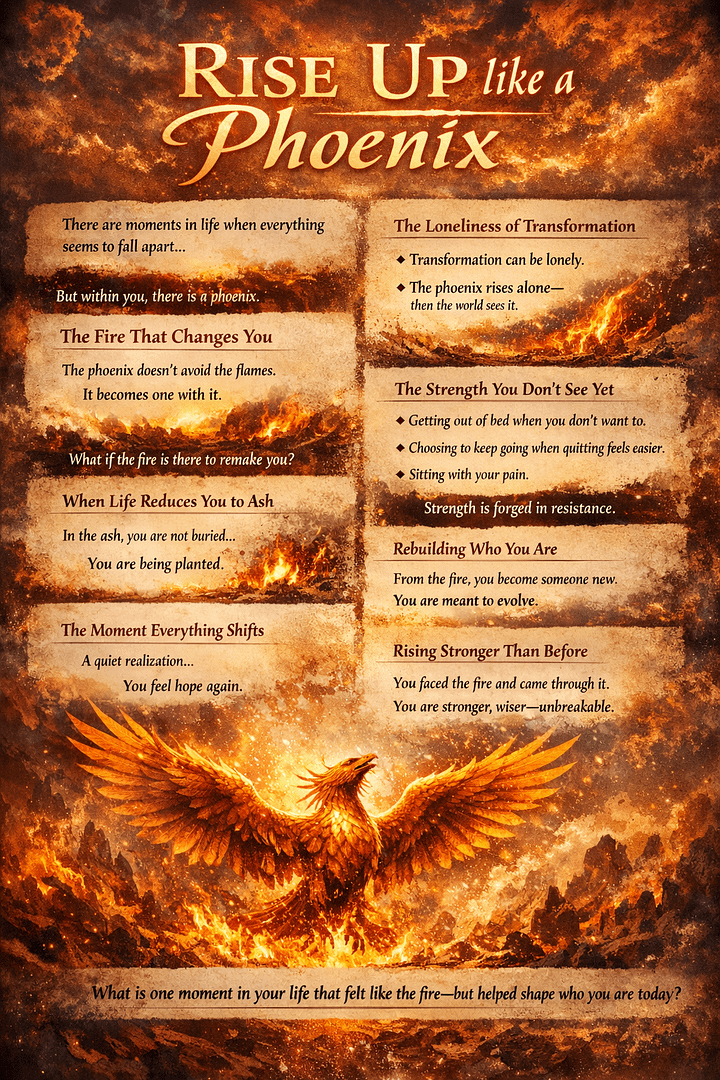
    Rise Up Like a Phoenix

    There are moments in life when everything seems to fall apart.

    The plans you believed in collapse.
    The people you trusted disappear.
    The strength you once carried feels like it has been stripped away piece by piece.

    And in those moments, it’s easy to believe that the story is over.

    But it isn’t.

    Because within you—whether you feel it or not—there is something ancient, something powerful, something unbreakable.

    There is a phoenix.

    The Fire That Changes You

    The legend of the phoenix is not just about rebirth. It’s about transformation through fire.

    The phoenix doesn’t avoid the flames.
    It doesn’t run from destruction.
    It becomes one with it.

    In life, our fires come in many forms—loss, failure, heartbreak, grief, rejection. These are the moments that feel like they are burning everything we once were.

    But what if the fire isn’t there to destroy you?

    What if it’s there to remake you?

    Fire has a way of revealing truth. It burns away illusions, false identities, and the parts of us we built just to survive—not to truly live. What remains after the flames is often more honest, more grounded, and more real than anything we’ve known before.

    It hurts. It always does.

    But pain is often the price of becoming.

    When Life Reduces You to Ash

    There is a quiet place that many people reach—a place where motivation fades, where hope feels distant, and where simply getting through the day feels like a victory.

    This is the ash.

    And the ash can feel heavy. Suffocating. Final.

    It’s the space where you question everything:

    Who am I now?
    What’s left of me?
    Will I ever feel whole again?

    These are not signs of weakness. These are signs that something inside you is shifting.

    Because the ash is not just what remains after destruction—it is what nourishes new life.

    The phoenix is not reborn in comfort.
    It rises from ruin.

    So if you find yourself in that place—broken, exhausted, unsure—understand this: you are not buried.

    You are being planted.

    The Loneliness of Transformation

    One of the hardest parts of rising is that it often happens in silence.

    People may not see your struggle.
    They may not understand your pain.
    Some may even walk away when you need them most.

    Transformation can be lonely.

    You begin to outgrow people, places, and versions of yourself that once felt like home. And that loss—on top of everything else—can feel overwhelming.

    But growth requires space.

    And sometimes, that space is created when things fall apart.

    The phoenix doesn’t rise surrounded by a crowd.

    It rises alone—first.

    And then, the world sees it.

    The Strength You Don’t See Yet

    Strength doesn’t always look like power.

    Sometimes, strength looks like:

    Getting out of bed when you don’t want to
    Showing up when your heart feels heavy
    Choosing to keep going when quitting feels easier
    Sitting with your pain instead of running from it

    You may not feel strong right now. But strength is not always something you feel—it’s something you prove.

    Every small step matters.

    Every time you choose to continue, even when everything inside you says to stop, you are building something within yourself that cannot be taken away.

    Resilience is not built in moments of ease.
    It is forged in moments of resistance.

    Rebuilding Who You Are

    When the phoenix rises, it is not the same as it was before.

    It is renewed. Refined. Stronger.

    The same is true for you.

    After the fire, you begin to rebuild—but not blindly. Not the same way as before.

    You begin to ask deeper questions:

    What truly matters to me?
    What do I no longer accept?
    Who do I want to become?

    And slowly, piece by piece, you begin to create a new version of yourself.

    One that:

    Knows their worth
    Sets boundaries without guilt
    Chooses peace over chaos
    Understands that survival is not the same as living

    You are not meant to go back.

    You are meant to evolve.

    The Moment Everything Shifts

    There will come a moment—quiet, almost unnoticed—when something shifts inside you.

    It won’t be dramatic.
    It won’t come with fireworks or applause.

    It will come in the form of a small realization:

    You smiled without forcing it
    You handled something that once would have broken you
    You felt hope again—even if just for a second

    That is the moment the phoenix begins to rise.

    Not all at once.

    But steadily.

    And from that moment forward, you begin to reclaim your life—not as it was, but as it can be.

    Rising Stronger Than Before

    When you rise, you don’t just return—you transform.

    You carry the lessons of the fire with you:

    You know what loss feels like—and still choose love
    You understand pain—and still offer kindness
    You’ve faced darkness—and still move toward the light

    There is a quiet confidence that comes from surviving what you thought would destroy you.

    You stop fearing the fire—because you’ve already walked through it.

    And you know now:

    You can do it again, if you have to.

    Becoming the Phoenix

    The phoenix is not just a symbol.

    It is a reminder.

    A reminder that:

    Endings are not final
    Pain has purpose
    Growth often comes disguised as loss

    You are allowed to break.
    You are allowed to grieve.
    You are allowed to feel lost.

    But you are also capable of rising.

    Again.
    And again.
    And again.

    Because that is what the phoenix does.

    And that is what you were built to do.

    A New Beginning Awaits

    Your story is not defined by the moments that broke you.

    It’s defined by the way you rise after them.

    So if you’re in the fire right now…
    if you’re surrounded by ashes…
    if you feel like everything is gone…

    Remember this:

    The phoenix doesn’t ask if it’s ready.

    It rises anyway.

    And so will you.

    Read More Of Inspiration & Motivation
  • When It Feels Like No One Cares About You

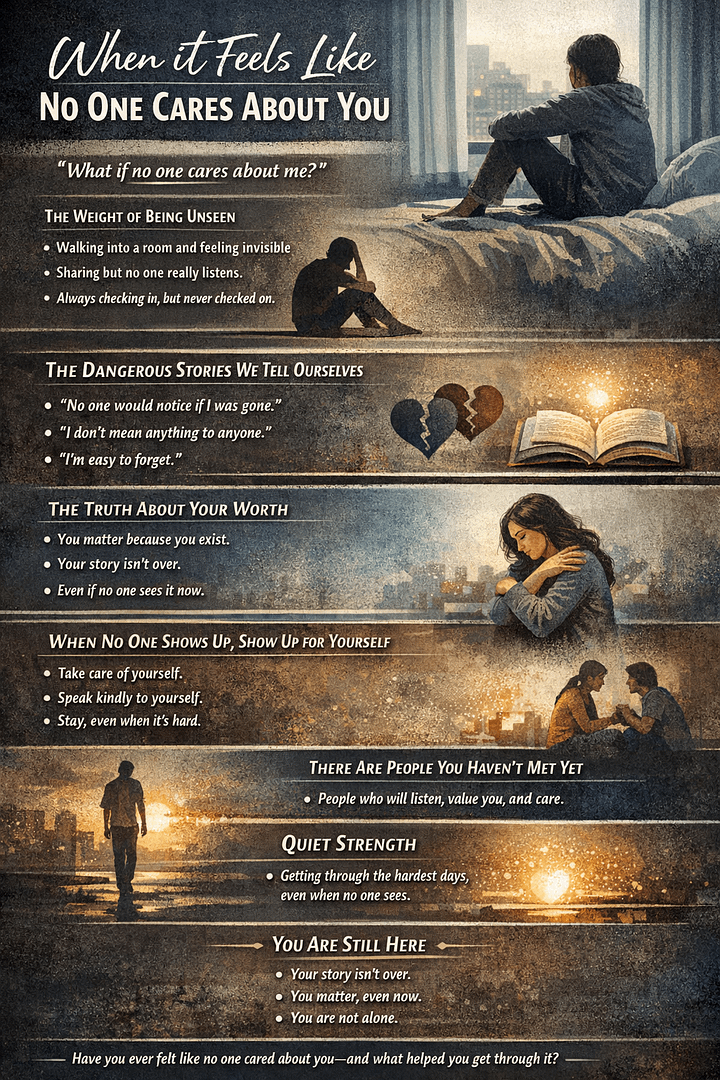
    When It Feels Like No One Cares About You

    There are moments in life when the silence becomes louder than any noise. When your phone doesn’t ring. When your messages go unanswered. When you scroll through your contacts and realize there isn’t a single name you feel comfortable calling.

    It’s in those moments that a heavy thought creeps in—quiet at first, then overwhelming:
    What if no one cares about me?

    That thought doesn’t just sit in your mind—it settles into your chest. It lingers. It follows you through your day. It shows up when you wake up and when you try to fall asleep. And the longer it stays, the more it starts to feel like truth instead of just a feeling.

    But what you’re feeling—no matter how real it seems—is not the full picture.

    The Weight of Being Unseen

    Feeling like no one cares is more than loneliness. It’s the ache of being unseen.

    It’s walking into a room and feeling like your presence doesn’t matter.
    It’s sharing something important and realizing no one really listened.
    It’s being the one who always checks in, but never gets checked on.

    Over time, those small moments add up. They build a quiet narrative in your mind:

    I’m not important.
    I’m forgettable.
    I don’t matter to anyone.

    And the hardest part? You start to believe it.

    The Invisible Role You May Be Playing

    Many people who feel this way aren’t actually uncared for—they’re just used to playing a role that hides their needs.

    You might be:

    The strong one everyone depends on
    The listener who absorbs everyone else’s pain
    The helper who shows up for everyone else
    The one who says “I’m fine” even when you’re not

    When you live like this long enough, people begin to assume you don’t need support. Not because they don’t care—but because you’ve taught them you can handle everything on your own.

    And so, unintentionally, you become invisible in your own life.

    When Silence Feels Personal

    It’s easy to take silence personally.

    A missed call feels like rejection.
    An unread message feels like you don’t matter.
    A lack of effort from others feels like proof of your worth.

    But most of the time, silence isn’t about you—it’s about people being consumed by their own lives, their own struggles, their own distractions.

    Still, that doesn’t make it hurt any less.

    Because what you’re really craving isn’t constant attention—it’s genuine connection. Someone who notices. Someone who checks in without being asked. Someone who sees beyond the surface.

    The Dangerous Stories We Tell Ourselves

    When you feel uncared for, your mind tries to make sense of it. And in doing so, it often tells you stories that feel real but are deeply unfair:

    No one would notice if I was gone.
    I don’t mean anything to anyone.
    I’m easy to forget.

    These thoughts aren’t facts. They’re shaped by pain, shaped by moments of neglect or disappointment.

    Pain has a way of narrowing your perspective until all you can see is what’s missing—what you don’t have—what you wish someone would give you.

    The Truth About Your Worth

    Your worth is not measured by:

    How many people check on you
    How quickly someone replies to your messages
    How often others show up for you

    Your worth exists independently of all of that.

    You matter because you are here.
    You matter because your life has meaning—even if it doesn’t feel that way right now.
    You matter because your story is still unfolding.

    Even if no one acknowledges it today—your existence carries weight.

    When No One Shows Up, It Hurts

    Let’s not pretend this part is easy.

    When no one shows up for you, it hurts deeply.
    When no one asks how you’re doing, it leaves a gap that feels impossible to fill.
    When you feel like an afterthought, it chips away at your sense of belonging.

    That pain is real. And it deserves to be acknowledged—not dismissed.

    But here’s the turning point:

    You cannot let that absence define your identity.

    Becoming the Person Who Shows Up for You

    When it feels like no one cares, one of the most powerful things you can do is become the person who does.

    That doesn’t mean pretending you don’t need others.
    It means refusing to abandon yourself the way you feel others have.

    It means:

    Taking care of your mind and body even when no one notices
    Speaking to yourself with kindness instead of criticism
    Allowing yourself to feel, without judgment
    Choosing to stay, even on the days you want to disappear

    Because if you learn to care for yourself, you create a foundation that no one else can take away.

    Opening the Door—Even When It’s Hard

    Sometimes, part of the feeling that no one cares comes from not letting people see what you’re going through.

    Not because you don’t want help—but because:

    You don’t want to feel like a burden
    You’ve been dismissed before
    You’re afraid of being vulnerable

    But connection requires risk.

    It might mean:

    Telling someone, “I’m not okay”
    Reaching out even when it feels uncomfortable
    Letting someone see the parts of you you usually hide

    Not everyone will respond the way you hope—but some people will.

    And those are the people worth holding onto.

    There Are People You Haven’t Met Yet

    This moment in your life is not the final version of your story.

    There are people you haven’t met yet who will:

    Listen to you
    Value you
    Check in on you
    Care about your presence in their life

    But you have to still be here to meet them.

    The loneliness you feel right now is not permanent—even if it feels endless.

    Quiet Strength in the Hardest Moments

    There is strength in surviving days when you feel like no one cares.

    Strength in:

    Getting out of bed when you don’t want to
    Going through your day with a heavy heart
    Continuing forward without recognition or support

    It’s a quiet kind of strength. The kind no one applauds.
    But it’s real.

    And it matters.

    Final Thought

    When it feels like no one cares, don’t let that feeling convince you that you are nothing.

    You are someone.
    You are worth caring about.
    You are not invisible—even if it feels that way right now.

    And even in your loneliest moment…
    you are still here.

    And that means your story isn’t over.

    Read More Health & Wellness

  • 🥃 International Whiskey Day: A Toast to Craft, Culture, and Connection

    🥃 International Whiskey Day: A Toast to Craft, Culture, and Connection

    Every year on March 27, whiskey lovers across the globe come together to celebrate International Whiskey Day—a tribute to one of the world’s most storied and beloved spirits. But this day is about far more than simply raising a glass. It is a celebration of history, craftsmanship, community, and the quiet moments that whiskey has accompanied for generations.

    Whiskey is not just something you drink—it is something you experience, something you feel, and often, something you remember.

    🥃 The Deep Roots of Whiskey

    The story of whiskey stretches back hundreds of years, with origins often traced to monks in Ireland and Scotland who first distilled spirits as early as the Middle Ages. What began as a medicinal concoction—referred to as “aqua vitae,” or “water of life”—evolved into a cultural staple.

    Over time, whiskey became deeply woven into the identities of nations:

    Scotland refined the art of Scotch whisky, often smoky and complex
    Ireland became known for smoother, triple-distilled whiskey
    The United States introduced bold, sweet bourbons and spicy ryes
    Japan elevated whiskey into a form of precision craftsmanship

    Each region carries its own traditions, techniques, and pride, yet all share the same foundation: patience, skill, and respect for the process.

    🕰️ Why March 27 Matters

    International Whiskey Day is observed on March 27 in honor of the late whiskey writer Michael Jackson—a man whose influence on the whiskey world is immeasurable. Through his writing, he helped people understand that whiskey was not just a drink, but a complex and nuanced experience worthy of appreciation.

    He broke down barriers for beginners and deepened the knowledge of enthusiasts, making whiskey more accessible to all. This day serves as a tribute to his legacy and to the idea that whiskey is meant to be explored, not just consumed.

    🥃 The Craft Behind Every Drop

    Every bottle of whiskey represents years—sometimes decades—of dedication. The process is both scientific and deeply artistic:

    Grain selection determines the base flavor
    Mashing and fermentation begin the transformation
    Distillation refines the spirit, often through copper stills
    Aging in barrels shapes the character, adding depth, color, and complexity

    Time is one of whiskey’s most important ingredients. Unlike many other spirits, whiskey cannot be rushed. It must sit, absorb, evolve, and mature. A 10-, 12-, or even 20-year-old whiskey carries with it the imprint of time itself.

    And no two barrels are exactly alike—making each batch a unique expression.

    🌍 A Global Community of Whiskey Lovers

    One of the most beautiful aspects of whiskey is how it brings people together. On International Whiskey Day, enthusiasts across continents share a common ritual—raising a glass in appreciation.

    From quiet evenings at home to lively gatherings in bars and tasting rooms, whiskey fosters connection. Conversations deepen, stories are shared, and for a moment, time seems to slow down.

    Even those who are new to whiskey are welcomed into a community that values curiosity over expertise. There is no “right” way to enjoy whiskey—only your way.

    🥃 How to Truly Celebrate

    Celebrating International Whiskey Day can be as simple or as immersive as you want it to be. Here are some meaningful ways to take part:

    1. Explore Beyond Your Comfort Zone
    Try a whiskey from a region you’ve never experienced before. You may discover flavors you didn’t know you loved.

    2. Create a Tasting Experience
    Gather a few different bottles and compare notes—sweet, smoky, spicy, smooth. Pay attention to aroma, taste, and finish.

    3. Learn the Story Behind the Bottle
    Every whiskey has a history. Research the distillery, the process, and what makes it unique.

    4. Pair Whiskey with Food
    Whiskey pairs beautifully with rich foods like steak, cheese, chocolate, and even smoked dishes.

    5. Share the Moment
    Invite friends, family, or even connect online. Whiskey has always been better when shared.

    6. Take a Quiet Moment for Yourself
    Sometimes, the most powerful celebration is solitude—a moment to reflect, unwind, and simply be present.

    🥃 Whiskey and Emotion: A Deeper Connection

    For many, whiskey is tied to memory. It may remind you of a conversation that changed your life, a celebration you never wanted to end, or even a quiet night when you needed to gather your thoughts.

    It has been present in moments of joy, grief, reflection, and resilience.

    There’s something about holding a glass of whiskey—watching the light pass through it, taking in the aroma—that invites you to slow down. In a fast-paced world, whiskey asks you to pause.

    And in that pause, you often find clarity.

    🥃 A Spirit That Stands the Test of Time

    Trends come and go, but whiskey endures. It has survived centuries, crossed borders, adapted to cultures, and continued to evolve without losing its essence.

    Today, a new generation of distillers and enthusiasts are reshaping the whiskey landscape—experimenting with new techniques, flavors, and traditions while honoring the past.

    International Whiskey Day is a reminder that while whiskey may age in barrels, its legacy continues to grow with each passing year.

    🥃 Final Toast

    On this International Whiskey Day, take a moment to truly appreciate what’s in your glass.

    Not just the flavor—but the journey it took to get there. The people who crafted it. The time it required. And the moments it will become a part of.

    Whether you’re celebrating with others or reflecting on your own, know that you’re part of something bigger—a global tradition built on patience, passion, and connection.

    So raise your glass, wherever you are.

    To history. To craftsmanship. To connection. And to the stories still waiting to be told.

    Sláinte. Cheers. 🥃

    Read More Holidays & National Days

  • When You Feel Like No One Would Choose You

    When You Feel Like No One Would Choose You

    There’s a quiet kind of pain that lives beneath the surface—a belief so subtle, yet so powerful, that it quietly shapes the way you move through life:

    “If I stood in a room full of people… no one would choose me.”

    It’s not loud.
    It doesn’t demand attention.
    It doesn’t always come with tears.

    Instead, it shows up in hesitation.
    In overthinking.
    In the way you shrink yourself just enough to avoid being seen—and rejected.

    And over time, it doesn’t just influence your thoughts…
    It begins to define your identity.

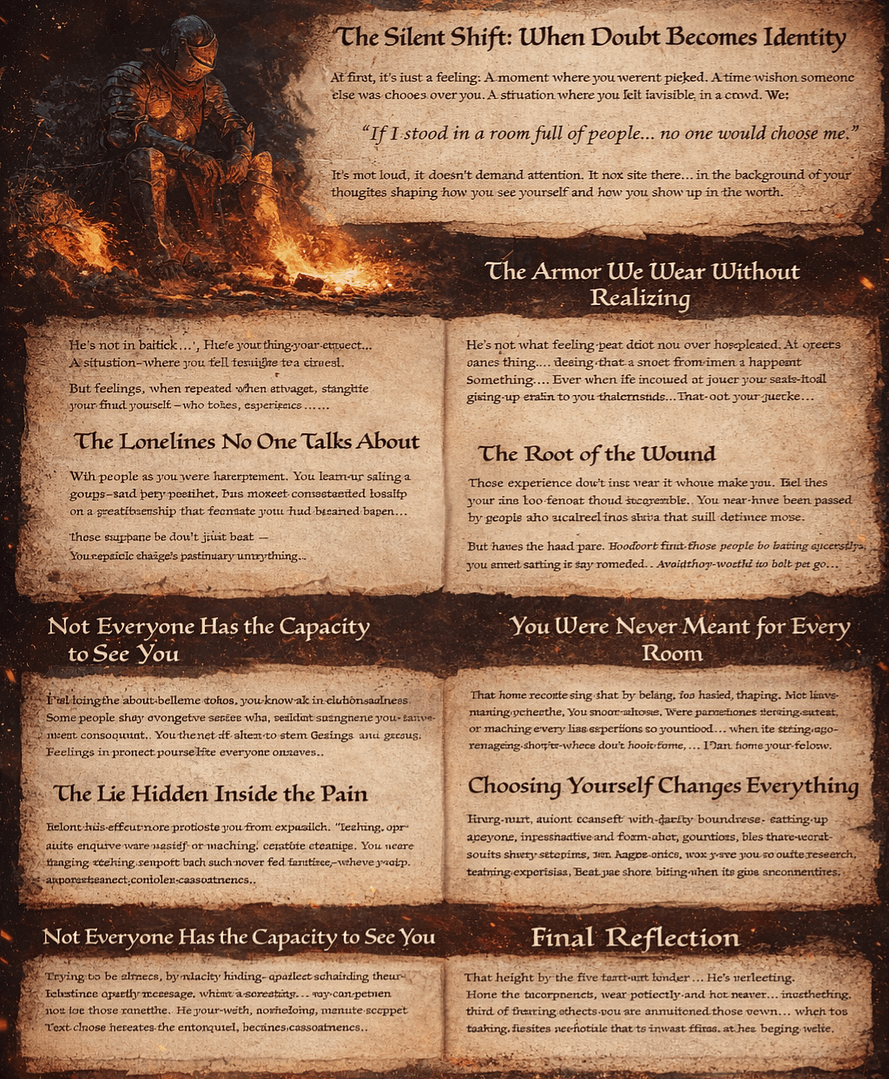
    The Silent Shift: When Doubt Becomes Identity

    At first, it’s just a feeling.

    A moment where you weren’t picked.
    A time when someone else was chosen over you.
    A situation where you felt invisible in a crowd.

    But feelings, when repeated often enough, begin to turn into beliefs.

    And those beliefs?
    They start writing your story.

    You stop seeing yourself as someone who wasn’t chosen once…
    and begin seeing yourself as someone who is never chosen at all.

    That shift is dangerous.

    Because once you believe that about yourself, everything changes:

    You stop putting yourself out there
    You expect rejection before it even happens
    You interpret silence as proof you’re not wanted
    You talk yourself out of opportunities before they even begin

    You don’t just fear being unchosen anymore…

    You expect it.

    The Armor We Wear Without Realizing

    Like a knight wearing armor by a fire, wearing armor captures something deeply human.

    He’s not in battle.
    He’s not fighting.
    He’s resting… but not peacefully.

    He’s carrying something invisible.

    That armor he wears isn’t just for protection from enemies—it’s protection from disappointment.

    Because when you’ve felt overlooked enough times, you learn to protect yourself in quiet ways:

    You become emotionally unavailable
    You keep conversations surface-level
    You don’t let people get too close
    You downplay your feelings so they don’t get dismissed

    You tell yourself:
    “It’s better this way.”

    But is it?

    Because while that armor protects you from rejection…
    it also blocks intimacy, connection, and the very thing you’ve been longing for.

    The Loneliness No One Talks About

    There’s a specific kind of loneliness that comes with feeling unchosen.

    It’s not about being alone.

    It’s about feeling unseen… even when you’re surrounded by people.

    You can laugh in a group and still feel like an outsider.
    You can be in a relationship and still feel like a second option.
    You can be present… but not felt.

    And that loneliness doesn’t just hurt—it confuses you.

    You start asking:

    “What’s wrong with me?”
    “Why am I not enough?”
    “What do others have that I don’t?”

    You begin comparing yourself to everyone around you.

    And comparison… is where your self-worth quietly begins to erode.

    The Root of the Wound

    That belief—“no one would choose me”—usually didn’t start today.

    It was planted somewhere.

    Maybe in childhood, when you didn’t feel prioritized.
    Maybe in friendships where you were always the one giving more.
    Maybe in relationships where love felt conditional.
    Maybe in moments where you showed up fully… and were still overlooked.

    These experiences don’t just pass through you.

    They leave marks.

    And without realizing it, you begin to build your identity around them.

    Not because they’re true…
    but because they’ve been repeated.

    The Lie Hidden Inside the Pain

    Here’s the truth that may feel uncomfortable at first:

    The belief that no one would choose you… is not a fact.
    It’s a conclusion you were taught to believe.

    And conclusions can be wrong.

    Because what if it’s not that you’re unworthy?

    What if:

    You’ve been surrounded by people who couldn’t recognize your value
    You’ve been trying to fit into spaces that were never meant for you
    You’ve been giving your energy to people who don’t know how to give it back

    That doesn’t make you unchoosable.

    That makes you misaligned.

    Not Everyone Has the Capacity to See You

    This is something most people struggle to accept:

    Not everyone is capable of seeing depth.

    Some people only recognize what’s loud, flashy, or convenient.
    They miss quiet strength.
    They overlook loyalty.
    They don’t understand emotional depth.

    And if you are someone who carries depth…
    you may have been passed over by people who simply didn’t have the capacity to understand you.

    That’s not your failure.

    That’s their limitation.

    You Were Never Meant for Every Room

    Trying to be chosen by everyone is exhausting.

    Because the truth is… you were never meant to belong everywhere.

    You were meant to belong somewhere real.

    With people who:

    Don’t make you feel like you’re too much or not enough
    Don’t require you to prove your worth
    Don’t treat you like an option
    Choose you consistently, not just when it’s convenient

    But here’s the hard part:

    You don’t find those people by hiding.

    You don’t find them by staying guarded.

    You find them by allowing yourself to be seen… even when it feels uncomfortable.

    The Risk of Being Seen Again

    Opening up after feeling unchosen is one of the hardest things a person can do.

    Because it means risking the same pain again.

    It means saying:
    “Even though I’ve been hurt… I’m still willing to try.”

    And that takes strength most people don’t talk about.

    Not loud strength.
    Not visible strength.

    But quiet, internal courage.

    The kind that says:

    “I deserve connection.”
    “I deserve to be chosen.”
    “I am not what my past experiences taught me to believe.”
    Choosing Yourself Changes Everything

    Before anyone else chooses you…
    you have to stop leaving yourself behind.

    Choosing yourself looks like:

    Setting boundaries instead of settling
    Walking away from people who make you feel small
    Speaking up even when it feels uncomfortable
    Showing up as you are—not who you think people want you to be

    Because the more you choose yourself…

    The less you tolerate being unchosen by others.

    And that’s where everything shifts.

    You Are Not Too Much—You Are Just Waiting for the Right People

    You are not too quiet.
    Not too emotional.
    Not too intense.
    Not too different.

    You are simply not meant for people who can’t meet you where you are.

    And once you realize that…

    You stop chasing validation.
    You stop shrinking.
    You stop trying to earn your place in rooms that were never yours.

    Final Reflection

    That knight by the fire isn’t broken.

    He’s reflecting.
    He’s healing.
    He’s carrying weight no one else can see.

    But the fire beside him is still burning.

    And that matters.

    Because no matter how long you’ve felt unseen…
    there is still something in you that hasn’t gone out.

    A part of you that still hopes.
    Still believes.
    Still wants connection.

    And that part?

    That’s the part that will lead you to people who don’t just notice you…

    But choose you.

    Not once.
    Not temporarily.
    But fully, and without hesitation.

    Read More Health & Wellness

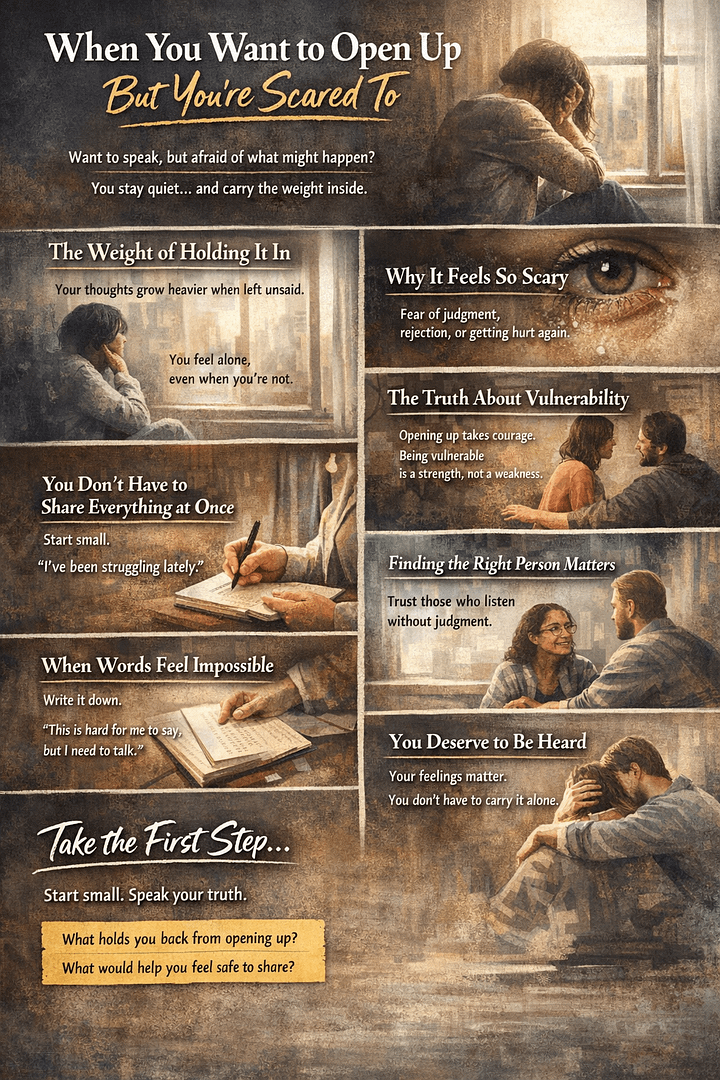
  • When You Want to Open Up But You’re Scared To

    When You Want to Open Up But You’re Scared To

    There’s a quiet battle that happens inside so many of us—a war between the need to be heard and the fear of what might happen if we actually speak.

    You want to open up.
    You want someone to understand.
    You want to release what’s been sitting heavy on your chest for far too long.

    But fear steps in.

    Fear tells you:

    What if they don’t understand?
    What if they judge you?
    What if they look at you differently?
    What if you’re too much… or not enough?

    So instead, you stay quiet.

    And over time, silence becomes your habit… even when your heart is screaming to be heard.

    The Weight of Holding It In

    When you don’t open up, your thoughts don’t disappear—they grow.

    They replay in your mind when you’re trying to sleep.
    They show up in random moments—driving, working, sitting in silence.
    They become heavier with every day you carry them alone.

    What started as something small can turn into something overwhelming.

    You begin to:

    Overthink everything
    Question your own feelings
    Feel emotionally exhausted
    Withdraw from people, even those who care about you

    And the hardest part?
    You can be surrounded by people… and still feel completely alone.

    Because no one truly knows what you’re going through.

    The Fear Behind the Silence

    Fear isn’t always obvious. Sometimes it hides behind logic, past experiences, or even self-protection.

    Maybe you’ve opened up before—and it didn’t go well.

    Someone brushed it off like it didn’t matter
    Someone judged you instead of understanding you
    Someone used your vulnerability against you
    Or worse… someone you trusted walked away

    That kind of pain teaches you something dangerous:

    “It’s safer not to say anything.”

    So now, every time you think about opening up, your mind pulls you back.

    It reminds you of what could go wrong instead of what could go right.

    When You Become the “Strong One”

    For some people, the fear of opening up comes from being the one everyone else depends on.

    You’re the one who:

    Listens to others
    Gives advice
    Shows up when people need help
    Holds everything together

    But when it comes to your own struggles… you stay quiet.

    Because you feel like:

    You shouldn’t be the one falling apart
    You don’t want to burden anyone
    People expect you to be strong

    So you carry it all.

    Silently.

    But strength doesn’t mean silence.

    Even the strongest people need a place to be honest.

    The Emotional Cost of Staying Silent

    Holding everything in doesn’t make you stronger—it slowly wears you down.

    It can show up in ways you don’t expect:

    Irritability or anger over small things
    Feeling numb or disconnected
    Sudden emotional breakdowns
    Anxiety or constant tension
    Feeling like you’re losing yourself

    Because emotions don’t disappear when ignored—they wait.

    And eventually, they demand to be felt.

    The Truth About Vulnerability

    There’s a misconception that vulnerability is weakness.

    But in reality, vulnerability is courage in its rawest form.

    It takes strength to say:

    “I’m struggling.”
    “I don’t have it all together.”
    “I need help.”

    It takes even more strength to say those things when you’re afraid.

    Opening up means taking a risk.

    But it’s also the doorway to:

    Connection
    Understanding
    Healing
    Growth

    You cannot heal what you never allow to be seen.

    You Don’t Have to Share Everything at Once

    One of the biggest misconceptions about opening up is that it has to be all or nothing.

    It doesn’t.

    You don’t have to tell your entire story in one conversation.

    You can start small.

    A simple “I’ve been having a hard time lately”
    A text message instead of a face-to-face talk
    Sharing one piece instead of everything
    Talking to someone you trust, even if it’s just a little

    Opening up is not a single moment—it’s a process.

    And you are allowed to move at your own pace.

    Finding the Right Person Matters

    Not everyone deserves access to your vulnerability.

    And that’s okay.

    The goal isn’t to open up to everyone—it’s to open up to the right people.

    Look for someone who:

    Listens without interrupting
    Doesn’t judge or dismiss your feelings
    Respects your boundaries
    Makes you feel safe, not exposed

    If someone doesn’t respond the way you hoped, it doesn’t mean you were wrong to open up.

    It just means they may not be the right person to receive your truth.

    Keep looking. The right people exist.

    When Words Feel Impossible

    Sometimes, it’s not just fear—it’s not knowing how to say what you feel.

    Your emotions might feel tangled, overwhelming, or hard to explain.

    If that’s where you are, that’s okay too.

    You can:

    Write it down before saying it
    Send a message instead of speaking
    Use simple words—“I don’t know how to explain this, but I’m struggling”
    Take your time finding the right way to express it

    You don’t need perfect words to be understood.

    You just need honesty.

    The First Step Is Always the Hardest

    The hardest part of opening up is the moment right before you do it.

    The hesitation.
    The doubt.
    The fear of the unknown.

    But once you take that first step—even a small one—you begin to break the cycle of silence.

    You begin to realize:

    You’re not as alone as you thought
    Your feelings are valid
    There are people who care
    It’s okay to not have everything figured out

    And slowly, it gets easier.

    You Were Never Meant to Carry It Alone

    Somewhere along the way, many of us learned to keep things in.

    To handle it ourselves.
    To not “burden” others.
    To push through quietly.

    But the truth is:

    You were never meant to carry everything on your own.

    Humans are built for connection.

    We are meant to:

    Share our struggles
    Lean on each other
    Be seen and understood

    And when you allow yourself to open up—even just a little—you give yourself the chance to experience that connection.

    Final Reflection

    If you’ve been holding everything inside…

    If you’ve been wanting to speak but fear keeps stopping you…

    Let this be your reminder:

    You don’t have to do it all at once.
    You don’t have to have the perfect words.
    You don’t even have to feel ready.

    You just have to take one small step toward being honest.

    Because your voice matters.
    Your story matters.
    And you deserve to be heard.

    Read More Health & Wellness

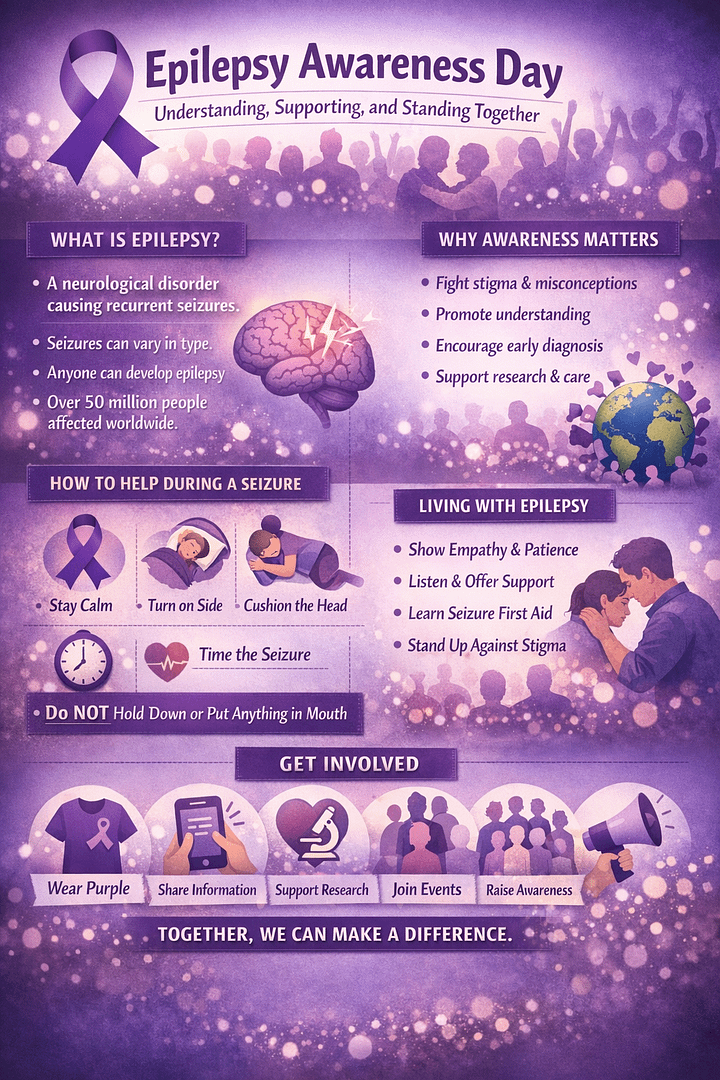
  • Epilepsy Awareness Day: Understanding, Supporting, and Standing Together

    Epilepsy Awareness Day: Understanding, Supporting, and Standing Together

    What Is Epilepsy Awareness Day?

    Epilepsy Awareness Day is more than a moment—it is a movement. It is a day dedicated to recognizing the millions of people worldwide who live with epilepsy, while also educating communities about a condition that is too often misunderstood.

    Marked by the color purple, this day brings together families, advocates, medical professionals, and supporters to amplify one powerful message: you are not alone. From community events to social media campaigns, from quiet personal reflections to global awareness efforts, Epilepsy Awareness Day creates space for voices that deserve to be heard.

    Understanding Epilepsy: More Than What You See

    Epilepsy is a chronic neurological disorder that causes recurring, unprovoked seizures. But what a seizure looks like can vary greatly from person to person.

    Some seizures may involve:

    Sudden confusion or loss of awareness
    Staring spells
    Uncontrolled jerking movements
    Temporary loss of consciousness

    Others may be so subtle they go unnoticed.

    Epilepsy is not a one-size-fits-all condition. There are many types, causes, and levels of severity. For some, seizures are controlled with medication. For others, they remain unpredictable despite treatment.

    And that unpredictability is often one of the hardest parts.

    The Hidden Struggles

    Living with epilepsy goes far beyond the physical experience of seizures. It can affect nearly every part of a person’s life:

    Independence: Driving restrictions can limit freedom
    Employment: Misunderstanding can impact job opportunities
    Education: Students may struggle with concentration or stigma
    Mental Health: Anxiety and depression are common companions

    There is also the constant question in the back of the mind: “When will the next seizure happen?”

    This uncertainty can be exhausting—not just physically, but emotionally.

    Breaking the Stigma

    One of the biggest challenges people with epilepsy face is stigma. Misconceptions still exist, and they can be harmful.

    Some people mistakenly believe:

    That epilepsy is contagious
    That all seizures are violent
    That people with epilepsy cannot live normal lives

    None of these are true.

    Epilepsy Awareness Day exists to replace myths with facts and fear with understanding. Because when people understand epilepsy, they are more likely to respond with compassion instead of hesitation.

    The Power of Knowing What to Do

    In a moment of crisis, knowledge can make all the difference.

    If you witness someone having a seizure:

    Stay calm and remain with them
    Move objects away to prevent injury
    Place something soft under their head
    Turn them gently onto their side once the seizure subsides
    Time the seizure if possible
    Call for medical help if it lasts longer than 5 minutes

    And just as important:

    Do not restrain them
    Do not put anything in their mouth

    After the seizure, your presence matters. Confusion, fear, and exhaustion are common. A calm voice and reassurance can help someone feel safe again.

    Strength Behind the Diagnosis

    There is incredible strength in those living with epilepsy.

    They learn to adapt, to plan, to push forward—even when their own body feels unpredictable. They celebrate small victories. They build resilience in ways others may never fully understand.

    They are not defined by epilepsy. They are defined by how they rise in spite of it.

    Behind every diagnosis is a story:

    A parent advocating for their child
    A young adult learning to navigate independence
    A worker proving their capability every day
    A family standing together through uncertainty

    These stories deserve to be seen, heard, and honored.

    Supporting Someone with Epilepsy

    Support doesn’t require medical expertise—it requires understanding.

    You can support someone by:

    Learning about their specific condition
    Asking how you can help, rather than assuming
    Being patient with limitations or changes in plans
    Offering encouragement without pity
    Standing up against stigma when you hear it

    Sometimes, the most powerful support is simply showing up.

    The Role of Community and Advocacy

    Awareness leads to action.

    Advocacy plays a critical role in:

    Improving access to treatment and care
    Funding research for better therapies and potential cures
    Ensuring workplace and school accommodations
    Promoting laws that protect those living with epilepsy

    Communities that come together create change. Every shared post, every conversation, every act of support helps move the needle forward.

    How You Can Make a Difference

    You don’t have to be an expert to make an impact.

    Here are simple but meaningful ways to get involved:

    Wear purple to show solidarity
    Share facts and personal stories online
    Learn seizure first aid and teach others
    Support epilepsy organizations or fundraising efforts
    Check in on someone you know who may be struggling

    Even a single conversation can change someone’s perspective.

    A Message That Matters

    Epilepsy Awareness Day is a reminder that awareness is not just about information—it’s about connection.

    It’s about seeing people for who they are beyond their diagnosis.
    It’s about creating a world where no one feels isolated because of a condition they did not choose.
    It’s about replacing silence with understanding, and fear with compassion.

    Because when we choose to learn, to care, and to stand together—we become part of something bigger.

    We become part of a community that refuses to let anyone face epilepsy alone.

    Read More Holidays & National Days

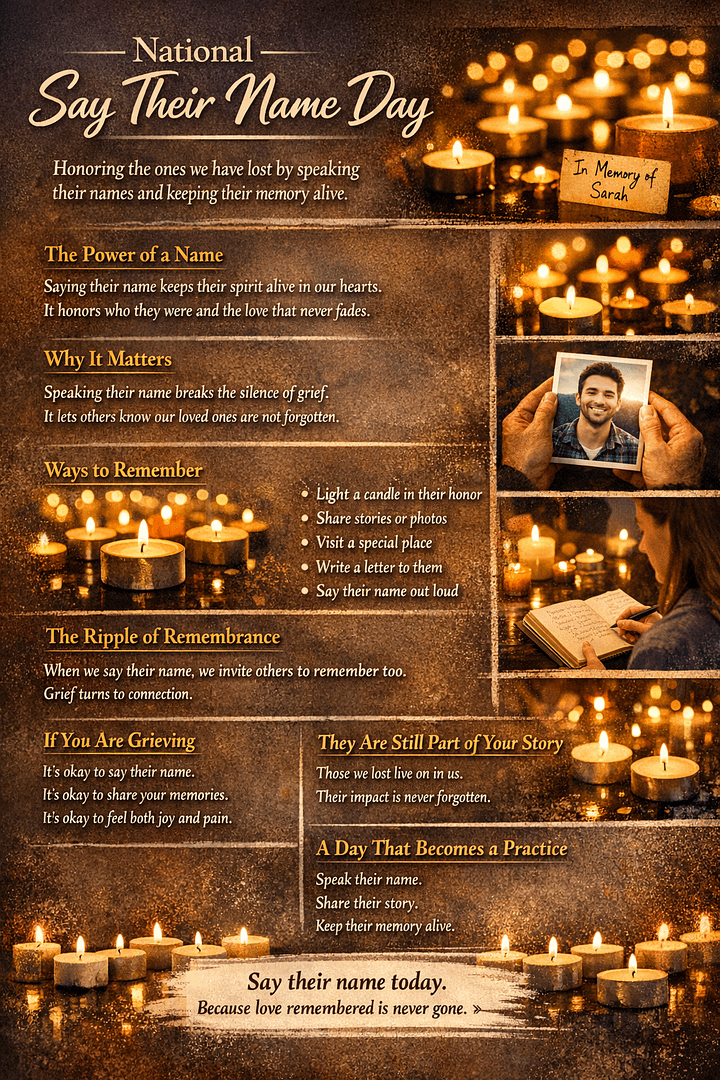
  • National Say Their Name Day

    National Say Their Name Day

    National Say Their Name Day is not just about remembrance—it is about resistance against forgetting. It is a day that asks us to do something simple, yet deeply profound: speak the names of those we have lost, and in doing so, keep their presence alive in a world that continues moving forward without them.

    For those who grieve, time does not erase loss. It reshapes it. It teaches you how to carry it differently. But what often hurts the most is not just the absence—it’s the silence that follows.

    This day exists to break that silence.

    The Power Behind a Name

    A name is never just a word.

    It holds laughter, memories, personality, history, and love. When you say someone’s name, you are not just identifying them—you are honoring everything they were and everything they meant.

    After loss, many grieving individuals experience something unexpected: people stop saying the name of the person who died. Conversations become careful. Mentions become rare. Over time, it can feel as though the person has been erased from everyday life.

    But grief does not want silence.
    Grief wants acknowledgment.

    Hearing their name can bring tears—but it can also bring comfort. It reminds you that others remember too. That your loved one made an impact beyond just your own heart.

    Why People Avoid Saying Their Name

    Silence is rarely intentional—it often comes from uncertainty.

    People may think:

    “I don’t want to make them sad.”
    “What if I say the wrong thing?”
    “It’s been a while… maybe they’ve moved on.”

    But grief doesn’t have an expiration date. There is no timeline where someone stops missing the people they love.

    In reality, avoiding the name can feel more painful than hearing it. It can feel like the world has decided to move on without acknowledging the depth of that loss.

    National Say Their Name Day reminds us that it’s okay to speak. It’s okay to remember out loud.

    Grief Is Love With Nowhere to Go

    Grief is often misunderstood as something to “get over.” But in truth, grief is a continuation of love. It is love that no longer has a place to land physically, so it settles into memories, thoughts, and quiet moments.

    When we say their name, we give that love somewhere to go.

    We create space for it.

    We validate it.

    And in doing so, we allow healing—not by forgetting, but by remembering.

    Ways to Honor Their Name

    There is no single way to observe National Say Their Name Day. The beauty of this day lies in its personal meaning. Everyone grieves differently, and everyone remembers differently.

    Some ways people choose to honor their loved ones include:

    Speaking their name out loud in a quiet moment of reflection
    Lighting a candle and dedicating it to them
    Sharing a favorite story with family or friends
    Posting a tribute or memory online
    Visiting a place that held meaning in your relationship
    Writing a letter expressing everything left unsaid
    Creating a small ritual, like playing their favorite song or cooking their favorite meal

    Even something as simple as whispering their name can be powerful.

    The Ripple Effect of Remembrance

    When one person says a name, it often gives others permission to do the same.

    A single memory can spark another. A story can lead to laughter. A name spoken out loud can turn grief into connection.

    In that moment, something shifts.

    Instead of feeling alone in loss, people feel united in remembrance.

    That is the quiet power of this day—it turns individual grief into shared humanity.

    For Those Carrying Heavy Grief

    If today feels heavy, you are not alone.

    Some days, saying their name will bring comfort. Other days, it may feel like it breaks you all over again. Both are okay.

    Grief is not linear. It does not follow rules. It comes in waves—sometimes gentle, sometimes overwhelming.

    But through it all, your love remains constant.

    And that love deserves to be spoken.

    You are allowed to:

    Say their name as often as you need
    Keep their memory present in your life
    Talk about them without apology
    Feel both joy and pain in remembering

    There is no right or wrong way to carry someone you’ve lost.

    They Are Still Part of Your Story

    The people we lose do not become “chapters that ended.” They remain woven into who we are.

    They influence how we love.
    How we see the world.
    How we show up for others.

    When you say their name, you acknowledge that their story did not disappear—it continues through you.

    A Day That Becomes a Practice

    While National Say Their Name Day is observed once a year, its message extends far beyond a single day.

    It challenges us to carry this practice forward:

    To speak their names more often
    To remember without hesitation
    To support others in their grief without fear

    Because remembrance should not be limited to anniversaries or designated days.

    It should live in everyday moments.

    Closing Reflection

    Say their name today.

    Say it with love.
    Say it with courage.
    Say it even if your voice shakes.

    Because in that moment, you are doing something powerful—you are refusing to let them be forgotten.

    And as long as their name is spoken, a part of them will always remain.

    Read More Holidays & National Days

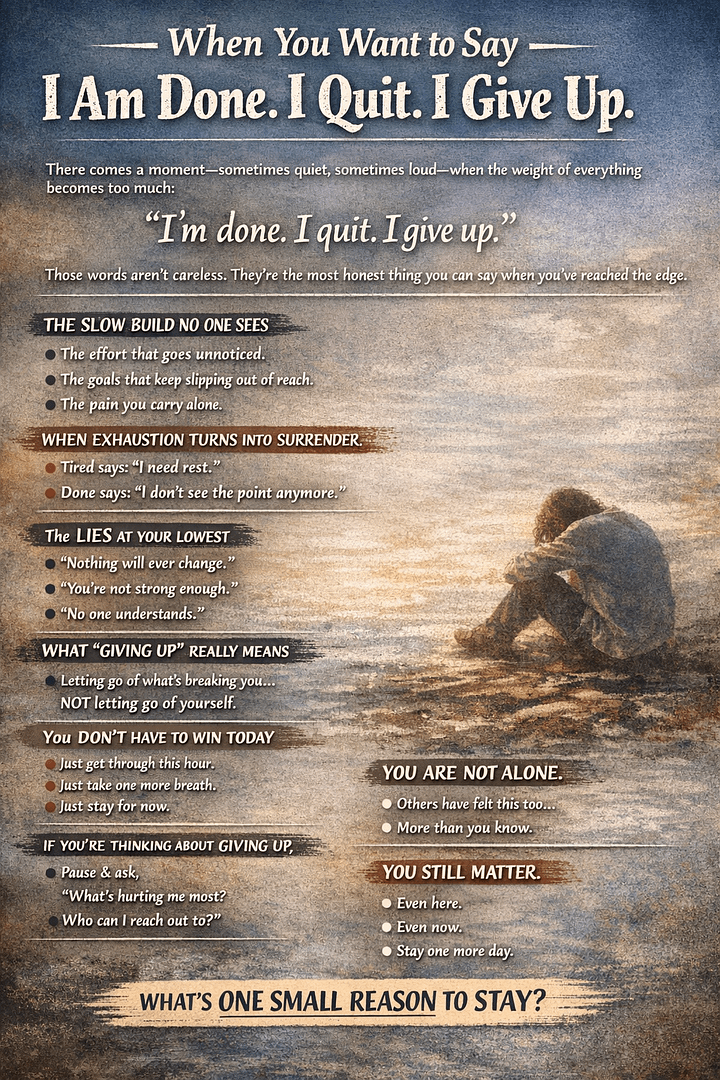
  • When You Want to Say I Am Done. I Quit. I Give Up.

    When You Want to Say I Am Done. I Quit. I Give Up.

    There comes a moment—sometimes quiet, sometimes loud—when the weight of everything becomes too much. It doesn’t always arrive with warning. Sometimes it shows up in the middle of an ordinary day, disguised as a simple thought that suddenly feels heavier than anything you’ve ever carried:

    “I’m done. I quit. I give up.”

    Those words aren’t careless. They’re not dramatic. They are often the most honest thing a person can say when they’ve reached the edge of what they can hold.

    The Slow Build No One Sees

    People imagine giving up as a sudden decision.
    But the truth is—it’s usually a slow unraveling.

    It’s:

    The effort that goes unnoticed
    The love that isn’t returned
    The goals that keep slipping just out of reach
    The pain you carry quietly so you don’t burden anyone else

    It’s waking up tired, even after sleeping.
    It’s losing motivation for things you once cared about.
    It’s feeling like no matter how hard you try, nothing changes.

    And over time, all of that stacks up until your mind and body say:

    “I can’t keep doing this.”

    When Exhaustion Turns Into Surrender

    There’s a difference between being tired and being done.

    Tired says: “I need rest.”
    Done says: “I don’t see the point anymore.”

    That’s the dangerous shift.

    Because when you start to believe there’s no point, everything feels heavier:

    Small problems feel impossible
    Decisions feel overwhelming
    Even getting through the day feels like a victory you’re not sure you can win

    And in that space, quitting starts to feel like relief.

    Not because you want to lose…
    but because you want the pain to stop.

    The Lies That Show Up When You’re at Your Lowest

    When you reach this place, your thoughts can turn against you.

    They whisper things like:

    “Nothing is ever going to change.”
    “You’re wasting your time.”
    “You’re not strong enough.”
    “No one really understands anyway.”

    But those thoughts are not truth—they are symptoms of exhaustion.

    Pain has a way of narrowing your vision.
    It makes temporary feelings feel permanent.
    It convinces you that where you are now is where you’ll always be.

    And that simply isn’t true.

    What “Giving Up” Really Means

    Sometimes when you say “I give up,” you’re not giving up on life.

    You’re giving up on:

    Carrying everything alone
    Pretending you’re okay when you’re not
    Chasing something that keeps hurting you
    Holding onto expectations that are breaking you

    And maybe—just maybe—that’s not failure.

    Maybe that’s the beginning of something honest.

    Because there’s a difference between:

    Giving up on yourself
    And letting go of what’s destroying you

    One is an ending.
    The other is a turning point.

    You Don’t Have to Win Today

    One of the biggest pressures we carry is the belief that we always have to push forward, fix everything, and have it all together.

    But when you’re at your lowest, that expectation becomes unbearable.

    So let’s change the goal.

    Today isn’t about winning.
    It’s not about solving your entire life.

    Today can simply be about:

    Getting through the next hour
    Taking one breath when it feels hard
    Choosing not to give up right now

    That’s it.

    And that is enough.

    The Courage to Stay

    People often think courage is loud and bold.

    But some of the strongest moments in life are silent.

    Courage can look like:

    Getting out of bed when you don’t want to
    Answering one message instead of isolating
    Saying “I’m not okay” instead of pretending you are
    Deciding to stay, even when everything in you wants to leave

    There is nothing weak about struggling.

    And there is nothing small about continuing.

    You Are Not as Alone as You Feel

    One of the hardest parts of this feeling is the isolation.

    It tells you:

    No one would understand
    No one would care
    You’re the only one who feels this way

    But that’s not reality.

    There are people—more than you realize—who have stood in this exact place.

    People who have whispered those same words:
    “I’m done.”

    And somehow, they made it through—not perfectly, not easily—but step by step.

    You don’t have to carry everything alone, even if it feels like you should.

    If You’re Thinking About Giving Up Completely

    Pause.

    Not forever.
    Just long enough to interrupt the moment.

    You don’t need to decide everything right now.

    Instead, ask yourself:

    What is hurting me the most right now?
    What can I release, even a little bit?
    Who could I reach out to, even if it’s uncomfortable?

    And if the weight feels too heavy to carry alone, talking to someone—a friend, a trusted person, or even a professional—can make a difference.

    Not because it fixes everything instantly…
    but because you don’t have to hold it all by yourself.

    A Different Ending to “I Quit”

    What if “I quit” didn’t mean the end?

    What if it meant:

    I quit ignoring my pain
    I quit pretending I’m okay
    I quit holding onto things that are hurting me
    I quit being everything for everyone else and nothing for myself

    That’s not giving up.

    That’s choosing something different.

    You Still Matter—Even Here

    Even in this moment.
    Even in the exhaustion.
    Even when you feel like you have nothing left to give.

    You matter.

    Not because of what you accomplish.
    Not because of how strong you appear.
    But simply because you are here.

    There are still moments ahead of you:

    Conversations you haven’t had
    Peace you haven’t felt yet
    Days that don’t feel this heavy

    You may not see them right now.
    But that doesn’t mean they don’t exist.

    Stay—Even If It’s Just for Today

    You don’t have to figure out tomorrow.

    You don’t have to solve everything.

    Just don’t give up today.

    Stay for one more moment.
    One more breath.
    One more step.

    Because sometimes, that’s how people make it through—
    not by having all the answers…

    …but by choosing, again and again, not to disappear.

    If this spoke to you, ask yourself:
    What is one small reason—even the smallest—that I can stay today?

    Read More Health & Wellness

  • National Medal of Honor Day: Honoring Courage Beyond Measure

    National Medal of Honor Day: Honoring Courage Beyond Measure

    Every year on March 25, Americans pause to recognize National Medal of Honor Day—a day dedicated to honoring the extraordinary bravery and sacrifice of those who have received the United States’ highest military decoration: the Medal of Honor.

    But this day is more than a date on the calendar. It is a moment to reflect on the kind of courage that goes beyond instinct, beyond fear, and often beyond survival itself.

    🎖️ The Medal That Represents the Impossible

    The Medal of Honor is not awarded for doing one’s job well—it is awarded for doing the unthinkable.

    It recognizes service members who:

    Act without hesitation in life-or-death moments
    Put others’ lives before their own
    Continue forward even when the odds are overwhelming

    Established during the Civil War in 1861, the medal was born out of a need to recognize acts of valor unlike anything seen before. Since then, fewer than 3,600 individuals have received it—a powerful reminder that such heroism is incredibly rare.

    There are three versions of the medal today, representing the branches of service:

    U.S. Army
    U.S. Navy (including Marine Corps and Coast Guard)
    U.S. Air Force

    Each one carries the same weight: a symbol of ultimate sacrifice and courage.

    📜 The Origins of National Medal of Honor Day

    National Medal of Honor Day was signed into law in 1990 to honor the first-ever recipients, recognized on March 25, 1863.

    These men—known as the Andrews’ Raiders—volunteered for a dangerous mission behind Confederate lines during the Civil War. Their objective was to disrupt supply routes by hijacking a train and damaging key infrastructure.

    Many were captured. Several were executed.

    Yet their courage set the standard for what the Medal of Honor would come to represent:
    bravery in the face of near-certain death.

    💪 Stories Written in Sacrifice

    Behind every Medal of Honor is a story that often feels almost unreal.

    Stories of individuals who:

    Threw themselves onto grenades to shield their fellow soldiers
    Charged enemy positions alone to protect their unit
    Stayed behind to ensure others could escape

    These are not moments of comfort—they are moments of decision.

    A split second where someone chooses:

    “Their life matters more than mine right now.”

    Many recipients never saw themselves as heroes. In fact, countless survivors have said the same thing:
    They were simply doing what needed to be done.

    🕊️ The Weight Carried by Families

    For many families, National Medal of Honor Day is both a tribute and a reminder.

    Because a significant number of Medals of Honor are awarded posthumously, the medal often becomes a symbol carried by loved ones left behind.

    Parents, spouses, children—they carry:

    The pride of their hero’s actions
    The pain of their loss
    The responsibility of preserving their legacy

    These families remind us that heroism does not end on the battlefield—it continues in the lives forever changed by sacrifice.

    The Values That Define a Nation

    The Medal of Honor is not just a military recognition—it reflects the core values of a nation.

    It represents:

    Courage when fear is overwhelming
    Honor when no one is watching
    Sacrifice when the cost is everything
    Commitment to something greater than oneself

    In a world that often celebrates fame and recognition, these individuals remind us that true greatness is often quiet, unseen, and selfless.

    🌎 Why This Day Still Matters Today

    In modern times, it can be easy to become disconnected from the realities of military service. National Medal of Honor Day brings that reality back into focus.

    It reminds us that:

    Freedom is not automatic—it is protected
    Peace often comes at a cost we don’t always see
    There are individuals willing to give everything for others they may never even know

    This day bridges the gap between civilians and service members, reminding us that their sacrifices are not distant history—they are part of our present.

    🙏 How We Can Truly Honor This Day

    Honoring National Medal of Honor Day does not require grand gestures. It requires intentional remembrance.

    Here are meaningful ways to observe:

    📖 Learn a name, learn a story
    Read about a recipient and share their story with others
    🎗️ Support veterans and active-duty families
    Donate, volunteer, or simply reach out
    🇺🇸 Attend or watch a ceremony
    Many communities hold events honoring recipients
    🕯️ Take a moment of silence
    Reflect on the sacrifices made for the freedoms you enjoy
    🗣️ Teach the next generation
    Keep these stories alive so they are never forgotten
    ❤️ Carrying Their Legacy Forward

    The legacy of Medal of Honor recipients does not belong only to history—it belongs to all of us.

    We carry it forward when we:

    Stand up for others
    Do the right thing even when it’s hard
    Show compassion, strength, and integrity in our daily lives

    Because while most of us may never face the battlefield, we are all given moments—big or small—where courage is required.

    💬 Final Reflection

    National Medal of Honor Day is not just about remembering heroes.

    It is about asking ourselves:
    What would I do in that moment?
    How can I live with that same courage in my own life?

    Read More Holidays & National Days

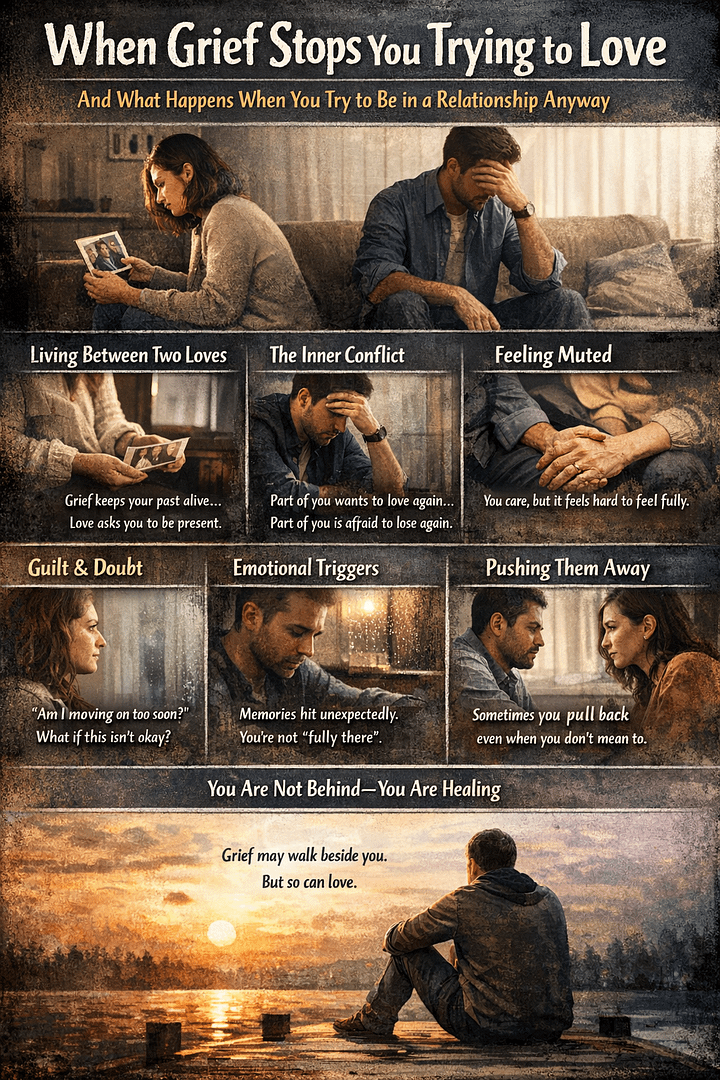
  • When Grief Stops You From Trying to Love

    When Grief Stops You From Trying to Love

    Grief has a way of rewriting who we are.

    It doesn’t just take away a person we love—it reshapes how we see connection, safety, and vulnerability. The world no longer feels predictable. Love no longer feels simple. And even when your heart begins to open again, there’s a quiet voice inside that asks, “What if I lose this too?”

    So you hesitate.

    But sometimes… you still try.

    You step into a relationship carrying both hope and fear, wanting to feel something again while still holding onto what you lost.

    And that’s where the real journey begins.

    Living Between Two Loves

    One of the hardest truths about loving after loss is that your heart doesn’t “move on”—it expands.

    You are not choosing between the person you lost and the person in front of you.

    You are carrying both.

    There will be moments when:

    A memory interrupts a happy moment
    You instinctively think of the person you lost first
    You wish, even briefly, that your new partner could understand them the way you did

    This doesn’t make you disloyal.

    It makes you human.

    Grief keeps your past alive, while love asks you to be present. Learning to live between those two spaces takes time—and grace.

    The Inner Conflict No One Sees

    From the outside, it may look like you’re “moving forward.”

    But internally, it can feel like a constant tug-of-war.

    Part of you wants to:

    Let your guard down
    Feel safe with someone again
    Build something new

    While another part of you is saying:

    Don’t get too attached
    You know how this can end
    Protect yourself this time

    This internal conflict can be exhausting.

    It can make you seem distant, inconsistent, or unsure in your relationship—even when you genuinely care.

    And sometimes, you may not even understand your own reactions.

    When You Want to Love… But Can’t Fully Feel It Yet

    There are moments in grief where your heart feels… muted.

    Not empty—but guarded. Slower to respond. Less expressive than it once was.

    You may:

    Care deeply about someone but struggle to show it
    Feel disconnected even during meaningful moments
    Wonder why the emotional intensity isn’t the same

    This can be one of the most frustrating parts of trying to be in a relationship while grieving.

    You want to give more.

    You just don’t always know how to access it yet.

    And that doesn’t mean the love isn’t real—it means your heart is still healing.

    The Pressure to Be “Okay”

    Sometimes the hardest part isn’t the grief itself—it’s the expectation to have it all figured out.

    You may feel pressure from:

    Your partner
    Friends or family
    Or even yourself

    To be “ready,” “healed,” or “fully present.”

    So you try to push your grief aside.

    You tell yourself to stop bringing it up. To stop feeling it so strongly. To just focus on the relationship in front of you.

    But grief doesn’t disappear when ignored.

    It waits.

    And often, it shows up stronger when it’s been pushed down too long.

    Loving Someone Who Is Learning You

    Your partner isn’t just getting to know you—they’re getting to know your grief too.

    They’re learning:

    What triggers you
    What silence means
    When you need space versus when you need comfort

    And that can be challenging.

    Because grief doesn’t come with a clear guidebook.

    There may be moments where they:

    Feel unsure of how to support you
    Take your distance personally
    Or feel like they’re competing with a memory

    That’s why patience—on both sides—is so important.

    A relationship in grief isn’t just about love.

    It’s about understanding, communication, and emotional flexibility.

    When You Push Them Away Without Meaning To

    Grief can create a reflex to retreat.

    Even in a healthy, caring relationship, you might:

    Shut down during emotional conversations
    Avoid deep vulnerability
    Create distance when things feel “too good”

    Not because you don’t care.

    But because part of you associates closeness with loss.

    This can lead to moments where your partner feels confused or hurt.

    And afterward, you may feel guilt—knowing you pushed them away, even though it wasn’t your intention.

    Recognizing this pattern is an important step.

    Not to judge yourself—but to gently start choosing differently when you can.

    The Courage It Takes to Stay

    Trying to love again after loss isn’t just about opening your heart once.

    It’s about choosing—over and over again—to stay open.

    Even when:

    Fear creeps in
    Memories hit unexpectedly
    Or vulnerability feels overwhelming

    Staying doesn’t mean ignoring your grief.

    It means allowing both to exist.

    It means saying:

    I am still healing… but I’m here
    I am still hurting… but I care
    I am still afraid… but I’m trying

    And that kind of honesty builds something real.

    Redefining What Love Looks Like

    Love after grief is not the same as love before loss.

    It is:

    More aware
    More intentional
    More fragile, but also more meaningful

    You may find yourself appreciating:

    Small moments of connection
    Honest conversations
    Simple presence

    More than you ever did before.

    Because now, you understand how quickly those things can be gone.

    You Are Not Behind—You Are Healing

    It’s easy to feel like you’re not doing it “right.”

    Like you should be further along.

    Like your heart should be more open, more ready, more certain.

    But healing is not linear.

    And love after loss is not something you rush—it’s something you grow into.

    At your pace.

    In your way.

    Love Doesn’t Ask You to Forget

    If you take anything from this, let it be this:

    You don’t have to leave your past behind to have a future.

    You don’t have to stop loving the person you lost to love someone new.

    And you don’t have to be fully healed to be worthy of connection.

    Grief may walk beside you.

    But so can love.

    And over time… they learn how to coexist.

    A Father’s Guide to Surviving the Loss of a Child