Author: Brett Murphy

  • When Your Heart Is Ready, Come Find Me – A Reflection on Patience, Timing, and the Kind of Love That Waits Without Losing Itself

    When Your Heart Is Ready, Come Find Me – A Reflection on Patience, Timing, and the Kind of Love That Waits Without Losing Itself

    There is a kind of love that speaks loudly through silence. It does not beg for attention, demand commitment, or force answers before someone is ready to give them. Instead, it stands gently at the edge of possibility and says, “When your heart is ready, come find me.”

    These words carry more depth than they first appear. They are not about waiting helplessly or putting life on hold. They are about understanding that love — real love — cannot grow under pressure. It must arrive freely, willingly, and fully awake.

    This is the story of patience, emotional maturity, and the rare courage it takes to love someone without trying to control the outcome.

    The Difference Between Wanting and Being Ready

    Many people confuse desire with readiness. Someone can deeply care for you, feel connected to you, even imagine a future with you — and still not be emotionally prepared to step into love completely.

    Readiness is not measured by feelings alone. It is shaped by healing, self-awareness, and timing.

    A heart becomes ready when:

    past wounds no longer dictate present choices,

    fear stops speaking louder than hope,

    and vulnerability feels safer than isolation.

    Until then, even the right person can feel overwhelming.

    “When your heart is ready” acknowledges that emotional timing matters just as much as emotional connection.

    It recognizes that love is not only about meeting the right person — it is also about becoming the right version of yourself.

    Loving Someone Enough to Let Them Grow

    One of the hardest truths about love is this: sometimes the most loving action is stepping back.

    Not disappearing.
    Not giving up.
    But allowing space.

    Space allows growth without expectation. It removes pressure and replaces it with freedom — freedom for someone to discover who they are without feeling responsible for someone else’s happiness.

    This kind of love says:

    I will not rush your healing.
    I will not compete with your fears.
    I will not ask you to choose me before you choose yourself.

    It is a love rooted in respect rather than urgency.

    And paradoxically, respect often strengthens connection more than closeness ever could.

    Waiting Without Losing Yourself

    Waiting has a bad reputation because it is often misunderstood. Healthy waiting does not mean emotional suspension or quiet suffering. It does not mean refusing new experiences or living in constant longing.

    Healthy waiting looks like growth.

    It means:

    continuing to pursue your goals,

    building your own happiness,

    discovering peace independent of another person’s decision.

    You are not standing still; you are walking your own path while leaving the door unlocked behind you.

    The statement “come find me” carries an important implication — you are not chasing. You trust that if the connection is genuine, effort will eventually meet effort halfway.

    Waiting becomes powerful when it transforms from attachment into acceptance.

    The Role of Timing in Love

    Timing is often the invisible force behind relationships. Two people may share undeniable chemistry, deep understanding, and emotional compatibility — yet still fail because their lives are moving in different emotional seasons.

    One may be rebuilding after heartbreak.
    Another may be discovering independence for the first time.
    One may crave stability while the other is learning self-trust.

    Love alone cannot erase unfinished personal journeys.

    Time, however, can align them.

    Life has a way of circling people back toward each other once lessons have been learned and emotional walls have softened. When reunion happens after growth, conversations feel easier, trust feels natural, and love feels less fragile.

    It is no longer potential — it becomes readiness.

    The Strength Behind an Open Door

    Leaving space for someone to return requires bravery. There is vulnerability in admitting that someone matters enough to be welcomed back into your life someday.

    But an open door is not the same as waiting in the doorway.

    You continue living fully. You laugh, heal, evolve, and become stronger. The invitation remains, but your life does not revolve around whether it is accepted.

    This balance is the essence of emotional maturity:
    loving deeply while remaining whole on your own.

    It transforms love from dependency into choice.

    And love chosen freely is always stronger than love chosen out of fear.

    When Hearts Finally Align

    If the day comes when two people meet again after growth, something subtle changes. There is less uncertainty and more calm recognition. Conversations carry honesty instead of hesitation. Presence replaces doubt.

    You no longer wonder if love will survive — you feel that it already has.

    Because distance did not destroy it.
    Time refined it.

    And when a heart finally becomes ready, it does not arrive halfway. It arrives with clarity.

    That reunion, if it happens, feels less like a beginning and more like a continuation that was always meant to unfold.

    The Meaning Behind the Words

    “When your heart is ready, come find me” is ultimately an expression of faith — not blind faith in another person, but faith in growth, timing, and authenticity.

    It says:

    I believe in what we felt.
    I respect where you are.
    I trust what is meant for us will not need to be forced.

    It is love without pressure.
    Hope without desperation.
    Connection without possession.

    And perhaps the most beautiful part is this:

    Whether they return or not, the person who speaks these words has already learned the greatest lesson love can teach — how to care deeply while still choosing peace.

    Because sometimes love’s greatest strength is not holding on tightly…

    but knowing exactly when to let time do its work.

    Read More Of Love & Relationships

  • Carpe Diem Day — Seize the Moment, Shape Your Life

    Carpe Diem Day — Seize the Moment, Shape Your Life

    A Day Dedicated to Living Fully

    Carpe Diem Day, observed annually on February 26, serves as a powerful reminder to embrace life as it unfolds — not tomorrow, not someday, but right now. The phrase carpe diem, meaning “seize the day,” is more than poetic inspiration; it is a philosophy that challenges us to live with awareness, courage, and purpose.

    In modern society, many people operate on autopilot. We rush through routines, chase future goals, and postpone happiness until circumstances feel perfect. Carpe Diem Day interrupts that cycle. It asks us to slow down long enough to recognize that life is not something waiting ahead — it is happening in every breath we take today.

    The Philosophy Behind Carpe Diem

    The concept originates from ancient Roman wisdom, yet its message feels uniquely suited for the modern world. At its core, carpe diem teaches three essential truths:

    Time is limited.

    The future is uncertain.

    The present is powerful.

    Rather than encouraging reckless decisions, the philosophy invites intentional living. It asks us to become active participants in our lives instead of passive observers.

    Seizing the day means recognizing opportunity in ordinary moments — choosing presence over distraction and purpose over hesitation.

    Why We Struggle to Seize the Day

    Despite understanding the idea intellectually, many people struggle to live it out. Several common barriers stand in the way:

    Fear of Failure

    People often delay action because they fear making mistakes. Yet growth rarely happens inside comfort zones.

    Waiting for Perfect Timing

    We convince ourselves we’ll begin when conditions improve — when we have more money, more confidence, or more certainty. The truth is that perfect timing rarely arrives.

    Overthinking the Future

    Constant worry about what might happen tomorrow steals energy from what can happen today.

    Digital Distraction

    Modern technology keeps us connected yet frequently pulls us away from real-life experiences happening around us.

    Carpe Diem Day reminds us that hesitation quietly consumes time. The cost of waiting is often greater than the risk of trying.

    The Psychology of Living in the Present

    Research in psychology consistently shows that mindfulness and present-focused living improve emotional well-being. When we focus on the current moment:

    Stress decreases

    Gratitude increases

    Relationships deepen

    Creativity expands

    Mental clarity improves

    Living in the present does not mean ignoring goals or responsibilities. Instead, it means fully engaging with each step of the journey rather than rushing toward outcomes.

    People who practice presence often report feeling that time slows down — not because life changes, but because awareness grows.

    Small Moments That Define a Life

    We often imagine life-changing moments as dramatic milestones: promotions, achievements, or major turning points. Yet most of life is built from small, quiet experiences:

    Morning sunlight through a window

    A meaningful conversation

    A shared laugh

    A personal breakthrough no one else sees

    Carpe Diem Day teaches us that fulfillment comes not from extraordinary events alone, but from learning to recognize the extraordinary within the ordinary.

    When we begin valuing small moments, life feels richer and more complete.

    Practical Ways to Celebrate Carpe Diem Day

    You don’t need travel plans or grand adventures to honor the spirit of the day. Meaningful change often begins with simple actions.

    🌞 Begin with Reflection

    Start your day by asking:

    What truly matters to me right now?

    What action would make today meaningful?

    Writing your thoughts in a journal helps clarify intention.

    📞 Reach Out to Someone

    Reconnect with a friend or family member. Many relationships fade not from conflict but from delay.

    🎯 Take One Brave Step

    Begin something you’ve postponed:

    Apply for an opportunity

    Share your creative work

    Start learning a skill

    Have an honest conversation

    Progress begins with a single action.

    🌿 Practice Presence

    Spend time outdoors, observe your surroundings, and notice details you normally overlook.

    💬 Speak Words You Mean

    Express appreciation, forgiveness, or love. Words left unsaid often become regrets.

    Carpe Diem and Personal Growth

    Seizing the day is deeply connected to personal transformation. Every meaningful life change begins with a decision made in the present moment.

    When you consistently act today instead of waiting for tomorrow, you build:

    Confidence through action

    Discipline through consistency

    Resilience through experience

    Self-trust through follow-through

    Over time, small daily choices reshape identity. You stop seeing yourself as someone who dreams and begin seeing yourself as someone who does.

    The Courage to Live Without Regret

    One of the greatest lessons behind Carpe Diem Day is learning to live in a way that minimizes regret. Studies on end-of-life reflections often reveal common themes:

    People regret chances not taken more than mistakes made.

    They wish they had expressed feelings more openly.

    They value relationships over achievements.

    They long for moments they rushed past.

    Seizing the day is ultimately about aligning daily actions with what matters most — so that looking back brings peace rather than “what if.”

    Turning a Day into a Lifestyle

    Carpe Diem Day is not meant to exist as a once-a-year motivation boost. Its real purpose is to inspire lasting change.

    You can carry its message forward by adopting simple habits:

    Start mornings with intention instead of urgency.

    Focus on progress rather than perfection.

    Celebrate small wins daily.

    Limit distractions that steal presence.

    Regularly ask: Am I living or merely existing?

    When practiced consistently, seizing the day becomes less of an effort and more of a natural way of living.

    A Modern Interpretation of Carpe Diem

    In today’s world, seizing the day may look different for everyone:

    For some, it means chasing dreams boldly.

    For others, it means slowing down and finding peace.

    For many, it means healing, growing, and starting again.

    Carpe Diem is not about constant productivity; it is about meaningful engagement with life — choosing experiences that align with your values rather than external expectations.

    Final Reflection: The Gift of Now

    Life does not unfold in the past or the future. It exists only in the present moment — the conversations we have, the risks we take, the gratitude we feel, and the love we share today.

    Carpe Diem Day reminds us that every sunrise carries possibility. Every ordinary day holds the potential for change, connection, and purpose.

    You don’t need a new year, a new week, or a new version of yourself to begin.

    All you need is today.

    So take the step. Say the words. Start the dream.

    Seize the day — because today is already here.

    Read More Holidays & National Days

  • Afraid to Say It

    Afraid to Say It

    I carry your name
    Like a fragile glass
    Careful not to drop it
    Careful not to ask
    If what I feel
    Lives inside you too.

    Because silence
    Is safer than goodbye.

    Every laugh we share
    Feels like standing on an edge —
    One word forward
    And everything changes,
    One truth spoken
    And I could lose
    The way you look at me now.

    So I hide my heart
    Behind jokes,
    Behind pauses,
    Behind messages rewritten
    A hundred times
    Before I send something smaller
    Than what I mean.

    You don’t know
    How loud my feelings are
    When the conversation ends.
    How the quiet
    Says your name
    Over and over again.

    I am not afraid of loving you —
    I already do.
    I am afraid
    That saying it aloud
    Might turn “us”
    Into a memory
    I have to pretend
    I’m strong enough to forget.

    So I stay here,
    Balanced between hope and fear,
    Holding emotions
    Like a secret flame,
    Warming my hands
    While praying
    It doesn’t burn everything down.

    Because losing you
    As something more
    Would hurt…

    But losing you entirely
    Would break me.

    Read More Poetry

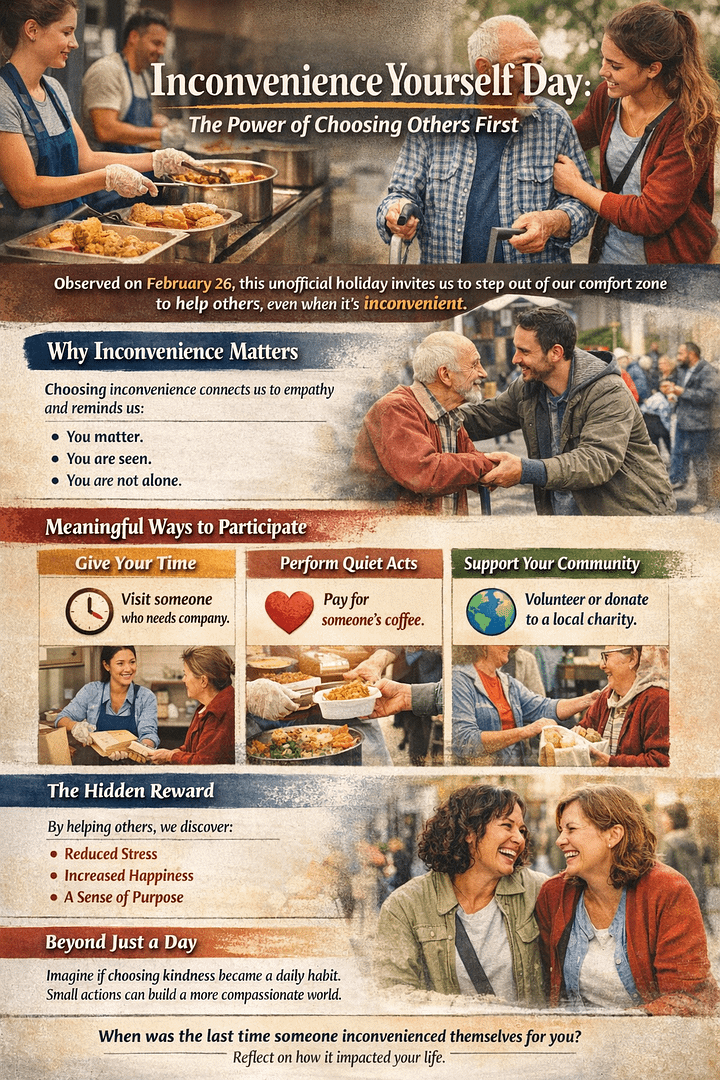
  • Inconvenience Yourself Day: The Power of Choosing Others First

    Inconvenience Yourself Day: The Power of Choosing Others First

    In a culture obsessed with convenience, efficiency, and instant gratification, Inconvenience Yourself Day stands as a quiet but powerful rebellion. Observed each year on fourth Wednesday of February, this unofficial holiday challenges us to do something many of us avoid: intentionally disrupt our comfort for the benefit of someone else.

    At first glance, the idea may sound counterintuitive. Why would anyone choose inconvenience in a world designed to eliminate it? Yet the deeper message behind this day reveals a truth often forgotten — meaningful human connection rarely happens when life is perfectly convenient.

    The Meaning Behind the Day

    Inconvenience Yourself Day encourages individuals to perform acts of kindness that require genuine effort. It’s not about random politeness or surface-level gestures; it’s about stepping beyond what is easy.

    Convenience prioritizes self.
    Inconvenience makes room for others.

    The holiday reminds us that compassion often requires:

    Extra time

    Emotional energy

    Patience

    Personal sacrifice

    These small costs transform ordinary kindness into something memorable and deeply human.

    How Modern Life Made Convenience King

    Technology has reshaped how we live:

    Groceries arrive with a click.

    Conversations happen through screens.

    Navigation apps eliminate getting lost.

    Entertainment streams instantly.

    While these innovations improve daily life, they also subtly reduce opportunities for spontaneous human interaction. We move faster but sometimes feel more disconnected.

    Convenience can unintentionally create emotional distance. We pass strangers without noticing them, rush through conversations, and treat interruptions as problems rather than opportunities.

    Inconvenience Yourself Day asks us to reverse that mindset — even if only briefly.

    The Psychology of Helping Others

    Research in psychology consistently shows that helping others benefits both the giver and the receiver. Acts of kindness activate reward centers in the brain, releasing chemicals associated with happiness and bonding.

    When we inconvenience ourselves for someone else, we experience:

    A stronger sense of purpose

    Increased empathy

    Reduced feelings of isolation

    Greater emotional resilience

    In other words, inconvenience becomes an investment in well-being.

    The paradox is simple: giving time away often makes life feel richer, not poorer.

    Everyday Opportunities We Often Miss

    Most chances to inconvenience ourselves don’t appear dramatic. They hide in ordinary moments we usually rush past.

    Consider how often we:

    Avoid eye contact because we’re busy.

    Ignore messages because responding takes effort.

    Choose speed over conversation.

    Walk past someone struggling because we assume someone else will help.

    Inconvenience Yourself Day encourages awareness. It teaches us to pause long enough to notice need — and then respond.

    Meaningful Ways to Participate

    You don’t need a grand plan. The spirit of the day lives in intentional choices.

    ⏰ Give Someone Your Time

    Time is one of the most valuable gifts we can offer.

    Visit a family member or friend you haven’t seen recently.

    Listen without checking your phone.

    Mentor or encourage someone who needs guidance.

    🧡 Perform Quiet Acts of Service

    Kindness doesn’t require an audience.

    Pay for someone’s coffee.

    Leave an encouraging note.

    Help a coworker finish a difficult task.

    🌎 Support Your Community

    Small contributions strengthen collective well-being.

    Volunteer locally.

    Donate items you no longer use.

    Offer skills or knowledge to someone learning something new.

    💬 Choose Patience Over Frustration

    Sometimes inconvenience is simply choosing grace.

    Let someone go ahead in line.

    Respond kindly instead of reacting emotionally.

    Slow down when others need extra understanding.

    The Courage to Be Interrupted

    One of the greatest barriers to kindness is the fear of interruption. We guard our schedules tightly, believing productivity defines success.

    But many of life’s most meaningful moments arrive unplanned:

    A conversation that changes perspective.

    A moment of comfort during someone’s hardship.

    A simple gesture remembered for years.

    Allowing ourselves to be interrupted is an act of humility — an acknowledgment that people matter more than perfect plans.

    Building a Habit, Not Just a Holiday

    While Inconvenience Yourself Day lasts only 24 hours, its lesson extends far beyond a single date.

    Imagine adopting one intentional inconvenience each day:

    Sending a thoughtful message.

    Offering help before being asked.

    Checking on someone who crosses your mind.

    Over time, these actions reshape character. Kindness becomes instinct rather than effort.

    And when enough individuals embrace that mindset, communities transform.

    Why This Message Matters Now

    In times marked by division, stress, and digital distance, choosing inconvenience may be one of the simplest ways to restore humanity.

    We don’t always need bigger platforms, louder voices, or grand solutions. Often, what people need most is presence — someone willing to slow down long enough to care.

    Inconvenience Yourself Day reminds us that compassion isn’t complicated. It simply requires intention.

    Final Reflection

    Convenience promises comfort.
    Inconvenience creates connection.

    When we willingly step outside our routines to serve others, we rediscover something essential about being human: we are meant to live not only for ourselves, but alongside one another.

    So take the extra step. Spend the extra minute. Offer the extra kindness.

    Because sometimes the smallest inconvenience becomes someone else’s greatest blessing — and your own deepest fulfillment.

    Read More Holidays & National Days

  • My Darling

    My Darling

    My darling,
    Loving you from a distance
    Feels heavier
    Than my heart was made to carry.

    What am I meant to do
    With a love
    That reaches for you
    Yet cannot hold you?

    My darling,
    I know you feel it too —
    The quiet truth
    Neither of us can deny.

    And still,
    Fear stands between us,
    As you hesitate
    At the edge of faith,
    Unsure if we should fall
    Into what waits for us.

    My darling, my darling,
    It breaks something inside me
    To watch our love
    Remain untouched,
    Left waiting
    Like a promise never claimed.

    Still, I stay.
    I am here for you,
    Even when loving you
    Comes with pain.

    My darling,
    I love you —
    A truth unchanged
    By distance, doubt, or time.

    And know this:
    My love for you
    Will always remain.

    Read More Poetry

  • Who to Follow on Pickax: Building a Feed That Helps You Grow

    Who to Follow on Pickax: Building a Feed That Helps You Grow

    Every new platform begins with curiosity — but success begins with who you choose to follow.

    On Pickax, your feed isn’t controlled by a heavy algorithm deciding what you should see. Instead, it grows from your own decisions, your interactions, and the communities you intentionally build. That makes following the right people one of the most powerful moves you can make early.

    This guide will help you understand not just who to follow, but why your following strategy shapes your growth, visibility, and experience on the platform.

    The Philosophy Behind Following on Pickax

    Traditional social networks train users to consume content passively. You scroll, react, and move on.

    Pickax works differently.

    Here, following someone is more like joining a conversation than subscribing to entertainment. Your feed becomes:

    A learning environment

    A networking space

    A creative collaboration hub

    A support system for growth

    The people you follow influence:

    What ideas you encounter daily

    Who discovers your content

    How quickly your account grows

    The tone of your online experience

    Think of your following list as building your digital neighborhood.

    1. Founding Voices & Early Adopters

    Early adopters are often the heartbeat of any emerging platform.

    These creators:

    Experiment with content styles

    Post consistently

    Engage deeply with new users

    Help define community culture

    Following early voices gives you an insider advantage because they are actively shaping how Pickax evolves.

    Why this matters

    Early engagement tends to be reciprocal. Conversations are easier to start, collaborations form naturally, and visibility grows faster when communities are still expanding.

    You’re not just watching growth — you’re participating in it.

    2. Writers, Thinkers, and Long-Form Creators

    One of Pickax’s strongest features is its support for meaningful written content.

    Unlike platforms built for short attention spans, Pickax encourages:

    Articles

    editorial writing

    storytelling

    personal reflections

    thought leadership

    Following writers transforms your feed into something valuable beyond entertainment — a place where ideas live longer than trends.

    What to look for

    Follow creators who:

    Share original perspectives

    Encourage discussion

    Ask thoughtful questions

    Publish consistently

    These accounts often become anchors in your daily feed.

    3. Community Builders (The Most Underrated Accounts)

    Not all influential users are creators with large audiences.

    Some people specialize in connection.

    Community builders:

    Comment thoughtfully

    Welcome newcomers

    Share others’ work

    Keep conversations alive

    These users create the social glue of Pickax.

    Following them increases your exposure because engagement spreads organically through interaction, not just posting.

    In many cases, these accounts become your strongest supporters.

    4. Niche Experts and Interest Hubs

    Pickax thrives on micro-communities.

    Instead of one massive crowd, you’ll find smaller ecosystems forming around shared interests:

    Personal development

    Gaming

    Lifestyle content

    Entrepreneurship

    Writing and poetry

    Motivation and self-growth

    Following niche hubs helps you quickly discover creators aligned with your interests.

    The benefit

    You skip random scrolling and enter conversations already meaningful to you.

    Your feed becomes intentional instead of chaotic.

    5. Creators Walking the Same Path as You

    One of the smartest strategies is to follow people who are at a similar stage of growth.

    Why?

    Because:

    They respond more often

    Collaboration feels natural

    Growth happens together

    Mutual support forms organically

    If you’re a writer, follow writers.
    If you’re building a brand, follow builders.
    If you’re exploring creativity, follow explorers.

    Growth accelerates when journeys align.

    6. Positive Energy Accounts

    Online environments affect mindset more than we realize.

    Follow accounts that:

    Inspire action

    Encourage resilience

    Share authentic experiences

    Promote growth instead of negativity

    Your daily feed becomes your mental environment. Curating positivity isn’t avoidance — it’s intentional focus.

    7. The Official Platform Updates

    Always follow official announcements and platform-related accounts.

    These profiles help you:

    Learn new features early

    Adapt content strategies

    Discover opportunities

    Stay ahead of platform changes

    Early awareness often equals early advantage.

    Building a Strategic Following System

    Instead of randomly following accounts, try this expanded framework:

    The Growth Feed Formula

    25% Inspiration
    Creators who motivate and energize you.

    25% Education
    Writers and thinkers who expand your perspective.

    25% Community
    Active engagers who interact regularly.

    15% Niche Interest
    Accounts aligned with your passions.

    10% Exploration
    New creators discovered weekly.

    This balance prevents burnout and keeps your experience evolving.

    Common Mistakes New Users Make

    Avoid these early pitfalls:

    ❌ Following hundreds of accounts instantly
    ❌ Chasing popularity instead of connection
    ❌ Ignoring smaller creators
    ❌ Treating Pickax like every other platform

    Instead:

    ✅ Engage before expecting engagement
    ✅ Comment meaningfully
    ✅ Build relationships slowly
    ✅ Focus on consistency over numbers

    The Early-Adopter Advantage

    Right now, Pickax offers something rare online: accessibility.

    You can still:

    Be noticed quickly

    Build genuine relationships

    Establish authority early

    Grow alongside the platform itself

    The people you follow today may become tomorrow’s leading voices — and early connections often last the longest.

    Final Thoughts: Your Feed Is Your Future

    Who you follow on Pickax determines more than what appears on your screen.

    It determines:

    Your opportunities

    Your network

    Your inspiration

    Your growth trajectory

    Choose connection over popularity.
    Choose conversation over consumption.
    Choose people who help you become better — not just busier online.

    Because on Pickax, your community becomes your algorithm.

    Start building your network early:
    👉 https://pickax.com/?referralCode=0mvx4ds&refSource=copy

    Read More Opportunities & Growth

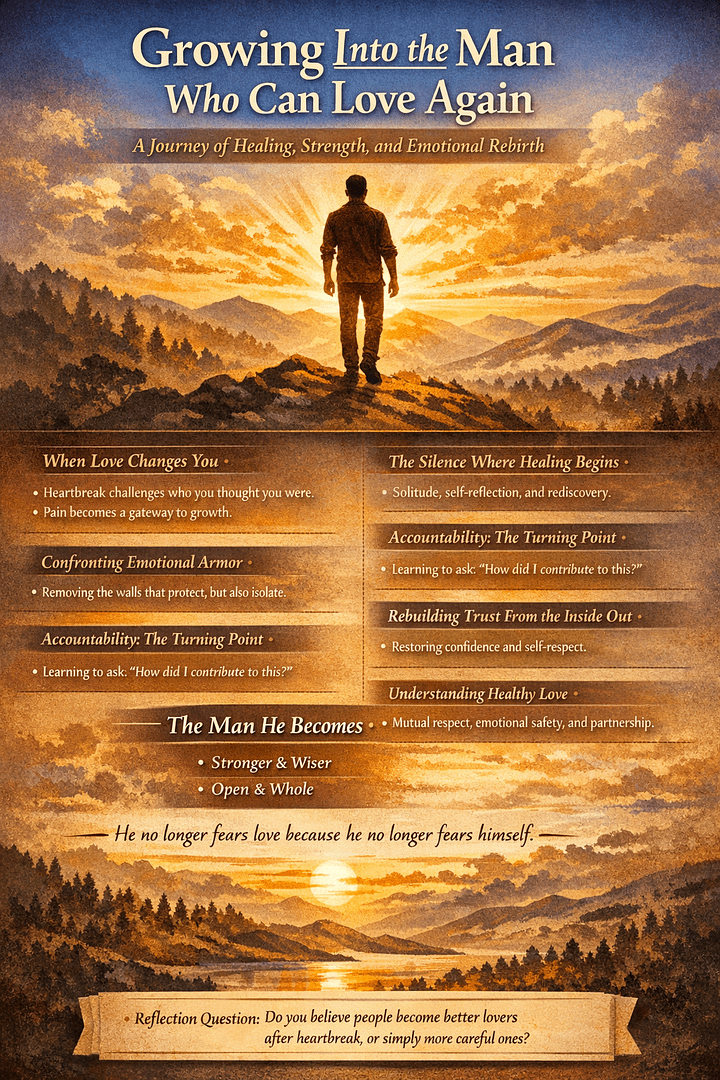
  • Growing Into the Man Who Can Love Again – A Journey of Healing, Strength, and Emotional Rebirth

    Growing Into the Man Who Can Love Again – A Journey of Healing, Strength, and Emotional Rebirth

    There is a version of a man that exists before heartbreak — hopeful, open, and often unaware of how deeply love can shape him. Then there is the version forged afterward: quieter, more guarded, carrying lessons written not in words but in experience.

    Growing into the man who can love again is not about returning to who he once was. It is about evolving into someone wiser — someone who understands that love is not just emotion, but responsibility, presence, and courage.

    This transformation does not happen overnight. It unfolds through reflection, discomfort, healing, and intentional growth.

    When Love Changes You

    Heartbreak does more than end relationships; it challenges identity. A man begins questioning his choices, his worth, and sometimes even his ability to trust his own judgment.

    Memories replay.
    Conversations echo.
    Regrets surface.

    He may wonder:

    Was I not enough?

    Did I love too much — or not enough?

    Can I risk feeling this again?

    These questions are not signs of weakness. They are signs of awakening. Pain forces introspection, and introspection becomes the doorway to growth.

    The man who learns from heartbreak gains emotional depth that comfort could never teach.

    The Silence Where Healing Begins

    Healing often happens in solitude. Not isolation born from bitterness, but intentional distance meant for rediscovery.

    In quiet moments, a man begins to reconnect with himself:

    rediscovering hobbies he abandoned,

    rebuilding friendships,

    strengthening his physical and mental health,

    learning to sit with his emotions instead of running from them.

    He realizes that distractions delay healing, but reflection accelerates it.

    This stage can feel lonely, yet it is essential. Because before he can offer love again, he must understand who he is without attachment.

    Solitude becomes training ground, not punishment.

    Confronting Emotional Armor

    Many men respond to emotional pain by building armor — emotional distance, sarcasm, detachment, or hyper-independence. These defenses feel protective, but they quietly prevent connection.

    Growth requires recognizing that armor designed to block pain also blocks love.

    The man who is becoming ready again learns to:

    express emotions without shame,

    admit fears without feeling diminished,

    apologize without ego,

    and forgive without forgetting lessons.

    He discovers that vulnerability is not exposure; it is authenticity.

    And authenticity is where real connection lives.

    Accountability: The Turning Point

    True growth happens when blame fades and accountability begins.

    Instead of focusing only on how he was hurt, a man begins asking deeper questions:

    What patterns did I repeat?

    Where did I fail to communicate?

    What boundaries did I ignore?

    What fears influenced my behavior?

    Accountability is not self-condemnation. It is self-respect.

    It transforms past mistakes into future wisdom.

    The man who takes ownership of his growth becomes emotionally safer — not only for others, but for himself.

    Rebuilding Trust From the Inside Out

    Trusting someone new is impossible without first rebuilding trust in oneself.

    After heartbreak, many men doubt their instincts. They fear misjudging character or repeating old cycles. Healing restores internal trust through consistency:

    keeping promises to himself,

    maintaining discipline,

    honoring personal boundaries,

    choosing peace over chaos.

    Confidence slowly returns, not as loud bravado but as calm certainty.

    He learns that love should add to his life, not rescue it.

    Understanding Healthy Love

    With maturity comes a new definition of love.

    Love is no longer:

    constant reassurance,

    emotional dependency,

    or sacrificing identity for connection.

    Instead, love becomes:

    mutual respect,

    emotional safety,

    shared growth,

    honest communication,

    and freedom to remain individuals while building together.

    A grown man recognizes red flags without ignoring them and appreciates green flags he once overlooked — consistency, kindness, patience, and emotional maturity.

    He stops chasing intensity and starts valuing stability.

    Letting Go of Fear

    Perhaps the greatest challenge in loving again is accepting uncertainty. No amount of growth guarantees a pain-free future.

    But maturity teaches that avoiding risk also avoids joy.

    The man who can love again understands:

    heartbreak did not destroy him,

    vulnerability did not weaken him,

    and love itself was never the enemy.

    Fear loses power when he realizes he survived his hardest emotional seasons.

    Hope quietly replaces hesitation.

    Loving With Wisdom Instead of Wounds

    When he finally opens his heart again, something feels different.

    He listens more carefully.
    He communicates more clearly.
    He sets boundaries calmly.
    He chooses patience over reaction.

    He no longer tries to prove his worth through love; he shares love from a place of wholeness.

    His past becomes guidance, not baggage.

    And for the first time, love feels peaceful rather than overwhelming.

    The Man He Becomes

    Growing into the man who can love again means becoming someone balanced between strength and softness.

    He is:

    strong enough to stand alone,

    wise enough to grow continuously,

    and open enough to welcome connection without losing himself.

    He understands that love is not about perfection — it is about presence.

    Not about possession — but partnership.

    Not about avoiding pain — but embracing life fully despite it.

    And one day, he realizes something profound:

    He no longer fears love because he no longer fears himself.

    He has grown into a man capable of loving deeply, honestly, and freely — not because he was never broken, but because he chose to heal.

    Read More Of Inspiration & Motivation

  • Keeping Your Word as a Man: The Foundation of Character

    Keeping Your Word as a Man: The Foundation of Character

    In a world where words are often spoken quickly and forgotten just as easily, keeping your word remains one of the clearest measures of a man’s character. Long before contracts were written or reputations lived online, a man’s honor was defined by something simple yet powerful: his word was enough.

    Today, that principle still carries weight. A man who keeps his word creates stability in uncertain spaces, trust in fragile relationships, and strength within himself. Integrity is not loud or flashy — it is steady, consistent, and proven through action.

    The True Meaning of a Man’s Word

    Your word is more than language. It is a reflection of identity.

    When you make a promise, you are not only committing to an action — you are declaring who you are. Every kept promise reinforces reliability. Every broken promise sends a message that your words cannot be trusted.

    Keeping your word means aligning three things:

    Intent — what you believe

    Speech — what you say

    Action — what you do

    When those three are in harmony, integrity is born.

    A man who lives this way does not need to convince people of his character. His consistency speaks for him.

    The Psychological Power of Follow-Through

    Keeping your word affects more than relationships — it shapes your inner world.

    Every time you follow through on a commitment, your brain registers proof that you are dependable. Confidence grows not from motivation but from evidence. You begin to trust yourself.

    On the other hand, repeated broken promises create internal doubt:

    “I’ll start tomorrow.”

    “I’ll handle it later.”

    “I didn’t really mean it.”

    Over time, these small betrayals weaken self-respect. The man who cannot rely on himself struggles to lead, love, or grow with certainty.

    Discipline, therefore, is not punishment — it is self-trust in action.

    Keeping Your Word in Relationships

    A man’s promises shape the emotional safety of those around him.

    In Family

    Children learn reliability by watching consistency. When a father or partner follows through, it teaches security without needing explanation.

    In Friendship

    Loyalty is proven through presence. Showing up during difficult times often matters more than grand gestures during easy ones.

    In Romantic Relationships

    Trust is built through repeated reliability — keeping small promises daily rather than making dramatic declarations occasionally.

    Love deepens when words match behavior.

    The Cost of Broken Promises

    Broken promises rarely fail loudly. Instead, they erode trust slowly.

    People may forgive once or twice, but inconsistency creates uncertainty. Eventually, others stop relying on what you say — not out of anger, but self-protection.

    The consequences include:

    Lost opportunities

    Strained relationships

    Damaged credibility

    Internal guilt and self-doubt

    The hardest part is that rebuilding trust takes far longer than breaking it.

    Strength Is Doing What You Said — Especially When It’s Hard

    Anyone can keep commitments when circumstances are convenient. True character reveals itself when keeping your word requires sacrifice.

    It may mean:

    Finishing work when exhaustion sets in

    Admitting mistakes instead of hiding them

    Standing by someone when it’s unpopular

    Honoring commitments even when no reward follows

    These moments define maturity. They transform boys seeking approval into men guided by principle.

    Speaking Less, Meaning More

    One of the strongest habits a man can develop is measured speech.

    Men of integrity do not promise lightly. They understand that every “yes” carries responsibility. Learning to pause before committing shows wisdom, not weakness.

    Consider adopting three rules:

    Think before promising.

    Underpromise and overdeliver.

    If circumstances change, communicate honestly.

    Keeping your word includes transparency. Sometimes integrity means admitting you cannot fulfill a promise and addressing it directly rather than disappearing or making excuses.

    Keeping Your Word to Yourself

    The most overlooked promises are the ones made privately.

    You promise yourself you will improve your health, pursue goals, forgive the past, or grow beyond old habits. These commitments shape your future more than any external obligation.

    When you keep promises to yourself:

    Confidence becomes natural

    Discipline becomes identity

    Progress becomes inevitable

    Self-respect grows quietly but powerfully.

    Teaching the Next Generation

    A man’s example teaches more than his advice ever could.

    Young people learn integrity not from lectures but from observation — watching how a man handles responsibility, failure, and commitment. When they see consistency, they learn accountability. When they see honesty, they learn courage.

    Legacy is not what you tell others to become; it is what your actions demonstrate daily.

    The Modern Challenge of Integrity

    Today’s world encourages instant gratification and easy exits. Messages can be ignored, commitments postponed, and responsibilities avoided with little immediate consequence.

    But character has always required resistance against convenience.

    Keeping your word in a culture of shortcuts makes integrity stand out even more. Reliability becomes rare — and therefore deeply valuable.

    The Quiet Confidence of an Honorable Man

    A man who keeps his word does not need constant validation. His confidence comes from alignment between belief and behavior.

    He walks differently because he knows:

    He does what he says.

    He shows up when needed.

    He can face himself honestly.

    This quiet confidence cannot be purchased or imitated. It is earned one fulfilled promise at a time.

    Final Reflection

    At the end of the day, titles fade, achievements change, and circumstances evolve. What remains is reputation — the memory people carry of how dependable you were when it mattered most.

    A man’s strength is not measured by how loudly he speaks, but by how faithfully he follows through.

    Your word becomes trust.
    Trust becomes character.
    Character becomes legacy.

    Read More Of Inspiration & Motivation

  • 🍌 National Banana Bread Day: A Celebration of Comfort, Creativity, and Homemade Joy

    🍌 National Banana Bread Day: A Celebration of Comfort, Creativity, and Homemade Joy

    Every year on February 23, the comforting scent of warm spices and sweet bananas fills kitchens across the country as people celebrate National Banana Bread Day. More than just a food holiday, this day honors tradition, resourcefulness, and the timeless joy of homemade baking — a reminder that some of life’s greatest pleasures come from the simplest ingredients.

    Banana bread is not merely a recipe; it’s a shared cultural experience passed down through generations, evolving with every family kitchen and personal touch.

    The Sweet History Behind Banana Bread

    Banana bread rose to popularity in the United States during the Great Depression of the 1930s, a time when families learned to stretch resources and minimize waste. Overripe bananas, once considered unusable, became the star ingredient in a new kind of baking innovation.

    At the same time, baking powder and baking soda became widely available, revolutionizing home baking. These ingredients allowed people to make “quick breads,” eliminating the need for yeast and long rising times. Banana bread quickly became a staple because it was:

    Affordable

    Easy to prepare

    Filling and satisfying

    Adaptable to available ingredients

    Cookbooks of the era began featuring banana bread recipes, and soon the humble loaf became a permanent fixture in American homes.

    Why Banana Bread Continues to Endure

    Few foods carry the emotional warmth that banana bread does. It bridges generations — grandparents, parents, and children often sharing the same recipe with small personal changes along the way.

    Its enduring popularity comes from several qualities:

    1. Accessibility

    Anyone can make banana bread. No advanced skills are required, making it one of the most beginner-friendly baked goods.

    2. Forgiveness

    Unlike delicate pastries, banana bread is flexible. Slight measurement changes or ingredient swaps rarely ruin the final product.

    3. Nostalgia

    For many people, banana bread recalls childhood kitchens, family gatherings, or quiet mornings at home.

    4. Versatility

    It works as breakfast, snack, dessert, or even a thoughtful homemade gift.

    The Science Behind Perfect Banana Bread

    Part of banana bread’s magic lies in food science.

    Overripe bananas contain more natural sugars, which enhance sweetness and moisture.

    Banana starches break down as the fruit ripens, creating a softer texture.

    Baking soda reacts with acidic ingredients like bananas or yogurt, helping the loaf rise.

    Fat and sugar lock in moisture, giving banana bread its signature tender crumb.

    The darker the banana peel, the better the flavor — a rare case where “too ripe” is actually perfect.

    Endless Variations: Creativity in Every Slice

    Banana bread thrives because it invites experimentation. Every baker adds a personal twist, transforming a classic recipe into something uniquely theirs.

    Popular variations include:

    Chocolate Chip Banana Bread – Rich and dessert-like

    Nutty Banana Bread – Walnuts or pecans for crunch

    Cinnamon Swirl – Warm spice layers throughout

    Peanut Butter Banana Bread – A protein-packed favorite

    Vegan Banana Bread – Using plant-based substitutes

    Gluten-Free Versions – Made with almond or oat flour

    Some bakers even turn banana bread into muffins, mini loaves, or layered cakes.

    Banana Bread and Modern Culture

    In recent years, banana bread experienced a global resurgence as people rediscovered home baking. During periods when daily life slowed down, baking became both therapy and creative expression.

    Social media played a major role, with home bakers sharing:

    Family recipes

    Baking tips

    Artistic presentations

    Flavor experiments

    Banana bread became symbolic of comfort, resilience, and connection — proof that simple rituals can bring stability during uncertain times.

    Health Benefits (Yes, Really!)

    While still a treat, banana bread offers surprising nutritional perks when made thoughtfully:

    Bananas provide potassium, vitamin B_toggle, and fiber

    Whole-grain flours add nutrients and satiety

    Reduced sugar versions support balanced eating

    Nuts contribute healthy fats and protein

    Many modern recipes aim to balance indulgence with nourishment, making banana bread both comforting and wholesome.

    How to Celebrate National Banana Bread Day

    Celebrating doesn’t require professional baking skills — just enthusiasm and maybe a few ripe bananas.

    Here are meaningful ways to join the celebration:

    🍌 Bake a traditional loaf using a family recipe

    🍌 Try a new flavor combination

    🍌 Teach someone how to bake banana bread

    🍌 Share slices with neighbors or coworkers

    🍌 Support a local bakery and try their version

    🍌 Freeze extra loaves for future comfort food moments

    The spirit of the day is sharing — both food and connection.

    Tips for the Perfect Loaf

    Want bakery-quality banana bread at home? Keep these tips in mind:

    Use very ripe bananas (brown spots are ideal)

    Avoid overmixing the batter to keep it tender

    Let the bread cool before slicing to maintain structure

    Add toppings like oats or nuts for texture

    Store wrapped tightly to preserve moisture

    A little patience often makes the difference between good and unforgettable banana bread.

    More Than a Recipe — A Tradition

    National Banana Bread Day celebrates more than a baked good; it celebrates creativity, resilience, and the warmth of home. From Depression-era kitchens to modern social media feeds, banana bread has remained a symbol of making something beautiful from what might otherwise be overlooked.

    In a world that often moves too fast, baking banana bread encourages us to slow down — to measure carefully, wait patiently, and enjoy something made with care.

    Because sometimes happiness is simple: a warm slice, a cup of coffee, and the feeling of home in every bite.

    Read More Holidays & National Days

  • National Margarita Day: A Celebration of Flavor, Culture, and Connection

    National Margarita Day: A Celebration of Flavor, Culture, and Connection

    Every year on February 22, people across the United States and beyond celebrate National Margarita Day, a holiday devoted to one of the most beloved cocktails ever created. Bright, citrusy, and endlessly customizable, the margarita has transcended its role as a simple drink to become a symbol of relaxation, celebration, and shared experiences.

    From beachside cantinas to backyard gatherings, the margarita represents a universal invitation: slow down, connect, and enjoy the moment.

    The Story Behind the Margarita

    The true origin of the margarita remains one of the cocktail world’s most charming mysteries. Multiple stories claim its creation, each adding to the drink’s legendary status.

    Some historians believe the margarita evolved from a classic “daisy” cocktail — a popular category of drinks combining spirits, citrus juice, and sweeteners. Others credit bartenders in Mexico during the 1930s and 1940s who experimented with tequila as tourism increased along coastal resorts and border towns.

    One tale suggests the drink was invented for a dancer who could only drink tequila due to allergies, while another credits a bartender crafting a special cocktail for a glamorous guest named Margarita. Regardless of which version is true, the drink’s popularity spread rapidly, especially in the United States during the mid-20th century as tequila gained mainstream appeal.

    What began as a regional specialty soon became a global icon.

    The Art of the Perfect Margarita

    The brilliance of the margarita lies in its simplicity. A traditional recipe balances just a few ingredients:

    Tequila – preferably made from 100% blue agave

    Fresh lime juice – providing crisp acidity

    Orange liqueur – adding sweetness and depth

    Salt rim – enhancing flavor contrast

    Ice – shaken or blended for texture

    The key is harmony. Too sweet, and it loses freshness. Too sour, and it becomes sharp. When perfectly balanced, the margarita delivers a smooth, refreshing experience that awakens the palate.

    Professional bartenders often emphasize fresh ingredients over pre-made mixes, proving that quality and simplicity make all the difference.

    Endless Variations: Creativity in a Glass

    Part of the margarita’s enduring popularity comes from its adaptability. The classic lime version remains timeless, but modern variations continue to expand the drink’s identity.

    Popular styles include:

    Frozen Margaritas – blended ice creates a slushy, dessert-like texture.

    Fruit Margaritas – strawberry, mango, pineapple, peach, and watermelon add vibrant sweetness.

    Spicy Margaritas – jalapeño or chili infusions introduce heat that complements citrus.

    Skinny Margaritas – lighter versions using fresh juice and reduced sugar.

    Mezcal Margaritas – smoky flavor profiles for adventurous drinkers.

    Mocktail Margaritas – alcohol-free options maintaining the same refreshing taste.

    This flexibility allows the margarita to evolve with changing tastes while staying rooted in tradition.

    Cultural Influence and Global Popularity

    The margarita’s rise mirrors the growing appreciation of Mexican cuisine and culture worldwide. Tequila itself carries deep heritage, crafted from agave plants cultivated for generations in Mexico.

    Restaurants and bars embraced the margarita as Mexican food gained popularity internationally, pairing perfectly with tacos, enchiladas, grilled seafood, and spicy dishes. Its refreshing acidity balances rich flavors, making it an ideal companion at the table.

    Over time, the drink moved beyond restaurants into pop culture — featured in movies, vacations, celebrations, and social traditions. Today, ordering a margarita feels instantly familiar almost anywhere in the world.

    National Margarita Day in Modern Times

    National Margarita Day has grown into a widely celebrated food-and-beverage holiday. Restaurants often offer special menus, discounted drinks, or creative limited-time flavors. Social media fills with colorful glasses, recipe videos, and friends toasting together.

    But the celebration isn’t limited to nightlife. Many people now mark the day at home by:

    Hosting taco nights with friends or family

    Learning cocktail-making skills

    Experimenting with homemade syrups or garnishes

    Trying premium tequilas or artisanal ingredients

    Creating alcohol-free versions for inclusive gatherings

    The holiday has evolved into a lifestyle celebration — one centered on enjoyment rather than excess.

    The Science Behind Why Margaritas Taste So Good

    There’s actually a reason margaritas feel so satisfying. The drink activates multiple taste sensations at once:

    Sour from lime juice stimulates freshness.

    Sweet from orange liqueur softens acidity.

    Salt enhances flavor perception and reduces bitterness.

    Alcohol warmth adds depth and complexity.

    This balance creates what chefs call a complete flavor experience, explaining why margaritas remain appealing even after decades of changing drink trends.

    Responsible Celebration

    While National Margarita Day is festive, it also encourages mindful enjoyment. Many establishments now promote responsible drinking and offer low-alcohol or non-alcoholic options so everyone can participate safely.

    Hydration, moderation, and sharing food alongside drinks help keep the celebration enjoyable for everyone.

    More Than a Cocktail — A Shared Experience

    Ultimately, National Margarita Day celebrates something bigger than a recipe. It honors moments of laughter, conversation, and connection. A margarita often marks beginnings — vacations, reunions, celebrations, or simply the end of a long week.

    Its enduring popularity reminds us that traditions don’t always come from grand events. Sometimes they grow from simple pleasures repeated over time.

    A chilled glass, a squeeze of lime, and people gathered together — that’s the true spirit of the margarita.

    Raising a Glass to the Moment

    In a fast-moving world, National Margarita Day offers permission to pause. It encourages us to savor flavor, appreciate culture, and celebrate the joy found in everyday experiences.

    Whether enjoyed at a lively restaurant, a quiet home gathering, or under the open sky, the margarita continues to bring people together — one refreshing sip at a time.

    Cheers to tradition, creativity, and the timeless taste of celebration.

    Read More Holidays & National Days