Author: Brett Murphy

  • National Pecan Cookie Day: Celebrate a Sweet, Nutty Classic

    National Pecan Cookie Day: Celebrate a Sweet, Nutty Classic

    Advertisements

    There is something special about biting into a freshly baked cookie and discovering the buttery crunch of pecans inside. The combination of a soft or crispy cookie with rich, toasted pecans creates a simple treat that feels comforting, homemade, and a little indulgent.

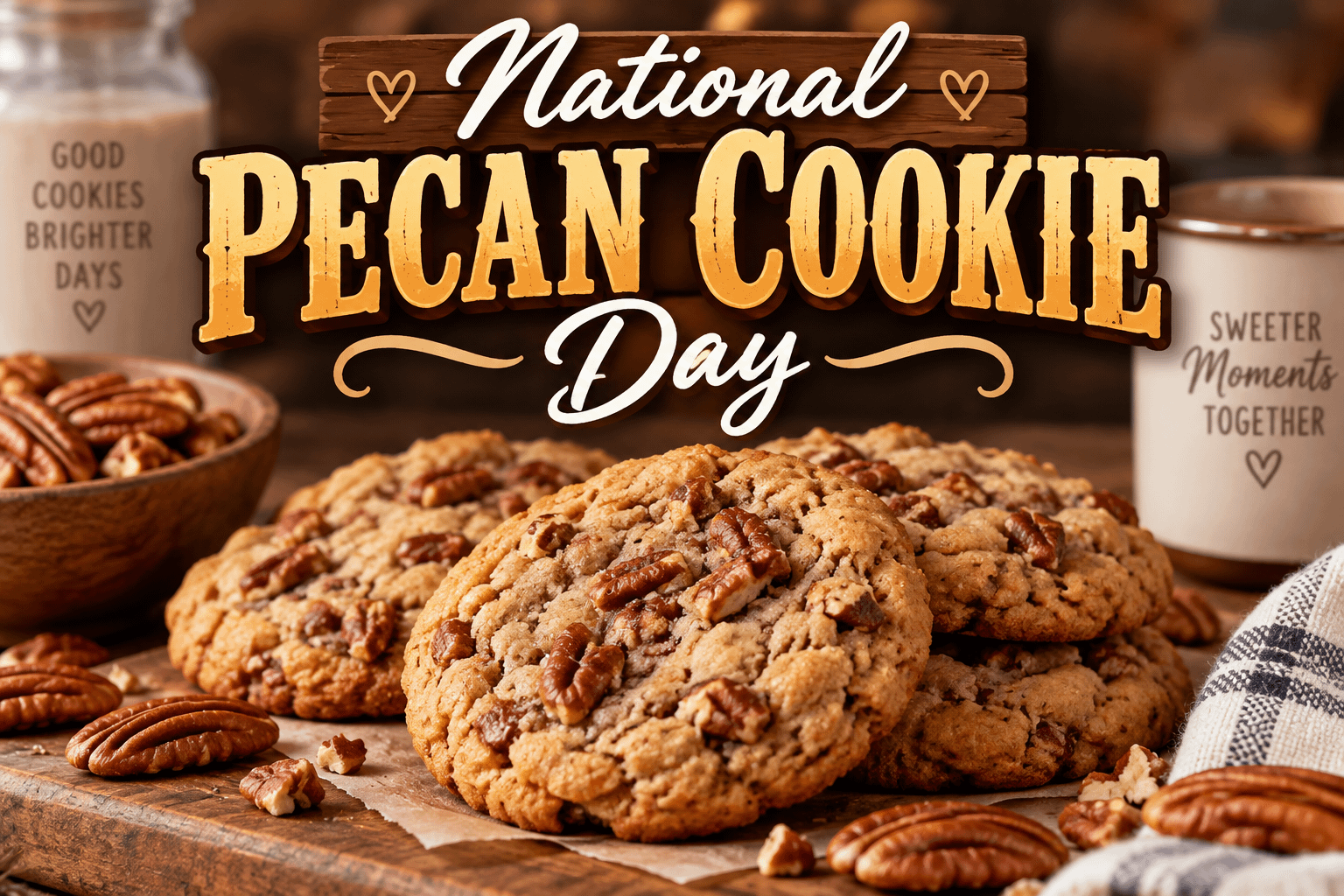
    That delicious combination gets its own celebration on National Pecan Cookie Day, observed every year on September 21.

    Whether you prefer classic pecan cookies, chocolate chip pecan cookies, maple pecan cookies, butter pecan cookies, or something completely different, today is a great excuse to turn on the oven and bake a batch.

    Pecans have been part of American cooking for generations, and cookies are one of the easiest ways to showcase their distinctive flavor. You don’t need an elaborate dessert or complicated baking techniques. Sometimes flour, butter, sugar, eggs, vanilla, and a generous handful of pecans are all you need.

    What Is National Pecan Cookie Day?

    National Pecan Cookie Day is a food celebration dedicated to cookies made with pecans.

    Pecans can completely change an ordinary cookie. They add crunch, texture, richness, and a naturally buttery flavor that works especially well with brown sugar, vanilla, maple, caramel, cinnamon, and chocolate.

    While September 21 gives pecan cookies their moment in the spotlight, you certainly don’t need to wait for the holiday to make them.

    Still, food holidays are fun because they give us an excuse to appreciate foods we may normally take for granted.

    And pecan cookies deserve some appreciation.

    The Pecan Is an American Original

    One of the most interesting things about pecans is their connection to North America.

    Pecan trees are native to North America, and pecans have been eaten on the continent for centuries. Indigenous peoples gathered and consumed the nuts long before modern commercial pecan production developed.

    Over time, pecans became increasingly important in American cooking.

    Today, they are closely associated with many traditional desserts and dishes, especially throughout the southern United States.

    Think about some of the foods that immediately come to mind when someone mentions pecans:

    Pecan pie.

    Pralines.

    Butter pecan ice cream.

    Candied pecans.

    Pecan bread.

    Pecan muffins.

    Pecan pancakes.

    And, of course, pecan cookies.

    Their naturally rich flavor makes pecans especially well suited for desserts.

    Why Pecans Work So Well in Cookies

    Cookies are often built around contrasting textures.

    You might have a crispy outside with a soft center. Chocolate chips melt while the cookie itself stays chewy. A sprinkle of salt can contrast with the sweetness of brown sugar.

    Pecans add another layer.

    Their crunch provides texture while their slightly sweet, buttery flavor complements the cookie dough.

    Toasting pecans before adding them to cookie dough can make that flavor even stronger.

    A few minutes of gentle toasting helps bring out their aroma and nuttiness. Once chopped and mixed into cookie dough, those toasted pecans can transform an otherwise simple cookie.

    Classic Pecan Cookies

    There are countless ways to make pecan cookies, but sometimes the simplest recipe is the best place to start.

    Ingredients

    • 1 cup unsalted butter, softened
    • 3/4 cup granulated sugar
    • 3/4 cup packed brown sugar
    • 2 large eggs
    • 2 teaspoons vanilla extract
    • 2 1/4 cups all-purpose flour
    • 1 teaspoon baking soda
    • 1/2 teaspoon salt
    • 1 1/2 cups chopped pecans
    • Optional whole pecans for topping

    Directions

    Preheat your oven to 350°F and line baking sheets with parchment paper.

    In a large mixing bowl, cream together the softened butter, granulated sugar, and brown sugar until the mixture becomes light and fluffy.

    Add the eggs one at a time, mixing after each addition. Stir in the vanilla extract.

    In another bowl, combine the flour, baking soda, and salt.

    Gradually add the dry ingredients to the butter mixture and mix until a cookie dough forms.

    Fold in the chopped pecans.

    Scoop rounded tablespoons of dough onto the prepared baking sheets, leaving enough space between each cookie for spreading.

    For an extra pecan touch, gently press a pecan half into the top of each cookie.

    Bake for approximately 9–12 minutes, or until the edges become lightly golden.

    Allow the cookies to cool on the baking sheet for several minutes before transferring them to a wire rack.

    Then comes the best part.

    Eat one while it is still slightly warm.

    Toast Your Pecans for Extra Flavor

    If you have a few extra minutes, toast your pecans before adding them to the dough.

    Spread the pecans in a single layer on a baking sheet and toast them briefly in the oven, watching them carefully so they don’t burn.

    You’ll know they’re ready when they become fragrant.

    Let them cool before chopping and adding them to your cookie dough.

    It is a small extra step, but it can make a noticeable difference in the final cookie.

    Chocolate Chip Pecan Cookies

    Chocolate and pecans are a combination that is difficult to beat.

    Take your favorite chocolate chip cookie recipe and add approximately a cup of chopped pecans.

    Dark chocolate works especially well because its slightly bitter flavor balances the sweetness of the cookie while complementing the richness of the pecans.

    Milk chocolate creates a sweeter cookie, while semi-sweet chocolate gives you something in between.

    You could even combine different varieties of chocolate.

    Try semi-sweet chocolate chips, dark chocolate chunks, and toasted pecans together for a cookie loaded with texture and flavor.

    Maple Pecan Cookies

    Maple and pecans seem made for each other.

    The deep sweetness of maple pairs beautifully with the buttery flavor of pecans.

    Maple pecan cookies can be made by adding maple flavor to a traditional cookie dough and folding in toasted pecans.

    For even more maple flavor, finish the cookies with a light maple glaze.

    These are particularly good during fall when maple, cinnamon, pecans, apples, pumpkin, and other warm flavors begin appearing everywhere.

    Serve them with hot coffee on a cool September morning and you have a pretty good way to celebrate National Pecan Cookie Day.

    Butter Pecan Cookies

    Butter pecan is already a beloved dessert flavor, particularly in ice cream.

    So why not turn it into a cookie?

    Butter pecan cookies emphasize the two ingredients that make the combination special: butter and pecans.

    Browned butter can make them even better.

    When butter is gently heated until the milk solids begin browning, it develops a deeper, almost nutty flavor. Pair browned butter with toasted pecans and brown sugar and you get a cookie with incredible richness.

    A small sprinkle of flaky salt on top can provide the finishing touch.

    Pecan Shortbread Cookies

    If you prefer cookies that are less sweet, pecan shortbread is another excellent option.

    Traditional shortbread relies heavily on butter, flour, and sugar.

    Adding finely chopped pecans gives the cookie additional flavor and crunch without overwhelming its simplicity.

    Pecan shortbread is especially good alongside coffee or tea.

    You can make traditional round cookies, cut the dough into rectangles, or create small bite-sized shortbread cookies.

    Dip one side in melted chocolate if you want something more decadent.

    Oatmeal Pecan Cookies

    Pecans can also give classic oatmeal cookies an upgrade.

    Oats already provide plenty of texture, so adding chopped pecans creates an especially hearty cookie.

    You can stop there or continue experimenting.

    Add raisins for oatmeal raisin pecan cookies.

    Add dried cranberries for something slightly tart.

    Add chocolate chips for something sweeter.

    Add cinnamon for warmth.

    Or combine several ingredients and create your own signature oatmeal pecan cookie.

    White Chocolate Cranberry Pecan Cookies

    For a colorful variation, combine white chocolate, dried cranberries, and pecans.

    Each ingredient contributes something different.

    White chocolate brings sweetness.

    Cranberries bring tartness and chewiness.

    Pecans bring richness and crunch.

    Together, they create a cookie with plenty happening in every bite.

    They are especially popular around the holidays, but National Pecan Cookie Day is a perfectly good reason to make them early.

    Salted Caramel Pecan Cookies

    If you want something truly indulgent, caramel and pecans belong together.

    Add caramel pieces to pecan cookie dough or drizzle finished pecan cookies with caramel sauce.

    Finish with a small amount of flaky sea salt.

    Sweet.

    Salty.

    Buttery.

    Crunchy.

    Chewy.

    That’s a lot of dessert packed into one cookie.

    Make a Pecan Cookie Ice Cream Sandwich

    Why stop with the cookie?

    Bake two pecan cookies and let them cool completely.

    Place a scoop of vanilla, chocolate, caramel, or butter pecan ice cream between them.

    Gently press the cookies together.

    You now have a homemade pecan cookie ice cream sandwich.

    For an even bigger dessert, roll the exposed ice cream edges in finely chopped toasted pecans.

    It might be messy.

    It will probably be worth it.

    Pecan Cookies and Coffee

    Cookies aren’t only for dessert.

    A pecan cookie can be a great afternoon treat alongside a cup of coffee.

    Try pairing pecan cookies with:

    Coffee

    Espresso

    Cappuccino

    Latte

    Cold brew

    Hot chocolate

    Chai

    Black tea

    The roasted flavor of coffee works particularly well with toasted pecans.

    You might even crumble a pecan cookie over vanilla ice cream and serve coffee alongside it for an easy after-dinner dessert.

    Make National Pecan Cookie Day a Family Baking Day

    Food celebrations don’t have to be complicated.

    National Pecan Cookie Day can simply become an excuse to spend some time together in the kitchen.

    Let everyone help.

    Someone measures the flour.

    Someone cracks the eggs.

    Someone chops the pecans.

    Someone mixes the dough.

    And someone inevitably volunteers to taste the first cookie.

    Cooking and baking together can create memories around something incredibly simple.

    Years later, people may not remember exactly what recipe you followed.

    They may remember standing around the kitchen, laughing and waiting for the next batch of cookies to come out of the oven.

    Sometimes those ordinary moments become the memories we treasure most.

    Share a Batch With Someone

    Cookies are one of the easiest foods to share.

    Bake an extra batch and bring them to someone who might appreciate a surprise.

    Give some to a neighbor.

    Bring them to work.

    Drop them off for a friend.

    Give them to teachers or coaches.

    Take a plate to a family gathering.

    You could even package several cookies in a small bag or box with a note saying:

    Happy National Pecan Cookie Day!

    A small act of kindness doesn’t have to cost much.

    Sometimes a homemade cookie is enough to brighten someone’s afternoon.

    Host a Pecan Cookie Taste Test

    If you really want to celebrate September 21, turn it into a cookie competition.

    Have several people bake different varieties.

    You could include:

    • Classic pecan cookies
    • Chocolate chip pecan cookies
    • Maple pecan cookies
    • Butter pecan cookies
    • Oatmeal pecan cookies
    • Pecan shortbread
    • Caramel pecan cookies
    • White chocolate cranberry pecan cookies

    Then have everyone taste each variety and vote for their favorite.

    You may even discover a new cookie that becomes a family tradition.

    A Simple Treat Worth Celebrating

    There are hundreds of elaborate desserts in the world, but sometimes the simplest treats are the ones we return to again and again.

    Cookies are one of them.

    They’re associated with childhood kitchens, holidays, family gatherings, bake sales, lunchboxes, late-night snacks, and countless ordinary moments.

    Adding pecans makes an already comforting food even better.

    Their buttery flavor and satisfying crunch can turn an everyday cookie into something special.

    National Pecan Cookie Day isn’t really about needing another excuse to eat dessert.

    It’s about enjoying something simple.

    Bake a batch.

    Pour yourself some coffee or milk.

    Share a few with someone you care about.

    And don’t worry if one mysteriously disappears while the cookies are still cooling.

    That’s part of baking.

    Happy National Pecan Cookie Day!

    What’s your favorite kind of pecan cookie: classic butter pecan, chocolate chip pecan, maple pecan, oatmeal pecan, or something completely different?


  • World Gratitude Day: The Power of Being Thankful

    Advertisements

    Every year on September 21, people around the world observe World Gratitude Day, a day dedicated to something incredibly simple yet deeply powerful: being thankful.

    Gratitude does not require money. It does not require a special occasion, an elaborate celebration, or a perfectly planned event. Sometimes gratitude is simply stopping long enough to recognize the people, moments, opportunities, memories, and blessings that have become part of our lives.

    Life moves quickly. We spend so much time thinking about what needs to happen next that we can easily overlook what is happening right now.

    There will always be another responsibility.

    Another bill.

    Another problem to solve.

    Another goal to reach.

    Another disappointment to overcome.

    But there are also countless reasons to be grateful hiding within ordinary moments.

    World Gratitude Day gives us an opportunity to notice them.

    What Is World Gratitude Day?

    World Gratitude Day is celebrated annually on September 21 as an opportunity for people to express appreciation for the good things in their lives and recognize the importance of gratitude.

    The observance traces its beginnings to 1965, when the idea was discussed during an international gathering in Hawaii. The following year, September 21 began being observed as Gratitude Day.

    What started as a simple idea carries a message that remains meaningful today:

    The world could use more gratitude.

    Gratitude crosses cultures, backgrounds, religions, ages, and national boundaries. Nearly everyone understands what it means to appreciate kindness, friendship, family, opportunity, beauty, generosity, or simply another day of life.

    Gratitude Changes What We Notice

    Gratitude does not necessarily change our circumstances.

    It changes what we notice within them.

    Imagine waking up and immediately thinking about everything that is wrong.

    The bills.

    The stress.

    The argument from yesterday.

    The work waiting for you.

    The things you wish were different.

    Before your feet even touch the floor, your mind can become overwhelmed.

    Now imagine beginning the same morning differently.

    You notice that you woke up.

    You appreciate the roof over your head.

    You enjoy that first cup of coffee.

    You notice sunlight coming through the window.

    You appreciate someone who checked on you.

    You remember something that made you smile.

    Your problems have not disappeared.

    But they are no longer the only things occupying your attention.

    That is one of the quiet powers of gratitude.

    It reminds us that difficult things and beautiful things can exist at the same time.

    Gratitude Doesn’t Mean Pretending Life Is Perfect

    One of the biggest misunderstandings about gratitude is the belief that being thankful means ignoring pain.

    It doesn’t.

    You can be grateful and still be hurting.

    You can appreciate your life while wishing certain parts of it were different.

    You can be thankful for the people around you while deeply missing someone who is no longer here.

    You can have faith while still having questions.

    You can smile while carrying sadness.

    You can appreciate today while grieving yesterday.

    Real gratitude does not require us to deny difficult emotions. Instead, gratitude can give us something to hold onto while we walk through them.

    Sometimes gratitude sounds like:

    “Today is difficult, but I am thankful I made it through.”

    Sometimes it sounds like:

    “I miss them more than words can explain, but I am grateful they were part of my life.”

    And sometimes gratitude is simply:

    “Thank You, God, for giving me another day.”

    Be Grateful for the People Who Stay

    World Gratitude Day is also a wonderful opportunity to think about the people who have made a difference in our lives.

    Some people enter our lives briefly.

    Others remain for decades.

    There are people who celebrate our victories and people who sit beside us during our worst moments.

    There are friends who answer the phone when we desperately need someone to talk to.

    Family members who continue loving us even when we are struggling.

    Coworkers who make difficult days easier.

    Neighbors who offer kindness without expecting anything in return.

    Teachers who believed in us.

    Mentors who showed us another path.

    Sometimes we do not fully understand someone’s importance until life changes.

    Do not wait until someone is gone to tell them what they mean to you.

    Say it now.

    Thank you.

    I appreciate you.

    I’m glad you’re in my life.

    You helped me more than you realize.

    Those words may seem small, but they can mean everything to someone who needs to hear them.

    Be Grateful for the Ordinary Days

    We often remember the extraordinary moments of life.

    Birthdays.

    Weddings.

    Vacations.

    Graduations.

    Promotions.

    Holidays.

    Major accomplishments.

    But most of life happens between those moments.

    It happens during ordinary Tuesdays.

    It happens while making breakfast.

    It happens during conversations in the car.

    It happens while sitting on the couch watching television with someone you love.

    It happens during family dinners, grocery-store trips, morning coffee, afternoon walks, and late-night conversations.

    These moments rarely seem important while they are happening.

    Until someday they become memories.

    That is why gratitude encourages us to recognize the value of ordinary life while we are still living it.

    Someday you may look back and realize that what you once considered an ordinary day was actually one of the best days of your life.

    Gratitude and Grief Can Exist Together

    Gratitude can become especially complicated after losing someone you love.

    When someone important is gone, being told to “focus on the positive” can feel completely disconnected from reality.

    Grief deserves to be acknowledged.

    But gratitude does not have to replace grief.

    The two can exist together.

    You can be devastated that someone is gone while being incredibly thankful that you knew them.

    You can cry because you miss them while smiling because of something they once did.

    You can wish for one more conversation while appreciating every conversation you were fortunate enough to have.

    Love creates memories, and those memories become treasures when someone is no longer physically beside us.

    Gratitude cannot erase grief.

    But sometimes it can help transform a painful thought from:

    “I can’t believe they’re gone.”

    into:

    “I’m grateful they were here.”

    Both feelings may continue to exist.

    And that is okay.

    Be Thankful for How Far You’ve Come

    We frequently criticize ourselves for not being where we want to be.

    We compare our lives to other people’s lives.

    We think we should have accomplished more.

    Earned more.

    Built more.

    Changed faster.

    Healed sooner.

    But how often do you stop and recognize everything you have already survived?

    Think about the person you were five years ago.

    Ten years ago.

    Twenty years ago.

    Think about the disappointments you thought would destroy you.

    The heartbreak you didn’t think you could survive.

    The failures that embarrassed you.

    The people you lost.

    The doors that closed.

    The plans that fell apart.

    And yet you are still here.

    Maybe your life looks nothing like you once imagined it would.

    But you kept going.

    That deserves recognition.

    On World Gratitude Day, don’t only express gratitude toward other people.

    Take a moment to appreciate the person in the mirror.

    You survived days you never thought you could survive.

    Gratitude Doesn’t Have to Be Something Big

    Sometimes people struggle with gratitude because they think they need an extraordinary reason to feel thankful.

    You don’t.

    You can be grateful for incredibly small things.

    A warm cup of coffee.

    Your favorite song coming on the radio.

    A beautiful sunset.

    A cool breeze.

    A stranger holding the door open.

    A text message from a friend.

    A dog greeting you when you come home.

    A meal you enjoyed.

    A good night’s sleep.

    A funny conversation.

    A quiet moment.

    A prayer.

    A memory.

    A second chance.

    Sometimes the smallest moments become the things that carry us through the hardest days.

    Tell Someone Thank You Today

    One of the easiest ways to celebrate World Gratitude Day is simply to thank someone.

    Think about someone who has positively influenced your life.

    Maybe they know what they have done for you.

    Maybe they don’t.

    Send them a message.

    Call them.

    Write them a letter.

    Tell them in person.

    You don’t need an elaborate speech.

    Simply say:

    “I was thinking about you today, and I wanted you to know how grateful I am to have you in my life.”

    Imagine receiving that message unexpectedly.

    You never know what someone else is going through.

    Your expression of gratitude might arrive on the exact day they need reassurance that they matter.

    Start a Daily Gratitude Habit

    World Gratitude Day lasts only one day, but gratitude can become part of everyday life.

    One simple habit is writing down three things you are grateful for each day.

    They don’t need to be profound.

    For example:

    I am grateful for the person who called me today.

    I am grateful that I had food to eat.

    I am grateful that I saw a beautiful sunset.

    Some days you might easily think of twenty things.

    Other days you may struggle to find one.

    Those difficult days may be when the practice matters most.

    The goal isn’t pretending everything is wonderful.

    The goal is training yourself to recognize that even when life is difficult, something meaningful may still exist within the day.

    Gratitude Can Become Action

    Gratitude becomes even more powerful when it inspires us to help someone else.

    If you are grateful someone helped you when you were struggling, help someone who is struggling now.

    If someone encouraged you when you wanted to quit, encourage someone else.

    If someone bought you a meal when money was tight, buy someone else lunch when you are able.

    If someone listened when you were grieving, sit beside someone who needs to talk.

    If someone gave you another chance, consider giving someone else one.

    Gratitude does not have to stop with “thank you.”

    Sometimes the greatest expression of gratitude is continuing the kindness.

    Gratitude and Faith

    For people of faith, gratitude is also an important part of our relationship with God.

    It can be easy to pray when we desperately need something.

    We pray for healing.

    Direction.

    Protection.

    Financial help.

    Peace.

    Strength.

    Answers.

    But gratitude reminds us to pray when things are going well too.

    Sometimes one of the most meaningful prayers contains only two words:

    “Thank You.”

    Thank You for another morning.

    Thank You for carrying me through yesterday.

    Thank You for the people You placed in my life.

    Thank You for the strength I didn’t know I had.

    Thank You for the prayers You answered.

    Thank You for protecting me from things I never even saw.

    And even when life doesn’t make sense:

    Thank You for staying with me through it.

    A Simple World Gratitude Day Challenge

    Today, challenge yourself to intentionally practice gratitude.

    Do five simple things:

    1. Thank one person who has positively influenced your life.
    2. Write down three things you are grateful for today.
    3. Do one kind thing for someone without expecting anything in return.
    4. Spend a few quiet minutes appreciating how far you have come.
    5. End your day with gratitude by remembering one good moment before you go to sleep.

    None of these actions require money.

    But each one can change someone’s day—including your own.

    Don’t Wait to Appreciate What You Have

    One of life’s hardest lessons is that things can change quickly.

    People move.

    Relationships change.

    Children grow up.

    Jobs end.

    Health changes.

    Opportunities disappear.

    People we love eventually leave this world.

    The things we assume will always be there may not always be there.

    That isn’t meant to make us afraid.

    It is meant to remind us to appreciate life while we are living it.

    Take the picture.

    Make the phone call.

    Say “I love you.”

    Give the hug.

    Take the trip when you can.

    Sit a little longer at the dinner table.

    Listen to the story you’ve heard a hundred times.

    Tell people what they mean to you.

    Because someday the ordinary moments happening today may become the memories you would give anything to experience again.

    Final Thoughts

    World Gratitude Day is more than another date on the calendar.

    It is a reminder.

    A reminder to look around.

    A reminder to appreciate the people who love us.

    A reminder to recognize the small blessings hidden within ordinary days.

    A reminder that gratitude and pain can exist together.

    A reminder that life does not need to be perfect before we can find something worth appreciating.

    Most importantly, it reminds us not to wait.

    Don’t wait until someone is gone to appreciate them.

    Don’t wait until life changes to appreciate today.

    Don’t wait until you have everything you want before being thankful for what you already have.

    Life will always contain things we wish were different.

    But even during difficult seasons, there can still be moments of kindness, love, faith, laughter, beauty, memories, and hope worth holding onto.

    This World Gratitude Day, take a moment to look at your life differently.

    Think about the people who have walked beside you.

    Think about everything you have survived.

    Think about the moments that still make you smile.

    Think about the blessings you sometimes overlook.

    And then say two simple words that can carry more meaning than we often realize:

    Thank you.

    What is one person, memory, blessing, or moment in your life that you are especially grateful for today?

  • History & Culture of the Day – September 21

    Advertisements

    September 21 is a date filled with moments that connect history, culture, literature, entertainment, science, and the continuing pursuit of peace around the world. Like every day on the calendar, September 21 carries stories from different generations—some famous, some nearly forgotten, and others that continue to influence the way we live today.

    From the birth of influential writers and entertainers to major developments in publishing, science, and international cooperation, September 21 provides an opportunity to look beyond a single historical event and explore the people, ideas, and cultural changes associated with this date.

    Perhaps most importantly, September 21 has become internationally associated with the hope that humanity can resolve disagreements without violence. It is observed as the International Day of Peace, giving the date a meaning that reaches far beyond any one country or culture.

    Let’s explore the history and culture connected with September 21.

    September 21 and the International Day of Peace

    One of the most important modern associations with September 21 is the International Day of Peace.

    The United Nations General Assembly established the International Day of Peace in 1981. Two decades later, the observance was designated as September 21 each year.

    The purpose of the day is simple in principle but enormously challenging in practice: encourage peace among people and nations.

    Around the world, communities, schools, governments, religious organizations, humanitarian groups, and individuals use the occasion to promote ideas such as nonviolence, cooperation, understanding, reconciliation, and respect.

    Peace does not only refer to ending wars.

    It can also mean finding peaceful solutions to disagreements within communities, treating people with dignity, helping those who are suffering, and refusing to allow hatred to determine how we treat one another.

    September 21 therefore represents something unusual on the historical calendar. Instead of only remembering something that happened in the past, the date encourages people to think about what kind of future they want to create.

    1780 – Benedict Arnold’s Treasonous Plot Moves Forward

    September 21, 1780, became an important date in one of the most infamous episodes of the American Revolution.

    American General Benedict Arnold had secretly agreed to help the British obtain control of West Point, an enormously important American fortification on the Hudson River.

    Arnold met with British Major John André during the night of September 21 into September 22 to discuss the plan.

    The conspiracy ultimately failed.

    André was captured while carrying documents related to West Point, exposing Arnold’s betrayal. Arnold escaped to British-controlled territory and later served with British forces.

    His name would become synonymous with betrayal in American culture.

    Calling someone a “Benedict Arnold” eventually became a way of describing a traitor, demonstrating how historical figures can become part of everyday language long after their deaths.

    1792 – A New Political Era Begins in France

    September 21, 1792, marked an extraordinary political transformation in France.

    During the French Revolution, the newly assembled National Convention abolished the monarchy.

    France was moving away from centuries of royal government and toward the establishment of a republic.

    The French Revolution would become one of the defining events of modern history. Its consequences spread far beyond France, influencing political movements and debates about citizenship, equality, liberty, government, and individual rights.

    The revolution also demonstrated the dangers of political instability and extreme violence.

    Its legacy remains complicated.

    Ideas associated with the revolution helped inspire democratic and republican movements, while the bloodshed of the revolutionary period demonstrated how quickly political upheaval could descend into terror.

    September 21 therefore stands near an important turning point in European political history.

    1866 – H. G. Wells Is Born

    On September 21, 1866, Herbert George Wells—better known as H. G. Wells—was born in England.

    Wells became one of the most influential writers associated with early science fiction.

    His novels included works such as The Time Machine, The War of the Worlds, The Invisible Man, and The Island of Doctor Moreau.

    What made Wells particularly important was his ability to combine imaginative storytelling with questions about science, society, morality, class, and humanity’s future.

    His stories were entertaining, but they also encouraged readers to consider the consequences of scientific and technological progress.

    Could humans travel through time?

    What might happen if Earth encountered an advanced extraterrestrial civilization?

    What ethical limits should exist when scientists experiment with living creatures?

    What happens when extraordinary power is placed in the hands of an individual?

    Those questions helped establish themes that continue to appear throughout modern science fiction.

    Movies, television programs, novels, comics, and video games still explore ideas that writers such as Wells helped popularize more than a century ago.

    1897 – The Famous “Yes, Virginia, There Is a Santa Claus” Editorial Appears

    September 21, 1897, is associated with one of the most famous newspaper editorials in American cultural history.

    Eight-year-old Virginia O’Hanlon wrote to The Sun, a New York newspaper, asking whether Santa Claus really existed.

    The newspaper responded with an editorial written by Francis Pharcellus Church.

    The response became famous for the line:

    “Yes, Virginia, there is a Santa Claus.”

    But the editorial was about considerably more than Christmas.

    It discussed childhood wonder, faith, generosity, imagination, and the importance of believing in things that cannot always be physically seen or scientifically measured.

    The editorial became a holiday tradition and has been reprinted countless times.

    More than a century later, the phrase “Yes, Virginia” remains recognizable in American popular culture.

    1934 – Leonard Cohen Is Born

    September 21, 1934, was the birthday of Canadian poet, novelist, songwriter, and singer Leonard Cohen.

    Cohen became known for deeply reflective writing that explored love, loneliness, spirituality, desire, loss, faith, and the complicated nature of human relationships.

    Before becoming internationally recognized as a musician, Cohen had already established himself as a writer and poet.

    His transition into music produced a distinctive body of work characterized by poetic lyrics and an unmistakable voice.

    One of his most famous compositions, “Hallelujah,” eventually became one of the most widely interpreted songs of the modern era, recorded and performed by numerous artists.

    Cohen’s cultural influence demonstrates how poetry and popular music can intersect.

    His work frequently addressed subjects that people struggle to explain in ordinary conversation—the tension between love and heartbreak, belief and doubt, hope and despair.

    That emotional complexity helped his writing survive across generations.

    1937 – J. R. R. Tolkien’s The Hobbit Is Published

    September 21, 1937, became a landmark date in fantasy literature with the publication of J. R. R. Tolkien’s The Hobbit in Britain.

    The story introduced readers to Bilbo Baggins, a seemingly ordinary hobbit who is pulled into an extraordinary adventure involving dwarves, trolls, goblins, a dragon, and a mysterious ring.

    The success of The Hobbit helped lead Tolkien toward the creation and publication of The Lord of the Rings.

    Together, those works transformed modern fantasy literature.

    Tolkien’s influence can be seen throughout books, movies, television, tabletop games, role-playing games, and video games.

    Entire generations of writers and creators have drawn inspiration from the detailed worlds, languages, histories, and mythology he developed.

    What began as a children’s fantasy novel ultimately helped establish one of the largest cultural movements in modern entertainment.

    1947 – Stephen King Is Born

    Another enormously influential writer was born on September 21, 1947.

    Stephen King became one of the world’s most recognizable authors, particularly in horror, suspense, supernatural fiction, and psychological drama.

    His books have included Carrie, The Shining, It, Misery, Pet Sematary, The Stand, and many others.

    King’s influence extends far beyond books.

    Numerous novels and stories have been adapted into movies and television productions, making his characters and ideas familiar even to people who have never read one of his novels.

    Part of King’s cultural importance comes from his ability to place frightening or supernatural events inside recognizable everyday settings.

    Small towns, families, friendships, childhood fears, addiction, grief, isolation, and ordinary human weaknesses often become just as important as the supernatural threats.

    His work demonstrates that some of the most powerful stories are not simply about monsters.

    They are about people.

    1947 – Don Felder Is Born

    September 21, 1947, was also the birthday of guitarist and songwriter Don Felder.

    Felder became widely known through his work with the Eagles, one of the most successful rock bands of the 1970s.

    He played an important role in the creation of “Hotel California,” one of the most recognizable songs in rock history.

    The song’s famous guitar work helped make it a defining recording of its era.

    Classic rock continues to occupy a significant place in American cultural memory, and songs from this period remain staples of radio, streaming services, concerts, movies, and television.

    1950 – Bill Murray Is Born

    Actor and comedian Bill Murray was born on September 21, 1950.

    Murray became one of the most recognizable figures in American comedy through television and movies.

    After appearing on Saturday Night Live, he built a film career that included movies such as Caddyshack, Stripes, Ghostbusters, Groundhog Day, and later more dramatic and unconventional roles.

    His career illustrates an interesting feature of American entertainment culture.

    Performers initially known primarily for comedy sometimes evolve into actors capable of portraying complicated, melancholy, or reflective characters.

    Groundhog Day, for example, became more than a comedy. Its story about a man repeatedly living the same day has inspired discussions about personal growth, purpose, morality, and what it means to change your life.

    1981 – Sandra Day O’Connor Is Confirmed by the Senate

    September 21, 1981, was an important date in American legal and cultural history.

    The U.S. Senate unanimously confirmed Sandra Day O’Connor to serve on the Supreme Court.

    She subsequently became the first woman to serve as a justice of the United States Supreme Court.

    Her appointment represented an important milestone for women in American public life.

    For much of American history, the country’s most powerful legal and political institutions were overwhelmingly occupied by men.

    O’Connor’s appointment demonstrated how those institutions were changing.

    Regardless of disagreements surrounding individual Supreme Court decisions, the historical significance of her appointment remains substantial.

    1980s and Beyond – September 21 Becomes a Cultural Date of Peace

    As the International Day of Peace became more established, September 21 gained an additional identity.

    It became a day when people around the world were encouraged to think beyond national boundaries.

    That is significant because history is often taught through conflict.

    We remember wars.

    We remember invasions.

    We remember political struggles.

    We remember revolutions.

    But history is also created by cooperation.

    Peace agreements, humanitarian organizations, community leaders, educators, volunteers, families, and ordinary individuals all contribute to history even if their actions rarely receive the same attention as battles.

    The International Day of Peace reminds us that preventing conflict can be just as historically meaningful as winning one.

    The Cultural Power of September 21

    Looking across the events and people associated with September 21 reveals several recurring themes.

    One is imagination.

    H. G. Wells imagined extraordinary technological possibilities.

    J. R. R. Tolkien imagined an entire mythology and world.

    Stephen King transformed ordinary places into extraordinary stories.

    Leonard Cohen turned complicated emotions into poetry and music.

    Another theme is change.

    France experienced a dramatic political transformation in 1792.

    Sandra Day O’Connor broke an important barrier in American government nearly two centuries later.

    And the International Day of Peace represents humanity’s continuing hope that conflict does not have to determine the future.

    These stories come from different centuries and different areas of life, yet they share something important.

    Culture is built through ideas.

    A book can change literature.

    A song can become part of a generation’s memories.

    A political decision can reshape a nation.

    An appointment can break a barrier.

    And a simple idea like dedicating one day to peace can encourage millions of people to reconsider how they treat one another.

    Why History and Culture Matter

    Studying history is not simply about memorizing names and dates.

    It is about understanding how people before us confronted the same fundamental questions humanity still faces.

    How should societies be governed?

    What responsibilities do people have toward one another?

    How should technology be used?

    What makes a story survive for generations?

    How do people respond to fear?

    How do cultures change?

    And perhaps most importantly, can humanity learn from its past?

    Culture gives us another way to explore those questions.

    Books, music, movies, art, traditions, and celebrations preserve the emotions and ideas of generations.

    Sometimes a novel tells us as much about an era as a political speech.

    Sometimes a song captures feelings that historical documents cannot.

    Sometimes a movie becomes part of the shared language of an entire generation.

    History records what happened.

    Culture helps us understand what those experiences meant to people.

    A Day to Remember the Past and Think About the Future

    September 21 offers an interesting combination of history and culture.

    It connects revolutionary politics with fantasy literature.

    It connects science fiction with horror.

    It connects music with poetry.

    It connects entertainment with political milestones.

    And through the International Day of Peace, it connects the lessons of the past with hopes for the future.

    Every generation inherits a world shaped by people who came before it.

    But every generation also gets an opportunity to decide what it will contribute.

    The writers, musicians, leaders, artists, and ordinary people remembered throughout history did not necessarily know how far their influence would travel.

    Some simply wrote a book.

    Some wrote a song.

    Some challenged an established barrier.

    Some imagined a different future.

    Their stories remind us that history is not something that only happened centuries ago.

    History is being created every day.

    September 21 encourages us to remember the people and events that shaped our world while considering what kind of history we are creating ourselves.

    If people look back on our generation 100 years from now, what do you hope they will say we contributed to history and culture?

  • This Day in American History – September 21

    Advertisements

    September 21 has witnessed moments of betrayal, disaster, innovation, entertainment, and historic progress in the United States. From Benedict Arnold’s infamous plot during the American Revolution to the confirmation of the first woman to serve on the U.S. Supreme Court, the date offers a fascinating look at how individual decisions and major events have shaped the country.

    Some September 21 events are remembered as national milestones. Others are reminders of tragedy and destruction. Together, they show that American history is not a simple story of uninterrupted progress. It is a collection of victories, failures, disasters, breakthroughs, and people whose choices changed what came next.

    1780 – Benedict Arnold’s Betrayal Unfolds

    Few names in American history are as closely associated with betrayal as Benedict Arnold.

    That reputation is especially connected to events unfolding around September 21, 1780.

    Arnold had once been considered one of the Continental Army’s most courageous commanders. He played an important role in several battles during the American Revolution and suffered serious injuries while fighting for the American cause.

    Yet Arnold became increasingly bitter.

    He believed that he had been overlooked for promotions and insufficiently recognized for his military achievements. Financial problems and political disputes added to his resentment.

    Eventually, Arnold began secretly communicating with the British.

    At the time, Arnold commanded West Point, an enormously important American military position overlooking the Hudson River in New York. Control of the Hudson was strategically valuable because British possession of the river corridor could potentially divide New England from the other American states.

    Arnold developed a plan to surrender West Point to the British.

    British Major John André became one of the central figures in the conspiracy. Arnold provided the British with sensitive information concerning West Point’s defenses, forces, and vulnerabilities.

    Their secret dealings came to a head in September 1780.

    The conspiracy ultimately failed after André was captured while carrying incriminating documents. Arnold learned that his plot had been exposed and escaped to British-controlled territory.

    He later served with British forces against the Americans he had once commanded.

    His name would live on in American culture for an entirely different reason than his early battlefield accomplishments.

    To this day, calling someone a “Benedict Arnold” is another way of calling that person a traitor.

    The story remains one of the most dramatic examples of how quickly a historical reputation can change. A man once celebrated for bravery became remembered primarily for betrayal.

    1893 – An Early American Automobile Takes to the Road

    September 21 also has a place in the early history of the American automobile.

    In 1893, Frank Duryea reportedly took an early gasoline-powered automobile for a test drive in Springfield, Massachusetts. Frank and his brother Charles Duryea became important pioneers in America’s developing automobile industry.

    Their work came at a time when the idea of replacing horses with gasoline-powered machines still seemed extraordinary to many people.

    The transformation that followed would be enormous.

    Automobiles changed where Americans lived, how they worked, where they shopped, how cities were designed, and how people traveled across the country.

    Road networks expanded. Gas stations appeared. Motels and roadside restaurants developed. Suburbs grew. Entire industries were eventually created around manufacturing, selling, maintaining, and fueling automobiles.

    The early Duryea experiments therefore represented much more than an unusual mechanical invention.

    They were part of the beginning of a transportation revolution that would reshape American life.

    1938 – The Great New England Hurricane

    September 21, 1938, brought one of the most devastating hurricanes ever experienced in New England.

    The Great New England Hurricane—sometimes called the Long Island Express—struck Long Island and southern New England with tremendous speed and power.

    The storm made landfall on Long Island before racing into Connecticut and the rest of New England. According to the National Weather Service, hurricane-force winds affected much of southern New England, while an enormous storm surge devastated coastal communities.

    At Blue Hill Observatory in Massachusetts, sustained winds reached 121 mph and a peak gust of 186 mph was recorded. Downtown Providence, Rhode Island, was submerged beneath a storm tide approaching 20 feet.

    Thousands of homes, cottages, and other buildings were destroyed or damaged.

    Boats were smashed or swept away.

    Electrical lines fell.

    Floodwaters overwhelmed communities.

    The National Weather Service records 564 deaths and more than 1,700 injuries in southern New England alone.

    The hurricane became an enduring reminder of how dangerous rapidly moving storms can be, particularly when communities have little time to prepare.

    1970 – Monday Night Football Makes Its Debut

    September 21, 1970, also changed the relationship between American sports and television.

    That evening, ABC aired the first regular-season broadcast of Monday Night Football.

    The Cleveland Browns defeated the New York Jets 31–21.

    The significance of the broadcast went far beyond the final score.

    Professional football was already growing rapidly in popularity, but placing a major NFL game in prime time on Monday night turned football into a weekly television event.

    Families, friends, coworkers, and football fans had something to discuss at the beginning of the workweek.

    The program blended sports with entertainment and helped demonstrate the enormous commercial potential of live professional football on television.

    Decades later, nationally televised football remains one of the biggest forces in American broadcasting.

    What began on September 21, 1970, helped establish the model.

    1981 – Sandra Day O’Connor Makes History

    One of the most important events associated with September 21 occurred in 1981.

    On that day, the United States Senate confirmed Sandra Day O’Connor to the U.S. Supreme Court.

    The vote was 99–0.

    Her confirmation was historic.

    O’Connor would become the first woman to serve as a justice of the United States Supreme Court.

    President Ronald Reagan had nominated her to replace retiring Justice Potter Stewart. Following hearings before the Senate Judiciary Committee, her nomination went before the full Senate.

    Her confirmation shattered a barrier that had existed throughout nearly two centuries of Supreme Court history.

    O’Connor ultimately served on the Court for approximately a quarter century and became an influential figure in American law. Because of the Court’s ideological balance during portions of her tenure, her vote sometimes became decisive in closely divided cases.

    But her influence extended beyond individual rulings.

    Her appointment demonstrated to generations of women that positions once effectively closed to them were becoming attainable.

    The National Archives notes that women represented about 36 percent of law students when O’Connor was appointed. By the time she retired in 2006, that figure had risen to approximately 48 percent.

    September 21, 1981, therefore stands as an important date not only in Supreme Court history but also in the broader history of women in American public life.

    1989 – Hurricane Hugo Strikes South Carolina

    Just over half a century after the devastating New England hurricane of 1938, September 21 was again associated with a major American hurricane.

    Hurricane Hugo struck the South Carolina coast in 1989.

    The powerful hurricane caused severe destruction in and around Charleston and across other parts of the Carolinas.

    According to the National Weather Service, downtown Charleston recorded sustained winds of 87 mph with gusts reaching 108 mph.

    Hugo caused extensive coastal flooding, destroyed homes, knocked down trees and power lines, and left communities facing a massive recovery effort.

    The storm became one of the defining natural disasters of its era.

    Interestingly, the fact that two historically significant hurricanes struck parts of the United States on September 21—51 years apart—makes the date especially notable in American weather history.

    September 21 and the Many Sides of American History

    Looking across these events reveals just how different the stories contained within a single date can be.

    September 21 includes the betrayal of Benedict Arnold during America’s struggle for independence.

    It includes early experiments with an invention that would eventually transform transportation.

    It includes natural disasters that destroyed communities and claimed hundreds of lives.

    It includes the beginning of a television tradition that became part of American popular culture.

    And it includes a groundbreaking moment for women in American government and law.

    History rarely follows one theme.

    Some moments demonstrate courage.

    Others reveal ambition or betrayal.

    Some remind us of humanity’s ability to innovate.

    Others remind us how vulnerable people remain to the forces of nature.

    And occasionally, history records a moment when a barrier that stood for generations finally falls.

    Why Remember September 21?

    Studying history is about more than memorizing dates.

    The value comes from understanding the people, circumstances, choices, and consequences behind those dates.

    Benedict Arnold’s story demonstrates how resentment and personal ambition can alter a person’s legacy.

    The early automobile experiments remind us that technologies capable of transforming society often begin as uncertain ideas.

    The hurricanes of 1938 and 1989 remind us that disaster preparedness and weather forecasting can become matters of life and death.

    The debut of Monday Night Football demonstrates how entertainment and technology can reshape American culture.

    Sandra Day O’Connor’s confirmation shows how an appointment involving one person can symbolize a much larger change in society.

    Each story contributes another piece to the complicated American experience.

    Remembering the Past

    September 21 is a day filled with dramatically different chapters of American history.

    There are stories of betrayal and innovation, devastation and entertainment, tragedy and progress.

    Perhaps that is one of the most important lessons history provides.

    America’s story has never been written through one event, one generation, or one type of experience. It has been shaped by millions of choices and countless moments—some famous and others nearly forgotten.

    When we look back at September 21, we are reminded that today’s events will eventually become tomorrow’s history.

    The question is not simply what happened before us.

    It is what we will learn from it—and what kind of history we are creating now.

    Which September 21 event do you think had the greatest impact on American history?

  • Mocktail of the Day: Saffron Cordial

    Advertisements

    Some drinks are designed simply to cool you down. Others are made to be sweet, fruity, or refreshing. Then there are drinks that feel like an experience from the moment you pour them into the glass.

    Today’s Mocktail of the Day: Saffron Cordial belongs in that last category.

    Golden, aromatic, lightly sweet, and beautifully sophisticated, Saffron Cordial takes one of the world’s most distinctive spices and transforms it into an elegant alcohol-free drink. A small amount of saffron gives the cordial its characteristic golden hue, subtle floral aroma, and earthy complexity.

    Combined with citrus, honey, and sparkling water, it becomes a refreshing mocktail that feels special enough for celebrations while remaining simple enough to prepare at home.

    If you are looking for something different from the usual berry lemonade or tropical fruit mocktail, Saffron Cordial deserves a place on your drink list.

    What Is Saffron Cordial?

    A cordial is traditionally a concentrated, sweetened beverage flavored with fruit, herbs, flowers, or spices. Cordials can be alcoholic or nonalcoholic, but this version is made specifically as an alcohol-free mocktail.

    The centerpiece is saffron.

    Saffron has an unmistakable character. Its flavor can be described as floral, earthy, slightly honey-like, and gently bitter. Because saffron is so aromatic, you only need a small amount.

    For this cordial, saffron threads are steeped in warm water to release their color and aroma. Honey or simple syrup provides sweetness, while fresh lemon juice adds enough acidity to brighten the drink.

    The concentrated cordial can then be poured over ice and topped with sparkling water.

    The result is simple but surprisingly complex.

    Why Saffron Makes This Mocktail Special

    There are countless ingredients available for making mocktails, but saffron immediately makes a drink stand apart.

    Even visually, it is distinctive.

    As saffron steeps, it gradually releases a beautiful yellow-gold color into the liquid. Instead of needing artificial coloring, the drink develops its appearance naturally from the spice itself.

    The aroma is equally important.

    Saffron isn’t overwhelmingly spicy like cinnamon or ginger. Its fragrance is more delicate and sophisticated. That makes it especially well suited to a cordial, where it can remain the centerpiece rather than competing with dozens of other ingredients.

    It also pairs particularly well with:

    • Lemon
    • Orange
    • Honey
    • Cardamom
    • Ginger
    • Rose
    • Mint
    • Pomegranate
    • Sparkling water

    The trick is restraint. Saffron should be noticeable without becoming overpowering.

    Saffron Cordial Recipe

    Serves: 2

    Prep Time: 10 minutes

    Steeping Time: 10–15 minutes

    Ingredients

    For the saffron cordial:

    • 1 generous pinch saffron threads
    • 1/2 cup warm water
    • 2 tablespoons honey
    • 2 tablespoons fresh lemon juice
    • 1 tablespoon fresh orange juice
    • 1/2 teaspoon orange zest

    For each mocktail:

    • 2–3 ounces saffron cordial
    • 4–5 ounces chilled sparkling water
    • Ice
    • Lemon or orange slice for garnish
    • Fresh mint for garnish, optional

    How to Make Saffron Cordial

    Step 1: Bloom the Saffron

    Place the saffron threads into a small heat-safe bowl or glass.

    Pour the warm water over the saffron.

    You don’t want aggressively boiling water. Warm-to-hot water is enough to encourage the saffron to release its color, flavor, and aroma.

    Allow it to steep for approximately 10 to 15 minutes.

    You should notice the water gradually turning a gorgeous golden color.

    Step 2: Add the Honey

    While the saffron water is still warm, stir in the honey.

    Continue stirring until the honey has completely dissolved.

    Honey works particularly well in this mocktail because its natural floral character complements saffron.

    If you prefer, you can substitute simple syrup or another sweetener.

    Step 3: Add the Citrus

    Stir in the fresh lemon juice, orange juice, and orange zest.

    Taste the cordial.

    This is the point where you can adjust the balance.

    If it is too tart, add a little more honey.

    If it tastes too sweet, add another splash of lemon juice.

    Remember that the cordial will eventually be diluted with sparkling water, so the concentrate should taste stronger than the finished drink.

    Step 4: Chill

    Transfer the cordial to the refrigerator and allow it to cool completely.

    Chilling also gives the flavors additional time to come together.

    Step 5: Build Your Mocktail

    Fill a tall glass with ice.

    Pour approximately 2 to 3 ounces of Saffron Cordial over the ice.

    Top with 4 to 5 ounces of chilled sparkling water.

    Stir gently.

    Garnish with a lemon wheel, orange slice, or fresh mint.

    Serve immediately.

    What Does Saffron Cordial Taste Like?

    Saffron Cordial isn’t meant to taste like a sugary soft drink.

    Its appeal comes from balance.

    The first thing you’ll probably notice is the citrus. Lemon gives the drink brightness, while orange adds a softer sweetness.

    Then comes the honey.

    Instead of providing only sweetness, honey reinforces the floral qualities of the saffron.

    Finally, saffron provides the lingering character that makes the drink unusual. It’s floral, earthy, aromatic, and slightly bittersweet.

    Sparkling water lightens everything and transforms the concentrated cordial into an easy-to-sip drink.

    Make It a Saffron Lemonade

    Want something a little more familiar?

    Turn the cordial into saffron lemonade.

    Prepare the saffron mixture as directed, but instead of topping it with sparkling water, combine it with chilled homemade lemonade.

    The additional lemon creates a brighter, more refreshing drink while saffron provides an unexpected aromatic finish.

    This is an excellent option for warm afternoons, backyard gatherings, and summer parties.

    Try a Saffron Ginger Cordial

    Ginger and saffron make an excellent combination.

    Add several thin slices of fresh ginger to the water while the saffron is steeping.

    Let both ingredients infuse together for approximately 10 to 15 minutes.

    Remove the ginger before assembling the drink.

    The finished mocktail will have a gentle warming spice underneath the floral saffron and bright citrus.

    For an even easier variation, top the cordial with ginger ale instead of sparkling water.

    Because ginger ale already contains sweetness, consider reducing the honey in the cordial.

    Saffron Rose Cordial

    If you enjoy floral drinks, try adding a small amount of food-grade rose water.

    Start with only a few drops.

    Rose water can quickly dominate a drink, and saffron is already delicate. The goal is to allow the two aromas to complement each other.

    Combine saffron, honey, lemon, and a touch of rose water before topping with sparkling water.

    Garnish with mint or an edible rose petal for an especially elegant presentation.

    Saffron Pomegranate Spritz

    Pomegranate provides both color and tartness.

    Pour the Saffron Cordial over ice and add a splash of unsweetened pomegranate juice before topping everything with sparkling water.

    You’ll get a drink with layers of golden yellow and ruby red before stirring.

    The tart pomegranate also balances the honey beautifully.

    Garnish with a few pomegranate arils if available.

    Saffron Cardamom Cordial

    Cardamom is another natural partner for saffron.

    Lightly crush one or two green cardamom pods and steep them with the saffron.

    Strain before serving.

    Cardamom adds a warm, citrusy, aromatic quality that makes the cordial even more complex.

    Don’t add too much. Both saffron and cardamom have strong personalities, so a little goes a long way.

    Choosing Saffron

    Because saffron is the star ingredient, quality matters.

    Look for whole saffron threads rather than powdered saffron whenever possible.

    The threads should have a rich reddish color and noticeable aroma.

    You don’t need a huge quantity.

    In fact, using too much saffron can make a drink unpleasantly bitter. A generous pinch is usually enough for a small batch of cordial.

    Think of saffron as you would a powerful seasoning. You want enough to recognize it, but not so much that everything else disappears.

    Honey or Simple Syrup?

    Both work.

    Honey produces a richer drink with additional floral notes. It is my preferred choice when pairing with saffron.

    Simple syrup creates a cleaner sweetness and allows the saffron to stand more prominently on its own.

    You could also experiment with maple syrup or agave, although each will alter the finished flavor.

    Whatever sweetener you choose, adjust it gradually.

    One of the benefits of making mocktails at home is having complete control over the sweetness.

    Still or Sparkling?

    Sparkling water is my first choice because carbonation makes the cordial feel lighter and more refreshing.

    However, carbonation isn’t required.

    You can dilute the cordial with chilled still water for a softer drink.

    Other options include tonic water, club soda, ginger ale, or lemon sparkling water.

    Each creates a slightly different version.

    For the most saffron-forward drink, stick with plain sparkling water.

    Make a Pitcher for a Party

    Saffron Cordial makes a beautiful alcohol-free option for gatherings.

    Instead of preparing each drink individually, make a larger batch of the cordial ahead of time.

    Keep it refrigerated until your guests arrive.

    When you’re ready to serve, combine the cordial with sparkling water in a pitcher and add fresh citrus slices.

    Add the sparkling water immediately before serving so the drink remains bubbly.

    Another option is to place the cordial in a small pitcher beside bottles of sparkling water and allow guests to build their own drinks.

    That way everyone can decide how concentrated they want their Saffron Cordial.

    How to Garnish Saffron Cordial

    Because this mocktail already has such a beautiful natural color, you don’t need an elaborate garnish.

    A simple lemon wheel looks fantastic against the golden drink.

    You could also use:

    Orange twist: Reinforces the citrus aroma.

    Fresh mint: Adds bright green contrast.

    Edible flowers: Creates an elegant presentation for celebrations.

    Pomegranate arils: Add dramatic red color.

    A few saffron threads: Float a couple on top for a minimalist presentation.

    The goal should be to complement the drink rather than hide it beneath decorations.

    When to Serve Saffron Cordial

    This mocktail can work for almost any occasion where you want an alcohol-free drink that feels more sophisticated than soda.

    Serve it at:

    Brunches, dinner parties, weddings, holiday gatherings, baby showers, birthdays, afternoon gatherings, family celebrations, or quiet evenings at home.

    Its golden color also makes it especially attractive for fall gatherings and festive celebrations.

    But you certainly don’t need a special occasion.

    Sometimes trying something completely different is reason enough.

    A Mocktail Worth Slowing Down For

    One of my favorite things about discovering new drinks is realizing how many flavors we overlook because we tend to order the same things repeatedly.

    Saffron Cordial isn’t your typical mocktail.

    It doesn’t rely on enormous amounts of fruit juice, sugary syrups, or complicated combinations of ingredients.

    Instead, one distinctive spice becomes the centerpiece.

    Saffron provides the aroma.

    Honey provides the sweetness.

    Citrus provides the brightness.

    Sparkling water brings everything together.

    Simple ingredients can produce something remarkably sophisticated when they’re balanced correctly.

    Mocktail of the Day: Saffron Cordial

    The Saffron Cordial proves that an alcohol-free drink doesn’t have to be predictable.

    With its brilliant golden color, floral aroma, citrus brightness, gentle sweetness, and subtle earthy finish, it offers something completely different from the usual mocktail.

    Prepare the saffron concentrate ahead of time and keep it chilled in the refrigerator. When you’re ready for a drink, pour it over ice, add sparkling water, garnish with fresh citrus, and enjoy.

    You can keep the original recipe simple or experiment with ginger, cardamom, rose, pomegranate, or different citrus fruits.

    That’s part of the fun of creating mocktails—you can take one basic recipe and make it completely your own.

    Would you try the classic Saffron Cordial first, or would you add ginger, rose, cardamom, or pomegranate to give it your own twist?

  • Shot of the Day: Revenge of the Betrayed

    Advertisements

    Some shots are sweet. Some are smooth. Some are made simply to get the night started.

    Then there are shots with names that tell an entire story.

    Today’s Shot of the Day: Revenge of the Betrayed belongs in that last category.

    It is bold, fiery, slightly bitter, and surprisingly smooth once everything comes together. The name captures that moment after betrayal when sadness begins turning into strength—the point when you realize the person who hurt you does not get to determine what happens next.

    This isn’t about revenge in the literal sense. The best revenge after betrayal isn’t hurting someone back. It’s rebuilding yourself, finding your confidence again, and eventually reaching a place where the betrayal no longer controls your life.

    So raise the glass—not to the person who betrayed you, but to the person who survived it.

    Revenge of the Betrayed Shot

    Ingredients

    • ½ ounce cinnamon whiskey
    • ½ ounce bourbon
    • ½ ounce coffee liqueur
    • ¼ ounce grenadine
    • 1 dash aromatic bitters
    • Ice

    Optional Garnish

    • Maraschino cherry
    • Cinnamon-sugar rim

    The cinnamon whiskey brings the fire, bourbon provides depth, coffee liqueur adds a darker sweetness, grenadine gives the shot its dramatic color, and bitters provide the sharp finish that fits the name perfectly.

    How to Make It

    Fill a cocktail shaker about halfway with ice.

    Pour in the cinnamon whiskey, bourbon, coffee liqueur, grenadine, and bitters.

    Shake vigorously for approximately 10–15 seconds. You want the ingredients thoroughly chilled and blended.

    Strain into a shot glass.

    For a more dramatic presentation, lightly coat the rim of the shot glass with cinnamon sugar before pouring.

    Add a maraschino cherry if desired.

    Serve immediately.

    What Does Revenge of the Betrayed Taste Like?

    The first thing you’ll notice is warmth.

    Cinnamon whiskey delivers an immediate spicy sweetness. Then the bourbon arrives with notes of oak, caramel, and vanilla.

    The coffee liqueur creates a darker, richer middle while the grenadine adds sweetness and fruitiness.

    Then comes the finish.

    Aromatic bitters cut through some of the sweetness and leave behind a slightly bitter edge.

    And that’s exactly how this shot should finish.

    Sweet.

    Hot.

    A little bitter.

    And unforgettable.

    Much like betrayal itself.

    Why Call It Revenge of the Betrayed?

    Betrayal has a way of changing people.

    Someone you trusted lies to you.

    Someone you loved chooses somebody else.

    A friend you defended turns against you.

    Someone makes promises they never intended to keep.

    You discover conversations you were never supposed to see.

    Or maybe you realize that while you were giving someone your loyalty, they were taking advantage of it.

    Whatever form betrayal takes, the pain usually comes from the same place:

    You trusted them.

    If you never cared, it wouldn’t hurt nearly as much.

    Betrayal hurts because somebody was given access to a vulnerable part of your life and chose to misuse that trust.

    That’s why the name Revenge of the Betrayed carries so much emotion.

    But revenge doesn’t have to mean retaliation.

    Sometimes revenge means healing.

    Sometimes revenge means walking away.

    Sometimes revenge means refusing to become bitter.

    Sometimes revenge means building a life so peaceful that you no longer care whether the person who hurt you ever realizes what they lost.

    The Best Revenge Is Moving Forward

    There is something incredibly tempting about wanting the person who betrayed you to experience the same pain they caused.

    You want them to understand.

    You want them to regret it.

    You may even imagine the day they come back and admit they made the biggest mistake of their life.

    But waiting for somebody else’s regret can become another prison.

    Your healing cannot depend on their apology.

    Your happiness cannot depend on their suffering.

    Your future cannot depend on whether karma eventually catches up with them.

    The most powerful moment comes when you realize:

    You don’t need revenge anymore.

    You survived.

    You learned.

    You grew.

    And you’re moving forward.

    That is enough.

    Betrayal Can Destroy Your Confidence

    One of the hardest parts of betrayal is what happens afterward.

    You don’t only question the person who betrayed you.

    You begin questioning yourself.

    How didn’t I notice?

    Were there signs?

    Was any of it real?

    Why wasn’t I enough?

    What could I have done differently?

    Can I ever trust someone again?

    Those questions can keep you awake at night.

    But someone else’s betrayal isn’t proof that you weren’t valuable.

    A person’s willingness to deceive you says far more about their choices than it does about your worth.

    You may have missed warning signs.

    You may have trusted too easily.

    You may have ignored your instincts.

    Learn from those things.

    But don’t punish yourself forever because you believed somebody you loved.

    Don’t Let One Betrayal Ruin Every Future Relationship

    This might be one of the biggest challenges.

    Someone betrays you, and suddenly everyone becomes suspicious.

    A delayed text feels different.

    A changed routine raises questions.

    A phone turned face down on the table makes your stomach tighten.

    Your mind remembers what happened before.

    It wants to protect you.

    So you build walls.

    Those walls may keep dishonest people away, but eventually they can also keep good people from getting close.

    Healing doesn’t mean becoming naive.

    It means learning the difference between wisdom and fear.

    You can have boundaries.

    You can pay attention to warning signs.

    You can require honesty.

    You can walk away when someone repeatedly disrespects you.

    But you can also leave room for the possibility that someone new may genuinely deserve your trust.

    Don’t make an innocent person serve a sentence for something somebody else did.

    Turn the Pain Into Standards

    Betrayal teaches painful lessons, but those lessons can become valuable.

    Maybe you learned that words mean very little without consistent actions.

    Maybe you learned not to ignore your intuition.

    Maybe you discovered that loyalty needs to go both ways.

    Maybe you finally realized how much disrespect you had been tolerating because you were afraid of losing someone.

    Take those lessons with you.

    Not the bitterness.

    The wisdom.

    Your standards should become stronger after betrayal.

    You should understand your boundaries better.

    You should know what behavior you will no longer tolerate.

    And most importantly, you should understand that walking away from someone who repeatedly hurts you isn’t failure.

    Sometimes walking away is how you finally choose yourself.

    When They See You Again

    There may come a day when the person who betrayed you sees you again.

    Maybe you’re happier.

    Maybe you’re healthier.

    Maybe you’ve built something meaningful.

    Maybe you’ve fallen in love again.

    Maybe you’ve simply found peace.

    They might regret what happened.

    They might not.

    Either way, your response doesn’t have to be anger.

    Your greatest victory may simply be realizing that seeing them no longer destroys your day.

    The memories remain, but the emotional power has disappeared.

    You aren’t trying to prove anything anymore.

    You aren’t waiting for an apology.

    You aren’t hoping they suffer.

    You’re simply living.

    That is freedom.

    A Shot With a Story

    Revenge of the Betrayed is more than a dramatic name for a drink.

    It’s a reminder that painful chapters don’t have to become the ending of your story.

    Maybe someone broke your trust.

    Maybe somebody walked away when you needed them most.

    Maybe you discovered that the relationship you believed in wasn’t what you thought it was.

    You cannot rewrite what happened.

    But you still control what happens next.

    You decide whether betrayal makes you permanently bitter or eventually wiser.

    You decide whether you spend years looking backward or begin creating something new.

    You decide whether the person who hurt you continues occupying space in your mind.

    Healing takes time.

    But eventually, the person who betrayed you can become nothing more than someone from a chapter you finished reading.

    When to Serve Revenge of the Betrayed

    With its dramatic name and bold flavor, this shot works especially well for breakup parties, singles nights, Halloween gatherings, themed cocktail nights, divorce celebrations, girls’ or guys’ nights, or any gathering where guests appreciate drinks with memorable names.

    It can also make a fun addition to a lineup of emotionally themed shots.

    Write the names on a small menu and let everyone choose the drink matching their mood.

    Someone chooses heartbreak.

    Someone chooses regret.

    Someone chooses giving up on love.

    And somebody walks up to the bar and says:

    “Give me Revenge of the Betrayed.”

    You already know there’s probably a story behind that order.

    Make It Your Own

    Want it sweeter? Add slightly more grenadine.

    Want additional heat? Increase the cinnamon whiskey.

    Want a stronger bourbon character? Reduce the coffee liqueur and increase the bourbon slightly.

    Want a darker appearance? Add a touch more coffee liqueur.

    For parties, you can also multiply the recipe and prepare several servings in a cocktail shaker at once. Shake with ice immediately before serving so every shot remains cold.

    Drink Responsibly

    A dramatic drink deserves a responsible ending.

    Enjoy Revenge of the Betrayed responsibly. Don’t drink and drive, know your limits, and make sure everyone in your group has a safe way home.

    And remember—the drink may be called revenge, but leave the actual revenge behind.

    Final Thoughts

    Betrayal can break your heart.

    It can destroy trust.

    It can make you question memories you once treasured.

    It can leave you wondering whether you’ll ever completely trust another person again.

    But betrayal doesn’t have to own the rest of your story.

    There comes a point when surviving becomes rebuilding.

    Rebuilding becomes growing.

    And growing eventually becomes living again.

    That’s the real meaning behind today’s Shot of the Day: Revenge of the Betrayed.

    Pour the cinnamon whiskey.

    Add the bourbon.

    Bring in the darkness of the coffee liqueur and the sweetness of grenadine.

    Finish it with that little touch of bitterness.

    Raise the glass.

    Not because you’re celebrating what happened.

    Because you’re celebrating the fact that it didn’t destroy you.

    The sweetest revenge isn’t watching the person who betrayed you fall. It’s reaching the point where you no longer need to look back.

    What would you rather have after betrayal—revenge, an apology, closure, or simply the peace to finally move forward?

  • Cocktail of the Day: Brandy Crusta

    Advertisements

    Some cocktails become famous because they are new. Others become legendary because they helped shape everything that came after them. The Brandy Crusta belongs firmly in the second category.

    Elegant, citrusy, spirit-forward, and instantly recognizable by its dramatic sugared rim and long strip of lemon peel, the Brandy Crusta is one of the great historic cocktails. It combines brandy with orange liqueur, fresh lemon juice, bitters, and a touch of sweetness to create a drink that manages to feel both sophisticated and refreshing.

    Long before bartenders were creating elaborate craft cocktails with specialty syrups, unusual bitters, and decorative garnishes, the Brandy Crusta was already showing drinkers how presentation and balanced ingredients could transform a simple glass of spirits into an experience.

    If you enjoy classic cocktails—or simply want something different from the usual margarita, martini, or Old Fashioned—the Brandy Crusta deserves a place on your cocktail list.

    What Is a Brandy Crusta?

    The Brandy Crusta is a classic brandy cocktail traditionally made with brandy, orange liqueur, lemon juice, bitters, and a small amount of sweetener.

    What makes it especially distinctive is the presentation.

    The rim of the glass is coated generously with sugar, creating the “crusta” that gives the cocktail its name. A large strip of lemon peel is then placed around the inside of the glass, often forming a bright yellow collar above the rim.

    That combination makes the drink immediately recognizable.

    But the Brandy Crusta isn’t memorable only because of its appearance. Its flavor is equally impressive.

    Brandy provides warmth and rich fruit notes. Lemon brings acidity and freshness. Orange liqueur adds citrus sweetness and complexity. Bitters contribute spice and depth, while the sugared rim allows you to control how much additional sweetness accompanies each sip.

    The result is a surprisingly balanced cocktail.

    A Cocktail With Serious History

    The Brandy Crusta dates to 19th-century New Orleans and is generally associated with bartender Joseph Santini, who is credited with creating the drink around the 1850s.

    Its historical importance extends well beyond its age.

    The Brandy Crusta is often discussed as an important step in the evolution of cocktails that combine a base spirit with citrus and a sweetening ingredient. Its influence can be seen in later drinks such as the Sidecar.

    It also demonstrated something bartenders now take for granted: presentation matters.

    The elaborate lemon garnish and sugar-crusted glass weren’t simply afterthoughts. They were part of the identity of the cocktail.

    More than 150 years later, bartenders continue doing essentially the same thing.

    That staying power says a lot about the original idea.

    Brandy Crusta Recipe

    Ingredients

    • 2 ounces brandy or Cognac
    • 1/2 ounce orange liqueur
    • 1/2 ounce fresh lemon juice
    • 1/4 ounce simple syrup
    • 2 dashes aromatic bitters
    • 1 dash orange bitters
    • Granulated sugar for the rim
    • 1 large lemon peel for garnish
    • Ice

    Equipment

    You’ll need a cocktail shaker, strainer, small cocktail or Nick & Nora-style glass, and a vegetable peeler or sharp paring knife for creating the lemon garnish.

    How to Make a Brandy Crusta

    Begin with the glass because the presentation is an important part of this cocktail.

    Cut a lemon and lightly rub it around the outside edge of the glass. Pour granulated sugar onto a small plate and carefully roll the rim through the sugar until it develops a thick, even coating.

    You want more sugar than you would normally use for a lightly rimmed cocktail. The pronounced sugar crust is part of the drink’s signature appearance.

    Next, cut a long, wide strip of lemon peel. Ideally, it should be long enough to curl around the inside of the glass. Position the peel so that it follows the shape of the glass and extends slightly above the rim.

    Now you’re ready to make the cocktail.

    Add the brandy, orange liqueur, fresh lemon juice, simple syrup, aromatic bitters, and orange bitters to a cocktail shaker filled with ice.

    Shake vigorously for approximately 10–15 seconds.

    Strain the cocktail into the prepared glass.

    Serve immediately.

    What Does a Brandy Crusta Taste Like?

    The first thing you’ll probably notice is the citrus.

    Fresh lemon gives the drink a bright acidity, but it doesn’t overwhelm the brandy. Instead, the lemon cuts through the spirit’s richness and makes the cocktail surprisingly refreshing.

    Then the brandy begins to come forward.

    Depending on the bottle you choose, you might notice flavors resembling dried fruit, vanilla, caramel, oak, grapes, spice, or toasted sugar.

    The orange liqueur connects the brandy and lemon beautifully.

    Bitters appear mostly in the background, providing enough spice and complexity to prevent the cocktail from tasting like sweetened brandy and lemonade.

    Finally, there’s the sugar rim.

    When you take a sip directly through the crusted portion of the glass, the cocktail becomes noticeably sweeter. Rotate the glass slightly and take another sip without as much sugar, and you’ll experience more of the brandy and citrus.

    It’s almost like being able to adjust the drink while you’re drinking it.

    Choosing the Right Brandy

    Because brandy is the primary ingredient, its quality makes a noticeable difference.

    You don’t necessarily need an extremely expensive bottle. In fact, using a rare or exceptionally old Cognac in a mixed drink may hide some of the subtleties you’re paying for.

    Instead, look for a good-quality brandy or Cognac that you’d happily drink on its own.

    A younger Cognac can work beautifully because its fruitiness pairs naturally with citrus.

    American brandy is another option and may create a slightly different flavor profile depending on the producer.

    The important thing is avoiding a harsh brandy that needs large amounts of sugar to become enjoyable.

    The Brandy Crusta is relatively simple, so there’s nowhere for poor-quality ingredients to hide.

    Fresh Lemon Juice Makes a Difference

    If you’re making this cocktail at home, use freshly squeezed lemon juice.

    Bottled lemon juice might be convenient, but fresh citrus has a brighter flavor and aroma that is difficult to reproduce.

    You’re already going to need a fresh lemon for the dramatic peel garnish and sugared rim, so squeezing a little juice only takes another moment.

    One medium lemon will usually provide more than enough juice for a cocktail.

    Don’t Forget the Lemon Peel

    Many cocktail garnishes are optional.

    This one isn’t.

    You could technically make the drink without the long lemon peel, but you’d lose one of the defining characteristics of a traditional Brandy Crusta.

    Try cutting the peel in one continuous strip.

    You want it wide enough to be noticeable and long enough to curl around the inside of the glass.

    The peel also contributes aroma. Every time you raise the cocktail toward your face, fragrant lemon oils help enhance the drinking experience.

    It’s a perfect example of a garnish doing more than simply making a drink look attractive.

    How Sweet Should It Be?

    One advantage of making cocktails yourself is controlling the sweetness.

    The traditional presentation already includes a substantial amount of sugar around the rim. Because of that, you don’t necessarily need much simple syrup inside the cocktail.

    Start with approximately 1/4 ounce.

    If you prefer a sweeter cocktail, increase it slightly.

    If you enjoy tart, spirit-forward drinks, you could reduce the syrup.

    Orange liqueur also provides sweetness, so keep the entire recipe in balance rather than thinking about the simple syrup by itself.

    Brandy Crusta vs. Sidecar

    Anyone familiar with classic cocktails may notice similarities between the Brandy Crusta and the Sidecar.

    Both feature brandy or Cognac, orange liqueur, and fresh lemon juice.

    The Sidecar, however, is generally more streamlined. The Brandy Crusta brings bitters and its famous elaborate garnish into the equation.

    Think of them as relatives rather than identical drinks.

    If you’re already a fan of the Sidecar, there’s a good chance you’ll appreciate the Brandy Crusta.

    Trying the two side by side can actually be an interesting way to see how small changes in a cocktail recipe dramatically affect the final experience.

    Tips for Making the Best Brandy Crusta

    Use fresh citrus. Lemon is one of the dominant flavors, so freshness matters.

    Don’t skimp on the sugar rim. This isn’t supposed to be a barely noticeable dusting of sugar. Create a real crust.

    Chill your glass. A cold cocktail glass helps keep the drink refreshing from beginning to end.

    Use plenty of ice when shaking. You need proper chilling and dilution to soften the alcohol and integrate the flavors.

    Choose a quality orange liqueur. The orange component should complement the brandy rather than taste artificially sweet.

    Take your time with the garnish. The long lemon peel is one of the reasons this cocktail looks so impressive.

    When to Serve a Brandy Crusta

    The Brandy Crusta is an excellent cocktail for an evening when you want something a little more sophisticated than your everyday drink.

    It works particularly well as a pre-dinner cocktail because the citrus and bitters can feel bright and refreshing without being excessively heavy.

    It also makes a great choice for cocktail parties.

    The dramatic presentation immediately gives guests something to talk about.

    If you’re hosting a classic cocktail night, consider serving the Brandy Crusta alongside drinks from different periods of cocktail history. It’s an easy way to turn an ordinary gathering into a tasting experience.

    Food Pairings

    Brandy’s rich fruit and oak characteristics give the Brandy Crusta plenty of food-pairing possibilities.

    Try it with aged cheeses, roasted nuts, charcuterie, grilled pork, roasted chicken, citrus-glazed dishes, or appetizers featuring dried fruits.

    For dessert, consider something with caramel, vanilla, apple, pear, orange, or dark chocolate.

    You don’t necessarily want an overwhelmingly sweet dessert because the cocktail already contains sugar. Something slightly rich with contrasting flavors usually works better.

    Make It Your Own

    Classic cocktails provide a foundation, but there’s nothing wrong with experimenting.

    Try changing the orange liqueur to see how the drink develops.

    Experiment with different brands of Cognac or brandy.

    Add another style of bitters.

    Adjust the lemon juice slightly.

    You could even experiment with the sugar crust by mixing a very small amount of finely grated citrus zest into the sugar.

    Just remember what makes the original special.

    Brandy, citrus, sweetness, bitters, and that unmistakable sugar-and-lemon presentation should remain at the heart of the drink.

    Why the Brandy Crusta Still Deserves Attention

    Cocktail menus change constantly.

    One year everyone seems to be drinking one style of cocktail, and the next year something completely different becomes popular.

    The Brandy Crusta has survived generations of changing tastes.

    There’s a reason.

    It isn’t relying on novelty.

    The recipe is built around balance.

    Strong brandy meets sharp lemon. Sweet orange liqueur softens the acidity. Bitters add complexity. Sugar creates contrast. Lemon oils provide aroma.

    Then the presentation turns those simple ingredients into something memorable.

    That’s great cocktail design—and it was happening more than a century before the modern craft cocktail movement.

    Cocktail of the Day Final Sip

    The Brandy Crusta is more than an old cocktail recipe. It’s a piece of cocktail history you can actually pour into a glass.

    From the first aroma of lemon to the warming richness of brandy and the final touch of sweetness from the sugar-crusted rim, every part of the drink has a purpose.

    It’s elegant without being complicated, historic without feeling outdated, and bold without becoming overwhelming.

    So when you’re ready to move beyond the usual cocktail rotation, pull out the brandy, grab a fresh lemon, coat that glass generously with sugar, and experience one of the drinks that helped shape cocktail culture.

    Sometimes the classics don’t need to be reinvented.

    They simply need to be rediscovered.

    Have you ever tried a Brandy Crusta, or would this historic cocktail be a first for you?

    Please enjoy responsibly. This recipe is intended for adults of legal drinking age.

  • Drink of the Day: Honey Trap

    Advertisements

    Sweet, smooth, inviting—and carrying just enough bite to remind you not to underestimate it. Today’s Drink of the Day is the Honey Trap, a cocktail built around the rich sweetness of honey, the warmth of bourbon, and the bright freshness of lemon.

    The name says everything.

    A honey trap draws you in with something irresistible. This drink does exactly that. The first sip is mellow and slightly sweet, with honey coating the palate and softening the whiskey. Then the bourbon begins to make itself known, followed by a refreshing citrus finish.

    It is simple enough to make at home but sophisticated enough to serve at a dinner party, date night, backyard gathering, or evening around the fire.

    What Is a Honey Trap?

    The Honey Trap is a bourbon-forward cocktail combining whiskey, honey, lemon, and a few complementary flavors to create a balance of sweet, tart, warming, and refreshing.

    Think of it as living somewhere between a Whiskey Sour and a Gold Rush, but with its own personality.

    Honey is particularly good with bourbon because the two ingredients naturally complement each other. Bourbon often carries notes reminiscent of vanilla, caramel, oak, spice, and brown sugar. Honey adds floral sweetness without completely covering those flavors.

    Fresh lemon juice provides the contrast.

    Without acidity, a honey cocktail can become overly sweet. Lemon cuts through that richness and keeps every sip bright.

    A touch of ginger gives our Honey Trap another layer of flavor and a gentle bite at the finish.

    Honey Trap Recipe

    Serves: 1
    Preparation Time: About 5 minutes

    Ingredients

    • 2 oz bourbon
    • ¾ oz fresh lemon juice
    • ½ oz honey syrup
    • ¼ oz ginger liqueur
    • 2 dashes aromatic bitters
    • Ice
    • Lemon twist or thin lemon wheel for garnish
    • Optional small drizzle of honey for garnish

    For the Honey Syrup

    • 1 tablespoon honey
    • 1 tablespoon warm water

    Mix the honey and warm water until completely combined. Allow it to cool before adding it to your cocktail.

    Making honey syrup instead of placing straight honey into the shaker makes a big difference. Cold honey doesn’t dissolve particularly well, especially when mixed with ice. Diluting it slightly allows the honey to blend evenly throughout the cocktail.

    How to Make the Honey Trap

    Fill a cocktail shaker about halfway with ice.

    Add the bourbon, fresh lemon juice, honey syrup, ginger liqueur, and aromatic bitters.

    Secure the lid and shake vigorously for approximately 10–15 seconds. You want everything thoroughly chilled while also allowing a small amount of dilution from the ice.

    Strain the cocktail into a rocks glass over one large ice cube or several fresh cubes.

    Express a lemon twist over the drink by gently squeezing the peel above the glass. This releases the citrus oils onto the surface.

    Drop the twist into the glass or garnish with a thin lemon wheel.

    For a little extra presentation, drizzle a tiny amount of honey over the lemon garnish.

    Your Honey Trap is ready.

    What Does the Honey Trap Taste Like?

    The Honey Trap begins sweet, but it shouldn’t taste like liquid candy.

    Honey creates a richer sweetness than ordinary simple syrup. Instead of disappearing into the cocktail, it contributes its own flavor and aroma.

    Then comes the bourbon.

    The whiskey brings warmth and complexity, especially if you choose one with noticeable vanilla, caramel, oak, or baking-spice characteristics.

    Fresh lemon immediately counters the sweetness.

    Finally, ginger and bitters add spice and complexity to the finish.

    That progression is what makes the drink interesting.

    Sweet → citrus → bourbon → spice.

    And before you realize it, you’re ready for another sip.

    That’s the trap.

    Choosing the Right Bourbon

    You don’t need an extremely expensive bourbon for this recipe.

    In fact, cocktails are often better made with a dependable mid-range whiskey that has enough character to remain noticeable after other ingredients are added.

    Look for bourbon with flavors such as:

    • Vanilla
    • Caramel
    • Toasted oak
    • Brown sugar
    • Cinnamon
    • Baking spices
    • Orange peel

    A higher-proof bourbon can make a particularly flavorful Honey Trap because the whiskey maintains its presence alongside the honey and lemon.

    If you prefer a softer cocktail, choose a smoother, lower-proof bourbon.

    Why Honey Works So Well in Cocktails

    Simple syrup is one of the most common cocktail sweeteners because it provides sweetness without dramatically changing the drink’s flavor.

    Honey does something different.

    It provides both sweetness and character.

    Depending on the variety, honey can taste floral, fruity, earthy, herbal, or even slightly spicy.

    Clover honey is a great starting point because it is mild and familiar.

    Wildflower honey can produce a more complex drink.

    Orange blossom honey brings subtle citrus and floral characteristics that pair beautifully with bourbon and lemon.

    Dark honey varieties provide deeper flavors and can create a richer Honey Trap.

    Experimenting with different honey varieties is an easy way to make the same basic cocktail taste noticeably different.

    Make It Spicier

    Want the trap to have a little more bite?

    Add one or two thin slices of fresh ginger to the shaker.

    Gently muddle the ginger before adding the other ingredients. Don’t completely pulverize it—you simply want to release some of its oils and juice.

    Then prepare the drink normally.

    You can also add a very small pinch of cayenne pepper.

    Be conservative.

    The objective isn’t to turn the Honey Trap into a painfully spicy cocktail. You want a subtle heat that appears near the end of each sip.

    Make It Sweeter

    If you prefer sweeter cocktails, increase the honey syrup from ½ ounce to ¾ ounce.

    Another option is to reduce the lemon juice slightly.

    Remember that balance matters. Adding too much honey can overwhelm the bourbon and transform a balanced cocktail into something heavy.

    Start with a little extra sweetness and adjust from there.

    Make It More Refreshing

    Turn the Honey Trap into a tall drink.

    Prepare the original recipe, strain it into a Collins or highball glass filled with ice, and top with approximately 2–3 ounces of club soda.

    Give it one gentle stir.

    The carbonation makes the cocktail lighter and particularly refreshing on warm afternoons and evenings.

    You could even garnish it with lemon and fresh mint.

    Honey Trap Pitcher for a Party

    Serving several people?

    You can prepare a larger batch ahead of time.

    For approximately 8 servings, combine:

    • 2 cups bourbon
    • ¾ cup fresh lemon juice
    • ½ cup honey syrup
    • ¼ cup ginger liqueur
    • 16 dashes aromatic bitters

    Stir everything together in a pitcher and refrigerate until thoroughly chilled.

    When you’re ready to serve, stir again and pour individual servings over ice.

    Add lemon garnishes immediately before serving.

    Avoid adding ice directly to the pitcher unless you’re serving the entire batch right away. Otherwise, melting ice can gradually dilute the drink.

    Food Pairings

    The combination of bourbon, honey, citrus, and ginger makes the Honey Trap surprisingly food-friendly.

    Try it alongside barbecue chicken, grilled pork chops, smoked ribs, spicy chicken wings, charcuterie, sharp cheddar, roasted nuts, or glazed ham.

    It also works well with desserts.

    Honey and bourbon naturally complement pecan pie, bread pudding, apple crisp, cheesecake, cinnamon rolls, and vanilla ice cream.

    For a particularly indulgent pairing, serve the Honey Trap alongside warm bread pudding with caramel sauce.

    A Smoky Honey Trap

    For a deeper evening cocktail, introduce a little smoke.

    Replace ½ ounce of the bourbon with a smoky whiskey.

    The recipe becomes:

    • 1½ oz bourbon
    • ½ oz smoky whiskey
    • ¾ oz lemon juice
    • ½ oz honey syrup
    • ¼ oz ginger liqueur
    • 2 dashes bitters

    The honey softens the smoke while the lemon prevents everything from becoming too heavy.

    This variation is particularly good during fall and winter.

    Honey Trap Mocktail

    The basic flavors can also work without alcohol.

    Ingredients

    • 1 oz fresh lemon juice
    • ¾ oz honey syrup
    • ½ oz ginger syrup
    • 3 oz sparkling water
    • 2 oz chilled black tea
    • Ice
    • Lemon wheel

    Shake the lemon juice, honey syrup, ginger syrup, and tea with ice.

    Strain into an ice-filled glass and top with sparkling water.

    Garnish with lemon.

    The tea provides some of the depth normally supplied by bourbon, while ginger adds warmth and bite.

    Presentation Matters

    The Honey Trap doesn’t need an elaborate garnish.

    Its golden color already provides plenty of visual appeal.

    Serve it in a heavy rocks glass over a large clear ice cube and finish with a curled lemon peel.

    For a rustic presentation, add a small piece of honeycomb on a cocktail pick if you have food-grade honeycomb available.

    A thin dehydrated lemon wheel also makes an attractive garnish.

    Sometimes simple looks better.

    When to Serve a Honey Trap

    This cocktail fits comfortably into several occasions.

    It makes an excellent after-dinner drink, especially when you’re looking for something flavorful without being extremely heavy.

    It works for date night because the recipe feels more sophisticated than simply pouring whiskey over ice.

    It’s also a great fall cocktail because bourbon and honey naturally bring warm, comforting flavors.

    But don’t limit it to cooler weather.

    Add club soda and plenty of ice, and the Honey Trap becomes an easy summer patio drink.

    Why This Drink Works

    Great cocktails usually aren’t about throwing as many ingredients as possible into a glass.

    They’re about balance.

    The Honey Trap demonstrates that perfectly.

    Bourbon provides strength.

    Honey provides sweetness.

    Lemon provides acidity.

    Ginger provides spice.

    Bitters provide depth.

    Each ingredient has a purpose.

    Remove the lemon and the cocktail becomes too sweet.

    Add too much honey and you lose the bourbon.

    Add too much ginger and it dominates everything.

    But when the proportions are right, the flavors support one another.

    That’s when a simple cocktail becomes something memorable.

    Drink of the Day Final Sip

    The Honey Trap earns its name by being dangerously easy to enjoy.

    Honey draws you in with smooth sweetness. Fresh lemon keeps things bright. Ginger provides a subtle kick. And underneath everything is the unmistakable warmth of bourbon.

    It’s elegant without being complicated, sweet without becoming syrupy, and strong without tasting unnecessarily harsh.

    Whether you’re relaxing after a long day, sitting around a backyard fire, entertaining friends, or simply experimenting with a new bourbon cocktail, the Honey Trap deserves a place on your drink list.

    Just remember—the sweetness is what gets you.

    Would the Honey Trap catch you, or are you escaping before the second round?

    Please enjoy responsibly. Alcohol is intended only for adults of legal drinking age.

  • Health Tip of the Day: Breakfast Is an Important Meal

    Advertisements

    You have probably heard the saying, “Breakfast is the most important meal of the day.” While no single meal is automatically the most important for every person, breakfast can be a valuable part of a healthy daily routine.

    After several hours of sleeping, breakfast is your first opportunity of the day to give your body fluids, protein, fiber, carbohydrates, vitamins, minerals, and energy. What you choose to eat in the morning can also influence how satisfied and focused you feel during the first part of your day.

    The key isn’t simply eating something for breakfast. It is building a breakfast that provides useful nutrition and fits your health goals, schedule, appetite, and lifestyle.

    Why Breakfast Can Be Beneficial

    When you wake up, you have typically gone many hours without eating. Your body has continued working throughout the night—breathing, circulating blood, regulating temperature, repairing tissues, and supporting countless other processes.

    Breakfast gives you an opportunity to replenish energy and nutrients.

    A balanced morning meal may also help you avoid reaching the middle of the morning extremely hungry. When hunger becomes intense, it can be much harder to make thoughtful food choices.

    Think about the difference between starting your morning with a filling meal and trying to survive until lunch on nothing but coffee.

    By 10 or 11 a.m., that vending machine, doughnut box, or fast-food restaurant can become much more tempting.

    Breakfast isn’t magic, but for many people it can make healthy eating throughout the day easier.

    Build Your Breakfast Around Protein

    One of the simplest ways to improve breakfast is to include a source of protein.

    Protein contributes to the maintenance and repair of body tissues and can help make a meal more satisfying.

    Common breakfast protein options include:

    • Eggs
    • Greek yogurt
    • Cottage cheese
    • Milk or fortified soy milk
    • Nut or seed butter
    • Beans
    • Tofu
    • Lean meats or poultry
    • Nuts and seeds

    Instead of making breakfast almost entirely refined carbohydrates, combine carbohydrates with protein and fiber.

    For example, instead of eating toast alone, try whole-grain toast with eggs and fruit. Instead of having only a bowl of sweetened cereal, consider a higher-fiber cereal with milk and berries.

    Small changes can make a substantial difference in the nutritional quality of your breakfast.

    Don’t Forget Fiber

    Fiber is another valuable component of a healthy breakfast.

    Whole grains, fruits, vegetables, beans, nuts, and seeds are excellent ways to incorporate more fiber into your morning.

    Try oatmeal topped with berries and nuts, whole-grain toast with avocado and an egg, or Greek yogurt with fruit and chia seeds.

    Fiber supports digestive health and can help a meal feel more filling.

    It is also one reason whole fruit is often a better everyday choice than relying entirely on fruit juice. Whole fruit provides fiber along with its naturally occurring sugars, water, vitamins, minerals, and other nutrients.

    Breakfast Doesn’t Have to Be Traditional Breakfast Food

    One mistake people make is believing breakfast has to consist of cereal, pancakes, bacon, eggs, toast, or pastries.

    There is no rule saying you have to eat “breakfast food” in the morning.

    Yesterday’s grilled chicken with vegetables can be breakfast.

    A turkey sandwich can be breakfast.

    Beans and rice can be breakfast.

    A vegetable wrap can be breakfast.

    If you enjoy traditional breakfast foods, that’s perfectly fine. But expanding your definition of breakfast can make healthy eating much easier—especially when you have leftovers available.

    Be Careful With Sugary Breakfasts

    Many popular breakfast foods can contain large amounts of added sugar while providing relatively little protein or fiber.

    Pastries, doughnuts, some muffins, sugary cereals, sweetened coffee drinks, and similar choices may be convenient, but they aren’t necessarily the most satisfying foundation for your morning.

    That doesn’t mean you can never enjoy them.

    Healthy eating doesn’t require perfection.

    The goal is to make nutritious choices your normal routine while leaving room for foods you simply enjoy.

    If you love pancakes, for example, consider adding berries and having eggs or Greek yogurt alongside them.

    If you enjoy cereal, compare labels and look for options with more fiber and less added sugar.

    Rather than thinking, “I can’t eat that,” ask:

    “How can I make this meal more balanced?”

    That question is often much more useful.

    Don’t Drink All Your Breakfast Calories

    Morning beverages deserve attention too.

    Coffee itself can fit into a healthy eating pattern for many adults, but some specialty coffee drinks contain considerable amounts of added sugar and calories.

    Creamers, syrups, whipped toppings, sweetened teas, energy drinks, juices, and blended coffee drinks can quickly turn a beverage into something closer to dessert.

    You don’t necessarily have to eliminate your favorite morning drink. Just recognize what you’re consuming.

    And remember one of the simplest morning beverages available:

    Water.

    After sleeping for hours without drinking, having water in the morning is an easy way to begin replacing fluids.

    What If You Aren’t Hungry in the Morning?

    You don’t have to force yourself to eat the moment you wake up.

    Despite the popular slogan, breakfast is not a requirement that every person must follow at exactly the same time.

    Some people naturally become hungry later in the morning. Others follow eating schedules that don’t include a traditional breakfast.

    Your overall eating pattern matters more than obeying a slogan.

    If you’re not hungry at 7 a.m., you might have something later. If you feel better eating breakfast shortly after waking, build it into your routine.

    Pay attention to how your eating schedule affects your hunger, energy, concentration, and food choices throughout the day.

    People managing diabetes or other medical conditions, or taking medications affected by meal timing, should follow the guidance of their healthcare professional rather than making major changes based solely on general nutrition advice.

    Healthy Breakfast Ideas

    Healthy breakfast doesn’t have to mean complicated breakfast.

    You can put together a nutritious meal in minutes.

    Try oatmeal with blueberries, banana, cinnamon, and walnuts. Have scrambled eggs with vegetables and whole-grain toast. Make Greek yogurt with strawberries, chia seeds, and a small handful of nuts.

    For something portable, make overnight oats the night before.

    You could also prepare a breakfast sandwich with an egg, vegetables, and a whole-grain English muffin.

    If mornings are extremely busy, preparation is your best friend.

    Hard-boil eggs ahead of time. Portion nuts into containers. Wash fruit. Prepare overnight oats. Keep yogurt available. Freeze homemade breakfast burritos.

    Removing decisions from a hectic morning can make healthy choices much easier.

    You Don’t Need a Perfect Breakfast

    One of the biggest obstacles to healthier eating is the belief that every meal needs to be perfect.

    It doesn’t.

    Maybe today’s breakfast is eggs, oatmeal, berries, and water.

    Tomorrow might be a banana and Greek yogurt because you’re rushing out the door.

    Another day might be leftover chicken and vegetables.

    And on Sunday, you might enjoy pancakes with your family.

    That’s normal.

    Health isn’t determined by one breakfast. It develops through patterns repeated over weeks, months, and years.

    Make One Improvement Tomorrow Morning

    If your current breakfast isn’t particularly nutritious, don’t feel like you need to completely redesign it overnight.

    Make one improvement.

    Add fruit.

    Choose whole-grain bread.

    Include protein.

    Drink water.

    Reduce the amount of added sugar in your coffee.

    Add vegetables to your eggs.

    Replace a pastry-only breakfast with a pastry plus Greek yogurt and fruit.

    Then build from there.

    Small improvements are easier to maintain than dramatic changes that disappear after a week.

    Health Tip of the Day

    Make breakfast an opportunity to nourish your body rather than simply something you grab because you’re hungry.

    Aim for a combination of protein, fiber-rich carbohydrates, fruits or vegetables, healthy fats, and fluids when practical.

    You don’t need an elaborate breakfast, expensive ingredients, or the latest nutrition trend.

    You need choices that work for your life and that you can repeat consistently.

    Breakfast may not literally be the most important meal for every person, but it can certainly be an important one.

    And tomorrow morning gives you another opportunity to make it count.

    What’s one healthy change you could make to your breakfast tomorrow?

  • Love Tip of the Day: Love Is a Product of a Healthy Relationship, Not the Foundation for It

    Advertisements

    We often hear that love is the foundation of a relationship.

    “Love is all you need.”

    “If two people truly love each other, they can make anything work.”

    “Love conquers all.”

    These ideas sound beautiful, but relationships are more complicated than that.

    Love is incredibly important. Without affection, emotional connection, attraction, compassion, and genuine care for one another, a relationship can become empty. But love by itself cannot carry the entire weight of a relationship.

    Love is often the product of a healthy relationship, not the foundation holding it together.

    The real foundation is built from things such as trust, honesty, respect, communication, loyalty, emotional safety, accountability, consistency, forgiveness, effort, and shared commitment.

    When those things are present, love has somewhere safe to grow.

    When they disappear, two people can still love each other deeply while becoming increasingly unhappy together.

    That is one of the hardest lessons about relationships:

    You can love someone and still have an unhealthy relationship with them.

    Love Alone Cannot Fix Everything

    People sometimes remain in struggling relationships because they believe their love should eventually overcome every problem.

    They think:

    We love each other, so we’ll figure it out.

    Sometimes they do.

    But figuring it out requires more than love.

    It requires action.

    You cannot love away dishonesty.

    You cannot love away disrespect.

    You cannot love away repeated betrayal.

    You cannot love away emotional neglect.

    You cannot love away poor communication if neither person is willing to learn how to communicate differently.

    You cannot love away resentment while refusing to address what created it.

    Love can provide the motivation to work through those problems, but it cannot do the work itself.

    Both people have to participate.

    A healthy relationship is not simply two people saying, “I love you.”

    It is two people consistently behaving in ways that make those words believable.

    Trust Gives Love Somewhere to Live

    Trust is one of the strongest pieces of any relationship.

    Without trust, even enormous amounts of love can become buried underneath suspicion, anxiety, jealousy, and fear.

    Trust means knowing that your partner’s words and actions generally match.

    It means believing they will protect the relationship even when you aren’t standing beside them.

    It means feeling comfortable being vulnerable because you believe your vulnerability will not later be used against you.

    Trust does not mean blindly believing everything someone says. Healthy trust develops through repeated experiences.

    Someone makes a promise and keeps it.

    They tell the truth when lying would have been easier.

    They admit when they make a mistake.

    They behave consistently when nobody is watching.

    Little by little, trust grows.

    And when trust grows, love often becomes deeper because both people feel safer giving more of themselves.

    Respect Protects Love

    You can disagree with someone and still respect them.

    In fact, disagreement is inevitable in a long-term relationship.

    Two people will not always have identical opinions, priorities, habits, personalities, or emotional needs.

    The important question isn’t whether you disagree.

    It is how you treat each other while disagreeing.

    Healthy couples learn that winning an argument is less important than protecting the relationship.

    They don’t deliberately humiliate one another.

    They don’t constantly bring up old mistakes simply to cause pain.

    They don’t attack vulnerabilities that were shared in confidence.

    They don’t treat each disagreement as an opportunity to prove who has more power.

    Instead, they try to understand.

    That doesn’t mean every conversation will be calm and perfect. People become frustrated. Voices sometimes rise. Emotions sometimes take over.

    What matters is the willingness to come back together afterward and repair what happened.

    Respect says:

    Even when I’m angry with you, I still recognize your value.

    That is one of the strongest forms of love.

    Communication Keeps the Relationship Connected

    Communication isn’t simply talking.

    It is learning how to express what is happening inside you while also creating enough emotional space to hear what is happening inside your partner.

    That requires vulnerability.

    Instead of:

    “You never care about me.”

    Try:

    “I’ve been feeling disconnected from you lately, and I miss feeling close to you.”

    Instead of:

    “You always ignore me.”

    Try:

    “When we’re together and you’re constantly distracted, I sometimes feel like I’m not important in that moment.”

    The goal is not to avoid difficult conversations.

    The goal is to make difficult conversations productive.

    Healthy communication allows two people to discuss uncomfortable subjects without constantly fearing that the relationship will collapse.

    Money.

    Family.

    Intimacy.

    Jealousy.

    Parenting.

    Boundaries.

    Future plans.

    Mistakes.

    Emotional needs.

    Disappointment.

    These conversations are not signs that something is wrong.

    Often, they are signs that two people care enough about their relationship to deal with reality rather than pretend everything is fine.

    Emotional Safety Allows Love to Become Deeper

    One of the most overlooked parts of a healthy relationship is emotional safety.

    Can you tell your partner what you are afraid of?

    Can you admit that something hurt you?

    Can you say you need reassurance without being mocked?

    Can you share your insecurities without worrying that they will later become ammunition during an argument?

    Can you admit when you’re struggling?

    When the answer is yes, something powerful happens.

    People stop performing.

    They stop pretending they have everything together.

    They allow themselves to be fully known.

    That is where intimacy becomes much deeper than physical attraction.

    There is something incredibly meaningful about being able to sit beside another person and know:

    I don’t have to pretend around you.

    You know my strengths.

    You know my weaknesses.

    You know the mistakes I’ve made.

    You know the things I’m still working through.

    And you still choose to walk beside me.

    That kind of emotional safety strengthens love.

    Consistency Matters More Than Grand Gestures

    Relationships aren’t usually built during anniversaries, vacations, Valentine’s Day, or expensive date nights.

    They’re built on ordinary Tuesdays.

    They are built in small moments nobody posts online.

    Making coffee for your partner.

    Checking on them after a difficult day.

    Sending a message because you know they have something important happening.

    Listening when they need to talk.

    Helping when they’re overwhelmed.

    Remembering something they mentioned weeks ago.

    Holding their hand when life becomes frightening.

    Showing affection for no particular reason.

    These things may seem insignificant individually.

    Together, they create security.

    A grand romantic gesture can make someone feel loved for an evening.

    Consistency can make someone feel loved for years.

    Accountability Keeps Love From Becoming an Excuse

    A healthy relationship requires two people capable of saying:

    “I was wrong.”

    Not:

    “I’m sorry you feel that way.”

    Not:

    “I only did it because you…”

    Not:

    “Well, you did something worse.”

    Real accountability means acknowledging your actions without immediately trying to escape responsibility for them.

    Everyone makes mistakes in relationships.

    We say things we shouldn’t.

    We misunderstand each other.

    We become defensive.

    We make selfish decisions.

    We sometimes fail the people we love.

    The difference between healthy and unhealthy relationships is often what happens afterward.

    Healthy partners take responsibility.

    They apologize.

    They listen.

    They make changes.

    Because an apology without changed behavior eventually becomes meaningless.

    Boundaries Do Not Weaken Love

    Some people believe love means having no boundaries.

    It doesn’t.

    Healthy boundaries protect both individuals and the relationship itself.

    You are still an individual even when you love someone deeply.

    You still need friendships.

    Interests.

    Privacy.

    Personal growth.

    Time to yourself.

    Goals.

    Opinions.

    Healthy love does not demand that two people erase themselves and become one identity.

    Instead, it allows two complete people to build a shared life while continuing to grow individually.

    A strong relationship should not make your world smaller.

    Ideally, it should give you the confidence and support to continue becoming the person you want to be.

    Friendship Matters More Than People Realize

    Romantic attraction is powerful, but friendship often carries relationships through the seasons when excitement naturally changes.

    Do you actually enjoy being around each other?

    Can you laugh together?

    Can you talk about meaningless things as easily as serious ones?

    Do you enjoy sharing experiences?

    Do you celebrate each other’s victories?

    Do you still have curiosity about one another?

    Do you genuinely like the person you love?

    That last question matters.

    Because life is long.

    There will be stressful seasons.

    Financial problems.

    Career changes.

    Family issues.

    Loss.

    Illness.

    Aging.

    Disappointment.

    There may be periods when romance takes a back seat to survival.

    Friendship becomes incredibly valuable during those seasons.

    Healthy Love Requires Two People Choosing Each Other

    Long-term relationships involve choice.

    Feelings naturally fluctuate.

    Some days you will feel incredibly close.

    Other days you might feel distant.

    There will be periods when life becomes busy and romance feels harder to prioritize.

    Healthy relationships recognize that love is both emotional and intentional.

    Sometimes love looks like passion.

    Sometimes love looks like patience.

    Sometimes love looks like forgiveness.

    Sometimes love looks like giving your partner space.

    Sometimes love looks like staying up late because they need someone to listen.

    Sometimes love looks like having a difficult conversation neither of you wants to have.

    And sometimes love looks like waking up and choosing the relationship again.

    Never Stop Learning Each Other

    One mistake couples sometimes make is believing they completely know their partner.

    But people change.

    The person you met five years ago isn’t exactly the same person standing beside you today.

    Neither are you.

    Life changes people.

    Success changes people.

    Failure changes people.

    Parenthood changes people.

    Loss changes people.

    Aging changes people.

    Experiences change priorities.

    That means healthy relationships require continued curiosity.

    Ask questions.

    What are they dreaming about now?

    What worries them?

    What makes them feel loved?

    What have they been thinking about lately?

    What do they need more of?

    What do they need less of?

    Who are they becoming?

    Don’t assume you already know every answer.

    Keep dating the person you’re with, even after you’ve been together for years.

    Love Should Feel Like Partnership

    A healthy relationship shouldn’t constantly feel like one person is dragging the other toward the future.

    There will certainly be seasons when one person carries more.

    If your partner is struggling, you may need to provide additional support.

    Later, you may be the one who needs them.

    Relationships will rarely be perfectly 50/50 every day.

    But over time, both people should be contributing.

    Both should care.

    Both should communicate.

    Both should compromise.

    Both should make sacrifices.

    Both should protect the relationship.

    Both should make the other person feel valued.

    A relationship becomes exhausting when only one person is constantly trying to save it.

    Love requires participation.

    A Healthy Relationship Creates More Love

    This is why love should not be viewed as the only foundation of a relationship.

    Imagine building a house.

    You don’t build the roof first.

    You create a strong foundation capable of supporting everything that comes afterward.

    Relationships work similarly.

    Build trust.

    Build respect.

    Build communication.

    Build emotional safety.

    Build friendship.

    Build loyalty.

    Build consistency.

    Build accountability.

    Build forgiveness.

    Build intimacy.

    Build partnership.

    Then something beautiful happens.

    Love grows naturally inside everything you’ve built together.

    The more emotionally safe you feel, the easier it becomes to love openly.

    The more respected you feel, the easier it becomes to give respect.

    The more trustworthy your partner becomes, the easier it becomes to be vulnerable.

    The more appreciated you feel, the more naturally affection grows.

    Healthy relationships create an environment where love can continuously renew itself.

    Love Is Something You Build Together

    The strongest relationships aren’t necessarily the ones with the most dramatic love stories.

    They are often the ones where two people quietly keep showing up.

    They choose honesty when dishonesty would be easier.

    They communicate when silence would be more comfortable.

    They apologize when pride tells them not to.

    They protect each other’s vulnerabilities.

    They support each other’s dreams.

    They laugh together.

    They forgive.

    They grow.

    They keep learning each other.

    And they refuse to take the relationship for granted.

    Love may have brought them together.

    But the relationship they intentionally built is what allowed that love to become stronger.

    Love Tip of the Day

    Don’t spend all your energy asking:

    “Does this person love me?”

    Also ask:

    “Are we building the kind of relationship where love can remain healthy?”

    Because saying “I love you” is important.

    But so is showing:

    I respect you.

    I trust you.

    I listen to you.

    I value you.

    I am honest with you.

    I will take responsibility when I hurt you.

    I want you to feel safe with me.

    I am willing to keep growing beside you.

    Those actions create the environment where lasting love becomes possible.

    Love doesn’t excuse an unhealthy relationship.

    Love doesn’t replace trust.

    Love doesn’t eliminate the need for communication.

    Love doesn’t make respect optional.

    Instead, love becomes stronger when all of those things exist together.

    Build the relationship first.

    Protect what you’ve built.

    Keep choosing each other.

    And allow love to become the beautiful product of two people who consistently create a healthy place for it to grow.

    What are you and your partner doing today to create a relationship where love can continue to grow?

Exit mobile version