On the morning of September 14, 1814, amid the smoke and thunder of the War of 1812, a young American lawyer named Francis Scott Key stood aboard a ship in Baltimore Harbor. What he witnessed would inspire him to write the words that became the most enduring anthem of the United States: “The Star-Spangled Banner.”
The Battle of Baltimore
The British Royal Navy had turned its might against the city of Baltimore following their invasion and burning of Washington, D.C. Just weeks earlier, the White House and the U.S. Capitol had gone up in flames. Now, the British sought to crush American resistance by bombarding Fort McHenry, the stronghold guarding Baltimore’s harbor.
For 25 hours, from the evening of September 13 to the morning of September 14, 1814, the fort endured relentless shelling. Key, who had boarded a British vessel to negotiate the release of an American prisoner, found himself detained behind enemy lines during the attack. From his vantage point, he could only watch anxiously as bombs exploded over the fort and the night sky glowed red with fire.
The Dawn’s Inspiration
As dawn broke, Key strained his eyes toward Fort McHenry. Through the haze and smoke, he spotted a massive American flag—30 feet by 42 feet—still waving proudly above the ramparts. The sight stirred something profound within him. Against all odds, the defenders had withstood the British assault, and the flag symbolized both survival and triumph.
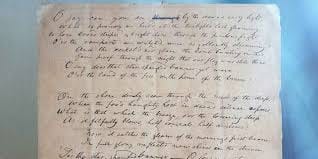
Filled with emotion, Key took to pen and paper. He began jotting down lines that would become the poem, “The Defence of Fort M’Henry.” Its opening words captured the spirit of resilience:
“O say can you see, by the dawn’s early light,
What so proudly we hailed at the twilight’s last gleaming…”
From Poem to Anthem
Key’s poem quickly spread across Baltimore and was soon set to the melody of a popular British tune, “To Anacreon in Heaven.” Renamed “The Star-Spangled Banner,” the song resonated deeply with Americans, capturing the courage and determination of a young nation fighting to preserve its independence.
In 1931, more than a century later, Congress officially designated “The Star-Spangled Banner” as the national anthem of the United States.
A Legacy of Patriotism
Francis Scott Key could not have foreseen the lasting power of his words that September morning. His spontaneous verses, born out of the terror and triumph of battle, became a symbol of unity, resilience, and national pride. Today, every time Americans stand and sing the anthem, they echo the spirit of that moment in 1814 when a flag over Fort McHenry signaled not defeat, but hope.
Read More Holidays & National Days
Leave a Reply