Category: Grief & Child Loss

  • The Empty Space They Leave Behind: Learning to Live While Longing for Your Child

    The Empty Space They Leave Behind: Learning to Live While Longing for Your Child

    There is no pain quite like losing a child. It defies explanation because it defies the natural order of life. Parents expect to guide their children into adulthood, celebrate their achievements, watch them build families of their own, and one day grow old knowing their legacy lives on through them. When a child dies, that future is taken away in an instant.

    While the world often focuses on the day your child died, parents know the grief doesn’t stay confined to a single date on the calendar. It follows you into every sunrise, every holiday, every family gathering, and every quiet evening when the house feels far too silent.

    Perhaps the hardest part of this journey is accepting one simple truth:

    You will probably always want your child back.

    No amount of time changes that longing. It may become quieter. It may not overwhelm you every hour of every day. But it never completely leaves because the love you have for your child never leaves either.

    Love Doesn’t End With Death

    People often speak of grief as though it is something to overcome. They imagine there is a finish line where one day you wake up and no longer hurt.

    Parents who have buried a child know that isn’t how grief works.

    Grief is not the opposite of healing.

    Grief is the continuation of love.

    You spent years loving your child, protecting them, encouraging them, and dreaming about their future. Those feelings cannot simply be turned off because their life ended.

    Your heart continues doing what it has always done.

    It continues loving.

    That love becomes grief because there is nowhere for it to go physically anymore.

    Every memory becomes precious.

    Every photograph becomes priceless.

    Every voice recording becomes something you protect because it allows you to hear them one more time.

    Love never stopped.

    Only the circumstances changed.

    The Silence Is Deafening

    Many parents say one of the hardest adjustments isn’t the crying.

    It’s the silence.

    The phone no longer rings with their name.

    Their bedroom remains untouched.

    No footsteps come down the hallway.

    No laughter echoes through the house.

    You may find yourself listening for sounds that you know will never come.

    For a brief moment, your mind forgets reality.

    You think you hear their voice.

    You imagine they just pulled into the driveway.

    Then reality returns.

    The silence reminds you all over again.

    People who have never experienced this type of loss may not understand how loud silence can actually be.

    But grieving parents understand it completely.

    Time Changes Grief—Not Love

    One of the biggest misconceptions about grief is that time heals all wounds.

    Time changes grief.

    It teaches us how to survive.

    It teaches us how to function.

    It teaches us how to smile again.

    But it does not erase the missing.

    Years later, you may still cry when hearing your child’s favorite song.

    You may still pause when someone says their name.

    You may still wonder how old they would be today.

    Would they have gotten married?

    Would they have become a parent?

    Would they have accomplished the dreams they once talked about?

    These questions never completely disappear.

    They’re evidence that you continue imagining the life your child deserved.

    Grief Comes in Unexpected Waves

    People often imagine grief becoming smaller every year.

    Instead, many parents discover grief behaves more like the ocean.

    Some days the water is calm.

    You remember your child with warmth and gratitude.

    Other days a single memory crashes into you without warning.

    A familiar scent.

    A favorite restaurant.

    A television show.

    A graduation ceremony.

    Seeing another parent hug their son or daughter.

    Suddenly, you’re right back in the middle of the storm.

    This doesn’t mean you’ve lost progress.

    It simply means grief is unpredictable.

    Healing isn’t measured by how often you cry.

    Healing is measured by your willingness to keep living despite the tears.

    The Guilt That Many Parents Carry

    One of the cruelest parts of child loss is the guilt that often follows.

    Parents replay every decision.

    Every conversation.

    Every missed opportunity.

    They ask impossible questions.

    “What if I had called?”

    “What if they had stayed home that day?”

    “What if I had noticed something sooner?”

    Most parents eventually realize those questions cannot change the past.

    Yet the heart continues asking because guilt creates the illusion that there might have been another outcome.

    The truth is that many tragedies happen despite our greatest efforts to protect the people we love.

    Learning to release guilt is not forgetting your child.

    It is allowing yourself to stop carrying burdens that were never yours to bear.

    Learning to Carry Their Legacy

    Although you cannot bring your child back, you can ensure they continue making a difference.

    Many parents find purpose through acts that honor their child’s memory.

    Some establish scholarships.

    Others volunteer.

    Some support organizations that helped during their family’s darkest days.

    Others write books, start nonprofits, mentor grieving parents, or simply tell stories about their child whenever someone asks.

    Legacy isn’t measured by money.

    It is measured by remembrance.

    Every time you speak their name with love, you remind the world they mattered.

    Every act of kindness done in their honor extends their influence beyond their years.

    When Others Stop Mentioning Your Child

    As months become years, something painful often happens.

    The world grows quieter.

    Friends may stop bringing up your child’s name because they fear making you sad.

    Coworkers move on.

    Extended family returns to normal life.

    Meanwhile, you never stop being a parent.

    You never stop thinking about birthdays.

    You never stop counting anniversaries.

    You never stop wondering what life would look like if they were still here.

    Many grieving parents secretly long for someone to simply say their child’s name.

    Not because it increases the pain.

    Because it reminds them their child is remembered.

    Never underestimate how meaningful it is to acknowledge someone’s child.

    Even decades later.

    Giving Yourself Permission to Feel Joy

    One of the greatest emotional battles after losing a child is learning that happiness is not betrayal.

    Many parents feel guilty laughing.

    They feel guilty taking vacations.

    They feel guilty celebrating birthdays or holidays.

    Some even feel guilty simply having a peaceful day.

    But grief was never meant to become a life sentence that prevents every future moment of happiness.

    Joy and grief can exist together.

    You can miss your child deeply while still enjoying dinner with friends.

    You can cry in the morning and laugh with your grandchildren in the afternoon.

    Both emotions can occupy the same heart.

    Choosing to live again does not mean choosing to love your child less.

    It means allowing the love they gave you to continue shaping your life.

    Faith During the Hardest Days

    For many parents, faith becomes both a struggle and a source of strength.

    There may be days when you question everything.

    You may ask God why your child had to die.

    You may wrestle with anger, confusion, or disappointment.

    God is not afraid of honest questions.

    Throughout Scripture, faithful people cried out in grief, asking why suffering had entered their lives.

    Faith does not remove pain.

    It provides hope that pain is not the end of the story.

    For Christian parents, there is comfort in believing death is not the final chapter. The promise of eternal life through Christ offers hope that one day every tear will be wiped away, every broken heart restored, and every reunion made complete.

    While that hope does not erase today’s sorrow, it can give grieving parents the strength to take one more step, one more day, trusting that love is stronger than death.

    Your Child Changed the World

    Some children lived only a few years.

    Others lived decades.

    The length of their life does not determine the size of their impact.

    Your child changed your world forever.

    They taught you lessons.

    They gave you memories.

    They made you laugh.

    They made you proud.

    They shaped the person you are today.

    Nothing—not even death—can erase those gifts.

    Their life mattered.

    Their story matters.

    And because you continue telling their story, their influence continues.

    The Love Remains

    The greatest misconception about healing is that one day you’ll stop wanting your child back.

    You won’t.

    You’ll still wish they could walk through the front door.

    You’ll still imagine hearing them call your name.

    You’ll still picture the milestones they should have experienced.

    That longing isn’t failure.

    It is the natural response of a loving parent.

    The ache remains because the love remains.

    One cannot exist without the other.

    A Message to Every Bereaved Parent

    If today is especially difficult, know this:

    You are not grieving incorrectly.

    There is no timetable for a parent’s love.

    There is no deadline for missing your child.

    You don’t have to apologize for tears that still come years later.

    You don’t have to pretend you’ve “moved on” to make other people comfortable.

    You are carrying one of life’s heaviest burdens, and every step forward is an act of remarkable courage.

    Your child will always be part of your story.

    Nothing can change that.

    As long as you speak their name, cherish their memory, and allow their love to shape your life, they continue to leave their mark on this world through you.

    The empty space they left behind may never be filled, but it can become a place where love, remembrance, compassion, and hope continue to grow.

    And perhaps that is one of the greatest ways a parent can honor a child whose life ended far too soon—not by forgetting them, but by living in a way that ensures their love never stops making a difference.

    A Father’s Guide to Surviving the Loss of a Child

  • Why Happiness Scares Me

    Why Happiness Scares Me

    Most people spend their lives chasing happiness. It’s presented as the ultimate destination—the place where everything finally makes sense. But for me, happiness has become something far more complicated.

    I want to be happy. I truly do.

    But after everything I’ve lived through, happiness doesn’t just bring hope—it brings fear.

    For years, I stopped caring about almost everything. Not because I wanted to become cold, but because I had been broken for so long that feeling nothing seemed safer than feeling everything. Pain became familiar. Grief became routine. Darkness became home.

    There was a time when none of that existed.

    Eleven years ago, I had the life I had always wanted. I had been married for fifteen years. My son, Paul, was alive. My home was filled with laughter, love, and purpose. I was the man my son admired and the man I wanted to be every single day.

    I loved without hesitation.

    I trusted without question.

    There was no darkness in my heart or my soul.

    Then everything changed.

    When My World Fell Apart

    During the July 3rd and 4th weekend of 2015, I discovered that my wife—the woman I loved with everything I had—had been unfaithful.

    What made the betrayal even more painful was knowing that I had encouraged her to pursue acting classes because I wanted to support her dreams. I believed in her. I trusted her completely.

    That trust was shattered almost instantly.

    The life I thought I had disappeared overnight.

    My heart didn’t simply break—it felt like it was burned to ashes. The love that had once filled me was replaced by betrayal, confusion, and a darkness I had never known before.

    On July 5, 2015, we officially separated.

    Six days later, I nearly lost my life.

    The First Time I Died

    On the evening of July 11, 2015, around 8:30 p.m., I suffered a massive stroke.

    I woke up in the emergency room surrounded by doctors telling me that the next few hours would determine whether I lived or died.

    Then something happened that still haunts me.

    My wife came to the hospital.

    Instead of compassion…

    Instead of comfort…

    Instead of standing beside me…

    She started an argument.

    The last words I spoke to her were simple.

    “Get out.”

    As I watched her walk out of the room, I suffered another massive stroke.

    My heart stopped.

    For two minutes, I was gone.

    When I woke up sometime on July 12 in a private hospital room, the doctors were shocked. They hadn’t expected me to regain consciousness for days, weeks, or possibly months.

    The man who woke up wasn’t the same man who had entered the hospital.

    Parts of my memory were gone.

    Parts of my emotions were gone.

    The joyful man who had once believed in people had died.

    The man who survived was empty, wounded, and filled with pain.

    My Son Saved My Life

    I’m alive today, it is because of my son.

    Paul was only fifteen years old.

    Most teenagers worry about school, friends, sports, or video games.

    Paul worried about keeping his father alive.

    Every morning he made sure I took my medication.

    He cooked breakfast.

    He went to school.

    He came home and made dinner.

    He checked on me constantly.

    He quietly carried responsibilities that no fifteen-year-old should ever have to carry.

    He never complained.

    He never asked, “Why me?”

    He simply loved his dad.

    For months, Paul became my caregiver until I was strong enough to care for myself again.

    He gave me a reason to fight.

    He needed his father.

    He deserved a father who refused to quit.

    I wanted him to see that when life knocks you down, you stand back up. I wanted him to know that strength isn’t about never falling—it’s about refusing to stay there.

    Watching Paul grow into the incredible young man he became was all the happiness I needed.

    The Second Time I Died

    On October 25, 2021, my son was killed in a car accident.

    He was only twenty-one years old.

    Nothing prepares a parent for hearing those words.

    Nothing.

    Every dream I had for the future disappeared in an instant.

    Paul wasn’t just my son.

    He was my best friend.

    He was the reason I had rebuilt my life after my strokes.

    He had already saved me once.

    Now I couldn’t save him.

    That broke something inside me that has never fully healed.

    The Man Paul Became

    Paul had an old soul.

    He was compassionate beyond his years.

    He believed in helping people quietly.

    He never looked for recognition.

    Whenever he helped someone, he would tell me, “Dad, someone needed help.”

    That was enough for him.

    He donated his time.

    He shared what he had.

    He protected people’s dignity by helping them privately so they would never feel embarrassed.

    He dreamed of returning to college to study business and computer technology.

    He loved gaming.

    He was an incredible cook.

    He cared deeply for everyone around him.

    More importantly, he possessed qualities many people spend a lifetime trying to develop.

    He was honest.

    Compassionate.

    Loyal.

    Empathetic.

    Responsible.

    Courageous.

    When he made mistakes, he admitted them and learned from them.

    He wasn’t perfect.

    He was genuine.

    He was the best son, grandson, cousin, nephew, and friend anyone could ask for.

    He brought me back to life once.

    When he died, I died with him.

    Why Happiness Terrifies Me

    It has now been years since Paul passed away.

    During that time, I’ve realized something about myself.

    Happiness scares me.

    Not because I don’t want it.

    Because I’ve had it.

    Twice.

    And both times, I lost everything.

    The first time I was truly happy, my marriage ended, and I died.

    The second time I found happiness again, it was through watching my son become an amazing man.

    Then he was taken from me.

    My mind learned a painful lesson.

    Whenever happiness arrives…

    Disaster follows.

    Whether that’s true or not doesn’t matter.

    Trauma has a way of convincing us that patterns are promises.

    So when life begins to feel peaceful, a quiet voice whispers,

    “Don’t get comfortable.”

    “This won’t last.”

    “Something terrible is coming.”

    It’s exhausting to live that way.

    Part of me wants to embrace joy.

    Another part keeps one foot in the grave and one foot in life, afraid that if I allow myself to be completely happy, life will once again take away the person or the future I love most.

    Learning to Trust Happiness Again

    Happiness also feels unfamiliar now.

    I’ve spent so many years surviving that I don’t always know how to simply live.

    Pain has become predictable.

    Grief has become comfortable.

    Healing feels uncertain.

    When happiness appears, I almost don’t recognize it.

    Instead of enjoying it, I question it.

    Do I deserve this?

    Is it real?

    How long until it’s gone?

    Can I survive losing it again?

    Those questions rob joy before it even has a chance to grow.

    The Vulnerability of Joy

    Being happy requires trust.

    It means opening your heart.

    It means allowing yourself to love.

    To hope.

    To dream.

    To believe tomorrow can be better.

    But those same things also leave you vulnerable.

    The higher you allow yourself to climb, the farther you can fall.

    After enough heartbreak, protecting your heart feels safer than risking another shattered one.

    That’s why happiness can feel frightening.

    It asks us to trust life again after life has broken us.

    Carrying the Weight of Grief

    Sometimes happiness feels like betrayal.

    How can I smile when my son isn’t here to smile with me?

    How can I laugh while other grieving parents are living the same nightmare?

    Part of me has believed that holding onto my pain somehow keeps me connected to Paul.

    As though healing would mean leaving him behind.

    But I’ve slowly begun to understand something important.

    Love isn’t measured by suffering.

    Paul doesn’t need me to remain broken to prove how much I loved him.

    If anything, he would want exactly the opposite.

    Becoming the Man My Son Believed I Was

    Last year, on the anniversary of Paul’s passing, I felt something deep within my heart.

    It was as if my son was reminding me who I used to be.

    Not the broken man.

    Not the angry man.

    Not the fearful man.

    The man he always believed I could become again.

    That has become my mission.

    I’m not trying to erase my grief.

    I’m learning to carry it differently.

    I’m not forgetting Paul.

    I’m honoring him.

    Every step I take toward healing is a tribute to the young man who once refused to let his father give up.

    Happiness Isn’t the Enemy

    I’m beginning to realize that happiness doesn’t have to last forever to be worth experiencing.

    It doesn’t erase grief.

    It doesn’t replace love.

    It simply reminds us that even after unimaginable loss, our hearts are still capable of feeling something beautiful.

    Maybe happiness isn’t a destination.

    Maybe it’s a collection of moments.

    A sunrise.

    A memory.

    A conversation.

    A prayer.

    A smile that appears unexpectedly.

    I’m learning to welcome those moments instead of fearing them.

    I know the fear won’t disappear overnight.

    Trauma doesn’t heal that quickly.

    But every day I choose to take one more step toward the man my son believed I could become.

    I’m not there yet.

    Some days are still incredibly hard.

    Some days grief wins.

    But for the first time in a very long time, I believe happiness and grief can exist together.

    I don’t have to stop loving my son to start living again.

    I don’t have to forget my past to embrace my future.

    And maybe that’s what healing truly is—not leaving the pain behind, but carrying it forward while allowing hope to walk beside it.

    Happiness still scares me.

    But it no longer scares me enough to stop trying.

    For Paul.

    For myself.

    And for the life that still remains ahead of me.

    Read More Of Love & Relationships

  • When Trauma and Grief Hit Like a Rogue Wave

    When Trauma and Grief Hit Like a Rogue Wave

    There are moments when grief seems manageable. You make it through the day. You smile at a joke. You complete your work. You begin to believe that maybe, just maybe, you are finding your footing again.

    Then, without warning, it happens.

    A song begins to play. A familiar scent drifts through the air. You drive past a place filled with memories. A birthday appears on the calendar. A stranger looks like someone you lost.

    Suddenly, it feels as though the ocean has risen beneath your feet.

    Trauma and grief can hit like a rogue wave—unexpected, overwhelming, and powerful enough to knock you completely off balance. No matter how much healing you’ve done, these moments can leave you feeling as though you’ve been pulled back to the very beginning.

    The truth is, you haven’t gone backward.

    You’ve simply been caught in one of grief’s most powerful waves.

    What Is a Rogue Wave?

    In the ocean, rogue waves are enormous walls of water that appear with little warning. They can tower over surrounding waves and overwhelm even experienced sailors. Scientists once believed they were myths until they were finally measured and documented.

    Trauma behaves much the same way.

    Most days may feel like gentle swells—sadness that comes and goes. But occasionally, emotions combine with memories, stress, anniversaries, exhaustion, or unexpected reminders to create an emotional wave that feels impossible to survive.

    These waves don’t ask permission.

    They simply arrive.

    The Body Remembers

    Trauma doesn’t only live in our memories.

    It settles into our nervous system.

    Long after our minds understand what happened, our bodies can still react as if the painful event is happening all over again.

    Your heart races.

    Your breathing becomes shallow.

    Your stomach tightens.

    You struggle to think clearly.

    Tears appear before you even know why.

    These reactions aren’t signs of weakness.

    They are reminders that trauma leaves an imprint on both the mind and body.

    Grief Is Not Linear

    Many people expect grief to follow a straight path toward healing.

    Life rarely works that way.

    Healing looks more like waves on the shoreline.

    Some are small.

    Some barely touch your feet.

    Others crash over your head without warning.

    One good week doesn’t mean grief is over.

    One difficult day doesn’t erase months of progress.

    Every wave eventually passes.

    The Hidden Triggers

    Sometimes we know what causes the emotional flood.

    Anniversaries.

    Birthdays.

    Holidays.

    Special places.

    Family gatherings.

    Other times, the trigger remains invisible.

    A certain smell.

    A change in weather.

    The sound of laughter.

    A face in a crowd.

    Your brain connects thousands of memories without your conscious awareness. When those connections activate, the emotions can feel immediate and intense.

    This is normal.

    Why It Feels Like You’re Back at Day One

    One of the cruelest lies grief tells us is this:

    “I’m back where I started.”

    But healing isn’t measured by whether pain returns.

    Healing is measured by how you respond when it does.

    Years ago, a wave may have kept you underwater for months.

    Today, it may last an afternoon.

    The pain may still be deep, but you’ve learned to breathe through it.

    You’ve survived every wave so far.

    That matters.

    When You Lose a Child

    Few experiences create waves as powerful as the loss of a child.

    The love between parent and child never ends.

    Neither does the grief.

    Parents often describe sudden moments when the loss feels as fresh as the day it happened, even years later.

    One photograph.

    One memory.

    One dream.

    One empty chair.

    And suddenly the world becomes quiet again.

    People around you may wonder why you’re hurting after so much time.

    The answer is simple.

    Love doesn’t have an expiration date.

    Neither does missing someone who was part of your heart.

    Don’t Fight the Wave

    When caught in powerful ocean currents, experienced swimmers often survive by avoiding panic.

    The same can be true emotionally.

    Instead of fighting every feeling, sometimes the healthiest response is simply acknowledging it.

    “This hurts.”

    “I miss them.”

    “This moment is hard.”

    Giving yourself permission to grieve often shortens the struggle.

    Suppressing emotions usually extends it.

    Tears are not surrender.

    They are release.

    Ways to Weather the Storm

    When trauma and grief strike unexpectedly, these gentle practices can help:

    • Pause and take slow, deep breaths.
    • Ground yourself by noticing five things you can see, four you can touch, three you can hear, two you can smell, and one you can taste.
    • Drink water and care for your body.
    • Reach out to someone you trust.
    • Pray or spend quiet time with God if your faith is an important source of strength.
    • Write down what you’re feeling instead of keeping it locked inside.
    • Remember that difficult moments are temporary, even when they feel endless.

    You don’t have to solve your grief in one day.

    You only have to survive today’s wave.

    Grace for Yourself

    Trauma often makes people feel guilty for struggling.

    You may think:

    “I should be over this.”

    “I shouldn’t still cry.”

    “Everyone else has moved on.”

    Healing doesn’t happen according to anyone else’s calendar.

    There is no finish line.

    No deadline.

    No perfect timetable.

    Offer yourself the same compassion you would give someone you love.

    Hope Beyond the Wave

    The ocean never stops producing waves.

    Life never completely removes grief.

    But over time, something changes.

    You become stronger.

    You recognize the signs sooner.

    You learn that the wave won’t destroy you.

    You discover that even after the fiercest storm, the water becomes calm again.

    The memories remain.

    The love remains.

    The loss remains.

    Yet so does hope.

    Every wave you’ve survived has quietly proven something remarkable:

    You are stronger than you realize.

    Final Thoughts

    When trauma and grief hit like a rogue wave, it can feel as though you’re drowning in memories and emotions that refuse to let go. Those moments are painful, exhausting, and deeply personal. But they are not proof that you’ve failed to heal. They are evidence that your heart loved deeply and that your mind and body are still learning how to carry a loss that changed your life forever.

    Be patient with yourself when the waves come.

    Rest when you need to.

    Lean on those who care about you.

    Hold tightly to your faith, your memories, and the hope that calmer waters will return.

    The wave may knock you down.

    But it does not define your journey.

    You have survived every one so far.

    And you will survive this one too.

    A Father’s Guide to Surviving the Loss of a Child
  • Honoring My Son’s Memory by Helping Others Through Grief

    Honoring My Son’s Memory by Helping Others Through Grief

    There are moments in life that divide everything into two chapters: before and after.

    For me, that moment was the day my son, Paul, died.

    There was life before that phone call, before the unimaginable became reality, before my heart was broken in a way I never knew was possible. Then there was life afterward—a life that looked familiar on the outside but felt completely different on the inside.

    People often say that time heals all wounds. I know they usually mean well, but I have learned that some wounds never fully heal. Losing a child isn’t something you “get over.” It isn’t a chapter you close or a burden you eventually set down.

    You simply learn how to carry it.

    The grief remains.

    The love remains.

    The longing remains.

    And because that love never disappears, I had to find somewhere for it to go.

    For me, that place became helping others.

    A Father’s Love Never Ends

    When people think about losing a child, they often focus on the funeral, the tears, and the first few weeks afterward. Those moments are heartbreaking, but they are only the beginning.

    The real challenge comes later.

    It comes when everyone else returns to their normal lives while yours never returns to what it once was.

    It comes during birthdays that no longer include your child.

    It comes at Christmas when one chair remains empty.

    It comes on Father’s Day when the title of “Dad” feels both incredibly precious and unbearably painful.

    Most of all, it comes in the ordinary moments.

    Walking through a grocery store.

    Watching fathers laugh with their sons.

    Seeing a young man about your son’s age.

    Hearing a favorite song.

    Smelling a familiar cologne.

    Every memory reminds you that someone incredibly important is missing.

    As Paul’s father, I will always love him.

    Death did not change that.

    If anything, it made that love even more visible because now it exists without the ability to hug him, hear his voice, or tell him how proud I am.

    Love like that doesn’t disappear.

    It has to find another expression.

    Paul Was More Than My Son

    Paul wasn’t simply my child.

    He was my best friend.

    It was just the two of us for many years, and we built a relationship that many fathers only dream about. We laughed together. We supported each other through difficult times. As I dealt with my own health struggles, Paul stepped into responsibilities that most young men his age never have to carry.

    He helped with meals.

    He reminded me about medications.

    He worried about me.

    He became my teammate in life.

    Although I was raising him, there were many days when it felt like he was taking care of me just as much as I was taking care of him.

    That kind of bond doesn’t disappear because someone dies.

    It remains woven into every part of your heart.

    I often think about the man he was becoming.

    His kindness.

    His compassion.

    His quiet strength.

    His willingness to help others without expecting recognition.

    Those qualities continue inspiring me every day.

    Finding Purpose Inside the Pain

    After Paul’s death, I struggled to understand what my life was supposed to look like.

    Everything I had planned revolved around watching him build his future.

    Suddenly, those dreams no longer existed.

    For a while, I simply survived.

    Some days, surviving was enough.

    Getting out of bed was an accomplishment.

    Taking a shower required strength.

    Answering a text message felt exhausting.

    Grief has a way of draining every ounce of energy from your soul.

    Then one day I realized something.

    If I couldn’t change what had happened…

    Perhaps I could change what happened next.

    I couldn’t bring Paul back.

    But I could choose what his life would continue to mean.

    That decision became the beginning of a new purpose.

    Why I Write About Grief

    Many people ask why I continue writing articles about grief, child loss, hope, and healing.

    The answer is simple.

    Because I know what it feels like to believe no one understands.

    I know what it’s like to sit alone in silence while the rest of the world keeps moving.

    I know what it’s like to smile on the outside while completely falling apart inside.

    When I first entered this journey, I searched desperately for someone who truly understood the pain of losing a child.

    I wanted honesty.

    Not clichés.

    Not quick fixes.

    Not empty promises that things would magically get better.

    I wanted someone who would simply say, “I know this hurts beyond words.”

    Now I try to be that person for someone else.

    Every article I write is a conversation with another grieving heart.

    Every sentence is written with the hope that someone, somewhere, will realize they are not walking this road alone.

    Helping Others Honors Paul’s Memory

    Some people honor loved ones by building memorials.

    Others create scholarships.

    Some plant trees or dedicate benches.

    Those are all beautiful tributes.

    For me, honoring Paul means living in a way that reflects who he was.

    When I comfort another grieving father…

    Paul is honored.

    When I encourage someone struggling with depression…

    Paul is honored.

    When I remind someone not to give up…

    Paul is honored.

    When I listen instead of judge…

    Paul is honored.

    Every act of kindness becomes another chapter in his story.

    His life did not end with the accident.

    His influence continues through every person I help.

    The Ripple Effect of Compassion

    One act of kindness rarely stops with one person.

    Hope spreads.

    Healing spreads.

    Compassion spreads.

    Someone I encourage today may encourage another person tomorrow.

    A grieving father who finds hope may become the support another grieving parent desperately needs years from now.

    We never truly know how far one compassionate moment will travel.

    That thought gives me incredible comfort.

    It means Paul’s legacy reaches people we may never meet.

    His life continues touching hearts through every act of love inspired by his memory.

    Grief Has Changed Me Forever

    I am not the same man I was before losing my son.

    Some changes have been painful.

    Others have become unexpected gifts.

    Grief has taught me patience.

    It has taught me humility.

    It has taught me to treasure ordinary moments.

    It has taught me never to assume someone is okay simply because they look fine.

    Everyone is carrying something.

    Some burdens are simply invisible.

    Because of Paul, I notice hurting people differently now.

    I recognize loneliness.

    I recognize exhaustion.

    I recognize silent suffering.

    And when I see it, I try to reach out because I know how much a simple act of kindness can mean.

    Keeping His Legacy Alive

    People sometimes ask if talking about Paul keeps me from moving forward.

    The truth is exactly the opposite.

    Talking about him helps me keep living.

    Remembering him keeps him close.

    Speaking his name reminds me that he mattered.

    Writing about him ensures his story continues.

    Love should never be buried with the person we lose.

    It deserves to continue growing.

    That is exactly what I hope to do every day.

    Not by living in the past…

    But by allowing Paul’s life to influence my future.

    A Message to Every Parent Living With Child Loss

    If you’re reading this after losing your own son or daughter, I want you to know something.

    You don’t have to stop loving them in order to keep living.

    You don’t have to “move on.”

    You don’t have to pretend you’re okay.

    Your grief is simply love with nowhere obvious to go.

    One day, when you’re ready, you may discover that helping someone else becomes one of the most meaningful ways to carry that love forward.

    It won’t erase the heartbreak.

    Nothing ever will.

    But it can give your pain purpose.

    It can transform unbearable sorrow into compassion.

    It can allow your child’s life to continue making a difference long after they’re gone.

    That is what helping others has become for me.

    It is not about forgetting.

    It is about remembering in a way that brings light into someone else’s darkness.

    Every article I publish…

    Every grieving parent I encourage…

    Every stranger I comfort…

    Every life touched by kindness…

    Is another way I tell my son, “You are still changing the world.”

    Paul’s life mattered.

    His love still matters.

    His memory still matters.

    As long as I have breath, I will continue sharing hope with those whose hearts have been shattered by loss.

    Because every person who finds comfort through my words becomes another living reminder that my son’s legacy did not end the day he died.

    It lives on—in compassion, in hope, in love, and in every heart that chooses to keep going despite unimaginable grief.

    That is how I honor my son.

    That is how I keep his light shining.

    And that is the legacy I pray will continue long after my own journey is complete.

    A Father’s Guide to Surviving the Loss of a Child
  • When the Anniversary of a Trauma Hits You: Why It Hurts Again and How to Get Through It

    When the Anniversary of a Trauma Hits You: Why It Hurts Again and How to Get Through It

    There are days on the calendar that most people see as ordinary.

    Then there are dates that forever changed your life.

    The anniversary of a traumatic event can arrive quietly, but its impact can feel overwhelming. Whether it’s the day you lost someone you love, survived an accident, experienced abuse, received devastating news, or endured another life-altering event, your mind and body often remember—even when you wish they wouldn’t.

    If you’ve ever wondered why you’re suddenly anxious, emotional, exhausted, or unable to concentrate as a certain date approaches, you’re not imagining it. What you’re experiencing is commonly known as an anniversary reaction, and it is a well-documented response to trauma.

    The important thing to remember is this:

    Feeling the weight of that day does not mean you’re moving backward. It means your heart is remembering something that mattered deeply.

    What Is an Anniversary Reaction?

    An anniversary reaction occurs when emotional or physical symptoms return around the date of a traumatic event. Sometimes it happens on the exact day. Other times it begins days or even weeks beforehand.

    Your brain stores traumatic memories differently than ordinary memories. Instead of filing them neatly away, it often associates them with dates, seasons, weather, sounds, smells, music, or even seemingly unrelated events.

    Without realizing it, your nervous system begins preparing for danger because it remembers what happened before.

    That’s why someone may suddenly experience:

    • Sadness
    • Anxiety
    • Panic attacks
    • Trouble sleeping
    • Nightmares
    • Fatigue
    • Irritability
    • Difficulty concentrating
    • Loss of appetite
    • Increased appetite
    • Feelings of loneliness
    • Crying unexpectedly
    • Physical aches and pains

    These reactions are your body’s way of remembering.

    Trauma Lives in More Than Your Memory

    Many people believe trauma is only something we think about.

    In reality, trauma affects the entire body.

    Researchers have found that traumatic experiences can influence:

    • Heart rate
    • Stress hormones
    • Muscle tension
    • Sleep cycles
    • Immune function
    • Digestion
    • Breathing patterns

    Sometimes your body remembers before your mind does.

    You may wake up feeling uneasy without understanding why until you realize what date is approaching.

    That realization often brings clarity:

    “That’s why I’ve been feeling this way.”

    Why It Can Feel Like It Just Happened

    One of the most frustrating parts of trauma anniversaries is how fresh the pain can seem.

    Years may have passed.

    Life may have changed.

    You’ve worked hard to heal.

    Yet suddenly it feels like you’re right back where you started.

    That doesn’t mean healing failed.

    Trauma memories are often stored differently than everyday memories. They can be recalled with remarkable emotional intensity because the brain originally viewed the event as life-threatening or deeply significant.

    Healing doesn’t erase the memory.

    It changes how you carry it.

    Everyone Experiences Trauma Anniversaries Differently

    No two people respond the same way.

    Some become emotional.

    Others become numb.

    Some withdraw.

    Others stay busy to avoid thinking.

    Some feel angry.

    Others become quiet.

    There is no “correct” way to react.

    Your experience is shaped by your personality, support system, coping skills, previous trauma, and the meaning the event holds in your life.

    Never compare your healing journey to someone else’s.

    Grief and Trauma Often Walk Together

    Many traumatic anniversaries involve loss.

    The death of a spouse.

    The loss of a child.

    A divorce.

    A medical diagnosis.

    The end of a friendship.

    A natural disaster.

    Military service.

    Violence.

    The anniversary often reminds us not only of what happened—but also of everything that never got to happen afterward.

    Birthdays that weren’t celebrated.

    Vacations never taken.

    Conversations never finished.

    Dreams left incomplete.

    That secondary grief can sometimes hurt just as much as the original event.

    You May Feel Guilty for Smiling

    Many survivors notice another painful emotion.

    Guilt.

    You may think:

    “Why am I laughing today?”

    “Shouldn’t I still be grieving?”

    “Am I forgetting them?”

    “Am I disrespecting what happened?”

    Healing often creates guilt because joy can feel like betrayal.

    But healing does not erase love.

    Moving forward does not mean moving on.

    You can remember the past while still embracing the future.

    Healthy Ways to Prepare for a Trauma Anniversary

    Planning ahead often helps reduce emotional overwhelm.

    Consider these ideas:

    Give Yourself Permission to Feel

    Don’t pressure yourself to “stay strong.”

    Allow yourself to cry.

    Allow yourself to rest.

    Allow yourself to remember.

    Suppressing emotions usually prolongs them.

    Reduce Your Schedule

    If possible, avoid filling the day with stressful obligations.

    Leave room to breathe.

    Your emotional energy may already be stretched thin.

    Reach Out to Someone Safe

    Tell a trusted friend or family member:

    “Tomorrow may be difficult for me.”

    You don’t have to carry it alone.

    Sometimes simply knowing someone understands can ease the burden.

    Honor What Was Lost

    Some people find comfort by:

    • Visiting a meaningful place
    • Looking through photographs
    • Lighting a candle
    • Writing a letter
    • Saying a prayer
    • Listening to meaningful music
    • Donating to a charity
    • Helping someone else

    Creating purpose around the day can transform it from only pain into remembrance.

    Take Care of Your Body

    Trauma affects physical health too.

    Try to:

    • Stay hydrated
    • Eat nourishing meals
    • Go for a gentle walk
    • Stretch
    • Practice slow breathing
    • Prioritize sleep

    Small acts of self-care help regulate your nervous system.

    What If You Feel Like You’re Falling Apart?

    Sometimes an anniversary hits much harder than expected.

    You may experience:

    • Flashbacks
    • Severe anxiety
    • Depression
    • Panic attacks
    • Thoughts that life feels hopeless
    • Emotional numbness lasting weeks

    If these symptoms become overwhelming or interfere with daily life, reaching out to a licensed mental health professional is a sign of strength—not weakness.

    You don’t have to face trauma alone.

    Healing is often something we do together.

    If Someone You Love Is Facing a Trauma Anniversary

    You don’t need perfect words.

    You simply need presence.

    Instead of trying to fix their pain, consider saying:

    “I’m thinking of you today.”

    “I remember what today means.”

    “You don’t have to go through today alone.”

    “I’m here if you want company.”

    Sometimes silence, a hug, or simply sitting together speaks louder than any advice.

    Healing Doesn’t Mean Forgetting

    Many people worry they’ll eventually forget.

    The sound of a laugh.

    The face of someone they loved.

    The life they once had.

    But healing isn’t about forgetting.

    It’s about learning how to remember without being completely consumed.

    The memory stays.

    The pain slowly changes.

    One day, the tears may come with gratitude instead of despair.

    That day doesn’t mean you’ve loved less.

    It means you’ve learned to carry both love and loss together.

    Finding Hope Beyond the Anniversary

    Every anniversary reminds us that something significant happened.

    But it also reminds us of something else.

    You survived.

    Even if survival didn’t feel brave.

    Even if you struggled every day.

    Even if you questioned whether you could continue.

    You are still here.

    Every sunrise after trauma is evidence that hope continues to exist—even when it feels distant.

    Healing isn’t measured by whether you stop hurting.

    It’s measured by whether you keep living despite the hurt.

    And every year you continue moving forward, you’re writing another chapter that trauma never intended for you to have.

    Final Thoughts

    Trauma anniversaries are never easy.

    Some years they may pass quietly.

    Other years they may knock the wind out of you.

    Both experiences are normal.

    Be gentle with yourself.

    Honor your emotions without letting them define your future.

    Remember the people you love.

    Remember how far you’ve come.

    And remember this:

    The anniversary marks the day your life changed—but it does not have to define every day that follows.

    There is room for grief.

    There is room for healing.

    There is room for hope.

    Even after the hardest dates on the calendar.

    A Father’s Guide to Surviving the Loss of a Child

  • When Grief Is Heavy and All You Feel Is… Everything

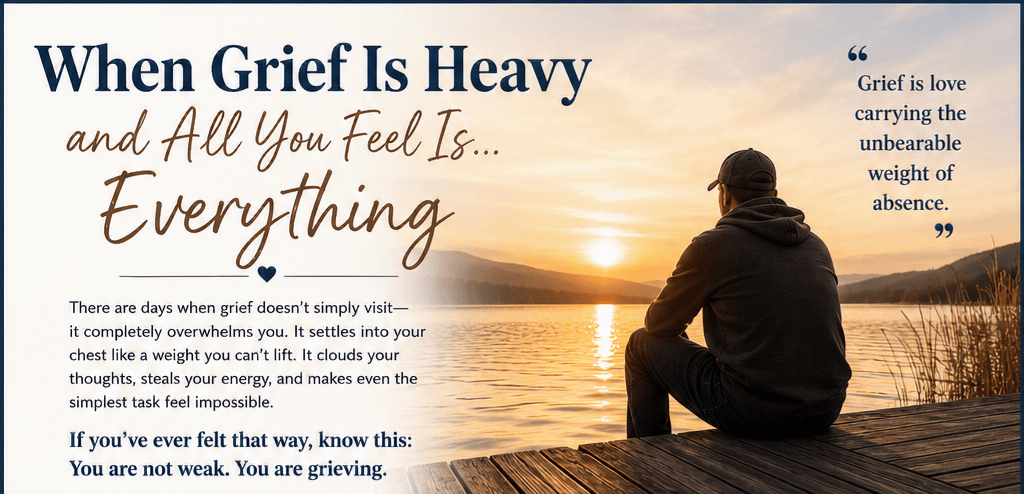
    When Grief Is Heavy and All You Feel Is… Everything

    There are days when grief doesn’t simply visit—it completely overwhelms you.

    It settles into your chest like a weight you can’t lift. It clouds your thoughts, steals your energy, and makes even the simplest task feel impossible. You wake up exhausted before your feet ever touch the floor, wondering how you’re supposed to survive another day carrying something so heavy.

    If you’ve ever felt that way, know this:

    You are not weak.

    You are grieving.

    Grief has a way of making every emotion louder while leaving you with very few answers.

    Grief Doesn’t Come One Emotion at a Time

    Many people think grief is sadness.

    In reality, grief is everything.

    It is sadness so deep it feels physical.

    It is anger over what happened.

    It is guilt for things you wish you had done differently.

    It is fear of what your future looks like now.

    It is loneliness even when surrounded by people.

    It is anxiety about facing another birthday, another holiday, another ordinary Tuesday without the person you love.

    Sometimes all of those emotions exist at the exact same moment.

    You don’t know whether to cry, scream, sit quietly, or simply stare at the ceiling.

    That’s what makes grief so exhausting.

    Your heart is fighting battles your body can’t see.

    The Weight Nobody Else Sees

    One of the hardest parts about grief is that it is invisible.

    People see you standing.

    They assume you’re okay.

    They see you smile once and believe you’ve moved on.

    What they don’t see is the conversation constantly happening inside your head.

    The memories.

    The regrets.

    The unanswered questions.

    The moments that replay over and over.

    The ache that never completely leaves.

    They don’t see the effort it takes just to get dressed, answer a text message, or walk into a grocery store where every aisle reminds you of someone who isn’t coming home.

    Invisible pain is still real pain.

    When Every Memory Hurts

    There comes a point where memories become bittersweet.

    At first, they often hurt more than they comfort.

    A favorite song suddenly becomes unbearable.

    A photograph steals your breath.

    A familiar scent can stop you in your tracks.

    You may even avoid places because they remind you of happier days.

    None of this means you’re moving backward.

    It means your heart is still learning how to carry love that no longer has a physical place to go.

    Love didn’t disappear.

    Its destination changed.

    The Days You Feel Completely Numb

    Ironically, grief isn’t always overwhelming emotion.

    Sometimes it is the complete absence of emotion.

    You may feel empty.

    Disconnected.

    Like you’re watching life happen from the outside.

    Many grieving people worry that numbness means they didn’t love enough.

    The opposite is usually true.

    Sometimes your mind simply protects you from emotions that are too overwhelming to process all at once.

    Healing doesn’t happen by feeling everything every second.

    Sometimes healing begins by simply surviving today.

    You Don’t Have to Be Strong Every Day

    People often say,

    “Stay strong.”

    But strength doesn’t always look the way people imagine.

    Sometimes strength is:

    • Getting out of bed.
    • Taking a shower.
    • Drinking enough water.
    • Answering one phone call.
    • Going for a five-minute walk.
    • Crying instead of pretending you’re okay.
    • Asking someone for help.

    Strength isn’t pretending grief doesn’t exist.

    Strength is carrying it one more day.

    Grief Changes You

    One truth many people don’t want to hear is this:

    You won’t become the person you were before your loss.

    Loss changes us.

    Especially after losing a child, spouse, parent, or someone who was part of your everyday life.

    The goal isn’t to erase grief.

    The goal is to learn how to carry it without allowing it to crush every part of who you are.

    Eventually, grief becomes something you walk beside instead of something that drags you behind it.

    That takes time.

    Sometimes years.

    Sometimes a lifetime.

    And that’s okay.

    What Helps When Grief Feels Too Heavy

    There is no magic formula.

    But there are small things that can make impossible days a little more survivable.

    Give yourself permission to cry.

    Talk about the person you lost.

    Write them a letter.

    Spend time in prayer or quiet reflection.

    Accept help when it is offered.

    Eat something, even if it’s small.

    Rest without feeling guilty.

    Remember that healing is measured in moments, not milestones.

    Some days your victory is simply making it to bedtime.

    That still counts.

    Hope Doesn’t Mean the Pain Is Gone

    One of the biggest misconceptions about healing is that hope replaces grief.

    It doesn’t.

    Hope grows beside grief.

    You can still miss someone every single day while slowly finding reasons to smile again.

    You can still cry unexpectedly while laughing with friends later that afternoon.

    You can still carry heartbreak while discovering purpose.

    The two can exist together.

    Healing isn’t forgetting.

    Healing is learning to live while continuing to love someone who will always be part of your heart.

    If Today Is One of Those Heavy Days

    If today feels unbearable…

    If all you feel is sadness…

    Or anger…

    Or loneliness…

    Or guilt…

    Or simply exhaustion…

    Please don’t judge yourself.

    Grief is love carrying the unbearable weight of absence.

    You don’t have to have everything figured out today.

    You don’t need to know what next year looks like.

    You only need to take the next breath.

    Then the next step.

    Then the next sunrise.

    There may come a day when your smile feels genuine again.

    When memories bring more gratitude than tears.

    When you realize you’ve survived days you once believed would destroy you.

    Until then, be gentle with yourself.

    Your heart is doing incredibly difficult work.

    And even if it doesn’t feel like it today…

    You are still here.

    That means hope is too.

    A Father’s Guide to Surviving the Loss of a Child
  • When It’s the Anniversary of Your Life Being Destroyed

    When It’s the Anniversary of Your Life Being Destroyed

    There are dates that most people celebrate with joy. Birthdays. Anniversaries. Graduations. Holidays. They mark milestones, accomplishments, and memories worth revisiting.

    Then there are the dates that divide life into two chapters: before and after.

    For parents who have lost a child, spouses who have lost the love of their life, or anyone who has experienced a devastating tragedy, there is another kind of anniversary. It is the anniversary of the day your life was forever changed—the day everything you knew was shattered.

    It is the anniversary of your life being destroyed.

    The Calendar Never Forgets

    Long before the date arrives, your heart often knows it’s coming.

    You may notice your mood changing without realizing why. Sleep becomes more difficult. Anxiety increases. Memories seem closer than usual. Songs, smells, or familiar places suddenly carry more weight.

    Your body remembers.

    Grief isn’t only emotional. It becomes woven into your mind, your body, and your spirit. Even when you aren’t consciously counting the days, something deep within you often is.

    By the time the anniversary arrives, it can feel as though you’ve stepped back into the worst day of your life.

    You Remember Every Detail

    You remember the phone call.

    You remember the silence.

    You remember where you were standing.

    You remember who was with you.

    You remember what was said—and sometimes what wasn’t.

    There are moments so painful they become permanently engraved in our memory.

    While other days gradually blur together over the years, that day remains painfully clear.

    You don’t relive it because you want to.

    You relive it because grief has a way of replaying trauma.

    The World Keeps Moving

    One of the hardest parts about these anniversaries is discovering that life continues for everyone else.

    People go to work.

    Children laugh at playgrounds.

    Restaurants are full.

    Social media is filled with celebrations.

    Meanwhile, you’re simply trying to survive another day.

    It can feel incredibly lonely when the world seems unaware that you’re carrying the weight of unimaginable loss.

    The person you lost may occupy every thought in your mind while barely crossing anyone else’s.

    That reality hurts.

    You Are Not Going Backward

    Many grieving people become discouraged when anniversary dates hit them hard.

    “I thought I was doing better.”

    “I thought I had healed more.”

    “I don’t understand why I’m crying again.”

    Here’s the truth:

    You are not going backward.

    Anniversaries reopen wounds because they reconnect you with profound memories.

    Healing is not measured by whether you cry.

    Healing is measured by whether you continue living despite the tears.

    Grief doesn’t move in a straight line.

    It comes in waves.

    Some waves are gentle.

    Others feel like they could drown you all over again.

    There Is No Right Way to Spend the Day

    Some people visit a cemetery.

    Others stay home.

    Some gather with family.

    Others need complete solitude.

    Some look through photographs.

    Others can’t bear to.

    Some cry.

    Some don’t cry at all.

    None of these responses are wrong.

    There is no rulebook for surviving the anniversary of devastating loss.

    The only expectation should be this:

    Give yourself grace.

    You are carrying something most people cannot imagine.

    Honor the One You Love

    Although the anniversary marks the day tragedy entered your life, it can also become a day to intentionally remember love.

    Light a candle.

    Visit a favorite place.

    Cook their favorite meal.

    Share stories about them.

    Write them a letter.

    Donate to a charity in their memory.

    Help someone else who is struggling.

    Speak their name.

    Love does not end because someone dies.

    It simply changes the way it is expressed.

    If People Forget, It Doesn’t Mean Your Loved One Didn’t Matter

    One of grief’s deepest hurts comes when others stop mentioning the person you lost.

    Friends may think bringing them up will make you sad.

    The truth is, you’re already thinking about them.

    Hearing someone else remember them often brings comfort instead of pain.

    If no one reaches out on the anniversary, don’t interpret it as proof your loved one has been forgotten.

    People often don’t know what to say.

    Others fear saying the wrong thing.

    Some simply don’t realize what the date means.

    Your loved one’s life still mattered.

    Their memory still matters.

    Their impact still matters.

    Faith in the Middle of Brokenness

    For those who trust in God, anniversary dates often bring difficult questions.

    Why did this happen?

    Why wasn’t my prayer answered?

    Why couldn’t this have been different?

    Those questions don’t make your faith weak.

    Even throughout Scripture, faithful people cried out in confusion, sorrow, and heartbreak.

    God is not intimidated by honest grief.

    He welcomes broken hearts.

    Sometimes faith isn’t having every answer.

    Sometimes faith is simply choosing to keep walking with God when your heart feels shattered.

    You Are Still Here

    If you’re reading this because today is that day, I want you to hear something.

    The fact that you’re still here is evidence of remarkable strength.

    Not because you’ve forgotten.

    Not because you’ve “moved on.”

    But because somehow, despite carrying unimaginable pain, you have continued taking one more breath.

    One more step.

    One more day.

    That doesn’t erase your grief.

    It reveals your courage.

    One Day at a Time

    No anniversary will ever become easy.

    The pain may soften around the edges, but love always remembers.

    There will always be a part of you that wishes the calendar could skip this date forever.

    Yet every year you survive it, you prove something extraordinary.

    Love is stronger than death.

    Memories are stronger than silence.

    Hope can still exist alongside heartbreak.

    If today is the anniversary of your life being destroyed, be gentle with yourself.

    Cry if you need to.

    Rest if you need to.

    Pray if you can.

    Lean on someone you trust.

    And remember this:

    The worst day of your life became part of your story, but it does not have to be the final chapter.

    Your loved one will always be part of who you are.

    And as long as you carry their love in your heart, their legacy continues to live through you.

    Final Thoughts

    Some anniversaries celebrate beginnings. Others remind us of endings we never wanted. But even on the darkest dates, there is still a quiet testimony: you have survived another year carrying a burden no parent, spouse, sibling, or friend should ever have to bear.

    Your scars tell the story of deep love. They reveal that someone precious existed, someone who forever changed your life. While grief may revisit you each year, so does love—and love is a force that death can never erase.

    Today may always hurt. But today also honors a life that mattered, a love that endures, and a strength within you that keeps choosing to move forward, one day at a time.

    A Father’s Guide to Surviving the Loss of a Child

  • Why Holidays Will Never Feel the Same After the Loss of a Child

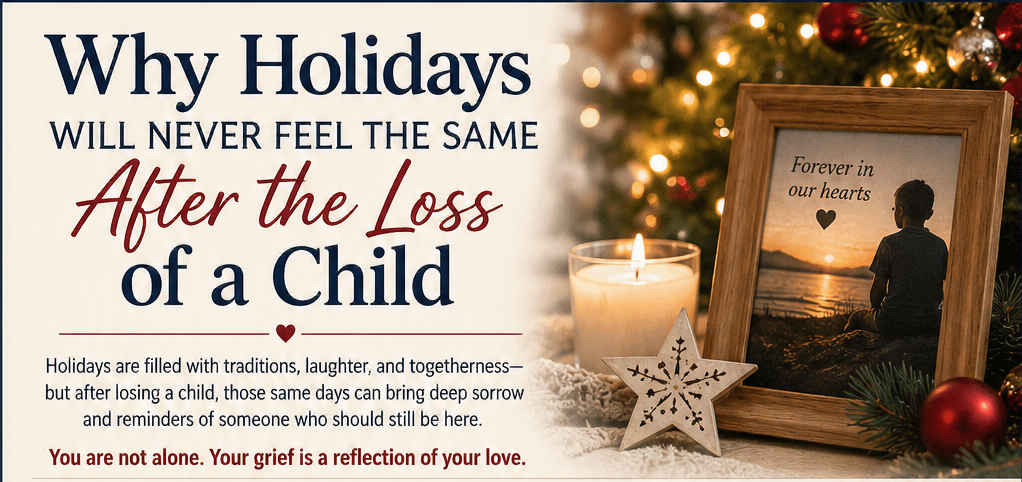
    Why Holidays Will Never Feel the Same After the Loss of a Child

    There are moments in life that permanently change us. Losing a child is one of them.

    Birthdays, anniversaries, and ordinary days can all carry the weight of grief, but holidays often bring a unique kind of heartache. Seasons that once represented laughter, traditions, and togetherness suddenly become painful reminders of someone who should still be there.

    For grieving parents, holidays don’t simply become “different.” They become milestones that measure both love and loss.

    The Empty Chair Is Impossible to Ignore

    Every family gathering has familiar places.

    A favorite seat at the dinner table.

    A stocking that once hung by the fireplace.

    A place in the family photo.

    When your child dies, those spaces remain, but they are painfully empty. Every tradition reminds you of the person who should still be laughing, talking, opening gifts, or sharing a meal with everyone else.

    Even when no one mentions it aloud, every parent notices the absence.

    Memories Return With Incredible Strength

    Holidays are built around memories.

    You remember helping your child decorate cookies, watching fireworks together, carving pumpkins, hiding Easter eggs, or opening Christmas presents before sunrise.

    Those memories are beautiful because they were filled with love.

    They are also heartbreaking because they cannot be recreated.

    Sometimes a simple Christmas ornament, a favorite song, or the smell of a holiday meal can instantly bring tears that seem to come out of nowhere.

    Grief often arrives without warning.

    Watching Other Families Can Be Difficult

    One of the hardest parts of the holiday season is seeing families enjoy what you once had.

    Parents proudly taking pictures.

    Children laughing together.

    Graduations, weddings, birthdays, and holiday celebrations shared across social media.

    While you may genuinely be happy for others, each image can quietly remind you of the future your child never had.

    Those feelings don’t make you selfish.

    They make you a grieving parent.

    Traditions May Need to Change

    Many bereaved parents discover that old traditions are simply too painful.

    Some skip certain celebrations.

    Others travel instead of staying home.

    Some create entirely new traditions centered around honoring their child.

    There is no right or wrong way to celebrate.

    Grief changes people, and it often changes how holidays are experienced as well.

    Giving yourself permission to do what brings the most peace is an important part of healing.

    Happiness and Grief Can Exist Together

    Many grieving parents struggle with guilt.

    They wonder if laughing means they’re forgetting.

    They question whether enjoying the holiday somehow dishonors their child’s memory.

    The truth is just the opposite.

    Your child remains part of your heart regardless of whether you smile, laugh, or experience moments of joy.

    Love is not measured by constant sadness.

    It is carried in the life you continue to live.

    Finding Ways to Include Your Child

    Many families find comfort by intentionally remembering their child during holiday celebrations.

    Ideas include:

    • Lighting a candle in their memory.
    • Displaying a favorite photograph.
    • Preparing one of their favorite holiday meals.
    • Donating to a charity in their name.
    • Hanging a personalized ornament.
    • Sharing favorite stories during dinner.
    • Visiting their resting place before or after the holiday.
    • Performing an act of kindness that reflects who they were.

    These simple acts help remind everyone that although your child is physically absent, they remain forever part of your family.

    It’s Okay If You Need Quiet

    Not every holiday needs to be filled with parties and celebrations.

    Some years, simply making it through the day is enough.

    If you need to leave early…

    If you decline invitations…

    If you spend part of the day alone…

    If you cry in the middle of dinner…

    You are not doing the holidays wrong.

    You are grieving.

    There is an important difference.

    Friends and Family May Not Understand

    As time passes, others often expect grief to become smaller.

    They may wonder why holidays are still difficult years later.

    What many people don’t realize is that parents don’t move on from losing a child.

    They learn to carry the loss.

    Every holiday marks another year of missing birthdays, hugs, conversations, and milestones that should have happened.

    The calendar keeps moving, but a parent’s love never stops.

    Hope Doesn’t Erase the Pain

    Healing does not mean forgetting.

    It doesn’t erase the empty chair or silence the memories.

    Instead, healing slowly teaches us that our child’s love can remain part of every holiday without completely overwhelming every moment.

    The pain may soften.

    The love never will.

    Final Thoughts

    The holidays are never the same after losing a child because life itself is never the same.

    You carry both cherished memories and unimaginable heartbreak into every celebration.

    If this holiday season feels especially heavy, know that you are not alone. Countless parents quietly understand exactly what you’re carrying.

    Take each day one moment at a time.

    Honor your child in whatever way brings you peace.

    Allow yourself to grieve without apology.

    And when moments of joy unexpectedly appear, receive them without guilt. Loving your child and continuing to live a meaningful life are not opposing choices—they are two expressions of the same enduring love.

    Your child will always be part of every holiday because they will always be part of your heart.

    A Father’s Guide to Surviving the Loss of a Child
  • National Bereaved Parents Day: Honoring a Love That Never Ends

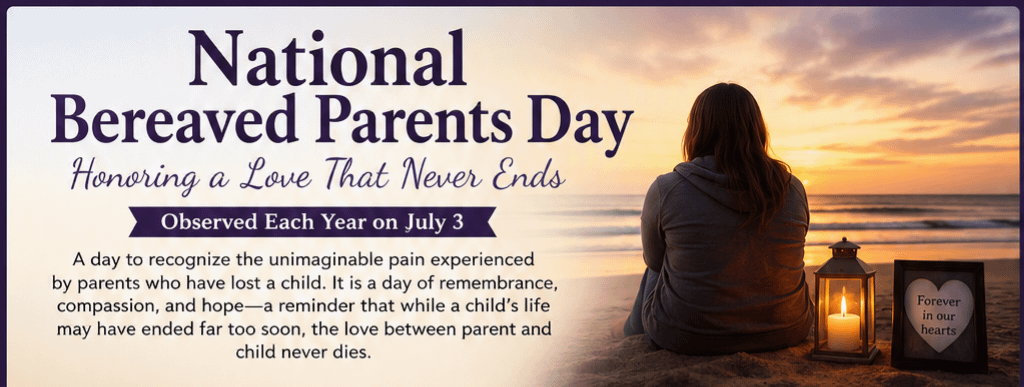
    National Bereaved Parents Day: Honoring a Love That Never Ends

    National Bereaved Parents Day is observed each year on July 3 as a day to recognize the unimaginable pain experienced by parents who have lost a child. It is a day of remembrance, compassion, and hope—a reminder that while a child’s life may have ended far too soon, the love between parent and child never dies.

    For bereaved parents, every day is marked by the absence of someone they expected to outlive. National Bereaved Parents Day offers the rest of the world an opportunity to pause, acknowledge that pain, and stand beside those whose lives have been forever changed.

    A Grief Unlike Any Other

    There is no roadmap for surviving the loss of a child.

    Parents dream of watching their children grow up, graduate, build careers, fall in love, and perhaps become parents themselves. Those dreams are shattered in an instant when a child dies. Whether the loss occurred through illness, an accident, miscarriage, stillbirth, violence, military service, addiction, or suicide, the grief is profound and lifelong.

    Many bereaved parents describe the experience as feeling like they have lost a piece of themselves. It changes how they see the world, how they celebrate holidays, and even how they define who they are.

    Healing does not mean forgetting. It means learning how to carry love and grief together.

    The Importance of National Bereaved Parents Day

    Days of recognition matter because they remind grieving families that they are not invisible.

    National Bereaved Parents Day serves several important purposes:

    • Honors children whose lives mattered.
    • Gives parents permission to speak their child’s name.
    • Raises awareness about child loss and its lifelong impact.
    • Encourages communities to offer compassion instead of silence.
    • Helps grieving families connect with others who understand.

    For many parents, simply hearing someone say, “I’m remembering your child today,” means more than words can express.

    Grief Doesn’t Have an Expiration Date

    One of the biggest misconceptions about grief is that it eventually ends.

    The intensity may change over time, but love never disappears.

    A parent may laugh again.
    They may find purpose again.
    They may even experience joy again.

    None of those things mean they have “moved on.”

    Instead, they have learned to move forward while carrying the memory of their child every single day.

    Birthdays.
    Graduations.
    Holidays.
    Family gatherings.

    Every milestone is experienced through the lens of someone who should still be here.

    How You Can Support Bereaved Parents

    Many people want to help but simply don’t know what to say.

    The truth is that perfect words don’t exist.

    What matters most is your willingness to stay present.

    Here are meaningful ways to support a bereaved parent:

    Say Their Child’s Name

    One of the greatest gifts you can give is speaking the child’s name.

    Parents are often afraid their child will be forgotten. Mentioning their son or daughter lets them know their child’s life still matters.

    Remember Important Dates

    Birthdays, anniversaries, holidays, and the anniversary of the child’s passing are often incredibly difficult.

    A simple text saying,

    “Thinking about you and remembering your child today.”

    can make an enormous difference.

    Don’t Try to Fix Their Grief

    Avoid phrases like:

    • “Everything happens for a reason.”
    • “They’re in a better place.”
    • “At least you have other children.”
    • “You’ll get over it.”

    Instead say:

    • “I’m here.”
    • “I remember.”
    • “Tell me about your child.”
    • “I’m listening.”

    Presence is far more powerful than advice.

    Continue Checking In

    Support usually fades after the funeral.

    Grief does not.

    Reach out weeks, months, and years later.

    The parents are still grieving.

    Finding Hope Without Letting Go

    Hope after child loss looks different.

    It is not about replacing what was lost.

    It is about discovering purpose despite unimaginable heartbreak.

    Some parents volunteer.

    Others create scholarships.

    Some advocate for safer roads, medical research, or mental health.

    Others simply choose to love people more deeply because they know how fragile life truly is.

    Every act of kindness becomes part of their child’s legacy.

    Ways Bereaved Parents Honor Their Children

    Every family remembers differently.

    Some common ways include:

    • Lighting a candle.
    • Visiting a special place.
    • Creating memory gardens.
    • Donating to charities.
    • Volunteering.
    • Wearing memorial jewelry.
    • Sharing photographs and stories.
    • Supporting newly bereaved families.
    • Writing letters to their child.
    • Living a life that honors their child’s memory.

    There is no right or wrong way to remember.

    Love creates its own traditions.

    To Every Bereaved Parent

    If you are reading this because your child has died, please know this:

    Your grief is real.

    Your love is eternal.

    You are not weak because you still cry.

    You are not broken because certain days are difficult.

    You are not alone.

    Your child mattered.

    Their story matters.

    Your story matters.

    No amount of time will erase the love you carry.

    Today, on National Bereaved Parents Day, may you find comfort in knowing that countless parents around the world understand this journey. Though each path is different, you walk among people who know that a parent’s love never ends.

    Final Thoughts

    National Bereaved Parents Day is more than a date on the calendar. It is a reminder that behind every grieving parent is a son or daughter who changed the world simply by existing.

    If you know a bereaved parent, reach out today. Speak their child’s name. Listen without judgment. Offer your presence rather than perfect words.

    Sometimes the greatest gift you can give someone who is grieving is simply reminding them that their child—and their love—will never be forgotten.

    A Father’s Guide to Surviving the Loss of a Child
  • Grieving Parents Need a Support System – No Parent Should Have to Carry This Burden Alone

    Grieving Parents Need a Support System – No Parent Should Have to Carry This Burden Alone

    The death of a child is one of the most devastating experiences a parent can endure. It changes every part of life—your heart, your future, your relationships, and even your sense of identity. While no support system can erase that pain, having compassionate people beside you can make the unbearable feel a little less impossible.

    Grieving parents often hear the phrase, “You’ll get through this.” The truth is, many don’t feel like they are getting through anything. They are simply trying to survive one day, one hour, or even one breath at a time. That is why a strong support system is not a luxury—it’s a necessity.

    Grief Can Be Isolating

    One of the hardest realities after losing a child is the loneliness that follows. Friends may not know what to say. Family members may grieve differently. Co-workers may expect life to return to normal after a few weeks.

    Meanwhile, the grieving parent is living with a pain that never takes a day off.

    Many parents withdraw because they feel no one understands. Others stop talking about their child because they fear making others uncomfortable. Unfortunately, silence often leads to deeper isolation.

    A support system reminds grieving parents that they are not invisible and that their child’s life still matters.

    What a Support System Really Looks Like

    Support isn’t about having dozens of people around you. Sometimes it’s only a handful of individuals who consistently show up.

    A healthy support system may include:

    • Family members who listen without trying to “fix” the grief.
    • Friends who continue checking in months and years later.
    • Faith communities that offer prayer, encouragement, and companionship.
    • Professional grief counselors who provide healthy coping tools.
    • Bereavement support groups where parents can speak openly with people who truly understand.
    • Online communities that offer connection during lonely moments.

    The quality of support matters far more than the quantity.

    The Power of Simply Being Present

    One of the greatest gifts you can give a grieving parent is your presence.

    You don’t need perfect words.

    You don’t need to explain why tragedy happened.

    You don’t need to offer solutions.

    Instead:

    • Sit with them.
    • Listen.
    • Let them cry.
    • Let them laugh when memories bring smiles.
    • Allow them to speak their child’s name.

    Sometimes the greatest comfort comes from someone willing to share the silence.

    Every Parent Grieves Differently

    No two grieving parents experience loss the same way.

    One parent may openly cry every day.

    Another may become quiet and private.

    Some throw themselves into work.

    Others struggle just to get out of bed.

    There is no “correct” way to grieve.

    A good support system recognizes these differences without judgment. Instead of expecting parents to heal on a schedule, it allows them to grieve in their own time and in their own way.

    Why Ongoing Support Matters

    Many grieving parents receive an outpouring of love immediately after the funeral.

    Meals arrive.

    Flowers are delivered.

    Phone calls come in.

    Then life moves on for everyone else.

    But grief doesn’t end after the funeral.

    In many ways, that’s when the hardest part begins.

    Months later…

    The birthday arrives.

    The holidays come.

    The anniversary of the loss returns.

    Graduations happen.

    Weddings happen.

    Life continues while one chair remains empty.

    These are often the moments when parents need support the most.

    Checking in a year later may mean more than all the flowers sent during the first week.

    Faith Can Strengthen a Support System

    For many parents, faith becomes an anchor during unimaginable sorrow.

    Believing that God is near to the brokenhearted offers hope when answers cannot be found.

    A supportive church family can provide prayer, encouragement, meals, practical help, and loving companionship without placing unrealistic expectations on the grieving parent.

    Faith doesn’t remove grief.

    It helps carry it.

    Don’t Be Afraid to Ask for Help

    Many grieving parents struggle with asking for support because they don’t want to burden others.

    But healing often begins with honesty.

    It’s okay to say:

    • “I’m having a really hard day.”
    • “Can we talk?”
    • “I don’t want to be alone today.”
    • “Would you pray with me?”
    • “I need help.”

    There is courage in reaching out.

    No one should have to carry this weight by themselves.

    If You Know a Grieving Parent

    If someone you love has lost a child, remember these simple truths:

    • Keep showing up.
    • Say their child’s name.
    • Remember birthdays and anniversaries.
    • Send a simple text that says, “I’m thinking of you.”
    • Be patient.
    • Listen more than you speak.
    • Don’t compare their loss to someone else’s.
    • Let them grieve without trying to hurry their healing.

    Your consistency may become one of the greatest gifts you ever give.

    Healing Happens Together

    Healing does not mean forgetting.

    Healing does not mean “moving on.”

    Healing means learning to carry love and loss together while continuing to live with purpose.

    No parent ever stops loving their child.

    No parent ever completely stops grieving.

    But with compassionate friends, faithful family members, caring counselors, and supportive communities, grieving parents can find the strength to face another day.

    A support system cannot take away the pain of losing a child.

    It can, however, remind grieving parents that they don’t have to walk this difficult road alone.

    And sometimes, knowing someone is walking beside you makes all the difference.

    A Father’s Guide to Surviving the Loss of a Child