There are moments when grief seems manageable. You make it through the day. You smile at a joke. You complete your work. You begin to believe that maybe, just maybe, you are finding your footing again.
Then, without warning, it happens.
A song begins to play. A familiar scent drifts through the air. You drive past a place filled with memories. A birthday appears on the calendar. A stranger looks like someone you lost.
Suddenly, it feels as though the ocean has risen beneath your feet.
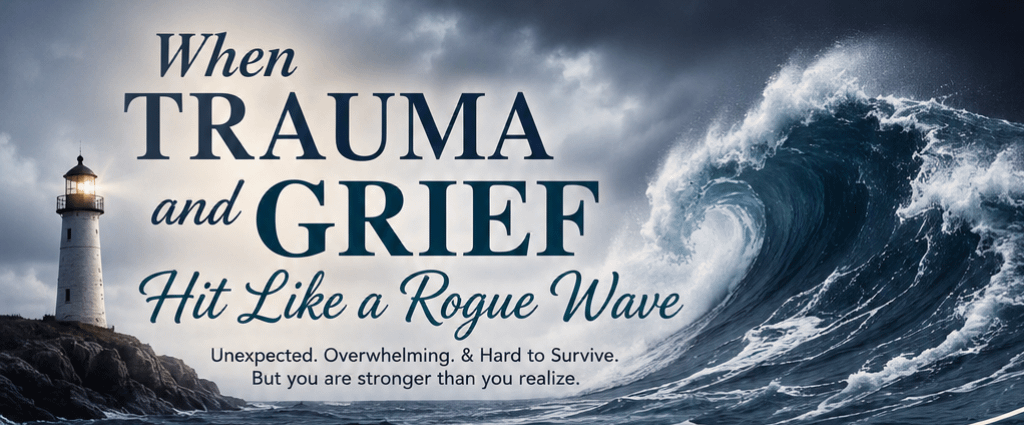
Trauma and grief can hit like a rogue wave—unexpected, overwhelming, and powerful enough to knock you completely off balance. No matter how much healing you’ve done, these moments can leave you feeling as though you’ve been pulled back to the very beginning.
The truth is, you haven’t gone backward.
You’ve simply been caught in one of grief’s most powerful waves.
What Is a Rogue Wave?
In the ocean, rogue waves are enormous walls of water that appear with little warning. They can tower over surrounding waves and overwhelm even experienced sailors. Scientists once believed they were myths until they were finally measured and documented.
Trauma behaves much the same way.
Most days may feel like gentle swells—sadness that comes and goes. But occasionally, emotions combine with memories, stress, anniversaries, exhaustion, or unexpected reminders to create an emotional wave that feels impossible to survive.
These waves don’t ask permission.
They simply arrive.
The Body Remembers
Trauma doesn’t only live in our memories.
It settles into our nervous system.
Long after our minds understand what happened, our bodies can still react as if the painful event is happening all over again.
Your heart races.
Your breathing becomes shallow.
Your stomach tightens.
You struggle to think clearly.
Tears appear before you even know why.
These reactions aren’t signs of weakness.
They are reminders that trauma leaves an imprint on both the mind and body.
Grief Is Not Linear
Many people expect grief to follow a straight path toward healing.
Life rarely works that way.
Healing looks more like waves on the shoreline.
Some are small.
Some barely touch your feet.
Others crash over your head without warning.
One good week doesn’t mean grief is over.
One difficult day doesn’t erase months of progress.
Every wave eventually passes.
The Hidden Triggers
Sometimes we know what causes the emotional flood.
Anniversaries.
Birthdays.
Holidays.
Special places.
Family gatherings.
Other times, the trigger remains invisible.
A certain smell.
A change in weather.
The sound of laughter.
A face in a crowd.
Your brain connects thousands of memories without your conscious awareness. When those connections activate, the emotions can feel immediate and intense.
This is normal.
Why It Feels Like You’re Back at Day One
One of the cruelest lies grief tells us is this:
“I’m back where I started.”
But healing isn’t measured by whether pain returns.
Healing is measured by how you respond when it does.
Years ago, a wave may have kept you underwater for months.
Today, it may last an afternoon.
The pain may still be deep, but you’ve learned to breathe through it.
You’ve survived every wave so far.
That matters.
When You Lose a Child
Few experiences create waves as powerful as the loss of a child.
The love between parent and child never ends.
Neither does the grief.
Parents often describe sudden moments when the loss feels as fresh as the day it happened, even years later.
One photograph.
One memory.
One dream.
One empty chair.
And suddenly the world becomes quiet again.
People around you may wonder why you’re hurting after so much time.
The answer is simple.
Love doesn’t have an expiration date.
Neither does missing someone who was part of your heart.
Don’t Fight the Wave
When caught in powerful ocean currents, experienced swimmers often survive by avoiding panic.
The same can be true emotionally.
Instead of fighting every feeling, sometimes the healthiest response is simply acknowledging it.
“This hurts.”
“I miss them.”
“This moment is hard.”
Giving yourself permission to grieve often shortens the struggle.
Suppressing emotions usually extends it.
Tears are not surrender.
They are release.
Ways to Weather the Storm
When trauma and grief strike unexpectedly, these gentle practices can help:
- Pause and take slow, deep breaths.
- Ground yourself by noticing five things you can see, four you can touch, three you can hear, two you can smell, and one you can taste.
- Drink water and care for your body.
- Reach out to someone you trust.
- Pray or spend quiet time with God if your faith is an important source of strength.
- Write down what you’re feeling instead of keeping it locked inside.
- Remember that difficult moments are temporary, even when they feel endless.
You don’t have to solve your grief in one day.
You only have to survive today’s wave.
Grace for Yourself
Trauma often makes people feel guilty for struggling.
You may think:
“I should be over this.”
“I shouldn’t still cry.”
“Everyone else has moved on.”
Healing doesn’t happen according to anyone else’s calendar.
There is no finish line.
No deadline.
No perfect timetable.
Offer yourself the same compassion you would give someone you love.
Hope Beyond the Wave
The ocean never stops producing waves.
Life never completely removes grief.
But over time, something changes.
You become stronger.
You recognize the signs sooner.
You learn that the wave won’t destroy you.
You discover that even after the fiercest storm, the water becomes calm again.
The memories remain.
The love remains.
The loss remains.
Yet so does hope.
Every wave you’ve survived has quietly proven something remarkable:
You are stronger than you realize.
Final Thoughts
When trauma and grief hit like a rogue wave, it can feel as though you’re drowning in memories and emotions that refuse to let go. Those moments are painful, exhausting, and deeply personal. But they are not proof that you’ve failed to heal. They are evidence that your heart loved deeply and that your mind and body are still learning how to carry a loss that changed your life forever.
Be patient with yourself when the waves come.
Rest when you need to.
Lean on those who care about you.
Hold tightly to your faith, your memories, and the hope that calmer waters will return.
The wave may knock you down.
But it does not define your journey.
You have survived every one so far.
And you will survive this one too.
A Father’s Guide to Surviving the Loss of a Child
Leave a Reply