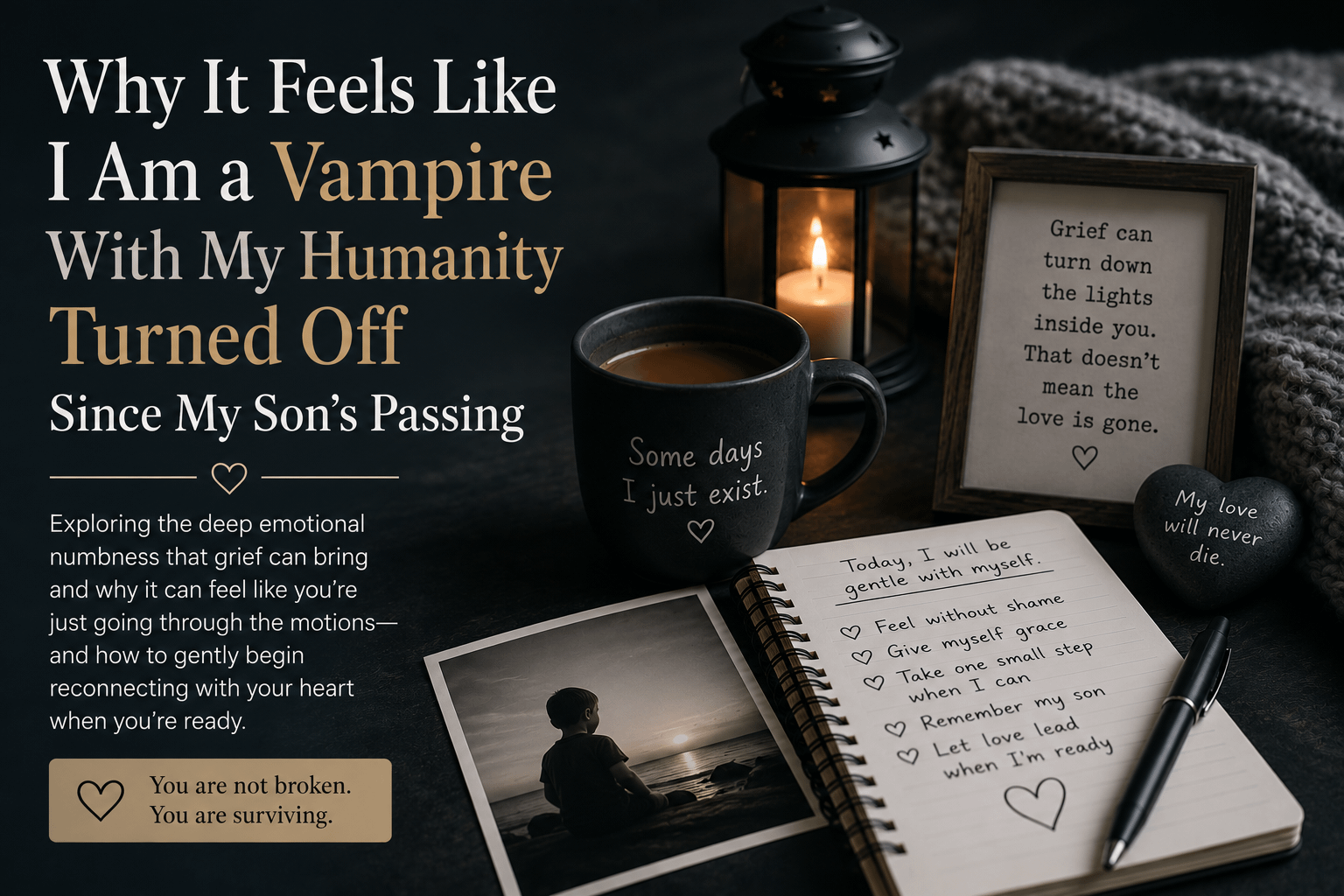
Losing a child is a grief so profound, so shattering, that it can feel like the very essence of your humanity has been stripped away. The metaphor of a vampire with their humanity turned off—a creature existing in a state of emotional detachment, driven by instinct rather than feeling—captures the raw, hollow experience of navigating life after such a loss. When my son passed away, it was as if a switch flipped inside me, leaving me in a world where emotions, once vibrant, now feel muted or inaccessible. I am writing this to help myself and others why this feeling emerges and how it reflects the complex nature of grief.
The Emotional Numbness of Grief
Grief is not a linear process; it is a storm that reshapes the landscape of your soul. After my son’s death, I expected to be consumed by sadness, but instead, I often felt nothing at all. This numbness, akin to a vampire’s emotional void, is a common response to overwhelming loss. Psychologists describe it as a defense mechanism—a way for the mind to protect itself when the pain is too intense to process. The American Psychological Association notes that dissociation, including emotional detachment, can occur in response to trauma, allowing individuals to function despite unbearable sorrow.
This numbness manifests in everyday moments. I might sit through a gathering, watching others laugh or cry, yet feel like an observer, disconnected from the warmth or sorrow. It’s as if I’m moving through life on autopilot, my heart sealed off like a vampire who can no longer feel the pulse of human connection. This detachment isn’t a choice; it’s a survival tactic, a way to keep going when every memory of my son threatens to unravel me.
The Loss of Identity and Purpose
A child is not just a person you love—they are a part of your identity, your purpose. As a parent, my son was my reason to wake up, to strive, to hope. His laughter was my light; his struggles, my battles. When he was taken, it felt like the core of who I was had been ripped away. Vampires, in lore, are often depicted as beings without a soul, existing without the spark that makes them human. Similarly, losing my son left me questioning who I am without him. Am I still a parent? What is my purpose now?
This identity crisis deepens the vampire-like detachment. Without the role that defined me, I sometimes feel like a shadow of myself, going through the motions of life without truly living it. Tasks like eating, working, or socializing lose their meaning when the person who gave them context is gone. The world feels drained of color, much like a vampire’s existence in a sunless realm.
The Guilt of Moving Forward
One of the most painful aspects of this experience is the guilt that creeps in when moments of joy or normalcy break through the numbness. If I laugh at a joke or enjoy a quiet evening, a voice inside whispers, “How dare you feel anything when your son is gone?” This guilt mirrors the vampire’s struggle in stories where they grapple with their lost humanity—wanting to feel, but fearing it betrays their nature.
Grief counselors explain that this guilt is a common part of mourning. The idea of “moving on” feels like a betrayal, as if feeling anything other than pain dishonors the memory of the one lost. Yet, this internal conflict only deepens the sense of being emotionally switched off. To avoid the guilt, I sometimes retreat further into detachment, choosing the safety of numbness over the risk of feeling.
The Isolation of Grief
Vampires are often solitary creatures, cut off from the world by their nature. Grief, too, can be profoundly isolating. After my son’s passing, I found it hard to connect with others, even those who meant well. Friends and family offered condolences, but their words often felt hollow, unable to reach the depth of my pain. Some avoided me, unsure of what to say, while others expected me to “heal” on their timeline. This left me feeling like an outsider, watching the world move on while I remained frozen in my loss.
This isolation reinforces the vampire-like state. When you feel disconnected from others, it’s easier to withdraw into a shell where emotions are suppressed. Social interactions become performances—smiling when expected, nodding at the right moments—but inside, the emotional switch remains off. The loneliness of grief becomes a self-perpetuating cycle, where detachment feels like the only way to cope.
Finding a Path Toward Feeling Again
The metaphor of a vampire with humanity turned off is powerful, but it’s not the whole story. In vampire lore, there are moments when humanity flickers back—a memory, a connection, a spark that reminds them of who they were. Similarly, healing from the loss of a child doesn’t mean erasing the pain, but finding ways to let light back into the darkness.
For me, this has meant small steps. I started by allowing myself to feel my son’s presence in memories, even when it hurt. I found solace in writing letters to him, pouring out the love and pain I couldn’t express aloud. Support groups, where others understood the depth of this loss, helped me feel less alone. Therapy provided tools to navigate the guilt and numbness, reminding me that feeling joy doesn’t diminish my love for my son.
Experts, like those from the National Institute of Mental Health, suggest that processing grief involves integrating the loss into your life, not “getting over” it. This might mean creating rituals to honor your child, like lighting a candle on their birthday, or finding ways to carry their memory forward, such as supporting causes they cared about. These acts don’t flip the humanity switch back on overnight, but they crack open the door to feeling again.
Conclusion
Feeling like a vampire with my humanity turned off since my son’s passing reflects the profound numbness, identity loss, guilt, and isolation that grief brings. It’s a state where the world feels distant, and emotions are locked away to survive the pain. But even in this darkness, there is hope. By acknowledging the depth of this loss and taking small steps toward connection—whether through memories, support, or honoring my son’s life—I am beginning to rediscover moments of humanity. The pain will always be part of me, but so will the love, and that love is the spark that keeps me reaching for the light when I am drowning in the darkness.
A Father’s Guide to Surviving the Loss of a Child
Leave a Reply