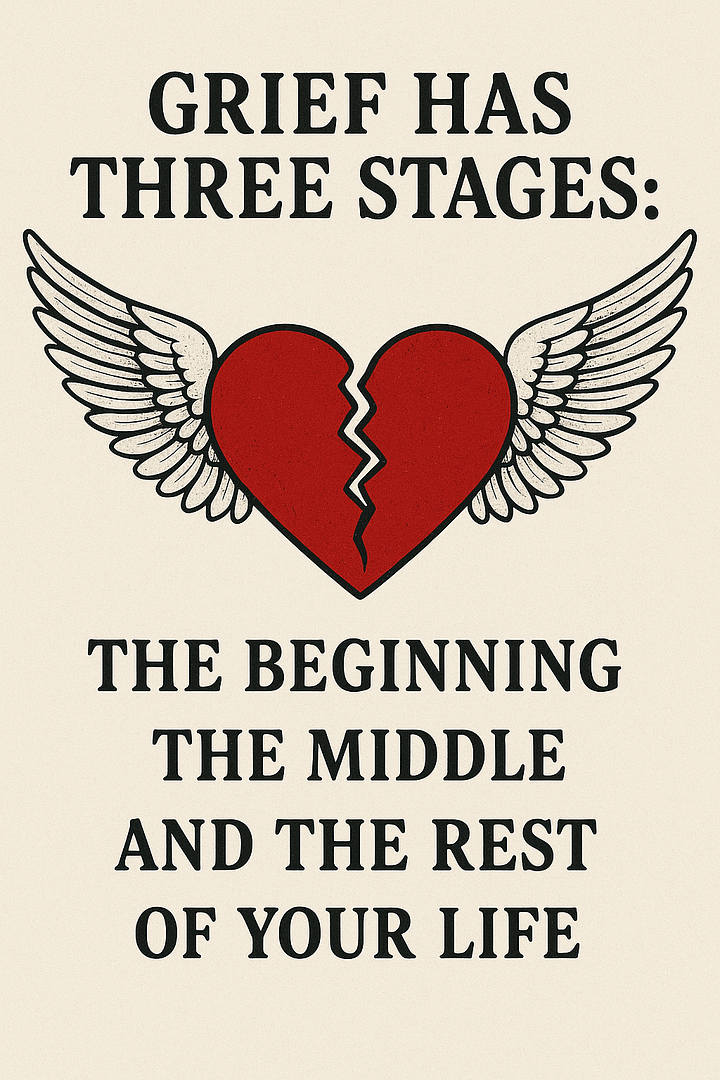
Grief is not something you “get through.” It’s not a chapter you close or a wound that simply fades. Grief is a lifelong companion—unwanted, uninvited, yet forever tied to the love you carry for the one you lost. When someone you love is taken from your world, everything changes. The way you breathe changes. The way you move changes. Even the way you see yourself changes.
You don’t return to who you were before.
You become someone new—someone shaped by love, by loss, by memory, by a kind of strength you never asked to learn.
For many hearts, grief unfolds in three powerful stages that have little to do with timelines and everything to do with transformation:
the beginning, the middle, and the rest of your life.
1. The Beginning: When Life Splits in Two
The beginning is the moment the world tilts off its axis.
There is before—warm, familiar, untouched by the unthinkable.
And then there is after—a landscape you never asked to enter.
In the beginning:
Time feels unreal.
You move through your days like a shadow.
Food has no taste.
Sleep brings no rest.
Memories hit with a force that knocks the air from your body.
You might find yourself replaying moments again and again, searching for answers that don’t exist, trying to grasp how life could be so ruthless. You cling to reminders—smells, photos, their handwriting, their voice in your head—because letting go of anything feels like another kind of death.
People may tell you to be strong, but in the beginning, strength has no meaning.
You are surviving heartbreak that feels too big for your chest.
This stage is raw. It is chaotic. It is filled with moments where you wonder how the world continues turning when yours has stopped.
The beginning of grief is where you meet a pain so profound it changes your understanding of love itself.
2. The Middle: Where You Learn to Carry the Weight
The middle of grief is long. It winds and twists and circles back on itself. It is not a straight path—it is a journey no one can map out for you.
In the middle:
You start to function again, but everything feels heavier.
You laugh, and then feel guilty for laughing.
You cry at the smallest reminders, sometimes without knowing why.
You learn the cruel truth that the world expects you to be “better” long before you’re ready.
The middle is where grief becomes quieter but no less powerful.
You learn to navigate daily life while carrying a heart that’s been permanently torn. Some days you feel almost normal. Other days, a memory, a song, a scent, or even a stranger’s face pulls you back into the beginning.
This stage hurts because it’s where reality settles in—they are not coming back.
You realize you have to live in a world without their physical presence.
But slowly, gently, something else happens too:
You start to see that grief is not only pain—it is proof of how deeply you loved.
You begin to find small ways to honor them, to keep their memory alive, to let your grief become something more than sorrow. The middle is messy, painful, beautiful, and sacred. It is where you discover your resilience, even if it is quiet and trembling.
3. The Rest of Your Life: When Grief Becomes Part of Who You Are
Grief never disappears.
It simply changes its shape.
At some point—weeks, months, years later—you wake up and realize that grief now lives within you like a second heartbeat. It no longer shatters you every day, but it remains an ever-present part of your identity.
In this lifelong stage:
You remember your loved one with more warmth than pain.
Their absence becomes woven into your story instead of dominating it.
You find ways to carry them forward—through traditions, words, choices, and the love you offer others.
You learn that honoring them doesn’t mean living in sorrow; it means living fully because they cannot.
There will still be days when the ache is sharp—anniversaries, holidays, their birthday, or even an ordinary morning when the sunlight hits in a familiar way. Grief has a way of tapping you on the shoulder just to remind you that love this strong never fades.
But you will also find moments of peace, of meaning, of unexpected joy.
You learn to smile again, not because the pain is gone, but because your heart is learning to hold both the grief and the gratitude.
This stage—the rest of your life—is not about “moving on.”
It is about moving forward, carrying the love, the memories, and the lessons with you.
Grief becomes a quiet compass that reshapes your priorities and deepens your compassion.
Grief Is the Shadow of Love
If grief feels endless, it’s because love is endless.
You grieve because you loved.
You hurt because their life mattered.
And you continue because their story lives on through you.
Grief’s three stages are not steps to conquer—they are chapters that transform you.
You survive the beginning.
You navigate the middle.
And you learn to live the rest of your life with a heart that has been forever marked by love.
Your grief may change, but your love never will.
A Father’s Guide to Surviving the Loss of a Child
Leave a Reply