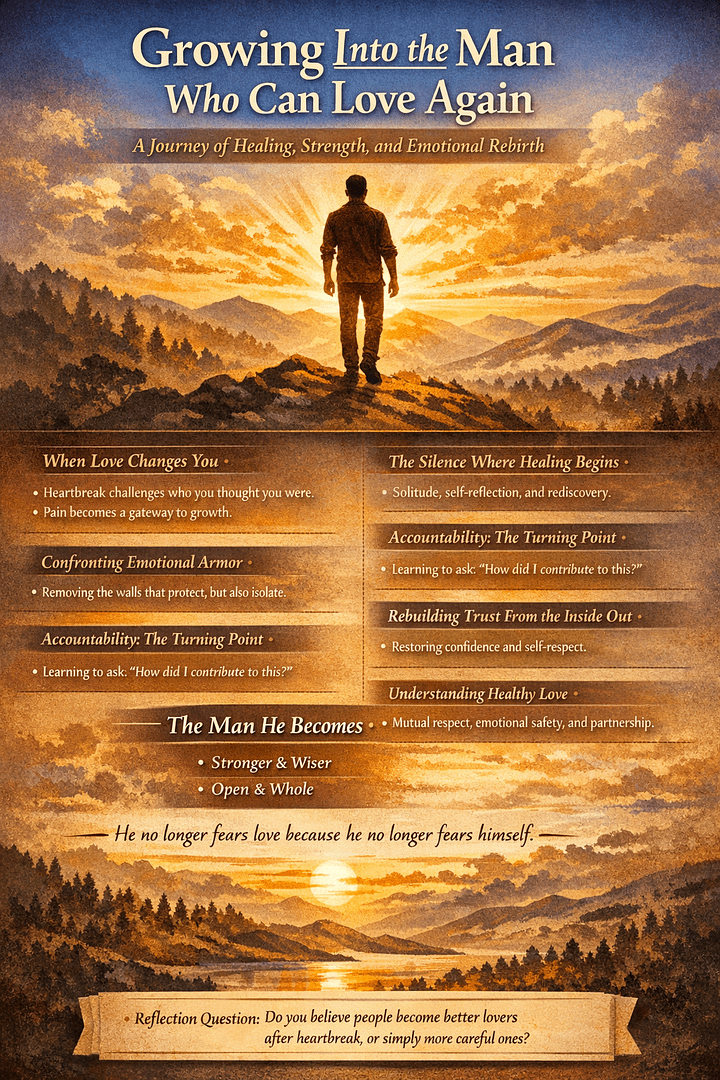
There is a version of a man that exists before heartbreak — hopeful, open, and often unaware of how deeply love can shape him. Then there is the version forged afterward: quieter, more guarded, carrying lessons written not in words but in experience.
Growing into the man who can love again is not about returning to who he once was. It is about evolving into someone wiser — someone who understands that love is not just emotion, but responsibility, presence, and courage.
This transformation does not happen overnight. It unfolds through reflection, discomfort, healing, and intentional growth.
When Love Changes You
Heartbreak does more than end relationships; it challenges identity. A man begins questioning his choices, his worth, and sometimes even his ability to trust his own judgment.
Memories replay.
Conversations echo.
Regrets surface.
He may wonder:
Was I not enough?
Did I love too much — or not enough?
Can I risk feeling this again?
These questions are not signs of weakness. They are signs of awakening. Pain forces introspection, and introspection becomes the doorway to growth.
The man who learns from heartbreak gains emotional depth that comfort could never teach.
The Silence Where Healing Begins
Healing often happens in solitude. Not isolation born from bitterness, but intentional distance meant for rediscovery.
In quiet moments, a man begins to reconnect with himself:
rediscovering hobbies he abandoned,
rebuilding friendships,
strengthening his physical and mental health,
learning to sit with his emotions instead of running from them.
He realizes that distractions delay healing, but reflection accelerates it.
This stage can feel lonely, yet it is essential. Because before he can offer love again, he must understand who he is without attachment.
Solitude becomes training ground, not punishment.
Confronting Emotional Armor
Many men respond to emotional pain by building armor — emotional distance, sarcasm, detachment, or hyper-independence. These defenses feel protective, but they quietly prevent connection.
Growth requires recognizing that armor designed to block pain also blocks love.
The man who is becoming ready again learns to:
express emotions without shame,
admit fears without feeling diminished,
apologize without ego,
and forgive without forgetting lessons.
He discovers that vulnerability is not exposure; it is authenticity.
And authenticity is where real connection lives.
Accountability: The Turning Point
True growth happens when blame fades and accountability begins.
Instead of focusing only on how he was hurt, a man begins asking deeper questions:
What patterns did I repeat?
Where did I fail to communicate?
What boundaries did I ignore?
What fears influenced my behavior?
Accountability is not self-condemnation. It is self-respect.
It transforms past mistakes into future wisdom.
The man who takes ownership of his growth becomes emotionally safer — not only for others, but for himself.
Rebuilding Trust From the Inside Out
Trusting someone new is impossible without first rebuilding trust in oneself.
After heartbreak, many men doubt their instincts. They fear misjudging character or repeating old cycles. Healing restores internal trust through consistency:
keeping promises to himself,
maintaining discipline,
honoring personal boundaries,
choosing peace over chaos.
Confidence slowly returns, not as loud bravado but as calm certainty.
He learns that love should add to his life, not rescue it.
Understanding Healthy Love
With maturity comes a new definition of love.
Love is no longer:
constant reassurance,
emotional dependency,
or sacrificing identity for connection.
Instead, love becomes:
mutual respect,
emotional safety,
shared growth,
honest communication,
and freedom to remain individuals while building together.
A grown man recognizes red flags without ignoring them and appreciates green flags he once overlooked — consistency, kindness, patience, and emotional maturity.
He stops chasing intensity and starts valuing stability.
Letting Go of Fear
Perhaps the greatest challenge in loving again is accepting uncertainty. No amount of growth guarantees a pain-free future.
But maturity teaches that avoiding risk also avoids joy.
The man who can love again understands:
heartbreak did not destroy him,
vulnerability did not weaken him,
and love itself was never the enemy.
Fear loses power when he realizes he survived his hardest emotional seasons.
Hope quietly replaces hesitation.
Loving With Wisdom Instead of Wounds
When he finally opens his heart again, something feels different.
He listens more carefully.
He communicates more clearly.
He sets boundaries calmly.
He chooses patience over reaction.
He no longer tries to prove his worth through love; he shares love from a place of wholeness.
His past becomes guidance, not baggage.
And for the first time, love feels peaceful rather than overwhelming.
The Man He Becomes
Growing into the man who can love again means becoming someone balanced between strength and softness.
He is:
strong enough to stand alone,
wise enough to grow continuously,
and open enough to welcome connection without losing himself.
He understands that love is not about perfection — it is about presence.
Not about possession — but partnership.
Not about avoiding pain — but embracing life fully despite it.
And one day, he realizes something profound:
He no longer fears love because he no longer fears himself.
He has grown into a man capable of loving deeply, honestly, and freely — not because he was never broken, but because he chose to heal.
Read More Of Inspiration & Motivation
Leave a Reply