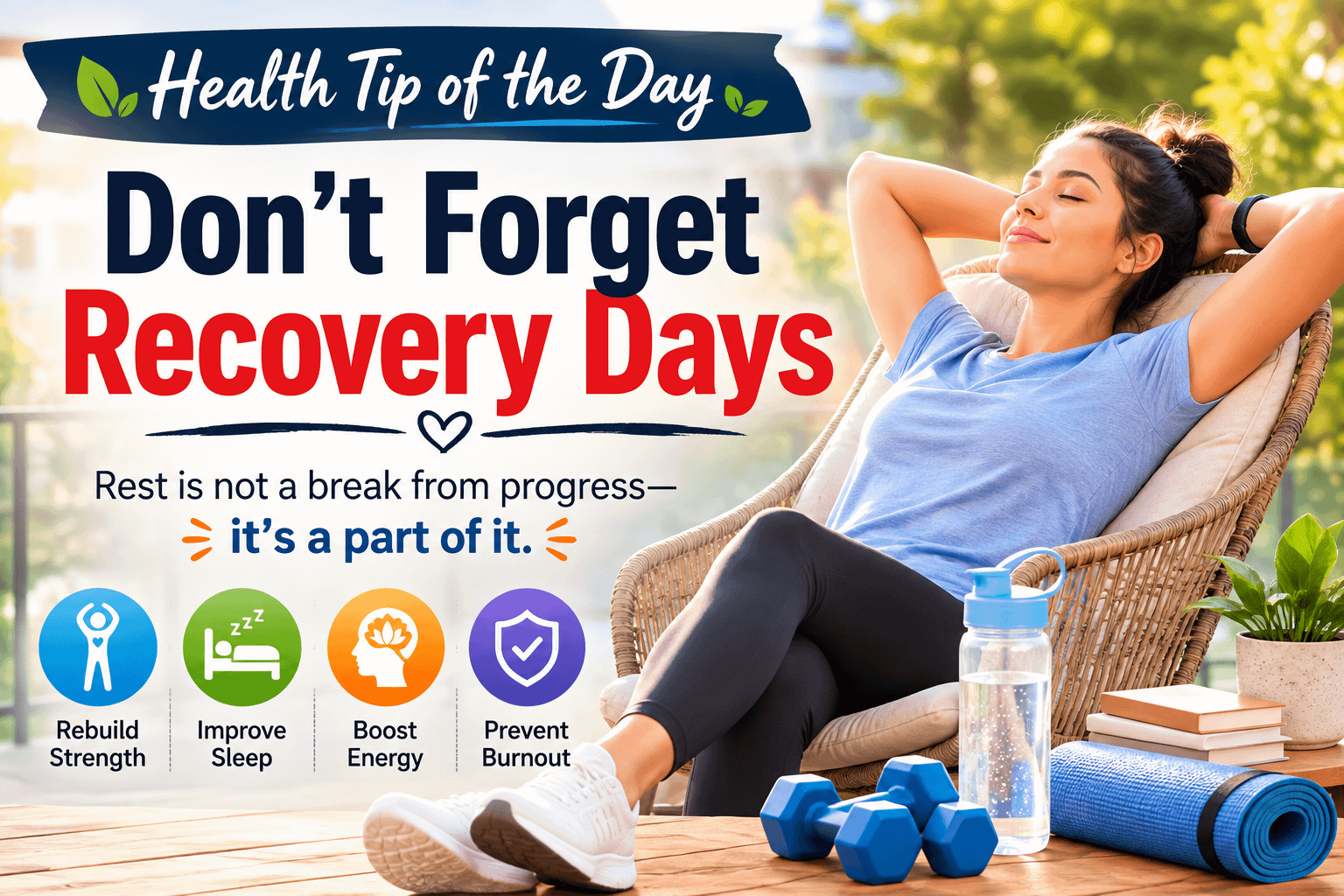
When people decide they want to improve their health, one of the first things they often focus on is doing more.
Walk more. Exercise more. Lift more. Burn more calories. Take more steps. Push harder. Stay active.
That motivation can be a powerful thing. Creating a regular exercise routine can improve strength, endurance, mobility, cardiovascular fitness, and overall well-being. But there is another side of fitness that doesn’t always receive the same attention.
Recovery.
Your body isn’t designed to operate at maximum effort every single day. Exercise challenges your body, but recovery gives your body the opportunity to adapt to those challenges.
That’s why today’s health tip is simple:
Don’t forget recovery days. Rest isn’t the opposite of progress. Rest is part of progress.
Whether you’re walking for better health, lifting weights, swimming, cycling, doing home workouts, playing sports, or simply trying to become more active, recovery deserves a place in your routine.
Exercise and Recovery Work Together
It’s easy to think that the workout itself is where all the progress happens.
You finish a difficult workout and think, “That made me stronger.”
But exercise is only one part of the process.
During physical activity, your muscles use energy and experience stress. Your cardiovascular system works harder. Your joints and connective tissues deal with repeated movement and impact. Your nervous system coordinates everything you’re doing.
Afterward, your body begins recovering.
It replenishes energy, repairs tissues, adapts to the physical demands you placed on it, and prepares itself for future activity.
Think about fitness as a cycle:
Challenge → Recover → Adapt → Repeat
Remove recovery from that cycle and you may eventually find yourself constantly tired rather than consistently improving.
Recovery Days Aren’t Lazy Days
Some people feel guilty when they take a day away from exercise.
They might think:
“I should be doing something.”
“I’m falling behind.”
“I’ll lose my progress.”
“I didn’t burn enough calories today.”
“Other people are exercising, so I should be exercising too.”
Those thoughts can turn fitness into something stressful instead of healthy.
A planned recovery day isn’t laziness.
It’s a deliberate decision to give your body the time it needs before asking it to perform again.
You aren’t abandoning your goals.
You’re supporting them.
Your Body Needs Time to Repair
Physical activity creates stress within the muscles and other tissues involved in movement. Your body responds by beginning repair and adaptation processes afterward.
That process requires time.
If you’re constantly stressing the same areas without enough recovery, fatigue can accumulate.
This is particularly important with strength training.
For example, if you’ve completed a challenging workout involving your legs, immediately performing another extremely demanding leg workout may not necessarily produce better results.
Your muscles need opportunities to recover from demanding training.
This doesn’t mean you can’t move the following day.
You might simply choose a different activity, train another muscle group, reduce the intensity, or take a recovery day.
Smart training isn’t always about doing more.
Sometimes it’s about knowing when enough is enough.
Recovery Helps Restore Your Energy
Exercise requires energy.
After a demanding workout, you might notice that you’re physically tired, mentally tired, or both.
That’s normal.
Your body needs opportunities to replenish what it used.
Adequate nutrition, hydration, sleep, and rest all contribute to this process.
When recovery is consistently neglected, workouts can begin feeling increasingly difficult.
You might notice that exercises that normally feel manageable suddenly seem exhausting.
Your usual walk feels harder.
Weights you normally handle comfortably feel heavier.
You don’t feel as motivated.
You have difficulty concentrating.
Your performance declines.
Sometimes the solution isn’t another energy drink, another supplement, or more determination.
Sometimes you simply need recovery.
Recovery Can Help You Perform Better
Imagine trying to complete a challenging workout when you’re exhausted.
Your movements may become slower.
Your concentration may decrease.
Your motivation may disappear.
You may cut your workout short.
Now imagine approaching that same workout after you’ve slept well, eaten properly, stayed hydrated, and allowed your body to recover.
You’re more likely to feel prepared.
That’s why rest days can actually improve the quality of future workouts.
The goal shouldn’t simply be accumulating as many workouts as possible.
The goal should be creating a routine where you can consistently perform well while supporting your overall health.
Learn the Difference Between Discomfort and Pain
Exercise can sometimes produce temporary discomfort.
Your muscles may feel tired.
Your breathing may become heavier.
You may experience ordinary post-workout soreness later.
But there is an important difference between expected exercise-related discomfort and pain that may indicate something is wrong.
Sharp, sudden, severe, worsening, or persistent pain shouldn’t simply be ignored.
Trying to prove your toughness by exercising through significant pain can potentially turn a small problem into a larger one.
If you’re experiencing concerning pain, significant swelling, loss of function, or symptoms following an injury, consider getting appropriate medical advice.
Your body doesn’t give awards for ignoring warning signs.
Listening to your body is part of taking care of it.
Active Recovery Can Keep You Moving
A recovery day doesn’t always require complete inactivity.
For many people, gentle movement can feel good on easier days.
This is often called active recovery.
Active recovery might include:
- An easy walk
- Gentle stretching
- Light mobility exercises
- Relaxed swimming
- Easy cycling
- Gentle yoga
- Casual outdoor activity
- Light household activities
- Playing outside with your family
- A comfortable walk through a park
The key word is easy.
A recovery walk shouldn’t accidentally become a competition with yesterday’s workout.
You shouldn’t finish active recovery feeling completely exhausted.
Think of it as movement designed to help you feel refreshed.
Complete Rest Has a Place Too
Active recovery can be helpful, but there will also be days when doing very little is appropriate.
Maybe you’ve completed several demanding workouts.
Maybe you haven’t been sleeping well.
Maybe work has been unusually stressful.
Maybe you’ve been traveling.
Maybe you’re physically exhausted.
Maybe your body simply feels like it needs a break.
It’s okay to rest.
You don’t have to turn every recovery day into another fitness challenge.
Sometimes recovery means stretching and walking.
Sometimes recovery means relaxing on the couch, watching a movie, reading a book, and going to bed early.
Both can have a place in a balanced lifestyle.
Sleep May Be Your Most Powerful Recovery Tool
You can buy expensive recovery products, supplements, massage devices, special clothing, and fitness gadgets.
But one of the most valuable recovery tools is something your body already requires:
Sleep.
Sleep supports physical recovery, mental performance, mood, energy regulation, and many other important functions.
If you’re exercising regularly while consistently sleeping poorly, your body may struggle to recover as effectively as you’d like.
Try creating a consistent nighttime routine.
Reduce unnecessary distractions before bed.
Make your bedroom comfortable.
Give yourself enough time to sleep instead of treating sleep as whatever time remains after everything else is finished.
Exercise matters.
Nutrition matters.
Hydration matters.
But sleep deserves a place beside them.
Nutrition Is Part of Recovery
Recovery doesn’t stop when you leave the gym or finish your walk.
What you eat afterward—and throughout the day—helps provide your body with the nutrients and energy it needs.
A balanced eating pattern that includes adequate protein, carbohydrates, healthy fats, fruits, vegetables, and other nutrient-rich foods can support your overall health and recovery.
Protein provides amino acids your body uses for maintaining and repairing tissues.
Carbohydrates help provide and replenish energy.
Healthy fats contribute to numerous normal bodily functions.
Vitamins and minerals support countless processes throughout your body.
You don’t necessarily need complicated recovery shakes or expensive products.
For many people, ordinary nutritious meals can provide what the body needs.
Think long-term rather than looking for one perfect “recovery food.”
Hydration Doesn’t End When the Workout Ends
Water is another important part of recovery.
You lose fluids throughout the day, and physical activity—especially exercise that causes significant sweating—can increase those losses.
Don’t wait until your next workout to think about hydration.
Drink fluids regularly throughout your day.
Your needs can vary depending on your body size, activity level, environment, diet, medications, and health circumstances.
Hot weather and prolonged exercise can also increase fluid needs.
Rather than thinking:
“I need water because I’m exercising.”
Think:
“Hydration is part of taking care of my body every day.”
Recovery Is Mental Too
Your muscles aren’t the only things that become tired.
Your mind can become exhausted from constantly trying to improve.
Fitness trackers, calorie goals, step counts, workout streaks, scales, and social media can sometimes make people feel like they must constantly be achieving something.
That pressure can become exhausting.
A recovery day can also be a mental break.
Put the fitness tracker aside for a while.
Stop worrying about beating yesterday’s step count.
Spend time doing something simply because you enjoy it.
Read.
Listen to music.
Spend time outside.
Call someone.
Watch your favorite show.
Work on a hobby.
Prepare a meal.
Relax.
Take a nap if you need one.
Your health is bigger than your workout statistics.
Stress Can Affect Recovery
Recovery isn’t determined solely by what happens during exercise.
Your entire life affects how you feel.
Work stress matters.
Family responsibilities matter.
Poor sleep matters.
Travel matters.
Emotional stress matters.
Busy schedules matter.
All of these things can contribute to fatigue.
That’s why two identical workouts may feel completely different depending on what else is happening in your life.
One week you may feel fantastic.
Another week the same routine may feel much harder.
Your exercise plan should have enough flexibility to recognize that you’re a human being—not a machine.
Your Recovery Needs May Change
There isn’t a universal rule saying everyone needs exactly the same number of recovery days.
Recovery needs depend on many factors, including:
- Exercise intensity
- Exercise duration
- Fitness level
- Training experience
- Age
- Sleep quality
- Nutrition
- Hydration
- Stress
- Work demands
- Physical activity outside of workouts
- Individual health considerations
Someone doing gentle 20-minute walks will have different recovery needs than someone completing demanding strength workouts several times per week.
And even your own needs can change.
You might need more recovery after an unusually challenging workout.
You might need additional rest during a stressful week.
You might recover more quickly after an easy session.
Instead of comparing yourself with someone else’s schedule, pay attention to how your body responds.
Beginners Especially Need to Respect Recovery
Starting a fitness routine can be exciting.
You feel motivated.
You’re ready to make changes.
You want results.
So you exercise hard on Monday.
Again on Tuesday.
Again Wednesday.
Thursday arrives and everything hurts.
By Friday, you’re exhausted.
Then the weekend arrives and you’re ready to quit.
This is one reason starting gradually can be helpful.
Your body needs time to adjust to increased physical activity.
You don’t have to prove anything during your first week.
The objective isn’t to survive the hardest workout possible.
The objective is to build habits you can maintain.
Consistency beats intensity that you can’t sustain.
Don’t Turn Exercise Into Punishment
Exercise shouldn’t be punishment for eating.
You don’t have to “work off” yesterday’s dinner.
You don’t have to exercise twice as long because you ate dessert.
And you don’t have to feel guilty for taking a recovery day because you think you haven’t earned it.
Movement can be something you do because you want to take care of yourself.
You can exercise because you want more energy.
Because you want to become stronger.
Because you want better endurance.
Because you enjoy being outdoors.
Because movement improves your mood.
Because you want to maintain independence.
Because you want to improve your overall quality of life.
Those are much healthier long-term motivations than constantly punishing yourself.
Avoid the “All or Nothing” Mentality
One of the biggest obstacles to long-term fitness is believing every day must be perfect.
You either complete your entire workout or the day was a failure.
You either hit your step goal or you failed.
You either exercise intensely or it doesn’t count.
Health doesn’t work that way.
There are many levels between doing absolutely nothing and completing a demanding workout.
Maybe today isn’t a 60-minute workout day.
Maybe it’s a 20-minute walk.
Maybe it’s 10 minutes of stretching.
Maybe it’s light mobility.
Maybe it’s complete rest.
All of those choices can fit into a healthy lifestyle.
You don’t have to be perfect to make progress.
Schedule Recovery Before You Need It
One of the best approaches is making recovery part of your plan rather than waiting until you’re completely exhausted.
If you know you’ve scheduled a demanding workout, consider what the following day should look like.
Maybe it’s another workout targeting different muscles.
Maybe it’s an easy walking day.
Maybe it’s active recovery.
Maybe it’s complete rest.
Planning recovery can also remove guilt.
Instead of waking up thinking:
“I’m skipping my workout today.”
You can think:
“Today is my scheduled recovery day.”
That small shift in perspective can make a major psychological difference.
Use Recovery Days to Support Other Healthy Habits
You can still make your recovery day productive without turning it into another workout.
Use the time to improve other areas of your health.
Prepare healthy meals.
Wash and organize your workout clothes.
Plan your meals for the week.
Refill your water bottles.
Go grocery shopping.
Spend time stretching.
Prepare your schedule.
Get outside.
Spend time with people you care about.
Reduce stress.
Go to bed earlier.
Recovery days can become days when you strengthen the habits surrounding your fitness routine.
Don’t Chase Soreness
Some people believe that if they’re not sore after exercising, their workout wasn’t effective.
That’s not necessarily true.
Soreness isn’t the only measurement of progress.
You can have an effective workout without struggling to walk the following day.
Instead of judging workouts entirely by soreness, look at broader indicators.
Are you becoming stronger?
Can you walk farther?
Do stairs feel easier?
Can you perform more repetitions?
Is your balance improving?
Do you have better endurance?
Are everyday activities becoming easier?
Are you exercising more consistently?
Those are meaningful forms of progress.
Recovery Can Support Long-Term Consistency
Imagine two people beginning a new fitness routine.
The first person exercises as hard as possible every single day.
Within several weeks, they’re exhausted and frustrated.
The second person exercises consistently but includes easier days and planned recovery.
Months later, they’re still exercising.
Who is more likely to make meaningful long-term progress?
Usually, the person who created a routine they could maintain.
Fitness isn’t a seven-day challenge.
It’s not a 30-day challenge.
Ideally, movement becomes part of your lifestyle for years.
That requires sustainability.
One Recovery Day Won’t Ruin Your Progress
Sometimes people panic when they miss a workout.
They think everything they’ve accomplished is disappearing.
It isn’t.
Your health isn’t determined by one day.
One workout won’t transform your body.
One unhealthy meal won’t destroy your health.
One recovery day won’t erase your fitness.
Look at the bigger picture.
What are you doing most weeks?
What habits are you maintaining over months?
Are you generally moving more?
Are you becoming stronger?
Are you improving your eating habits?
Are you sleeping better?
Are you taking better care of yourself?
Long-term patterns matter much more than individual days.
Rest Can Be an Act of Discipline
We often associate discipline with pushing harder.
But discipline can also mean stopping when appropriate.
It can mean recognizing that another intense workout isn’t what your body needs today.
It can mean going to bed instead of staying awake another two hours.
It can mean eating enough nutritious food to support your activity.
It can mean taking a recovery day even though part of you feels guilty.
Sometimes discipline means doing more.
Sometimes discipline means knowing when not to do more.
You Don’t Have to Compete With Social Media
Social media can make it seem like everyone else is constantly exercising.
Someone ran five miles before breakfast.
Someone completed an intense gym session.
Someone hit 20,000 steps.
Someone set a personal record.
What you don’t always see are their recovery days.
You don’t see every tired morning.
You don’t see every modified workout.
You don’t know their training history, schedule, genetics, health, responsibilities, or fitness level.
Your health journey isn’t a competition with someone else’s highlight reel.
Focus on your own progress.
Ask Yourself Better Questions
Instead of constantly asking:
“How hard can I push today?”
Try asking:
“What would help me become healthier today?”
Sometimes the answer will be a challenging workout.
Sometimes it’ll be a walk.
Sometimes it’ll be stretching.
Sometimes it’ll be preparing nutritious meals.
Sometimes it’ll be getting eight hours of sleep.
Sometimes it’ll be drinking more water.
Sometimes it’ll be sitting down and allowing your body to rest.
Health includes all of these things.
Build a Routine You Can Live With
The best exercise routine isn’t necessarily the hardest one.
It’s the routine you can realistically continue.
If your plan constantly leaves you exhausted, sore, stressed, or feeling guilty, it may be worth reconsidering how you’re approaching fitness.
A balanced routine leaves room for life.
There will be birthdays.
Vacations.
Busy workdays.
Family responsibilities.
Unexpected events.
Poor nights of sleep.
Stressful weeks.
And days when you’re simply tired.
Your routine should be flexible enough to survive those realities.
Recovery Days Are Part of Self-Care
Taking care of yourself means more than forcing yourself to accomplish something every day.
It means respecting your body’s needs.
Your body carries you through every workout, every workday, every responsibility, and every challenge.
Treat it accordingly.
Feed it.
Hydrate it.
Move it.
Challenge it.
Let it sleep.
And let it recover.
A Simple Recovery-Day Routine
Your recovery day doesn’t have to be complicated.
You could keep it as simple as:
Morning: Drink some water, eat a nutritious breakfast, and take a few minutes to gently move or stretch.
Afternoon: Take an easy walk if you feel like moving. Keep the pace comfortable.
Evening: Eat a balanced dinner, relax, reduce unnecessary stress, and prepare for a good night’s sleep.
That’s it.
No complicated recovery program required.
Sometimes simple habits are the most sustainable ones.
Recovery Is Where Patience Becomes Progress
We live in a culture that often celebrates constant productivity.
Do more.
Work harder.
Keep going.
Never stop.
But your body doesn’t measure success by how busy you are.
It responds to stress, nourishment, movement, sleep, and recovery.
If you want to become stronger and healthier, patience matters.
You don’t need immediate results.
You need consistent habits.
Some days will be about challenging yourself.
Other days will be about allowing yourself to recover from those challenges.
Both days matter.
Today’s Health Challenge
Take a moment to look at your current routine.
Ask yourself:
When was my last real recovery day?
If you’ve been exercising intensely without giving yourself much time to recover, consider scheduling an easier day.
Drink water.
Eat nutritious foods.
Take a gentle walk.
Stretch if it feels comfortable.
Get some extra sleep.
Give yourself permission to slow down.
Then notice how you feel when you return to your regular exercise.
You may discover that slowing down occasionally helps you move forward more consistently.
Health Tip of the Day: Don’t Forget Recovery Days
Improving your health isn’t about pushing your body until it has nothing left.
It’s about learning how to challenge your body while also taking care of it.
Exercise provides the stimulus.
Nutrition provides fuel.
Hydration supports normal function.
Sleep supports restoration.
Recovery gives your body time to prepare for what comes next.
All of these pieces work together.
So the next time you feel guilty about taking a recovery day, change the way you think about it.
You’re not quitting.
You’re not falling behind.
You’re not wasting time.
You’re recovering so you can continue.
Your health journey is measured over months and years, not by whether you completed a workout every single day.
Work hard when it’s appropriate.
Move regularly.
Eat well.
Stay hydrated.
Sleep.
Listen to your body.
And when it’s time to recover, recover without guilt.
Because sometimes one of the healthiest things you can do today is give your body what it needs to be ready for tomorrow.
Leave a Reply