It starts innocently enough. You pick up your phone to check a notification, read a message, or see what is happening in the world. A few minutes later, you are scrolling through breaking news, upsetting headlines, arguments, disasters, political conflicts, crime stories, and troubling posts.
Before you realize it, 30 minutes—or even an hour—has disappeared.
This habit is commonly called doomscrolling, and while staying informed is important, constantly consuming negative or emotionally intense information can leave you feeling mentally exhausted.
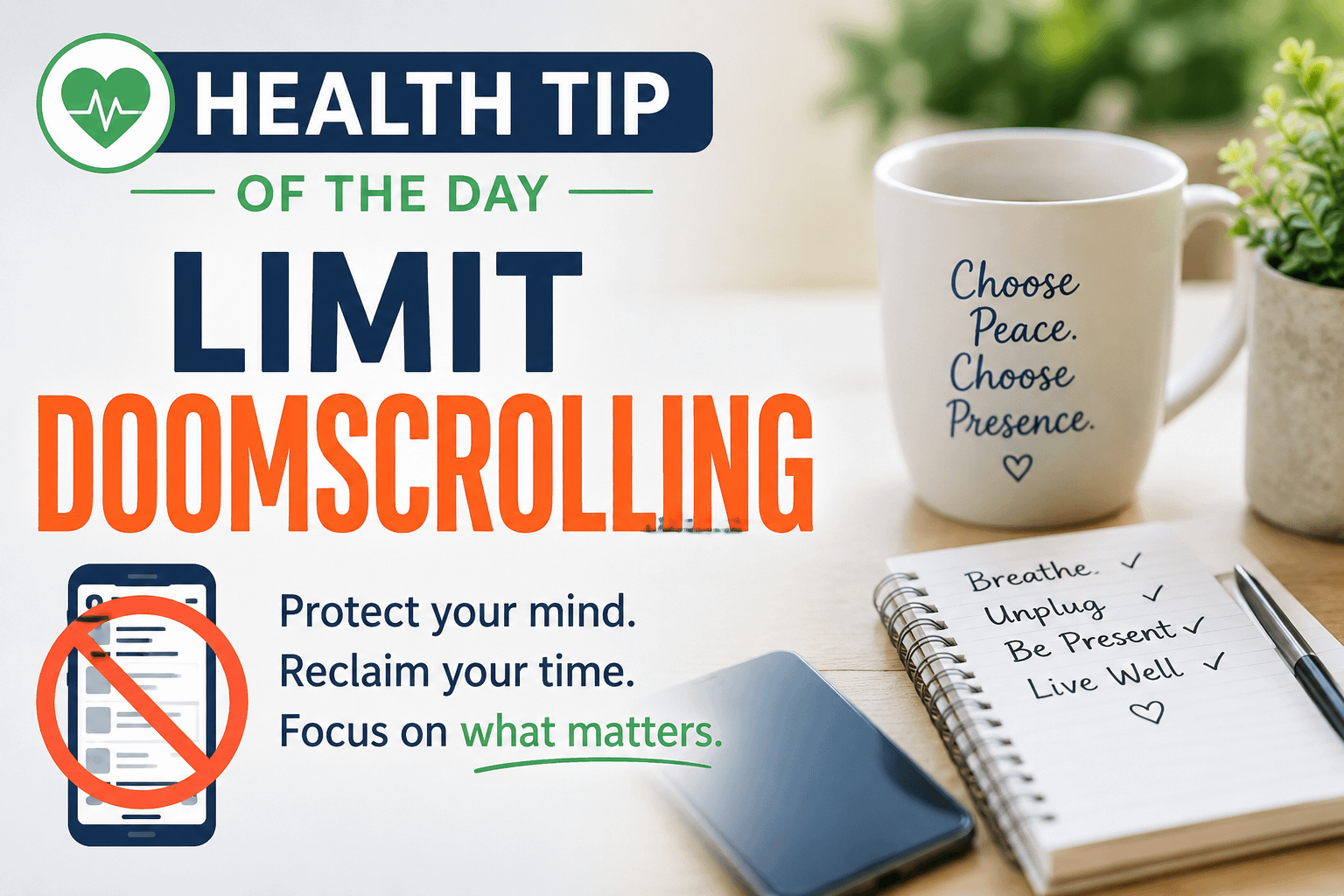
Today’s Health Tip of the Day is simple: Limit doomscrolling and give your mind permission to disconnect.
Your brain needs breaks from bad news just as your body needs breaks from physical activity. Creating healthier boundaries around your phone, social media, and news consumption can help protect your time, attention, sleep, and emotional well-being.
What Is Doomscrolling?
Doomscrolling is the habit of continuously scrolling through negative, frightening, stressful, or upsetting information online.
You may know you should stop, yet you keep looking.
One headline leads to another. One video leads to another. One social media post leads to a comment section, which leads to another discussion, another article, and another search.
The problem isn’t simply reading bad news. Difficult events are part of life, and staying informed about important issues can be valuable.
The problem begins when consuming negative information becomes repetitive and difficult to control.
Instead of learning what you need to know and moving on with your day, you become trapped in an endless cycle of searching for more information.
And there will almost always be more.
Why Is Doomscrolling So Hard to Stop?
Human beings naturally pay attention to potential threats.
For much of human history, noticing danger quickly was essential for survival. While the threats we encounter today may look very different, our brains can still become highly focused on information that appears dangerous, uncertain, or emotionally significant.
Your mind may essentially be asking:
What happened?
Could this affect me?
Has anything changed?
Is there something else I need to know?
The problem is that the internet never really gives you an answer of “You’re finished.”
There is always another update.
Another opinion.
Another video.
Another comment.
Another headline.
Another notification.
Social media feeds and news platforms can provide seemingly endless amounts of information. If you don’t intentionally decide when to stop, you can continue scrolling much longer than you originally intended.
Doomscrolling Can Steal Your Time
One of the most noticeable consequences of doomscrolling is lost time.
You might intend to spend five minutes checking your phone and suddenly discover that you’ve been scrolling for 45 minutes.
Think about what that time could have been used for.
You could have taken a walk.
Called someone you care about.
Prepared a healthy meal.
Read a few chapters of a book.
Worked on a personal goal.
Played with your children.
Cleaned part of your home.
Spent time outside.
Listened to music.
Prayed or reflected.
Or simply rested.
You don’t need to turn every free minute into something productive. Rest is valuable too.
But there is a significant difference between intentionally choosing to relax and accidentally losing an hour to your phone.
Taking control of your scrolling habits allows you to decide where your time goes instead of allowing an algorithm to decide for you.
Pay Attention to How You Feel After Scrolling
One useful way to evaluate your online habits is to notice how you feel afterward.
Ask yourself:
Do I feel better after spending 30 minutes scrolling?
Sometimes the answer may be yes. Perhaps you laughed at something, learned something useful, connected with friends, or discovered an interesting idea.
Other times, you may notice that you feel worse.
You might feel:
- Anxious
- Angry
- Frustrated
- Overwhelmed
- Helpless
- Distracted
- Mentally exhausted
- Irritable
- Afraid
- Discouraged
Those feelings are worth noticing.
You don’t necessarily need to eliminate social media or stop following current events. Instead, become more intentional about what you consume and how much of it you allow into your day.
Staying Informed Doesn’t Mean Staying Connected Constantly
One of the biggest reasons people continue checking the news is the fear that they will miss something important.
But you usually don’t need to monitor events every few minutes to stay informed.
Consider checking reliable news sources at specific times instead.
For example, you might check the news once in the morning and once later in the afternoon.
Read the important developments.
Learn what you need to know.
Then move on with your day.
If something truly significant happens, chances are you will hear about it.
Being informed and being constantly connected are not the same thing.
You can care deeply about what is happening in the world without allowing every breaking-news alert to interrupt your life.
Create a Time Limit for Scrolling
Setting a time limit can be one of the easiest ways to reduce doomscrolling.
Instead of opening social media with no stopping point, decide beforehand how long you will spend there.
Maybe you give yourself 10 or 15 minutes.
You can even set a timer.
When the timer goes off, close the app.
At first, this might feel surprisingly difficult. You may immediately think:
“Just one more post.”
That’s exactly when the boundary becomes valuable.
You are teaching yourself that you control when the scrolling ends.
Don’t Start and End Your Day With Bad News
The first and last parts of your day deserve special protection.
Imagine waking up, reaching for your phone, and immediately reading about disasters, violence, arguments, financial worries, political conflicts, and other upsetting events.
Before you have even gotten out of bed, your mind is already processing stress.
Now imagine beginning your day differently.
Stretch.
Drink some water.
Open the curtains.
Take a shower.
Eat breakfast.
Pray.
Write down something you’re grateful for.
Take a short walk.
Talk to someone you love.
Give yourself a little time to enter the day before inviting the entire world’s problems into your mind.
The same principle applies before bed.
Late-night doomscrolling can keep your mind engaged when it should be winding down.
Consider creating a phone-free period before bedtime.
Use that time for something quieter: reading, stretching, listening to calming music, preparing for tomorrow, talking with your family, or simply resting.
Turn Off Unnecessary Notifications
Every notification is an invitation to pick up your phone.
Breaking news.
Social media alerts.
Trending topics.
Recommended videos.
Suggested posts.
Someone commented.
Someone liked something.
Someone posted something.
Something is happening somewhere.
Most of these notifications aren’t emergencies.
Turning off unnecessary alerts reduces the number of times your attention is pulled toward your phone throughout the day.
You don’t have to respond to everything immediately.
The internet will still be there later.
Make Doomscrolling Slightly More Difficult
Small barriers can make a surprisingly big difference.
Try moving social media apps away from your phone’s home screen.
Log out after using them.
Disable automatic notifications.
Remove news widgets from your lock screen.
Use your phone’s built-in screen-time limits.
Keep your phone away from your bed.
Charge it across the room at night.
You don’t necessarily need enormous changes.
Sometimes adding just a few seconds between the urge to scroll and actually opening an app gives you enough time to reconsider.
You may catch yourself thinking:
“Why am I opening this?”
That moment of awareness can help break an automatic habit.
Replace Scrolling Instead of Simply Removing It
Habits are often easier to change when you replace them.
If you normally scroll when you’re bored, ask yourself what else you could do during those moments.
You might:
- Walk around the block.
- Listen to a podcast.
- Read a book.
- Make coffee or tea.
- Stretch for five minutes.
- Work on a hobby.
- Write in a journal.
- Call a friend.
- Sit outside.
- Play with a pet.
- Listen to your favorite music.
- Work on something you’ve been putting off.
You don’t need to replace doomscrolling with something impressive.
The goal is simply to give your mind another option.
Be Selective About Who and What You Follow
Your social media feed doesn’t appear randomly.
It is partly shaped by what you follow, click, watch, comment on, and interact with.
Take some time to clean up your feed.
Unfollow or mute accounts that consistently leave you angry, anxious, discouraged, or emotionally drained.
Then intentionally add content that contributes something positive to your life.
Follow accounts related to:
Healthy recipes.
Exercise.
Nature.
Art.
Comedy.
History.
Faith.
Personal development.
Travel.
Animals.
Music.
Hobbies.
Educational topics.
Inspirational stories.
Your online environment affects what you see every day.
Curating that environment can make your time online healthier and more intentional.
Don’t Live in the Comment Section
Sometimes the original article isn’t what causes the most stress.
It’s the comments underneath it.
People argue.
Insult each other.
Spread rumors.
Make extreme claims.
Attack strangers.
Turn complicated situations into angry debates.
You can easily spend far more time reading people’s reactions than reading the actual information.
Give yourself permission to skip the comments.
You don’t need to know what hundreds of strangers think about every issue.
Sometimes reading the facts and closing the page is enough.
Ask Yourself One Question Before Opening an App
Before opening social media or a news app, ask:
“What am I looking for?”
Maybe you’re checking today’s weather.
Maybe you’re responding to a message.
Maybe you’re looking for a recipe.
Maybe you’re checking the latest headlines.
Maybe you’re simply taking a short break.
Having a purpose helps prevent mindless scrolling.
Once you’ve accomplished what you intended to do, close the app.
This small habit can transform your relationship with technology from automatic consumption into intentional use.
Your Attention Is Valuable
Every app, website, advertisement, video, and headline is competing for one thing:
Your attention.
Your attention is limited.
Where you place it influences your thoughts, emotions, habits, relationships, and priorities.
That doesn’t mean you should ignore difficult realities.
It means you should decide how much access those realities receive to your mind each day.
You cannot personally carry every tragedy happening around the world.
You cannot solve every problem you read about.
And consuming another 100 upsetting posts doesn’t necessarily make you more informed or more prepared.
Sometimes the healthiest thing you can do is close the screen.
Give Your Brain Some Quiet
Modern life provides very few naturally quiet moments.
Standing in line?
Check the phone.
Waiting for food?
Check the phone.
Sitting in the car before an appointment?
Check the phone.
Commercial break?
Check the phone.
Five minutes before bed?
Check the phone.
We’ve become accustomed to filling nearly every empty moment with information.
But your brain doesn’t need constant stimulation.
Try allowing yourself to experience small moments without reaching for your phone.
Look out the window.
Notice your surroundings.
Think.
Daydream.
Pray.
Breathe.
Listen.
Let yourself be bored for a few minutes.
Quiet isn’t wasted time.
Sometimes it is exactly what your mind needs.
Try a Daily Digital Reset
Consider creating one period each day when you intentionally step away from screens.
It doesn’t need to be several hours.
Start with 20 or 30 minutes.
Put your phone somewhere else and do something offline.
Take a walk.
Eat dinner without your phone.
Sit outside.
Work in the yard.
Cook.
Exercise.
Talk with your family.
Read.
Take a shower.
Clean.
Relax.
The activity itself isn’t particularly important.
What matters is reminding yourself that you can exist without constantly checking what is happening online.
Over time, those small breaks can become something you look forward to.
Don’t Let the World’s Worst Moments Become Your Entire View of the World
News naturally focuses on unusual and significant events.
Unfortunately, those events are often negative.
Accidents.
Crime.
War.
Conflict.
Natural disasters.
Economic problems.
Political controversies.
Scandals.
If this becomes most of what you consume, it can become easy to believe that everything everywhere is terrible.
But while difficult things are happening, countless good things are happening too.
Someone is helping a stranger.
Someone is recovering.
Someone is volunteering.
Someone is falling in love.
Someone is adopting a pet.
Someone is rebuilding their life.
Someone is graduating.
Someone is feeding a hungry family.
Someone is forgiving another person.
Someone is starting over.
Someone is quietly doing something kind without ever posting about it.
The internet’s loudest stories don’t represent every moment of human life.
Sometimes you need to look away from your screen and notice the world directly around you.
You Don’t Have to Know Everything Right Now
One of the healthiest boundaries you can create with information is accepting that you don’t need to know everything immediately.
The latest update can wait.
The trending topic can wait.
The argument can wait.
The comments can wait.
The notification can wait.
You are allowed to put your phone down.
You are allowed to enjoy dinner without checking the news.
You are allowed to watch a movie without checking social media.
You are allowed to spend an afternoon outside without knowing what is trending.
You are allowed to protect some parts of your day from the constant stream of information.
A Healthier Relationship With Your Phone
The goal isn’t necessarily to delete every social media account or completely disconnect from the internet.
Technology can be incredibly useful.
It helps us communicate, learn, work, discover new ideas, stay informed, and maintain relationships.
The goal is intentional use.
Use technology when it serves you.
Put it down when it starts consuming your attention without giving anything meaningful back.
Some days you’ll do this better than others.
That’s okay.
Changing digital habits takes practice.
Start small.
Turn off a few notifications.
Move one distracting app.
Set one time limit.
Take one phone-free walk.
Stop scrolling 30 minutes before bed.
Small boundaries can gradually create healthier habits.
Final Thoughts
Doomscrolling can make you feel as though you’re accomplishing something because you’re gathering information. But there comes a point when more information stops being useful and simply becomes more mental noise.
You don’t have to carry the weight of the entire internet.
Stay informed about the things that matter.
Pay attention to what is happening in your community and around the world.
But also recognize when you’ve had enough for today.
Close the app.
Put down your phone.
Step outside.
Talk to someone.
Listen to music.
Make dinner.
Watch the sunset.
Read something uplifting.
Spend time with people you love.
Give your mind an opportunity to experience life beyond the screen.
The world will still be there when you return.
Health Tip of the Day: Set boundaries around news and social media consumption, especially first thing in the morning and before bed. Even a short daily break from constant scrolling can help you reclaim your attention and make more room for the people, activities, and experiences happening right in front of you.
How much time could you reclaim each day if you replaced just 30 minutes of doomscrolling with something that genuinely makes you feel better?
Leave a Reply