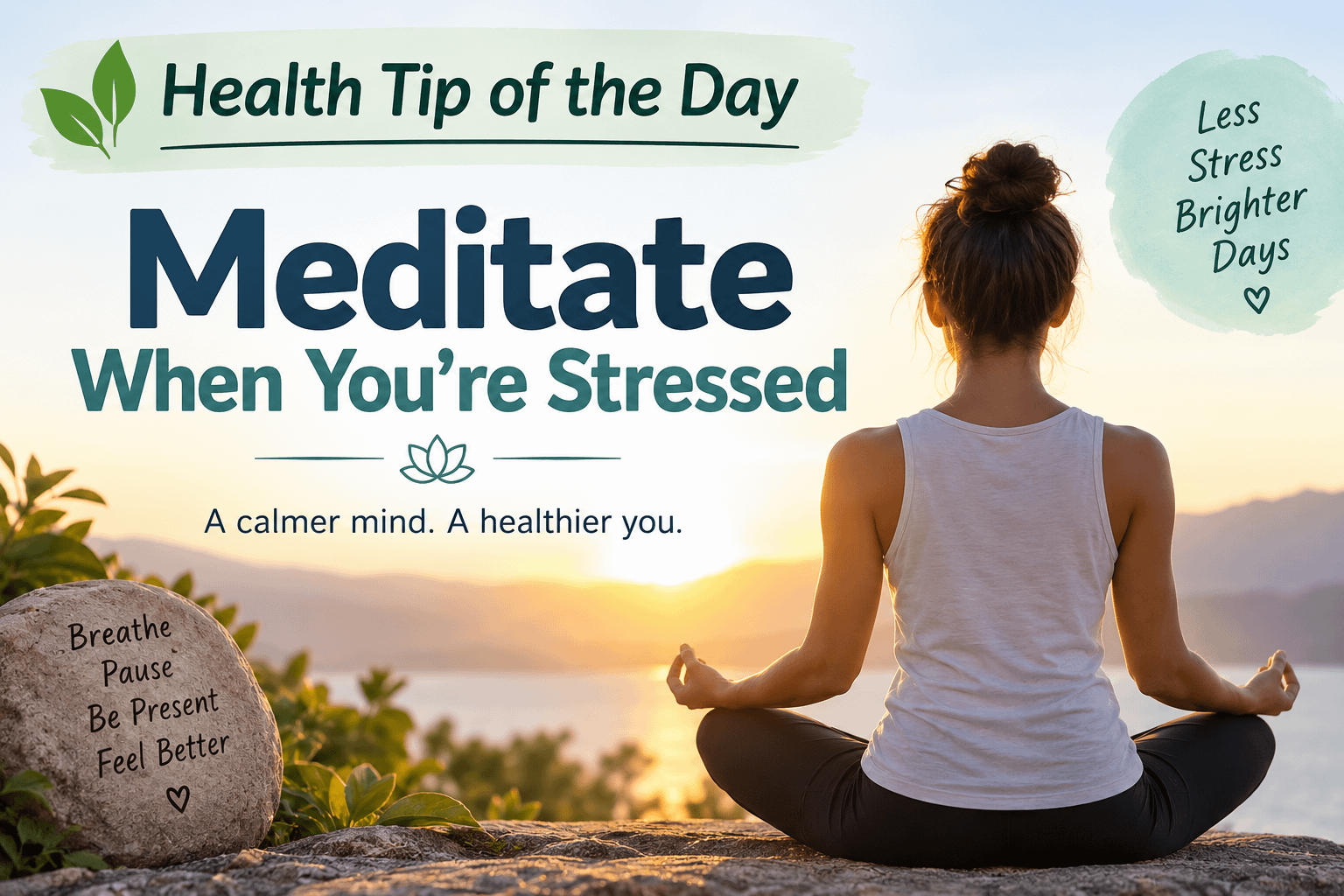
Stress has a way of showing up when we least need it.
It can hit during a busy workday, after an uncomfortable conversation, while dealing with financial pressures, when thinking about the future, or even late at night when everything around us has finally become quiet. Sometimes there is an obvious reason for feeling stressed. Other times, we simply notice that our mind is racing, our muscles are tense, and we cannot seem to relax.
When that happens, one simple habit may help:
Meditate.
Meditation does not require hours of silence, special equipment, or a perfectly peaceful environment. Even a few minutes of intentional stillness and focused breathing can give you an opportunity to slow down and regain your composure.
Today’s health tip is simple: When stress starts building, give yourself a few minutes to meditate instead of allowing the stress to control the rest of your day.
Stress Affects More Than Your Mood
We often think about stress as an emotional problem, but stress can affect the entire body.
When you experience stress, your body activates its natural stress response. This response can be useful when you are facing an immediate challenge because it prepares you to react quickly.
The problem occurs when stress becomes frequent or persistent.
You may notice symptoms such as:
- Muscle tension
- Headaches
- Difficulty sleeping
- Irritability
- Racing thoughts
- Trouble concentrating
- Changes in appetite
- Feeling overwhelmed
- Fatigue
- Restlessness
- A faster heartbeat
Everyone experiences stress differently, but the important thing is recognizing when your body and mind are telling you that you need a break.
Meditation can become one of the tools you use during those moments.
What Is Meditation?
Meditation is the practice of intentionally focusing your attention.
There are many different types of meditation, but you do not have to master complicated techniques to benefit from taking a few quiet moments.
One of the easiest approaches is simply focusing on your breathing.
Instead of thinking about everything that happened yesterday or worrying about everything that could happen tomorrow, you bring your attention back to what is happening right now.
You breathe in.
You breathe out.
You notice your thoughts without feeling obligated to chase every one of them.
That sounds incredibly simple, but simplicity is part of what makes meditation useful.
Our minds spend so much time jumping between responsibilities, worries, memories, notifications, conversations, and plans that intentionally doing one thing for several minutes can provide a welcome mental reset.
You Don’t Have to Stop Thinking
One of the biggest misconceptions about meditation is that you have to completely empty your mind.
That expectation can actually make meditation more frustrating.
Thoughts are going to appear.
You might sit down to meditate and suddenly remember that you need groceries.
Then you remember an email you forgot to answer.
Then you start thinking about tomorrow.
Then you remember something embarrassing that happened ten years ago.
That’s normal.
Meditation isn’t necessarily about preventing thoughts from appearing. Instead, you practice noticing when your attention has wandered and gently bringing it back to your chosen focus.
For a simple breathing meditation, that focus is your breath.
Your mind wanders.
You notice it.
You return to your breathing.
That process itself is part of the practice.
Try a Five-Minute Stress Meditation
The next time you notice stress building, try giving yourself five minutes.
Find somewhere reasonably comfortable where you can sit without being disturbed.
You don’t need complete silence. You simply need a place where you can safely pause.
Sit comfortably and relax your shoulders.
Close your eyes if that feels comfortable, or simply lower your gaze.
Then begin noticing your breathing.
Don’t worry about forcing yourself to breathe in a particular way. Start by noticing your natural breath.
After a few moments, you can intentionally slow your breathing.
Take a comfortable breath in.
Pause briefly.
Slowly breathe out.
Continue breathing comfortably while paying attention to the sensation of each breath.
If stressful thoughts appear, acknowledge them without criticizing yourself.
Then bring your attention back to your breathing.
Continue for several minutes.
When you’re finished, don’t immediately jump up and rush back into whatever you were doing.
Give yourself a moment.
Notice how your body feels.
Notice whether your shoulders have relaxed.
Notice whether your thoughts feel slightly less chaotic.
You may not eliminate every stressful feeling, but even creating a little distance between yourself and your stress can be valuable.
Meditation Can Be Short
There is no rule saying meditation has to last 20, 30, or 60 minutes.
Sometimes you only have two minutes.
Use them.
A two-minute meditation is better than deciding you don’t have enough time to meditate at all.
You can meditate for a few minutes before leaving for work.
You can meditate during your lunch break.
You can sit quietly in your parked car before walking into an appointment.
You can meditate after arriving home.
You can spend a few minutes meditating before bed.
You can even take several intentional breaths while sitting at your desk.
The goal isn’t perfection.
The goal is developing the habit of recognizing stress and responding to it in a healthier, more intentional way.
Meditation Creates a Pause Between Feeling and Reacting
Stress can make us reactive.
Someone says something frustrating, and we immediately respond.
Something goes wrong, and suddenly it feels like the entire day has been ruined.
An unexpected problem appears, and our minds instantly jump toward the worst possible outcome.
Meditation can help you practice pausing.
That pause can become incredibly valuable.
Instead of immediately reacting to every stressful feeling, you learn to notice what you’re experiencing.
You might recognize:
“I’m frustrated right now.”
Or:
“I’m overwhelmed.”
Or:
“I’m worrying about something that hasn’t happened yet.”
Recognizing the emotion doesn’t automatically make it disappear.
But awareness can give you more control over what you do next.
You can decide whether the situation requires action, patience, a conversation, rest, or simply a little time.
Use Your Breath as an Anchor
Your breathing is always with you, which makes it one of the easiest tools for meditation.
You don’t need an app.
You don’t need music.
You don’t need candles.
You don’t need a meditation room.
You simply need a moment to pay attention.
When your mind starts racing, bring your attention to your breathing.
Notice the air entering your nose.
Notice your chest or abdomen moving.
Notice the air leaving your body.
If your attention wanders, return to your breath.
Think of your breathing as an anchor bringing you back to the present moment.
You may have to return to it dozens of times during a meditation session.
That’s okay.
Every return is part of the practice.
Meditation Doesn’t Mean Ignoring Your Problems
Meditation should not become a way of pretending that problems don’t exist.
If you’re stressed because something needs to be addressed, you may still need to take action.
You may need to have a difficult conversation.
You may need to make a decision.
You may need to reorganize your schedule.
You may need to ask someone for help.
You may need professional guidance.
Meditation doesn’t magically solve those problems.
What it can do is give you an opportunity to approach them with a calmer mind.
Instead of making an important decision while your emotions are at their highest point, you can pause, breathe, settle yourself, and then determine your next step.
Create a Small Meditation Routine
Meditation can be especially useful when it becomes part of your regular routine instead of something you only try when you’re completely overwhelmed.
Start small.
Choose five minutes during your day.
Maybe it’s shortly after waking up.
Sit quietly before checking your phone and think about your breathing.
Or make meditation part of your evening routine.
Turn off the television, put your phone aside, sit somewhere comfortable, and spend several minutes quietly breathing.
Consistency matters more than trying to create the perfect meditation session.
Five minutes each day can help you develop the habit.
Once meditation becomes familiar, you’re more likely to remember it when a stressful moment arrives.
Try a Simple Body Scan
Breathing meditation isn’t your only option.
Another simple technique is a body scan.
Sit or lie somewhere comfortable.
Begin by noticing your feet.
Are they relaxed?
Are you holding tension there?
Gradually move your attention upward.
Notice your legs.
Your hips.
Your stomach.
Your chest.
Your hands.
Your arms.
Your shoulders.
Your neck.
Your jaw.
Your forehead.
Stress often causes us to tighten muscles without realizing it.
You may discover that your shoulders are raised, your hands are clenched, or your jaw is tight.
As you notice those areas, intentionally allow them to relax.
Combine the body scan with slow, comfortable breathing.
This can be especially helpful after a stressful day when you feel like you’re carrying tension throughout your body.
Walking Can Become Meditation Too
Sitting still isn’t comfortable for everyone.
If traditional meditation doesn’t appeal to you, try mindful walking.
Put your phone away and take a short walk.
Instead of spending the entire walk thinking about your problems, intentionally notice what’s around you.
Feel your feet touching the ground.
Notice the temperature.
Listen to the sounds around you.
Look at the trees, buildings, clouds, or whatever happens to be nearby.
Pay attention to your breathing.
When your thoughts drift back toward your worries, gently return your attention to your surroundings.
You’re giving your brain something different to focus on while also getting your body moving.
Meditation Before Bed
Stress often becomes louder at night.
During the day, we’re surrounded by activity and distractions. Then we finally lie down, the room becomes quiet, and our minds decide it’s time to review every problem in our lives.
A short meditation before bed can become part of your nighttime wind-down routine.
Dim the lights.
Put your phone aside.
Get comfortable.
Spend five or ten minutes focusing on slow, relaxed breathing.
When thoughts about tomorrow appear, remind yourself that you can deal with tomorrow when it arrives.
For now, your job is simply to rest.
Meditation isn’t guaranteed to make you immediately fall asleep, but establishing a calming routine may help you transition away from the stimulation and stress of the day.
Don’t Judge Your Meditation
Some meditation sessions will feel peaceful.
Others won’t.
There will be days when your mind wanders constantly.
There may be days when five minutes feels like 30.
Don’t turn meditation into another thing you have to be perfect at.
You aren’t failing because you became distracted.
You aren’t doing it wrong because stressful thoughts appeared.
You noticed that your mind wandered and returned your attention to the present.
That’s the practice.
Over time, meditation may begin to feel more natural.
Know When Stress Requires More Support
Meditation can be a useful stress-management practice, but it isn’t a replacement for appropriate medical or mental-health care.
If stress or anxiety is persistent, severe, interfering with your sleep or everyday life, or causing concerning physical symptoms, consider speaking with a qualified healthcare professional.
And if you experience new or severe symptoms such as significant chest pain, difficulty breathing, fainting, or other potentially urgent symptoms, don’t assume they’re simply caused by stress. Seek appropriate medical attention.
Taking care of your health includes knowing when a self-care strategy is enough and when additional help is necessary.
Today’s Health Challenge
At some point today, intentionally stop for five minutes.
Put down your phone.
Step away from whatever you’re doing if it’s safe to do so.
Sit comfortably.
Relax your shoulders.
Close your eyes or lower your gaze.
Breathe slowly.
Don’t worry about solving everything.
Don’t worry about tomorrow.
Don’t replay yesterday.
For those five minutes, simply be where you are.
When thoughts appear, notice them and return your attention to your breathing.
Then continue with your day.
You may discover that those five minutes become something you look forward to.
Final Thoughts
Stress is an unavoidable part of life.
There will always be responsibilities, unexpected problems, difficult conversations, busy days, and situations beyond our control.
We may not always be able to control what causes stress, but we can work on how we respond to it.
Meditation gives us an opportunity to stop reacting for a moment and simply breathe.
It doesn’t require perfection.
It doesn’t require an hour.
It doesn’t require expensive equipment.
Sometimes all you need is a quiet place, a few minutes, and your breath.
So the next time you feel stress beginning to take over, don’t immediately let yourself get pulled deeper into the chaos.
Pause.
Sit down.
Breathe.
Give your mind a few minutes of stillness.
Then take the next step.
When you’re feeling stressed, what helps you slow down, clear your mind, and feel more grounded?
Leave a Reply