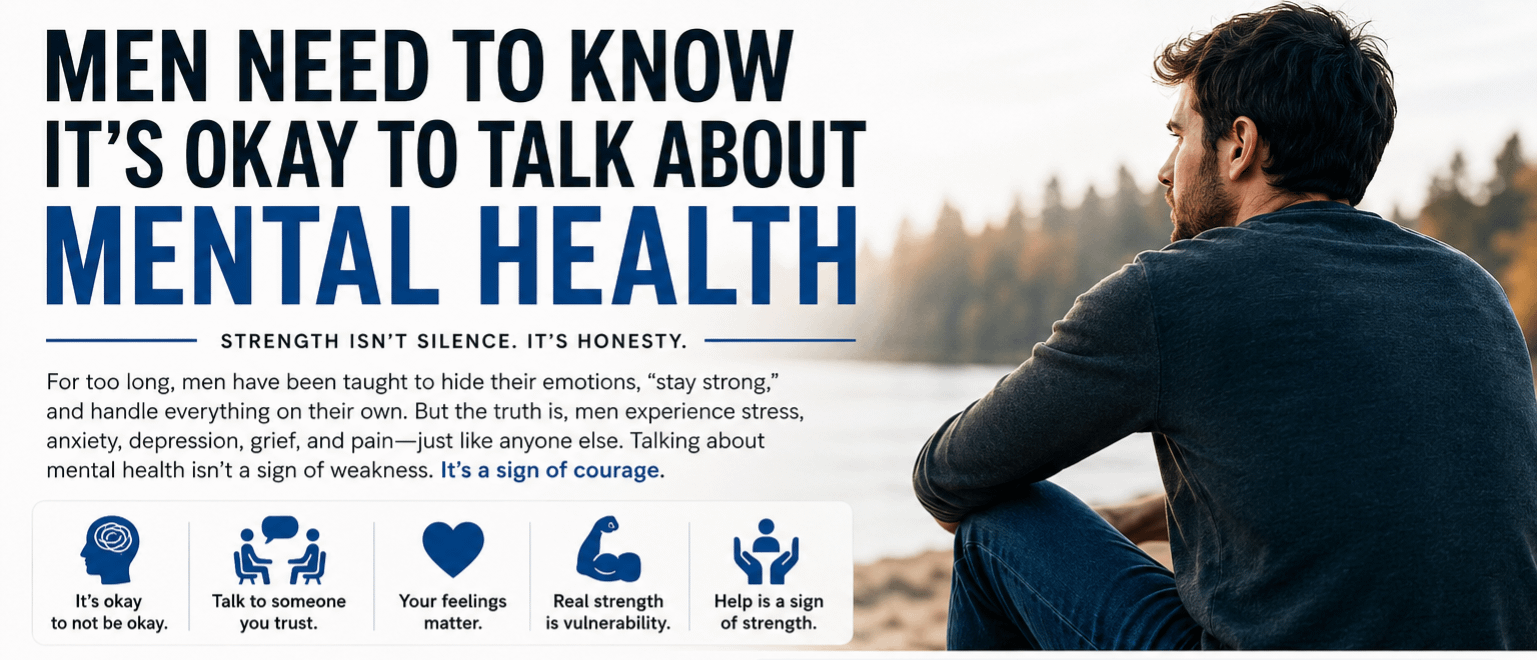
For generations, men have been taught a dangerous lesson: stay strong, keep your emotions to yourself, and never let anyone see you struggle. Many boys grow up hearing phrases like “man up,” “be tough,” “don’t cry,” or “handle it yourself.” While these messages may be intended to encourage resilience, they often create a culture where men feel ashamed to admit when they are hurting.
The truth is simple: men experience emotional pain just like everyone else. They face anxiety, depression, grief, loneliness, stress, trauma, and heartbreak. Yet countless men suffer in silence because they fear being judged, misunderstood, or viewed as weak.
It’s time to change that conversation.
The Silent Battle Many Men Fight
Mental health challenges do not discriminate. They affect men from every walk of life—fathers, sons, husbands, veterans, business owners, athletes, laborers, and professionals. On the outside, a man may appear successful and confident while privately fighting battles nobody can see.
Many men become experts at hiding their pain.
They go to work.
They pay the bills.
They take care of their families.
They smile when asked how they’re doing.
And when someone asks if everything is okay, they often respond with the same two words:
“I’m fine.”
But beneath those words may be overwhelming stress, grief, depression, fear, or emotional exhaustion.
Research continues to show that many men are willing to discuss their mental health when they feel safe, supported, and free from judgment, yet societal expectations often discourage those conversations.
Why Men Often Stay Silent
Many men learn early in life that vulnerability carries consequences.
Perhaps they were teased for crying.
Perhaps they were told to toughen up.
Perhaps they grew up believing that strength meant handling everything alone.
As adults, these lessons can become deeply ingrained beliefs:
- Asking for help is weakness.
- Talking about emotions is uncomfortable.
- Other people have bigger problems.
- Nobody will understand anyway.
- I should be able to fix this myself.
These beliefs create emotional walls that become harder to break down over time.
Unfortunately, silence doesn’t make pain disappear.
It simply allows it to grow.
The Cost of Carrying Everything Alone
When mental health struggles go unaddressed, they often affect every area of life.
Relationships may suffer.
Sleep becomes difficult.
Work performance declines.
Physical health can deteriorate.
Many men turn to unhealthy coping mechanisms such as excessive work, alcohol, isolation, anger, or emotional withdrawal.
What starts as stress can slowly become burnout.
What begins as sadness can develop into depression.
What feels like loneliness can become overwhelming isolation.
The longer emotional pain remains hidden, the heavier it becomes.
Strength and Vulnerability Can Exist Together
One of the biggest misconceptions about masculinity is that vulnerability and strength are opposites.
They are not.
In fact, some of the strongest moments in a man’s life involve vulnerability.
It takes courage to admit you’re struggling.
It takes courage to ask for help.
It takes courage to tell a friend, “I’m not doing okay.”
Real strength is not pretending everything is fine.
Real strength is facing reality honestly.
A man who talks about his mental health is not weak.
He is brave enough to confront what many others try to avoid.
Breaking the Stigma
The stigma surrounding men’s mental health is slowly changing.
More athletes, actors, military veterans, and public figures are openly discussing their experiences with depression, anxiety, grief, and therapy. These conversations are helping redefine what strength looks like.
But cultural change doesn’t happen through celebrities alone.
It happens in everyday conversations.
It happens when a father tells his son it’s okay to cry.
It happens when friends check in on one another.
It happens when a husband tells his wife he’s overwhelmed.
It happens when a grieving father admits that losing his child still hurts every day.
Every honest conversation chips away at the stigma.
Grief and Men’s Mental Health
For many men, grief is one of the most misunderstood emotional experiences.
Society often expects men to be the strong one during tragedy. They are expected to hold everything together for their family while suppressing their own pain.
But grief doesn’t disappear because it’s hidden.
Whether it’s the loss of a child, spouse, parent, sibling, or friend, grief affects men deeply.
Many grieving fathers, in particular, suffer in silence because they feel responsible for supporting everyone else.
The reality is that healing begins when grief is acknowledged rather than buried.
Talking about loss does not make a man weak.
It honors the love that still exists.
How Men Can Begin Opening Up
If you’re struggling, you don’t need to share your entire life story today.
Start small.
Talk to one trusted friend.
Speak with a family member.
Join a support group.
Write your thoughts in a journal.
Schedule a conversation with a counselor or therapist.
One honest conversation can become the first step toward healing.
You don’t have to have all the answers.
You don’t have to explain everything perfectly.
You simply have to begin.
How We Can Support the Men in Our Lives
If you know a man who may be struggling, don’t wait for him to ask for help.
Reach out.
Ask how he’s doing.
Listen without immediately trying to fix the problem.
Avoid judgment.
Avoid telling him to “get over it.”
Sometimes the most powerful thing you can do is simply sit beside someone and let them know they are not alone. Supportive conversations often work best when they occur naturally during shared activities rather than formal confrontations.
A New Definition of Strength
The old definition of masculinity told men to suffer silently.
A healthier definition recognizes that courage includes honesty.
Strong men cry.
Strong men grieve.
Strong men ask for help.
Strong men talk about their mental health.
Strong men heal.
No man should feel ashamed for experiencing emotions that are part of being human.
You are not weak because you struggle.
You are not broken because you hurt.
You are not less of a man because you need support.
Your mental health matters.
Your story matters.
And your voice deserves to be heard.
If you’re carrying a burden today, remember this:
You don’t have to carry it alone.
Leave a Reply