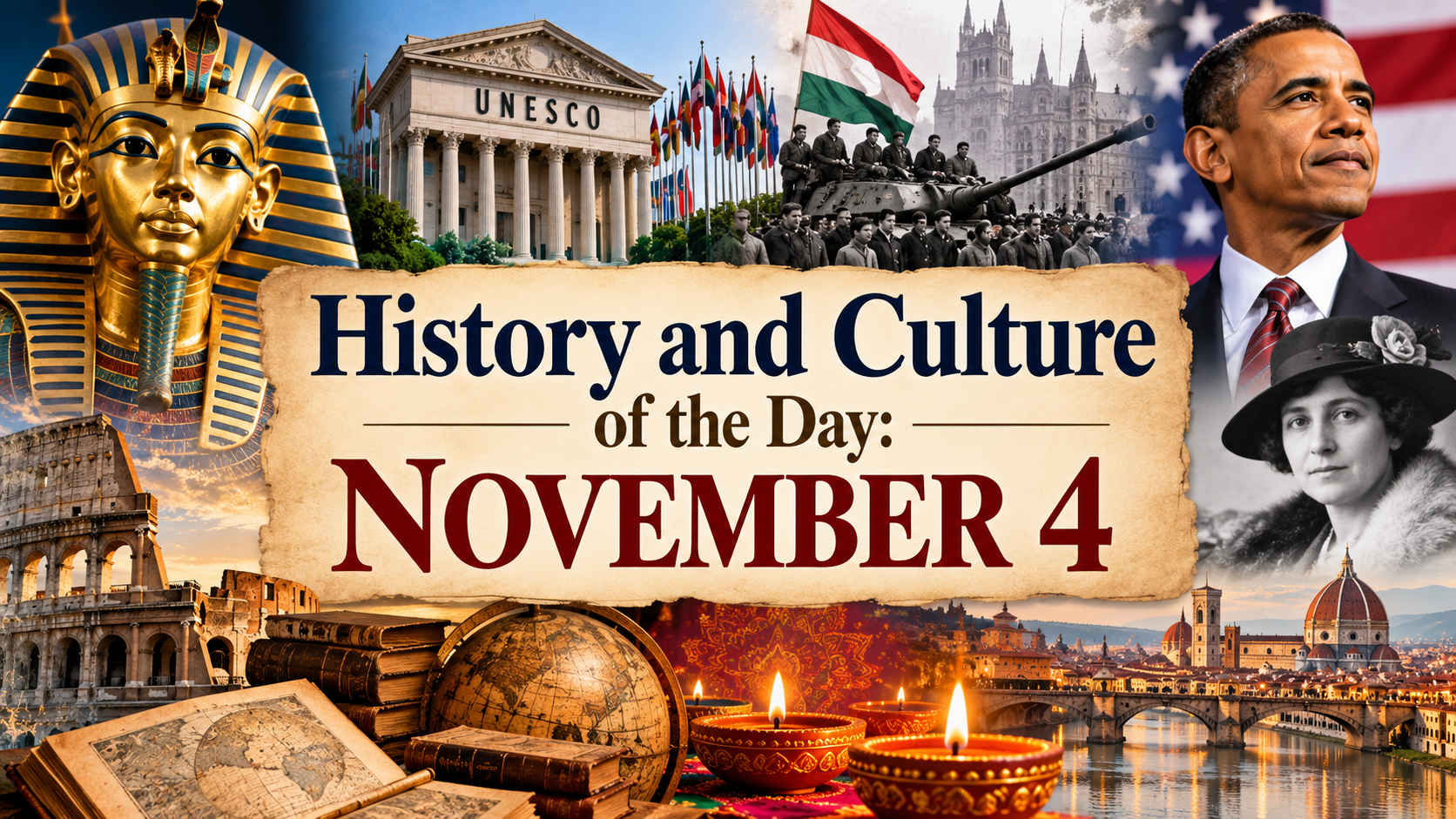
November 4 is a day filled with fascinating historical events, cultural achievements, political transformations, and remarkable stories that have helped shape civilizations around the world. From the discovery of ancient treasures to the establishment of international organizations, this date reminds us how history connects the past with the present.
Throughout the centuries, November 4 has witnessed moments of discovery, courage, artistic expression, and social change. Some events changed the direction of entire nations, while others influenced how people understand culture, education, freedom, and human achievement.
History is more than a collection of dates and names. It is the story of people, their struggles, their accomplishments, and the legacies they leave behind.
Today, we explore some of the most interesting historical and cultural events associated with November 4, along with the traditions, influential figures, and lasting lessons connected to this remarkable date.
1. 1922 – The Discovery of King Tutankhamun’s Tomb Begins a New Chapter in Archaeology
One of the most celebrated archaeological discoveries in history began on November 4, 1922, when British archaeologist Howard Carter’s team discovered the first step of a staircase leading to the tomb of the ancient Egyptian pharaoh Tutankhamun.
The discovery took place in Egypt’s Valley of the Kings, a burial ground that had served as the final resting place for numerous Egyptian rulers.
For years, Carter had searched for the tomb of the young pharaoh, whose burial location remained a mystery.
When workers uncovered the staircase, it marked the beginning of a discovery that would capture worldwide attention.
Why the discovery mattered
Tutankhamun ruled ancient Egypt during the 18th Dynasty and died while still a teenager.
Although his reign was relatively short, the discovery of his tomb transformed him into one of the most recognizable figures of ancient history.
The tomb contained thousands of objects, including jewelry, furniture, ceremonial items, and the famous golden burial mask.
These treasures provided extraordinary insight into ancient Egyptian beliefs about death, religion, royalty, and the afterlife.
The discovery also inspired a worldwide fascination with Egyptology.
Museums, historians, archaeologists, and ordinary people became captivated by the civilization that had flourished along the Nile thousands of years earlier.
Cultural significance
The discovery of Tutankhamun’s tomb demonstrated how archaeology can reconnect modern societies with civilizations that existed long before recorded modern history.
It also raised important questions about cultural heritage, preservation, and the responsibility of protecting ancient artifacts.
Today, the story of King Tut continues to inspire documentaries, museum exhibitions, books, and educational programs around the world.
2. 1946 – UNESCO’s Constitution Comes Into Force
On November 4, 1946, the constitution of the United Nations Educational, Scientific and Cultural Organization, commonly known as UNESCO, officially came into force.
The organization was established following the devastation of World War II, when nations recognized the importance of international cooperation in preventing future conflicts.
Its founders believed that lasting peace required more than political agreements and military security.
Peace also depended on education, cultural understanding, scientific cooperation, and respect for human dignity.
UNESCO’s mission
UNESCO works to encourage cooperation among nations through education, science, culture, and communication.
Its work includes protecting important historical sites, supporting educational development, preserving cultural traditions, and promoting scientific collaboration.
One of its best-known initiatives is the World Heritage program.
Through this program, UNESCO recognizes cultural and natural locations considered to have outstanding universal value.
Examples include the Great Wall of China, the Taj Mahal, Machu Picchu, and numerous historic cities and natural landscapes.
Why November 4 matters
The anniversary of UNESCO’s constitution reminds us that protecting history and culture is a shared international responsibility.
Languages, traditions, monuments, literature, and artistic achievements help define human identity.
When cultural heritage disappears, future generations lose opportunities to understand the societies that came before them.
UNESCO’s work reflects the belief that cultural diversity should be celebrated and preserved rather than forgotten.
3. 1956 – Soviet Forces Enter Budapest During the Hungarian Revolution
November 4, 1956, marked a tragic turning point in the Hungarian Revolution.
In the early morning hours, Soviet military forces launched a major offensive against Budapest and other locations in Hungary.
The revolution had begun in October as demonstrations demanding political reform, greater independence, and freedom from Soviet domination.
Students, workers, and ordinary citizens participated in protests that developed into a nationwide uprising.
For a brief period, many Hungarians believed their country might achieve greater political independence.
However, the Soviet military intervention on November 4 crushed the revolution.
The human cost
Thousands of people died during the uprising and its suppression, and approximately 200,000 Hungarians fled the country.
Families were separated, communities were disrupted, and political repression followed.
Despite the revolution’s defeat, the courage of those who participated became an enduring symbol of resistance to authoritarian rule.
Cultural legacy
The Hungarian Revolution influenced literature, political thought, journalism, and artistic expression.
Writers, filmmakers, and historians have continued documenting the experiences of those who fought for freedom.
The events also became an important part of Hungary’s national identity.
November 4 serves as a reminder of the sacrifices people have made in pursuit of political independence and human rights.
4. 1979 – The Iran Hostage Crisis Begins
On November 4, 1979, Iranian students supporting the Islamic Revolution seized the United States Embassy in Tehran.
The students took American diplomatic personnel and other embassy occupants hostage, beginning an international crisis that lasted 444 days.
The seizure occurred during a period of enormous political transformation in Iran.
Earlier that year, the Iranian Revolution had overthrown Shah Mohammad Reza Pahlavi, whose government had maintained close relations with the United States.
Many revolutionaries opposed American influence in Iran and feared foreign intervention.
International consequences
The hostage crisis severely damaged relations between Iran and the United States.
It became a defining event in modern diplomatic history and influenced international politics for decades.
The hostages were eventually released on January 20, 1981.
Why the event remains important
The crisis demonstrates how revolutions, historical grievances, and international relationships can intersect with dramatic consequences.
It also highlights the importance of diplomatic protections and peaceful methods of resolving international disagreements.
For historians, November 4, 1979, remains a significant date in understanding modern Middle Eastern politics.
5. 2008 – Barack Obama’s Election Becomes a Global Cultural Milestone
On November 4, 2008, Barack Obama won the United States presidential election, becoming the first African American elected president of the country.
Although the election was an American political event, its historical and cultural significance extended around the world.
Obama’s victory represented a major milestone in the long history of racial equality and civil rights in the United States.
For generations, African Americans had faced slavery, segregation, discrimination, and barriers to political participation.
The election reflected important changes in American society while also reminding the country that the pursuit of equality remained unfinished.
A moment watched around the world
Millions of people followed the election results.
Obama’s victory speech in Chicago became one of the most widely remembered political speeches of the period.
The election inspired discussions about race, representation, democracy, and the possibilities of social progress.
Cultural impact
The event influenced books, documentaries, films, classroom discussions, and political scholarship.
It also encouraged younger generations to consider the importance of civic participation and public service.
Regardless of political affiliation, the election remains a historically significant milestone in American culture.
6. 2008 – Michael Crichton, Influential Author and Filmmaker, Dies
November 4, 2008, also marked the death of Michael Crichton, the American novelist, screenwriter, and filmmaker known for blending science, technology, suspense, and adventure.
Crichton became internationally famous for works such as Jurassic Park, The Andromeda Strain, and The Lost World.
His storytelling frequently explored the unintended consequences of scientific discoveries and technological developments.
His influence on popular culture
Jurassic Park, published in 1990, introduced readers to a fictional world where scientists used genetic engineering to recreate dinosaurs.
The novel later inspired Steven Spielberg’s enormously successful 1993 film adaptation.
The franchise became a cultural phenomenon, influencing entertainment, merchandise, theme park attractions, and public interest in dinosaurs.
Crichton also created the medical television drama ER, which became one of the most influential television series of its era.
A lasting legacy
Crichton’s stories encouraged audiences to think about ethical questions surrounding scientific advancement.
His work demonstrates how fiction can shape public conversations about technology, responsibility, and the relationship between humanity and nature.
7. 1924 – Nellie Tayloe Ross Becomes the First Woman Elected Governor in the United States
On November 4, 1924, Nellie Tayloe Ross was elected governor of Wyoming, becoming the first woman elected to serve as a state governor in American history.
Her election occurred just four years after the ratification of the 19th Amendment, which prohibited denying voting rights on the basis of sex.
Ross entered politics following the death of her husband, Wyoming Governor William B. Ross.
She won a special election to complete his term and took office in January 1925.
Why her election mattered
At a time when women faced significant barriers to political leadership, Ross demonstrated that women could successfully compete for major elected offices.
Her victory represented an important milestone in the broader movement for women’s political participation.
Later, she became the first woman to serve as director of the United States Mint, holding that position from 1933 to 1953.
Cultural significance
Ross’s election helped challenge assumptions about women’s roles in government and public life.
Her accomplishments contributed to the gradual expansion of opportunities for women in politics.
Today, her story remains an important chapter in the history of women’s rights and American democracy.
8. 1966 – The Arno River Flood Devastates Florence, Italy
On November 4, 1966, the Arno River overflowed its banks, causing catastrophic flooding in Florence, Italy.
The flood devastated neighborhoods, damaged historic buildings, and threatened priceless works of art.
Florence is widely recognized as one of the most important cultural centers of the Italian Renaissance.
Its museums, churches, libraries, and architectural landmarks contain centuries of artistic and historical achievements.
When floodwaters swept through the city, countless cultural treasures were damaged by water, mud, and oil.
The fight to save Florence’s heritage
Volunteers from around the world traveled to Florence to help rescue damaged books, paintings, manuscripts, and other cultural objects.
Many of these volunteers became known as the Mud Angels.
They worked alongside residents, conservators, and international experts to recover important materials.
A turning point in art conservation
The disaster encouraged major advancements in restoration techniques and cultural heritage preservation.
It demonstrated how natural disasters can threaten not only lives and infrastructure but also humanity’s shared artistic legacy.
The response showed the extraordinary power of international cooperation.
Florence’s recovery remains an inspiring example of people working together to protect cultural history.
9. 1879 – Will Rogers Is Born
On November 4, 1879, American humorist, actor, and social commentator Will Rogers was born in what was then Indian Territory, near present-day Oologah, Oklahoma.
A citizen of the Cherokee Nation, Rogers became one of America’s most beloved entertainers during the early twentieth century.
He gained fame through vaudeville performances, newspaper columns, radio broadcasts, and motion pictures.
His humor often focused on politics, human behavior, and everyday life.
Why Will Rogers became so popular
Rogers had a remarkable ability to make complicated social and political subjects understandable through humor.
He frequently poked fun at powerful institutions while maintaining an approachable public image.
His observations reflected the concerns and experiences of ordinary Americans.
His cultural influence
Rogers helped establish a style of American political humor that continues to influence comedians and commentators.
He demonstrated that laughter could encourage people to examine serious issues without necessarily creating hostility.
His legacy remains particularly important in Oklahoma, where museums and memorials celebrate his life and achievements.
10. 1916 – Walter Cronkite Is Born
November 4, 1916, marks the birth of Walter Cronkite, one of the most recognizable television journalists in American history.
Cronkite became the longtime anchor of the CBS Evening News, serving in that role from 1962 until 1981.
During his career, he reported on some of the twentieth century’s most consequential events.
These included the assassination of President John F. Kennedy, the Vietnam War, the civil rights movement, and the Apollo moon landings.
A trusted voice in American journalism
Cronkite became known for his calm delivery and emphasis on factual reporting.
His broadcasts helped establish television news as a central source of information for American households.
His coverage of the Apollo 11 moon landing in 1969 remains particularly memorable.
Why his legacy matters
Cronkite’s career illustrates the enormous influence of journalism on public understanding of history.
News organizations do more than report events. Their coverage can become part of the historical record itself.
His legacy also raises important questions about journalistic ethics, accuracy, public trust, and the responsibilities of the media.
Cultural Traditions and Observances Associated With November 4
Beyond major historical events, November 4 is associated with several cultural and religious traditions around the world.
National Unity Day in Russia
Russia observes National Unity Day on November 4.
The holiday commemorates the events of 1612, when a popular militia helped expel Polish-Lithuanian forces from Moscow during the Time of Troubles.
The holiday emphasizes national solidarity and the importance of unity during periods of crisis.
In modern Russia, observances can include public ceremonies, cultural events, and patriotic celebrations.
Italian National Unity and Armed Forces Day
Italy observes its National Unity and Armed Forces Day on November 4.
The date commemorates the end of Italy’s participation in World War I, associated with the Armistice of Villa Giusti, which took effect on November 4, 1918.
The observance honors military service members and remembers those who died during wartime.
Ceremonies often include wreath-laying, memorial services, and public commemorations.
The day also encourages reflection on the costs of war and the importance of national remembrance.
Diwali and the Hindu Calendar
Diwali, the Festival of Lights, sometimes falls on November 4, depending on the year and the traditional calendar.
For example, Diwali was celebrated on November 4 in 2021 in many communities.
The festival symbolizes the triumph of light over darkness, knowledge over ignorance, and hope over despair.
Celebrations may include lighting oil lamps, decorating homes, sharing sweets, exchanging gifts, and gathering with loved ones.
Diwali is celebrated by Hindus, Jains, Sikhs, and some Buddhists, although its religious significance and associated traditions vary among communities.
It is one of the world’s most recognizable cultural celebrations.
Famous People Born on November 4
Several influential individuals in entertainment, politics, sports, and culture share November 4 as their birthday.
| Name | Born | Known for |
|---|---|---|
| Will Rogers | 1879 | American humorist, actor, and social commentator |
| Walter Cronkite | 1916 | Influential American broadcast journalist |
| Art Carney | 1918 | Actor famous for The Honeymooners |
| Loretta Swit | 1937 | Actress best known for MASH* |
| Laura Bush | 1946 | Former First Lady of the United States |
| Matthew McConaughey | 1969 | Academy Award-winning actor |
| Sean Combs | 1969 | Music producer, rapper, and entrepreneur |
| Luís Figo | 1972 | Portuguese football legend |
These individuals represent different generations and areas of cultural influence, demonstrating how achievements in entertainment, journalism, sports, and public life can shape society.
What Can We Learn From November 4?
Looking back at the events of November 4 reveals several important lessons about humanity, culture, and the passage of time.
History is constantly being rediscovered
The discovery of Tutankhamun’s tomb reminds us that important pieces of human history may remain hidden for centuries.
Every archaeological discovery offers new opportunities to understand ancient civilizations and their contributions.
Culture deserves protection
The Florence flood and UNESCO’s establishment highlight the importance of preserving art, literature, historic sites, and cultural traditions.
These treasures connect generations and help communities understand their identities.
Freedom and equality require courage
The Hungarian Revolution and Nellie Tayloe Ross’s election demonstrate different ways people have challenged existing systems and pursued greater opportunities.
Progress often depends on individuals who are willing to challenge expectations and advocate for change.
Storytelling shapes how we remember the past
Writers, journalists, artists, and entertainers influence how societies interpret historical events.
The work of Michael Crichton, Will Rogers, and Walter Cronkite shows that culture is shaped not only by what happens but also by how stories are communicated.
International cooperation matters
The founding of UNESCO and the international response to Florence’s flood demonstrate how cooperation can protect valuable cultural achievements.
Despite differences in language, nationality, and tradition, people share an interest in preserving humanity’s history.
Why Studying History and Culture Matters Today
In a rapidly changing world, studying history helps us better understand the challenges and opportunities facing modern society.
Historical knowledge provides context for political developments, cultural traditions, scientific discoveries, and social movements.
It also encourages critical thinking.
By examining the decisions and experiences of previous generations, we can better recognize patterns, question assumptions, and consider the consequences of our own choices.
Cultural awareness is equally important.
Every society has traditions, stories, languages, and artistic expressions that contribute to the diversity of human experience.
Learning about these differences can encourage understanding and mutual respect.
History reminds us that the world we live in did not appear overnight.
It was shaped by countless generations of people who built communities, developed ideas, confronted injustice, created art, and passed their knowledge to those who followed.
Final Thoughts: November 4 Is a Reminder That Every Day Has a Story
November 4 offers a remarkable journey through centuries of human history.
From the discovery of an ancient Egyptian tomb to the protection of cultural heritage, from political revolutions to groundbreaking achievements in journalism and entertainment, this date represents the complexity and richness of the human experience.
Some of its events remind us of tragedy and sacrifice. Others celebrate discovery, creativity, courage, and progress.
Together, they demonstrate that history is not simply about the past. It continues to influence our values, traditions, institutions, and understanding of the world.
As we reflect on November 4, we can appreciate the individuals and communities whose actions helped shape the societies we know today.
Every day in history tells a story, and every story offers an opportunity to learn something meaningful about ourselves and the world around us.
Which November 4 historical event or cultural milestone do you find the most fascinating, and why?



Leave a Reply