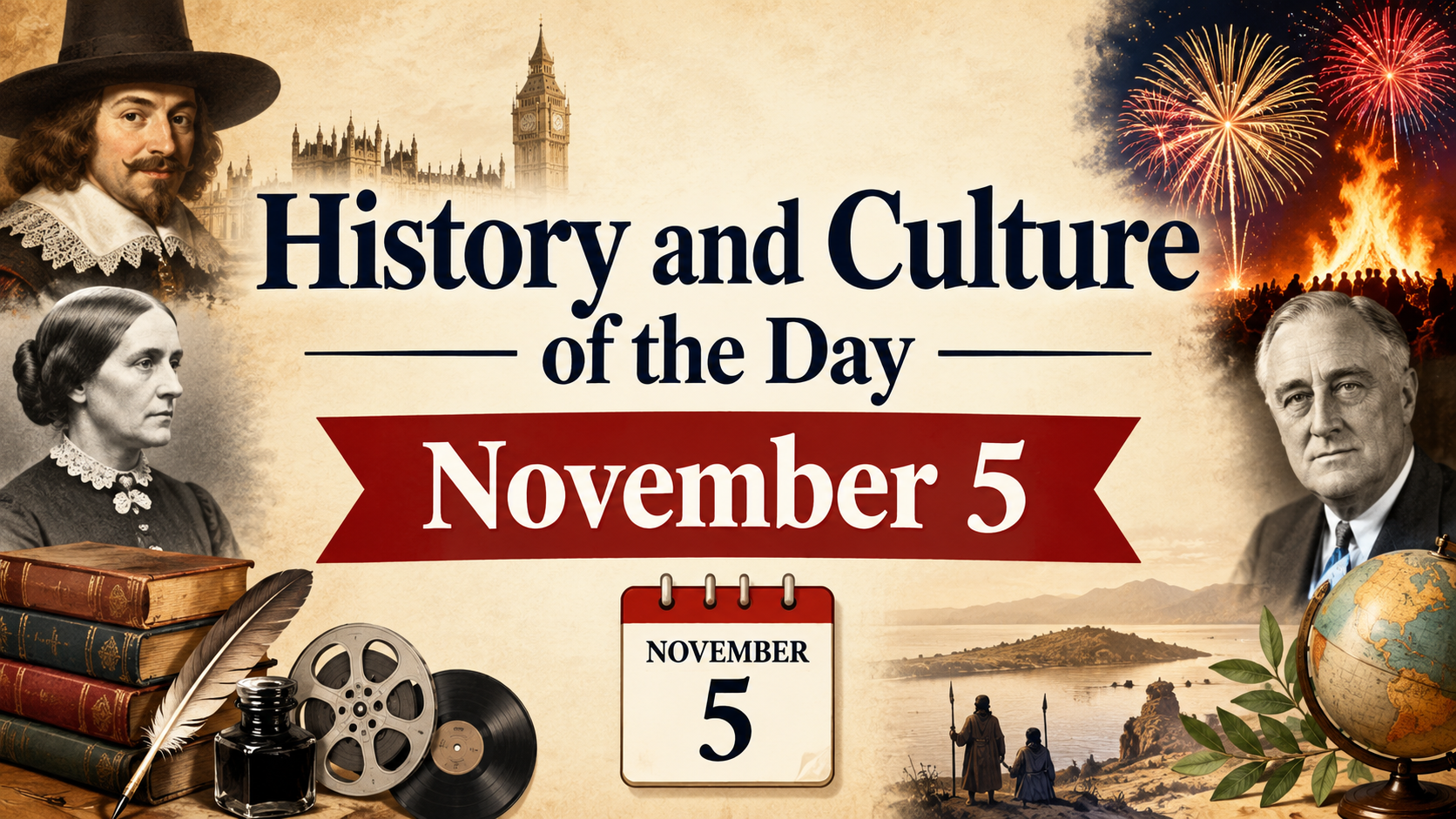
November 5 is a date filled with fascinating history, cultural traditions, political milestones, and events that have shaped societies around the world. From the famous Gunpowder Plot in England to important moments in American history, this day reminds us how events from centuries ago continue to influence modern life.
One of the most recognizable celebrations associated with November 5 is Guy Fawkes Night, a British tradition involving bonfires and fireworks. However, the historical significance of this date extends far beyond England, touching politics, entertainment, literature, social movements, and cultural identity.
Every date on the calendar carries stories worth remembering. November 5 is especially interesting because it brings together themes of rebellion, democracy, remembrance, and celebration.
Let’s explore the historical events, cultural traditions, famous birthdays, and lasting legacies that make November 5 a remarkable day in world history.
1. The Gunpowder Plot of 1605: The Event That Made November 5 Famous
One of the most significant historical events associated with November 5 occurred in England in 1605.
A group of English Catholic conspirators planned to assassinate King James I by blowing up the House of Lords during the State Opening of Parliament.
The conspiracy became known as the Gunpowder Plot.
Who Was Guy Fawkes?
Guy Fawkes was one of the conspirators involved in the plot. Although Robert Catesby was its principal organizer, Fawkes became the most famous participant because he was discovered guarding barrels of gunpowder beneath Parliament.
In the early hours of November 5, 1605, authorities found Fawkes in the undercroft beneath the House of Lords.
His arrest prevented the planned explosion.
The conspirators had hoped to overthrow the Protestant political establishment and bring about major religious and political change in England.
The failed plot resulted in arrests, executions, and increased persecution of Catholics.
Why Is Guy Fawkes Night Celebrated?
Following the discovery of the plot, November 5 became a day of thanksgiving for the king’s survival.
Over time, the observance developed into a popular annual tradition known as Guy Fawkes Night or Bonfire Night.
Today, celebrations in parts of the United Kingdom feature:
-
Large community bonfires.
-
Colorful fireworks displays.
-
Historical reenactments and educational activities.
-
Traditional autumn foods and family gatherings.
-
Effigies associated with Guy Fawkes.
The event has evolved considerably over the centuries. For many modern participants, it is primarily a seasonal community celebration rather than a religious or political statement.
The famous rhyme begins:
Remember, remember the Fifth of November, Gunpowder Treason and Plot.
These words have helped preserve the event in British cultural memory for more than four centuries.
2. November 5, 1872: Susan B. Anthony Casts Her Ballot
November 5 also holds an important place in the history of women’s voting rights in the United States.
On November 5, 1872, women’s rights activist Susan B. Anthony voted in the presidential election in Rochester, New York.
At the time, women generally did not have the legal right to vote in federal elections.
Anthony believed the Fourteenth Amendment supported women’s citizenship rights, including the right to vote.
Her decision was a deliberate challenge to the existing political system.
The Consequences of Her Vote
Anthony was arrested later that month and eventually put on trial in 1873.
She was convicted of voting illegally and fined $100, which she refused to pay.
Her case became an important symbol of the women’s suffrage movement.
Although Anthony did not live to see nationwide women’s suffrage, her activism helped build the movement that eventually secured ratification of the Nineteenth Amendment in 1920.
Why This Moment Still Matters
Anthony’s decision demonstrated how individuals can challenge laws they believe are unjust.
Her actions also highlight the long struggle for equal political participation.
The history of American voting rights includes generations of activists who fought to expand access to the ballot, often facing imprisonment, intimidation, and discrimination.
November 5 provides an opportunity to remember those efforts and reflect on the importance of civic participation.
3. November 5, 1688: The Glorious Revolution Begins a New Chapter in England
On November 5, 1688, William of Orange landed at Brixham in southwestern England with an invasion force.
His arrival helped set in motion the events that became known as the Glorious Revolution.
King James II faced growing opposition because of concerns about his religious policies, political authority, and relationship with Parliament.
William, who was married to James’s daughter Mary, had been invited by influential English political figures to intervene.
How the Revolution Changed England
James II eventually fled the country, and William and Mary became joint monarchs in 1689.
The revolution led to significant changes in the relationship between the monarchy and Parliament.
The English Bill of Rights of 1689 established important constitutional principles and placed limits on royal authority.
Although the revolution did not create modern democracy, it contributed to the development of constitutional monarchy and parliamentary government.
The Cultural Legacy
The Glorious Revolution influenced political thinking far beyond England.
Its ideas about government accountability, representative institutions, and limits on executive power became part of broader debates about constitutional government.
The events of 1688 remain important to understanding British political history and the evolution of democratic institutions.
4. November 5, 1912: Woodrow Wilson Wins the American Presidency
On November 5, 1912, Woodrow Wilson won the United States presidential election.
The election was unusual because four major candidates competed for the presidency.
They included incumbent President William Howard Taft, former President Theodore Roosevelt, Democrat Woodrow Wilson, and Socialist Eugene V. Debs.
Roosevelt had broken with the Republican Party and formed the Progressive Party, commonly called the Bull Moose Party.
Why the Election Was Significant
The division between Taft and Roosevelt weakened the Republican vote and helped Wilson win a decisive Electoral College victory.
Wilson’s administration later became associated with major changes in American government, including the creation of the Federal Reserve System and the country’s involvement in World War I.
The 1912 election also reflected the growing influence of the Progressive Era.
Americans were debating labor protections, business regulation, economic inequality, and the role of the federal government.
These discussions helped shape American political culture throughout the twentieth century.
5. November 5, 1930: Sinclair Lewis Makes Literary History
On November 5, 1930, American novelist Sinclair Lewis was announced as the winner of the Nobel Prize in Literature.
He became the first American to receive the prestigious literary award.
Lewis was known for his sharp observations of American society and his criticism of conformity, materialism, and social hypocrisy.
His Most Influential Works
His best-known novels include:
-
Main Street (1920): Examined the limitations and expectations of small-town American life.
-
Babbitt (1922): Satirized middle-class materialism and social conformity.
-
Arrowsmith (1925): Explored medicine, scientific ethics, and professional ambition.
-
Elmer Gantry (1927): Criticized religious hypocrisy and exploitation.
Lewis helped establish American literature as an influential force in international cultural discussions.
His writing continues to encourage readers to question social expectations and think independently.
Why Literature Matters to Culture
Literature provides more than entertainment.
Books preserve social attitudes, reveal historical tensions, and introduce readers to perspectives different from their own.
The recognition of Sinclair Lewis demonstrated that stories about ordinary American life could have worldwide literary significance.
6. November 5, 1940: Franklin D. Roosevelt Wins an Unprecedented Third Term
November 5, 1940, marked another historic American presidential election.
President Franklin D. Roosevelt defeated Republican candidate Wendell Willkie and secured a third consecutive term.
No previous American president had been elected to a third term.
America During a Period of Uncertainty
The United States was still recovering from the Great Depression, while World War II was spreading across Europe and other regions.
Many Americans viewed Roosevelt’s experience as an important source of stability.
His victory reflected public concerns about economic recovery, national security, and international conflict.
Roosevelt eventually won a fourth term in 1944 but died in April 1945.
In 1951, the Twenty-Second Amendment was ratified, generally limiting presidents to two elected terms.
The Historical Importance
Roosevelt’s presidency transformed the federal government’s role in American society.
Programs associated with the New Deal expanded federal involvement in economic security, employment, and financial regulation.
His wartime leadership also helped shape the United States’ emergence as a major global power.
7. November 5, 1881: The Invasion of Parihaka in New Zealand
One of the most significant events in Māori history occurred on November 5, 1881.
Government forces entered Parihaka, a Māori settlement on New Zealand’s North Island that had become a center of peaceful resistance to colonial land confiscation.
The community was associated with the leadership of Te Whiti-o-Rongomai and Tohu Kākahi.
Rather than responding to government pressure with armed conflict, they promoted nonviolent resistance.
A Community Built Around Peaceful Resistance
Parihaka residents challenged land seizures through actions such as plowing disputed land and erecting fences.
Their resistance demonstrated a commitment to protecting their land and communities without resorting to violence.
On November 5, government forces entered the settlement, arrested leaders, and began the process of dismantling the community.
Residents suffered displacement, destruction of property, and other abuses.
Why Parihaka Is Remembered
Today, Parihaka symbolizes Indigenous resistance, cultural survival, and the pursuit of justice.
Its history also reminds us that peaceful protest has played an important role in movements for human rights around the world.
Remembering Parihaka means acknowledging both the suffering caused by colonial policies and the determination of communities to protect their identity.
8. November 5, 1994: George Foreman Makes Boxing History
On November 5, 1994, George Foreman defeated Michael Moorer to become the oldest heavyweight boxing champion in history at the time.
Foreman was 45 years old.
The victory was especially remarkable because Foreman had returned to professional boxing after a lengthy retirement.
An Extraordinary Comeback
Foreman had previously won the heavyweight championship in 1973.
He lost the title to Muhammad Ali in the famous 1974 Rumble in the Jungle.
After retiring in 1977, Foreman pursued other interests, including religious ministry.
He returned to boxing in 1987.
Many observers doubted that an athlete in his forties could compete successfully against younger heavyweight champions.
However, Foreman continued training and competing.
His knockout victory over Moorer in the tenth round became one of boxing’s most memorable comeback stories.
A Cultural Symbol of Perseverance
Foreman’s victory reached beyond sports.
It became an example of determination, reinvention, and the possibility of achieving major goals later in life.
His story reminds us that age does not automatically determine what a person can accomplish.
9. November 5, 2006: Saddam Hussein Receives a Death Sentence
On November 5, 2006, former Iraqi President Saddam Hussein was convicted of crimes against humanity by the Iraqi High Tribunal.
The case concerned the killing and persecution of residents of Dujail following a 1982 assassination attempt against Hussein.
The court sentenced him to death.
The verdict followed the 2003 invasion of Iraq, the collapse of Hussein’s government, and a lengthy judicial process.
Why the Verdict Was Historically Significant
The trial became an important event in Iraq’s political transition.
It raised questions about accountability for abuses committed by authoritarian governments.
The proceedings also generated international debate about judicial fairness, capital punishment, and the challenges of administering justice following war and regime change.
Hussein was executed on December 30, 2006.
The event remains part of the complicated history of modern Iraq and the broader Middle East.
10. The Cultural Meaning of November 5 Around the World
November 5 is not simply a collection of historical dates.
It is also a reminder that different societies preserve their histories in different ways.
Some commemorate historical events through public celebrations, while others use anniversaries for remembrance, education, and reflection.
British Bonfire Night Traditions
In the United Kingdom, Bonfire Night remains one of the best-known November traditions.
Community gatherings often include fireworks, seasonal food, and outdoor celebrations.
Popular foods associated with the occasion include toffee apples, parkin, baked potatoes, and warming autumn dishes.
The celebration demonstrates how a historical political event can gradually become a broader cultural tradition.
Indigenous Remembrance in New Zealand
For communities connected to Parihaka, November 5 carries a very different meaning.
It is associated with the remembrance of colonial injustice and the importance of peaceful resistance.
The anniversary offers opportunities to discuss Indigenous rights, historical accountability, and cultural preservation.
American Civic History
In the United States, November 5 has coincided with numerous important elections.
The date provides a useful opportunity to explore the evolution of voting rights, political participation, and presidential leadership.
These different traditions show that historical memory is shaped by culture, community, and national experience.
11. Famous People Born on November 5
November 5 is also the birthday of several influential figures in music, film, television, and popular culture.
Art Garfunkel – Born November 5, 1941
Art Garfunkel is an American singer best known as one half of the legendary musical duo Simon & Garfunkel.
His distinctive voice helped make songs such as Bridge Over Troubled Water and The Sound of Silence enduring classics.
His contributions to popular music helped define the folk-rock movement of the 1960s.
Bryan Adams – Born November 5, 1959
Bryan Adams is a Canadian singer-songwriter who achieved international success with songs such as Summer of ’69, Heaven, and (Everything I Do) I Do It for You.
His music became especially influential during the 1980s and 1990s.
Adams remains one of Canada’s most recognizable musical performers.
Tilda Swinton – Born November 5, 1960
Tilda Swinton is an Academy Award-winning actress known for her distinctive performances in independent films and major Hollywood productions.
Her work includes Michael Clayton, Doctor Strange, and The Chronicles of Narnia.
She is recognized for her versatility and willingness to take on unconventional roles.
Kris Jenner – Born November 5, 1955
Kris Jenner is an American television personality and businesswoman.
She became widely known through the reality television series Keeping Up with the Kardashians.
Her career illustrates the growing influence of reality television, celebrity branding, and social media on modern entertainment culture.
12. Interesting Historical Facts About November 5
November 5 offers several surprising connections across different periods of history.
The date is associated with both rebellion and political reform. The Gunpowder Plot involved a violent attempt to overthrow a government, while Susan B. Anthony’s vote represented a challenge to voting restrictions through civil disobedience.
Guy Fawkes became more famous than the plot’s organizer. Although Robert Catesby led the conspiracy, Fawkes became the central figure in popular memory.
The same date marks different kinds of resistance. The Glorious Revolution and the peaceful resistance at Parihaka illustrate very different approaches to political and social conflict.
Several American presidential elections occurred on November 5. Important elections in 1912, 1940, 1968, and 1996 all took place on this date.
November 5 has a strong connection to cultural storytelling. From the Guy Fawkes rhyme to the literary achievements of Sinclair Lewis, stories have helped preserve the meaning of historical events.
A boxing comeback became a worldwide inspirational story. George Foreman’s 1994 victory showed how athletic achievements can become cultural symbols of perseverance.
13. What Can We Learn From November 5?
History is more than remembering dates, names, and events.
It is about understanding the choices people made, the circumstances they faced, and the consequences that followed.
The events associated with November 5 offer several valuable lessons.
The Importance of Standing Up for Rights
Susan B. Anthony’s determination reminds us that meaningful social change often requires people willing to challenge accepted practices.
Her actions helped advance a movement that transformed American democracy.
The Power of Peaceful Resistance
The history of Parihaka demonstrates that resistance does not always require violence.
Communities can express strength through unity, cultural preservation, and a commitment to nonviolent principles.
The Value of Perseverance
George Foreman’s remarkable return to championship boxing illustrates how determination can create opportunities even when success appears unlikely.
The Need to Understand Historical Context
The Gunpowder Plot and the Glorious Revolution remind us that religious conflict, political authority, and competing visions of government shaped earlier societies.
Understanding these events requires examining their historical circumstances rather than judging them solely through modern assumptions.
The Importance of Preserving Culture
Literature, music, traditions, and public commemorations help communities pass knowledge from one generation to another.
Without these forms of cultural preservation, important stories might eventually be forgotten.
14. Ways to Explore History and Culture on November 5
Learning about history does not have to be limited to textbooks or classrooms.
November 5 provides opportunities to discover something new and share meaningful conversations.
You might explore the history of Guy Fawkes Night, read about the women’s suffrage movement, study Indigenous resistance in New Zealand, or discover a novel by Sinclair Lewis.
Watching a documentary, visiting a museum, reading historical accounts, or discussing an important event with family can deepen your understanding of the past.
For parents and educators, November 5 can also provide an opportunity to teach young people about the importance of voting rights, religious tolerance, peaceful protest, and cultural traditions.
Even learning one new historical fact each day can gradually build a greater appreciation for the people and events that shaped our world.
Conclusion: Remembering November 5 and the Stories That Shaped Our World
November 5 is a day filled with history, cultural significance, and remarkable human stories.
From the failed Gunpowder Plot of 1605 to Susan B. Anthony’s courageous vote in 1872, the date reminds us that individuals and communities have repeatedly challenged established systems.
The peaceful resistance at Parihaka, the literary achievements of Sinclair Lewis, the historic presidency of Franklin D. Roosevelt, and George Foreman’s unforgettable comeback each offer different perspectives on human determination.
Some events are remembered through celebration. Others are remembered through reflection, education, or mourning.
Together, they demonstrate that history is not simply something that happened long ago. Its influence continues through our traditions, political institutions, cultural expressions, and everyday lives.
As we recognize November 5, we can appreciate the importance of understanding the past while considering the kind of future we want to build.
Which November 5 historical event do you find most fascinating, and what lesson do you think it offers people today?

Leave a Reply