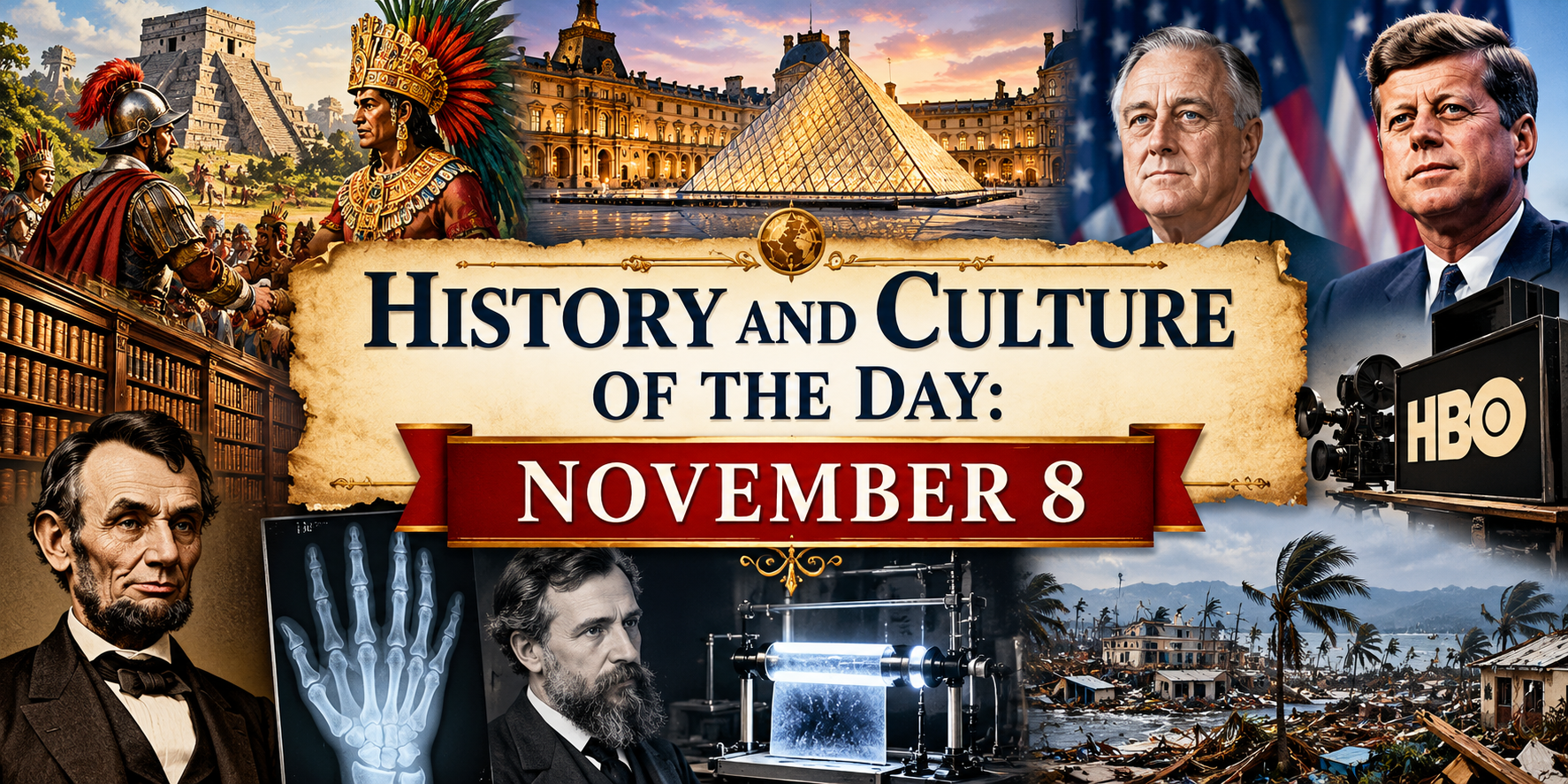
Every day in history tells a story. Some dates are remembered for groundbreaking discoveries, political milestones, cultural achievements, and moments of courage. Others remind us of the struggles, sacrifices, and decisions that helped shape the world we live in today.
November 8 is a date filled with remarkable historical events, cultural milestones, and influential figures whose contributions continue to affect our lives.
From revolutionary scientific discoveries and American political history to the arts, entertainment, and world-changing events, November 8 offers an opportunity to reflect on how the past continues to influence the present.
In today’s History and Culture of the Day, we will explore the most significant events associated with November 8, the people born on this date, and the lasting lessons history can teach us.
Major Historical Events That Happened on November 8
November 8, 1519 – Hernán Cortés Meets Aztec Emperor Moctezuma II
One of the most significant encounters in world history occurred on November 8, 1519, when Spanish conquistador Hernán Cortés entered the Aztec capital of Tenochtitlan and met Emperor Moctezuma II.
Tenochtitlan, located in what is now Mexico City, was among the most impressive cities in the Americas. Its elaborate canals, marketplaces, temples, and sophisticated infrastructure demonstrated the achievements of the Aztec civilization.
The meeting between Cortés and Moctezuma marked a turning point in the history of Mexico.
Although the encounter initially involved diplomatic exchanges, tensions between the Spanish expedition and the Aztec Empire eventually escalated into warfare.
By 1521, Spanish forces and their Indigenous allies had conquered Tenochtitlan, bringing an end to the Aztec Empire.
The consequences were enormous. Spanish colonization transformed the political, religious, linguistic, and cultural landscape of Mexico.
However, Indigenous cultures did not disappear. Their traditions, languages, foods, and artistic influences remain essential parts of Mexican identity.
Historical significance: This encounter illustrates how contact between civilizations can produce profound cultural change, but also conquest, suffering, and the loss of political independence.
November 8, 1602 – The Bodleian Library Opens at Oxford
On November 8, 1602, the Bodleian Library at the University of Oxford officially opened to readers.
Named after Sir Thomas Bodley, who helped restore and expand the university’s library, the institution became one of the world’s most important centers for preserving knowledge.
At a time when books were expensive and access to education was limited, libraries played a vital role in protecting written history.
The Bodleian Library eventually accumulated millions of books, manuscripts, maps, and historical documents.
Its collections have supported generations of scholars, historians, scientists, and writers.
The library represents something greater than a building filled with books. It symbolizes humanity’s desire to preserve ideas and pass knowledge from one generation to the next.
Historical significance: Libraries protect cultural heritage and ensure that the discoveries and experiences of earlier generations remain accessible.
November 8, 1793 – The Louvre Opens to the Public
November 8, 1793, is associated with an important milestone in the history of art and culture.
The Louvre in Paris, which had opened as a public museum earlier that year on August 10, became a symbol of the French Revolution’s changing ideas about art and public access.
Previously, many of Europe’s greatest artistic treasures had been held in royal palaces and private collections.
The transformation of the Louvre into a public museum reflected the belief that important works of art should be accessible beyond the monarchy and aristocracy.
Today, the Louvre Museum is one of the world’s most recognized cultural institutions.
Its collections include paintings, sculptures, archaeological artifacts, and decorative arts representing thousands of years of human civilization.
Among its most famous treasures are Leonardo da Vinci’s Mona Lisa and the ancient Greek sculpture Venus de Milo.
Historical significance: The Louvre’s development helped establish the modern concept of museums as institutions dedicated to education, preservation, and public appreciation of art.
November 8, 1864 – Abraham Lincoln Wins Reelection
On November 8, 1864, President Abraham Lincoln won reelection during one of the most difficult periods in American history.
The United States was still fighting the Civil War, a conflict that had divided the nation and claimed hundreds of thousands of lives.
Lincoln faced Democratic candidate George B. McClellan, a former Union general.
The election took place amid questions about the war’s future, national unity, and the abolition of slavery.
Lincoln’s victory gave his administration a renewed mandate to continue the Union war effort.
Several months later, the Civil War ended, and the Thirteenth Amendment abolishing slavery was ratified.
Tragically, Lincoln was assassinated in April 1865, shortly after the Confederate surrender at Appomattox.
His leadership during the Civil War remains one of the most studied periods in American presidential history.
Historical significance: The 1864 election demonstrated the endurance of democratic elections even during a devastating civil war.
November 8, 1889 – Montana Becomes the 41st State
On November 8, 1889, Montana officially joined the United States as the 41st state.
Known for its mountains, vast plains, forests, and natural beauty, Montana became an important part of America’s westward expansion.
The region had long been home to Indigenous nations, including the Crow, Blackfeet, Northern Cheyenne, and other peoples.
During the nineteenth century, mining discoveries, railroad expansion, ranching, and settlement brought dramatic changes to the territory.
Montana eventually developed a strong identity shaped by agriculture, mining, outdoor recreation, and Western traditions.
Today, the state is famous for destinations such as Glacier National Park and Yellowstone National Park, which extends into Montana.
Its nickname, the Treasure State, reflects its mineral wealth and natural resources.
Historical significance: Montana’s statehood represents a chapter in American expansion while also reminding us of the displacement and challenges experienced by Indigenous communities.
November 8, 1895 – Wilhelm Röntgen Discovers X-Rays
One of the greatest scientific breakthroughs in medical history occurred on November 8, 1895.
German physicist Wilhelm Conrad Röntgen discovered X-rays while experimenting with electrical currents in vacuum tubes.
During his experiments, he noticed that a nearby fluorescent screen glowed even though the apparatus was shielded from visible light.
Röntgen realized that an unknown form of radiation was passing through materials.
He called the mysterious radiation X-rays because its nature was initially unknown.
His discovery made it possible to examine structures inside the human body without surgery.
Medical professionals eventually began using X-ray technology to identify broken bones, detect certain illnesses, and investigate internal injuries.
In 1901, Röntgen received the first Nobel Prize in Physics for his discovery.
The technology continued to evolve, eventually contributing to computed tomography, commonly called CT scanning, and numerous other scientific applications.
Historical significance: The discovery of X-rays transformed medical diagnosis and opened new possibilities for scientific research.
November 8, 1923 – The Beer Hall Putsch Begins in Germany
On November 8, 1923, Adolf Hitler and members of the Nazi Party launched an attempted coup in Munich, Germany.
The event became known as the Beer Hall Putsch.
Germany was experiencing severe economic instability, political division, and public frustration following World War I.
Hitler attempted to exploit those conditions to overthrow the existing government.
The coup failed the following day, and Hitler was later arrested and imprisoned.
However, the failed uprising became an important moment in the Nazi Party’s political development.
During his imprisonment, Hitler wrote much of Mein Kampf, a book outlining his extremist ideology.
Within a decade, the Nazis had gained power in Germany, establishing a dictatorship that led to persecution, war, and the Holocaust.
Historical significance: The Beer Hall Putsch serves as a warning about political extremism, propaganda, and the dangers of movements that seek to destroy democratic institutions.
November 8, 1932 – Franklin D. Roosevelt Is Elected President
On November 8, 1932, Franklin D. Roosevelt defeated incumbent President Herbert Hoover in the United States presidential election.
The country was struggling through the Great Depression.
Millions of Americans were unemployed, banks had failed, businesses were closing, and families faced tremendous economic hardship.
Roosevelt campaigned on the promise of a New Deal for the American people.
After taking office in March 1933, his administration introduced programs intended to stabilize financial institutions, provide employment, and support economic recovery.
These initiatives included public works projects, financial reforms, and social welfare measures.
Roosevelt would eventually serve an unprecedented four terms as president, leading the nation through the Depression and most of World War II.
Historical significance: The 1932 election reshaped the relationship between the federal government and the American economy.
November 8, 1942 – Operation Torch Begins During World War II
On November 8, 1942, Allied forces launched Operation Torch, a major military campaign in North Africa.
American and British troops landed in French Morocco and Algeria as part of the broader effort to defeat Axis forces.
The operation was an important step in expanding Allied military operations against Nazi Germany and Fascist Italy.
General Dwight D. Eisenhower served as the supreme commander of the Allied expeditionary force.
Operation Torch helped establish an Allied presence in North Africa and contributed to the eventual defeat of Axis forces in the region.
It also provided valuable experience in coordinating large-scale amphibious landings.
Those lessons would become important during later operations, including the invasion of Normandy in June 1944.
Historical significance: Operation Torch helped shift the strategic balance of World War II and demonstrated the importance of cooperation among Allied nations.
November 8, 1960 – John F. Kennedy Is Elected President
On November 8, 1960, John F. Kennedy defeated Vice President Richard Nixon in a closely contested presidential election.
At age 43, Kennedy became the youngest person elected president of the United States.
He was also the first Roman Catholic to hold the office.
The 1960 election was especially notable for the role of television.
Kennedy and Nixon participated in the first nationally televised general-election presidential debates, helping establish television as a powerful influence on American politics.
Kennedy’s presidency became associated with the Space Race, the Cold War, the Cuban Missile Crisis, and growing demands for civil rights.
Although his presidency was cut short by his assassination in November 1963, his leadership and public speeches remain important parts of American history.
Historical significance: Kennedy’s election represented a generational change in American politics and demonstrated the growing influence of television on political campaigns.
November 8, 1972 – HBO Begins Broadcasting
On November 8, 1972, Home Box Office, better known as HBO, began broadcasting.
The subscription television service initially operated through a regional cable system in Pennsylvania.
Its early programming included movies and sporting events.
At a time when most Americans relied on a small number of broadcast television networks, HBO introduced a different entertainment model.
Subscribers paid for access to programming that was not supported by traditional commercial advertising.
Over the following decades, HBO expanded nationally and became known for original television series, documentaries, films, and sports programming.
Its success helped establish premium cable television as an important part of the entertainment industry.
The network later became associated with influential series such as The Sopranos, The Wire, and Game of Thrones.
Historical significance: HBO helped transform television from a primarily broadcast-based industry into one increasingly shaped by subscription entertainment.
November 8, 2013 – Super Typhoon Haiyan Strikes the Philippines
On November 8, 2013, Super Typhoon Haiyan, known locally as Yolanda, devastated parts of the Philippines.
The storm was among the strongest tropical cyclones ever recorded at landfall.
Powerful winds, heavy rainfall, and an enormous storm surge destroyed communities and infrastructure.
The city of Tacloban and surrounding areas suffered catastrophic damage.
Thousands of people lost their lives, while millions were affected by the disaster.
International relief organizations, governments, and volunteers responded with humanitarian assistance.
The disaster highlighted the importance of emergency preparedness, resilient infrastructure, and international cooperation.
It also raised awareness of the risks that coastal communities face from extreme tropical cyclones.
Historical significance: Typhoon Haiyan remains a powerful reminder of the destructive force of natural disasters and the importance of disaster preparedness.
Famous People Born on November 8
November 8 is also the birthday of several influential figures who made lasting contributions to literature, science, music, television, and society.
Bram Stoker – Born November 8, 1847
Bram Stoker was an Irish author best known for his 1897 Gothic horror novel Dracula.
His portrayal of Count Dracula helped shape modern vampire fiction and horror entertainment.
The character has appeared in countless movies, television programs, books, and theatrical productions.
Stoker’s work remains influential because it combines suspense, supernatural themes, and anxieties about the unknown.
Dorothy Day – Born November 8, 1897
Dorothy Day was an American journalist, social activist, and Catholic convert.
She co-founded the Catholic Worker Movement in 1933 alongside Peter Maurin.
The movement promoted hospitality, nonviolence, and assistance for people experiencing poverty.
Day dedicated much of her life to advocating for peace and social justice.
Her legacy continues through Catholic Worker communities and charitable organizations.
Margaret Mitchell – Born November 8, 1900
Margaret Mitchell was an American novelist best known for Gone with the Wind, published in 1936.
The novel became an enormous commercial success and won the Pulitzer Prize for Fiction in 1937.
Its 1939 film adaptation became one of the most famous movies in American cinema.
However, the novel and film have also faced substantial criticism for romanticizing the antebellum South and presenting distorted portrayals of slavery and Reconstruction.
Mitchell’s legacy illustrates how influential cultural works can be celebrated for their artistic achievements while also being critically examined for their historical representations.
Christiaan Barnard – Born November 8, 1922
Christiaan Barnard was a South African cardiac surgeon who performed the world’s first successful human-to-human heart transplant in December 1967.
The groundbreaking operation took place in Cape Town, South Africa.
Although the first recipient survived only 18 days, the procedure demonstrated that transplanting a human heart was medically possible.
Barnard’s achievement helped advance organ transplantation and modern cardiac surgery.
Bonnie Raitt – Born November 8, 1949
Bonnie Raitt is an American singer, songwriter, and guitarist known for blending blues, rock, folk, and country music.
Her expressive vocals and slide-guitar playing have earned her widespread recognition.
Her album Nick of Time, released in 1989, became a major commercial and critical success.
Raitt has received numerous Grammy Awards and is recognized as an influential figure in American music.
Kazuo Ishiguro – Born November 8, 1954
Kazuo Ishiguro is a British novelist born in Japan.
His books frequently explore memory, regret, identity, and the complexity of human relationships.
Among his best-known works are The Remains of the Day and Never Let Me Go.
In 2017, Ishiguro received the Nobel Prize in Literature.
His writing has influenced readers around the world through its emotional depth and exploration of the human experience.
Gordon Ramsay – Born November 8, 1966
Gordon Ramsay is a British chef, restaurateur, and television personality.
He is internationally recognized for his culinary expertise and appearances on television programs such as Hell’s Kitchen, MasterChef, and Kitchen Nightmares.
His restaurants and television productions have helped introduce professional cooking techniques and restaurant management to broader audiences.
Ramsay has become one of the most recognizable personalities in modern culinary entertainment.
November 8 in American Culture
The history of November 8 reveals several important themes in American society.
The Importance of Presidential Elections
November 8 has been the date of several significant American presidential elections.
Abraham Lincoln won reelection in 1864, Franklin D. Roosevelt won his first presidential election in 1932, and John F. Kennedy was elected in 1960.
More recently, Donald Trump won the 2016 presidential election against Hillary Clinton on November 8.
These elections occurred during different periods of American history, yet each reflected the challenges and priorities of its time.
Elections can reveal how Americans respond to economic uncertainty, national security concerns, social change, and competing visions of government.
The Evolution of Entertainment
The launch of HBO in 1972 illustrates how technology can change cultural habits.
For much of television history, viewers depended on scheduled broadcasts.
Cable television expanded the number of available channels and introduced new programming formats.
Later, digital technology and streaming services created even more ways to watch entertainment.
These developments changed not only how people consume television but also how stories are produced and distributed.
The Role of Science in Everyday Life
Röntgen’s discovery of X-rays is a reminder that scientific discoveries often begin with curiosity and experimentation.
What started as an unexpected observation in a laboratory eventually became an essential medical tool.
The discovery demonstrates how basic scientific research can lead to practical innovations that improve human health.
Cultural Traditions and Observances on November 8
November 8 is associated with several observances that celebrate science, remembrance, and cultural identity.
International Day of Radiology
International Day of Radiology is observed annually on November 8 to commemorate Wilhelm Röntgen’s discovery of X-rays in 1895.
The observance recognizes the contributions of radiologists, radiographers, and other medical imaging professionals.
Modern radiology includes X-rays, CT scans, magnetic resonance imaging, ultrasound, and other technologies used to diagnose and monitor medical conditions.
The day encourages awareness of the importance of medical imaging and patient safety.
World Urbanism Day
World Urbanism Day, also called World Town Planning Day, is observed on November 8.
The observance promotes awareness of urban planning and the importance of creating healthy, sustainable, and well-organized communities.
Urban planning influences housing, transportation, public parks, infrastructure, and environmental protection.
The day encourages people to consider how thoughtful community design can improve quality of life.
National Indigenous Veterans Day in Canada
Canada observes National Indigenous Veterans Day on November 8.
The day recognizes the military service and sacrifices of First Nations, Inuit, and Métis veterans.
Indigenous service members have contributed to Canada’s military history despite facing discrimination and unequal treatment.
The observance honors their courage while encouraging greater awareness of their contributions.
Interesting Facts About November 8
Here are some fascinating facts connected to this date:
1. The discovery of X-rays began with an unexpected observation. Wilhelm Röntgen noticed a fluorescent glow during experiments with electrical equipment.
2. November 8 has been an important presidential election date. Lincoln, Roosevelt, Kennedy, and Trump all won presidential elections held on this date.
3. Montana became America’s 41st state on November 8, 1889. Its landscape and natural resources helped shape its identity.
4. Bram Stoker and Margaret Mitchell share a birthday. Both authors created works that became internationally famous through literature and film.
5. HBO launched in 1972. Its subscription model helped change the television industry.
6. The first successful human heart transplant was performed by a November 8 birthday celebrant. Christiaan Barnard carried out the historic operation in 1967.
7. November 8 honors medical imaging. International Day of Radiology commemorates the discovery of X-rays.
8. The Allied invasion of North Africa began on this date in 1942. Operation Torch was a major turning point in the Allied war effort.
What Can We Learn From the History of November 8?
History is more than a collection of names, dates, and events. It is a record of human decisions, achievements, failures, and struggles.
The events of November 8 provide several meaningful lessons.
1. Curiosity Can Change the World
Wilhelm Röntgen did not begin his experiments knowing that he would discover a technology that would revolutionize medicine.
His willingness to investigate something unexpected led to an extraordinary breakthrough.
Curiosity encourages people to ask questions, explore possibilities, and challenge existing assumptions.
Some of humanity’s greatest achievements have come from individuals who refused to stop learning.
2. Leadership Matters During Difficult Times
The elections of Abraham Lincoln, Franklin D. Roosevelt, and John F. Kennedy occurred during periods of uncertainty and change.
Each leader faced different circumstances, but their presidencies demonstrate how political decisions can influence a nation’s direction.
History also shows that leadership must be judged not only by speeches and promises but by actions and their consequences.
3. Culture Preserves Human Experiences
Literature, music, museums, and television allow societies to preserve stories and express ideas.
Bram Stoker’s Dracula continues to influence horror fiction more than a century after its publication.
The Louvre preserves artistic achievements from civilizations across the world.
Musicians such as Bonnie Raitt carry musical traditions forward while introducing them to new generations.
Culture helps connect the past with the present.
4. History Must Include Difficult Truths
Not every historical event deserves celebration.
The conquest of the Aztec Empire, the rise of Nazi extremism, and the devastation of war remind us that history also contains suffering and injustice.
Understanding these events requires examining their causes, consequences, and effects on ordinary people.
Learning history responsibly means recognizing achievements without ignoring the harm associated with certain events.
5. Progress Often Begins With Courage
Scientific innovation, social reform, and cultural change frequently require people to challenge established practices.
Dorothy Day advocated for people experiencing poverty and promoted peaceful social change.
Christiaan Barnard helped advance cardiac surgery through groundbreaking medical work.
Their contributions demonstrate how individuals can influence society through dedication, knowledge, and determination.
Why Learning About History and Culture Matters
In a world that moves quickly, it can be easy to focus entirely on the present.
However, understanding history gives us a broader perspective on the challenges we face today.
Many modern debates about government, technology, education, healthcare, and cultural identity have deep historical roots.
Studying the past helps us understand why societies developed certain institutions and traditions.
It also teaches us that progress is rarely simple.
Important changes often involve disagreement, experimentation, sacrifice, and unexpected consequences.
History encourages critical thinking by asking us to examine evidence, consider different perspectives, and understand events within their original circumstances.
Culture adds another dimension to that understanding.
Through literature, music, art, food, language, and traditions, we discover how people from different backgrounds express their identities and experiences.
Learning about history and culture can create greater appreciation for the diversity of human civilization.
It can also remind us that, despite differences in geography and time, people throughout history have shared many familiar hopes: safety, opportunity, freedom, belonging, and a better future for their families.
Final Thoughts: Remembering November 8
November 8 stands as a remarkable date in history, connecting scientific discoveries, political turning points, cultural achievements, and powerful human stories.
From the discovery of X-rays in 1895 to the election of John F. Kennedy in 1960, the events associated with this date demonstrate how individual actions and larger historical forces can shape generations.
The opening of important cultural institutions, the development of new entertainment technologies, and the achievements of influential writers and artists remind us that human creativity is an essential part of history.
At the same time, events such as the Beer Hall Putsch and the devastation caused by Typhoon Haiyan remind us of the importance of learning from tragedy and preparing for future challenges.
History is not simply about remembering what happened. It is about understanding why it happened, how it changed the world, and what we can learn from it today.
Every generation inherits the accomplishments and mistakes of those who came before.
By studying history, preserving culture, and sharing knowledge, we help ensure that important lessons are not forgotten.
And perhaps that is the greatest value of exploring history one day at a time.
Which historical event from November 8 do you find most fascinating, and why do you think it continues to matter today?



Leave a Reply